Supply Chain Fragmentation Creating New Startup Opportunities
March 19, 2026 by Harshit Gupta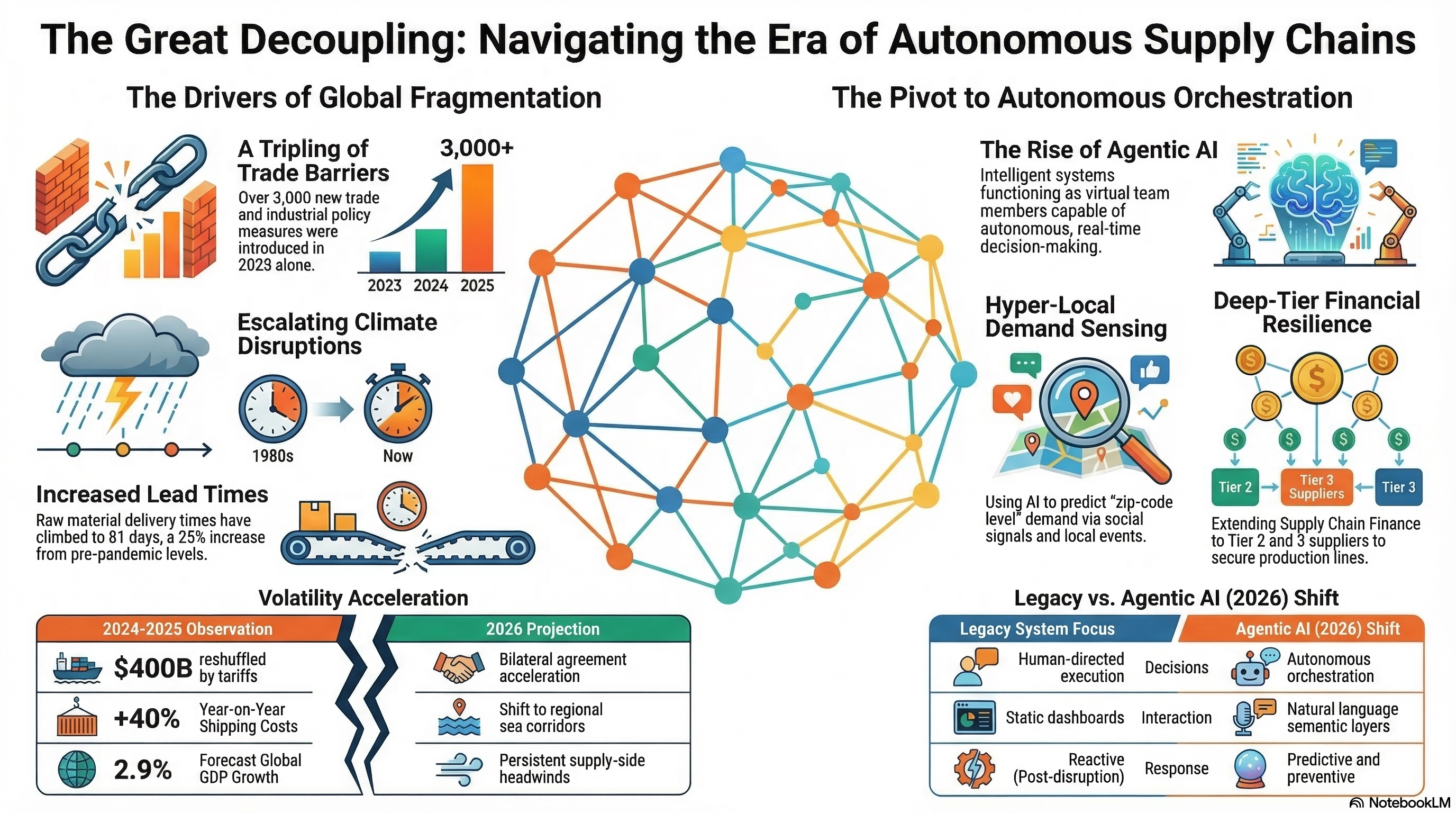
The transition of global supply chains from a regime of predictable integration to an era of structural volatility marks the most significant economic realignment since the end of the Cold War. In the early months of 2026, it is increasingly evident that the linear model of "produce anywhere, deliver everywhere," which defined the past four decades, has been rendered obsolete by a confluence of geopolitical, environmental, and technological pressures. The historical assumptions that once underpinned global trade—institutional stability, network predictability, and cost-driven optimization—have transformed into primary sources of fragility. The result is a fragmented global landscape where supply itself has become a strategic constraint across energy, minerals, labor, and logistics, forcing a fundamental rewiring of globalization into competing blocs and decentralized networks.
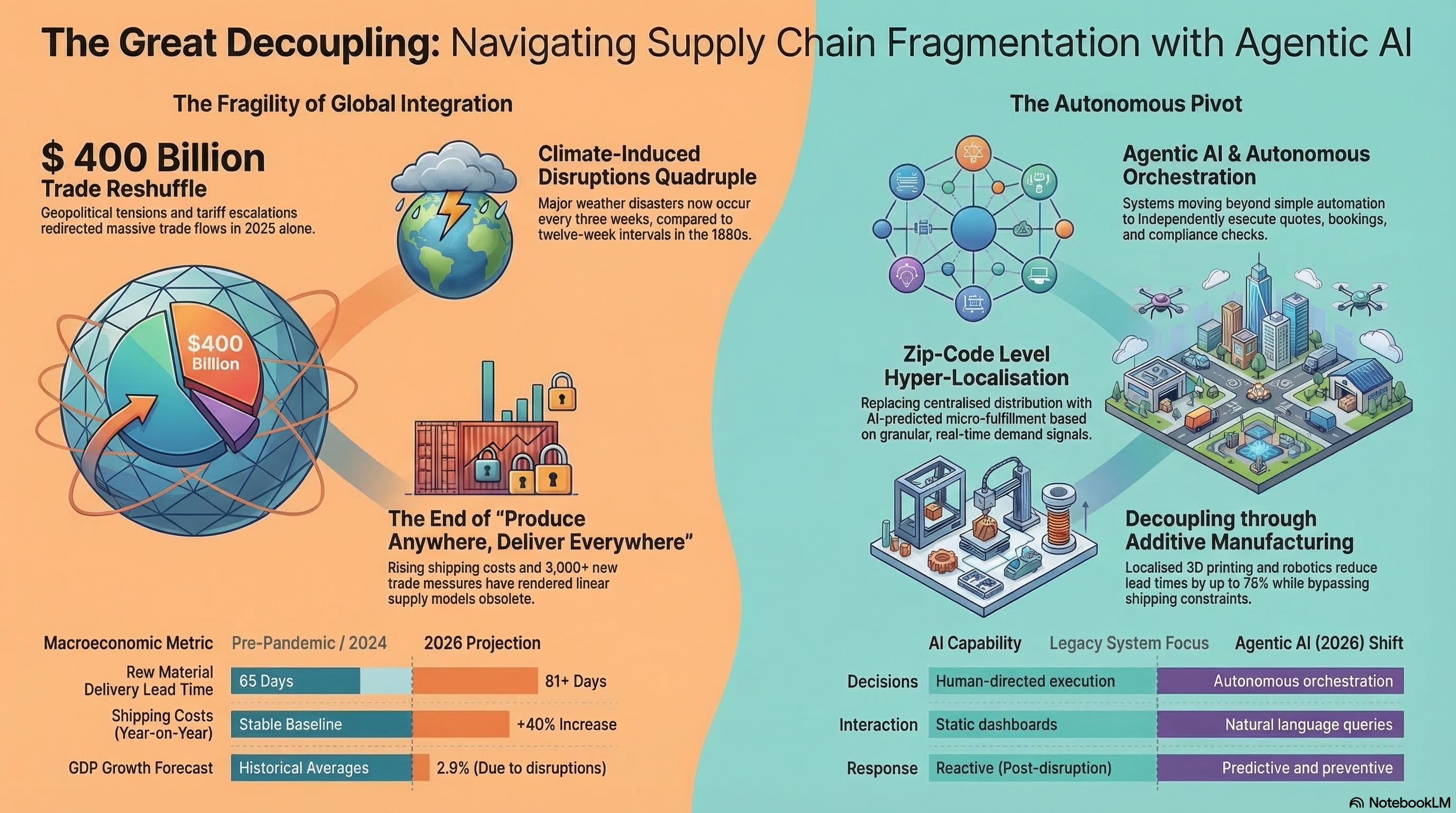
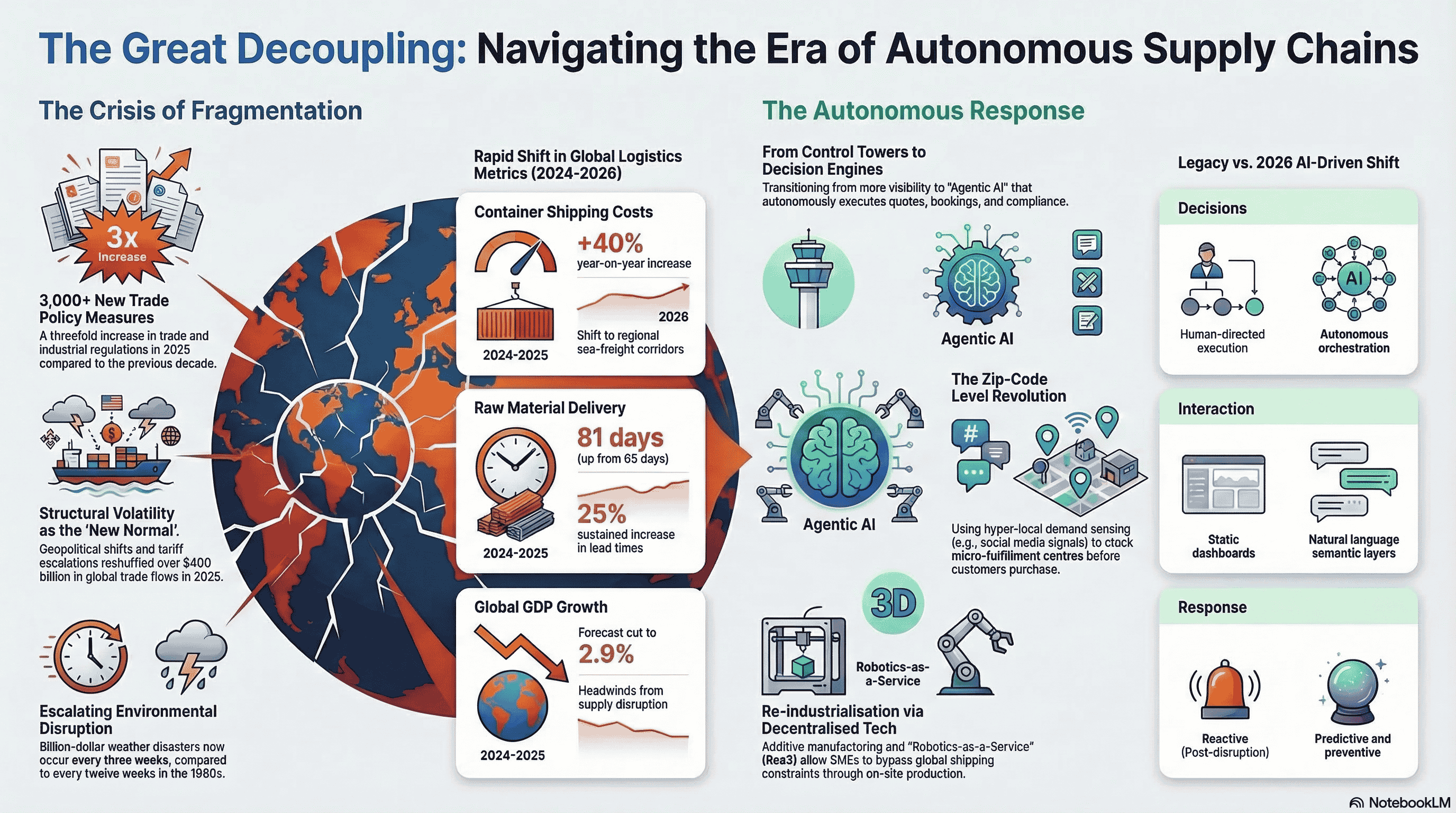
This fragmentation is not merely a series of isolated shocks but a systemic shift toward enduring uncertainty. In 2025 alone, tariff escalations between major economies reshuffled over $400 billion in trade flows, while disruptions in major shipping routes like the Red Sea pushed container shipping costs up by 40% year-on-year. Governments have responded by introducing more than 3,000 new trade and industrial policy measures in 2025—a threefold increase compared to the annual level recorded just a decade prior. For the startup ecosystem, this "Great Decoupling" creates an unprecedented vacuum, where legacy Enterprise Resource Planning (ERP) systems and centralized management models are no longer viable. New opportunities are emerging for ventures that can provide the "connective tissue" of resilience, regional intelligence, and autonomous orchestration required to navigate this fractured reality.
The Macro-Economics of Fragmentation: Drivers and Disparities
The current supply chain landscape is defined by five interlocking structural forces: slowing and uneven growth, geopolitical fragmentation, technological rivalry, resource scarcity, and climate-induced disruption. These forces are compelling organizations to redesign their networks around constrained supply rather than unbridled demand. As inflation, tighter capital markets, and widening economic divergence persist, the priority for supply chain leaders has shifted from short-term efficiency to the creation of adaptive networks that can be reconfigured with optionality as conditions change.
Geopolitical uncertainty has become the "new normal," as conflicts, trade wars, and shifting alliances continue to fracture global trade blocs anchored by the United States, China, and the European Union. This geopolitical stress testing now includes trade policy shifts and currency volatility as critical components of any corporate risk framework. Furthermore, the concentration of capabilities in select technology-enabled ecosystems has deepened dependencies on data, energy, and talent, reinforcing a digital divide between advanced and emerging economies.
Macroeconomic Metric | 2024-2025 Observation | 2026 Projection/Context |
Trade Flow Reshuffling | $400B reshuffled due to tariffs | Acceleration of bilateral trade agreements |
New Trade Policy Measures | 3,000+ measures introduced | Increased complexity in customs classification |
Container Shipping Costs | +40% year-over-year | Shift toward regional sea-freight corridors |
Global GDP Growth | Forecast cut to 2.9% in 2025 | Headwinds from supply disruption and inflation |
Raw Material Delivery Time | 81 days (up from 65 pre-pandemic) | 25% sustained increase in lead times |
Environmental pressures further amplify these disruptions. Currently, billion-dollar weather disasters occur every three weeks, a frequency four times higher than the twelve-week intervals observed in the 1980s. Droughts affecting critical waterways such as the Panama Canal, the Rhine, and the Danube, combined with flooding-induced port congestion, have compromised global shipping and driven up operational costs. These climate risks also impact health and workforce productivity, particularly in sectors facing extreme heat, creating additional operational pressures on manufacturing and logistics.
The Technological Pivot: Agentic AI and Autonomous Orchestration
The most transformative response to supply chain fragmentation is the emergence of "Agentic AI"—intelligent systems that function as virtual team members capable of autonomous decision-making. While 2025 was characterized by pilots and proofs of concept, 2026 is the year of industrialization, where widespread operational rollout is finally taking hold among the top 15% of market leaders. These AI agents are designed to take over repetitive, time-consuming tasks such as quoting, booking, compliance checks, and disruption alerts, moving beyond simple task automation to orchestrate entire workflows.
From Control Towers to Decision Engines
Legacy "control towers" were primarily focused on providing visibility—the ability to see where a shipment is at any given time. In 2026, these platforms are evolving into true decision-making engines powered by AI and digital twin technology. This shift is necessitated by the growing complexity of global trade, where response times must be reduced from days to minutes to manage tariff changes, geopolitical shocks, and capacity swings.
The mechanism of agentic AI allows for a fundamental shift in the role of human managers. Rather than acting as operators who manually intervene in every process, leaders are becoming "architects" who design the guardrails within which autonomous agents operate. These agents can read policies, process external market data, and execute transactions without constant supervision, managing thousands of daily transactions across global receivables, payables, and foreign exchange (FX) management.
Human-in-the-Loop and Skill Partnerships
The rise of AI agents is not a complete replacement of the human workforce but a reconfiguration of it. The concept of "Superagency" in the workplace involves empowering people to unlock AI's full potential through skill partnerships. This is particularly critical in light of the massive talent gap; it is estimated that 90% of supply chain leaders lacked the necessary talent and skills by 2025.
Startups are filling this gap by building AI systems that blend intuitive pattern recognition with formal reasoning into a unified architecture. This allows organizations to democratize data access, enabling business analysts and process owners to query complex databases and extract insights using natural language rather than relying on technical data engineering teams.
AI Capability | Legacy System Focus | Agentic AI (2026) Shift |
Forecasting | Historical data patterns | Real-time demand sensing |
Decisions | Human-directed execution | Autonomous orchestration |
Interaction | Static dashboards and reports | Natural language semantic layers |
Scope | Internal operations (Silos) | Multi-tier network visibility |
Response | Reactive (Post-disruption) | Predictive and preventive |
Hyper-Localization and the Zip-Code Level Revolution
As global optimization gives way to regional resilience, the "zip-code level revolution" has emerged as a primary driver of ecommerce profitability and manufacturing agility. Fragmentation has made large-scale, centralized distribution inefficient. Instead, brands are using AI to predict demand at the most granular levels, allowing them to stock micro-fulfillment centers with the specific items neighborhood residents are likely to buy.
Demand Sensing vs. Traditional Forecasting
Traditional inventory management relied heavily on historical data, but in the volatile market of 2026, what happened in 2024 is often irrelevant. Demand sensing uses AI to "sense" real-time market shifts by ingesting a massive array of external signals, including social media sentiment from platforms like TikTok and Instagram, hyper-local weather patterns, and local events such as concerts or festivals.
For example, if a specific tech accessory begins trending in a particular urban center, demand sensing agents can automatically initiate shipping to a local warehouse before the customer even clicks "buy," a practice pioneered by retail giants like Amazon. This hyper-localization prevents the costly mistake of shipping items across the country, a move that significantly eats into margins and increases the carbon footprint.
Real-Time Inventory Rebalancing
Startups like YDISTRI are addressing the persistent issue of "inventory imbalance"—where certain stores face stockouts while others hold excess inventory. By identifying slow-moving products at the store level and reallocating them to high-demand locations in near real time, retailers can protect their margins and reduce the need for aggressive markdowns. This strategy makes stores feel more relevant and responsive to local demand, directly boosting sales and customer satisfaction.
Another key player, Omnistream, integrates sales data with store attributes and real-time scenario modeling to help retailers design shelves that reflect the shopping habits of local customers. In a world where the "half-life of a good decision" has become shorter, the ability to localize choice at scale has become a survival mechanism.
The Re-industrialization Engine: Robotics and Decentralized Manufacturing
The move toward localized manufacturing is fundamentally reshaping global trade by eliminating reliance on distant suppliers and the associated risks of extended supply chains. This transition is powered by the convergence of additive manufacturing (3D printing) and collaborative robotics, which allow for on-site, on-demand production.
Additive Manufacturing as Core Infrastructure
Additive Manufacturing (AM) has transitioned from a niche tool for rapid prototyping into a core component of the industrial infrastructure. It is now serving as a foundational technology on par with CNC machining and injection molding, participating widely in end-product production across aerospace, healthcare, and automotive sectors.
The strategic advantage of AM lies in its ability to consolidate parts, reduce lead times by up to 75%, and support sustainability goals by minimizing waste and carbon emissions through shorter, localized supply networks. Furthermore, process-based certification and the use of a "digital thread" across design, build, and inspection are making AM systems more reliable and auditable, which is essential for large-scale industrial adoption.
Robotics-as-a-Service (RaaS) and SME Accessibility
The rise of "Robotics-as-a-Service" (RaaS) is removing the high upfront costs that once prevented small and mid-size enterprises (SMEs) from adopting automation. These flexible, scalable financing options allow warehouses and machine shops to deploy six-axis collaborative robots (cobots) that can be programmed without code and integrated into existing workflows in hours.
Standard Bots, for instance, targets 20- to 150-person machine shops that form the backbone of U.S. manufacturing but were previously priced out of the automation market. By focusing on affordability and ease of use, these startups are addressing the labor shortages that plague domestic manufacturing.
Warehouse Robotics Segment | Key Technology/Startup | Primary Benefit |
Mobile Picking | Locus Robotics AMRs | Reduces worker walking; easy deployment |
High-Speed Sortation | Symbotic AI platform | Orchestrates massive fleets for major retailers |
Autonomous Yard | Outrider yard management | Digitalizes yard operations and trailer moves |
Collaborative Cobots | Standard Bots Core | Affordable automation for smaller machine shops |
Piece Picking | Covariant AI arms | Deep learning-powered handling of irregular items |
Autonomous Logistics and Last-Mile Delivery
Autonomous solutions, including self-driving trucks and delivery drones, are projected to significantly reduce delivery costs in 2026 by bypassing traditional obstacles like traffic congestion. These technologies are proving especially valuable for serving remote or hard-to-reach areas where traditional logistics are cost-prohibitive. The integration of these autonomous vehicles into a cohesive, software-defined orchestration platform is the "next frontier" for warehouse leaders seeking to optimize inbound and outbound operations.
Financial Resilience: The Strategic Evolution of Supply Chain Finance
As the global economy remains unstable, companies are integrating Supply Chain Finance (SCF) more deeply into their corporate finance strategy, viewing it as a high-stakes tool for business survival and resilience. The SCF market is experiencing robust growth, reaching an estimated $62 billion in 2026.
Deep-Tier Visibility and Tier 2/3 Financing
A significant trend in 2026 is the expansion of SCF beyond Tier 1 suppliers. New platforms allow buyers to extend financing to Tier 2 and Tier 3 suppliers—the smaller manufacturers further down the chain—to shore up weak links that can disrupt entire production lines. This deep-tier visibility is enabled by AI systems that automatically detect invoice anomalies and evaluate supplier risk in real time, triggering payments with minimal human intervention.
This is particularly critical as supply chains shift from "just-in-time" to "just-in-case" models, where inventory finance has become a standalone trend. Banks and private credit providers are offering new structures to finance goods while they are in transit or held in "dark stores" near consumer hubs, providing a critical buffer against trade disruptions and geopolitical instability.
Regional Innovations and Embedded Finance
The Asia-Pacific region now accounts for over 47% of global SCF activity, leading the shift toward "Embedded Finance" where SCF is integrated directly into B2B e-commerce marketplaces like Alibaba and Flipkart. This enables SMEs to access cash without a traditional bank relationship, fostering financial inclusion and regional trade.
In Africa, Ecobank's AI-powered "Omni Plus" leverages partnerships with development finance institutions to roll out risk-sharing programs, enabling SMEs to scale regional value chains under the AfCFTA. Meanwhile, in North America, MUFG Americas is transforming working capital finance through a modular platform that combines SCF, dynamic discounting, and inventory finance, serving over 85,000 suppliers in 46 countries.
Regional SCF Leader | Focus / Innovation | Impact on SMEs |
DBS (Asia-Pacific) | Trade-corridor network | Seamless cross-border supplier financing |
Santander (LatAm) | Invensa Joint Venture | Inventory finance for agriculture and automotive |
UniCredit (CEE) | Trade Finance Gate portal | Digitalizing the Balkans' paper trail |
Ecobank (Africa) | Digital invoice discounting | Driving financial inclusion for regional value chains |
Societe Generale (WE) | Fintech-driven SCF solution | Bank-agnostic, ERP-integrated financing stability |
The Regulatory Frontier: Compliance and Sustainability as Strategy
In 2026, global supply chains are facing stricter ESG disclosure requirements and growing pressure to demonstrate ethical and resilient practices. Compliance is shifting from a reactive paperwork exercise to a strategic capability, powered by AI-driven platforms that monitor suppliers and automate documentation.
The ESG Readiness Gap
A significant portion of a company's carbon footprint—often 80-90%—originates from its supply chain, making it crucial for companies to apply ESG rigor throughout their entire network. However, market readiness remains uneven; data is often fragmented, standards are evolving, and initiatives are too frequently treated as compliance exercises rather than value-creating strategies. A survey of business leaders found that 59% still rely on spreadsheets or manual surveys for ESG data collection, raising risks of inaccuracies and scalability issues as regulations like the EU's CSRD and CBAM gain momentum.
Startups are addressing this "readiness gap" by offering digital tools that enable transparency and traceability. Sphera's 2026 report highlights that while leaders express confidence in their capabilities, there is a persistent misalignment between perceived and actual risk sources within direct supplier relationships. AI maturity in this sector is now focusing on foundational strength—identifying cross-category patterns and strengthening business foundations through ESG pressure examination—rather than merely providing faster alerts.
Sustainability-Linked Finance
Europe is emerging as the "green leader" in supply chain finance. Almost all major European SCF programs now include sustainability-linked finance, where the interest rate a supplier incurs for early payment is tied to its ESG score or carbon footprint verification. This incentivizes responsible business practices and helps companies meet their ESG and net-zero commitments while also improving operational efficiency.
Sustainability Regulation | Key Drivers | Startup Opportunity |
CBAM (Europe) | Carbon border taxes | AI tools for embodied carbon analysis |
ESPR (Europe) | Eco-design standards | Product traceability and digital passports |
UFLPA (USA) | Forced labor prevention | AI-driven supply chain risk intelligence |
CSRD (Europe) | Standardized ESG reporting | Automated ESG data collection and assurance |
EUDR (Europe) | Deforestation regulation | Satellite monitoring and satellite-based traceability |
The Data Foundation: Interoperability and the Semantic Layer
The primary challenge to AI adoption and autonomous orchestration is poor and fragmented data quality, cited by two-thirds of executives as a structural bottleneck. Successful AI implementation depends more on fixing foundational data and integration layers than purely on perfecting AI models.
The Rise of the Semantic Layer
One of the most critical innovations in 2026 is the "Semantic Layer," which enables business users to query complex databases and spreadsheets using natural language. Startups like Sema4.ai have launched AI-powered semantic data modeling that eliminates data access bottlenecks, allowing analysts to reconcile extracted invoice data against ERP records in minutes rather than days.
This technology is built on open standards like Snowflake’s Open Semantic Interchange (OSI), ensuring that data models are portable, shareable, and compatible across the industry. By creating a unified data layer that connects ERP, PLM, and market intelligence, companies can ensure their autonomous agents act on a single source of truth.
Digital Twins for Scenario Modeling
In 2026, digital twin technology has become the primary enabler of modern agility and resilience. These virtual replicas use real-time data from IoT sensors to mirror the entire physical supply network, from production to logistics. Successful leaders are using these twins to simulate scenarios, such as the impact of a sudden tariff outcome, allowing them to anticipate issues before they hit customers.
The effective adoption of digital twins requires a robust commitment to data governance and cross-functional alignment. Companies must centralize and ensure the integrity of data streams from all vendors, warehouses, and transport providers to create an accurate virtual model that supports synchronized decision-making.
Venture Capital Trends: Funding the Supply Chain Renaissance
The supply chain technology ecosystem remains a crucial innovation engine, even as investors increasingly concentrate capital in fewer, more promising ventures amid a challenging funding environment. While the number of newly founded startups was lower in 2025 than in previous peak years, the average pre-seed and seed round sizes have increased significantly, reflecting concentrated investor confidence.
The Role of Specialized VCs
Firms like Schematic Ventures, Dynamo Ventures, and Prequel Ventures are at the forefront of this transformation, backing founders who deeply understand industrial operations and can build technology that makes supply chains more efficient, transparent, and automated.
Schematic Ventures, for instance, invests exclusively in early-stage companies focusing on industrial technology, supply chain optimization, and manufacturing innovation. Their portfolio includes autonomous yard automation (Outrider), shared trucking networks (Flock Freight), and industrial AI for real-time data (CVector). Dynamo Ventures similarly backs the "systems that run our industrial economy," focusing on pre-seed and seed-stage teams that are reimagining manufacturing, logistics, and monetization.
Leading VC Firm | Hubs of Activity | Investment Philosophy |
Prequel Ventures | Europe (Germany/UK) | Visionary founders aligning "profits with principles" |
Dynamo Ventures | North America/Europe/LatAm | Backing the invisible infrastructure of modernization |
Schematic Ventures | USA / Canada | Industrial tech and "physical systems AI" experts |
Ironspring Ventures | Austin, Texas | Leading seed rounds in construction and transport |
Glasswing Ventures | Boston, Massachusetts | AI-native enterprise SaaS and supply chain tech |
Geographic Hub Concentration
In Europe, innovation is heavily concentrated in two major hubs: Germany and the United Kingdom, which together account for approximately 80% of new startups. Germany leads in supply chain startup activity, particularly in manufacturing and intralogistics, while the UK is a significant player in freight, shipping, and carbon compliance tech. Other active regions include France, Switzerland, and the Netherlands. In the United States, New York is rising as a hub for insurtech and retail-focused AI, even as Silicon Valley maintains its importance for deep-tech and AI research.
The Transformation of Insurtech: Managing Systemic Disruption
As supply chain issues have moved from back-office logistics to enterprise-wide risk, the insurtech sector has pivoted to provide specialized coverage and risk intelligence. In 2026, leading startups are providing insurers with unprecedented visibility into global trade networks to predict disruptions and price policies more accurately.
AI-Powered Risk Intelligence and Parametric Insurance
Startups like Altana AI and Overhaul are leading the way in supply chain risk intelligence. Altana AI analyzes millions of data points to identify hidden connections between suppliers and manufacturers, creating comprehensive risk profiles that traditional methods miss. This is particularly valuable for commercial insurance lines where a single disruption can trigger massive claims events.
Parametric insurance has also gained traction as a solution for climate change events. Unlike traditional claims-based insurance, which can be slow and inefficient, parametric platforms trigger instant payouts based on pre-defined criteria like wind speed, rainfall thresholds, or seismic activity. Using IoT sensors and satellite data, these startups eliminate the lengthy claims process, providing companies with immediate liquidity when a disaster occurs.
Blockchain-Powered Insurance Management
In 2026, cloud-based blockchain platforms are being used for end-to-end insurance management, reducing operational costs by up to 40%. These platforms enable real-time policy adjustments based on risk changes and automated claims processing, creating a transparent ecosystem that is particularly attractive for underserved markets in Latin America and Southeast Asia.
Future Outlook: Orchestrating for Permanent Uncertainty
The supply chain landscape in late 2026 and beyond will be defined by the successful orchestration of flexible, software-defined platforms. Winning strategies will not be determined by who has the most automation, but by who integrates it most effectively across their entire ecosystem.
The Shift to Decentralized Intelligence
The transition from centralized control to decentralized intelligence is nearly complete for industry leaders. Legacy supply chains were built for stability and abundance; the future belongs to interdependent networks that can function under "permanent uncertainty". This requires moving away from efficiency-driven models and toward adaptive networks that prioritize regional resilience and total value.
Strategic Imperatives for the Next Decade
To succeed in this fragmented world, businesses must treat trade capabilities as a strategic differentiator rather than a cost center. This involves:
Industrializing AI: Moving beyond pilots to operationalize agentic AI that can autonomously manage workflows and negotiate with suppliers.
Strengthening Data Foundations: Investing in semantic layers and unified data layers to ensure AI and digital twins act on high-quality, real-time information.
Localizing Demand Sensing: Transitioning to zip-code level forecasting and micro-fulfillment to protect margins and reduce carbon footprints.
Scaling Deep-Tier Finance: Extending liquidity to the smallest suppliers in the network to ensure the health of the entire production line.
Adopting Decentralized Manufacturing: Leveraging 3D printing and collaborative robotics to decouple production from global shipping constraints.
In conclusion, while supply chain fragmentation presents significant challenges, it also creates a fertile ground for startup innovation. By addressing the massive gaps in visibility, compliance, and financial inclusion, a new generation of technology-driven ventures is building the resilient, sustainable, and intelligent infrastructure that will power the global economy for decades to come. Success in this era will depend on the ability to navigate complexity with agility, turning the structural volatility of today into the competitive advantage of tomorrow.
Startup Guides, Founder Lessons, and Real Insights from the Startup World
Building a startup is exciting, chaotic, and often misunderstood. If you’ve ever wondered how founders actually validate ideas, find co-founders, raise funding, and survive the emotional rollercoaster, these articles explore the realities behind the startup world.
Start with How to Validate Your Startup Idea in 48 Hours for $0 to understand how founders test ideas quickly before wasting months building the wrong product. Once you have an idea, the next challenge is building it—From Idea to MVP: A Step-by-Step Guide for Solo Founder walks through the journey from concept to a real product.
Many founders struggle with partnerships and team decisions. Should your co-founder live in the same city? Explore Remote vs. Local: Does Your Co-Founder Need to Live in the Same City? and learn the risks hidden in partnerships in 5 Red Flags to Look for When Choosing a Startup Partner. If you’re searching for technical help, How to Find a Technical Co-Founder (Without a Six-Figure Salary) explains how founders actually do it.
The startup journey isn’t just about building products—it’s also about mindset and decision-making. Articles like Decision Fatigue: The Silent Startup Killer, Fear vs Logic: How Founders Actually Make Decisions, and How Overthinking Destroys Early Momentum reveal the psychological battles founders face behind the scenes.
Growth is another misunderstood part of startups. Learn why strategy matters more than hype in Ideas Don’t Scale. Systems Do. and why discipline matters in Why Your Startup Doesn’t Need Growth — It Needs Focus. Discover the importance of early traction in How the First 100 Users Decide Your Startup’s Fate and understand team building through The First Hire That Actually Matters.
Funding is often romanticized, but reality is more complex. Why First-Time Founders Should Avoid Big Funding challenges common assumptions about venture capital, while Revenue Solves More Problems Than Funding explains why sustainable businesses matter more than investor money.
The startup ecosystem also varies by geography. If you're curious about India’s startup scene, explore The New Playbook for Raising in Bangalore, Why Raising Pre-Seed in Bangalore Is Harder Than Ever, and Why B2B SaaS from Bangalore Scales Faster.
But startups are not just about strategy and growth—they’re also about people and emotions. Articles like The Hidden Burnout of Bangalore Founders, Comparison Culture in India’s Startup, and The Loneliness of First-Time Founders in Bangalore reveal the personal struggles founders rarely talk about publicly.
And finally, if you want a deeper perspective on the startup journey itself, explore Lessons Learned Too Late by First-Time Founders and The Myth of the “Overnight Success” Startup—because the truth behind startup success is far more complex than it appears.
Protect Your Future: The Precision Vesting Calculator
Don't let a "handshake deal" complicate your exit. Map out your ownership journey with our Vesting Calculator
Calculate Your Vesting Schedule →