The Hidden Burnout of Bangalore Founders
March 9, 2026 by Harshit Gupta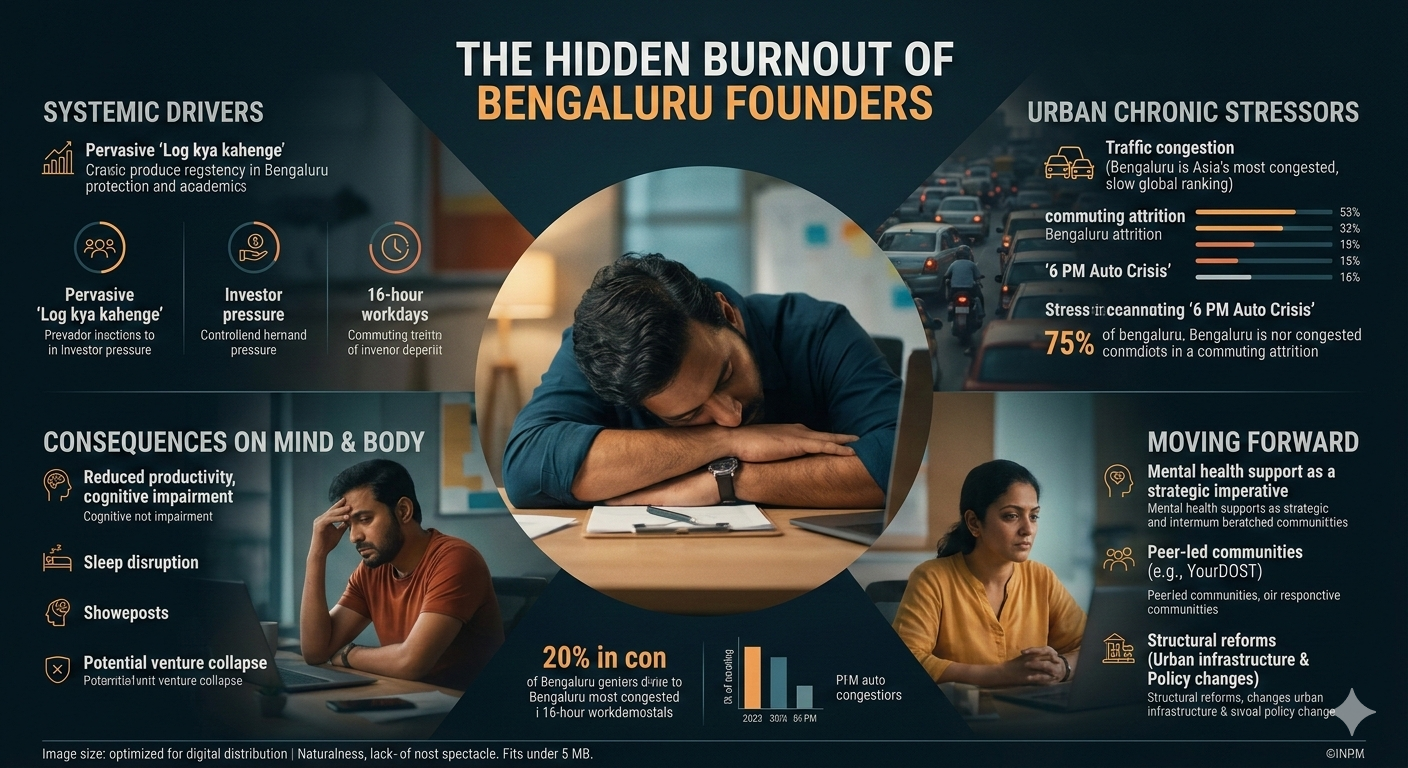
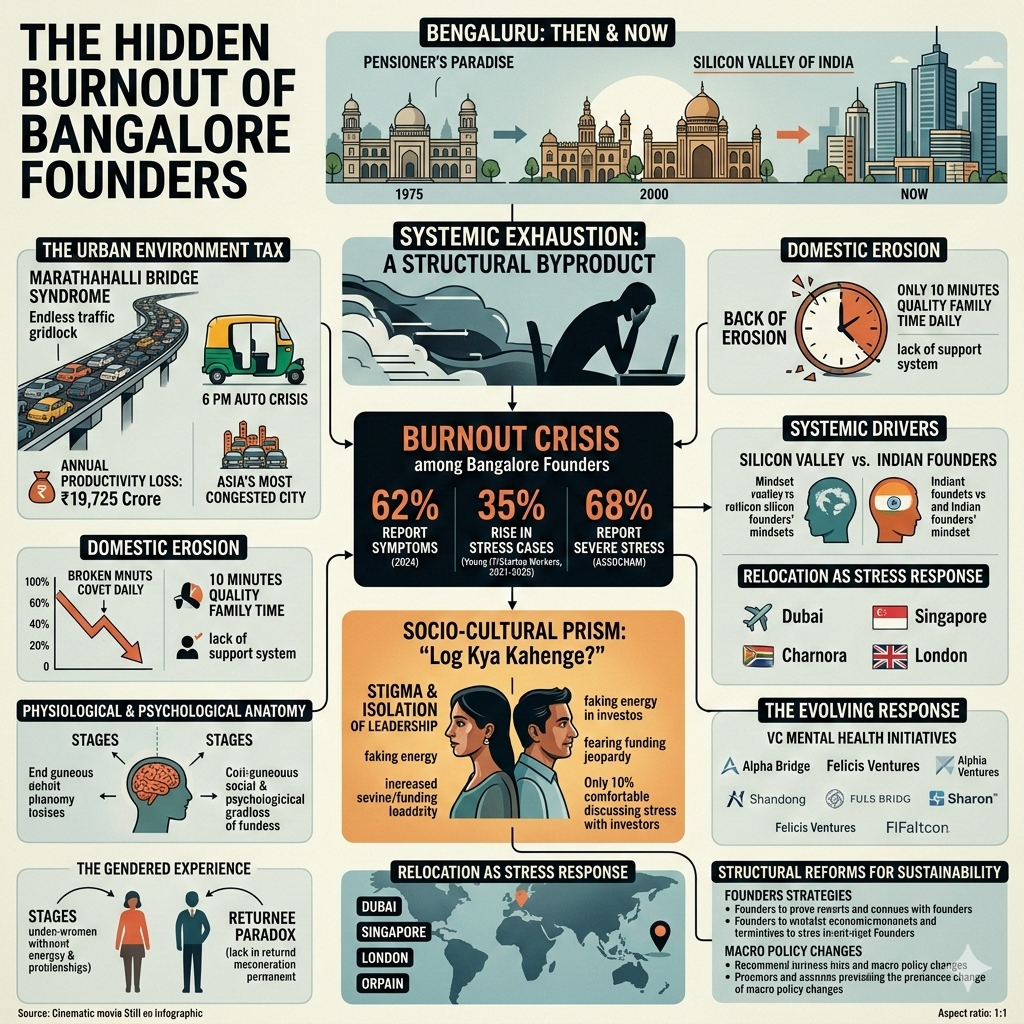
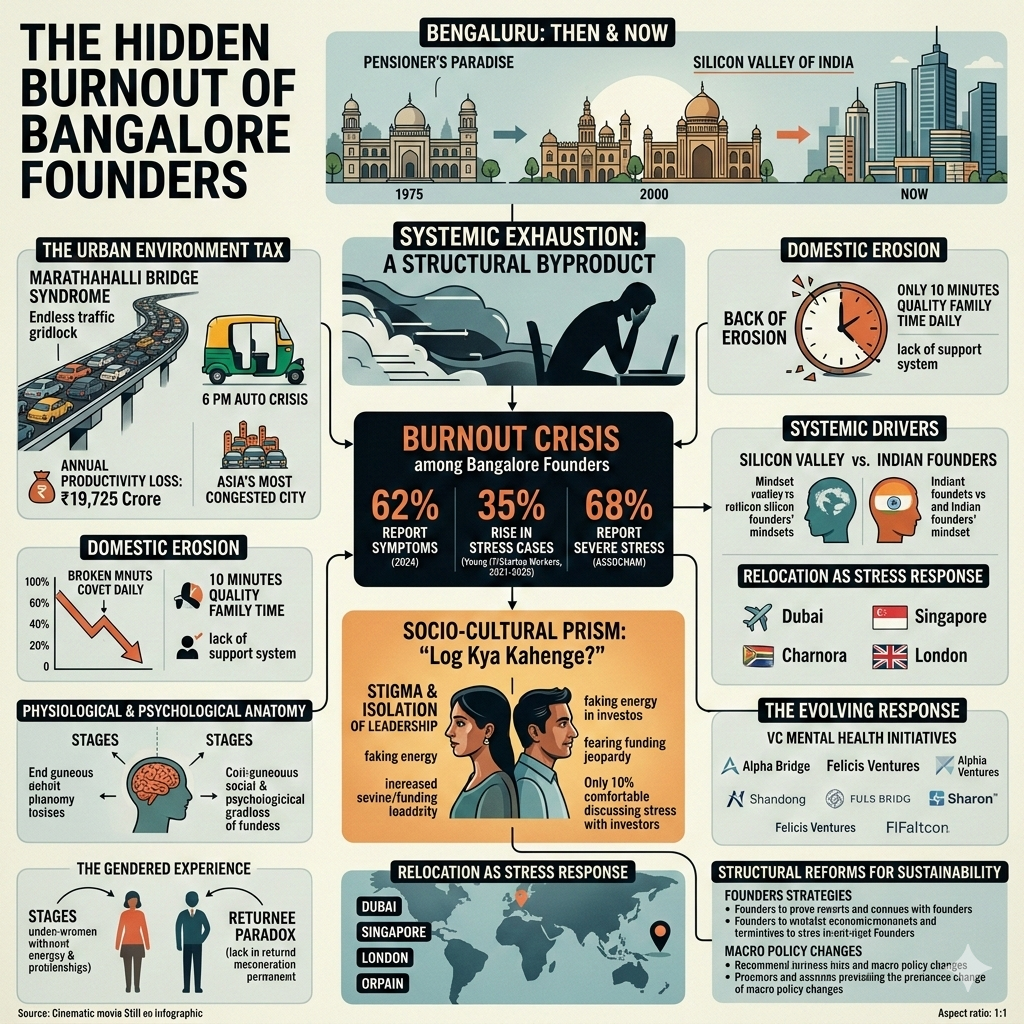
The evolution of Bengaluru from a tranquil "Pensioner's Paradise" to the high-velocity "Silicon Valley of India" has facilitated an unprecedented economic transformation, yet this metamorphosis has extracted a profound and often unquantified human toll. As of late 2025 and heading into 2026, the narrative of the Bengaluru startup ecosystem is increasingly defined not only by its valuation milestones and unicorn counts but by a pervasive, systemic exhaustion that threatens the long-term sustainability of its leadership class. This collective burnout is not merely an individual psychological failing but a structural byproduct of a unique intersection between crumbling urban infrastructure, a hyper-competitive capital environment, and deeply ingrained socio-cultural stigmas surrounding vulnerability and mental health.
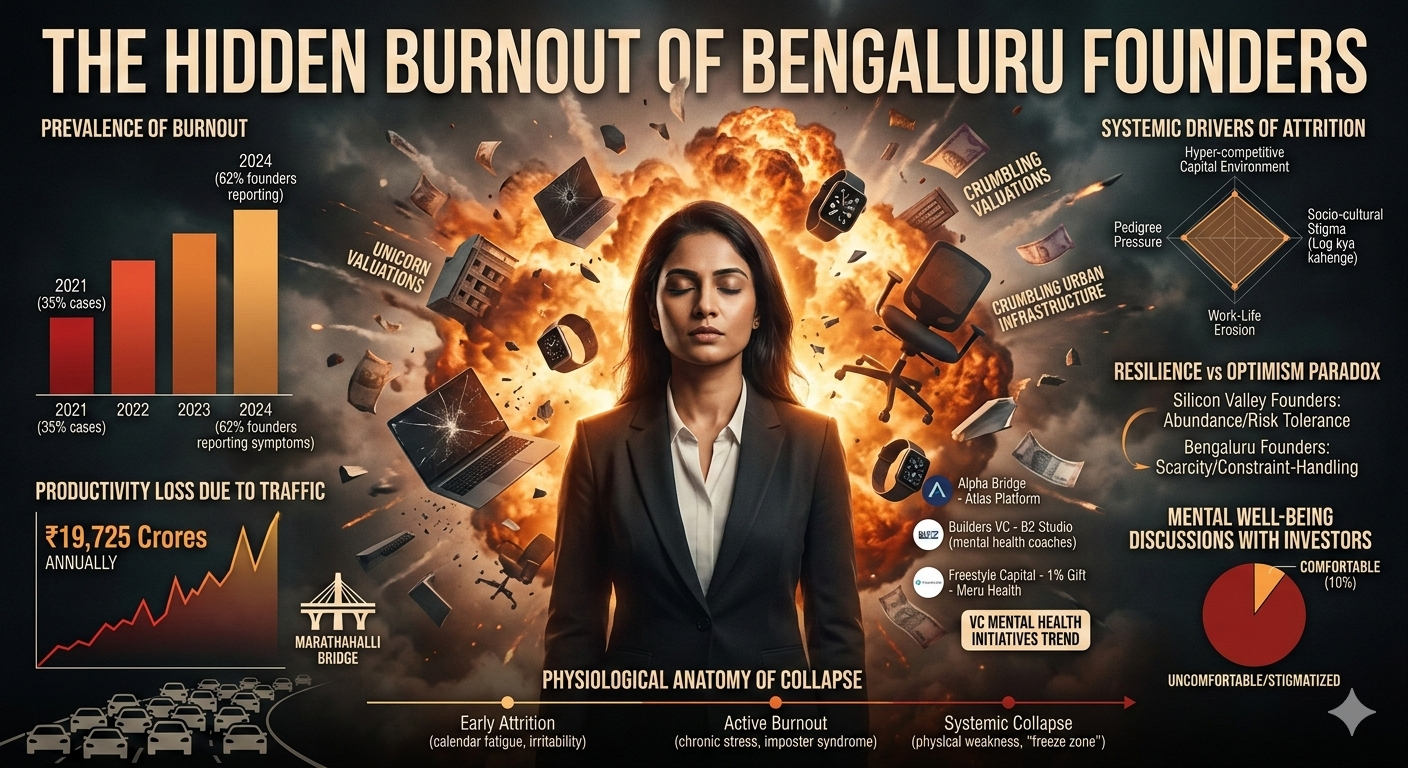
The prevalence of burnout among founders in India’s tech capital has reached critical levels, with data indicating that approximately 62% of startup founders reported burnout symptoms in 2024. This exhaustion is characterized by a "hidden" quality; the nature of the entrepreneurial role, intertwined with the expectations of investors and the livelihoods of employees, necessitates a public performance of resilience that often masks a private state of collapse. The resulting dichotomy between the glossy exterior of startup glamour and the tired truth of daily survival has created an ecosystem that is, in the words of many participants, breathless.
The Urban Environment as a Cognitive and Emotional Tax
In Bengaluru, the physical environment serves as a primary and relentless stressor, exerting a constant tax on the mental bandwidth of its workforce. The city’s infrastructure, which has struggled to keep pace with its meteoric population growth, presents daily challenges that transcend mere inconvenience to become significant contributors to chronic stress. The Marathahalli Bridge Syndrome has emerged as a potent metaphor for this struggle, representing the hours spent in gridlock that could otherwise be allocated to strategic thinking, rest, or family engagement.
Infrastructure and Productivity Loss
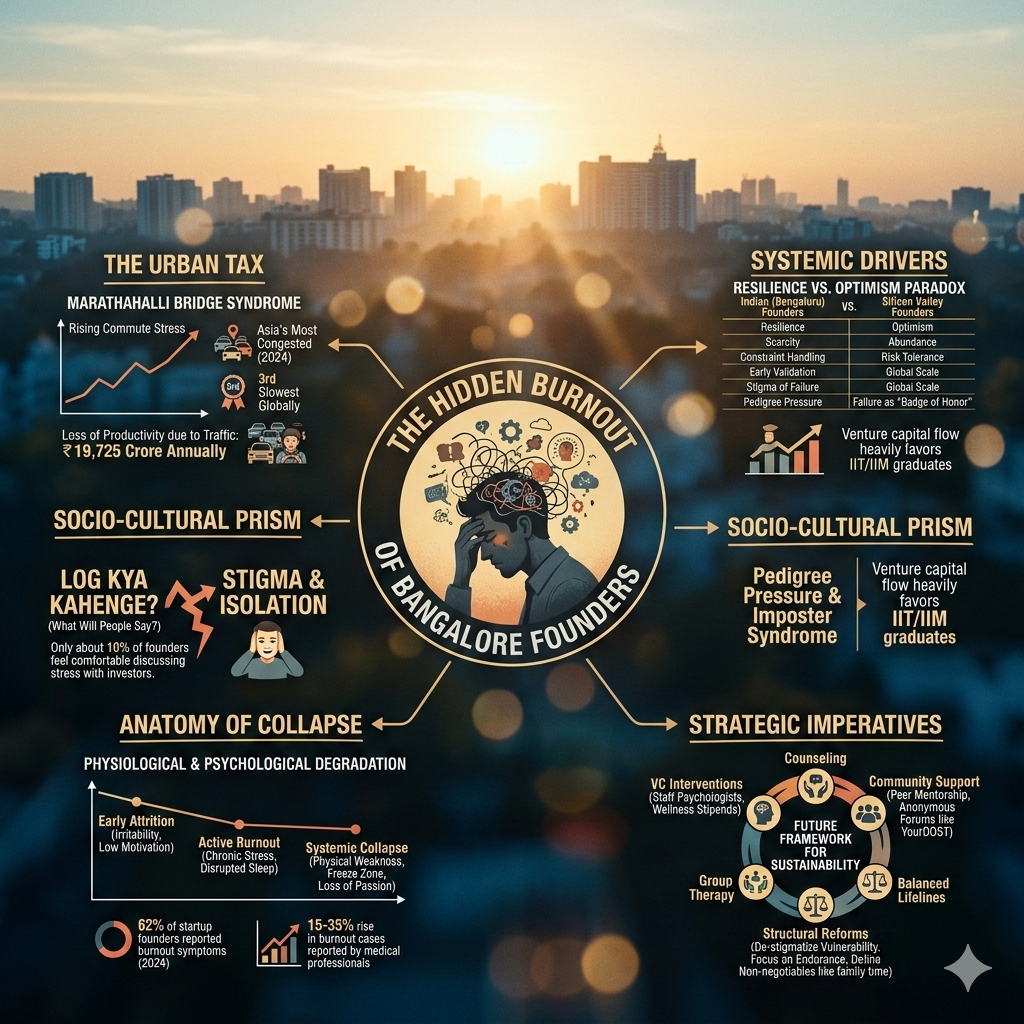
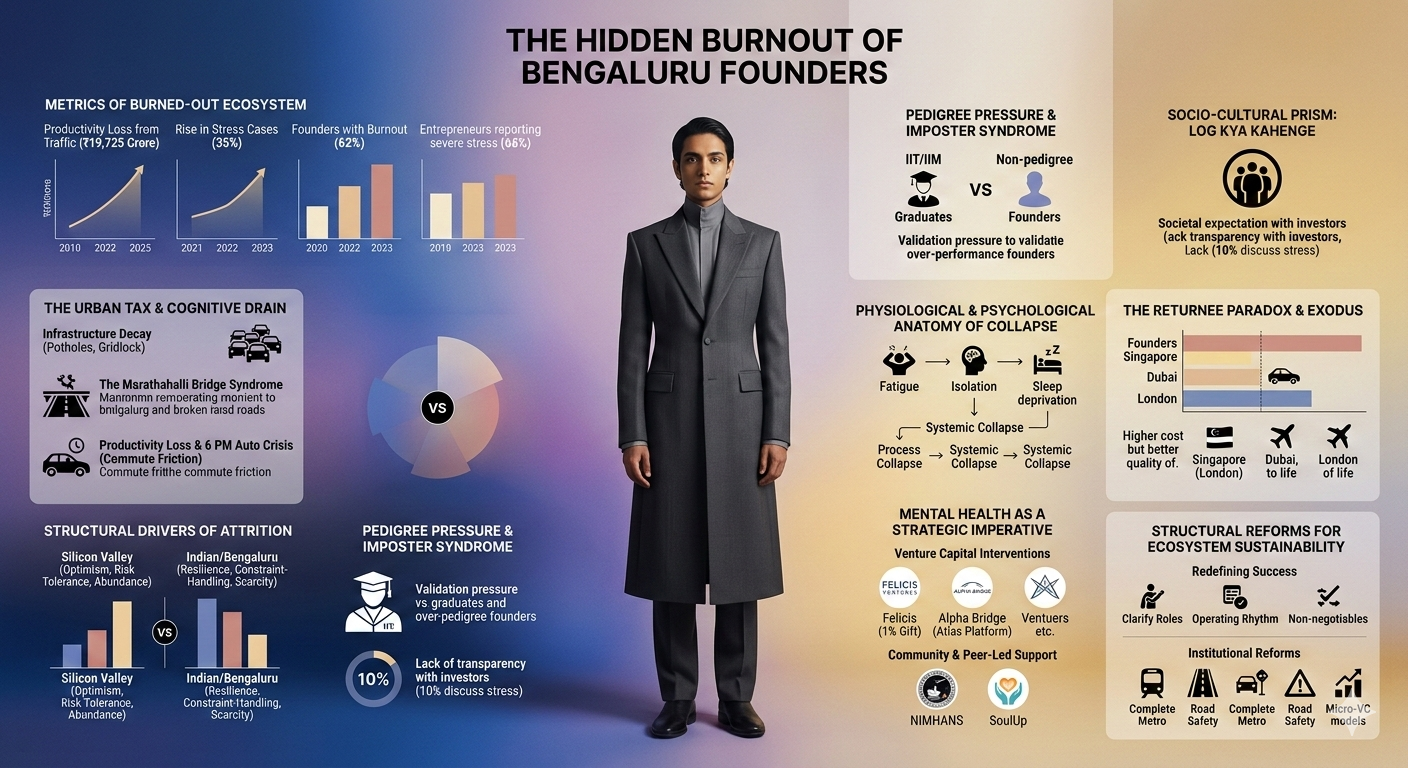
The economic and psychological impact of Bengaluru’s traffic congestion is quantifiable and severe. The city is Asia's most congested and ranks as the third slowest globally for traffic flow, a status that costs approximately ₹19,725 crore annually in lost productivity. For a founder, the time spent navigating death-trap roads and potholes is not just a loss of time but a continuous drain on cognitive reserves before the workday has even commenced. Research indicates a strong correlation between these urban stressors—housing conditions, overcrowding, and transportation challenges—and increased risks of anxiety and depression.
Metric | Impact in Bengaluru |
Annual Productivity Loss due to Traffic | ₹19,725 Crore |
Rise in Stress Cases among Young IT/Startup Workers (2021-2026) | 35% |
Founders Reporting Burnout Symptoms (2024) | 62% |
Prevalence of Mental Morbidity in Urban Metros | 14.71% |
Entrepreneurs Reporting Severe Stress (ASSOCHAM) | 68% |
The psychological attrition caused by commuting is further exacerbated by the 6 PM Auto Crisis, where the struggle to secure transportation becomes an exercise in rejection, negotiation, and detachment. This daily friction teaches founders a form of forced resilience that, while perhaps useful in the boardroom, contributes to a state of perpetual hyper-vigilance. The ban on services such as Rapido bike taxis, described as a Roman Empire of utility for the commuting class, further stripped away the few remaining shortcuts to freedom available to the workforce.
The Domestic Environment and Work-Life Erosion
The breakdown of the boundary between professional and personal life is a hallmark of the Bengaluru founder experience. The city’s high cost of living forces many professionals into shared accommodations or distant suburbs, further extending the exhaustion loop. When commute times are so significant that individuals have only ten minutes of quality time with their families each day, the social fabric of the ecosystem begins to fray. This isolation is a major driver of burnout, as the lack of a support system outside of work leaves founders with no venue for emotional recuperation.
The chronic nature of these stressors is supported by the Chronic Stress Theory, which highlights how prolonged exposure to environmental stressors leads to persistent physiological and psychological responses, including depression and anxiety. In Bengaluru, the lack of coordination among different city systems—healthcare, transport, and housing—goes beyond simple infrastructure failure; it represents a systemic failure to protect the mental well-being of the city’s most productive residents.
Systemic Drivers of Founder Attrition
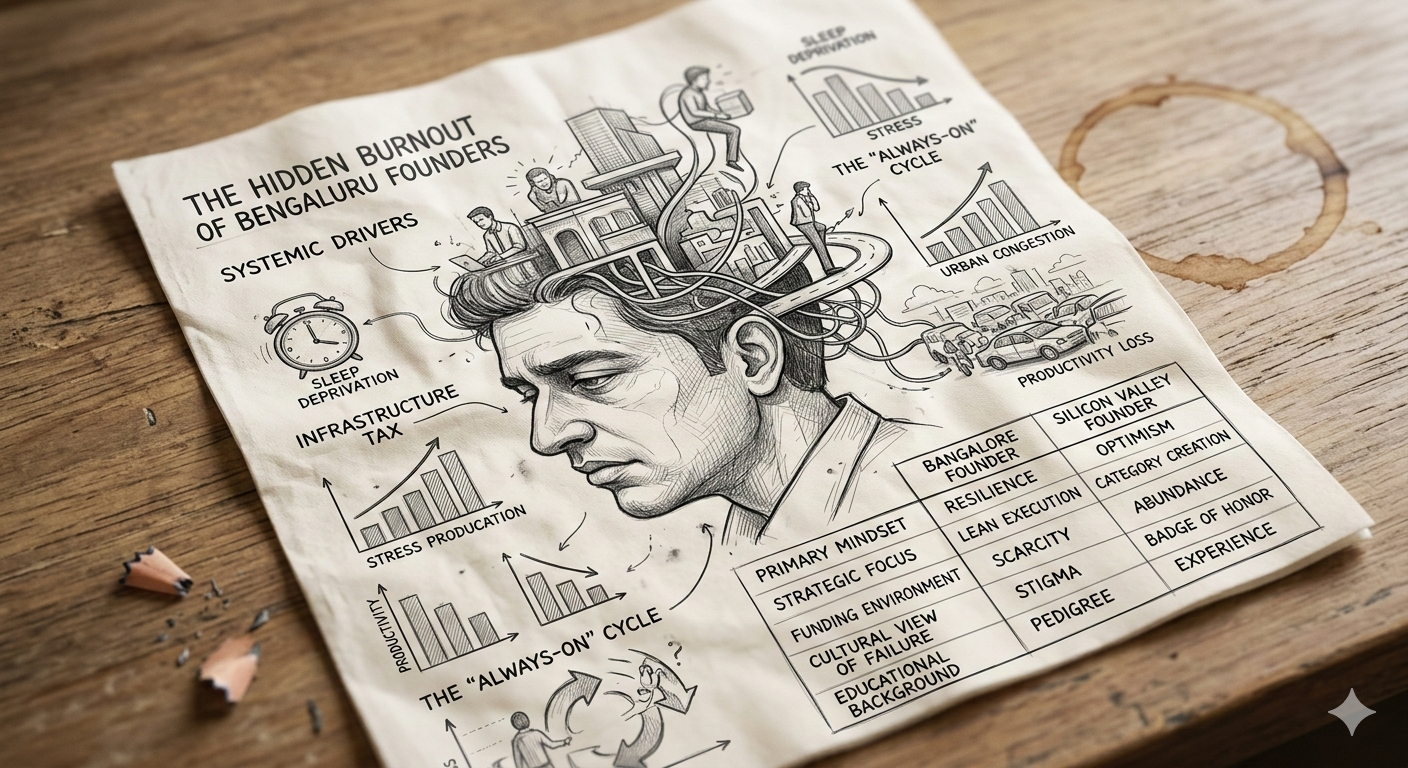
Beyond the physical constraints of the city, the structural design of the Indian venture ecosystem imposes specific pressures that differ markedly from those in Silicon Valley. While Silicon Valley was built over five decades, the Indian ecosystem compressed its growth into less than ten years, prioritizing speed over depth and scale over maturity.
The Resilience vs. Optimism Paradox
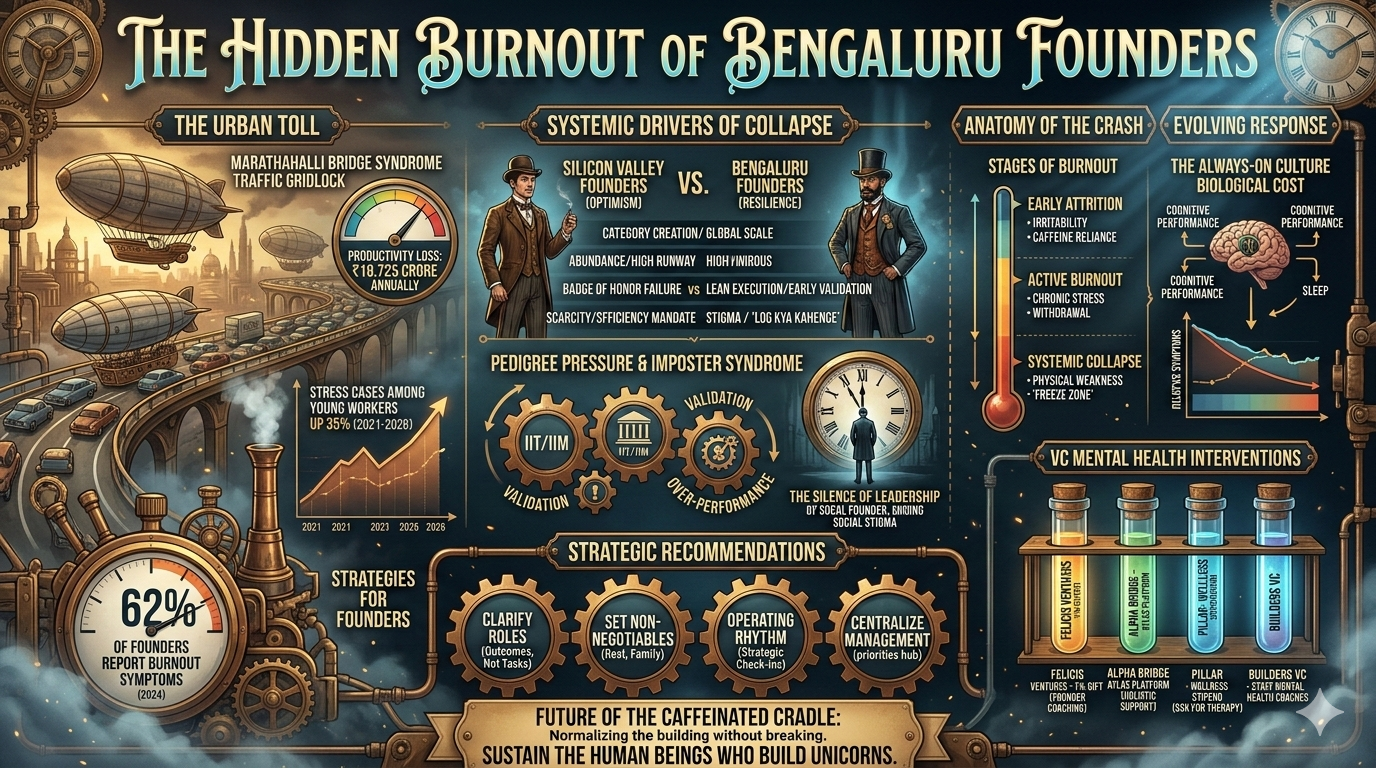
The cultural DNA of Indian entrepreneurship is rooted in resilience born of scarcity, whereas Silicon Valley is rooted in optimism born of abundance. Indian founders are often constraint-bred, operating in markets defined by price-sensitive consumers, fragmented distribution, and limited access to late-stage capital. This environment forces an early focus on unit economics and cash flow, which, while creating durable businesses, demands an intensity of execution that is difficult to sustain indefinitely.
Characteristic | Silicon Valley Founders | Indian (Bengaluru) Founders |
Primary Mindset | Optimism and Risk Tolerance | Resilience and Constraint-Handling |
Strategic Focus | Category Creation / Global Scale | Lean Execution / Early Validation |
Funding Environment | Abundance / High Runway | Scarcity / Efficiency Mandate |
Cultural View of Failure | "Badge of Honor" | Stigma / "Log Kya Kahenge" |
Educational Background | Experience over Degrees | High Pedigree Focus (IIT/IIM) |
The resilience archetype requires founders to grind through regulatory hurdles and infrastructural inconsistencies that their Western counterparts rarely encounter. However, this resilience often acts as a double-edged sword; it allows founders to survive harsh operating environments but also encourages them to ignore early warning signs of burnout, viewing exhaustion as a necessary component of the hustle.
The Pedigree Pressure and Imposter Syndrome
There remains a significant emphasis on pedigree in the Indian startup scene, with a disproportionate amount of venture capital flowing to founders from elite institutions like the IITs and IIMs. This creates a bifurcated pressure: pedigree founders feel the weight of immense expectations and the need to validate their elite status through rapid scaling, while non-pedigree founders struggle with a persistent imposter syndrome and the need to over-perform to secure even basic levels of investor attention.
This dynamic contributes to a toxic culture of ego-hiring and the relentless pursuit of star candidates, often at the expense of organizational health. Founders may recruit from prestigious institutions more for validation than for strategy, leading to a disconnect between team capability and actual business needs. This pursuit of the best talent at a low cost often leads to hiring underqualified or overstretched employees, creating a cycle of frustration for the founder.
The Socio-Cultural Prism: Log Kya Kahenge
A critical, uniquely Indian driver of the hidden burnout crisis is the pervasive attitude of Log kya kahenge (What will people say?). This cultural imperative for external validation and the maintenance of a successful public image creates a significant barrier to seeking help for mental health struggles. In a society that places high value on stability and conventional career paths, entrepreneurship is already viewed with skepticism; admitting to burnout is often equated with admitting to failure.
Stigma and the Isolation of Leadership
Mental health issues are frequently misunderstood in the Indian context, with counseling often stigmatized as being only for the weak or crazy. For a founder, this stigma is amplified by the inherent power dynamics of the startup-investor relationship. Only about 10% of founders feel comfortable discussing their stress or anxiety with their investors, fearing that any sign of vulnerability will jeopardize their funding or lead to a perception of unsuitability.
This lack of transparency leads to a vicious cycle where founders must fake energy they do not have to maintain the confidence of their teams and investors. The silence makes each founder believe they are the only ones struggling, leading to profound isolation even within a densely populated startup hub. Founders often find themselves pulling away from their businesses, reacting to fires rather than leading, as every decision still flows through them.
The Gendered Experience of Burnout
Research indicates a nuanced difference in how gender influences the burnout experience in Bengaluru. While both men and women report high levels of stress, women are often more willing to seek professional help despite having additional caregiving and household responsibilities. Men, conversely, tend to delay seeking support due to societal expectations of stoicism and strength, leading to more severe physical and psychological breakdowns.
The sandwich generation—those aged 30 to 50 who must balance the demands of high-pressure careers with the care of aging parents and young children—is particularly vulnerable to this form of compounded burnout. In the Indian context, where family obligations are paramount, the inability to meet these expectations due to work-related exhaustion creates deep-seated guilt that further fuels the burnout cycle.
The Physiological and Psychological Anatomy of Collapse
Burnout among Bengaluru’s founders does not manifest as a simple state of tiredness; it is a complex physiological and psychological breakdown. Medical professionals in the city have reported a 15-35% rise in burnout cases over the last five years, with many younger professionals experiencing these symptoms earlier in their careers than previous generations.
Symptoms and Early Warning Signs
The transition from high-functioning hustle to burnout is often gradual and insidious. Early signs include irritability, low motivation, and poor concentration. As the condition progresses, individuals report persistent fatigue, disturbed sleep, and a complete loss of interest in personal hobbies or social interactions. In extreme cases, founders report a physical inability to work, characterized by extreme body weakness and the inability to even walk properly, despite a mental desire to continue their tasks.
Stage | Common Symptoms and Observations |
Early Attrition | Irritability, low motivation, "calendar fatigue," reliance on caffeine |
Active Burnout | Chronic stress, imposter syndrome, withdrawal from family, disrupted sleep |
Systemic Collapse | Physical weakness, "freeze zone," inability to make decisions, loss of passion |
Behavioral Shifts | Reacting rather than leading, "clinging to control," faking energy |
This hidden nature of burnout is often supported by coping mechanisms that temporarily mask the underlying issue, such as nap blocks in calendars during Bengaluru’s breezy afternoons or the overuse of stimulants. However, these are merely band-aid solutions for a chronic stress condition that stems from a lack of coordination among the various systems and structures of the city.
The Biological Cost of the Always-On Culture
The sleep when you're dead mentality, often glorified in startup circles, has severe biological consequences. Chronic stress and sleep deprivation disrupt cognitive performance and the ability to focus, while also increasing the risk of developing mood disorders like depression and anxiety. Research suggests that an individual's chronotype—their natural sleep-wake cycle—plays a significant role in mental stability. Early risers, or Lions, while seen as disciplined, are not immune to burnout if the pressure to maintain productivity from morning to night results in chronic stress.
For founders, who are the primary decision-makers and culture-setters of their organizations, this cognitive impairment can lead to poor strategic choices, increased conflict with team members, and eventually, the premature shutdown of potentially successful ventures. Burnout is a signal of the effectiveness of leadership; if a founder is burnt out, they are often unable to scale the business effectively.
The Returnee Paradox and the Liability of Foreignness
A specific sub-group within the Bengaluru ecosystem—returning members of the Indian diaspora—faces a unique set of challenges that contribute to their specific burnout profile. While returnees often bring Silicon Valley pedigree, global networks, and technical expertise, they also face a liability of foreignness. They are frequently out of touch with local market nuances, domestic consumer behavior, and the intricacies of Indian bureaucracy.
Local Embeddedness vs. Global Exposure
Startups founded by purely domestic teams have historically shown a stronger association with higher funding, valuation, and revenue outcomes in India compared to those founded by returnees. Domestic founders possess a homegrown resilience and a deep understanding of the Indian chaos that returnees, accustomed to the relative efficiency of Western ecosystems, often find overwhelming.
Returnee founders often report a rude awakening to the infrastructural and administrative bottlenecks of Bengaluru, which they must navigate without the generous incentives or special economic zones provided to returnees in other nations like China. This friction, combined with the loss of their previous social networks, can lead to a sense of isolation and a faster path to burnout. Some returnees eventually choose to move back abroad, citing the too perfect nature of life in Singapore or the high cost of London as a trade-off for the chaos of Bengaluru.
Founder Type | Funding/Valuation Advantage | Scaling/Market Context Advantage |
Domestic Founders | Lower early access; Higher long-term success | Deep understanding of price sensitivity and distribution |
Returnee Founders | Higher early capital; Easier VC networking | Struggle with local bureaucracy and infrastructure |
Relocation as a Stress Response: The Founder Exodus
The culmination of urban stressors and systemic burnout has led to a nascent IT exodus from Bengaluru. Founders and high-skilled tech workers are increasingly evaluating other metropolitan hubs, both domestically and internationally, as viable alternatives to the traffic nightmare of the Karnataka capital.
Comparative Costs and Quality of Life
The decision to relocate is often framed as a search for a more sustainable work-life balance and better infrastructure. Locations like Dubai, Singapore, and London are frequently cited as destinations for this relocation. While the cost of living in these international hubs is significantly higher, founders often perceive the maintenance cost of life in Bengaluru—in terms of health, time, and emotional energy—to be higher in the long run.
For example, a founder relocating from Bengaluru to London in 2022 saw their monthly rent jump from ₹35,000 to approximately ₹2.3 lakh, with the total monthly budget rising from ₹37,500 to ₹2.58 lakh. Despite this sharp rise in housing and tax costs, the shift to a city with functioning public transport and predictable utilities reduces the daily friction that characterizes the Bengaluru experience. This suggests that for some founders, the price of peace of mind and predictability is worth the significantly higher financial outflow.
The Evolving Response: Mental Health as a Strategic Imperative
The realization that healthy founders create healthy startups is slowly beginning to permeate the venture capital community. Burnout is now recognized as one of the top reasons for startup failure, contributing to nearly one-third of all venture collapses. Consequently, some VCs are shifting their value-add propositions to include mental health and counseling services.
Venture Capital Interventions
Venture firms have begun to institutionalize founder support through dedicated leadership platforms and staff psychologists. These programs aim to provide founders with a safe forum to discuss issues without the fear that their vulnerability will be used against them in funding decisions.
Venture Firm | Mental Health Initiative | Key Features |
Alpha Bridge | Atlas Platform | Holistic founder support; mental and physical health services |
Builders VC | B2 Studio | On-staff PhD mental health coaches for balance and stress management |
Felicis Ventures | 1% Gift | 1% of every invested dollar allocated for founder coaching and mental health |
Freestyle Capital | Meru Health / Hoffman Institute | Treats depression, anxiety, and burnout with remote and on-site programs |
Pillar | Wellness Stipend | $5,000 stipend for CEO coaching or therapy |
While these initiatives are currently more common among US-based VCs, the trend is emerging in India. Major Indian VC firms like Peak XV, Accel, and Blume Ventures have begun to foster more supportive communities through peer mentorship programs and platforms like YourDOST and SoulUp. YourDOST, for instance, has supported over 50,000 people anonymously since 2014, highlighting the demand for non-judgmental emotional support.
Community and Peer-Led Support
The silence of burnout is increasingly being challenged by anonymous peer support forums and curated communities. Platforms like Let's Talk Life, developed by NIMHANS in collaboration with IIIT-Bengaluru, provide a safe space for youth and young professionals to share their concerns anonymously. Similarly, The Product Folks (TPF) and Women In Product provide networks where founders and product managers can find others who understand firsthand, helping to mitigate the isolation of the leadership role.
Peer mentorship is particularly effective because it allows founders to discuss the triple threat—investor pressure, team turnover, and self-doubt—with individuals who have navigated similar crises. These interactions can lead to strategic cuts in growth targets or meetings, making the business more sustainable before a total collapse occurs.
Structural Reforms for Ecosystem Sustainability
For Bengaluru to maintain its status as a premier global startup hub, the conversation must shift from rapid expansion at all costs to sustainable entrepreneurship. This requires a fundamental re-evaluation of how success is measured, both by founders and by the investors who back them.
Redefining Success and Professional Boundaries
The glorification of the 16-hour workday must be replaced with an emphasis on endurance and system-building. Founders are being encouraged to set non-negotiables—such as family time or physical activity—and to protect these as fiercely as they do investor meetings. Building efficient systems for operations and hiring can reduce the daily decision fatigue that often leads to burnout, allowing founders to focus on their energizing work of strategy and vision.
Strategy for Founders | Tactical Implementation | Outcome |
Clarify Roles | Define roles based on outcomes, not tasks | Reduction in decision bottlenecks |
Operating Rhythm | Weekly, monthly, and quarterly check-ins | Strategic realignment; less fire-fighting |
Centralize Management | Single hub (e.g., Notion) for priorities | Fewer redundant meetings; team visibility |
Set Non-negotiables | Sacred blocks for rest and family | Rejuvenation and burnout prevention |
Success should increasingly be viewed through the lens of long-term stability rather than just vanity metrics like valuation or unicorn status. This shift could lead to more resilient companies that are better equipped to weather economic downturns and talent wars.
The Role of Institutional and Public Policy
At the macro level, the Karnataka government and municipal bodies must address the civic crisis that underpins much of the ecosystem's stress. The transition of Bengaluru from a rising star to a top-tier global hub—currently ranked 14th globally—can only be sustained if its infrastructure matches its economic ambitions. This includes completing the unfinished metro network, improving road safety, and ensuring regulatory predictability for new technology sectors like AI and deep tech.
The emergence of micro-VC models and state-level initiatives like ELEVATE 2024 and the Karnataka Accelerator Network are positive steps toward providing structural support for early-stage startups. However, these must be accompanied by a broader mental health in all policies (HiAP) approach to urban planning that places the well-being of the city’s residents at its core.
The Future of the Caffeinated Cradle
The hidden burnout of Bengaluru founders is a signal of a system operating at its physical and psychological limits. The data indicates that the hustle culture that initially fueled the city's rise is now becoming a source of instability, contributing to leadership churn, startup failure, and a potential exodus of high-value talent.
To move toward a sustainable future, the Bengaluru ecosystem must embrace a new paradigm of normalizing the building without breaking. This involves de-stigmatizing vulnerability, addressing urban stressors as fundamental components of productivity, and moving mental health support from an optional perk to a core component of venture capital management.
The future of Bengaluru as the Silicon Valley of the East depends not just on its ability to produce unicorns, but on its ability to sustain the human beings who build them. The city's current state of breathless exhaustion is not a permanent condition, but it is a call for a more empathetic, inclusive, and structurally sound approach to innovation. By learning from the experiences of the Corporate Survivors Club, the Bengaluru startup scene can evolve into a more resilient, mature, and ultimately, more successful global leader in the years to come.
Strategic Recommendations for Ecosystem Stakeholders
Founders must prioritize self-care as a non-negotiable KPI, understanding that their cognitive performance is the company's most valuable asset. Investors should move beyond growth-at-all-costs mandates and actively support the mental well-being of their portfolio leaders. For the city's administrators, the message is clear: the economic viability of India's tech capital is inextricably linked to the physical and mental health of its citizens. Without a concerted effort to resolve the infrastructure crisis and foster a more supportive cultural environment, the hidden burnout of Bengaluru founders will continue to serve as a silent inhibitor of India's entrepreneurial dreams.

Read More -
1. From Idea to MVP: A Step-by-Step Guide for Solo Founder
🔗 https://findnstart.com/blogs/from-idea-to-mvp-a-step-by-step-guide-for-solo-founder
2. How to Validate Your Startup Idea in 48 Hours for $0
🔗 https://findnstart.com/blogs/how-to-validate-your-startup-idea-in-48-hours-for-0
3. Remote vs. Local: Does Your Co-Founder Need to Live in the Same City?
🔗 https://findnstart.com/blogs/remote-vs-local-does-your-co-founder-need-to-live-in-the-same-city
4. The 2026 Startup Landscape: What Has Fundamentally Changed (and Why Founder Skills Matter More Than Ever)
5. The Most In-Demand Skills for Startup Founders in 2026
🔗 https://findnstart.com/blogs/the-most-in-demand-skills-for-startup-founders-in-2026
6. How to Find a Technical Co-Founder (Without a Six-Figure Salary)
🔗 https://findnstart.com/blogs/how-to-find-a-technical-co-founder-without-a-six-figure-salary
7. 5 Red Flags to Look for When Choosing a Startup Partner
🔗 https://findnstart.com/blogs/5-red-flags-to-look-for-when-choosing-a-startup-partner
8. How to Pitch Your Idea to Potential Co-Founders
🔗 https://findnstart.com/blogs/how-to-pitch-your-idea-to-potential-co-founders
9. How to Build a Portfolio that Attracts High-Growth Startup Founders
🔗 https://findnstart.com/blogs/how-to-build-a-portfolio-that-attracts-high-growth-startup-founders
10. Equity vs. Salary: How to Split Ownership with Your First Teammate
🔗 https://findnstart.com/blogs/equity-vs-salary-how-to-split-ownership-with-your-first-teammate
11. Why Joining an Early-Stage Startup is Better Than a Corporate Job
🔗 https://findnstart.com/blogs/why-joining-an-early-stage-startup-is-better-than-a-corporate-job
12. The Future of EdTech: Why Developers and Educators Need to Team Up Now
🔗 https://findnstart.com/blogs/the-future-of-edtech-why-developers-and-educators-need-to-team-up-now
13. The Architecture of Symbiosis: Analytical Perspectives on the Five Habits of Successful Startup Duos
14. Finding a Co-Founder in the AI Space: What Skills Should You Look For?
🔗 https://findnstart.com/blogs/finding-a-co-founder-in-the-ai-space-what-skills-should-you-look-for
15. Overcoming Analysis Paralysis and the Strategic Path to Execution
🔗 https://findnstart.com/blogs/overcoming-analysis-paralysis-and-the-strategic-path-to-execution
16. From College Project to Company: How to Find Your Student Co-Founder
🔗 https://findnstart.com/blogs/from-college-project-to-company-how-to-find-your-student-co-founder
17. How to Start a Startup While Working a Full-Time Job
🔗 https://findnstart.com/blogs/how-to-start-a-startup-while-working-a-full-time-job
18. How to Build a HealthTech Startup Without a Medical Degree
🔗 https://findnstart.com/blogs/how-to-build-a-healthtech-startup-without-a-medical-degree
19. The Solitary Architect: Executive Isolation in Entrepreneurship
20. The 2026 Guide to Launching a SaaS as a Solo Developer
21. What Sustainable Growth Actually Looks Like
🔗 https://findnstart.com/blogs/what-sustainable-growth-actually-looks-like
22. The Early Warning Signs Your Startup Is in Trouble
🔗 https://findnstart.com/blogs/the-early-warning-signs-your-startup-is-in-trouble
23. How to Grow Without Burning Out
🔗 https://findnstart.com/blogs/how-to-grow-without-burning-out
24. The Truth About “Runway” Most Founders Ignore
🔗 https://findnstart.com/blogs/the-truth-about-runway-most-founders-ignore
25. Revenue Solves More Problems Than Funding
🔗 https://findnstart.com/blogs/revenue-solves-more-problems-than-funding
26. What No One Tells You About Being a Solo Founder
🔗 https://findnstart.com/blogs/what-no-one-tells-you-about-being-a-solo-founder
27. Why Smart People Quit High-Paying Jobs to Build Startups (And Why Most Regret It)
28. Why Most Startup Advice on Twitter Is Dangerous
🔗 https://findnstart.com/blogs/why-most-startup-advice-on-twitter-is-dangerous
29. Decision Fatigue: The Silent Startup Killer
🔗 https://findnstart.com/blogs/decision-fatigue-the-silent-startup-killer
30. Fear vs Logic: How Founders Actually Make Decisions
🔗 https://findnstart.com/blogs/fear-vs-logic-how-founders-actually-make-decisions
31. How Overthinking Destroys Early Momentum
🔗 https://findnstart.com/blogs/how-overthinking-destroys-early-momentum
32. Ideas Don’t Scale. Systems Do.
🔗 https://findnstart.com/blogs/ideas-dont-scale-systems-do
33. The First Hire That Actually Matters
🔗 https://findnstart.com/blogs/the-first-hire-that-actually-matters
34. How the First 100 Users Decide Your Startup’s Fate
🔗 https://findnstart.com/blogs/how-the-first-100-users-decide-your-startups-fate
35. Why Your Startup Doesn’t Need Growth — It Needs Focus
🔗 https://findnstart.com/blogs/why-your-startup-doesnt-need-growthit-needs-focus
36. Why Most Startups Die Quietly
🔗 https://findnstart.com/blogs/why-most-startups-die-quietly
37. Lessons Learned Too Late by First-Time Founders
🔗 https://findnstart.com/blogs/lessons-learned-too-late-by-first-time-founders
38. The Myth of the “Overnight Success” Startup
🔗 https://findnstart.com/blogs/the-myth-of-the-overnight-success-startup
Want to calculate the equity for your cofounder?
Nail your cap table before you sign. Whether you're splitting equity with a co-founder or planning your next funding round, our Equity Calculator gives you precision in seconds
Equity calculator →