Why B2B SaaS from Bangalore Scales Faster
March 9, 2026 by Harshit Gupta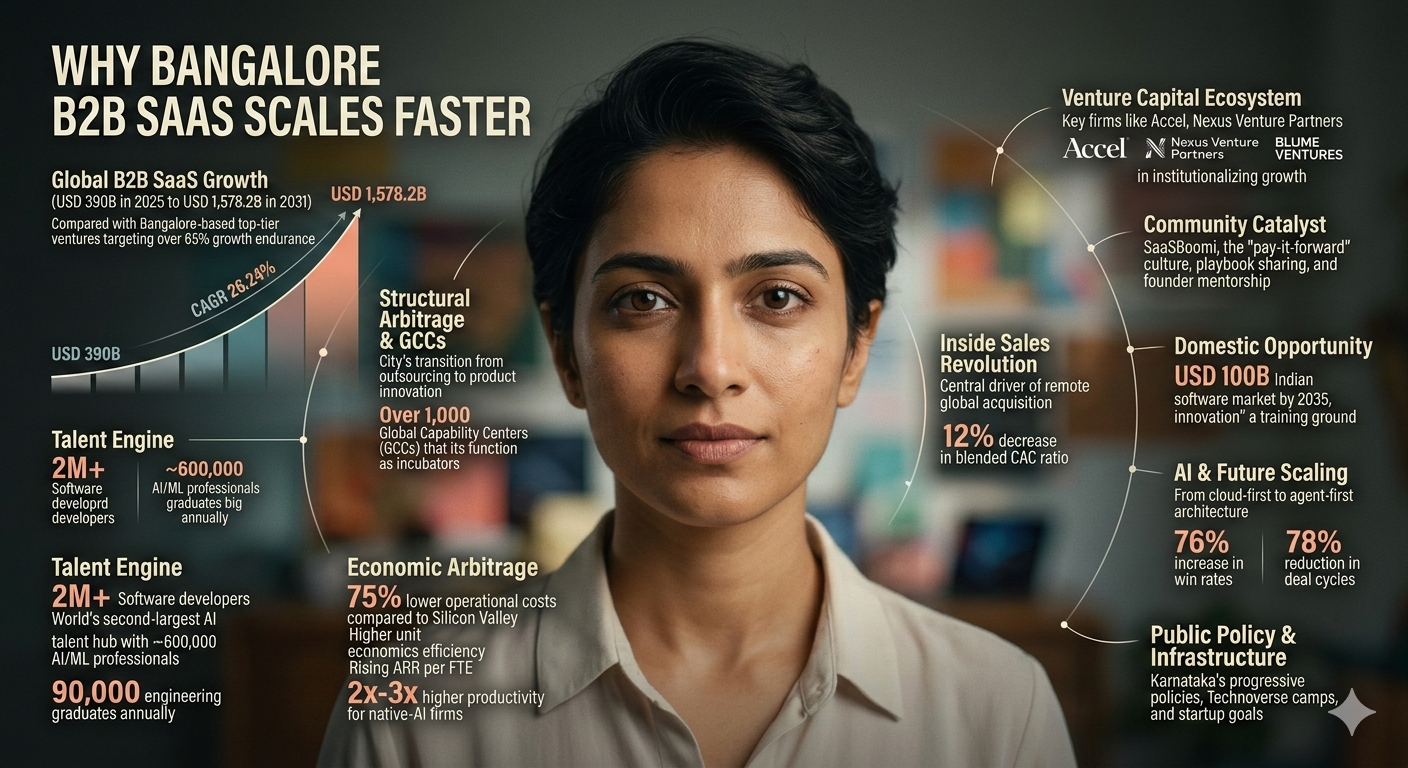
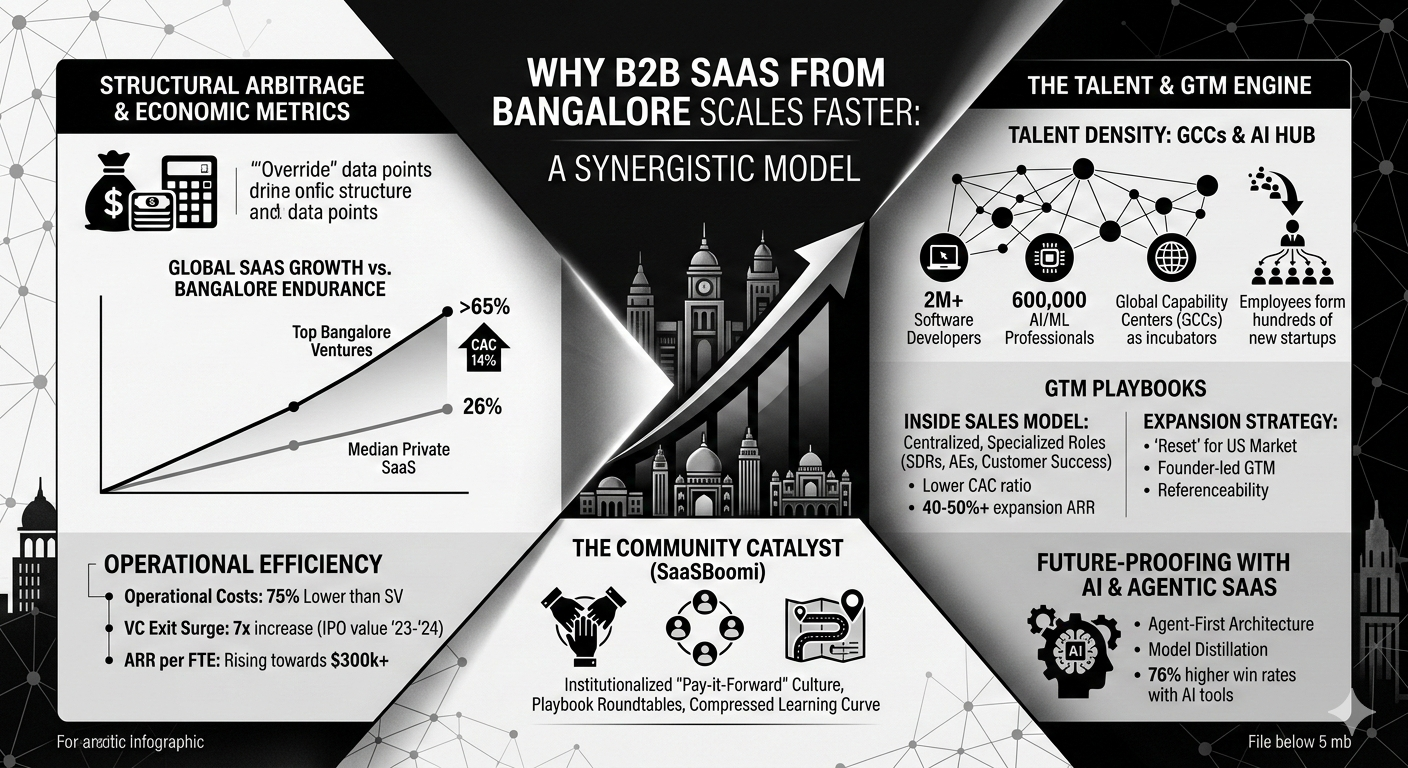
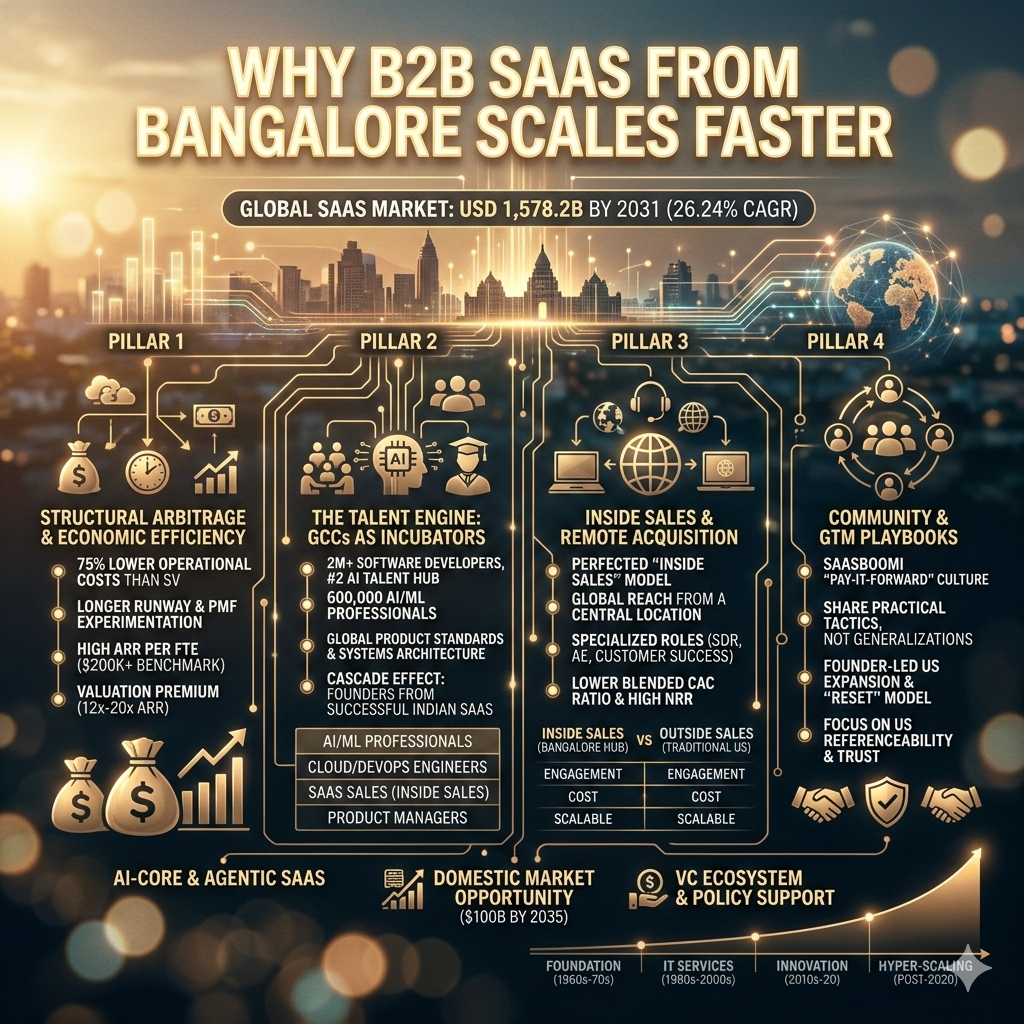
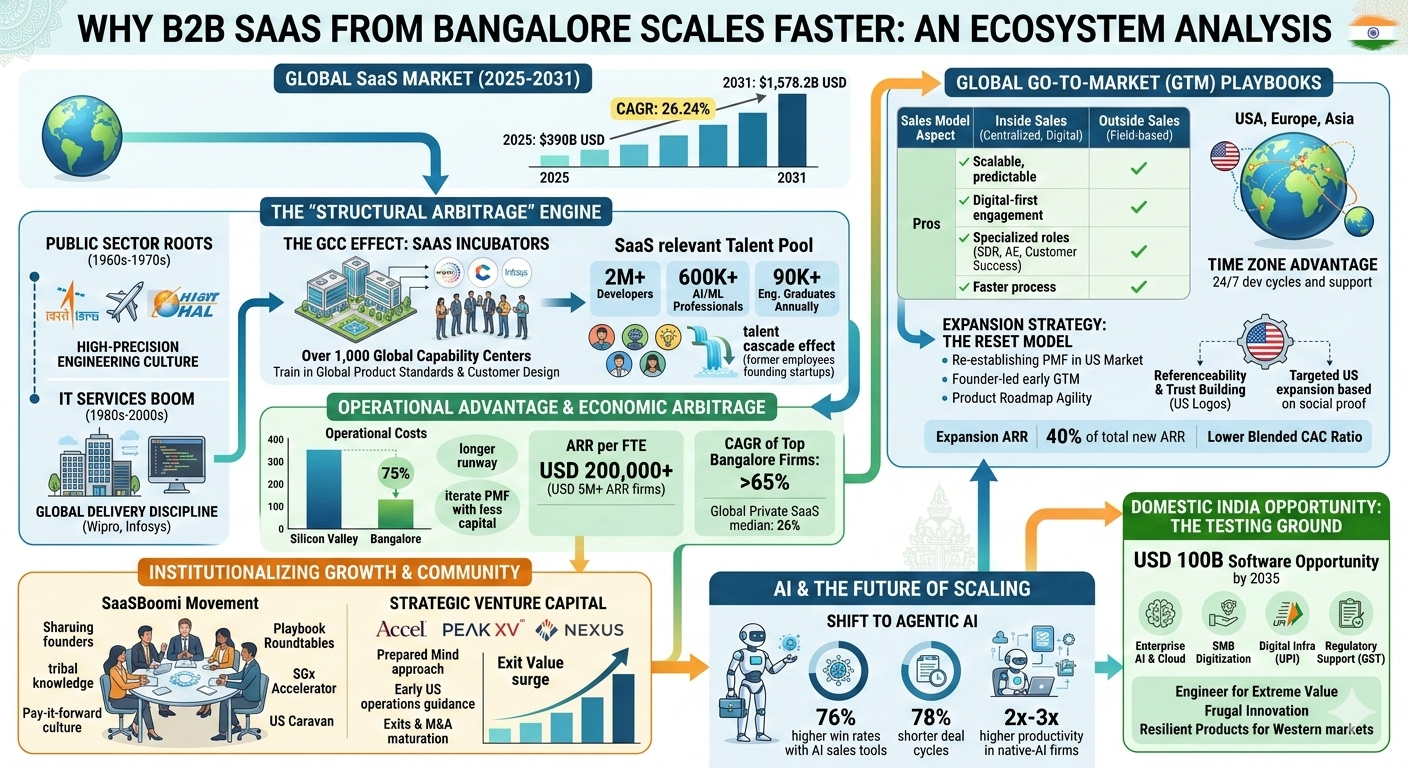
The global proliferation of Software-as-a-Service (SaaS) has historically been anchored in Silicon Valley, yet a significant paradigm shift has positioned Bangalore, India, as a primary engine for high-velocity B2B scaling. By 2025, the global B2B SaaS market reached a valuation of USD 390 billion, with projections indicating a trajectory toward USD 1,578.2 billion by 2031, driven by a compound annual growth rate (CAGR) of 26.24%. Within this global expansion, Bangalore-based firms have demonstrated a unique ability to outpace their international peers through a combination of structural cost arbitrage, specialized talent density, and institutionalized go-to-market (GTM) playbooks. While the median growth rate for private SaaS companies globally has moderated to approximately 26%, top-tier ventures in the Bangalore hub continue to target growth endurance benchmarks that exceed 65%, even as new customer acquisition costs (CAC) rise by 14% across the industry.
The fundamental inquiry into why Bangalore-based B2B SaaS scales faster necessitates an examination of the "structural arbitrage" that the city provides. This involves an intersection of historical industrial policy, the evolution of global capability centers (GCCs), and the maturation of a domestic ecosystem that has shifted from providing services to creating intellectual property. The subsequent analysis provides an exhaustive review of these drivers, the institutional mindset of the founder community, and the economic metrics that underpin the region's competitive moat.
Historical Evolution: From Outsourcing Center to Product Innovation Hub
The acceleration of the Bangalore SaaS ecosystem is not a spontaneous event but the result of a compounding history spanning over six decades. The city’s identity as a technical hub was established in the 1960s and 1970s, not by commercial enterprise, but by strategic public sector investment in aerospace and defense, led by institutions such as the Indian Space Research Organisation (ISRO) and Hindustan Aeronautics Limited (HAL). These entities fostered a culture of high-precision engineering and attracted a core of scientific and research-oriented talent.
The liberalization of the Indian economy in the 1980s served as the second catalyst. In 1984, the introduction of new computer and software policies eased import-export restrictions, enabling firms like Wipro and Infosys to pioneer the IT services model. The establishment of the Software Technology Parks of India (STPI) in the early 1990s—with Bangalore as the pilot location—provided critical infrastructure and tax incentives that catalyzed the global outsourcing wave. This period was essential for training a massive workforce in the "global delivery model," instilling the discipline of serving international clients across time zones.
Historical Phase | Period | Strategic Focus | Systemic Impact |
Foundation | 1960s–1970s | Science & Aerospace | Created a rigorous engineering and research culture. |
IT Services | 1984–2000s | Software Outsourcing | Built a global talent pool proficient in service delivery. |
Innovation | 2010s–2020 | R&D and Product | Shift from back-office to core product development. |
Hyper-Scaling | Post-2020 | AI & Global SaaS | Emergence of "AI-native" firms with hyper-efficient GTM. |
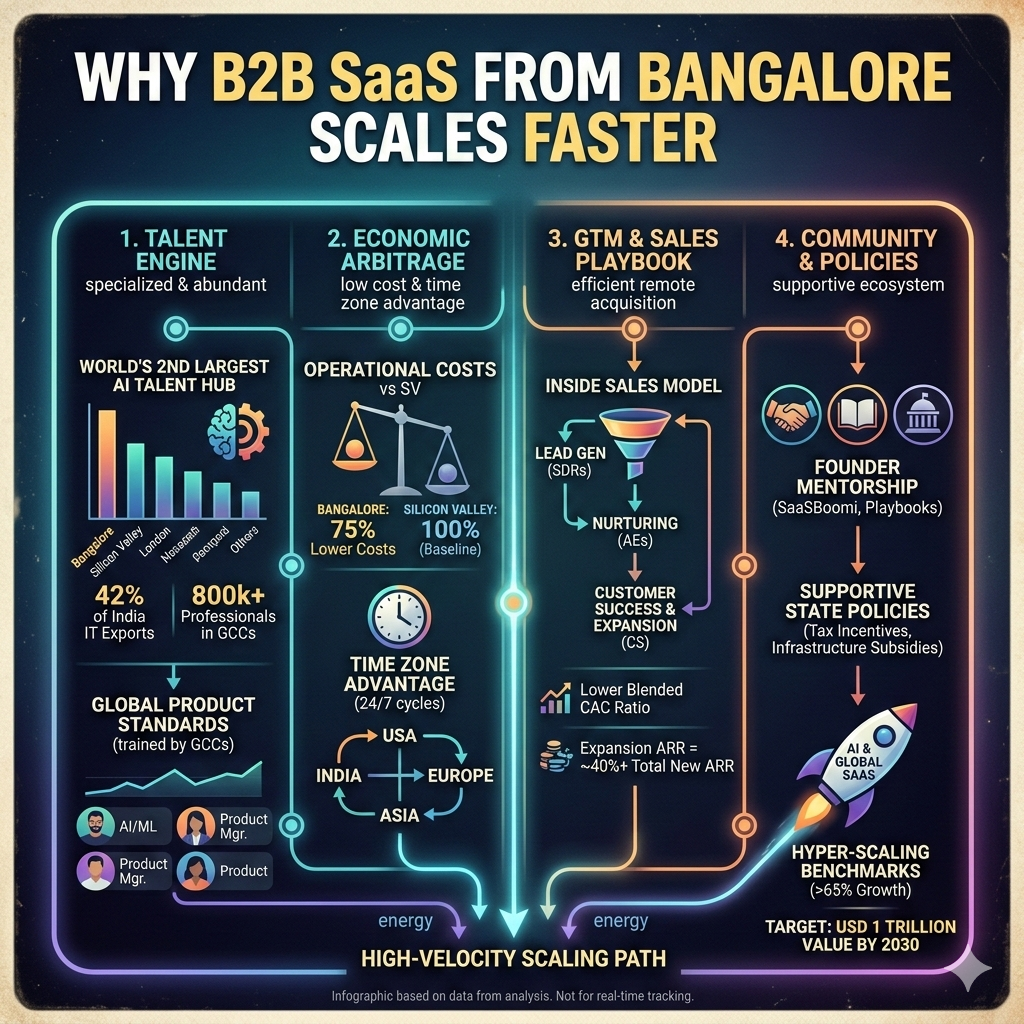
The critical transition occurred around 2010, as the ecosystem matured from "service-intensity" to "product-intensity". Multinational corporations began establishing Global Capability Centers (GCCs) in Bangalore that moved beyond back-office support into core R&D, product design, and deep learning. By 2025, Bangalore hosted over 1,000 GCCs, accounting for 42% of India’s total IT exports and employing over 800,000 professionals. These centers have functioned as incubators for the SaaS sector, training talent in global product standards, customer-centric design, and complex systems architecture—skills that are directly transferable to building B2B SaaS ventures.
The Talent Engine: GCCs as Incubators for SaaS Leadership
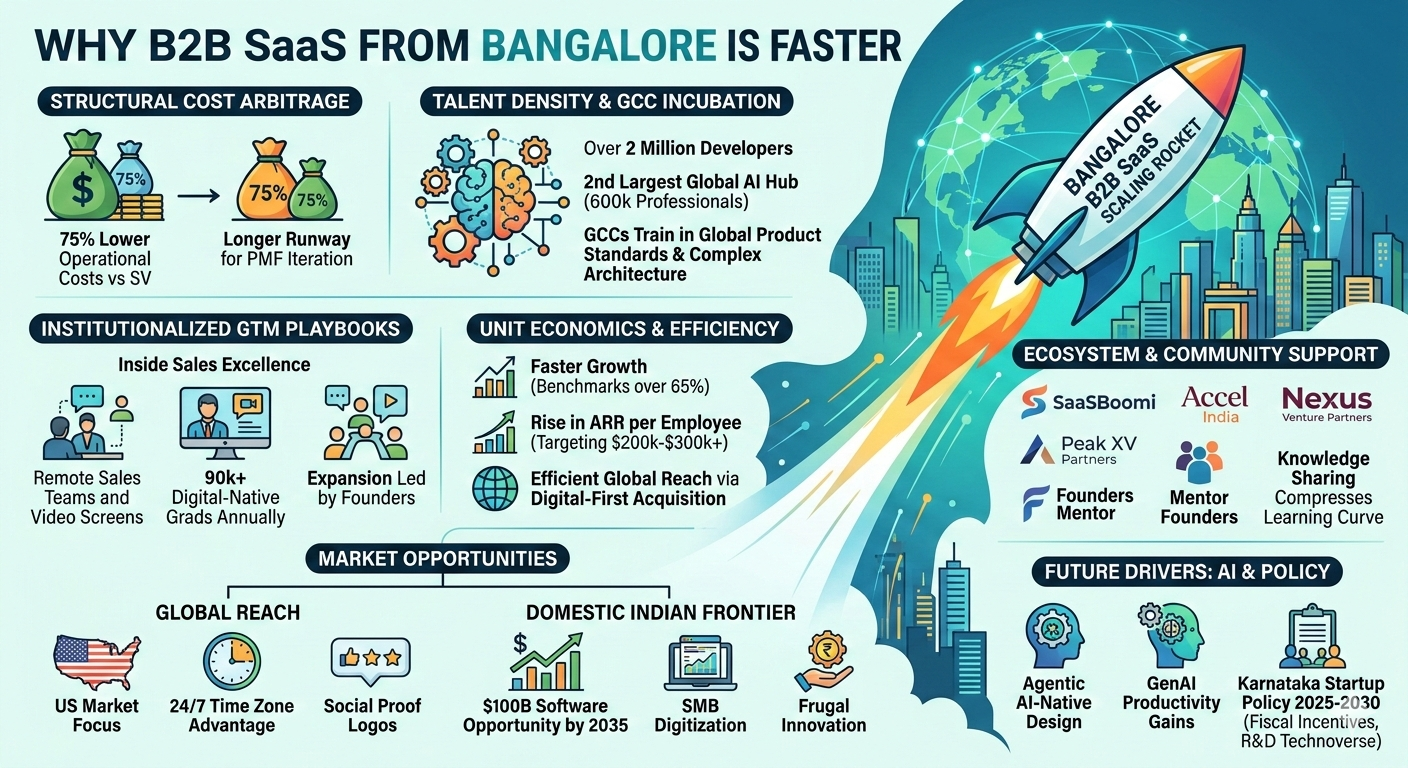
A primary reason Bangalore-based SaaS firms scale faster is the density and availability of specialized, "SaaS-relevant" talent. The city houses over 2 million software developers and is recognized as the world's second-largest AI talent hub, with approximately 600,000 AI/ML professionals. This concentration allows startups to hire across research, product engineering, and data science functions without the geographic friction common in other tech hubs.
The role of GCCs in training this talent is multifaceted. Professionals in a Bangalore GCC gain in-depth understanding of global product collaboration and complex systems. This experience frequently inspires them to either join early-stage startups or launch their own ventures, creating a "cascade effect" where former employees of established firms found hundreds of new startups. Over 250 new firms have been established by former employees of successful Indian SaaS companies, further institutionalizing product-building knowledge.
The evolution of talent in Bangalore has resulted in the rise of "multidimensional" profiles—engineers who possess not only technical depth in areas like Java, Python, and React but also functional expertise in sectors like finance, healthcare, and logistics. This domain expertise is a prerequisite for vertical SaaS, where deep industry-specific workflows are integrated into the software.
Specialized Talent Category | Concentration in Bangalore | Application in B2B SaaS Scaling |
AI/ML Professionals | ~600,000 | Accelerating the transition to native-AI and Agentic SaaS. |
Cloud/DevOps Engineers | High (AWS, Azure, GCP) | Ensuring 24/7 reliability and global scalability of products. |
SaaS Sales (Inside Sales) | Dense (EdTech, Fintech) | Powering digital-first, remote acquisition models. |
Product Managers | GCC-trained | Designing products to global enterprise-grade standards. |
Furthermore, the academic pipeline remains robust, with approximately 90,000 engineering graduates joining the workforce annually from local universities. This continuous influx of "digital-native" talent ensures that the ecosystem remains agile and capable of adopting emerging technologies like generative AI and agentic systems faster than regions with aging or less dense technical populations.
Economic Arbitrage: Unit Economics and the Efficiency Advantage
The ability of Bangalore SaaS firms to scale rapidly is significantly underpinned by a dramatic operational cost advantage. Bangalore offers approximately 75% lower operational costs compared to Silicon Valley, providing startups with a longer "runway" and the ability to iterate on product-market fit (PMF) with significantly less capital. This cost arbitrage is most visible in human capital, where high-quality engineering and sales teams can be assembled at a fraction of the cost found in Western markets.
For instance, a Salesforce developer in the United States may command a median annual salary of USD 113,000, while a professional with similar competencies in Bangalore earns a figure that, when adjusted for purchasing power parity (PPP), provides a significantly higher lifestyle for the employee while remaining 70-80% more affordable for the employer. This financial efficiency allows Bangalore-based firms to maintain a lean structure, which is increasingly becoming the industry standard; ARR per employee has climbed consistently in firms exceeding USD 5M in ARR. In the USD 50M to USD 100M ARR segment, the benchmark for ARR per FTE (Full-Time Equivalent) has reached USD 200,000, with expectations that native-AI firms will achieve 2x to 3x higher productivity.
The "structural efficiency" of Bangalore-based firms is further enhanced by the "Time Zone Advantage". By maintaining a global team, these firms can achieve 24/7 development cycles, where product updates and customer support occur continuously across US, European, and Asian time zones. This minimizes "time-to-market" and allows firms to respond to customer feedback with a velocity that single-region competitors cannot match.
Operational Metric | Bangalore Advantage | Strategic Implication |
Operational Costs | 75% Lower than SV | More experimentation and longer runway per funding round. |
Valuation Premium | 15–25% Uplift | Higher credibility due to efficient growth and unit economics. |
ARR per FTE | Rising toward $300k+ | High human capital efficiency in scaled segments. |
CAC Ratio | Lower through Inside Sales | Efficient global reach without expensive field operations. |
The valuation metrics for these firms reflect their efficiency. B2B SaaS companies in Bangalore frequently command revenue multiples of 12x to 20x ARR, with a 25% "growth premium" for companies growing at over 100% year-on-year. International investors, particularly those from Silicon Valley, increasingly view Bangalore as a source of "risk-adjusted returns" where technical excellence is paired with a resilient and efficient cost structure.
The Inside Sales Revolution: Institutionalizing Remote Acquisition
A defining characteristic of the Bangalore SaaS playbook is the perfection of the "Inside Sales" model. Historically, B2B software sales were characterized by "Outside Sales"—face-to-face meetings, physical product demonstrations, and long, travel-intensive sales cycles. Bangalore-based firms have redefined this by leveraging digital tools to reach and engage potential customers globally from a centralized location.
The SaaS inside sales model uses email, phone, and video meetings to manage the complete sales lifecycle. This approach is inherently more scalable and predictable than traditional models. It allows firms to specialize roles within the sales organization: one team focuses on lead generation (SDRs/BDRs), another on nurturing and closing (Account Executives), and a third on customer success and expansion. This specialization enables firms to process a high volume of leads and qualify them with scientific precision, identifying prospects likely to convert while minimizing wasted effort.
The pandemic accelerated this shift, as businesses globally were forced to move operations online, normalizing remote interactions and virtual demos. For Bangalore firms, this was a validation of their existing model. They can target global markets—particularly the US—without having to establish a large, expensive physical presence early in their growth journey.
Sales Model Aspect | Inside Sales (Bangalore Hub) | Outside Sales (Traditional US) |
Engagement Medium | Digital (Email, Zoom, CRM) | Face-to-Face / Travel |
Cost Structure | Low (High ROI per rep) | High (Travel, T&E, Field salaries) |
Scalability | Rapid (Process-driven) | Slow (Hiring/Training field reps) |
Global Reach | Immediate (Internet-based) | Restricted to local geographies. |
The efficiency of this model is captured in the "Blended CAC Ratio," which measures the cost of adding both new customer ARR and existing customer expansion ARR. In 2024, the median blended CAC ratio decreased by 12%, highlighting that firms are becoming more efficient by leveraging their existing customer base for expansion. Expansion ARR now represents 40% of total new ARR for private SaaS companies, rising to over 50% in companies with more than USD 50M in ARR. This shift toward expansion-led growth is highly suited to the high-touch, remote customer success models prevalent in Bangalore.
Expansion Strategies: The MoEngage Case Study and the "Reset" Model
The hyper-scaling of Bangalore SaaS is often realized through a strategic focus on the US market, which remains the largest software opportunity globally. However, successful expansion is not a simple "revision" of the India playbook; it is a "reset". Leading firms like MoEngage have demonstrated that moving to the US requires a fundamental re-establishment of product-market fit (PMF) tailored to the specific demands of American enterprise customers.
A critical component of this reset is "referenceability". US customers, especially in the mid-market and enterprise segments, prioritize social proof from other US-based firms. MoEngage, for instance, reached USD 1M in ARR in the US market only after 24 months of persistent effort, emphasizing that "logos" in the US carry disproportionate weight in establishing trust. This focus on social proof and trust-building is a core pillar of the Bangalore expansion strategy.
Founders are encouraged to lead the expansion personally in the early days, acting as "hustlers" who build the initial "plane mid-flight" rather than hiring expensive executives who only know how to execute pre-existing playbooks. This founder-led GTM motion ensures that the product roadmap remains nimble, allowing firms to accelerate specific features to win key US RFPs—a move that MoEngage successfully utilized to win major accounts.
Expansion Tactic | Mechanism | Impact on Scaling |
Value-Based Pricing | Pricing in the US is 3x–4x higher than in India. | Significantly increases ARPU and accelerates ARR growth. |
Community Networking | Investing in "Champions" and hosting industry mixers. | Establishes trust and drives high-quality referral leads. |
MFT (Minimum Foundational Team) | A balanced team for marketing and outreach. | Ensures a sustainable presence rather than relying on one hire. |
Product Roadmap Agility | Founder-led feature prioritization for key customers. | Rapidly secures credible anchor logos in the target market. |
Furthermore, firms leverage the "Talent Arbitrage" to provide superior customer service. By utilizing their cost advantage, Bangalore firms can afford higher-touch, proactive account management teams that monitor account health daily and use metrics like NPS and product usage to identify churn risks before they escalate. This "defense-offense" strategy—defending existing revenue through hyper-automation and attacking new markets through efficient inside sales—is a hallmark of the Bangalore hub.
Venture Capital Ecosystem: Institutionalizing Growth and Market Entry
The venture capital (VC) landscape in Bangalore has evolved from mere capital providers to strategic partners who institutionalize growth. Firms like Accel India, Peak XV Partners, and Nexus Venture Partners have deep, long-term focuses on the ecosystem, providing founders with "company-building insights," strategic guidance, and introductions to global customers and talent.
Accel India, for example, utilizes its "Prepared Mind" approach to stay ahead of industry dynamics and identify transformative ideas quickly. Their Accel Atoms program focuses on pre-seed and seed-stage founders, offering up to USD 2M in co-investment and mentorship from global leaders. This early-stage support is crucial for "frontier AI" companies that need deep technical support and infrastructure access from day zero.
Nexus Venture Partners has been instrumental in encouraging its portfolio companies to establish US operations early, staying closer to the customers in the world's largest software market while retaining the advantages of Bangalore’s cost-effective talent. This "cross-border" strategy allows firms to scale internationally soon after raising early rounds, using the US market size and funding availability as a massive growth lever.
VC Firm | Strategy / Initiative | Impact on B2B SaaS Ecosystem |
Accel India | Fund VIII (USD 650M) | Targeting fintech, AI, and vertical applications with Agentic AI. |
Nexus Venture Partners | US-India Corridor | Encouraging early US operations to capture global market share. |
Blume Ventures | "Indus Valley" Startups | Backing deeptech, SaaS, and fintech built for Indian and global consumers. |
SaaSBoomi | Playbook Roundtables | Founder-led mentorship to institutionalize execution success. |
The exit landscape has also matured significantly, with a 7x surge in IPO exit value from 2023 to 2024. Public market exits rose to 76% of total exit value, fueled by rising liquidity and regulatory reforms. This maturation of the "lifecycle" of a startup—from seed funding to public listing—provides a predictable path for founders and investors, attracting more high-quality capital into the ecosystem.
The Community Catalyst: SaaSBoomi and the Institutionalized "Pay-it-Forward" Culture
A significant qualitative driver of Bangalore's SaaS success is the SaaSBoomi movement, which has fostered a unique "pay-it-forward" culture among founders. SaaSBoomi is a volunteer-driven organization where leading SaaS founders meet to share playbooks, chart the industry's future, and mentor earlier-stage peers.
The "Playbook Roundtables" are a cornerstone of this community. These closed-door, experience-led sessions involve 10-12 curated founders and a seasoned mentor who shares practical tactics on sales, product, and customer success. These sessions avoid generalized panel discussions, focusing instead on "practitioner’s insights from the trenches". This structured knowledge sharing has compressed the 50-year learning curve of Silicon Valley into a decade for India, enabling founders to avoid common pitfalls and scale more efficiently.
Community Initiative | Nature of Interaction | Value for Scaling Founders |
Playbook Roundtables | Intimate, closed-door strategy workshops. | Directly actionable tactics from peers who are 2-3 steps ahead. |
SGx Accelerator | Cohort-based graduation for early-stage ventures. | Structured pathway to USD 1M ARR and beyond. |
US Caravan | Founders traveling to the Bay Area. | Direct exposure to the US ecosystem and potential champions. |
Founders' Wellbeing | Support on leadership and personal guidance. | Ensuring long-term resilience of the leadership team. |
The "tribal knowledge" shared within SaaSBoomi includes nuanced GTM strategies, pricing frameworks, and hiring playbooks. This institutionalized execution mindset ensures that the ecosystem is not just a collection of individual startups but a unified movement where the success of one firm (e.g., Freshworks’ IPO) provides the blueprints and capital for the next generation of founders.
Domestic Frontier: Tapping into India's USD 100 Billion Software Opportunity
While global expansion is a primary driver, the domestic Indian market is emerging as an "untapped goldmine" that allows Bangalore-based firms to build and refine products before going global. India's domestic software market is poised to reach USD 100 billion by 2035, with homegrown companies expected to claim up to 50% of this prize.
This domestic opportunity is fueled by several forces:
Enterprise AI & Cloud Adoption: AI-driven automation is dominating enterprise budgets, with a projected USD 35 billion opportunity.
SMB Digitization: Over 60 million MSMEs in India are racing to digitize, requiring voice-enabled, vertical-specific apps that solve for affordability and localization.
Digital Infrastructure: Advancements in payment infrastructure, specifically the Unified Payments Interface (UPI), have revolutionized B2B transactions, making it easier for marketplaces and SaaS tools to facilitate commerce.
Regulatory Support: The implementation of the Goods and Services Tax (GST) has simplified multi-state operations and reduced compliance burdens, creating a favorable environment for B2B marketplaces.
Market Segment | Projected Size (2035) | Key Drivers |
Enterprise AI & Cloud | USD 35 Billion | Automation of high-volume business workflows. |
Digital Native Businesses | USD 26 Billion | High spending from tech-first startups and powerhouses. |
SMB Digitization | USD 13 Billion | Demand for hyper-local, low-cost "India-native" software. |
Security & Compliance | USD 10 Billion | Data localization and regulatory demands. |
Building for the Indian market allows firms to "engineer for extreme value"—creating products that are 10x cheaper and 10x faster to deploy. This "frugal innovation" is a critical training ground; products refined in the complex, cost-conscious Indian market are frequently more resilient and feature-rich when eventually introduced to mature Western markets. For example, Zenoti’s founders spent an entire year on product development in India, making sure their solution was "stellar" before expanding into the US.
AI and the Future of Scaling: From Cloud-First to Agent-First Architecture
The convergence of generative AI and B2B SaaS is arguably the most transformative force in the current landscape. AI is not just making businesses faster; it is making them leaner and more agile. In the Bangalore hub, this is manifesting as a shift toward "Agentic AI" and "AI-native" design.
Teams that frequently use AI-powered sales tools have reported a 76% increase in win rates and a 78% reduction in deal cycles. AI is fundamentally changing the "sales development" function by providing "perfect product knowledge". An AI SDR has instant access to entire technical documentations and can handle complex technical queries from a VP of Engineering—such as OAuth 2.0 flows or security best practices—without needing to "punt" the question to a human.
AI Impact Area | Quantitative Outcome | Qualitative Shift |
Sales Conversions | +32% Increase | Shifting from "sourcing meetings" to "outcomes". |
Win Rates | +76% Increase | Hyper-personalized outreach at scale. |
Deal Cycle Length | 78% Shorter | Accelerated journey from lead to opportunity. |
ARR per FTE | 2x–3x Productivity | AI-core products offset lower margins with growth. |
As user interactions surge, AI-centric firms are navigating the balance between compute costs (COGS) and profitability. Forward-looking strategies in the Bangalore hub include model distillation, intelligent caching, and hybrid fixed-plus-usage pricing models to stabilize margins. The shift toward "Agentic AI"—where autonomous agents handle entire workflows rather than just providing suggestions—is seen as the next frontier that will redefine the B2B SaaS stack.
Public Policy and Infrastructure: The State as a Catalyst for Growth
The Karnataka government’s support through progressive policies has been a crucial enabler for the Bangalore ecosystem. The "Karnataka Startup Policy 2025–2030" approved with an outlay of INR 518 crore, aims to support 25,000 new startups over five years. This policy places a strong emphasis on emerging technologies like AI, blockchain, and semiconductor design.
Key provisions of the policy include:
Technoverse: Integrated technology campuses within upcoming "Global Innovation Districts" that offer advanced R&D labs and sector-focused innovation zones.
Fiscal Incentives: Support for faculty development, recruitment assistance, and talent relocation reimbursements.
Operational Ease: Exemption from industrial employment rules for five years, self-certification for compliance, and permission for 24/7 operations in three shifts.
Infrastructure Subsidies: Capital grants of up to INR 50 lakh for private incubation centers and PF/ESI reimbursements for early-stage employees.
Policy Provision | Allocation / Benefit | Objective |
Total Outlay | INR 518.27 Crore | Supporting 25,000 startups over 5 years. |
Startup Goal | 10,000 outside B'lore | Balanced regional growth in North Karnataka. |
Technoverse | Integrated Campuses | Providing future-ready tech ecosystem and digital testbeds. |
Talent Fellowship | 1,000 Women professionals | Launching fellowships for mid-career women tech leaders. |
This policy framework is designed to increase the IT sector’s contribution to Gross State Value Added (GSVA) from 26% to 36% by 2030. By streamlining regulatory approvals and providing simplified access to government schemes, the state is actively reducing the "friction" that often hampers the scaling of technology businesses in emerging economies.
Synthesis: Why Bangalore B2B SaaS Scales Faster
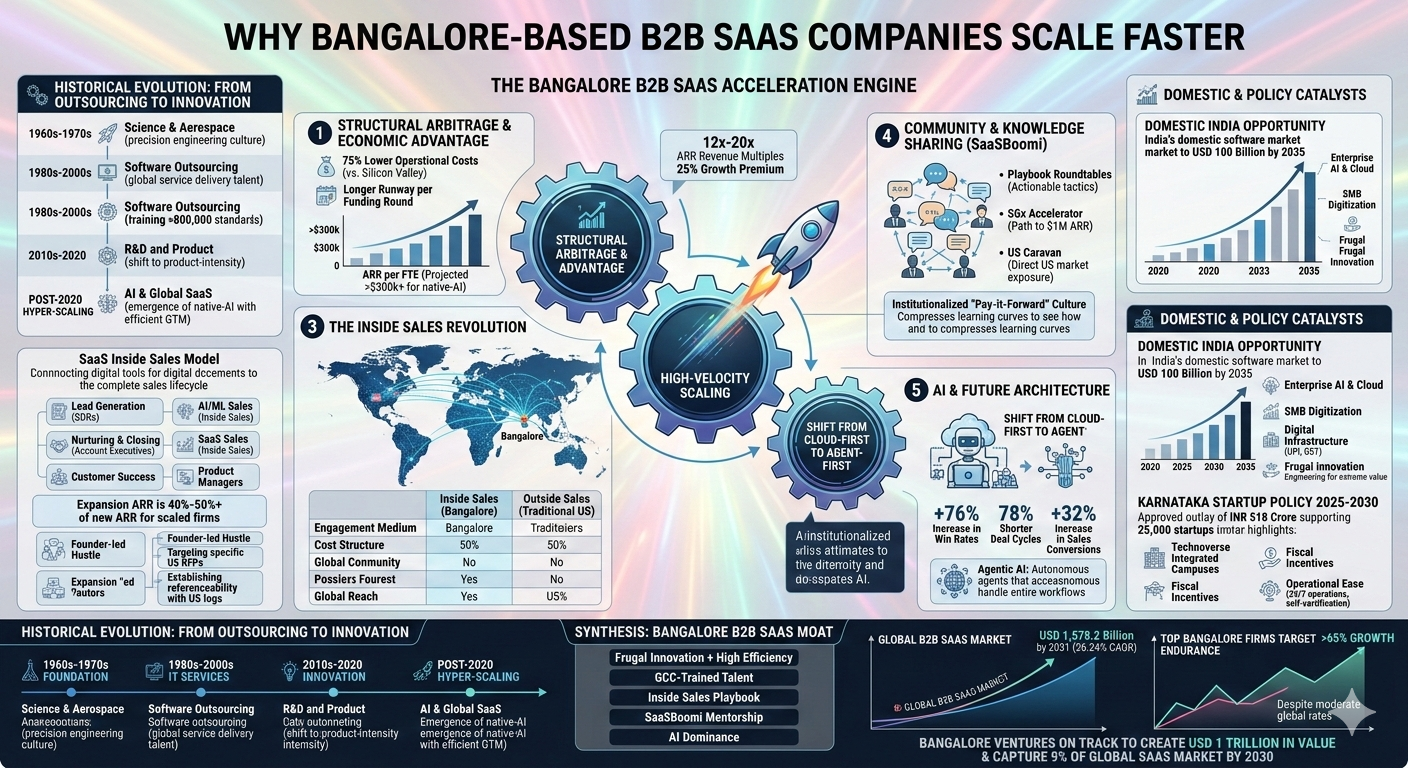
The accelerated scaling of B2B SaaS from Bangalore is a result of a highly integrated "structural advantage." The core of this advantage is not any single factor but the synergy between them:
Frugal Innovation and High Efficiency: The 75% cost advantage combined with a culture of "engineering for extreme value" results in superior unit economics and capital efficiency.
The GCC Effect on Talent: The maturation of GCCs has created a deep reservoir of professionals who understand global product standards, enterprise-grade compliance, and complex system design.
The Inside Sales Playbook: Institutionalized remote acquisition models allow firms to capture global demand without the overhead of field operations, maintaining lower CAC ratios while driving high NRR.
The "Pay-it-Forward" Mentorship: Organizations like SaaSBoomi ensure that scaling tactics and GTM playbooks are treated as "recurring knowledge," shared transparently among peers to elevate the entire industry.
AI Dominance: As the second-largest AI talent hub, Bangalore is at the forefront of the shift from "tools" to "agents," allowing firms to achieve 2x–3x productivity gains compared to legacy SaaS providers.
As global enterprises increasingly embrace "composable architectures" and "best-of-breed" applications communicating via standardized APIs, the flexibility and technical excellence of Bangalore SaaS firms position them as primary beneficiaries of the next phase of digital transformation. The transition from being the "back office of the world" to the "product innovation hub for the world" is now complete, with Bangalore-based ventures on track to create USD 1 trillion in value and capture up to 9% of the global SaaS market by 2030.

Read More -
1. From Idea to MVP: A Step-by-Step Guide for Solo Founder
🔗 https://findnstart.com/blogs/from-idea-to-mvp-a-step-by-step-guide-for-solo-founder
2. How to Validate Your Startup Idea in 48 Hours for $0
🔗 https://findnstart.com/blogs/how-to-validate-your-startup-idea-in-48-hours-for-0
3. Remote vs. Local: Does Your Co-Founder Need to Live in the Same City?
🔗 https://findnstart.com/blogs/remote-vs-local-does-your-co-founder-need-to-live-in-the-same-city
4. The 2026 Startup Landscape: What Has Fundamentally Changed (and Why Founder Skills Matter More Than Ever)
5. The Most In-Demand Skills for Startup Founders in 2026
🔗 https://findnstart.com/blogs/the-most-in-demand-skills-for-startup-founders-in-2026
6. How to Find a Technical Co-Founder (Without a Six-Figure Salary)
🔗 https://findnstart.com/blogs/how-to-find-a-technical-co-founder-without-a-six-figure-salary
7. 5 Red Flags to Look for When Choosing a Startup Partner
🔗 https://findnstart.com/blogs/5-red-flags-to-look-for-when-choosing-a-startup-partner
8. How to Pitch Your Idea to Potential Co-Founders
🔗 https://findnstart.com/blogs/how-to-pitch-your-idea-to-potential-co-founders
9. How to Build a Portfolio that Attracts High-Growth Startup Founders
🔗 https://findnstart.com/blogs/how-to-build-a-portfolio-that-attracts-high-growth-startup-founders
10. Equity vs. Salary: How to Split Ownership with Your First Teammate
🔗 https://findnstart.com/blogs/equity-vs-salary-how-to-split-ownership-with-your-first-teammate
11. Why Joining an Early-Stage Startup is Better Than a Corporate Job
🔗 https://findnstart.com/blogs/why-joining-an-early-stage-startup-is-better-than-a-corporate-job
12. The Future of EdTech: Why Developers and Educators Need to Team Up Now
🔗 https://findnstart.com/blogs/the-future-of-edtech-why-developers-and-educators-need-to-team-up-now
13. The Architecture of Symbiosis: Analytical Perspectives on the Five Habits of Successful Startup Duos
14. Finding a Co-Founder in the AI Space: What Skills Should You Look For?
🔗 https://findnstart.com/blogs/finding-a-co-founder-in-the-ai-space-what-skills-should-you-look-for
15. Overcoming Analysis Paralysis and the Strategic Path to Execution
🔗 https://findnstart.com/blogs/overcoming-analysis-paralysis-and-the-strategic-path-to-execution
16. From College Project to Company: How to Find Your Student Co-Founder
🔗 https://findnstart.com/blogs/from-college-project-to-company-how-to-find-your-student-co-founder
17. How to Start a Startup While Working a Full-Time Job
🔗 https://findnstart.com/blogs/how-to-start-a-startup-while-working-a-full-time-job
18. How to Build a HealthTech Startup Without a Medical Degree
🔗 https://findnstart.com/blogs/how-to-build-a-healthtech-startup-without-a-medical-degree
19. The Solitary Architect: Executive Isolation in Entrepreneurship
20. The 2026 Guide to Launching a SaaS as a Solo Developer
21. What Sustainable Growth Actually Looks Like
🔗 https://findnstart.com/blogs/what-sustainable-growth-actually-looks-like
22. The Early Warning Signs Your Startup Is in Trouble
🔗 https://findnstart.com/blogs/the-early-warning-signs-your-startup-is-in-trouble
23. How to Grow Without Burning Out
🔗 https://findnstart.com/blogs/how-to-grow-without-burning-out
24. The Truth About “Runway” Most Founders Ignore
🔗 https://findnstart.com/blogs/the-truth-about-runway-most-founders-ignore
25. Revenue Solves More Problems Than Funding
🔗 https://findnstart.com/blogs/revenue-solves-more-problems-than-funding
26. What No One Tells You About Being a Solo Founder
🔗 https://findnstart.com/blogs/what-no-one-tells-you-about-being-a-solo-founder
27. Why Smart People Quit High-Paying Jobs to Build Startups (And Why Most Regret It)
28. Why Most Startup Advice on Twitter Is Dangerous
🔗 https://findnstart.com/blogs/why-most-startup-advice-on-twitter-is-dangerous
29. Decision Fatigue: The Silent Startup Killer
🔗 https://findnstart.com/blogs/decision-fatigue-the-silent-startup-killer
30. Fear vs Logic: How Founders Actually Make Decisions
🔗 https://findnstart.com/blogs/fear-vs-logic-how-founders-actually-make-decisions
31. How Overthinking Destroys Early Momentum
🔗 https://findnstart.com/blogs/how-overthinking-destroys-early-momentum
32. Ideas Don’t Scale. Systems Do.
🔗 https://findnstart.com/blogs/ideas-dont-scale-systems-do
33. The First Hire That Actually Matters
🔗 https://findnstart.com/blogs/the-first-hire-that-actually-matters
34. How the First 100 Users Decide Your Startup’s Fate
🔗 https://findnstart.com/blogs/how-the-first-100-users-decide-your-startups-fate
35. Why Your Startup Doesn’t Need Growth — It Needs Focus
🔗 https://findnstart.com/blogs/why-your-startup-doesnt-need-growthit-needs-focus
36. Why Most Startups Die Quietly
🔗 https://findnstart.com/blogs/why-most-startups-die-quietly
37. Lessons Learned Too Late by First-Time Founders
🔗 https://findnstart.com/blogs/lessons-learned-too-late-by-first-time-founders
38. The Myth of the “Overnight Success” Startup
🔗 https://findnstart.com/blogs/the-myth-of-the-overnight-success-startup