Why Raising Pre-Seed in Bangalore Is Harder Than Ever
March 11, 2026 by Harshit Gupta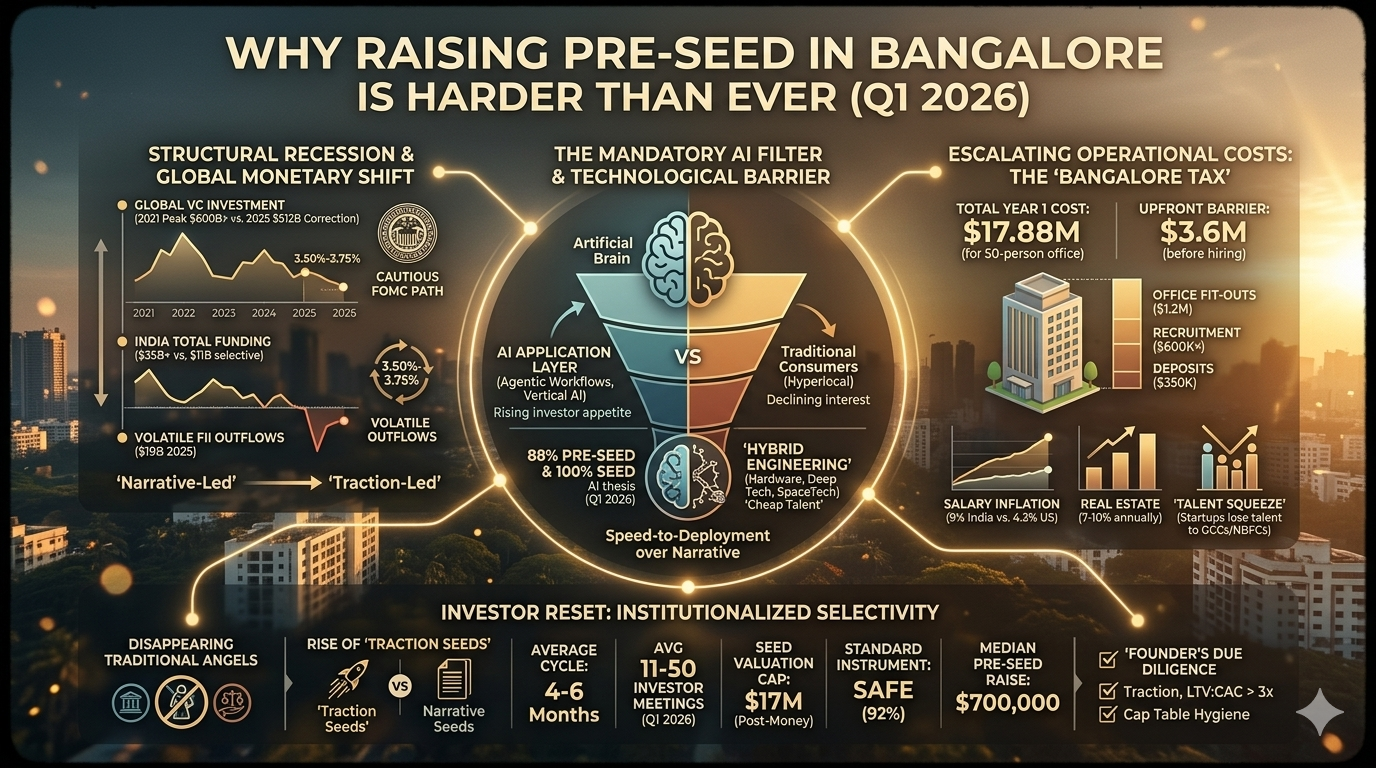
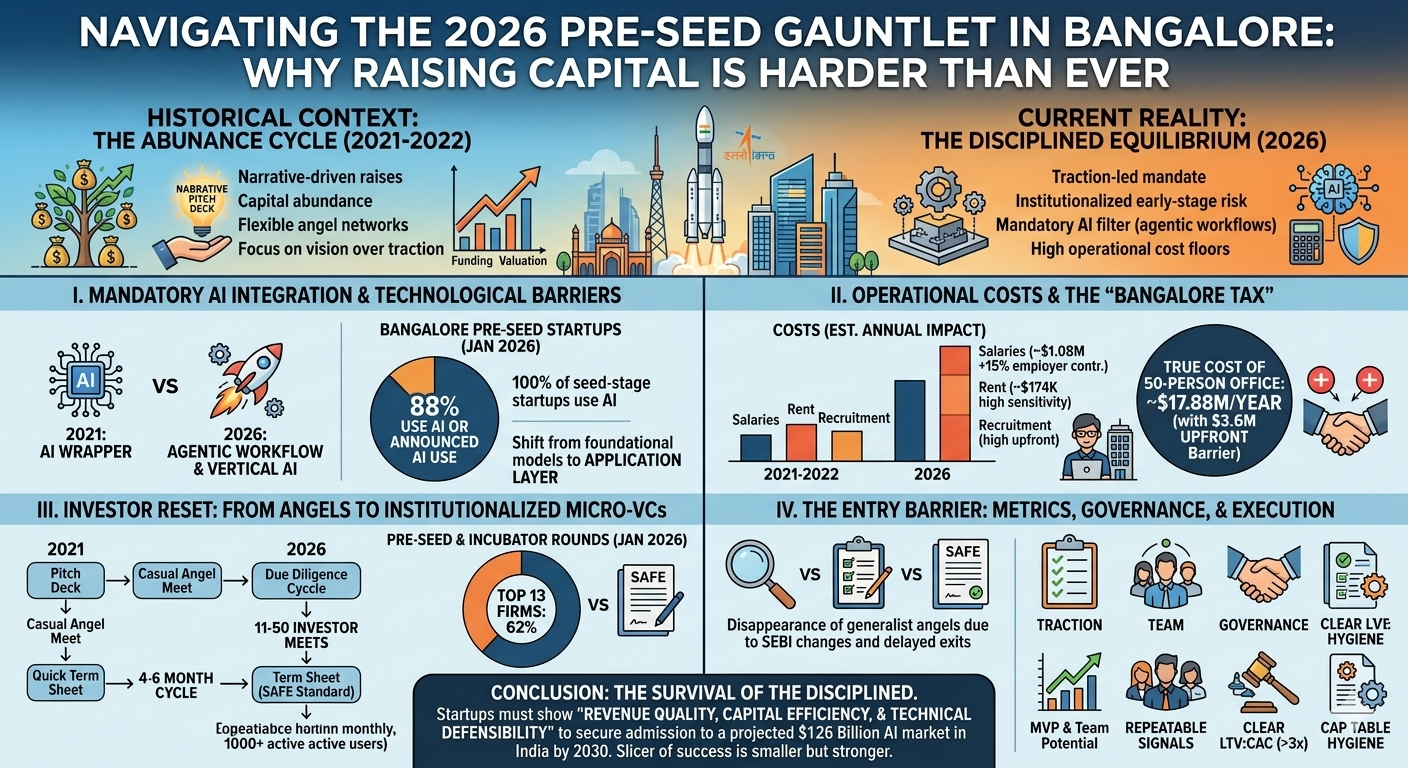
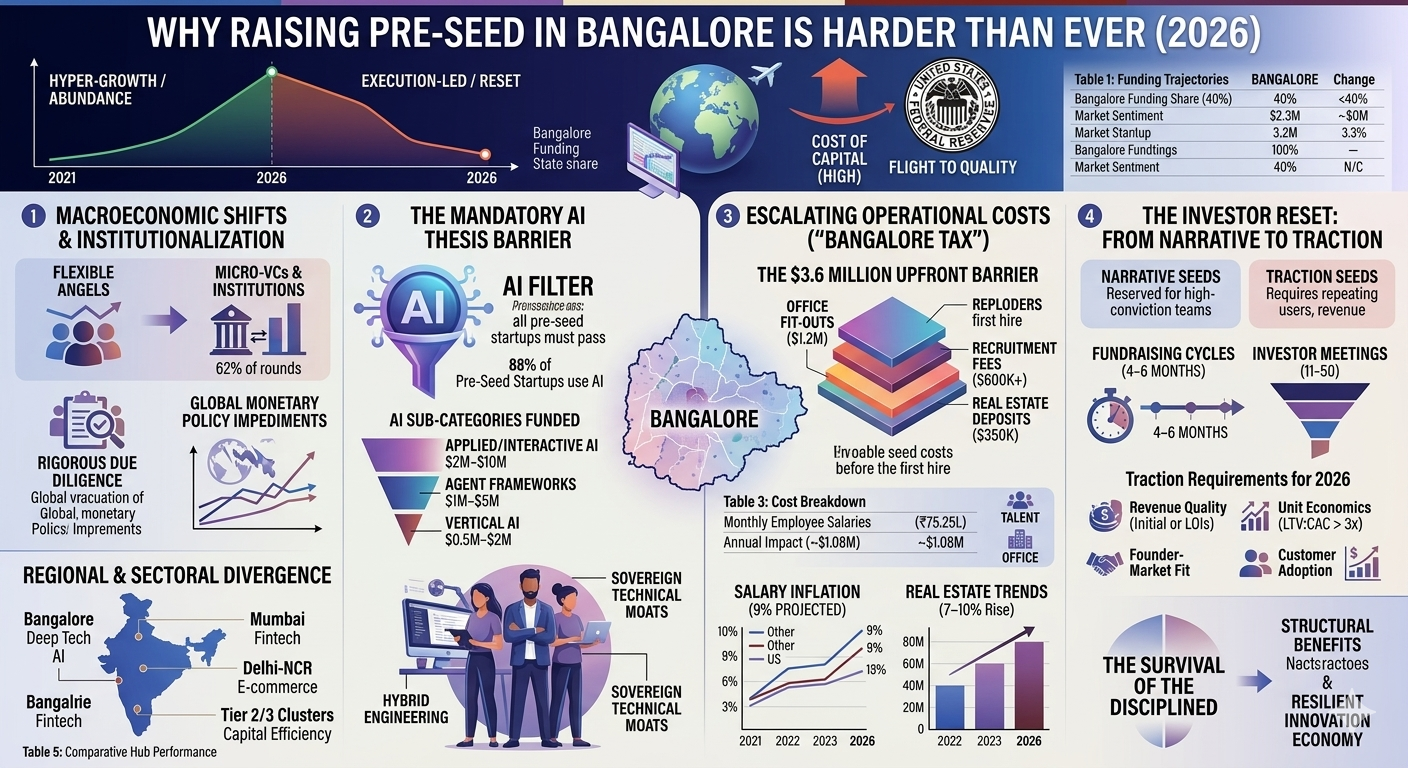
The startup ecosystem in Bangalore, historically the undisputed center of gravity for Indian innovation, has entered a period of profound structural recalibration as of the first quarter of 2026. While the city remains the top-tier destination for venture capital in India—securing approximately 40% of the nation’s total deal value in the first half of 2025—the barriers to entry for pre-seed founders have escalated to unprecedented heights. This phenomenon, characterized by a "disciplined equilibrium," represents a fundamental departure from the capital-abundance cycles of 2021-2022. Founders today navigate an environment where the "narrative-driven" raise has been almost entirely supplanted by a "traction-led" mandate, and where technological prerequisites, specifically artificial intelligence, have become a binary filter for institutional interest. The current difficulty in raising pre-seed capital in Bangalore is not merely a function of a "funding winter," but a reflection of a maturing ecosystem that has institutionalized early-stage risk, elevated operational cost floors, and redefined the archetypes of successful founding teams.
The Macro-Economic Foundations of the 2026 Funding Landscape
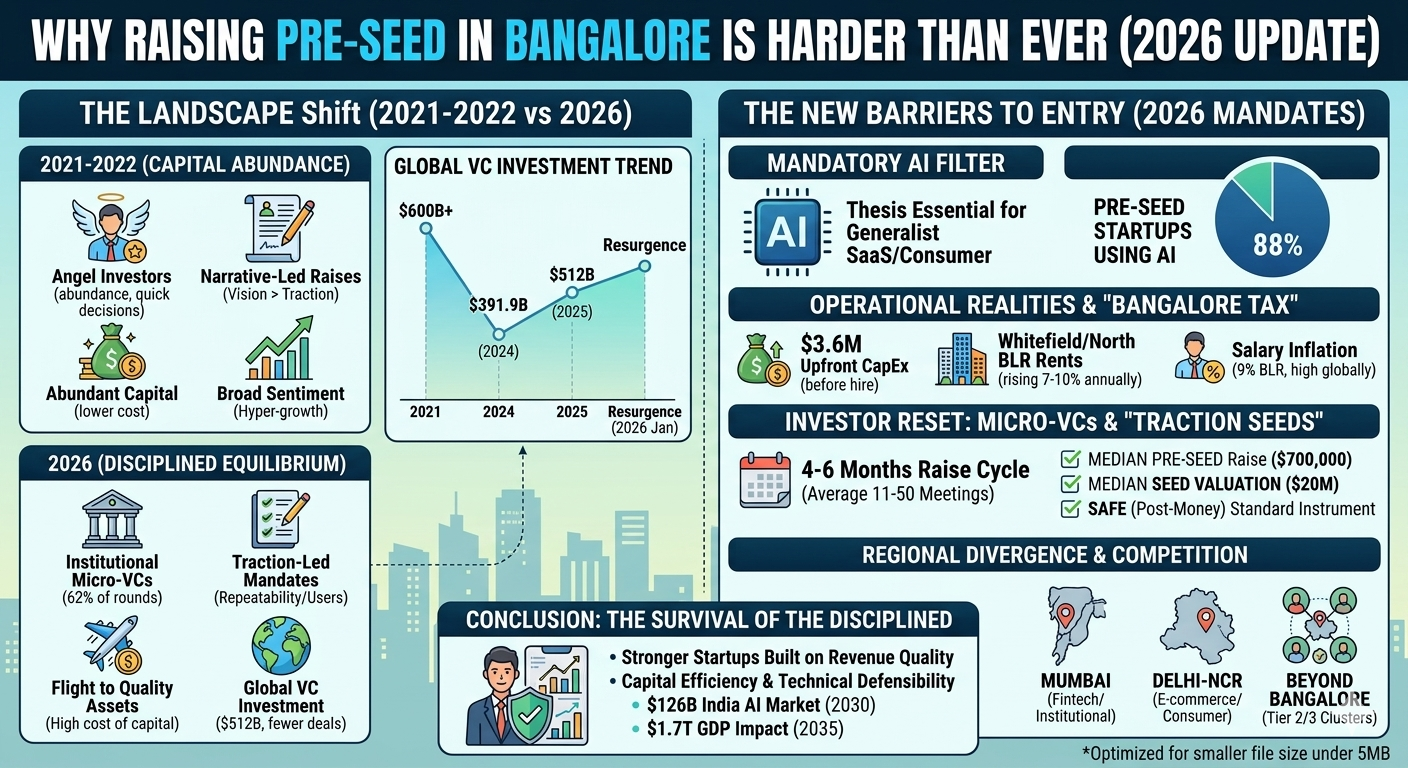
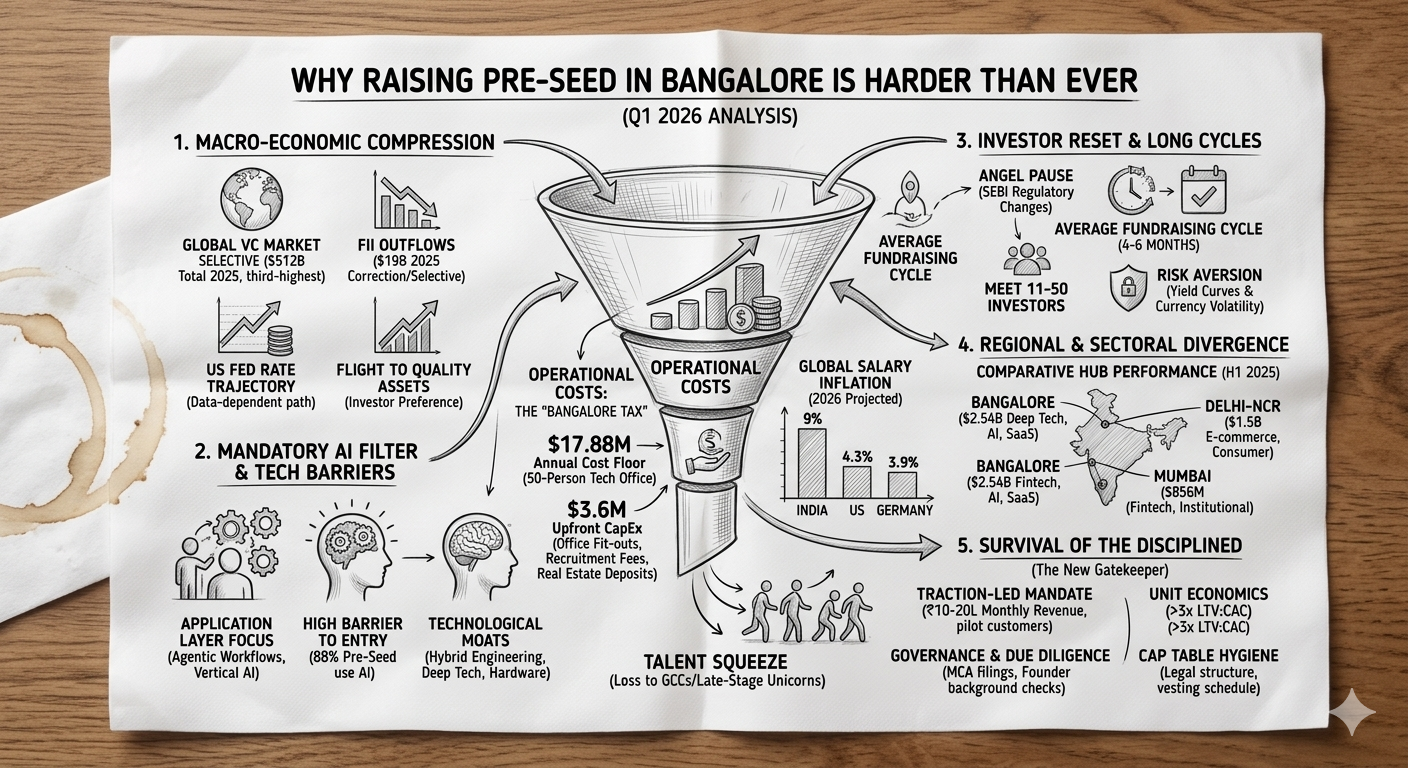
The contemporary difficulty in securing pre-seed funding in Bangalore is inextricably linked to a global shift in monetary policy and liquidity dynamics. As of January 2026, the global venture capital market is emerging from a complicated 2025 where total investment reached $512 billion, the third-highest on record, yet deal counts continued to dwindle. In India, this macro-volatility was mirrored by record foreign institutional investor (FII) outflows of $19 billion in 2025, driven by a broad economic slowdown and geopolitical tensions. Although domestic flows of $63 billion acted as a stabilizing force, the direction of capital movement has fundamentally altered the risk appetite of the primary providers of pre-seed capital.
The U.S. Federal Reserve’s policy trajectory remains the primary driver of global liquidity. After cutting interest rates to a 3.50%–3.75% range in late 2025, the January 2026 FOMC meeting signaled a cautious, data-dependent path forward. For Bangalore-based founders, this means that the "cost of capital" for their potential investors remains high, leading to a preference for "flight to quality" assets over speculative, early-stage bets. Investors are no longer underwriting vision alone; they are managing yield curves and currency volatility that impacts their dollar-denominated returns.
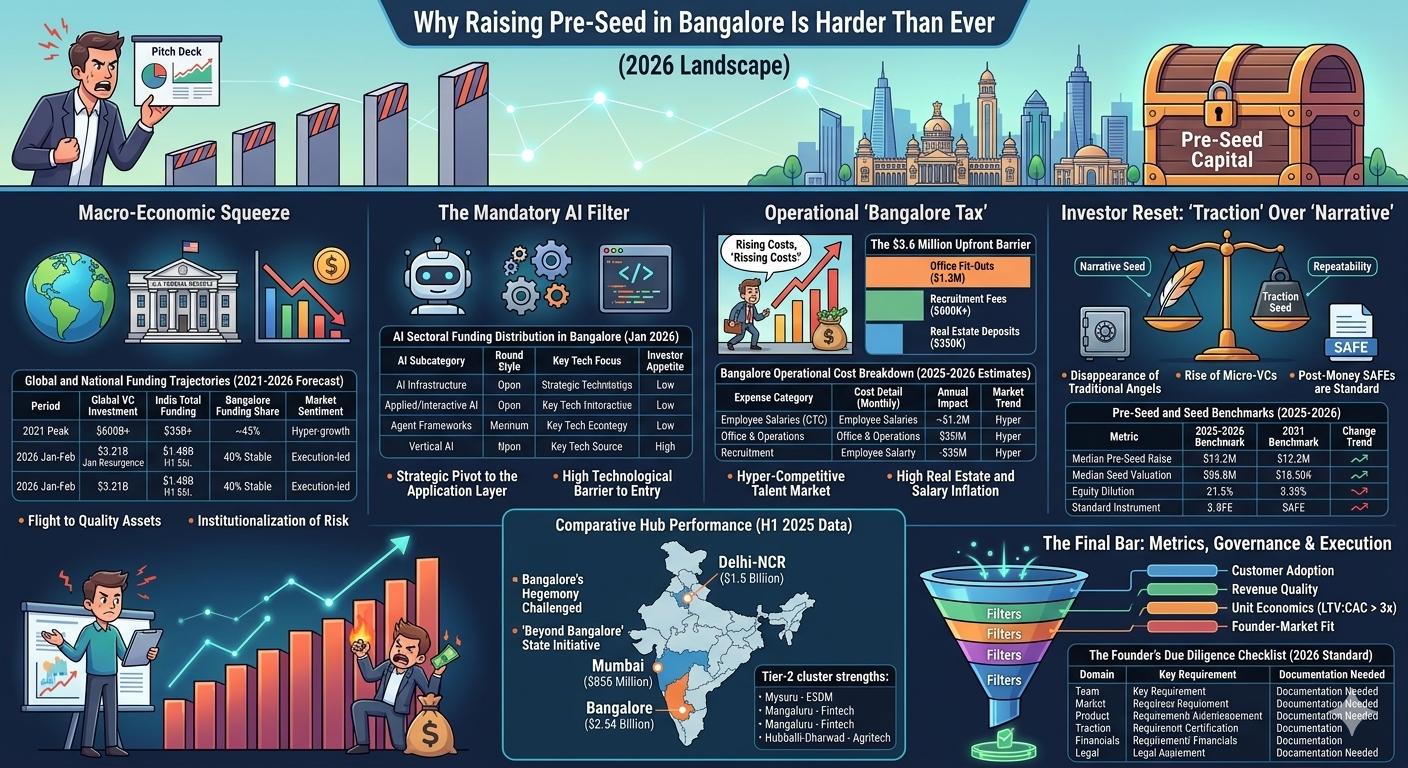
Table 1: Global and National Funding Trajectories (2021-2026 Forecast)
Period | Global VC Investment | India Total Funding | Bangalore Funding Share | Market Sentiment |
2021 (Peak) | $600B+ | $35B+ | ~45% | Hyper-growth / Abundance |
2024 | $391.9B | $12.7B | ~47% | Correction / Selective |
2025 | $512B | $11B | ~40% | Disciplined / AI-Centric |
2026 (Jan-Feb) | $3.21B (Jan Resurgence) | $1.48B (H1 Est.) | 40% (Stable) | Execution-led / Reset |
The result of this macroeconomic backdrop is a "structural compression." Pre-seed rounds, which were once the domain of flexible angel investors and personal networks, have become highly institutionalized. In January 2026, the top 13 venture firms in India backed 62% of all pre-seed and incubator rounds, the highest level of concentration in recent years. This institutionalization means that pre-seed founders are being subjected to the same rigorous due diligence—unit economics, margin structure, and governance—that was historically reserved for Series A or B rounds.
The Mandatory AI Filter and Technological Barriers
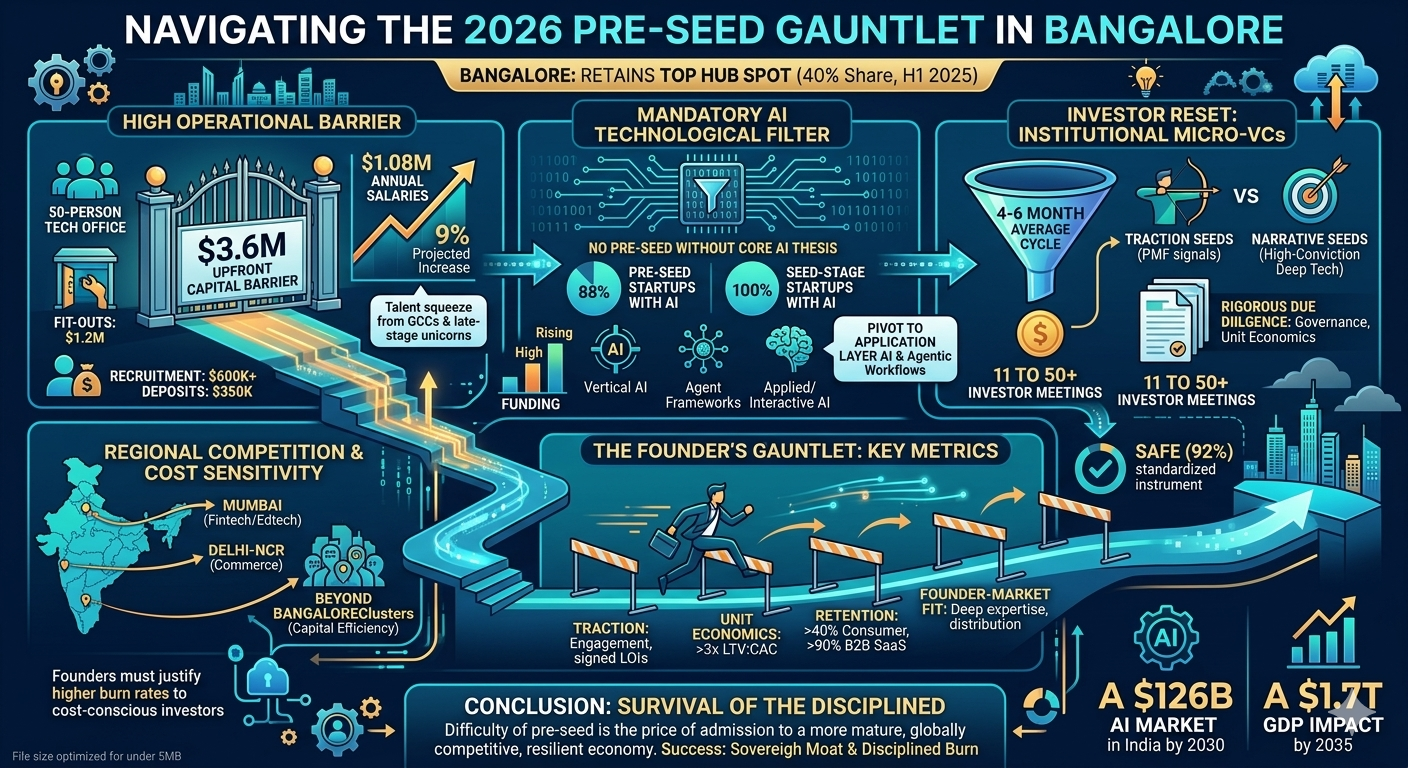
The single most defining feature of the 2026 Bangalore pre-seed market is the mandatory integration of artificial intelligence. It is no longer possible for a generalist software-as-a-service (SaaS) or consumer startup to secure institutional capital without a core AI thesis. As of January 2026, 88% of pre-seed startups and 100% of seed-stage startups in Bangalore either use or have announced the use of AI in their products. This shift has created a high barrier to entry, placing extreme demands on the technical composition of founding teams.
The Pivot to the Application Layer
Bangalore has strategically positioned itself to capture the "Application Layer" of AI, moving away from the resource-heavy competition of foundational models dominated by Western firms. The city is home to 2.5 million technology professionals and ranks #5 globally among AI cities. However, this specialization has made the pre-seed bar harder to clear. Investors are no longer funding "AI wrappers"; they are looking for "agentic workflows" and "vertical AI" solutions that solve complex, real-world industry problems.
The concentration of capital in AI subcategories shows a clear investor bias. In early 2026, sectors like "Applied, Interactive & Research AI" and "AI Development & Agent Frameworks" drew the majority of investor interest. Founders building in traditional categories like consumer internet or hyperlocal delivery now face an uphill battle unless they can demonstrate how AI fundamentally alters their cost structure or user experience.
Table 2: AI Sectoral Funding Distribution in Bangalore (Jan 2026)
AI Subcategory | Round Style | Key Tech Focus | Investor Appetite |
AI Infrastructure | "Round" Style ($100M+ avg) | Data Centers, Hardware | Very High |
Applied/Interactive AI | Early-Stage ($2M - $10M) | Empathetic AI, Research | High |
Agent Frameworks | Seed ($1M - $5M) | Workflow Automation | High |
Vertical AI | Pre-Seed ($0.5M - $2M) | Finance, Health, Logistics | Rising |
This technological shift also demands a return to "hybrid engineering." The software-only era of Bangalore is evolving into a model that includes deep tech and hardware. The city now hosts over 40% of India’s biotechnology companies and has become a global hub for SpaceTech and Semiconductors. For a pre-seed founder, this means that "cheap talent" is no longer a viable competitive advantage; the new game is "speed-to-deployment" and the creation of sovereign technical moats.
Operational Realities: The "Bangalore Tax" and Rising Costs
A critical reason raising pre-seed is harder than ever in Bangalore is the escalating cost of operations. The city’s success has created a hyper-competitive market for talent and real estate, leading to what many in the industry call the "Bangalore tax." For a pre-seed startup, the financial floor required to simply exist has risen dramatically.
The $3.6 Million Upfront Barrier
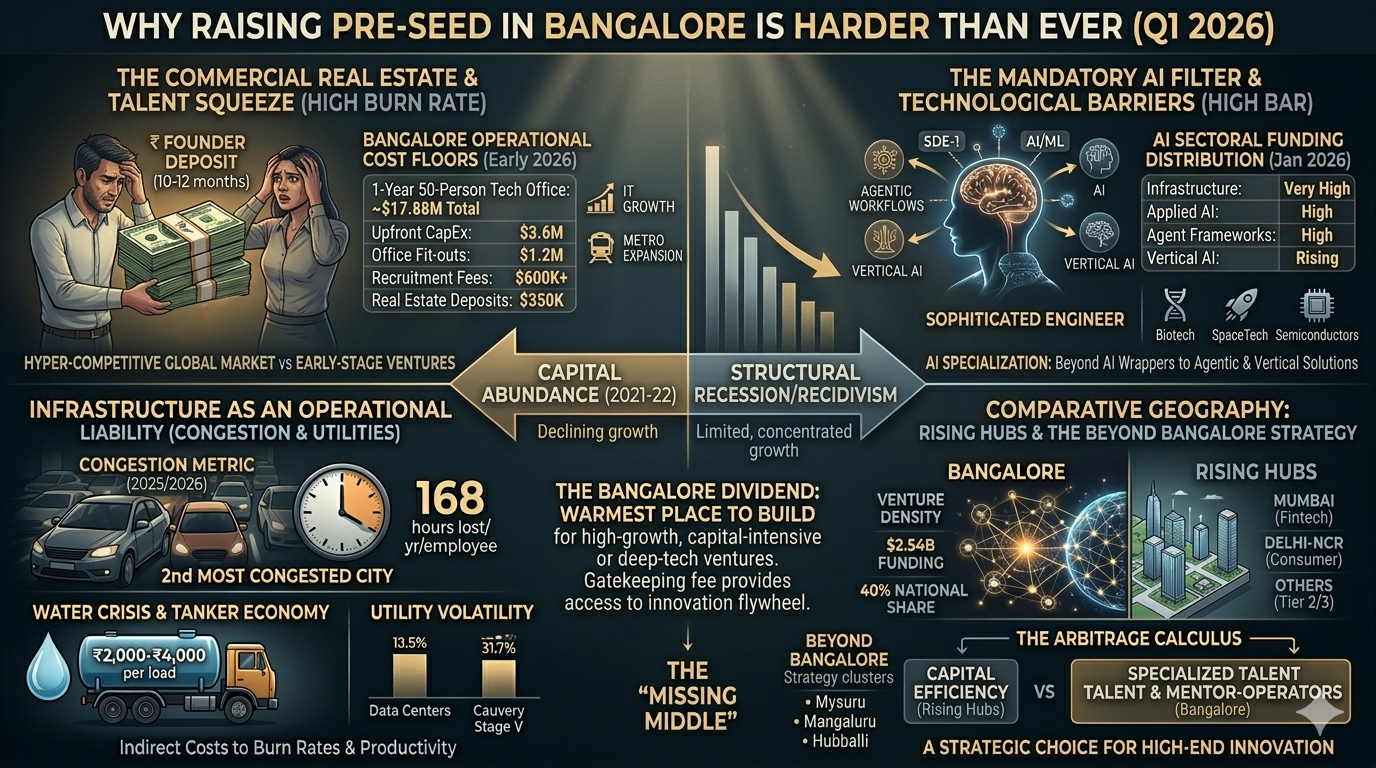
Data from 2025 and early 2026 indicates that the true cost of setting up a 50-person tech office in Bangalore is approximately $17.88 million for the first year, with an upfront capital expenditure (CapEx) barrier of $3.6 million before the first employee is even hired. This includes mandatory office fit-outs ($1.2 million), recruitment agency fees ($600,000+), and real estate deposits ($350,000). While pre-seed startups often operate with much smaller teams, they are forced to compete with Global Capability Centers (GCCs) and late-stage unicorns for the same pool of talent.
Table 3: Bangalore Operational Cost Breakdown (2025-2026 Estimates)
Expense Category | Cost Detail (Monthly) | Annual Impact | Market Trend |
Employee Salaries (CTC) | ₹75.25 Lakhs ($90,600) | ~$1.08M | 9% Projected Increase |
Employer Contributions | 15% on top of CTC | ~$160K | Increasing (SSS/PF) |
Office & Operations | ₹12 Lakhs ($14,500) | ~$174K | High Rent Sensitivity |
Recruitment/Talent Acq. | Variable | High Upfront | Hyper-competitive |
The impact of these costs is two-fold. First, it forces pre-seed founders to raise larger initial rounds to maintain a 12-18 month runway, which in turn leads to greater equity dilution. Second, it makes "seed strapping"—bootstrapping until seed-stage milestones—nearly impossible for founders who do not already have significant personal capital or a high-income background.
Real Estate and Talent Competition
Real estate trends in Bangalore remain strong into 2026, driven by IT growth and infrastructure upgrades like the metro expansion. Prices in tech hubs like Whitefield, Sarjapur Road, and North Bangalore continue to rise at 7–10% annually. For a pre-seed founder, finding affordable "Grade A" office space near talent-rich corridors is a major strategic challenge. Furthermore, salary inflation in India is projected to be among the highest globally at 9% for 2026, outpacing the U.S. (4.3%) and Germany (3.9%). This creates a "talent squeeze" where startups are losing mid-level engineers to traditional financial services firms and NBFCs, which are aggressively investing in tech retention.
The Investor Reset: From Angels to Institutionalized Micro-VCs
The fundraising process itself has undergone a fundamental transformation. The era of "quick, serendipitous closes" based on a pitch deck is over. As of 2026, the average fundraising cycle for a pre-seed round in Bangalore has extended to 4–6 months, requiring founders to meet with an average of 11 to 50 investors before securing a term sheet.
The Disappearance of Traditional Angels
Regulatory changes by SEBI, including higher net-worth thresholds and expanded compliance requirements for angel investors, have materially altered the economics of early-stage investing. Many individuals who previously wrote first checks have paused or stepped away due to delayed exits from 2020-21 vintages and taxation uncertainties. This has left a gap that is being filled by "Micro-VCs"— institutionalized seed funds with smaller check sizes but much higher bars for entry.
The Rise of "Traction Seeds" vs. "Narrative Seeds"
In 2026, investors are evaluating early-stage companies in two distinct buckets. "Traction seeds" are startups showing early repeatability, such as ₹10–20 lakhs in monthly revenue or 1,000+ active users. "Narrative seeds" are reserved for exceptionally high-conviction teams building ambitious infrastructure or deep tech. For the average first-time founder in Bangalore, the "narrative" path is largely closed; they are expected to show product-market fit (PMF) signals—such as 40%+ retention for consumer apps or 90%+ for B2B SaaS—before they can even secure a pre-seed check.
Table 4: Pre-Seed and Seed Benchmarks (2025-2026)
Metric | 2025-2026 Benchmark | 2021 Benchmark (Comparative) | Change Trend |
Median Pre-Seed Raise | $700,000 | $1M - $2M | Correction/Stabilization |
Median Seed Valuation | $20.0 Million | $10M - $15M | Selective Premium |
Equity Dilution | 10% - 15% | 15% - 25% | Lower Dilution, Higher Bar |
Valuation Cap (Post-Money) | $17 Million | $5M - $10M | Rise of "Mega-Pre-Seed" |
Standard Instrument | SAFE (92%) | Convertible Note / Equity | Standardization |
The standardization of the SAFE (Simple Agreement for Future Equity) has simplified the legal process, but it has not made the money easier to get. Post-money SAFEs with valuation caps are now the industry standard, providing downside protection for investors who are increasingly cautious about over-valuation.
Regional and Sectoral Divergence: Bangalore vs. The Rising Hubs
While Bangalore retains its top spot, its hegemony is being challenged by other Indian cities that offer lower cost structures and specialized ecosystems. This inter-city competition is a secondary factor making it harder for Bangalore-based founders to justify their higher burn rates to cost-conscious investors.
The Rise of Mumbai and Delhi-NCR
Mumbai has emerged as a powerhouse for fintech and edtech, leveraging its role as India’s financial nerve center. In some quarters of 2025, Mumbai’s total funding actually exceeded Bangalore’s, driven by its proximity to institutional capital and regulators. Delhi-NCR, meanwhile, has become the preferred destination for mass-market commerce and brand-driven growth, thanks to its superior distribution networks.
Table 5: Comparative Hub Performance (H1 2025 Data)
Hub | Total Funding | Deal Count | National Share | Primary Strength |
Bangalore | $2.54 Billion | 143 | 40% | Deep Tech, AI, SaaS |
Delhi-NCR | $1.5 Billion | 116 | 23.6% | E-commerce, Consumer |
Mumbai | $856 Million | 80 | 13.5% | Fintech, Institutional |
Others (Tier 2/3) | ~$800 Million | Variable | 7% | Capital Efficiency |
The "Beyond Bangalore" Strategy
The Karnataka state government has responded to these pressures by seeding innovation clusters in Tier-2 and Tier-3 cities through the "Beyond Bangalore" initiative. Clusters in Mysuru (ESDM and Cybersecurity), Mangaluru (Fintech), and Hubballi-Dharwad (Agritech) are attracting startups that want to leverage Bangalore’s talent pool while avoiding its exorbitant operational costs. For a pre-seed founder in Bangalore, this means they must now provide a compelling reason why they need to be in the high-cost capital rather than a more efficient regional cluster.
The Bar for Entry: Metrics, Governance, and Execution
For the 2026 pre-seed founder in Bangalore, the bar for entry has shifted from "potential" to "execution." Investors are no longer just betting on the horse; they are scrutinizing the track, the jockey, and the previous lap times.
Traction Requirements for 2026
At the pre-seed stage, "traction" has a new definition. It is no longer about raw user numbers, but about the quality of engagement and the defensibility of the business model. Founders are expected to demonstrate:
Customer Adoption: Early engagement metrics that prove the market cares.
Revenue Quality: Initial revenue or signed LOIs from credible partners.
Unit Economics: A clear path to profitability, with an LTV:CAC ratio exceeding 3x.
Founder-Market Fit: Deep industry expertise or unique access to distribution channels.
Governance and Due Diligence
Post-2024, the Indian venture ecosystem has seen a "governance reset." Investors are conducting deeper background checks on founders and directors, often using MCA filings and director history as a screen. Issues like frequent founder conflicts or unclear roles are immediate red flags. Founders must now have a solid legal structure and "cap table hygiene" before they even begin their first outreach.
Table 6: The Founder’s Due Diligence Checklist (2026 Standard)
Domain | Key Requirement | Documentation Needed |
Team | Technical/Product/GTM balance | Resume, track record, IC process |
Market | TAM justification (> ₹1,000 Cr) | Market analysis, TAM/SAM/SOM |
Product | MVP with AI integration | Technical audit, IP assignments |
Traction | Retention > 40%, pilot customers | Revenue data, LOIs, engagement |
Financials | 12-18 month runway plan | Fund math, unit economics model |
Legal | C-Corp or similar entity | Founders' agreement, vesting schedule |
Conclusion: The Survival of the Disciplined
The reality of raising pre-seed capital in Bangalore in 2026 is one of structural compression and extreme selectivity. The city remains a premier global hub, ranking alongside Paris and Seattle, but the "entry ticket" to this ecosystem has become significantly more expensive. The convergence of high operational costs, a mandatory AI technological filter, and a shift toward institutionalized micro-VCs has created a "missing middle"—a gap where high-potential but early-stage ideas struggle to find the "blind faith" capital that was once abundant.
However, this reset is not without its benefits. The startups that do successfully navigate the 2026 pre-seed gauntlet are fundamentally stronger than their predecessors. They are built on a foundation of revenue quality, capital efficiency, and technical defensibility. For these disciplined founders, the rewards are structural: a projected $126 billion AI market in India by 2030 and a $1.7 trillion GDP impact by 2035. The difficulty of raising pre-seed in Bangalore today is the price of admission to a more mature, globally competitive, and ultimately more resilient innovation economy. Success in 2026 is no longer about the "slick deck," but about the "sovereign moat" and the "disciplined burn".

Read More -
1. From Idea to MVP: A Step-by-Step Guide for Solo Founder
🔗 https://findnstart.com/blogs/from-idea-to-mvp-a-step-by-step-guide-for-solo-founder
2. How to Validate Your Startup Idea in 48 Hours for $0
🔗 https://findnstart.com/blogs/how-to-validate-your-startup-idea-in-48-hours-for-0
3. Remote vs. Local: Does Your Co-Founder Need to Live in the Same City?
🔗 https://findnstart.com/blogs/remote-vs-local-does-your-co-founder-need-to-live-in-the-same-city
4. The 2026 Startup Landscape: What Has Fundamentally Changed (and Why Founder Skills Matter More Than Ever)
5. The Most In-Demand Skills for Startup Founders in 2026
🔗 https://findnstart.com/blogs/the-most-in-demand-skills-for-startup-founders-in-2026
6. How to Find a Technical Co-Founder (Without a Six-Figure Salary)
🔗 https://findnstart.com/blogs/how-to-find-a-technical-co-founder-without-a-six-figure-salary
7. 5 Red Flags to Look for When Choosing a Startup Partner
🔗 https://findnstart.com/blogs/5-red-flags-to-look-for-when-choosing-a-startup-partner
8. How to Pitch Your Idea to Potential Co-Founders
🔗 https://findnstart.com/blogs/how-to-pitch-your-idea-to-potential-co-founders
9. How to Build a Portfolio that Attracts High-Growth Startup Founders
🔗 https://findnstart.com/blogs/how-to-build-a-portfolio-that-attracts-high-growth-startup-founders
10. Equity vs. Salary: How to Split Ownership with Your First Teammate
🔗 https://findnstart.com/blogs/equity-vs-salary-how-to-split-ownership-with-your-first-teammate
11. Why Joining an Early-Stage Startup is Better Than a Corporate Job
🔗 https://findnstart.com/blogs/why-joining-an-early-stage-startup-is-better-than-a-corporate-job
12. The Future of EdTech: Why Developers and Educators Need to Team Up Now
🔗 https://findnstart.com/blogs/the-future-of-edtech-why-developers-and-educators-need-to-team-up-now
13. The Architecture of Symbiosis: Analytical Perspectives on the Five Habits of Successful Startup Duos
14. Finding a Co-Founder in the AI Space: What Skills Should You Look For?
🔗 https://findnstart.com/blogs/finding-a-co-founder-in-the-ai-space-what-skills-should-you-look-for
15. Overcoming Analysis Paralysis and the Strategic Path to Execution
🔗 https://findnstart.com/blogs/overcoming-analysis-paralysis-and-the-strategic-path-to-execution
16. From College Project to Company: How to Find Your Student Co-Founder
🔗 https://findnstart.com/blogs/from-college-project-to-company-how-to-find-your-student-co-founder
17. How to Start a Startup While Working a Full-Time Job
🔗 https://findnstart.com/blogs/how-to-start-a-startup-while-working-a-full-time-job
18. How to Build a HealthTech Startup Without a Medical Degree
🔗 https://findnstart.com/blogs/how-to-build-a-healthtech-startup-without-a-medical-degree
19. The Solitary Architect: Executive Isolation in Entrepreneurship
20. The 2026 Guide to Launching a SaaS as a Solo Developer
21. What Sustainable Growth Actually Looks Like
🔗 https://findnstart.com/blogs/what-sustainable-growth-actually-looks-like
22. The Early Warning Signs Your Startup Is in Trouble
🔗 https://findnstart.com/blogs/the-early-warning-signs-your-startup-is-in-trouble
23. How to Grow Without Burning Out
🔗 https://findnstart.com/blogs/how-to-grow-without-burning-out
24. The Truth About “Runway” Most Founders Ignore
🔗 https://findnstart.com/blogs/the-truth-about-runway-most-founders-ignore
25. Revenue Solves More Problems Than Funding
🔗 https://findnstart.com/blogs/revenue-solves-more-problems-than-funding
26. What No One Tells You About Being a Solo Founder
🔗 https://findnstart.com/blogs/what-no-one-tells-you-about-being-a-solo-founder
27. Why Smart People Quit High-Paying Jobs to Build Startups (And Why Most Regret It)
28. Why Most Startup Advice on Twitter Is Dangerous
🔗 https://findnstart.com/blogs/why-most-startup-advice-on-twitter-is-dangerous
29. Decision Fatigue: The Silent Startup Killer
🔗 https://findnstart.com/blogs/decision-fatigue-the-silent-startup-killer
30. Fear vs Logic: How Founders Actually Make Decisions
🔗 https://findnstart.com/blogs/fear-vs-logic-how-founders-actually-make-decisions
31. How Overthinking Destroys Early Momentum
🔗 https://findnstart.com/blogs/how-overthinking-destroys-early-momentum
32. Ideas Don’t Scale. Systems Do.
🔗 https://findnstart.com/blogs/ideas-dont-scale-systems-do
33. The First Hire That Actually Matters
🔗 https://findnstart.com/blogs/the-first-hire-that-actually-matters
34. How the First 100 Users Decide Your Startup’s Fate
🔗 https://findnstart.com/blogs/how-the-first-100-users-decide-your-startups-fate
35. Why Your Startup Doesn’t Need Growth — It Needs Focus
🔗 https://findnstart.com/blogs/why-your-startup-doesnt-need-growthit-needs-focus
36. Why Most Startups Die Quietly
🔗 https://findnstart.com/blogs/why-most-startups-die-quietly
37. Lessons Learned Too Late by First-Time Founders
🔗 https://findnstart.com/blogs/lessons-learned-too-late-by-first-time-founders
38. The Myth of the “Overnight Success” Startup
🔗 https://findnstart.com/blogs/the-myth-of-the-overnight-success-startup
Want to calculate the equity for your cofounder?
Nail your cap table before you sign. Whether you're splitting equity with a co-founder or planning your next funding round, our Equity Calculator gives you precision in seconds
Equity calculator →