Ideas Don’t Scale. Systems Do.
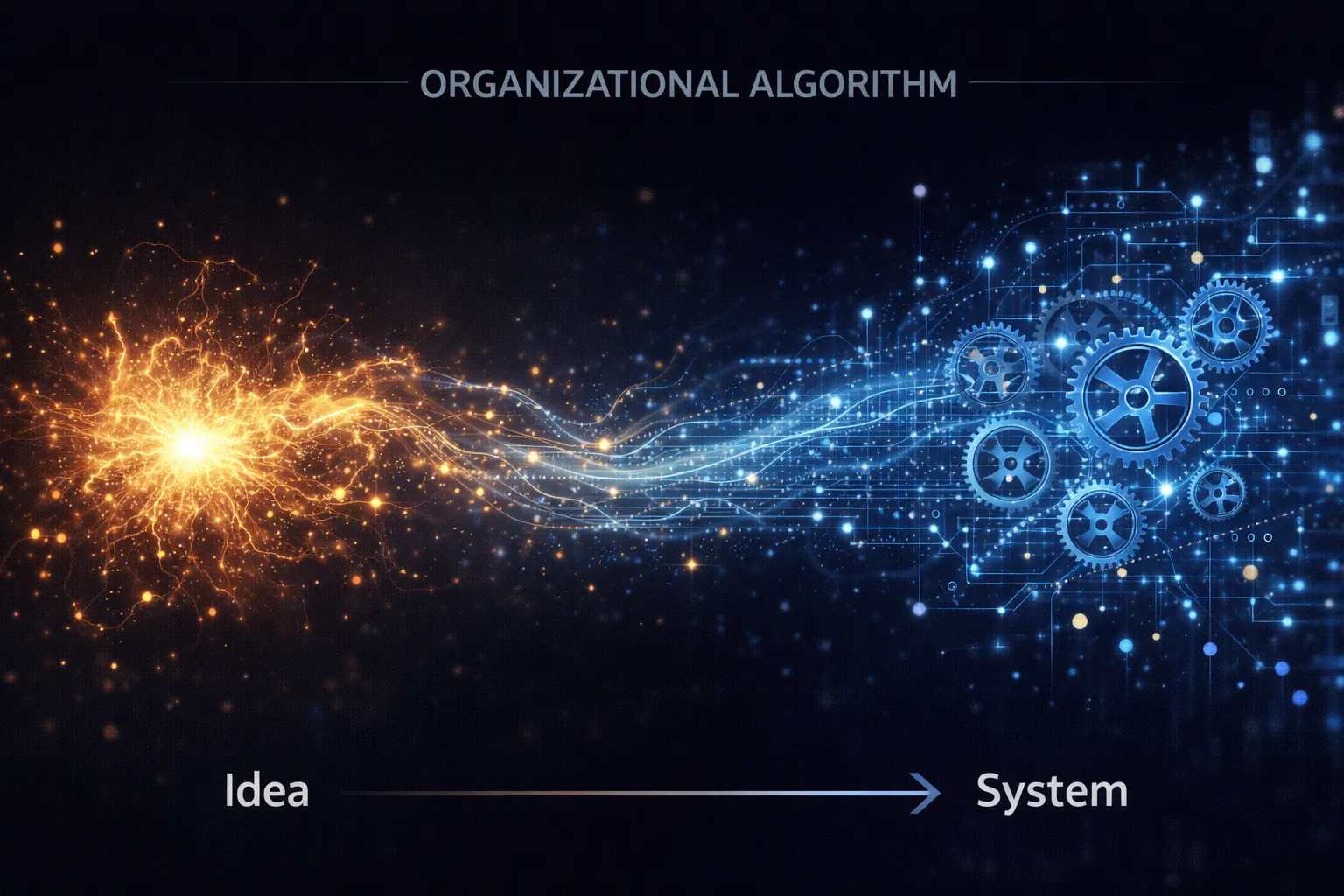
February 12, 2026 by Harshit GuptaThe history of commerce is frequently romanticized as a series of "Eureka" moments—singular flashes of individual brilliance that transform markets overnight. However, an exhaustive analysis of organizational longevity and rapid growth trajectories reveals a more clinical reality: while ideas serve as the initial catalyst for a venture, they possess no inherent capacity for expansion. The spark of an idea is a volatile, non-repeatable event, often bound to the cognitive limits and physical presence of its originator. In contrast, systems represent the engineered environment designed for the predictable multiplication of value. The prevailing wisdom among elite business architects suggests that an organization is not a collection of people chasing an idea, but a living algorithm—a network of micro-decisions and repeatable processes that transform clarity into precision.
The Ontology of the Systemic Shift: From Inspiration to Infrastructure
The fundamental barrier to scaling a business is the founder’s own "intensity." Many leaders operate within a "visible game" characterized by profit, image, and market presence, yet they remain oblivious to the "invisible game" of discipline, decision-making logic, and time management. In the early stages of a venture, the founder’s hustle acts as a glue, holding together disparate functions through sheer force of will. This reliance on individual effort creates a fragile structure that eventually reaches a "systemic growth ceiling". At this juncture, the leader’s inability to transition from managing operations to architecting the future becomes a bottleneck. The failure to scale is, therefore, often a failure to de-personalize the organization’s core logic.
A system, in its most refined state, is a mechanism for the "disciplined subtraction" of noise. It removes the need for constant supervision by turning behaviors into instincts. When a leader scales their own confusion, it eventually becomes the company culture, leading to a state where effort is high but effectiveness is low. Scaling elegantly requires a shift from motivation—which makes an organization faster—to clarity, which makes it effective. This transition is marked by the installation of reflection into the organizational rhythm, ensuring that the leader’s mental rhythm becomes the "code" that governs collective behavior.
Dimension of Growth | Idea-Centric Model (Startup) | System-Centric Model (Scaleup) |
Primary Resource | Individual brilliance and "hustle" | Repeatable processes and logic |
Primary Limitation | Founder’s cognitive and physical bandwidth | Robustness of the process architecture |
Nature of Growth | Chaotic, reactive, and personality-dependent | Predictable, proactive, and independent |
Role of Technology | Ad-hoc tools to fix immediate problems | Extension of core logic and consciousness |
Cultural Driver | Founder’s personality and ad-hoc reactions | Explicitly defined values and rituals |
Decision Logic | Centralized and often intuitive | Decentralized and data-driven |
The Startup Paradox: The Strategic Value of Unscalable Manualism
A nuanced understanding of systemic growth requires acknowledging the necessity of "doing things that don’t scale" during the exploratory phase of a business. This concept, popularized in elite entrepreneurial circles, posits that the manual, labor-intensive tasks performed in a startup's infancy are not inefficiencies, but essential research for future system design. By engaging in direct sales, personal customer service, and manual product fulfillment, founders gain a granular understanding of customer pain points that cannot be captured by automated data sets.
For instance, the founders of Seamless personally took lunch orders and oversaw deliveries in their early days to understand the logistics of the New York restaurant market. Similarly, the founders of Diapers.com bought products at retail price from Costco to validate demand before investing in a complex supply chain. These manual efforts establish a high-fidelity feedback loop, allowing for rapid iteration and the refinement of a product-market fit. Once the model is validated through these "unscalable" activities, the manual labor provides the logical blueprint for the automated systems that will replace it. Automation, when applied prematurely to a messy or unvalidated process, only serves to multiply confusion; however, when applied to a refined manual logic, it acts as a powerful amplifier of efficiency.
The Six S Framework and the Mechanics of Organizational Leverage
To move from an entrepreneurial stage to a sophisticated scaleup, organizations must align across six critical pillars, often referred to as the Six S framework. This alignment ensures that the organization can execute and grow without collapsing under its own weight.
The Human Element: Staff and Shared Values
Scaling is impossible without a team of "A+ players" who are significantly more productive than the average employee. According to McKinsey research, high performers are 400 percent more productive than average staff, and this figure jumps to 800 percent in roles of high complexity. These individuals do not just perform tasks; they propagate the organization’s values. Culture, therefore, must transition from an implicit reflection of the founder’s personality to an explicit "shared organizational fabric". This involves moving from describing desired "outputs" (e.g., "we want a creative culture") to defining specific "inputs" or actions that leaders can take to deliver on that culture.
Structure and Strategic Speed
As a company scales, its structure must evolve to increase the number of decision-makers. The founder cannot remain the final arbiter for every deal or delivery. This requires recruiting seasoned leaders with specialized skill sets and creating a culture where failure is viewed as an essential component of invention. Speed in this context is not just about moving fast, but about the velocity of the learning cycle. Organizations that scale effectively prioritize long-term structures over short-term wins, a strategy that has been shown to outperform short-term-focused companies on key metrics like market capitalization and value creation.
Pillar | Strategic Focus | Operational Implication |
Staff | Talent density and "A+" hiring | Hiring for values and high-complexity productivity |
Shared Values | Culture as an explicit "code" | De-personalizing founder-centric mantras |
Structure | Decentralized decision-making | Empowering mid-level leaders and specialists |
Speed | Iteration and "fail early" logic | Maintaining agility as volume increases |
Scope | Defining products and customers | Avoiding "scaling confusion" in the model |
Series X | Financial and resource sustainability | Securing capital for rapid expansion phases |
The Entrepreneurial Operating System (EOS) as a Scalable Engine
For many small to mid-market enterprises, the Entrepreneurial Operating System (EOS) provides a structured methodology to move beyond the limitations of founder-led hustle. EOS is predicated on the idea that every company is composed of six key components: Vision, People, Data, Issues, Process, and Traction.
Vision and the People Component
The Vision component ensures that every member of the organization is aligned on the company’s direction. This is complemented by the People component, which uses the "People Analyzer" to verify that individuals are in the "Right Seats". A "Right Seat" is occupied by someone who understands the role (Get it), desires to do the work (Want it), and has the ability to perform at the required level (Capacity). This rigor prevents the "team-dependency" bottleneck where the business relies on individuals who may not be suited for their evolving roles.
Data, Issues, and the Traction Rhythm
Systems scale through the replacement of opinions with objective data. EOS utilizes a "Scorecard" of weekly metrics to provide a real-time pulse of performance. When problems arise, the "Issues" component mandates a culture of transparency through the IDS (Identify, Discuss, Solve) method, which prioritizes solving the root cause of an issue rather than merely addressing its symptoms. Finally, the "Traction" component instills discipline through a regular "Meeting Pulse," such as the Level 10 Meeting, and the setting of "Rocks"—specific 90-day priorities that move the company toward its annual goals.
Technical Systems and the Science of Process Optimization
While EOS manages the "human energy" of an organization, technical frameworks like Lean and Six Sigma focus on the mechanical efficiency of its processes.
Lean Methodology: The Elimination of Waste
Lean thinking, rooted in the Toyota Production System, defines waste as any process or activity that does not add value to the customer. In a scaling business, waste often takes the form of overproduction, excessive inventory, or unnecessary waiting times. Lean centers on "smooth motions," scrubbing away "inefficient footling" and streamlining methods to ensure a continuous flow of value. It is a mindset of continuous improvement (Kaizen) that is particularly effective in flatter, more autonomous organizational structures like those found in modern software development.
Six Sigma: The Reduction of Variability
In contrast to Lean’s focus on speed and waste, Six Sigma is a data-driven program aimed at reducing variability and eliminating defects. It follows a highly structured hierarchy—including Black Belts and Green Belts—and employs the DMAIC (Define, Measure, Analyze, Improve, Control) methodology to ensure that processes encounter fewer errors. Six Sigma is essential for complex environments where even minor deviations in quality can lead to catastrophic failures. Many high-performing organizations now combine these methodologies into "Lean Six Sigma," leveraging the strengths of both to achieve high-velocity, high-quality growth.
Methodology | Primary Goal | Focus Area | Approach |
Lean | Maximize Value | Speed and Flow | Waste elimination (Kaizen) |
Six Sigma | Minimize Defects | Quality and Consistency | Variability reduction (DMAIC) |
EOS | Align Human Energy | Culture and Execution | Six Key Components / Traction |
OKRs | Goal Alignment | Outcome and Ambition | Objective setting and Key Results |
Case Study in Systemic Disruption: Zerodha’s Tech-Centric Scaling
The ascent of the Indian stockbroking firm Zerodha illustrates the power of a digital-first system to disrupt an industry characterized by legacy complexity and high fees. Zerodha’s success was built not on an idea—discount broking was already an established concept globally—but on the superior engineering of its operational stack.
Operational Efficiency through Automation
Zerodha identified that traditional brokers were hindered by physical branches, manual paperwork, and outdated platforms that crashed during high-volume sessions. To scale, they rebuilt the entire stockbroking experience from the ground up:
Account Opening: By implementing a fully digital onboarding process using Smartphone verification and document automation, they reduced account opening time from weeks to minutes.
Vision AI: The integration of Google Vision AI for real-time PAN card validation eliminated 80% of manual intervention in the application process.
Infrastructure silo architecture: They pioneered an architecture where independent physical racks and software setups (OMS installations) act as "silos," ensuring that a failure in one does not compromise the entire system—a design that has since become an industry standard.
Performance Gains via Technical Refinement
As Zerodha scaled from 2 million to 14 million clients between 2020 and 2024, they systematically upgraded their backend technologies to maintain stability. This involved replacing traditional databases with high-performance alternatives and rebuilding core processes to leverage parallel processing.
Process / Technology Upgrade | Previous Performance | New Performance | Improvement Gain |
PnL Calculation (AWS Batch) | 7 Hours | 20-30 Minutes | ~1500% |
Contract Note Generation (Typst/Nomad) | 8 Hours | 25 Minutes | ~1800% |
Client Balance Generation (ClickHouse) | 1 Hour | 5 Minutes | ~1100% |
Margin Statement Generation | 6 Hours | 30 Minutes | ~1100% |
Data Storage (Postgres to ClickHouse) | 20 TB | 4 TB | 80% reduction |
Candlestick Processing (ClickHouse) | 1 TB disk | 120 GB disk | 90% reduction |
This technical rigor allowed Zerodha to handle daily trading volumes exceeding ₹3 lakh crores with a remarkably small tech team. Their commitment to "technology as a core strength" meant they could focus on building digital solutions for customers rather than managing mail servers or manual backend tasks.
The Platform Paradigm: Zoho Corporation and the Integration Strategy
Zoho Corporation provides a parallel example of systemic scaling within the global SaaS market. Their growth strategy is defined by a shift from individual business applications to an integrated, "platform-centric" model.
The Unified Data Model
One of the primary friction points in a growing business is data fragmentation—leads in the CRM, invoices in the accounting software, and tickets in the support tool. Zoho’s system addresses this by using a "unified data model" where common customer, product, and transaction records flow automatically across more than 55 applications. This integration ensures that "productivity beats size," as information moves between systems without the need for manual data entry or human handovers.
AI-First Strategy and Decentralized Innovation
Zoho has embedded AI capabilities, through its Zia engine, across its entire product suite to power "vertical-specific automation". This AI integration allows even small businesses to leverage sophisticated data insights and market trend analysis. Furthermore, Zoho’s organizational design is uniquely decentralized, with offices in Tier 2 and Tier 3 cities (e.g., Tenkasi and Renigunta in India) to support regional ecosystems and access untapped talent pools. This "decentralized execution model" aligns with the need for organizations to adapt to global market trends while maintaining geographic flexibility.
The Transition in Legacy Organizations: Professionalizing Family Businesses
In India, the philosophy of "systems over ideas" faces its sternest test in the transition of family-run enterprises. These businesses often start with a "personality-driven" model where the founder’s values and instincts govern all operations. However, to achieve long-term survival beyond the third generation, these firms must "professionalize"—a process involving the transformation from entrepreneurial management to sophisticated professional management.
Moving Beyond Paternalism
Professionalization requires a separation of ownership and operational control. In a paternalistic culture, control systems are informal and based on trust; in a professionalized system, these are replaced by "formal strategic planning and control mechanisms". Marquee Indian firms like Dabur, Mahindra, and Marico have successfully pivoted by appointing non-family CEOs, a move that reimagines succession not as a rejection of legacy, but as a "journey of capability mapping and cultural alignment".
Transition Barrier | Traditional Family Approach | Professionalized Approach |
Succession Logic | Hereditary / Lineage-based | Meritocratic / Capability-based |
Control Mechanism | Informal trust and proximity | Codified governance and KPIs |
Decision Authority | Centralized in the family head | Decentralized among specialists |
Talent Strategy | Loyalty-based promotion | Market-driven professional hiring |
Governance | Informal family council | Board oversight and family constitution |
The "thin line" between family and business must be explicitly defined through a "family constitution" to prevent emotions from manipulating critical decision-making processes. This transition is often "hostile" to the original promoter, as it requires "letting go" of the managerial control that built the business—a psychological hurdle that is a primary reason why many family firms fail to survive beyond three generations.
Leadership Scaling: The Psychological Foundation of Systems
A business cannot scale its systems unless it first "scales its leaders". Leadership scaling involves a fundamental shift in mindset—from control to trust, and from managing operations to shaping future growth. This is particularly critical in global operations where a traditional top-down structure becomes a bottleneck.
The Systemic Growth Ceiling
Leaders who fail to scale themselves create "fragile systems that collapse under pressure". This "Systemic Growth Ceiling" is often the real limit on an organization's expansion, more so than market opportunity or innovation. Scaling a leader requires three fundamental shifts:
From Control to Trust: Empowering others to lead at every level, which has a measurable financial impact; research indicates that 93% of executives agree that maintaining trust improves the bottom line.
From Short-Term Wins to Sustainable Systems: Prioritizing long-term structures over quick gains, which correlates with better performance on key metrics like revenue and market capitalization.
From Personal Success to Legacy Impact: Architecting the future of the business so that it outlives any single individual.
The Entropy of Systems: Managing Bureaucratic Inertia
While systems are necessary for scale, they carry the inherent risk of "over-systematization," which leads to bureaucratic inertia. This phenomenon is characterized by a "rigid adherence to established rules" that can stifle motivation, creativity, and innovation. In rapidly evolving contexts, these inflexible structures can lead to "information pathologies," where the organization fails to respond to new market demands.
The Signs of Systemic Decay
Organizations succumbing to bureaucratic inertia often display "decision paralysis," where multiple layers of approval and tedious paperwork result in missed opportunities. This is often driven by:
Psychological Inertia: An anchoring into the familiar, where leaders and employees resist new mindsets even when the old ones no longer work.
Insight Inertia: A lack of awareness—or an unwillingness to accept—that the marketplace has shifted and the current business model is obsolete.
Action Inertia: An inability to take and sustain the actions required for change, often because the routines and rituals are too deeply embedded in the culture.
Simplicity as a Counter-Strategy
To combat complexity, high-performing organizations like Amazon have historically fought against bureaucracy by flattening hierarchies and giving individual teams ownership and accountability. Leaders must make simplicity a core value, focusing on "eliminating the extras"—rules, processes, or approvals that add zero value to the customer. This requires a proactive stance in refining organizational structure to catch small inefficiencies before they grow into systemic crises.
The Future of Scaling: Autonomous Systems and AI Integration
The evolution of systems is moving toward a state of autonomous operation. Modern infrastructure is transitioning from manual monitoring to the use of "autonomous AI agents" that can predict and manage flash spikes in traffic without human intervention.
Predictive Systems and Resource Optimization
The implementation of "sequence models" (e.g., Transformers and LSTMs) allows organizations to predict traffic patterns well in advance, while "unsupervised algorithms" can detect anomalies in real-time. This allows for a "mixed-tier architecture" where resources are allocated dynamically based on demand. Furthermore, the use of "constraint optimization algorithms" can prioritize job scheduling in batch processing, ensuring that critical data tasks are completed within tight internal deadlines.
Model-Driven Modernization
As businesses struggle with legacy systems, a "model-driven approach" to modernization is becoming standard. This involves inserting a technology-agnostic intermediate model between the legacy codebase and a modern target platform. By extracting architecture and dependency information automatically, companies can reduce the risk and effort involved in scaling their digital infrastructure. This systematic approach to legacy modernization ensures that the resulting codebase exhibits higher maintainability and extensibility, which are the hallmarks of a truly scalable system.
Synthesis: The Disciplined Architecture of Scale
The evidence gathered from high-performance business coaches, academic researchers, and successful tech founders converges on a single conclusion: scaling is an architectural challenge, not an inspirational one. The creative spark of an idea provides the "why," but the system provides the "how."
The trajectory of a successful organization can be summarized as a progression through four systemic layers:
The Layer of Clarity: Removing ego and confusion to reveal the essential logic of the business.
The Layer of Validation: Performing manual, unscalable work to build deep customer intimacy and refined process models.
The Layer of Standardization: Implementing frameworks like EOS, Lean, or professionalized management structures to ensure repeatability and alignment.
The Layer of Automation: Leveraging technology and AI to amplify the refined logic and allow the system to run independently of human bottlenecks.
In this framework, the leader’s role shifts from being the "star of the show" to being the "architect of the engine." Those who succeed in this transition build organizations that do not just grow, but compound—creating a sustainable legacy that is built on the robust architecture of the system rather than the fragile brilliance of the individual idea.
Comprehensive Comparative Metrics of Scaling Methodologies
To assist organizational architects in selecting the appropriate systemic framework, the following comparison highlights the operational requirements and expected outcomes of the dominant methodologies discussed.
Feature | EOS | Lean Six Sigma | Scaling Up | OKRs |
Primary Focus | Human energy / Alignment | Process efficiency / Quality | Strategic direction / Cash | Outcome / Goal setting |
Ideal Revenue | $1M - $50M+ | Any (Process-heavy) | $10M - $250M+ | Any (High-innovation) |
Implementation | Meeting pulse / Rocks | DMAIC / Kaizen | OPSP / BHAG | Quarterly objectives |
Cultural Impact | High accountability | Continuous improvement | Strategic ambition | Ambition / Transparency |
Tech Dependency | Low (People-centric) | Medium (Data-centric) | Medium (Market-centric) | Low (Metric-centric) |
Core Philosophy | Traction over complexity | Quality through discipline | Strategy fuels scale | Alignment through goals |
By adhering to the discipline of systemic architecture, ventures transcend the "hustle" phase and enter a state of "elegant scale." In this state, the organization functions as a living algorithm—resilient to market shocks, independent of individual heroics, and capable of infinite expansion. The final realization for the elite leader is that the system is not a set of constraints that limits the idea, but the very vessel that allows the idea to reach its full potential in the global marketplace.
Protect Your Future: The Precision Vesting Calculator
Don't let a "handshake deal" complicate your exit. Map out your ownership journey with our Vesting Calculator
Calculate Your Vesting Schedule →