The Myth of the “Overnight Success” Startup
February 11, 2026 by Harshit GuptaThe prevailing cultural archetype of the modern technology startup is characterized by a romanticized vision of the "overnight success." This narrative suggests that visionary entrepreneurs experience a singular epiphany, develop a transformative product in a matter of weeks, and achieve billion-dollar valuations shortly after public launch. Such stories—typified by the meteoric rises of platforms like Instagram, which moved from launch to a billion-dollar acquisition in 18 months, or Uber, which reached a $70 billion valuation in under a decade—are frequently presented by media outlets as the standard for entrepreneurial achievement. However, empirical evidence suggests that these examples are extreme statistical outliers rather than the representative rule. The "overnight success" narrative functions as a distorted lens that masks a grueling reality: building a sustainable, high-impact business is a marathon that typically requires a decade of quiet toil, multiple near-death experiences, and fundamental shifts in core business models. This report examines the systemic factors that perpetuate this myth, the longitudinal data that refutes it, and the operational and psychological architectures required for long-term venture survival.
Deconstructing the Media Artifact: The Manufacturing of the "Overnight" Narrative
The concept of an overnight success is frequently a byproduct of selective media representation and the specific timing of public awareness. For an external observer, a startup "appears" once it hits the headlines or enters a specific social lexicon, creating an illusion that the company did not exist or struggle prior to that moment. This phenomenon is described in the industry as a form of "cultural psychosis," where the public and prospective founders desire to believe that success is achieved through luck or a momentary flash of brilliance rather than the hours of toil and years of iterative failure.
The Role of Tech Journalism and the "FOMO-Factory"
Technology journalism plays a pivotal role in shaping public perception of startup success. Reporters often prioritize stories that conform to a "cookie-cutter founder myth": an unusually young founder, an epiphany moment, rapid implementation, and a massive funding event or exit. This narrative serves as a "FOMO-factory" (Fear Of Missing Out), creating an environment where investors and employees reach out only after seeing press coverage, driven by the fear that they are missing a "rocket ship".
The media treatment of high-profile founders often involves a particular frame that amplifies hype. Analysis of thousands of news stories reveals that narratives often rely on personalization, exceptionalism, and essentialism to build a narrow ideal of success. For example, the rise and subsequent fall of the "girlboss" archetype demonstrates how media hype can build a "narrow ideal" that can just as easily be turned to discredit founders when reality contradicts the manufactured image. This "sloppy journalism" or "machine-journalism" focuses on capital raises and celebrity status rather than the operational substance of the business.
Strategic PR and the "Lines, Not Dots" Methodology
The manufacturing of the overnight success narrative is often a deliberate choice by venture capital (VC) firms and public relations (PR) agencies. Narrative building is treated as a mechanism of "lines, not dots," connecting disparate events into a cohesive, dramatic story of rapid ascent. PR strategies are structured to engage stakeholders through emotional and intellectual connections, often following a "Hero's Journey" framework:
Narrative Element | PR Function | Objective |
Exposition | Defining the mission and problem. | Establishes the founder as a hero solving a crisis. |
Rising Action | Highlighting hurdles and pivotal moments. | Humanizes the journey and builds empathy. |
Dramatic Climax | The breakthrough event or unique value. | Demonstrates disruption of the status quo. |
Resolution | Forward-looking vision and call to action. | Secures funding and long-term interest. |
This structured storytelling is effective for securing capital but is often disconnected from the lived experience of the founders, who may have spent years in "stealth" or "slow growth" phases that the media chooses to ignore because they lack the "glamour" of a rapid rise.
The Longitudinal Reality: The Ten-Year Rule of Significant Building
While the media focuses on months, research into startup lifecycles points toward a much longer horizon. Most companies remain in "startup territory" for 3 to 10 years. The journey toward maturity is benchmarked by various rules, such as the "50-100-500 rule," which suggests that a company only truly leaves the startup phase when it reaches $50 million in revenue, 100+ employees, and a $500 million valuation.
The Lifecycle Stages and Chronological Expectations
The reality for successful ventures is a series of phases that each consume significant time. The Typical Startup Lifecycle unfolds over several years, requiring "supported endurance" to survive the transition between stages :
Phase | Estimated Duration | Core Objectives |
Ideation | 6 months – 1 year | Researching the market and identifying deep-seated problems. |
Validation | 6 months – 1.5 years | Building an MVP and collecting real-world feedback. |
Early Traction | 1 – 2 years | Gaining initial users; growth is often uneven and messy. |
Scaling | 2 – 5+ years | Refining processes and securing institutional investment. |
This timeline suggests that a "mature" startup is typically at least five years old. Research into the S&P 500 shows that while the average lifespan of companies has decreased, the time required to build a foundational, high-impact business remains substantial. Furthermore, tax and investment structures like the "10-year rule" for Opportunity Zones reward "patient capital," recognizing that significant community impact and wealth creation require a decade-long holding period to move beyond short-term speculation.
The "Iceberg Effect" of Entrepreneurship
The "Iceberg Effect" provides a framework for understanding why the overnight success myth persists. The visible portion of the iceberg represents the public event—the IPO, the acquisition, or the viral launch. Beneath the surface lies a massive, invisible mass of hidden costs, struggles, and systemic influences :
Events (The Tip): These are the incidents we observe, such as declining sales or a team struggling to meet deadlines.
Patterns: Recurring trends and incidents that suggest a broader, systemic issue.
Structures: The systems, policies, or cultural practices that create conditions for certain behaviors to happen.
Mental Models: The deeply held beliefs and assumptions that shape how people within a system perceive and react.
The "Iceberg of Ignorance" suggests that leaders often have access to only a limited fraction of real problems due to hierarchical filters and truncated information flow. Trust is built over time by breaking this cycle of ignorance and reconnecting with the "hidden part" of the iceberg through direct observation and action.
The Science of the Pivot: Resilience as a Primary Success Driver
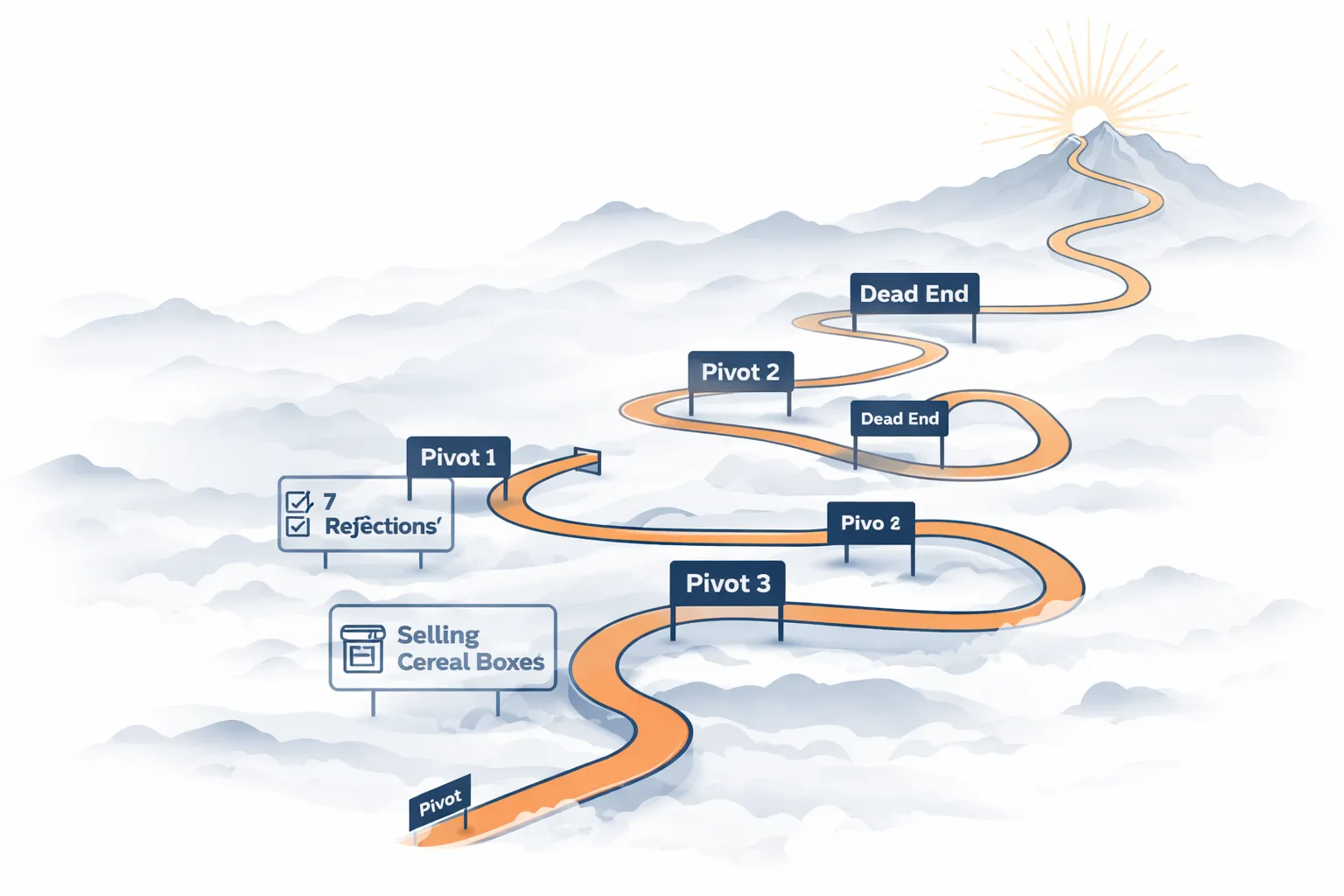
A central tenet of the overnight success myth is that the successful product was the original idea. Statistical analysis of 847 startups that reached valuations of $100 million or more reveals a different truth: 100% of these companies pivoted multiple times, with an average of 3.2 major pivots per company.
Quantitative Analysis of Startup Transitions
The research into these 847 companies found that the vast majority violated "conventional wisdom" and faced extreme instability before succeeding.
Statistic | Findings for Successful Startups ($100M+ Valuation) |
Pivot Frequency | 100% pivoted; Average of 3.2 major pivots. |
Survival Crises | 73% almost died at least once before success. |
Near-Death Experiences | Most stories include 3 to 7 hidden near-death experiences. |
Conventional Wisdom | 89% violated popular advice at critical moments. |
These findings suggest that founders must budget runway for 2 to 3 complete pivots financially and psychologically. If a founder only has runway for one idea, they do not have enough runway to find product-market fit (PMF).
Case Studies in Radical Pivoting
The transition from a failed initial concept to a successful "overnight" sensation is a hallmark of the startup journey. The following examples demonstrate the distance between original intent and ultimate success:
Slack: Originally a gaming company called Glitch. After three years and $17 million raised, the game failed, and the team pivoted to the internal chat tool they had built for themselves.
Instagram: Originally "Burbn," a complicated Foursquare competitor with 15 features. The founders stripped away 13 features to focus solely on photos and filters.
YouTube: Started as a video dating site ("Tune in, Hook up"). When no one uploaded dating videos, they pivoted to "any video" in a single meeting.
Twitter: Began as Odeo, a podcasting platform. When iTunes launched podcasting, rendering Odeo irrelevant, the team pivoted to status updates in an emergency two-week brainstorm.
Pinterest: The founders originally launched a mobile shopping app called Tote, which was unsuccessful, forcing a pivot to Pinterest.
In each case, the "overnight" success of the final product was built on the ruins of a multi-year failure. Founders who succeed are those who "fall in love with the problem, not the solution," allowing the solution to change while the core problem remains constant.
Anatomy of "Overnight" Failures: Hidden Struggles of Market Giants
Examining the actual histories of companies frequently labeled as overnight successes reveals a pattern of near-bankruptcy, intense rejection, and years of obscurity.
Airbnb: The Cereal Box Strategy and the 7 Rejections
Airbnb is often cited as a disruptive startup, yet its path was paved with desperation. In 2008, the founders could not convince any investors to invest; they maxed out credit cards and sold custom cereal boxes ("Obama O's" and "Cap'n McCain") during the 2008 elections just to afford their rent.
On June 26, 2008, the founders were introduced to 7 prominent Silicon Valley investors to raise $150,000 at a $1.5 million valuation—a 10% stake that would be worth billions today. The responses were as follows:
Investor Response | Frequency | Context/Reasoning |
Boilerplate Rejection | 5 | Cited market size or lack of focus in the specific area. |
No Reply | 2 | Founders were simply ignored. |
Their initial interview with Y Combinator's Paul Graham went poorly, and the situation was only saved when Brian Chesky handed Graham a box of "Obama O's," demonstrating the "relentless resourcefulness" required for survival.
Canva: 101 Rejections and the 5-Year Stealth Phase
Melanie Perkins, founder of Canva, experienced what appeared as a sudden rise to dominance. In reality, Perkins spent five years pitching to investors and faced 101 rejections. Her first business, Fusion Books, was operated out of her mother’s living room for years, even moving large printing presses into the space.
Perkins revised her pitch deck more than a hundred times in a year to answer investor concerns. She treated every "no" as free market research, using rejections to refine her strategy. The platform finally launched in 2013, six years after the initial idea for Fusion Books. This trajectory proves that the best companies are built slowly, thoughtfully, and with genuine care for the people they serve.
WhatsApp: The Vengeance of the Rejected Interviewee
The acquisition of WhatsApp for $19 billion in 2014 is a landmark event in tech history. However, the founders, Jan Koum and Brian Acton, started the company after both were rejected for jobs at Facebook and Twitter in 2009.
Chronology of the WhatsApp development:
September 2007: Koum and Acton leave Yahoo and travel South America.
May 2009: Acton is rejected by Twitter.
August 2009: Acton is rejected by Facebook.
2009: WhatsApp is founded but is initially unpopular until Apple adds push notifications in June 2009.
2014: Facebook acquires the company for $19 billion after it amasses 450 million global users.
Koum’s childhood experience of Soviet-era surveillance inspired the app’s focus on privacy and freedom of speech, a vision he maintained even when the app struggled for traction in its first year.
The Scaling Trap: Why Moving Too Fast Destroys Value
The pressure to achieve "overnight" success often drives startups toward "premature scaling," which is the primary reason for startup self-destruction. Data from the Startup Genome Report indicates that 74% of internet startups fail because they attempt to scale before they are ready.
Quantitative Impact of Premature Scaling
Premature scaling occurs when a startup expands operations—hiring, marketing, or infrastructure—ahead of its actual product-market fit or operational capacity.
Metric | Startups that Scale Properly | Startups that Scale Prematurely |
Growth Speed | Typically 20x faster. | Stagnate or self-destruct. |
Capital Generation | Efficiently attracts investment. | Generates 18x less capital during scale stage. |
User Benchmarks | Consistent growth in user base. | None passed the 100,000 user mark. |
Success Probability | Higher sustainable growth. | 74% fail due to this single factor. |
Premature scaling often takes the form of hiring too many employees too fast or spending too much on customer acquisition before the product is ready. Startups with big ideas have many ways to succeed, but attempting to do too much at once leads to collapse.
Sustainable Growth Models vs. Blitzscaling
While "Blitzscaling" worked for companies like Uber or Facebook, it is a trap for most others. Speed dominating attention often leads to mismanagement of cash flow, which causes 82% of startup failures.
Retention Over Acquisition: It costs 5–7x more to acquire a new user than to retain one. Companies like Notion grew by doubling down on community evangelism rather than ad spend.
Cash Flow Discipline: Disciplined startups measure burn rate as a "rhythm" for endurance rather than a limitation.
Trust Before Scale: Sustainable growth prioritize profitability and minimize the risk of over-leveraging the business. Airbnb invested in trust—verified reviews and secure payments—before raising billions.
The Probability of Survival: A Quantitative Reality Check
The startup environment is defined by a "mortality curve" that challenges the notion of rapid, easy success. Reaching the five-year mark is a significant milestone, with only 50% managing to make it through this period.
Startup Survival Rates and Risk Profiles
The highest risk period is not necessarily the first year, but the growth phase when companies attempt to scale.
Year | Startup Survival Rate | Traditional Business Survival Rate |
Year 1 | 90% survive (10% fail). | 71.4% – 84.6% survive. |
Year 5 | 50% survive (50% fail). | ~50% survive. |
Year 10 | 10% – 30% survive. | ~30% survive. |
Startups are significantly riskier than traditional businesses in the long term, reflecting a high-risk, high-reward nature that results in either exponential growth or rapid obsolescence. Founder experience also impacts survival probability: first-time founders have an 18% success rate, while those with a previous success have a 30% chance.
Industry-Specific Survival Disparities
The "average" survival rate masks significant differences between sectors. Some industries require much longer timelines for development, which traditional yearly survival rates may underestimate.
Industry | 5-Year Survival Rate | 10-Year Survival Rate |
Agriculture/Forestry | High | 50.5%. |
Health Care | 60% | 40%. |
Real Estate | 55% | 35%. |
Finance/Insurance | 55% | 35%. |
Prof/Technical Services | 50% | 30%. |
Deep tech companies, for example, may require 3–5 years of development before generating meaningful revenue, compared to software companies that can achieve PMF within 12–18 months. This extended timeline means cumulative risk is much higher for deep tech ventures.
Systemic Distortions: Survivorship Bias and Cognitive Heuristics
The persistence of the overnight success myth is not merely an accident of storytelling but a systemic outcome of cognitive biases and heuristics. Survivorship bias occurs when we assess successful outcomes and disregard failures, painting a rosier picture of reality than is warranted.
Cognitive Drivers of the Myth
Human psychology naturally emphasizes success stories while failed ones "fade into the background".
Availability Heuristic: We prioritize information that comes to mind quickly. Because successes are glorified and amplified, we tend to believe they are more likely to occur than they really are.
Confirmation Bias: Founders often focus on information that supports their belief in their success (stories of billionaire dropouts) while ignoring data on failure.
Correlation vs. Causation: We see successful examples with particular attributes and incorrectly assume those attributes (e.g., "The Morning Habits of Successful People") caused the success.
The Danger of "Successful Dropout" Narratives
The media frequently highlights Steve Jobs, Bill Gates, and Mark Zuckerberg as successful college dropouts. However, this ignores the reality that for every highly successful dropout, there are thousands who struggle. Statistics show that graduates with a bachelor's degree make a median of $77,636 compared to $46,748 for those without. Equating their success to the single act of dropping out—or even to hard work alone—is a classic example of survivorship bias that ignores variables like luck, timing, and pre-existing networks.
The Architecture of Persistence: Operational and Psychological Requirements
To move beyond the myth, founders and investors must align on long-term goals and embrace a marathon mindset. Building a sustainable business requires not just ambition, but patience, resilience, and a willingness to learn over time.
Operational Stability and Metrics
Successful startups continually refine their offerings based on user feedback. Achieving product-market fit requires obsessive focus on the customer's problem rather than the founder's solution.
Critical Metrics for Sustainable Growth:
CAC (Cost to Acquire a Customer): Must be manageable relative to LTV.
LTV (Lifetime Value): The total revenue expected from a customer.
LTV:CAC Ratio: Should be 3:1 or higher for a healthy business.
Payback Period: The months required to break even on CAC.
Startups should aim to get one paying customer before raising money, as revenue is the only validation that truly matters. Furthermore, hiring decisions are crucial; the first 10 hires define a company's culture significantly more than the next 90.
The "Romantic Capitalist" Philosophy
Some industry leaders argue that building a startup is "romantic in nature" and cannot be justified by business arguments alone. The darkness of the struggle requires a "warrior spirit" and a deep belief in the mission. This philosophy identifies three key traits for hires:
Romantic: Cares about beauty and love.
Philosopher: Cares about truth.
Warrior-Capitalist: Cares about applying values in the struggle of the real world.
This mindset shifts the focus from "cash and equity" to a sense of purpose, which is often what allows a team to stay together during "hellish" pivots and near-death experiences.
Synthesis: Rethinking the Success Paradigm
The "overnight success" startup is a fiction manufactured at the intersection of cognitive bias, sensationalist journalism, and venture capital marketing. The data across hundreds of successful companies confirms that the path to a sustainable, high-valuation business is marked by longitudinal struggle rather than rapid ascent.
Longevity is the Rule: Success is a marathon of ideation, validation, traction, and scaling that typically requires 5 to 10 years.
The Pivot is Universal: 100% of major successes are the result of significant shifts away from the original idea.
Resilience Over Speed: Moving too fast without a foundation leads to a 74% failure rate.
Substance Over Hype: Long-term success is not created by the speed of growth but by its quality and the robustness of its foundation.
Founders and investors must dismantle the "cultural psychosis" of the overnight myth. By celebrating "steady, persistent builders" who create value over time, the industry can foster a more sustainable startup ecosystem—one where enduring companies solve real-world problems and create lasting social value. The most impactful companies of our time were not built overnight; they were built day by day, with patience, persistence, and an unwavering commitment to a vision that the rest of the world initially ignored.
Want to calculate the equity for your cofounder?
Nail your cap table before you sign. Whether you're splitting equity with a co-founder or planning your next funding round, our Equity Calculator gives you precision in seconds
Equity calculator →