Tech Communities and Founder Networks in Belgium
March 15, 2026 by Harshit Gupta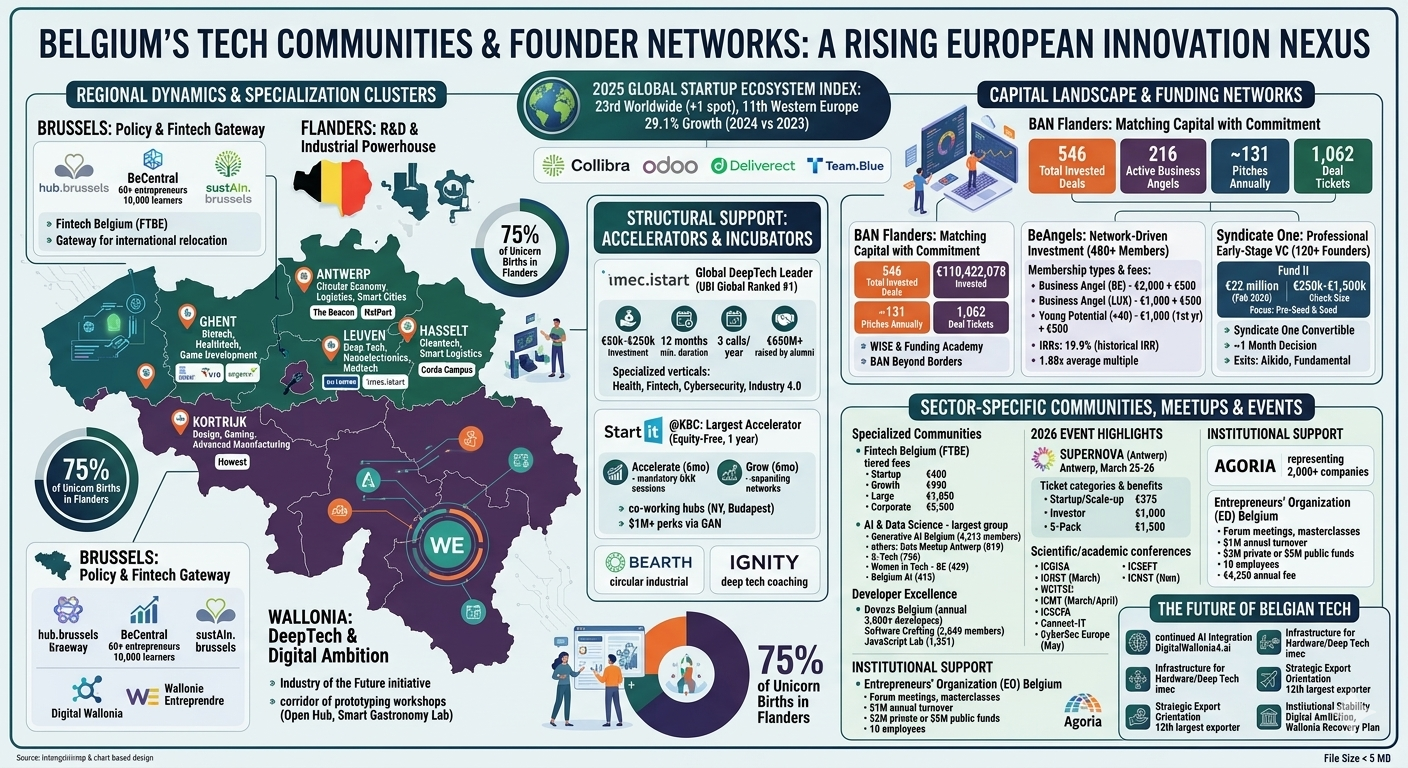
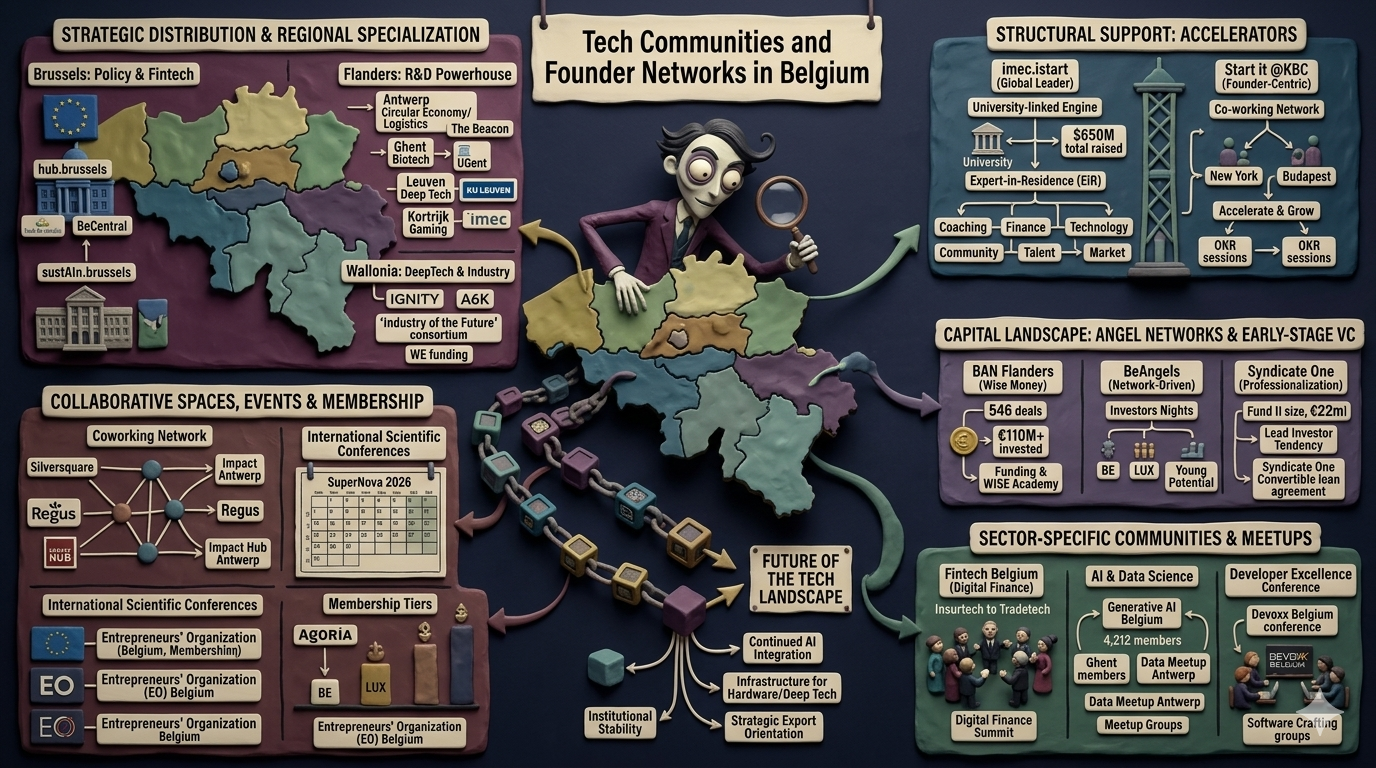
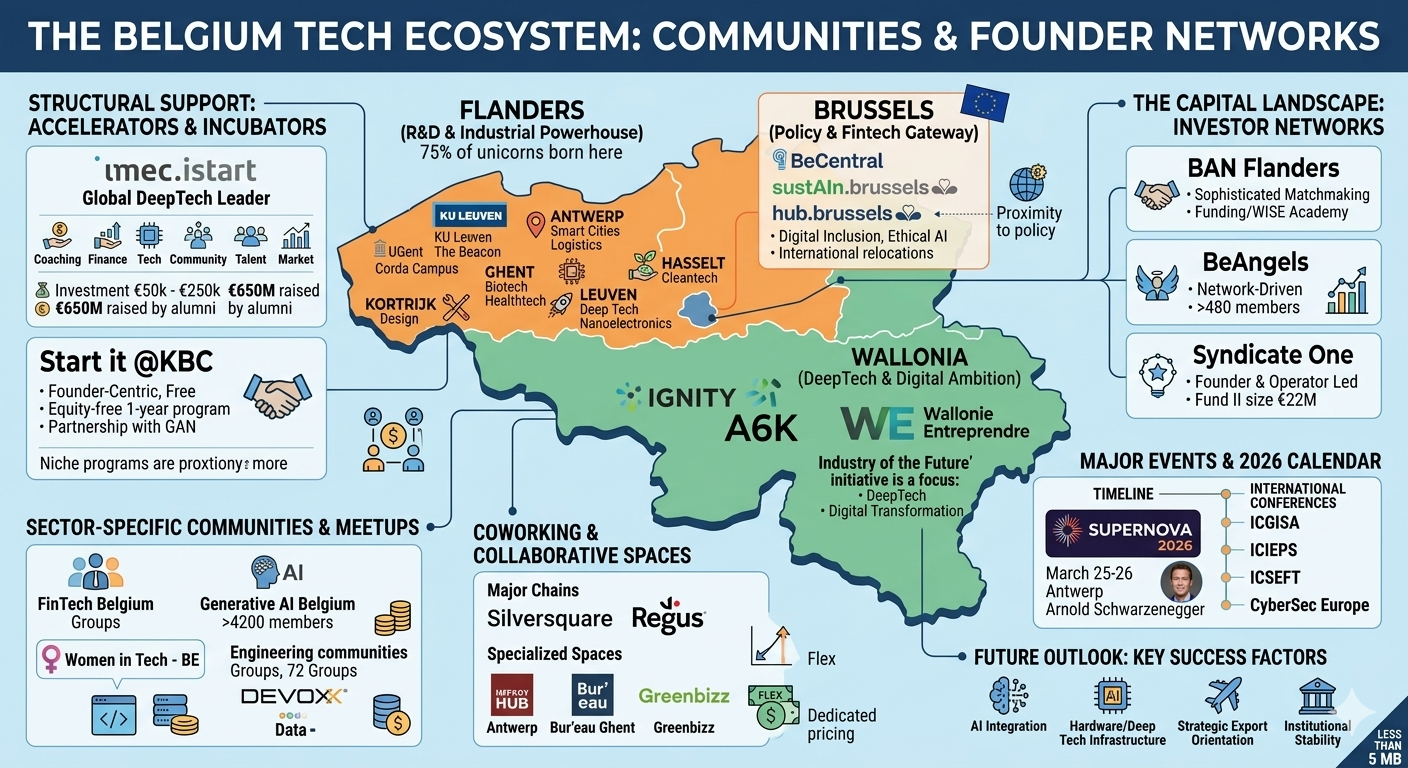
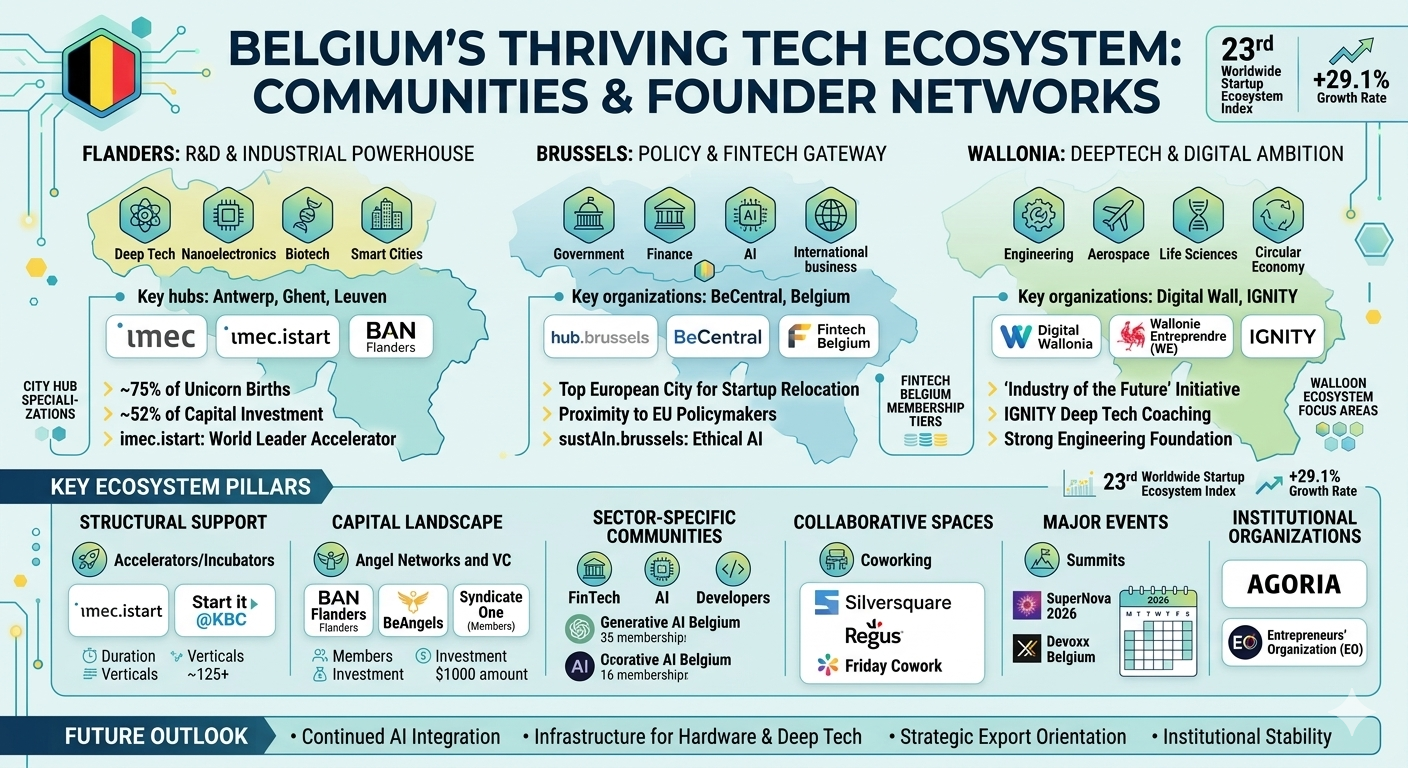
The technological landscape of Belgium has transitioned from a fragmented collection of regional interests into a highly integrated, maturing ecosystem that serves as a critical nexus for European innovation. In the 2025 Global Startup Ecosystem Index, Belgium’s standing reached the 23rd position worldwide, reflecting a climb of one spot over the previous year and solidifying its place as the 11th most robust ecosystem in Western Europe. This trajectory is characterized by a remarkable growth rate of 29.1% over the preceding year, a momentum underpinned by a population of 1,325 startups and a growing roster of unicorns including Collibra, Odoo, Deliverect, and Team.Blue. The resilience of this ecosystem is further evidenced by its rapid recovery following the post-pandemic global funding reset; while the drop in Belgian funding was more pronounced than the European average in 2023, the recovery in 2024 has outpaced regional peers.
Central to this stability is the geographical and strategic distribution of Belgian innovation. Unlike many European nations where technological activity is hyper-concentrated in a single capital city, the Belgian model is distributive. Flanders, which accounts for approximately 60% of the national GDP, receives a proportionate share of investment at 52% of the total capital. Meanwhile, Brussels leverages its status as the administrative heart of the European Union to provide startups with unparalleled proximity to policy makers and international trade institutions. This analysis explores the intricate layers of support, networking, and capital that define this unique European gateway.
Regional Dynamics and Specialization Clusters
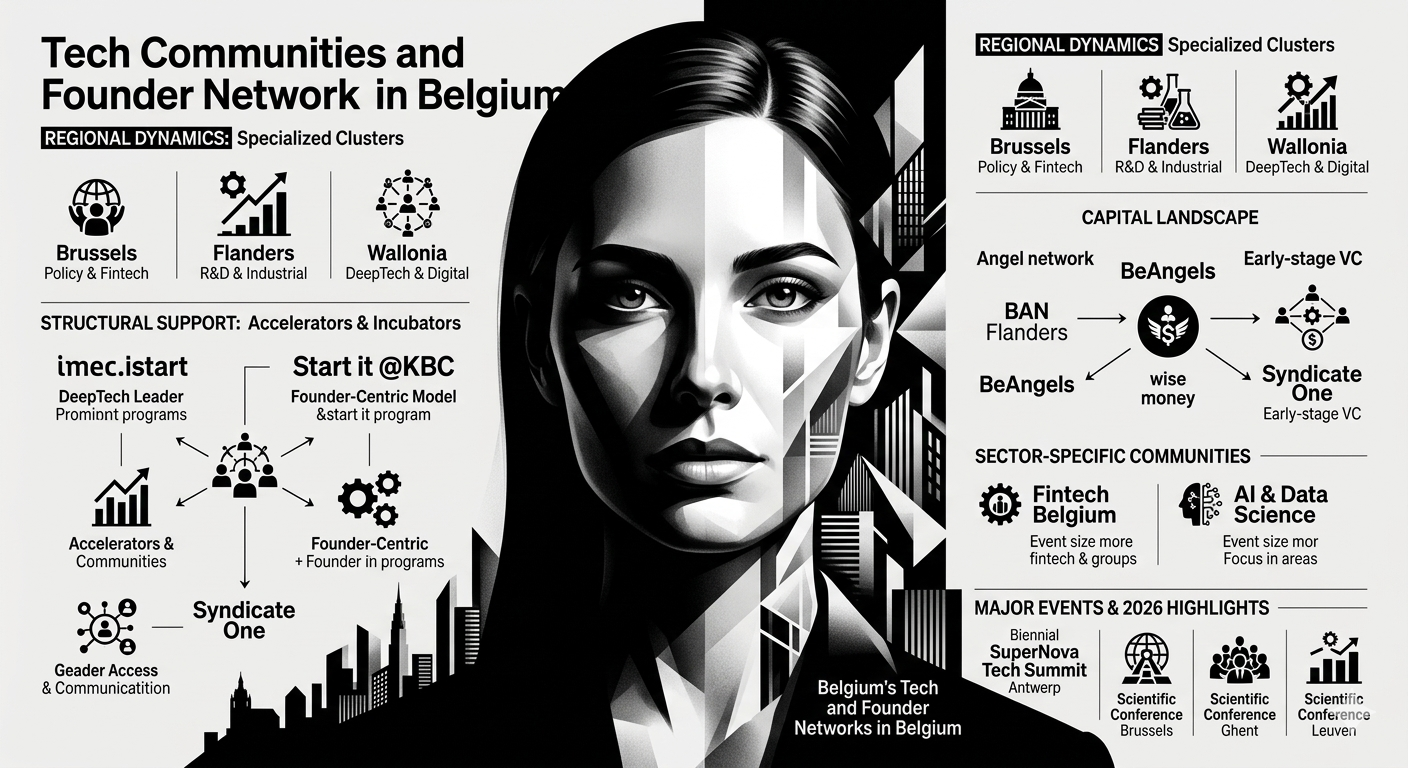
The Belgian tech scene is organized into highly specialized clusters, each deriving strength from local heritage and academic excellence. The distributed nature of its unicorn births—75% of which occurred in Flanders—demonstrates that high-value innovation is not confined to a single urban center.
Brussels: The Policy and Fintech Gateway
Brussels operates as a primary destination for founders seeking international relocation, ranking among the top 30 European cities for startup relocations in 2024. Its identity is defined by its role as a political and financial nerve center, hosting over 1,500 international companies and serving as Europe’s leading city for hosting congresses. The regional agency hub.brussels acts as the structural vanguard, offering specialized support through thematic clusters and the 1819 information service.
The Brussels ecosystem is increasingly focused on digital inclusion and ethical AI. BeCentral, a campus located within the Brussels Central Station, serves as a collaborative hub for over 60 entrepreneurs and 10,000 learners, effectively democratizing access to digital skills. Furthermore, the sustAIn.brussels initiative promotes the ethical adoption of artificial intelligence by connecting research institutions with corporate partners.
Flanders: The R&D and Industrial Powerhouse
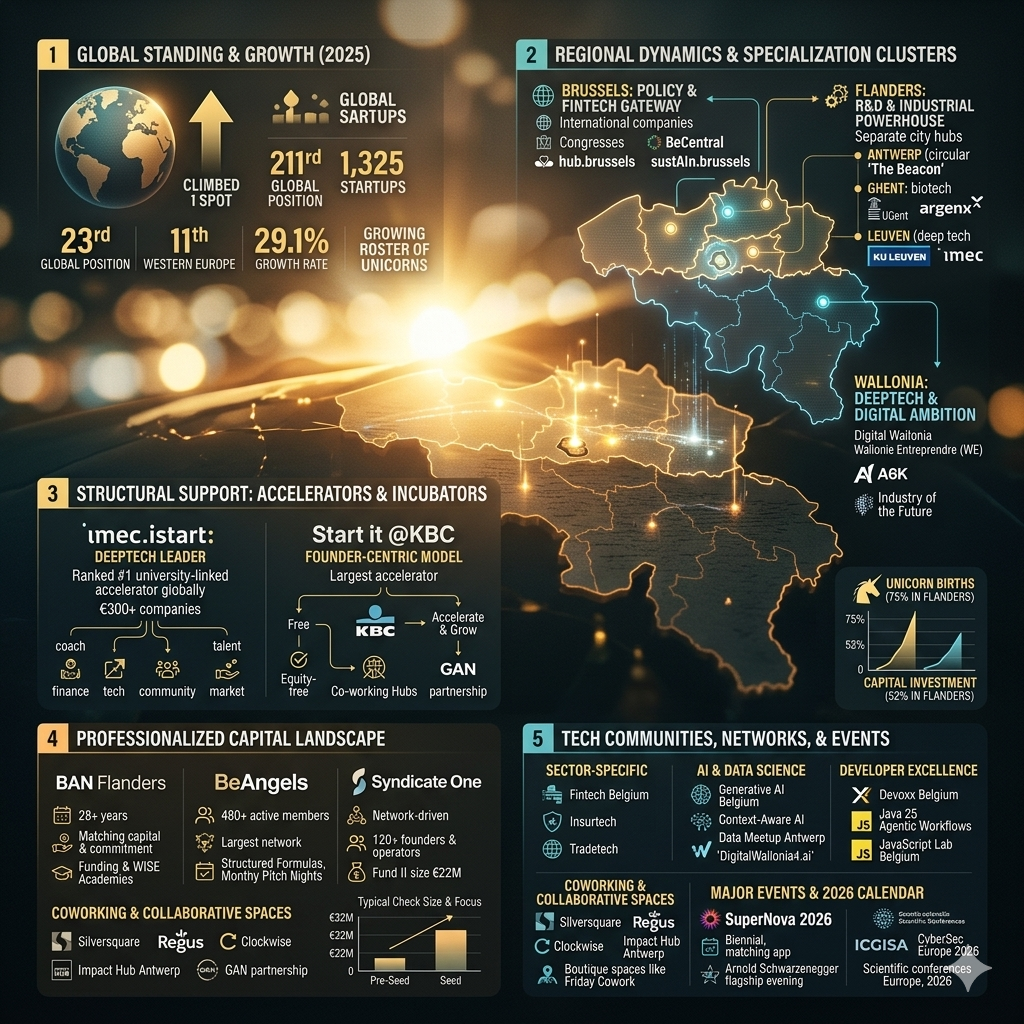
Flanders is home to several world-class innovation hubs that bridge the gap between academic research and industrial application. The city of Antwerp serves as a living lab for smart technologies, where 171 nationalities contribute to a diverse entrepreneurial base. Ghent has emerged as a center for biotech and digital arts, while Leuven, home to KU Leuven, is a global leader in deep tech and medical technology.
City Hub | Primary Technological Focus | Key Stakeholders | Source |
Antwerp | Circular Economy, Logistics, Smart Cities | The Beacon, NxtPort, Port of Antwerp-Bruges | |
Ghent | Biotech, Healthtech, Game Development | UGent, VIB, argenx | |
Leuven | Deep Tech, Nanoelectronics, Medtech | KU Leuven, imec, imec.istart | |
Hasselt | Cleantech, Smart Logistics | Corda Campus, TEDxUHasselt | |
Kortrijk | Design, Gaming, Advanced Manufacturing | Howest, K-Tech Meetup |
Wallonia: DeepTech and Digital Ambition
The Walloon ecosystem is structured around the Digital Wallonia strategy, which acts as a platform for convergence among public and private players. The region emphasizes DeepTech and engineering sciences through structures like IGNITY and A6K. Wallonie Entreprendre (WE) provides the financial backbone, supporting sectors such as life sciences, aerospace, and energy transition.
The Walloon corridor is noted for its "Industry of the Future" initiative, a consortium designed to accelerate the digital transformation of industrial businesses. This is supported by an extensive network of prototyping and manufacturing workshops, including Open Hub and the Smart Gastronomy Lab.
Structural Support: Accelerators and Incubators
The Belgian support system for startups is characterized by institutional longevity and a high degree of specialization. These programs provide not only capital but also the "collective wisdom" of an expansive alumni network.
imec.istart: The Global Leader in DeepTech Acceleration
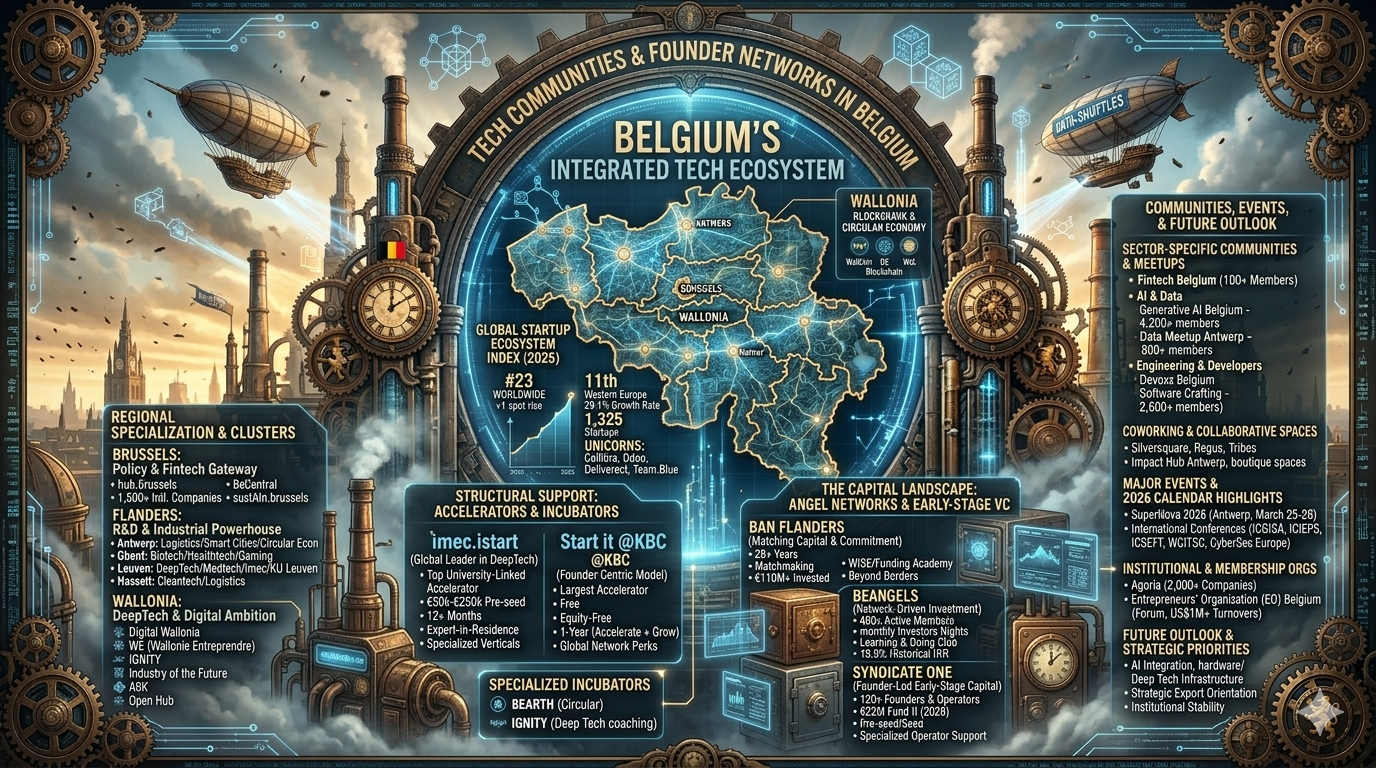
imec.istart, the business accelerator of the world-leading R&D hub imec, is consistently ranked as the top university-linked accelerator globally by UBI Global. Since 2011, it has invested in over 300 companies, providing pre-seed funding and tailored support to help startups grow globally. The program is built on six pillars: access to coaching, finance, technology, community, talent, and market.
Program Metric | Detail | Source |
Typical Investment | €50,000 to €250,000 | |
Program Duration | Minimum 12 months | |
Open Calls | 3 times per year (Feb, June, Oct) | |
Success Rate | €650M total funding raised by alumni | |
Specialized Verticals | Health, Fintech, Cybersecurity, Industry 4.0 |
The imec.istart program is uniquely intensive, offering founders a personal "day-to-day sparring partner" and the opportunity to embed an Expert-in-Residence (EiR) for one to two days per week. This model ensures that high-risk technological ventures have the necessary technical and strategic guidance to navigate the transition from proof-of-concept to commercial launch.
Start it @KBC: The "Founder-Centric" Model
Start it @KBC is the largest accelerator in Belgium, providing a free, equity-free one-year program. It focuses on innovative and scalable startups, offering access to co-working hubs in major cities across Belgium and international locations such as New York and Budapest.
The program is divided into an initial six-month "Accelerate Phase" followed by a six-month "Grow Phase". During the first phase, founders are challenged through mandatory OKR sessions, while the second phase focuses on expanding networks. Start it @KBC’s partnership with the Global Accelerator Network (GAN) provides members with over $1 million in perks, including software deals and mentorship.
Specialized Incubators and Regional Programs
Secondary and niche programs play a vital role in local economic transition. In Brussels, the BEARTH incubator supports circular industrial projects over a six-month journey that includes a bootcamp and prototyping at Greenbizz. Wallonia’s IGNITY program provides dedicated coaching for deep tech ventures, utilizing tools like MatMaX™ to track progress and WISKLI for community exchange.
The Capital Landscape: Angel Networks and Early-Stage VC
A defining feature of the Belgian ecosystem is the professionalization of its investor base. The market has moved from informal angel investing to structured networks and founder-led syndicates that prioritize "wise money".
BAN Flanders: Matching Capital with Commitment
Business Angels Network (BAN) Flanders has operated for over 28 years, creating a sophisticated matchmaking platform for capital-seeking entrepreneurs and private investors. It is supported by the Flemish government and VLAIO, acting as a bridge between sketched ideas and market reality.
BAN Flanders Statistics | Value | Source |
Total Invested Deals | 546 | |
Total Amount Invested | €110,422,078 | |
Active Business Angels | 216 | |
Annual Pitches Organized | ~131 | |
Deal Tickets Facilitated | 1,062 |
BAN Flanders distinguishes itself through its "Funding Academy" and "WISE Academy," which provide masterclasses on valuation, term sheet clauses, and exit strategies. Their international reach is expanded through "BAN Beyond Borders," which partners with EuroQuity and the Business Angels Europe (BAE) Club to facilitate cross-border investments.
BeAngels: The Network-Driven Investment Approach
BeAngels connects entrepreneurs with over 480 active members, making it one of the largest business angel networks in Europe. The network addresses the needs of both experienced and novice investors by offering structured investment formulas, such as the "Learning & Doing" Business Angel Club and the Tracker Fund.
Membership Type | Annual Fee (excl. VAT) | Entry Fee (excl. VAT) | Source |
Business Angel (Belgium) | €2,000 | €500 | |
Business Angel (Luxembourg) | €1,000 | €500 | |
Young Potential (<40) | €1,000 (1st year) | €500 |
BeAngels maintains a rigorous selection process, hosting monthly "Investors Nights" where pre-selected projects are pitched. The network boasts a historical internal rate of return (IRR) of 19.9% with an average multiple of 1.88, reinforcing the value of organized angel communities in driving venture success.
Syndicate One: The Professionalization of Early-Stage Capital
Syndicate One represents a strategic evolution in the Belgian funding continuum. Established in 2022, it is a network-driven investment firm that pools capital and expertise from 120+ founders and operators to help early-stage companies scale globally. The firm’s "dual-mandate" involves both deploying capital and building the ecosystem through initiatives like the "State of Belgian Tech Report" and standardized legal templates.
Fund Metric | Detail | Source |
Fund II Size (Feb 2026) | €22 million | |
Typical Check Size | €250,000 to €1,500,000 | |
Stage Focus | Pre-Seed and Seed | |
Investment Decision Time | ~1 Month | |
Lead Investor Tendency | High (Actively leads rounds) |
Syndicate One has achieved early success with portfolio companies such as Aikido Security and Fundamental reaching unicorn status. By providing founders with access to operators who have scaled companies like Collibra and Deliverect, the syndicate offers a specialized tier of support that extends beyond traditional financial investment. Their development of the "Syndicate One Convertible," a Belgian-market adapted Convertible Loan Agreement, has been pivotal in streamlining the fundraising process for first-time founders.
Sector-Specific Communities and Meetups
The Belgian tech ecosystem is fragmented into highly active, specialized communities that facilitate knowledge sharing and peer networking. These groups are often the primary source of informal mentorship for founders.
Fintech Belgium: The Voice of Digital Finance
FinTech Belgium (FTBE) is an independent non-profit representing over 100 members in sectors ranging from Insurtech to Tradetech. It organizes evening conferences, deep-dive workshops, and the flagship Digital Finance Summit, which features over 600 attendees and 120 speakers.
Membership Tier | Annual Fee | Target Personnel Size | Source |
Seed/Startup | €400 | 0–4 FTE | |
Growth/Scale-up | €990 | 5–49 FTE | |
Large Scale-up | €1,850 | 50–249 FTE | |
Corporate Partner | €5,500 | >250 FTE |
FTBE also serves as a critical point of contact for regulators and international networks like the Singapore Fintech Association. Their activities include a "Mentors" program and a dedicated job board to support founders as they scale their teams.
AI and Data Science Communities
The AI scene in Belgium is characterized by vibrant grassroots activity and professional journal clubs. "Generative AI Belgium," headquartered in Ghent, is the largest group in the country with over 4,200 members. Brussels-based "Belgium AI Community Building" sessions and "Data Meetup Antwerp" provide venues for enthusiasts and seasoned builders to exchange project feedback and tools.
Meetup Group | Location | Membership Size | Source |
Generative AI Belgium | Ghent | 4,212 | |
Data Meetup Antwerp | Antwerp | 819 | |
K-Tech Meetup | Kortrijk | 756 | |
Women in Tech - BE | Antwerp | 429 | |
Belgium AI, ML & CV | Brussels | 413 |
These communities are increasingly focused on "Context-Aware AI," looking to solve real-life use cases rather than just experimenting with general tools. High-profile events like "European AI Week" and the "DigitalWallonia4.ai" program reinforce the region’s commitment to accelerating AI adoption.
Engineering and Developer Excellence
Developer-focused communities thrive through platforms like Devoxx Belgium, an annual conference that attracts over 3,000 developers from 47 countries. The conference highlights innovations in the Java ecosystem (e.g., Java 25) and Generative AI, offering deep dives into "agentic workflows" and "autonomous systems".
For software crafters, groups like "Software Crafting and Testing Belgium" (2,649 members) and "JavaScript Lab Belgium" (1,351 members) organize regular technical sessions. These groups are essential for maintaining the high technical standard that Belgian developers are known for internationally.
The Coworking and Collaborative Space Landscape
Coworking in Belgium has evolved from simple desk-rental services into community-led hubs that provide the physical infrastructure for ecosystem growth.
Major Chains and Networks
Silversquare and Regus provide the most extensive networks of coworking spaces in Belgium, covering all major commercial districts. Silversquare’s "Antwerp Tower" and "Brussels Central" locations are particularly favored by tech startups for their modern amenities and central positioning.
Coworking Brand | Key Location | Pricing Starting Point | Source |
Silversquare | Brussels Central | ~$48 / day | |
Tribes | Brussels Central | ~$55 / day | |
Clockwise | Antwerp | ~$41 / day | |
Regus | National Network | €5 / day (Dedicated Desk) | |
Impact Hub | Antwerp | €60 / month (Flex 4 days) |
Specialized and Independent Spaces
Boutique spaces often offer a more intimate community experience. In Antwerp, "Friday Cowork" is highly rated for its supportive staff and 24/7 access, while "The Attic Cowork" balances social interaction with deep work through its rooftop terrace and "honesty bar". "Impact Hub Antwerp" caters specifically to purpose-driven founders at the Blue Gate circular innovation hub, offering weekly community lunches and curated networking moments.
In Ghent, "Bur’eau Ghent" provides high-quality meeting rooms and flexible workstations near the tech district. Brussels hosts numerous specialized centers, such as "Greenbizz" for circular projects and "The POD" for digital and tech experts in Walloon Brabant.
Major Events and 2026 Calendar Highlights
The Belgian tech calendar is anchored by several "must-attend" summits that facilitate high-level networking and brand building.
SuperNova 2026: The Premier Tech Summit
SuperNova is a biennial event in Antwerp that transforms the city into a playground for visionary leaders and innovators. The 2026 edition is scheduled for March 25–26, featuring over 250 inspirational speakers and a massive networking area.
Ticket Category | Entry Price (excl. VAT) | Key Benefits | Source |
Startup / Scale-up | €375 | Matchmaking App, Access to 300+ Investors | |
Regular Attendee | €375 | Networking Area, Inspirational Speakers | |
Professional Investor | €1,000 | Investor Lounge, Exclusive Side Events | |
5-Ticket Pack | €1,500 | Team access, matchmaking |
SuperNova’s "matchmaking app" uses AI to help delegates schedule 1-on-1 meetings, ensuring that time at the event is converted into strategic partnerships. The 2026 festival includes a flagship evening with Arnold Schwarzenegger, focusing on long-term ambition and personal transformation—a theme aligned with the "Developer Renaissance" observed in the ecosystem.
International Scientific and Academic Conferences
Brussels serves as a primary host for international technology conferences throughout 2026. These events provide a platform for Belgian researchers and startups to interact with global academic leaders.
Conference | Venue | Date (2026) | Source |
IC on Geospatial Intelligence (ICGISA) | Brussels | March 03 | |
IC on Information Ethics (ICIEPS) | Brussels | March 09 | |
IC on Startups in FinTech (ICSEFT) | Brussels | March 31 | |
IC on Nuclear Science & Tech (ICNST) | Brussels | March 06 | |
World Congress on IT & CS (WCITSC) | Ghent | March 27 | |
IC on Marine Technology (ICMT) | Leuven | April 03 | |
IC on Smart Contracts (ICSCFA) | Ghent | May 07 | |
Connect-IT 2026 | Antwerp | May 07 | |
CyberSec Europe 2026 | Brussels | May 20-21 |

Institutional and Membership Organizations
The professionalization of the tech sector is further supported by broad-based industry federations and exclusive entrepreneurship clubs.
Agoria: The Industry Guardian
Agoria is Belgium’s largest industry federation, representing over 2,000 technology-inspired companies. It operates through specialized expertise centers focusing on innovation, talent, and energy. Agoria offers its members strategic consulting and business development services, specifically targeting markets such as Financial Services, Healthcare, and Transport & Mobility.
Membership provides access to exclusive benefits, including professional advice on regulations and taxation, and opportunities for "secondments" where post-doctoral fellows collaborate with industry leaders. Agoria’s lobbying efforts at the regional, federal, and European levels ensure that the interests of the digital industry are represented in policy discussions.
Entrepreneurs' Organization (EO) Belgium
The Entrepreneurs' Organization (EO) is a global peer-to-peer network with a robust Belgian chapter, designed for founders who have reached a high level of success. Membership is by invitation only and requires a minimum annual turnover of $1 million.
EO Membership Qualification | Requirement | Source |
Annual Revenue | > US$1 million | |
Venture-Backed Alternate | $2M Private or $5M Public funds | |
Personnel Minimum | 10 full-time employees | |
Annual Fee (BE) | €4,250 (Global + Local) | |
Initiation Fee | One-time payment (varies, ~$2,500+) |
The EO experience is centered on the "Forum," where groups of 8-12 entrepreneurs meet monthly to share experiences in a high-trust, confidential environment. This peer-to-peer learning is supplemented by masterclasses and learning tracks designed to foster both personal and business growth.
The Future of the Belgian Tech Landscape
The Belgian startup ecosystem is entering a distinctive maturation phase, moving away from local validation toward global leadership. The successes of the past five years have laid the groundwork for a self-reinforcing cycle where exits breed new capital and experienced talent reinvests in the next generation of founders.
Critical success factors for the upcoming years include:
Continued AI Integration: programs like DigitalWallonia4.ai and sustAIn.brussels ensure that Belgian companies are not just users of AI, but leaders in ethical and industrial AI applications.
Infrastructure for Hardware and Deep Tech: The strong presence of research centers like imec and specialized accelerators like IGNITY suggests that Belgium will maintain a competitive edge in hardware and nanoelectronics—sectors that attract 48% of total tech investment.
Strategic Export Orientation: As the 12th largest exporting nation globally, Belgian startups are naturally geared for international expansion, often fluently navigating the French and Dutch markets before expanding further.
Institutional Stability: Initiatives like "Digital AmBEtion" and the "Recovery Plan for Wallonia" signal a sustained commitment to digital infrastructure and skills training at the governmental level.
In conclusion, Belgium offers one of the most comprehensive support structures in Europe for technological founders. By blending academic research, world-class acceleration, and a professionalized investor base, the country has established itself as a resilient and high-growth hub within the European Union. Founders entering this market benefit from a "close-knit network" where strategic partnerships can be forged across regional and sectoral boundaries.
The Real Startup Playbook: Ideas, Growth, Funding, and Founder Psychology
Building a startup is exciting, chaotic, and often misunderstood. If you’ve ever wondered how founders actually validate ideas, find co-founders, raise funding, and survive the emotional rollercoaster, these articles explore the realities behind the startup world.
Start with How to Validate Your Startup Idea in 48 Hours for $0 to understand how founders test ideas quickly before wasting months building the wrong product. Once you have an idea, the next challenge is building it—From Idea to MVP: A Step-by-Step Guide for Solo Founder walks through the journey from concept to a real product.
Many founders struggle with partnerships and team decisions. Should your co-founder live in the same city? Explore Remote vs. Local: Does Your Co-Founder Need to Live in the Same City? and learn the risks hidden in partnerships in 5 Red Flags to Look for When Choosing a Startup Partner. If you’re searching for technical help, How to Find a Technical Co-Founder (Without a Six-Figure Salary) explains how founders actually do it.
The startup journey isn’t just about building products—it’s also about mindset and decision-making. Articles like Decision Fatigue: The Silent Startup Killer, Fear vs Logic: How Founders Actually Make Decisions, and How Overthinking Destroys Early Momentum reveal the psychological battles founders face behind the scenes.
Growth is another misunderstood part of startups. Learn why strategy matters more than hype in Ideas Don’t Scale. Systems Do. and why discipline matters in Why Your Startup Doesn’t Need Growth — It Needs Focus. Discover the importance of early traction in How the First 100 Users Decide Your Startup’s Fate and understand team building through The First Hire That Actually Matters.
Funding is often romanticized, but reality is more complex. Why First-Time Founders Should Avoid Big Funding challenges common assumptions about venture capital, while Revenue Solves More Problems Than Funding explains why sustainable businesses matter more than investor money.
The startup ecosystem also varies by geography. If you're curious about India’s startup scene, explore The New Playbook for Raising in Bangalore, Why Raising Pre-Seed in Bangalore Is Harder Than Ever, and Why B2B SaaS from Bangalore Scales Faster.
But startups are not just about strategy and growth—they’re also about people and emotions. Articles like The Hidden Burnout of Bangalore Founders, Comparison Culture in India’s Startup, and The Loneliness of First-Time Founders in Bangalore reveal the personal struggles founders rarely talk about publicly.
And finally, if you want a deeper perspective on the startup journey itself, explore Lessons Learned Too Late by First-Time Founders and The Myth of the “Overnight Success” Startup—because the truth behind startup success is far more complex than it appears.
Protect Your Future: The Precision Vesting Calculator
Don't let a "handshake deal" complicate your exit. Map out your ownership journey with our Vesting Calculator
Calculate Your Vesting Schedule →