Why Some Founders Quietly Shut Down Instead of Pivoting
March 8, 2026 by Harshit Gupta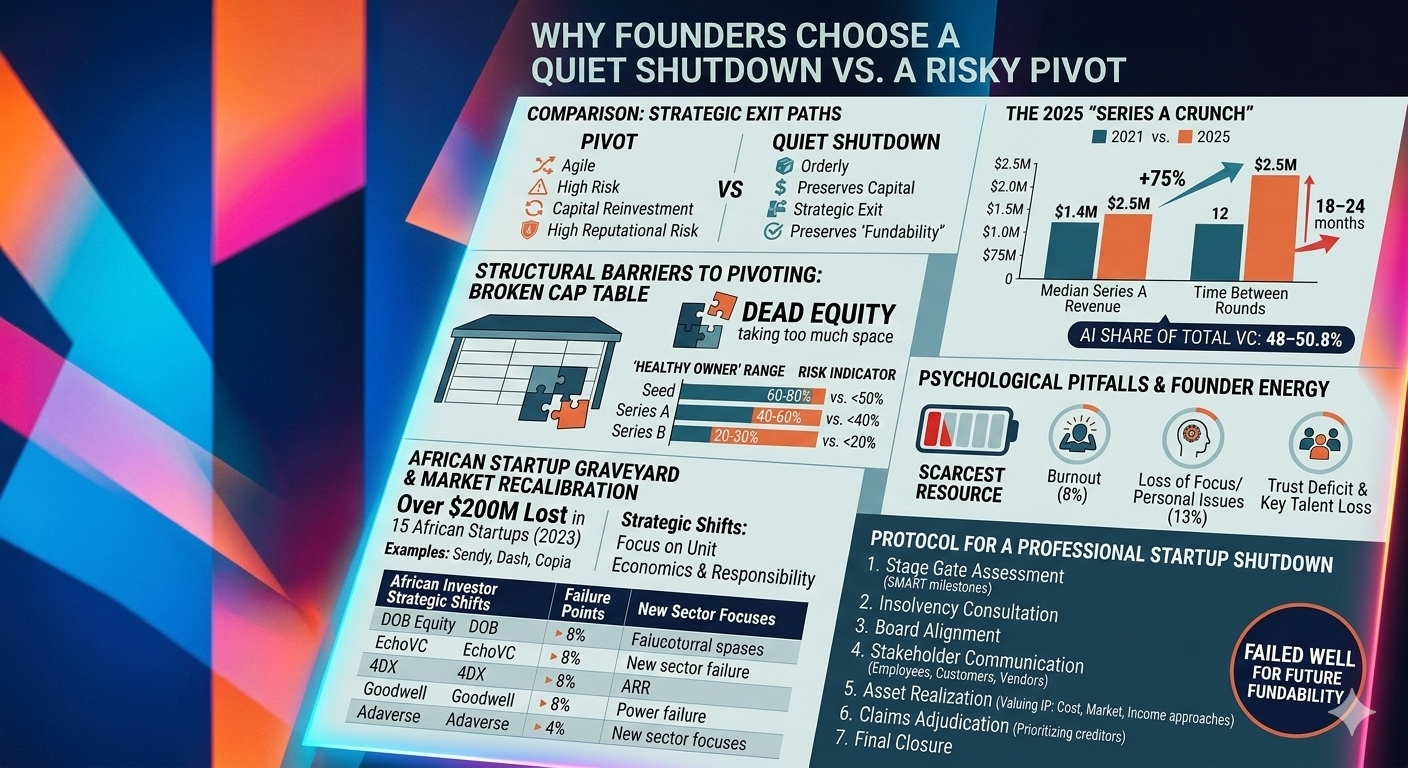
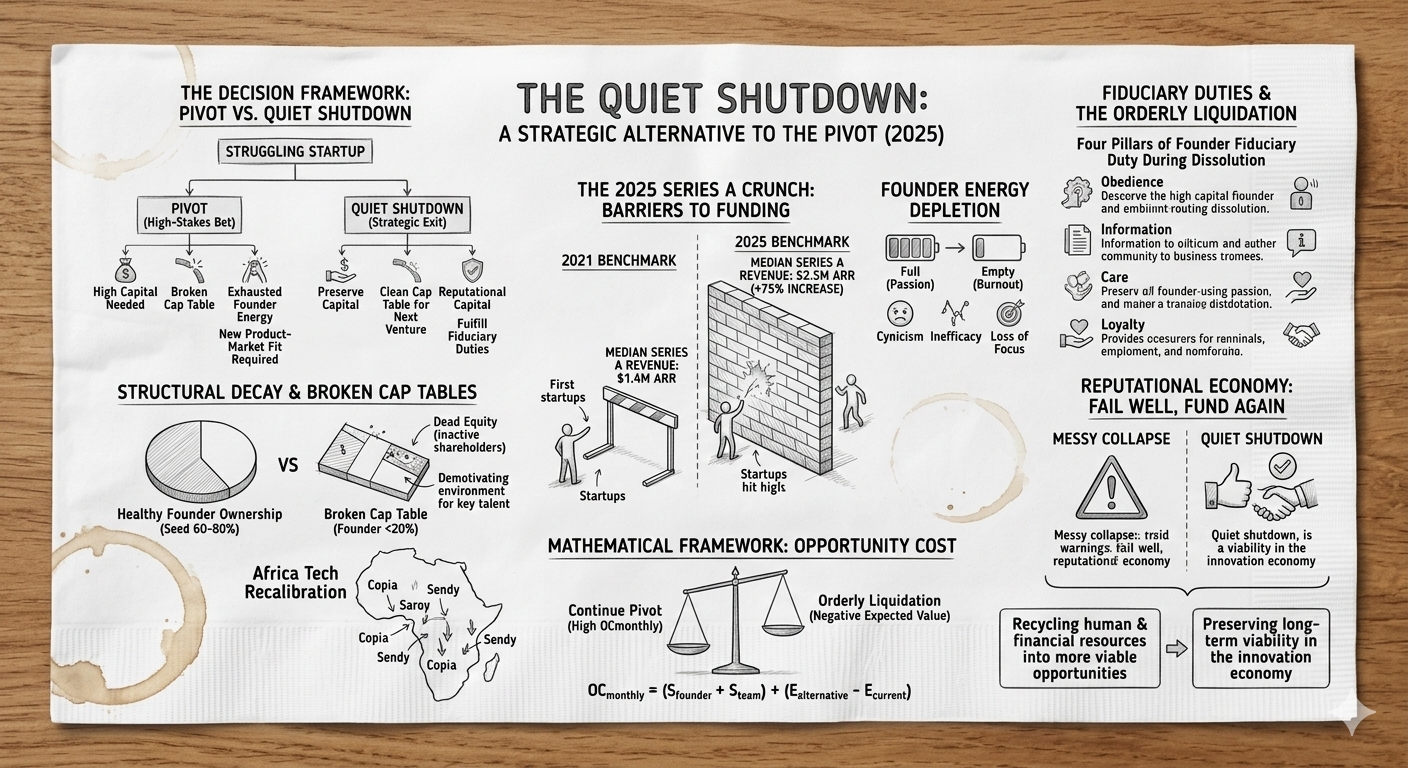
The traditional narrative of the venture-backed startup ecosystem has long been dominated by the myth of the "pivot"—the agile, high-stakes maneuver popularized by the Lean Startup methodology that allows a failing enterprise to iterate toward success. However, as the global venture capital landscape shifts from an era of abundant, low-cost capital into a period defined by rigorous capital efficiency and a "Series A crunch," a significant cohort of founders is opting for a "quiet shutdown". This phenomenon, characterized by a methodical winding down of operations and the return of remaining capital to investors, represents a fundamental change in how failure is perceived and managed within the innovation economy. The decision to forgo the pivot in favor of an orderly liquidation is rarely a sign of defeat but is increasingly recognized as a strategic choice to preserve reputational capital, fulfill fiduciary duties, and recycle human and financial resources into more viable opportunities.
The Taxonomy of Startup Endings and the Rise of Strategic Finality
In the contemporary market, the way a startup concludes its lifecycle has become a primary indicator of ecosystem maturity. The binary distinction between success and failure has been replaced by a more nuanced taxonomy of endings, ranging from the celebrated "unicorn" exit to the "zombie startup" state. A quiet shutdown is defined by its lack of public fanfare and its emphasis on administrative compliance and stakeholder protection. This stands in stark contrast to the "silent end," where founders simply vanish, leaving behind unpaid salaries and unresolved debts, a practice that is increasingly marginalized in mature markets like Silicon Valley and the emerging African tech hubs.
The pivot itself has undergone a conceptual re-evaluation. While historically viewed as a "structured course correction," in the 2024-2025 market, it is often seen as a "final, desperate act" before total collapse. Many founders have realized that a pivot requires as much, if not more, product-market validation as the original idea—a luxury that few can afford when cash reserves are low and investor patience has been exhausted. Consequently, the orderly liquidation has emerged as the preferred path for founders who recognize that their initial hypothesis is irredeemably flawed. This process involves the systematic realization of assets at fair market value, ensuring that creditors are satisfied and remaining funds are distributed to shareholders.
Comparison of Strategic Exit Paths in the Current Venture Ecosystem
Exit Strategy | Primary Objective | Communication Strategy | Capital Treatment | Reputational Impact |
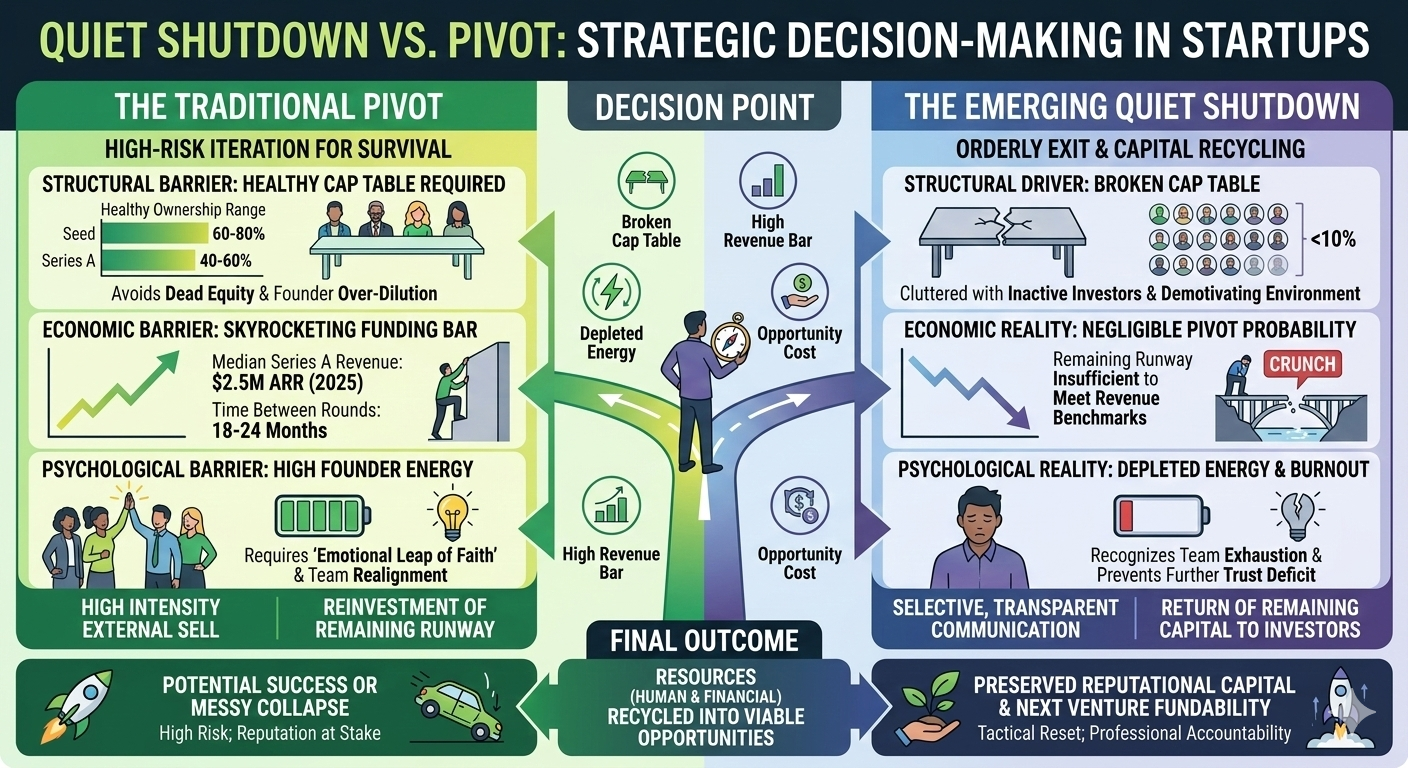
Pivot | Iterative Survival | High-intensity internal/external sell | Reinvestment of remaining runway | High risk; potential for "pivot gone bad" |
Quiet Shutdown | Strategic Exit | Selective, transparent disclosure | Return of remaining capital to LPs | Preserves "fundability" for next venture |
Orderly Liquidation | Asset Maximization | Formal, regulated transparency | Payout to creditors then shareholders | Professional accountability and dignity |
Zombie Startup | Stagnant Persistence | Minimal/Static reporting | Slow burn of cash with no growth | Erosion of founder and investor brand |
Messy Collapse | Uncontrolled Failure | Silence or public dispute | Potential for fraud or legal liability | Permanent exclusion from ecosystem |
The Structural Decay: How Broken Cap Tables Inhibit the Pivot
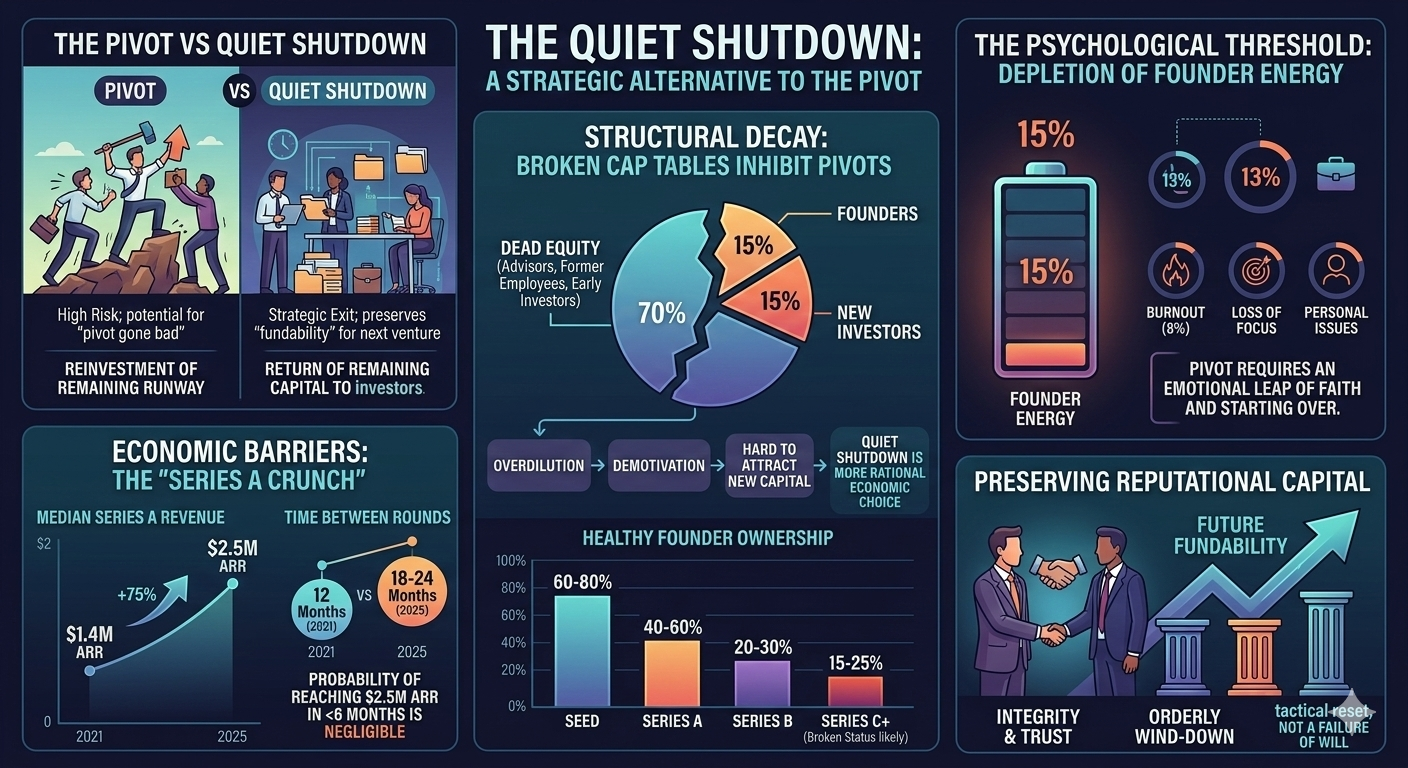
One of the most significant, yet frequently overlooked, reasons founders choose to shut down instead of pivoting is the structural decay of the company's capitalization table. A "broken cap table" occurs when the equity distribution becomes so misaligned that the founders and key employees—those responsible for executing a pivot—lack sufficient financial incentive to continue. In many cases, early-stage founders give away too much equity too soon to angel investors or through multiple seed rounds, leading to a situation where they own less than 10% to 20% of the company by the time a major strategic shift is required.
When a pivot is necessitated, it essentially demands that the founder starts a "new" company within the shell of the old one. However, the presence of "dead equity"—shares held by advisors, former employees, or early investors who are no longer contributing value—creates a demotivating environment. New investors are often reluctant to provide the fresh capital needed for a pivot when they see a cap table cluttered with inactive shareholders and founders who are overly diluted. The legal and financial cost of "cleaning up" a broken cap table can exceed $15,000, and the administrative friction involved in negotiating buyouts or restructuring can sap the remaining energy of the founding team. For many, the "math no longer makes sense," and shutting down to start a fresh venture with a clean cap table is the more rational economic choice.
Benchmarks for Healthy Founder Ownership by Funding Stage
Funding Stage | Risk Indicator (Low Ownership) | Healthy Ownership Range | Strategic Implication |
Seed | Below 50% | 60% - 80% | High dilution early on restricts pivot capacity |
Series A | Below 40% | 40% - 60% | Essential for attracting top-tier Series A leads |
Series B | Below 20% | 20% - 30% | Critical threshold for maintaining long-term motivation |
Series C+ | Below 10% | 15% - 25% | Broken cap table status likely; restructuring needed |
The Economic Barrier: The 2025 "Series A Crunch" and Revenue Benchmarks
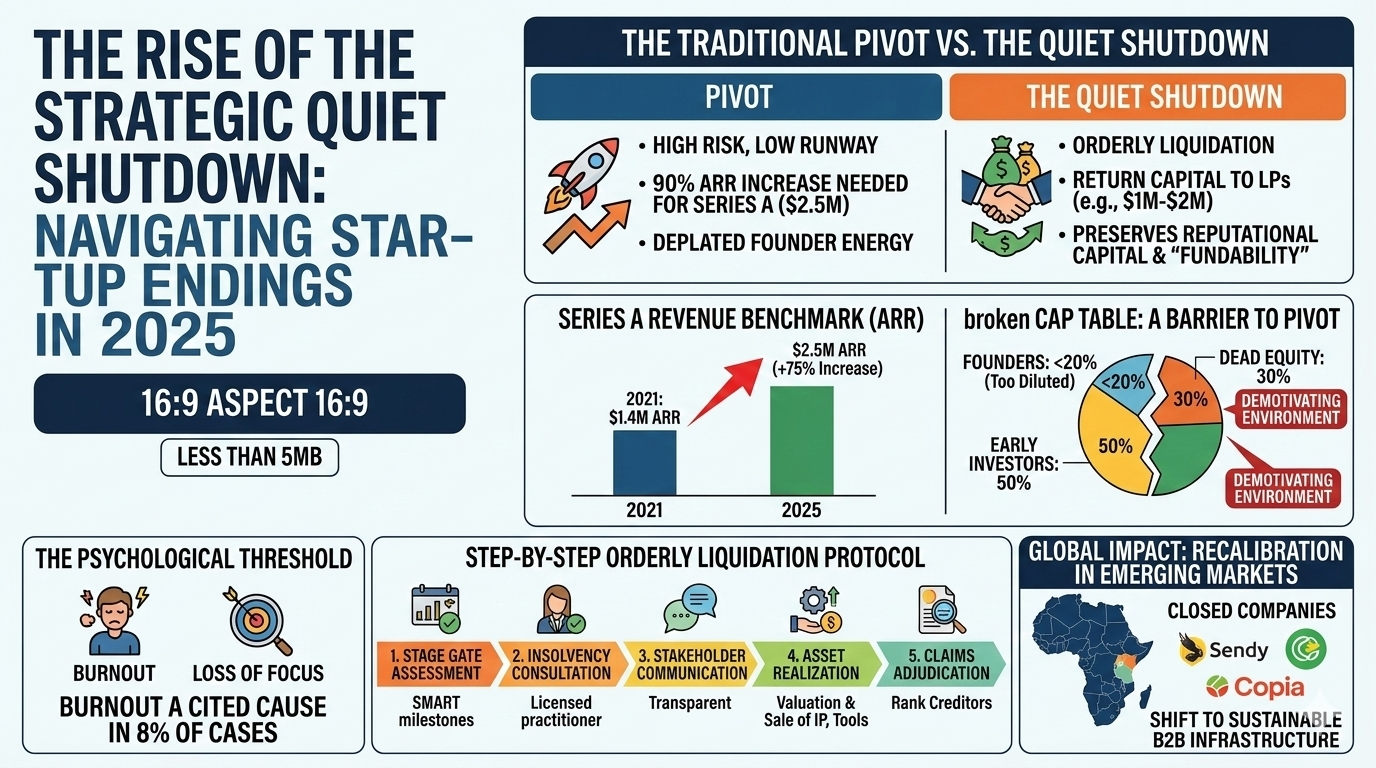
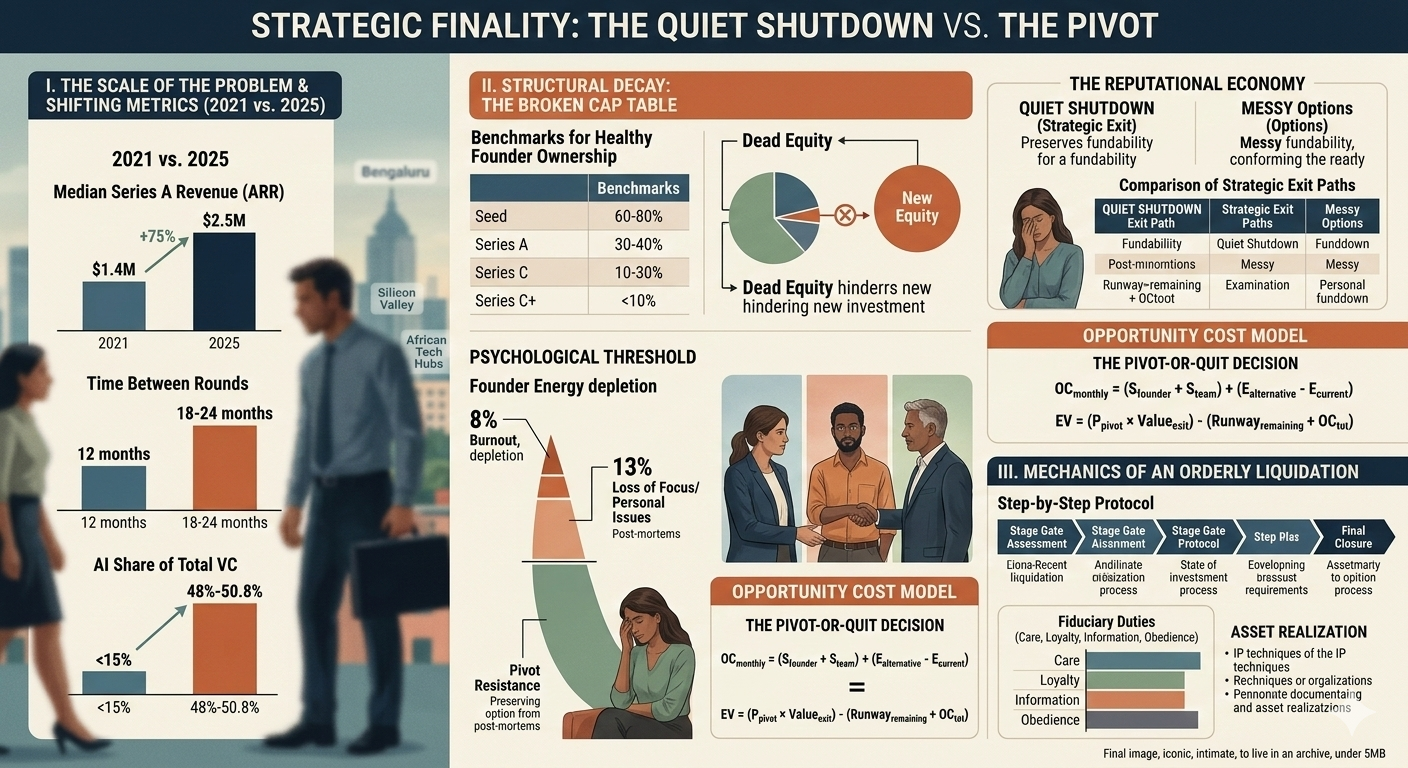
The shift from the "growth at all costs" era of 2021 to the "capital efficiency" era of 2024-2025 has fundamentally altered the viability of the pivot. In the current market, the bar for securing follow-on funding has skyrocketed. The median Series A company now requires approximately $2.5 million in annual revenue to be considered fundable—a 75% increase from the standards of 2021. This "Series A crunch" means that many seed-funded startups hit a wall if they cannot demonstrate significant, verifiable traction.
When a startup's initial model fails to find product-market fit, a pivot is intended to bridge the gap to the next milestone. However, the time required to achieve the same valuation growth has doubled, moving from one year in 2021 to more than two years in 2025. Founders must now plan for 18 to 24 months of runway between funding rounds. If a startup only has six months of runway remaining, the probability of executing a pivot, building a new product, and reaching a $2.5 million revenue run rate is statistically negligible. In this context, the decision to return the remaining capital is an admission of market reality rather than a failure of will.
Escalation of Venture Capital Performance Metrics (2021 vs. 2025)
Metric | 2021 Benchmark | 2025 Benchmark | % Change / Trend |
Median Series A Revenue | $1.4M ARR | $2.5M ARR | +75% increase |
Time Between Rounds | 12 Months | 18 - 24 Months | Duration doubled |
AI Share of Total VC | < 15% | 48% - 50.8% | Dominant sector concentration |
Valuation Multiple | High (Growth-based) | Moderate (Efficiency-based) | Reset to historic norms |
Dry Powder Reserves | High (Rapid deployment) | Record High ($299B) | High "selectivity" in deployment |
The Psychological Threshold: Founder Energy as the Scarcest Resource
Beyond the financial and structural barriers, the decision to shut down is often driven by the depletion of "founder energy"—the invisible force that sustains a team through the volatility of a startup's early stages. While passion is often described as a fleeting emotion, founder energy is the management discipline required to ship product at 2:00 AM and navigate the tensions of a failing business model. Research into startup post-mortems reveals that burnout is a cited cause of failure in 8% of cases, while "loss of focus" and "personal issues" account for 13%.
A pivot is not a simple change of direction; it is an emotional and cognitive "leap of faith" that requires the team to abandon their previous work and start over. This process can be exhausting. If the founding team has already spent two years fighting for a failing idea, they may lack the "gas in the tank" needed for a second or third pivot. Furthermore, a pivot is an implicit admission to the staff that the initial vision was incorrect, which can lead to a "trust deficit" and the loss of key talent. High-performing employees, who often joined for the original mission, may start taking recruiter calls as soon as a pivot is announced, further hollowing out the startup's capacity to execute the new strategy. Founders who recognize this internal decay often choose a quiet shutdown to preserve their team's sanity and their own professional health.
The Selection Event: AI Maturation and the "Wrapper" Cull
The 2025 market is undergoing what analysts call a "selection event," particularly in the artificial intelligence sector. The 2023-2024 period saw a massive influx of capital into "AI wrappers"—products built quickly on top of commoditized large language models without deep defensive moats. As these models become more capable and hyperscalers (like AWS, Google, and Microsoft) integrate similar features directly into their cloud offerings, the "wrapper" startups are finding their value proposition evaporated.
For these founders, pivoting is often impossible because they lack "proprietary data advantages" or "deep integration into enterprise workflows". The market is now filtering aggressively for companies with real unit economics rather than usage arbitrage. This shift has led to the "first wave of AI shutdowns," where companies that raised early capital based on speed and UX are being forced to close because they cannot compete with the infra-layer giants or the next generation of AI-native startups. Winding down such a company is often seen as a strategic move to clear the path for the founder to start a more defensible, "next-gen" AI venture.
Fiduciary Duties and the Legal Mechanics of a Responsible Wind-Down
The decision to shut down is also a reflection of a founder's maturing understanding of their fiduciary duties. Accepting venture funding puts a founder in a fiduciary role, responsible for managing investor capital with a high degree of care, loyalty, information, and obedience. When it becomes clear that a startup's chance of success is negligible, continuing to "burn" investor cash on a low-probability pivot may be seen as a breach of the duty of care.
A responsible wind-down, or orderly liquidation, is the legal and ethical fulfillment of these duties. This involves conducting reasonable diligence to maximize the value of assets—including intellectual property, equipment, and customer lists—to satisfy creditors. In some jurisdictions, such as Illinois, minority investors in closely held corporations may be deemed to have fiduciary duties toward one another akin to partners, increasing the legal risk of a messy or negligent shutdown. By following a structured process, often guided by a licensed insolvency practitioner, founders protect themselves from personal liability and "Insolvency Act offenses," such as trading while insolvent or "preferring" certain creditors over others.
The Four Pillars of Founder Fiduciary Duty During Dissolution
Duty | Core Obligation | Strategic Application in a Shutdown |
Obedience | Adherence to bylaws and law | Ensuring all corporate filings and tax returns are finalized before closure. |
Information | Candor and transparency | Disclosing the true state of the runway and traction to the board and shareholders. |
Care | Prudent decision-making | Conducting a thorough due diligence process before accepting a "soft landing" or liquidation offer. |
Loyalty | Prioritizing the company | Avoiding self-dealing during asset sales and protecting sensitive company information. |
The Reputational Economy: "Failing Well" for Future Fundability
In the venture capital ecosystem, a founder's reputation is their most durable asset. Investors frequently state that "money is made in successful investments and your reputation in failed ones". A quiet shutdown that involves returning the remaining $1 million or $2 million of a pre-seed or seed round is a powerful signal of integrity. It demonstrates that the founder is a responsible steward of capital who can be trusted with future investments.
This "Reputational Capital" is especially critical for serial entrepreneurs. Investors like Blackbird VC emphasize that their role is to "remove stress from a failed company" and help the team find new jobs quickly, often reinvesting in the founder's next startup if the previous wind-down was handled correctly. Conversely, founders who burn every last dollar on a hopeless pivot, or who end their venture in "messy disputes" or "silence," may find themselves permanently excluded from future funding rounds. The quiet shutdown, therefore, is not an exit from the ecosystem, but a tactical reset that preserves the founder's ability to "play the game" in the next cycle.
Mathematical Frameworks for the Shutdown Decision: Opportunity Cost and Stage Gates
The most disciplined founders utilize quantitative frameworks to determine when to kill a project. Central to this is the concept of "Opportunity Cost"—the potential gain from the best alternative that must be foregone to continue the current path. For a founder, the opportunity cost of a pivot is not just the remaining cash runway, but the time they could spend starting a more promising venture or returning to the high-paying workforce.
The "Stage Gate" framework is a common method for operationalizing this decision. Stage gates are SMART (Specific, Measurable, Achievable, Relevant, and Time-bound) milestones that a startup must hit to justify further investment or effort. If a startup misses its stage gates—such as failing to reach break-even after X months or failing to develop a Minimum Viable Product (MVP) within a specific timeframe—the protocol is to either pivot or shut down. Smart founders define these gates in advance of launch, ensuring that "emotion does not take over" when the business hits inevitable roadblocks.
Opportunity Cost Modeling for the Pivot-or-Quit Decision
To assess whether to continue a pivot, founders can calculate the "Revenue Per Employee" (RPE) and the "Cost of Delay." A simple model for the monthly opportunity cost of continuing an underperforming venture is:
OCmonthly=(Sfounder+Steam)+(Ealternative−Ecurrent)
Where:
S represents the direct salary costs.
Ealternative is the expected value of the founder's next venture or salary in a new role.
Ecurrent is the current (often zero or negative) expected value generated by the startup.
If OCmonthly is high and the probability of a successful pivot (Ppivot) is low, the "Expected Value" (EV) of continuing is often negative:
EV=(Ppivot×Valueexit)−(Runwayremaining+OCtotal)
When EV falls below zero, the "orderly liquidation" becomes the mathematically superior choice.
Regional Insights: The African Startup Graveyard and Market Maturity
The trend of the quiet shutdown is particularly visible in emerging markets like Africa, where the tech ecosystem is undergoing a rapid "recalibration". In 2023, over $200 million was lost across 15 high-profile African startups, including Sendy, Dash, and Copia. These failures have forced a shift away from "growth-at-all-costs" toward "lasting viability" and "unit economics".
In the African context, shutdowns like that of TradeHub or Okra were driven by "prohibitively expensive" physical assets and competition from global giants like AWS. Founders in these regions are increasingly opting for "Responsible Wind-Downs" to reassure investors that funds were managed properly despite the challenging macro environment. This trend is seen as a sign of ecosystem maturity, moving away from the "messy or silent ends" of the past toward a more professionalized culture of accountability.
Strategic Shifts of Active African Investors (Post-2023 Failures)
Investment Firm | Key Failures | Strategic Response / Shift | New Sector Focus |
DOB Equity | Sendy, Copia | Focus on "lasting viability" over growth | Sustainable food, water, renewables |
EchoVC Partners | Gro Intelligence | Shift to microfunds (<$1M cheques) | Energy infrastructure, physical assets |
4DX Ventures | Dash ($86M loss) | Rigorous auditing of metrics; senior advisors | Later-stage deals; Egypt focus |
Goodwell Investments | Lydia, WhereIsMyTransport | Abandoning unsustainable B2C models | B2B infrastructure, profit-first |
Adaverse | Web3 Portfolio | Geographic abandonment of Africa | Middle East (Saudi Arabia) |
The Mechanics of an Orderly Liquidation: A Step-by-Step Guide for Integrity
For founders who choose to shut down, industry experts at The MacDonald Partnership (TMP) and other insolvency practitioners emphasize that the manner of the exit is as important as the decision itself. An orderly liquidation is a systematic process designed to treat all parties fairly and minimize disruption.
The process begins with a consultation with a licensed insolvency practitioner to understand the implications of different liquidation paths, such as a Creditors' Voluntary Liquidation (CVL). This is followed by transparent communication with all stakeholders—employees, clients, and creditors—to manage expectations and preserve professional relationships. The core of the process involves the valuation and sale of assets, including "Intellectual Property" (IP), proprietary tools, and equipment. Methods for valuing IP include the "Cost Approach" (recreation cost), the "Market Approach" (comparable sales), and the "Income Approach" (discounted future cash flows). By selling these assets at fair market value, the founder ensures the maximum possible return for creditors, which is a legal priority in insolvency.
Step-by-Step Protocol for a Professional Startup Shutdown
Stage Gate Assessment: Formally determine that the business is no longer viable and that a pivot lacks sufficient EV.
Insolvency Consultation: Engage a licensed practitioner to evaluate legal obligations and avoid "Insolvency Act" offenses.
Board Alignment: Present a clear case for dissolution, adhering to the "duty of information".
Stakeholder Communication: Notify employees, customers, and vendors with transparency; provide assistance for team transitions.
Asset Realization: Conduct a systematic valuation and sale of all tangible and intangible assets at fair market value.
Claims Adjudication: Scrutinize and rank creditor claims according to legal priority for distribution.
Final Closure: File final tax returns, submit accounts, and formally dissolve the legal entity.
Conclusion: The Quiet Shutdown as the Final Act of Strategic Leadership
The quiet shutdown represents the evolution of the startup founder from a single-minded visionary to a disciplined, serial architect of innovation. In a world where 90% of startups fail, the ability to recognize that failure early and manage it with integrity has become a defining characteristic of high-performing founders. The pivot, while still a valuable tool in the right conditions, is increasingly seen for what it is: a high-stakes bet that requires a solid foundation, a healthy cap table, and significant team energy—resources that are often in short supply when a company is struggling.
By choosing to wind down quietly and return remaining capital, founders are making a sophisticated bet on their own future. They are choosing the "long game" of the reputation economy over the "short game" of a desperate, under-capitalized pivot. This shift is a sign that the global venture ecosystem is maturing, moving past the "move fast and break things" ethos toward a more sustainable model of "calculated risk and responsible exit". Ultimately, the quiet shutdown is the final act of strategic leadership—an admission that while this specific venture has failed, the founder's capacity to build, lead, and act with integrity remains fully intact for the challenges of tomorrow.

Read More -
1. From Idea to MVP: A Step-by-Step Guide for Solo Founder
🔗 https://findnstart.com/blogs/from-idea-to-mvp-a-step-by-step-guide-for-solo-founder
2. How to Validate Your Startup Idea in 48 Hours for $0
🔗 https://findnstart.com/blogs/how-to-validate-your-startup-idea-in-48-hours-for-0
3. Remote vs. Local: Does Your Co-Founder Need to Live in the Same City?
🔗 https://findnstart.com/blogs/remote-vs-local-does-your-co-founder-need-to-live-in-the-same-city
4. The 2026 Startup Landscape: What Has Fundamentally Changed (and Why Founder Skills Matter More Than Ever)
5. The Most In-Demand Skills for Startup Founders in 2026
🔗 https://findnstart.com/blogs/the-most-in-demand-skills-for-startup-founders-in-2026
6. How to Find a Technical Co-Founder (Without a Six-Figure Salary)
🔗 https://findnstart.com/blogs/how-to-find-a-technical-co-founder-without-a-six-figure-salary
7. 5 Red Flags to Look for When Choosing a Startup Partner
🔗 https://findnstart.com/blogs/5-red-flags-to-look-for-when-choosing-a-startup-partner
8. How to Pitch Your Idea to Potential Co-Founders
🔗 https://findnstart.com/blogs/how-to-pitch-your-idea-to-potential-co-founders
9. How to Build a Portfolio that Attracts High-Growth Startup Founders
🔗 https://findnstart.com/blogs/how-to-build-a-portfolio-that-attracts-high-growth-startup-founders
10. Equity vs. Salary: How to Split Ownership with Your First Teammate
🔗 https://findnstart.com/blogs/equity-vs-salary-how-to-split-ownership-with-your-first-teammate
11. Why Joining an Early-Stage Startup is Better Than a Corporate Job
🔗 https://findnstart.com/blogs/why-joining-an-early-stage-startup-is-better-than-a-corporate-job
12. The Future of EdTech: Why Developers and Educators Need to Team Up Now
🔗 https://findnstart.com/blogs/the-future-of-edtech-why-developers-and-educators-need-to-team-up-now
13. The Architecture of Symbiosis: Analytical Perspectives on the Five Habits of Successful Startup Duos
14. Finding a Co-Founder in the AI Space: What Skills Should You Look For?
🔗 https://findnstart.com/blogs/finding-a-co-founder-in-the-ai-space-what-skills-should-you-look-for
15. Overcoming Analysis Paralysis and the Strategic Path to Execution
🔗 https://findnstart.com/blogs/overcoming-analysis-paralysis-and-the-strategic-path-to-execution
16. From College Project to Company: How to Find Your Student Co-Founder
🔗 https://findnstart.com/blogs/from-college-project-to-company-how-to-find-your-student-co-founder
17. How to Start a Startup While Working a Full-Time Job
🔗 https://findnstart.com/blogs/how-to-start-a-startup-while-working-a-full-time-job
18. How to Build a HealthTech Startup Without a Medical Degree
🔗 https://findnstart.com/blogs/how-to-build-a-healthtech-startup-without-a-medical-degree
19. The Solitary Architect: Executive Isolation in Entrepreneurship
20. The 2026 Guide to Launching a SaaS as a Solo Developer
21. What Sustainable Growth Actually Looks Like
🔗 https://findnstart.com/blogs/what-sustainable-growth-actually-looks-like
22. The Early Warning Signs Your Startup Is in Trouble
🔗 https://findnstart.com/blogs/the-early-warning-signs-your-startup-is-in-trouble
23. How to Grow Without Burning Out
🔗 https://findnstart.com/blogs/how-to-grow-without-burning-out
24. The Truth About “Runway” Most Founders Ignore
🔗 https://findnstart.com/blogs/the-truth-about-runway-most-founders-ignore
25. Revenue Solves More Problems Than Funding
🔗 https://findnstart.com/blogs/revenue-solves-more-problems-than-funding
26. What No One Tells You About Being a Solo Founder
🔗 https://findnstart.com/blogs/what-no-one-tells-you-about-being-a-solo-founder
27. Why Smart People Quit High-Paying Jobs to Build Startups (And Why Most Regret It)
28. Why Most Startup Advice on Twitter Is Dangerous
🔗 https://findnstart.com/blogs/why-most-startup-advice-on-twitter-is-dangerous
29. Decision Fatigue: The Silent Startup Killer
🔗 https://findnstart.com/blogs/decision-fatigue-the-silent-startup-killer
30. Fear vs Logic: How Founders Actually Make Decisions
🔗 https://findnstart.com/blogs/fear-vs-logic-how-founders-actually-make-decisions
31. How Overthinking Destroys Early Momentum
🔗 https://findnstart.com/blogs/how-overthinking-destroys-early-momentum
32. Ideas Don’t Scale. Systems Do.
🔗 https://findnstart.com/blogs/ideas-dont-scale-systems-do
33. The First Hire That Actually Matters
🔗 https://findnstart.com/blogs/the-first-hire-that-actually-matters
34. How the First 100 Users Decide Your Startup’s Fate
🔗 https://findnstart.com/blogs/how-the-first-100-users-decide-your-startups-fate
35. Why Your Startup Doesn’t Need Growth — It Needs Focus
🔗 https://findnstart.com/blogs/why-your-startup-doesnt-need-growthit-needs-focus
36. Why Most Startups Die Quietly
🔗 https://findnstart.com/blogs/why-most-startups-die-quietly
37. Lessons Learned Too Late by First-Time Founders
🔗 https://findnstart.com/blogs/lessons-learned-too-late-by-first-time-founders
38. The Myth of the “Overnight Success” Startup
🔗 https://findnstart.com/blogs/the-myth-of-the-overnight-success-startup
Protect Your Future: The Precision Vesting Calculator
Don't let a "handshake deal" complicate your exit. Map out your ownership journey with our Vesting Calculator
Calculate Your Vesting Schedule →