From College Project to Company: How to Find Your Student Co-Founder
February 23, 2026 by Harshit GuptaThe transition from a university-based project to a commercially viable corporate entity represents a pivotal juncture in the entrepreneurial lifecycle. This evolution is characterized by a shift from academic exploration to the rigorous demands of market validation, legal structuralization, and the formation of a resilient founding team. Historical data from the last three decades suggests that the university environment serves as a high-density incubator for disruptive innovation, largely due to the concentration of specialized talent, shared intellectual curiosity, and institutional support mechanisms. However, the journey from "side project land" to a venture-backed startup is fraught with structural challenges, the most significant of which is the identification and retention of a compatible co-founder. This report analyzes the mechanisms of student co-founder discovery, vetting strategies, the legal complexities of university intellectual property, and the architectural foundations of early-stage equity management.

The Psychological Evolution of Student Entrepreneurship
The initial stage of a student-led venture often occurs within what is described as "blissful side project land," a state characterized by a lack of external accountability and the absence of negative market feedback. In this environment, students are free to focus on features and technologies that interest them personally rather than those that satisfy a specific market need. The transition to a formal startup requires a radical shift toward "building something people want," a process that involves exposing the project to the scrutiny of potential users through listservs, hackathons, and on-campus demonstrations. This shift is not merely operational but psychological, requiring a commitment level that often conflicts with academic requirements.
The "binary choice" described by industry veterans posits that a founder must eventually decide whether to remain a student or become a full-time entrepreneur. Most side projects occupy approximately 10% of a student's time, whereas a viable startup requires the inversion of this ratio. This disparity often leads to the first major hurdle in team formation: identifying which team members are willing to prioritize the venture over their academic or post-graduation career paths. Those who choose to remain in academia often transition into roles as "academic" or "scientific" co-founders, typically retaining a smaller equity stake compared to the full-time founders who dedicate the required one to two years of exclusive focus before the company is ready for major venture capital rounds.
The Vision Expansion Milestone
A critical component of finding a co-founder is the articulation of a vision that transcends the project’s original scope. Many iconic student ventures, such as Meetingbird, began as modest tools (e.g., improving meetings) but evolved into grander visions (e.g., improving the world's GDP). A compelling vision serves as a talent magnet, attracting individuals who are motivated not just by the technology but by the potential for global impact. This "Dream Bigger" phase is essential for recruiting partners who possess the high-stress resilience necessary for the "marathon" of startup development.
Strategic Sourcing Within the Academic Ecosystem
The university campus provides a unique geographic and social infrastructure for co-founder discovery. Unlike professional networking environments, the campus allows for prolonged observation of a potential partner’s work ethic, technical proficiency, and problem-solving capabilities.
Research Labs and Technical Sourcing
University research labs are cited as primary locations for meeting intellectually honest co-founders. The collaborative nature of laboratory work provides a proxy for the startup environment. For example, the founders of Hashicorp met while writing software in the University of Washington’s networks lab, where they developed a shared technical conviction that enabled them to build cloud deployment software. Labs offer proximity to state-of-the-art equipment and high-tech gear, which often serve as the technological foundation for the venture.
Institutional Venues and Engagement Zones
Campuses often designate specific areas that facilitate serendipitous networking. At institutions like UC Berkeley and Columbia, the geographic proximity of research centers to coworking spaces and student lounges creates a "cluster effect".
Campus Engagement Category | Specific Venues and Channels | Strategic Utility for Founder Sourcing |
Formal Innovation Zones | Berkeley Startup Cluster, Bakar Labs, Leslie eLab | Access to pre-vetted entrepreneurial talent and industry mentors. |
Academic High-Friction Zones | Research Labs, Advanced Engineering Classes | Observing technical skills and persistence during long-term projects. |
Social and Residential | Residence Hall Lounges, Lerner Hall, Ancell Plaza | Building shared trust and interpersonal compatibility in informal settings. |
Digital Communities | School-specific listservs, Entrepreneurship Slack/Discord channels | Broad-spectrum outreach to students and alumni with specific interests. |
Competitive Events | Hackathons, Pitch Competitions, Job Fairs | Rapid assessment of speed, execution, and ability to handle pressure. |
The Power of the.edu Network
The ".edu" email address is a powerful credential that facilitates outreach to alumni and subject matter experts. Founders are encouraged to leverage school directories and LinkedIn to find alumni who could serve as early adopters or potential co-founders. Including the university name in the subject line of cold emails is a documented strategy for increasing response rates, as it leverages the shared identity of the academic community. Furthermore, student organizations and venture clubs, such as those at UC Berkeley where the Cue AI founders met, provide structured environments for skill-set matching.
Vetting and Validation: The Partnership "Marriage"
Identifying a candidate is merely the first step; the subsequent vetting process is critical to ensure long-term stability. Industry experts frequently characterize the co-founder relationship as a "marriage," emphasizing that the stakes are high and the emotional tax is significant. VCs often prefer founding teams that have a shared history of high-stress collaboration, such as being former roommates or college colleagues, as this indicates they can survive the inevitable downturns of the startup journey.
The Trial Project Framework
The most effective method for evaluating a potential co-founder is the implementation of a small-scale trial project. This "test drive" should ideally last between one and four weeks and focus on a specific, actionable milestone. The goal of the trial project is not necessarily the final output, but the observation of the process.
Vetting Metric | Desired Behavior | Indicators of Risk (Red Flags) |
Execution Speed | Moves quickly; prioritizes "good enough" to ship | Analysis paralysis; perfectionism that stalls progress. |
Communication Clarity | Explains complex ideas simply; active listener | Failure to explain logic; dismissal of feedback. |
Ownership | Takes responsibility when things go sideways | Playing the "blame game"; lack of initiative in problem-solving. |
Intellectual Curiosity | Asks deep questions; finds non-obvious solutions | Passive nodding; lack of engagement with the core problem. |
Stress Management | Maintains focus and morale under pressure | Despondency or pessimism during minor setbacks. |
The 10 Essential Vetting Questions
Before formalizing a partnership, founders are advised to discuss a standardized set of questions to ensure alignment on vision, roles, and values. These questions help surface potential conflicts before they become legally or financially damaging.
Incentives: Why do you want to do this startup? What are your financial and non-financial goals?
Roles and Governance: Who will be the CEO? How will roles change over the next 12 months?
Equity: How will we split the ownership?
Commitment Threshold: What needs to happen for you to go full-time and quit other commitments?
Financial Situation: How long can you work for free? What is your minimum required salary?
Working Style: What will our typical schedule look like? In-person vs. remote?
Culture and Values: What kind of team and environment do we want to build?
Decision Making: How will we handle deadlocks in important decisions?
Exit Strategy: What is the target outcome? (e.g., $10M exit vs. billion-dollar IPO)
Termination: What happens if we decide we no longer want to work together?
Navigating the Regulatory Landscape: Intellectual Property and University Policy
A defining characteristic of the student startup is its relationship with the host institution’s intellectual property (IP) policies. The ownership of ideas, code, and inventions depends on several variables, including the student's status, the use of university resources, and the nature of the development environment.
The General Rule of Student Ownership
Most universities adhere to a policy where IP developed by a student in a "for-credit" course belongs to the student. This applies to both undergraduate and graduate students, provided the work is not part of a 600-level research course or a graduate thesis. However, if the student is employed by the university (e.g., as a research assistant) or uses significant university resources—such as specialized laboratories, research funds, or faculty startup funds—the university typically claims ownership.
University IP Policy Comparison
Institution | Coursework IP Ownership | Research/Employment IP Ownership | Key Conditions/Exceptions |
Penn State | Student | University | Graduate theses (600-level) are University-owned. |
Univ. of California | Student | University | Use of UC research facilities or funds triggers University ownership. |
Univ. of Iowa | Student | University | Requires formal COI approval and financial separation. |
Univ. of Cincinnati | Student | University | 12-month grace period for patent filing after public disclosure. |
Stanford University | Inventor (with exceptions) | University | Strict conflict-of-interest rules for faculty-led startups. |
Tech Transfer and Licensing Negotiations
When a university owns the IP, the startup must negotiate a licensing agreement to move the technology into a corporate entity. This "spin-out" process involves several critical terms that can affect the venture's viability.
Equity Allocation to the University: Typically ranges from 3-5%. Ownership exceeding 10% is generally considered a deterrent for future venture capital rounds.
Royalties: A percentage of revenue or profit paid back to the institution. Ideally, this should be kept under 5% and include termination clauses after reaching a certain payment threshold.
Milestone Payments: Cash payments triggered by funding rounds or clinical/technical successes. These should be minimized to preserve cash in the early stages.
Exclusivity: Exclusive licenses are often necessary to prevent the university from licensing the same technology to competitors. However, non-exclusive licenses may be suitable for certain software applications where the "secret sauce" lies in the ongoing development rather than the initial IP.
Conflict of Interest (COI) and Governance
For ventures involving faculty or university staff, managing COI is paramount. Institutions like Stanford and WashU prohibit inventors from negotiating directly with the university’s Technology Transfer Office (TTO) on behalf of their startup. There must be a clear separation between university research and company research, and university resources cannot be used for company activities without an approved agreement. Furthermore, faculty are often restricted from supervising students who are also working at their company to prevent academic coercion.
Capital Architecture: Equity Splitting and Vesting
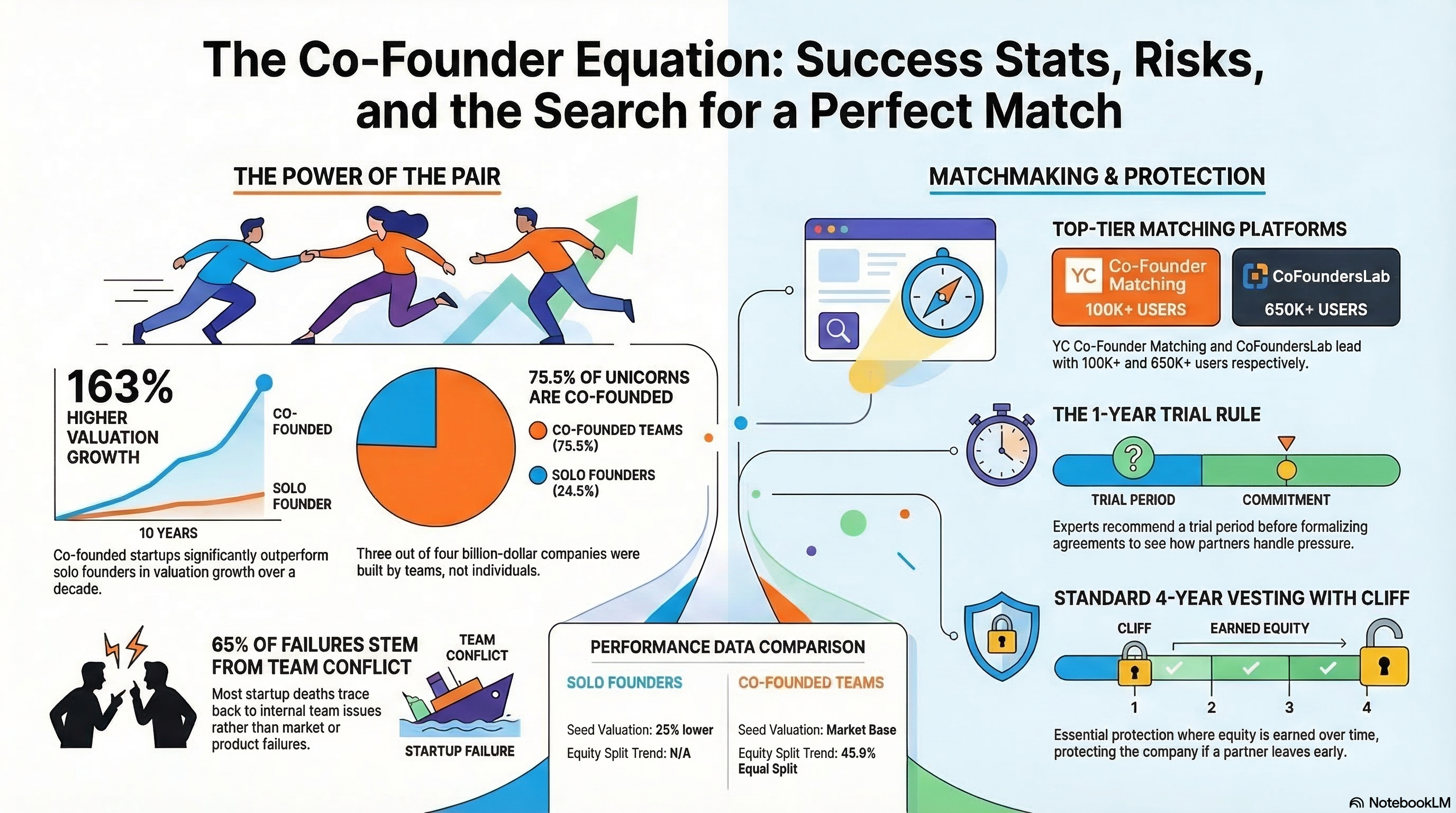
One of the most complex negotiations in the transition from project to company is the allocation of equity. Equity should reflect both past contributions and future commitment. While equal splits are becoming more common—rising from 31.5% in 2015 to 45.9% in 2024 for two-person teams—investors often view them with caution, as they may indicate a failure to have "tough conversations" about leadership and value.
Factors in Equity Distribution
Equity should be distributed based on a weighted matrix of contributions. Full-time founders who take significant financial risk should always hold more equity than part-time or academic co-founders.
Contribution Type | Typical Impact on Equity Split | Rationale |
Full-Time Commitment | High Premium (1.0x multiplier) | Founder is taking 100% risk and opportunity cost. |
Technical/MVP Build | Moderate Premium (e.g., 60/40) | Value of existing functional prototype and domain expertise. |
Capital Investment | Simple Equity-for-Cash Exchange | Directly offsets initial operating expenses. |
Academic/Advisor Role | 5-10% Cap | Provides ongoing expertise without full-time risk. |
Domain Knowledge | Milestone-linked Equity | Value is realized only if the company reaches specific targets. |
The Role of Vesting and 83(b) Elections
Vesting is an essential mechanism for protecting the company from "dead equity"—shares held by founders who leave early. The industry standard is a four-year vesting schedule with a one-year cliff. If a founder leaves before the cliff, they forfeit all shares; after the cliff, shares vest monthly. For shares subject to vesting, founders must file an 83(b) election within 30 days of acquisition to avoid potentially massive tax liabilities as the company’s valuation grows.
The Institutional Support Ecosystem: Student VCs and Accelerators
A unique feature of the current entrepreneurial landscape is the emergence of student-run venture capital funds and university-specific fellowships. These organizations provide "first money in" capital and integrate student founders into elite networks.
Key Student Venture Funds
Dorm Room Fund (DRF): Backed by First Round Capital, DRF invests between $90,000 and $250,000 for a target 1.3% equity stake. They prioritize "awesome founders" and teams with a unique connection to the problem they are solving.
Rough Draft Ventures (RDV): A General Catalyst initiative that provides $25,000 in pre-seed funding. RDV focuses on technology-focused university entrepreneurs and provides a suite of resources including AWS credits and legal support.
XFund (The Experiment Fund): Targets university-born startups but requires a full-time team, meaning founders must have graduated or be on a leave of absence.
Pear Fellows: An apprenticeship program where student investors work with Pear VC to find and support student founders.
Digital Communities and Networking Platforms
For founders without an immediate on-campus network, online communities have become a vital source of co-founder matching and advice.
Community Type | Key Platforms | Primary Value Proposition |
Founder Matching | YC Co-founder Matching, StartHawk, Indie Hackers | Platforms specifically designed to match skill sets and interests. |
Vibrant Slack Groups | Startup Chat, MindTheProduct, Furlough, #Launch | Real-time feedback, Q&A, and networking with global founders. |
Diversity-Focused | #FemaleFounders, Black in Technology, LGBTQ in Tech | Specialized support and safe spaces for underrepresented founders. |
Regional Channels | Philly Startup Leaders, MSPTech, pdxstartups | Localized resources, events, and co-working opportunities. |
Case Studies: From Dorm Room to Global Market
The narrative of student entrepreneurship is punctuated by several foundational case studies that illustrate the transition from a side project to a market-dominating entity.
DoorDash: The Stanford Logistics Experiment
Founded in 2012 by Stanford students Tony Xu, Evan Moore, Andy Fang, and Stanley Tang, DoorDash (originally PaloAltoDelivery.com) was born from a localized insight. The founders spent time interviewing small business owners in Palo Alto and discovered that many had clipboards full of delivery orders they were unable to fulfill. The team’s MVP was a simple website with restaurant menus and their personal phone numbers. By performing the deliveries themselves for the first six months, the founders gained the granular operational knowledge necessary to build a software-enabled logistics platform.
Snackpass: Socializing the Campus Economy
Kevin Tan, Jamie Marshall, and Jonathan Cameron founded Snackpass at Yale in 2017. Their key insight was that eating is a social activity; by making ordering fun through social features like "gifting" reward points and food, they achieved viral growth. The gifting feature was actually inspired by Tan's attempt to flirt with a girl by sending her a smoothie through the app. Within a semester, the app reached 80% penetration at Yale, demonstrating the power of a hyper-local, social-first strategy on a dense college campus.
Google and Facebook: The Academic Infrastructure
The world's most famous search engine, Google, was started in 1996 by PhD students Larry Page and Sergey Brin at Stanford. Their meeting was serendipitous—Brin was assigned to show Page around campus. Together, they developed the "BackRub" algorithm from their dorm rooms, eventually securing a $100,000 check from Silicon Valley investors. Similarly, Facebook was launched as "TheFacebook" in 2004 in Mark Zuckerberg's Harvard dorm room, initially as a way to connect students through an online community before expanding to other Ivy League colleges.
Strategic Synthesis and Future Outlook
The process of transitioning a college project into a company is fundamentally a exercise in risk management and talent aggregation. Successful student founders are those who recognize the university as a temporary sandbox for experimentation but have the discipline to professionalize their operations as they scale.
The data suggests that the most successful ventures are those that:
Iterate on Real Problems: Both DoorDash and Snackpass succeeded because they addressed documented pain points in the restaurant-consumer relationship rather than purely theoretical problems.
Establish Robust Governance Early: Negotiating equity splits, implementing vesting, and resolving IP ownership before significant value is created are the hallmarks of a mature founding team.
Utilize the Campus for "Low-Stakes" Vetting: Trial projects and on-campus demonstrations provide an empirical basis for selecting a co-founder, reducing the likelihood of a "co-founder breakup" later in the company's life.
Leverage Institutional and Peer Capital: The growth of student-run venture funds has created a bridge between the university and Sand Hill Road, allowing student founders to raise pre-seed capital without dropping out prematurely.
As the global economy increasingly values rapid technical innovation, the university's role as a founder-sourcing engine will only intensify. For the student entrepreneur, the campus is not just a place for study, but a high-fidelity simulator for the professional venture landscape. The ability to find a co-founder in this environment is the first, and perhaps most important, test of a founder's ability to build a world-changing company.
Read More
1. From Idea to MVP: A Step-by-Step Guide for Solo Founder
🔗 https://findnstart.com/blogs/from-idea-to-mvp-a-step-by-step-guide-for-solo-founder
2. How to Validate Your Startup Idea in 48 Hours for $0
🔗 https://findnstart.com/blogs/how-to-validate-your-startup-idea-in-48-hours-for-0
3. Remote vs. Local: Does Your Co-Founder Need to Live in the Same City?
🔗 https://findnstart.com/blogs/remote-vs-local-does-your-co-founder-need-to-live-in-the-same-city
4. The 2026 Startup Landscape: What Has Fundamentally Changed (and Why Founder Skills Matter More Than Ever)
5. The Most In-Demand Skills for Startup Founders in 2026
🔗 https://findnstart.com/blogs/the-most-in-demand-skills-for-startup-founders-in-2026
6. How to Find a Technical Co-Founder (Without a Six-Figure Salary)
🔗 https://findnstart.com/blogs/how-to-find-a-technical-co-founder-without-a-six-figure-salary
7. 5 Red Flags to Look for When Choosing a Startup Partner
🔗 https://findnstart.com/blogs/5-red-flags-to-look-for-when-choosing-a-startup-partner
8. How to Pitch Your Idea to Potential Co-Founders
🔗 https://findnstart.com/blogs/how-to-pitch-your-idea-to-potential-co-founders
9. How to Build a Portfolio that Attracts High-Growth Startup Founders
🔗 https://findnstart.com/blogs/how-to-build-a-portfolio-that-attracts-high-growth-startup-founders
10. Equity vs. Salary: How to Split Ownership with Your First Teammate
🔗 https://findnstart.com/blogs/equity-vs-salary-how-to-split-ownership-with-your-first-teammate
11. Why Joining an Early-Stage Startup is Better Than a Corporate Job
🔗 https://findnstart.com/blogs/why-joining-an-early-stage-startup-is-better-than-a-corporate-job
12. The Future of EdTech: Why Developers and Educators Need to Team Up Now
🔗 https://findnstart.com/blogs/the-future-of-edtech-why-developers-and-educators-need-to-team-up-now
13. The Architecture of Symbiosis: Analytical Perspectives on the Five Habits of Successful Startup Duos
14. Finding a Co-Founder in the AI Space: What Skills Should You Look For?
🔗 https://findnstart.com/blogs/finding-a-co-founder-in-the-ai-space-what-skills-should-you-look-for
15. Overcoming Analysis Paralysis and the Strategic Path to Execution
🔗 https://findnstart.com/blogs/overcoming-analysis-paralysis-and-the-strategic-path-to-execution
16. From College Project to Company: How to Find Your Student Co-Founder
🔗 https://findnstart.com/blogs/from-college-project-to-company-how-to-find-your-student-co-founder
17. How to Start a Startup While Working a Full-Time Job
🔗 https://findnstart.com/blogs/how-to-start-a-startup-while-working-a-full-time-job
18. How to Build a HealthTech Startup Without a Medical Degree
🔗 https://findnstart.com/blogs/how-to-build-a-healthtech-startup-without-a-medical-degree
19. The Solitary Architect: Executive Isolation in Entrepreneurship
20. The 2026 Guide to Launching a SaaS as a Solo Developer
21. What Sustainable Growth Actually Looks Like
🔗 https://findnstart.com/blogs/what-sustainable-growth-actually-looks-like
22. The Early Warning Signs Your Startup Is in Trouble
🔗 https://findnstart.com/blogs/the-early-warning-signs-your-startup-is-in-trouble
23. How to Grow Without Burning Out
🔗 https://findnstart.com/blogs/how-to-grow-without-burning-out
24. The Truth About “Runway” Most Founders Ignore
🔗 https://findnstart.com/blogs/the-truth-about-runway-most-founders-ignore
25. Revenue Solves More Problems Than Funding
🔗 https://findnstart.com/blogs/revenue-solves-more-problems-than-funding
🆕 Newly Added Articles
26. What No One Tells You About Being a Solo Founder
🔗 https://findnstart.com/blogs/what-no-one-tells-you-about-being-a-solo-founder
27. Why Smart People Quit High-Paying Jobs to Build Startups (And Why Most Regret It)
28. Why Most Startup Advice on Twitter Is Dangerous
🔗 https://findnstart.com/blogs/why-most-startup-advice-on-twitter-is-dangerous
29. Decision Fatigue: The Silent Startup Killer
🔗 https://findnstart.com/blogs/decision-fatigue-the-silent-startup-killer
30. Fear vs Logic: How Founders Actually Make Decisions
🔗 https://findnstart.com/blogs/fear-vs-logic-how-founders-actually-make-decisions
31. How Overthinking Destroys Early Momentum
🔗 https://findnstart.com/blogs/how-overthinking-destroys-early-momentum
32. Ideas Don’t Scale. Systems Do.
🔗 https://findnstart.com/blogs/ideas-dont-scale-systems-do
33. The First Hire That Actually Matters
🔗 https://findnstart.com/blogs/the-first-hire-that-actually-matters
34. How the First 100 Users Decide Your Startup’s Fate
🔗 https://findnstart.com/blogs/how-the-first-100-users-decide-your-startups-fate
35. Why Your Startup Doesn’t Need Growth — It Needs Focus
🔗 https://findnstart.com/blogs/why-your-startup-doesnt-need-growthit-needs-focus
36. Why Most Startups Die Quietly
🔗 https://findnstart.com/blogs/why-most-startups-die-quietly
37. Lessons Learned Too Late by First-Time Founders
🔗 https://findnstart.com/blogs/lessons-learned-too-late-by-first-time-founders
38. The Myth of the “Overnight Success” Startup
🔗 https://findnstart.com/blogs/the-myth-of-the-overnight-success-startup
Protect Your Future: The Precision Vesting Calculator
Don't let a "handshake deal" complicate your exit. Map out your ownership journey with our Vesting Calculator
Calculate Your Vesting Schedule →