Why Fintech in the US Is Quietly Making a Comeback
February 26, 2026 by Harshit GuptaThe narrative of the United States financial technology sector has undergone a profound transformation, evolving from the speculative exuberance of the 2021 hype cycle to a period of rigorous structural maturation and discipline in 2025 and 2026. This resurgence is not characterized by the loud, valuation-driven headlines of the past but by a "quiet" comeback rooted in fundamental infrastructure, sustainable unit economics, and the integration of sophisticated technological paradigms such as agentic artificial intelligence and real-world asset tokenization. After three consecutive years of decline, the industry entered 2025 with a regained level of industry optimism, marked by high levels of innovation and positive developments on the regulatory front. The United States has re-emerged as the primary beneficiary of this stabilization, capturing a dominant share of global fintech mega-rounds and demonstrating a clear investor preference for platforms that have achieved a state of "AI-readiness" and operational profitability. This report analyzes the multi-faceted drivers of this comeback, examining the macroeconomic environment, the shift toward B2B infrastructure, the impact of landmark legislation such as the GENIUS Act, and the profound reshaping of the financial stack through autonomous AI agents.
Macroeconomic Foundations and the Valuation Equilibrium
The revitalization of the U.S. fintech sector is inextricably linked to the broader macroeconomic shift from a regime of aggressive monetary tightening to one of stability and anticipated easing. Throughout 2025, the U.S. economy settled into an equilibrium where slower labor supply growth was met by slower labor demand, avoiding the widely feared recessionary spiral. This environment provided a predictable backdrop for fintech valuations to normalize and for capital to begin flowing again with purpose. The Federal Reserve's decision to hold the target range for the funds rate steady at 3.5%–3.75% by the end of 2025 signaled the end of the "Great Reset," allowing firms to price risk more accurately and plan for long-term expansion.
The Impact of Monetary Easing on Cost of Capital
The trajectory of interest rates serves as the primary lever for fintech recovery, directly influencing the discount rates applied to future cash flows. The Federal Reserve executed rate cuts totaling 175 basis points between September 2024 and December 2025, bringing the overnight rate to a range of 3.50% to 3.75%. This reduction in the base rate has a threefold impact on the fintech ecosystem: it lowers the cost of financing for buyouts and growth equity, boosts asset valuations by decreasing the discount rate, and improves the economics of new transactions, thereby stimulating overall investment activity. For private equity and venture capital, lower base rates support higher debt service coverage ratios and alleviate concerns regarding default risks among highly leveraged portfolio companies.
Macroeconomic Indicator | 2024 Actual | 2025 Estimate | 2026 Projection |
U.S. Real GDP Growth | 2.5% | 2.0% | 2.0% |
Federal Funds Rate (Year-End) | 4.25% - 4.50% | 3.50% - 3.75% | 3.00% - 3.25% |
Consumer Price Inflation (CPI) | 3.1% | 2.7% | ~2.0% |
Fed Balance Sheet Size | ~$7.5 Trillion | $6.5 Trillion | Variable |
S&P 500 Performance | ~24% | 15.8% | N/A |
Sources:
The stabilization of inflation at approximately 2.7% by December 2025 further buoyed market confidence, even as the labor market cooled. This cooling, characterized as a "low-hire, low-fire" environment, has allowed fintech firms to manage their talent costs more effectively, moving away from the wage inflation that plagued the 2021–2022 period. The anticipation of an additional 50 basis points of easing in the second half of 2026 continues to fuel optimism, suggesting that the "new trade order" and domestic growth supports, such as tax cuts, will provide a constructive path for fintech service demand.
The Flight to Quality and Profitability Metrics
In contrast to the 2021 cycle, where "headline growth at any cost" was the primary metric for capital allocation, the 2025–2026 resurgence is defined by a "flight to quality". Investors have become significantly more selective, focusing on category-defining leaders that demonstrate sustainable profit potential and realized unit economics. This shift has resulted in a concentration of capital into fewer, higher-conviction opportunities, where total global fintech investment rose from $95.5 billion in 2024 to $116 billion in 2025, even as the total number of deals fell to an eight-year low. The market now distinguishes between "disciplined B2B solutions," which are thriving, and "B2C fintechs built for expansion rather than efficiency," which remain misaligned with current investor and acquirer appetites.
Capital Concentration and the Dominance of the U.S. Hub
The United States has reinforced its position as the global center for fintech innovation and capital deployment. In 2025, the U.S. captured 65% of global fintech mega-rounds and 43% of all fintech deals, representing record highs in capital concentration. Total fintech investment in the Americas rose to $66.5 billion in 2025, with the U.S. accounting for $56.6 billion of that total—a marked increase from $42.4 billion in 2024. This trend indicates a decisive return of confidence at the top end of the market, particularly in the second half of 2025, when U.S. funding was 63% higher than in the first half.
Regional Shifts and Talent Arbitrage
A significant insight into the 2025–2026 recovery is that fintech growth is no longer exclusively concentrated in traditional coastal hubs. Lower talent costs and the ubiquity of high-performance digital infrastructure have made regional U.S. markets attractive for scaling startups. Investors are increasingly shifting capital to these areas, where they can capture stronger risk-reward potential due to lower operational overhead. This decentralization allows fintechs to achieve profitability faster by turning what were previously high fixed labor costs into more manageable variable expenses, often through the use of strategic outsourcing and AI-driven automation.
Region/Metric | 2025 Total Investment | H1 2025 Investment | H2 2025 Investment |
Global Fintech | $116.0 Billion | $59.7 Billion | $56.3 Billion |
Americas (Total) | $66.5 Billion | $39.1 Billion | $27.4 Billion |
United States | $56.6 Billion | $32.7 Billion | $23.9 Billion |
EMEA | $29.2 Billion | $15.4 Billion | $13.8 Billion |
Asia-Pacific | $9.3 Billion | $4.7 Billion | $4.6 Billion |
Sources:
The resilience of the U.S. market is further demonstrated by the role of Corporate Venture Capital (CVC). Corporate participation in fintech funding rose to $29.7 billion globally in 2025, up from $20.9 billion in 2024. This surge in CVC activity highlights a strategic pivot by incumbent financial institutions: rather than viewing fintechs purely as competitors, banks are investing in them to accelerate their own digital transformation and AI integration efforts.
The Evolution of the Fintech Funding Stack
The funding mechanism itself has matured, moving beyond simple equity rounds. Private credit now accounts for nearly 20% of total deal financing, often working alongside traditional bank lending to provide growth capital for fintechs that possess strong collateral or predictable cash flows. The rise of "structured equity" and "convertible debt" allows growth companies to manage market timing risks more effectively, while "revenue-based financing" and "token-based financing" have emerged as viable alternatives for startups in the blockchain and digital asset sectors. This diversification of the capital stack provides a safety net that was absent during previous cycles, ensuring that viable companies can maintain a runway even during periods of public market volatility.
The Technological Vanguard: Agentic AI and the Autonomous Stack
The most transformative force driving the quiet fintech comeback in 2026 is the transition from pilot programs to the enterprise-wide deployment of agentic artificial intelligence. Unlike the first wave of generative AI, which focused on content creation and simple chat interfaces, agentic AI systems are designed to "think, act, learn, and collaborate" within complex, multi-step financial workflows. This shift represents a fundamental reshaping of the financial landscape, where cloud-native systems and modular architectures are becoming the backbone of the major fintech trends.
From Predictive Analytics to Autonomous Workflows
By 2026, banks and fintechs are no longer merely using AI for siloed pilots; they are integrating autonomous agents into their core operations to handle everything from KYC/AML investigations to underwriting and personalized wealth management. These agentic systems excel at interpreting unstructured financial documents, investigating anomalies in real-time transaction streams, and interacting with multiple APIs to resolve exceptions without human intervention.
AI Agent Use Case | Efficiency Metric/Outcome | Key Capability |
KYC/AML Case Agents | 95% reduction in review time | Automated SAR drafting and data gathering |
Underwriting Agents | Real-time credit decisioning | Calculation of risk factors from diverse signals |
Fraud Investigation | Autonomous triage of alerts | Pattern matching across high-velocity data |
Document Processing | 360,000+ manual hours saved | Extraction from legal documents and tables |
Customer Service | 65% reduction in resolution time | End-to-end resolution of complex inquiries |
Sources:
The deployment of platforms like Salesforce’s Agentforce and JPMorgan’s proprietary document extraction engines demonstrates a practical path to scaling AI across global teams. Gartner reports that by 2026, autonomous customer service agents will maintain satisfaction rates as high as 92% while significantly reducing the operational burden on human representatives. This allows human capital to be redirected toward high-stakes advisory work and strategic innovation, fundamentally improving the operating leverage of financial institutions.
Redefining Customer Experience and Personalization
Hyper-personalization has moved from a marketing buzzword to a technical reality. AI agents analyze user context, spending patterns, and market trends to build "genuinely personalized financial profiles" for each client. In wealth management, this means providing real-time guidance that reflects an individual’s personal goals and risk tolerance as market conditions shift. In 2026, 66% of consumers express comfort with their financial institutions using data to tailor services, and 35% of banks have listed data-driven personalized engagement as a top strategic priority.
However, this rapid adoption has created a "trust barrier." While AI is integral to fraud detection and risk management, 84% of American consumers express concerns about AI in banking, primarily regarding privacy, security, and the potential for errors. Consequently, the "quiet comeback" is also a "transparent comeback," where institutions are prioritizing "explainable AI" and regular audits to build consumer confidence. Successful firms in 2026 are those that pair AI efficiency with "human reassurance," often utilizing a hybrid model where AI handles the heavy lifting but humans provide final oversight for high-impact decisions.
The Technical Requirements for "AI-Ready" Data
The success of these AI initiatives in 2026 hinges on data modernization. Legacy data silos are the primary inhibitor of AI progress, leading banks to pour capital into what is termed "AI-ready data"—systems that are accurate, timely, broad in scope, and properly governed. Technology readiness is becoming the decisive factor in M&A activity; firms that possess modular, API-first architectures are the "acquirers," while those with rigid legacy systems are increasingly the "acquired". This drive for infrastructure modernization is a key reason why financial infrastructure is expected to be the trend that the industry focuses on most intensely throughout 2026.
The Legislative Watershed: The GENIUS Act and the Legitimatization of Digital Assets
Regulatory uncertainty has historically been one of the greatest headwinds for U.S. fintech, particularly in the realm of blockchain and digital currencies. This changed decisively on July 18, 2025, with the enactment of the Guiding and Establishing National Innovation for U.S. Stablecoins (GENIUS) Act. This landmark legislation provides the first comprehensive federal framework for the issuance of payment stablecoins, offering the clarity necessary for mass adoption by traditional financial institutions.
Structural Provisions and Regulatory Oversight
The GENIUS Act defines "payment stablecoins" as digital assets pegged to a stable currency (typically the U.S. Dollar) and intended for use as a means of payment or settlement. To protect consumers and ensure financial stability, the act mandates that stablecoins be 100% backed by cash and high-quality liquid assets, such as U.S. Treasuries.
The legislation creates a tiered system of Permitted Payment Stablecoin Issuers (PPSIs):
Insured Depository Institution Subsidiaries: Allowing traditional banks to enter the space under existing regulatory umbrellas.
Federal Qualified Payment Stablecoin Issuers: Entities licensed directly by the Office of the Comptroller of the Currency (OCC).
State Qualified Stablecoin Issuers: Permitting states to regulate issuers if their regime is "substantially similar" to the federal framework, provided the issuers do not exceed $10 billion in consolidated outstanding issuance.
This framework effectively "de-risks" the stablecoin market, preventing future administrations from targeting digital assets through extra-legal measures like "Operation Chokepoint". By August 2025, stablecoin transaction volumes had surged to $10 billion, up from $6 billion in February, as corporates began to leverage the technology for real-time B2B settlement.
Implications for the U.S. Dollar and B2B Payments
The GENIUS Act is not merely a crypto bill; it is a strategic move to reinforce the U.S. dollar’s status as the global reserve currency. By creating a regulated path for dollar-denominated stablecoins, the act drives significant new demand for U.S. Treasuries, as issuers must hold these assets to back their digital tokens. For fintechs, the act enables a "paradigm shift" in payments. Sending money abroad, which was previously slow and costly, can now happen near-instantaneously at a fraction of the cost. This unlocks working capital for U.S. companies with international operations and creates a new competitive front for B2B banking.
GENIUS Act Category | Regulatory Body | Reserve Requirements | Compliance Standards |
Federal Qualified Issuer | OCC | 100% Liquid Assets | Full BSA/AML & Sanctions |
State Qualified Issuer | State Regulators / Treasury | 100% Liquid Assets | Substantially Similar to Fed |
Bank Subsidiary | OCC / FDIC / FRB | 100% Liquid Assets | Traditional Bank Standards |
Foreign Issuer (FPSI) | Federal Regulators | Varies | Must meet U.S. standards |
Sources:
The implementation of the GENIUS Act in 2026 is driving massive infrastructure investment. Companies must develop robust custody and safekeeping protocols, while also building real-time settlement rails that can integrate with existing U.S. payment systems. This has sparked a surge in "asset tokenization," particularly of money market funds and real estate, as both incumbents and fintechs look to leverage blockchain for operational efficiency and broader investment access.
The Open Banking Struggle: Section 1033 and the Right to Data
While the GENIUS Act provided clarity for digital assets, the battle over consumer data rights under Section 1033 of the Dodd-Frank Act has been more contentious. The CFPB’s "Open Banking" rule, finalized in October 2024, aimed to empower consumers to share their financial data with third-party apps for free. However, the rule faced immediate legal challenges from the Bank Policy Institute and other banking trade groups, leading to a temporary stay and a subsequent "reopening" of the rulemaking process in 2025.
The Core of the Conflict: Security vs. Competition
The conflict centers on the definition of a consumer’s "representative" and the allocation of costs. Banks argue that the rule as originally written gives "big technology companies the green light to exploit the privacy and security of consumer financial data," while forcing banks to shoulder the financial burden of providing the data-sharing infrastructure. They advocate for a fiduciary relationship between consumers and the third parties that access their data, as well as the right to charge "commercially reasonable" fees for data fulfillment.
Fintech coalitions and consumer advocates, conversely, view any data-access fees as a "chill on competition" that would solidify the position of incumbent institutions. They insist that consumers should retain the freedom to delegate data access to any trusted third party—from budgeting apps to alternative lenders—to ensure a fair and competitive marketplace.
The 2026 Trajectory for Section 1033
Despite the legal delays, the CFPB is expected to issue a modified proposed rule in 2026, with an emphasis on four primary areas:
Authorized Recipients: Clarifying who can act as a consumer-authorized recipient.
Cost Allocation: Addressing the debate over data provider fees.
Information Security: Managing risks related to "screen scraping" and ensuring symmetrical security standards for both banks and fintechs.
Consumer Privacy: Limiting secondary uses of data (such as marketing or profiling) without explicit consent.
While the compliance deadlines for the largest institutions have been deferred, with the first potential deadline moving into mid-2026, the industry is already moving toward API-first standards. Bain estimates that embedded finance transaction value in the U.S. will exceed $7 trillion in 2026, a figure that is predicated on the eventual maturation of this open banking framework. Firms are increasingly prioritizing governance and trust over "quick wins," treating regulation as a common rulebook that will eventually foster a more stable and mature ecosystem.
The Renaissance of Banking-as-a-Service (BaaS) and Real-Time Settlement
The BaaS model, which allows non-bank entities to offer financial services through bank partnerships, faced a "crisis of confidence" in 2024 following the high-profile collapse of Synapse. This failure, which left millions of users without access to their funds, served as a catalyst for a more resilient "BaaS 2.0" in 2025 and 2026.
Lessons from Failure: The Regulatory Pivot
The fallout from Synapse led to intensified scrutiny by the FDIC and OCC, with regulators emphasizing that banks are "ultimately accountable for the actions and compliance of their third-party partners". In 2026, "operational resilience" has become a non-negotiable foundation for BaaS arrangements. Banks must now demonstrate robust governance oversight, early warning systems, and annual plan testing to ensure they can manage the operational risks of their fintech partners.
The BaaS market is evolving from simple white-labeling to a model where technology is "demonstrably embedded" to deliver measurable improvements in risk management. Financial institutions are now focusing on:
API-First Core Banking: Investing 6% to 12% of their revenues in cloud-native infrastructure to reduce the cost of IT spend and improve flexibility.
Direct-Ledgering Systems: Moving away from middleware that "obfuscates" the relationship between the bank and the end user to more transparent, direct integration.
Real-Time Compliance: Using AI to monitor transactions in real-time, fulfilling the rigorous KYC/AML requirements mandated by the post-2024 regulatory regime.
The Impact of FedNow and RTP Adoption
The quiet comeback of fintech is also a story of "settlement velocity." In 2025 and 2026, the U.S. has seen a surge in banks and credit unions onboarding to the FedNow Service and the private-sector Real-Time Payments (RTP) network. By mid-2025, daily transaction volumes on the RTP network reached well over a million, as consumers and businesses demanded 24/7 liquidity.
This infrastructure matters because it enables new value propositions that were previously impossible. For instance, gig workers can now receive "instant pay," and SMEs can manage their cash flows with much higher precision. The global market for RTP infrastructure is booming, and institutions that proactively design their stack around real-time processing are seeing faster adoption and higher customer loyalty.
Payment Network | Type | Launch/Growth | Primary Use Case |
FedNow | Public (Federal Reserve) | Launch 2023 / High Growth 2025 | Interbank Settlement, B2B |
RTP Network | Private (The Clearing House) | Mature / Rapid Adoption 2025-26 | Consumer Pay, B2B, Gig Economy |
Stablecoins | Decentralized/Regulated | Surge post-GENIUS Act | Cross-border, Settlement |
SWIFT | Traditional/Global | Incremental Upgrades | High-Value Cross-border |
Sources:
Market Consolidation and the Reopening of the Exit Window
A primary indicator that fintech is making a "comeback" is the re-acceleration of M&A and IPO activity. In 2025, global M&A volumes reached $4.3 trillion, a 39% increase from the prior year, driven largely by megadeals in tech and financial services. In the U.S., the total issuance reached $259 billion, signaling renewed confidence across sectors.
The Backlog of Mature Ventures
The exit market in 2026 is addressing a "backlog" of mature, venture-backed companies that stayed private during the 2022–2023 downturn. Public market investors are now welcoming issuers with "clear profitability paths" and "transparent governance," a stark contrast to the growth-at-any-cost IPOs of the previous cycle.
Significant listings in 2025 and planned for 2026 include:
Klarna: Completed a $1.3 billion U.S. listing in 2025, valuing the company at $15.1 billion.
Plaid: Anticipated 2026 issuer, representing the maturation of the fintech infrastructure layer.
Circle: Expected to test the market following the regulatory clarity provided by the GENIUS Act.
Databricks and Canva: Technology-driven giants that are increasingly intersecting with the fintech ecosystem.
Strategic Consolidation in Banking and Fintech
Bank M&A is also re-accelerating as institutions seek the scale necessary to support AI and digital transformation. In October 2025 alone, 21 bank deals were announced totaling $21.4 billion, the highest monthly value since 2019. Traditional banks are eyeing payments and specialty finance companies as acquisition targets to "import new capabilities" and consolidate back-office operations to yield expense savings. This consolidation is often the quickest path to "digital competitiveness" in a world of rising tech costs.
The M&A landscape is also being reshaped by "take-private" deals. In 2025, the $7.7 billion take-private of Dun & Bradstreet and the $10.4 billion acquisition of Skechers by 3G Capital highlighted a trend where PE firms deploy "dry powder" into mature companies with stable cash flows, often to restructure them away from the quarterly pressures of public markets.
Conclusion: The Structural Maturation of the U.S. Fintech Sector
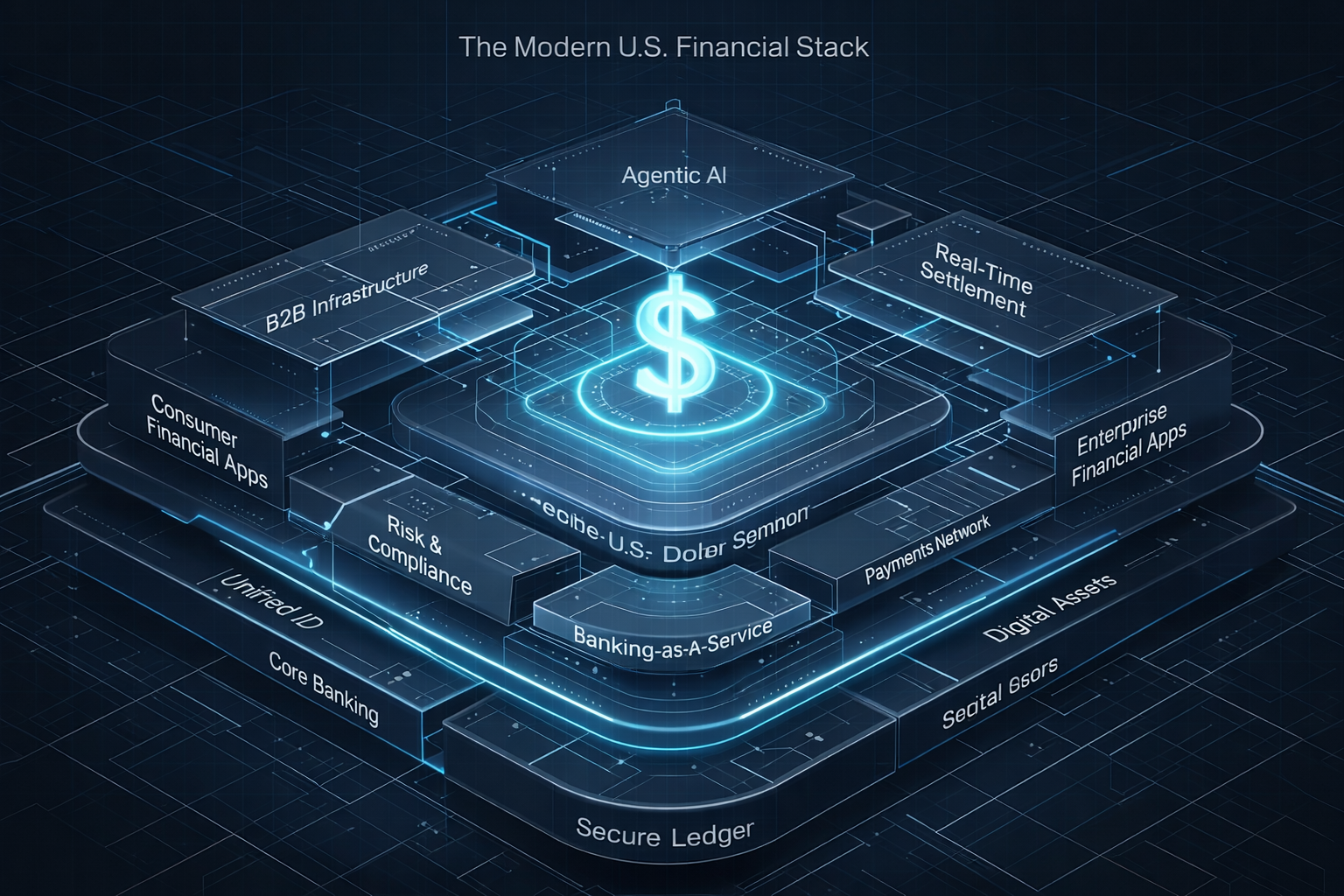
The "quiet comeback" of fintech in the United States in 2025 and 2026 represents a fundamental reinvention of the industry rather than a mere recovery. The sector has successfully navigated a period of intense contraction, emerging with more robust unit economics, a sophisticated infrastructure-first approach, and a newfound alignment with the regulatory perimeter. The convergence of landmark legislation like the GENIUS Act, the normalization of interest rates, and the enterprise-scale adoption of agentic AI has created a "new equilibrium" characterized by disciplined strategy and long-term value creation.
As the industry moves through 2026, the distinction between "fintech" and "finance" continues to blur. Traditional banks have become fintech-heavy through massive IT spending and M&A, while fintech leaders have become bank-like through licensing and rigorous compliance. The winners in this landscape are those that have prioritized "AI-ready data," operational resilience, and the "flight to quality" demanded by modern investors. While challenges such as regulatory fragmentation and the "trust barrier" in AI persist, the underlying data indicates that the U.S. fintech sector is once again the world’s most compelling investable opportunity, driven by a silent renaissance of technological and structural excellence.
Read More -
1. From Idea to MVP: A Step-by-Step Guide for Solo Founder
🔗 https://findnstart.com/blogs/from-idea-to-mvp-a-step-by-step-guide-for-solo-founder
2. How to Validate Your Startup Idea in 48 Hours for $0
🔗 https://findnstart.com/blogs/how-to-validate-your-startup-idea-in-48-hours-for-0
3. Remote vs. Local: Does Your Co-Founder Need to Live in the Same City?
🔗 https://findnstart.com/blogs/remote-vs-local-does-your-co-founder-need-to-live-in-the-same-city
4. The 2026 Startup Landscape: What Has Fundamentally Changed (and Why Founder Skills Matter More Than Ever)
5. The Most In-Demand Skills for Startup Founders in 2026
🔗 https://findnstart.com/blogs/the-most-in-demand-skills-for-startup-founders-in-2026
6. How to Find a Technical Co-Founder (Without a Six-Figure Salary)
🔗 https://findnstart.com/blogs/how-to-find-a-technical-co-founder-without-a-six-figure-salary
7. 5 Red Flags to Look for When Choosing a Startup Partner
🔗 https://findnstart.com/blogs/5-red-flags-to-look-for-when-choosing-a-startup-partner
8. How to Pitch Your Idea to Potential Co-Founders
🔗 https://findnstart.com/blogs/how-to-pitch-your-idea-to-potential-co-founders
9. How to Build a Portfolio that Attracts High-Growth Startup Founders
🔗 https://findnstart.com/blogs/how-to-build-a-portfolio-that-attracts-high-growth-startup-founders
10. Equity vs. Salary: How to Split Ownership with Your First Teammate
🔗 https://findnstart.com/blogs/equity-vs-salary-how-to-split-ownership-with-your-first-teammate
11. Why Joining an Early-Stage Startup is Better Than a Corporate Job
🔗 https://findnstart.com/blogs/why-joining-an-early-stage-startup-is-better-than-a-corporate-job
12. The Future of EdTech: Why Developers and Educators Need to Team Up Now
🔗 https://findnstart.com/blogs/the-future-of-edtech-why-developers-and-educators-need-to-team-up-now
13. The Architecture of Symbiosis: Analytical Perspectives on the Five Habits of Successful Startup Duos
14. Finding a Co-Founder in the AI Space: What Skills Should You Look For?
🔗 https://findnstart.com/blogs/finding-a-co-founder-in-the-ai-space-what-skills-should-you-look-for
15. Overcoming Analysis Paralysis and the Strategic Path to Execution
🔗 https://findnstart.com/blogs/overcoming-analysis-paralysis-and-the-strategic-path-to-execution
16. From College Project to Company: How to Find Your Student Co-Founder
🔗 https://findnstart.com/blogs/from-college-project-to-company-how-to-find-your-student-co-founder
17. How to Start a Startup While Working a Full-Time Job
🔗 https://findnstart.com/blogs/how-to-start-a-startup-while-working-a-full-time-job
18. How to Build a HealthTech Startup Without a Medical Degree
🔗 https://findnstart.com/blogs/how-to-build-a-healthtech-startup-without-a-medical-degree
19. The Solitary Architect: Executive Isolation in Entrepreneurship
20. The 2026 Guide to Launching a SaaS as a Solo Developer
21. What Sustainable Growth Actually Looks Like
🔗 https://findnstart.com/blogs/what-sustainable-growth-actually-looks-like
22. The Early Warning Signs Your Startup Is in Trouble
🔗 https://findnstart.com/blogs/the-early-warning-signs-your-startup-is-in-trouble
23. How to Grow Without Burning Out
🔗 https://findnstart.com/blogs/how-to-grow-without-burning-out
24. The Truth About “Runway” Most Founders Ignore
🔗 https://findnstart.com/blogs/the-truth-about-runway-most-founders-ignore
25. Revenue Solves More Problems Than Funding
🔗 https://findnstart.com/blogs/revenue-solves-more-problems-than-funding
26. What No One Tells You About Being a Solo Founder
🔗 https://findnstart.com/blogs/what-no-one-tells-you-about-being-a-solo-founder
27. Why Smart People Quit High-Paying Jobs to Build Startups (And Why Most Regret It)
28. Why Most Startup Advice on Twitter Is Dangerous
🔗 https://findnstart.com/blogs/why-most-startup-advice-on-twitter-is-dangerous
29. Decision Fatigue: The Silent Startup Killer
🔗 https://findnstart.com/blogs/decision-fatigue-the-silent-startup-killer
30. Fear vs Logic: How Founders Actually Make Decisions
🔗 https://findnstart.com/blogs/fear-vs-logic-how-founders-actually-make-decisions
31. How Overthinking Destroys Early Momentum
🔗 https://findnstart.com/blogs/how-overthinking-destroys-early-momentum
32. Ideas Don’t Scale. Systems Do.
🔗 https://findnstart.com/blogs/ideas-dont-scale-systems-do
33. The First Hire That Actually Matters
🔗 https://findnstart.com/blogs/the-first-hire-that-actually-matters
34. How the First 100 Users Decide Your Startup’s Fate
🔗 https://findnstart.com/blogs/how-the-first-100-users-decide-your-startups-fate
35. Why Your Startup Doesn’t Need Growth — It Needs Focus
🔗 https://findnstart.com/blogs/why-your-startup-doesnt-need-growthit-needs-focus
36. Why Most Startups Die Quietly
🔗 https://findnstart.com/blogs/why-most-startups-die-quietly
37. Lessons Learned Too Late by First-Time Founders
🔗 https://findnstart.com/blogs/lessons-learned-too-late-by-first-time-founders
38. The Myth of the “Overnight Success” Startup
🔗 https://findnstart.com/blogs/the-myth-of-the-overnight-success-startup
Protect Your Future: The Precision Vesting Calculator
Don't let a "handshake deal" complicate your exit. Map out your ownership journey with our Vesting Calculator
Calculate Your Vesting Schedule →