The Role of Accelerators in Brazil’s Startup Growth
March 11, 2026 by Harshit Gupta
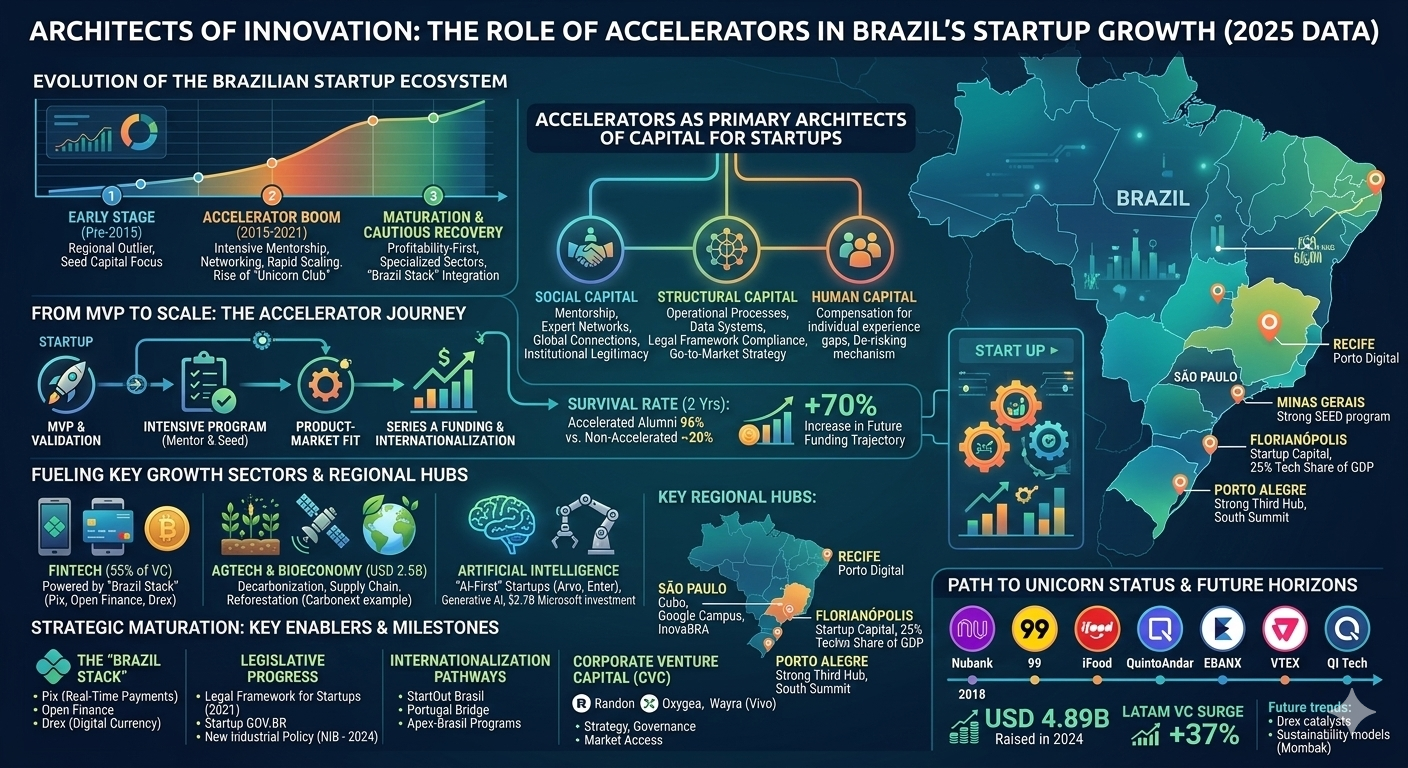
The transformation of the Brazilian startup ecosystem from a regional outlier to a global innovation powerhouse represents one of the most significant shifts in the modern venture capital landscape. As of 2025, Brazil stands as the undisputed leader in Latin American technology ventures, characterized by an increasingly sophisticated infrastructure known as the "Brazil Stack," a maturing regulatory framework, and a resilient recovery following the global post-pandemic market correction. Central to this evolution is the role of accelerators—institutional entities that have moved beyond simple seed capital provision to become the primary architects of structural, social, and structural capital for nascent enterprises. This report analyzes the multifaceted impact of these programs on the growth, survival, and internationalization of Brazilian startups, set against the backdrop of a recovering venture capital market that raised USD 4.89 billion in 2024 alone.
Macroeconomic Foundations and the 2024–2025 Venture Pivot
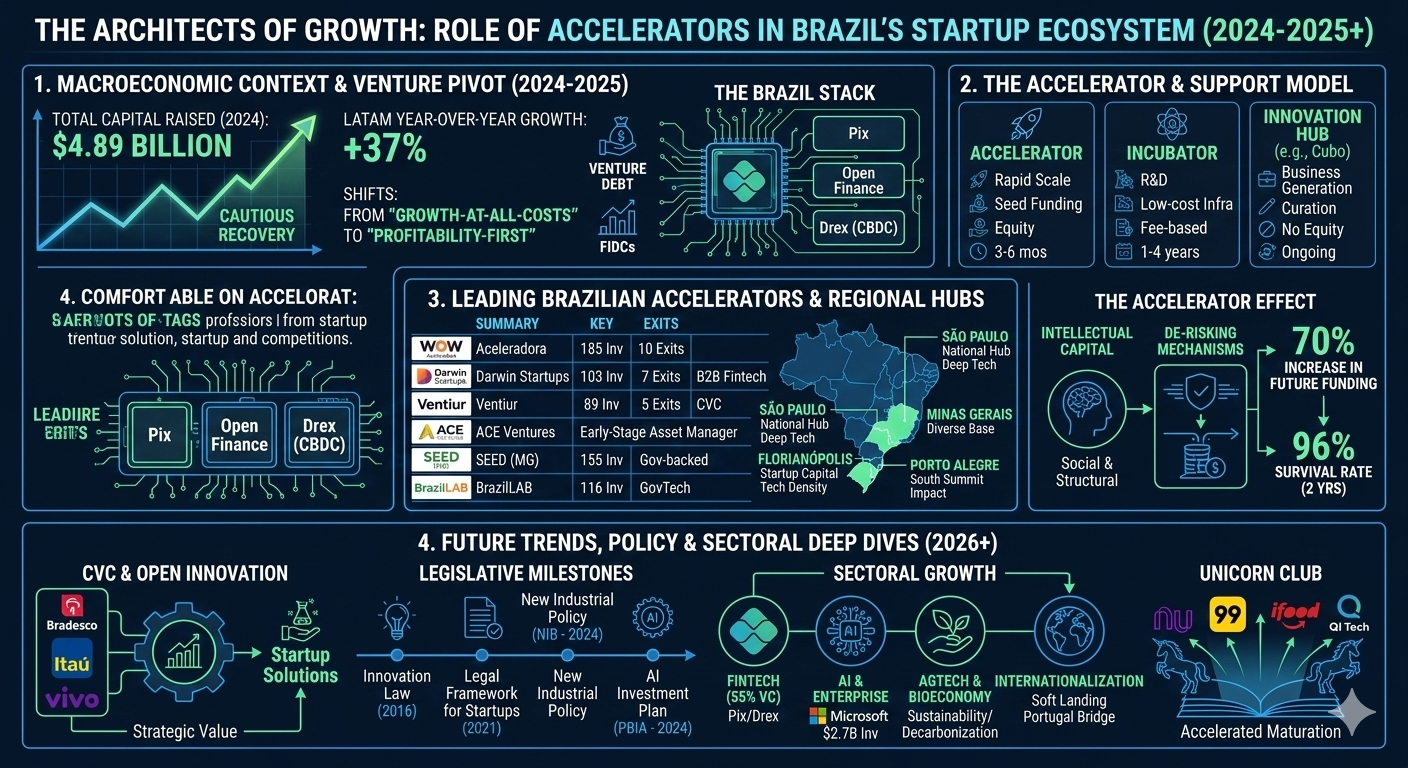
The Brazilian innovation landscape in the 2024–2025 period is defined by a cautious but steady recovery. After two years of consolidation, capital deployment in 2024 showed signs of growth and renewed optimism compared to 2023. While the total volume of deals remained "timid" in comparison to the 2021 peak, the quality of financing rounds has improved, driven primarily by local investors focusing on seed and early-stage opportunities. Latin American startups saw a 37% year-over-year increase in capital raised in 2024, marking the first annual surge in the current cycle.
However, the environment remains complex. High interest rates, maintained by the Brazilian government to contain inflation, have created an uncertain scenario for the 2025 VC market. This has necessitated a shift in startup financing; venture debt and structured financing instruments, such as Receivables Investment Funds (FIDCs), have become vital tools for companies navigating the challenges of traditional equity fundraising. Investors have transitioned from a "growth-at-all-costs" mentality to a "profitability-first" approach, where capital is priced around execution and governance rather than narrative.
Annual Venture Capital Deployment Metrics
Metric | 2024 Performance | 2025 Projections/Context |
Total Capital Raised (Brazil) | USD 4.89 Billion | Cautious rebound with USD 1.25B in H1 |
Year-over-Year Growth (LATAM) | 37% | 13.8% rebound in total VC rounds |
Number of Financing Rounds | 513 | Decreasing deal count with larger tickets |
Dominant Sector (Fintech) | 55% of total investment | Continued dominance through Pix/Drex |
Regional Concentration (São Paulo) | ~47% of total funding | Rise of Florianópolis and Porto Alegre |
This structural maturation is further evidenced by the rise of specialized sectors. While fintech continues to absorb the majority of capital, energy (13%), deep tech (6%), and healthtech (3%) are gaining significant traction. The "New Industrial Policy" launched in early 2024 has reinforced this by focusing government attention on agro-industrial chains, digitalization, and the bioeconomy, providing a supportive backdrop for verticalized accelerators in these fields.
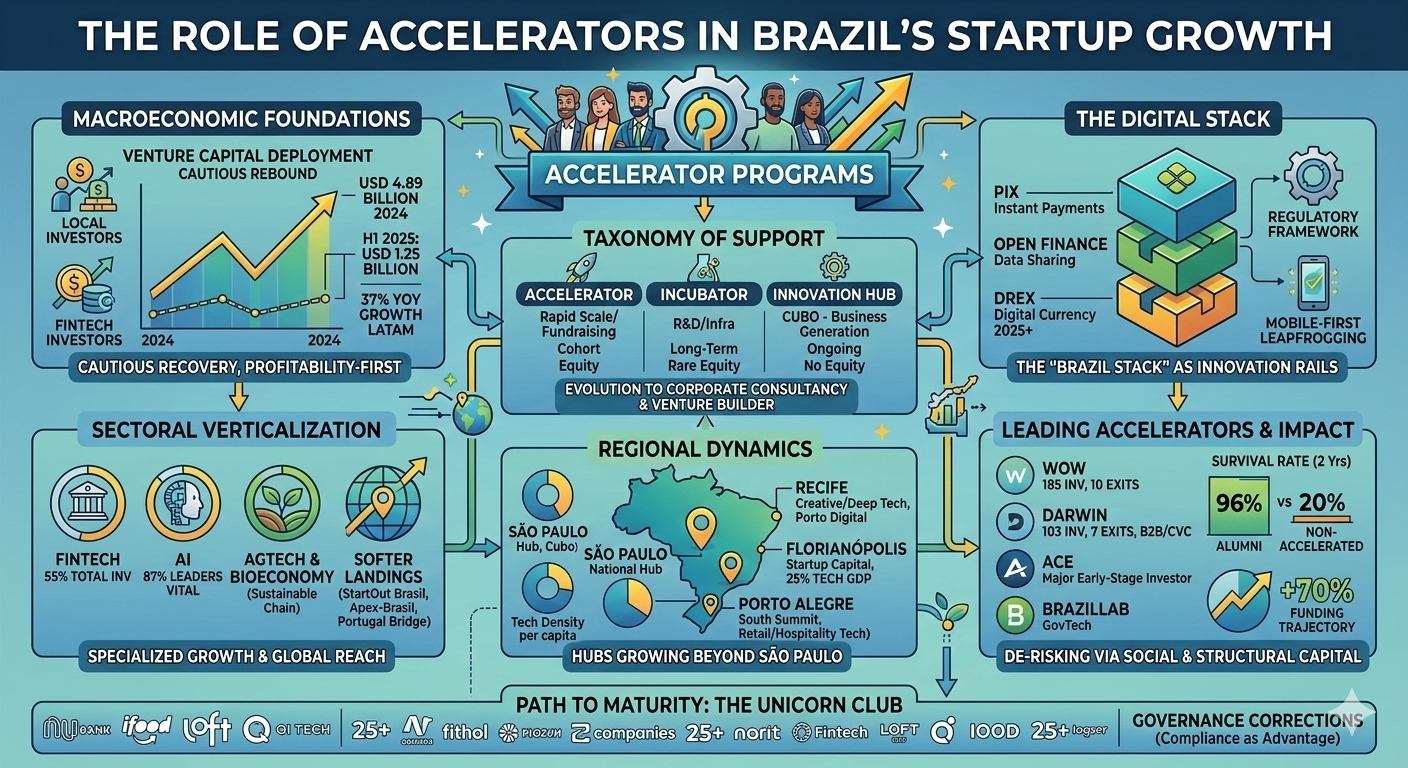
Taxonomy of Support: Accelerators, Incubators, and Hubs
The Brazilian ecosystem utilizes a variety of support mechanisms, each serving distinct stages of the startup lifecycle. Understanding the nuances between these entities is critical for assessing their respective roles in growth.
The Evolution of the Accelerator Model
In Brazil, accelerators are defined as fixed-term, cohort-based programs that provide intensive mentorship, networking, and seed funding in exchange for equity. Unlike traditional incubators, which are often real-estate-focused ventures linked to universities offering low-cost coworking space and professional services for one to four years, accelerators focus on rapid scalability.
However, the original accelerator model, which frequently involved taking high equity stakes (often 10–15%) for small financial contributions, has largely been phased out. Institutional venture capital funds increasingly viewed such stakes as a deterrent for future rounds, leading to "cluttered" cap tables. Consequently, many accelerators have pivoted toward becoming innovation consultancies for large corporations or adopting the venture builder model, where equity is earned through deeper, operational co-creation.
Innovation Hubs: The Case of Cubo Itaú
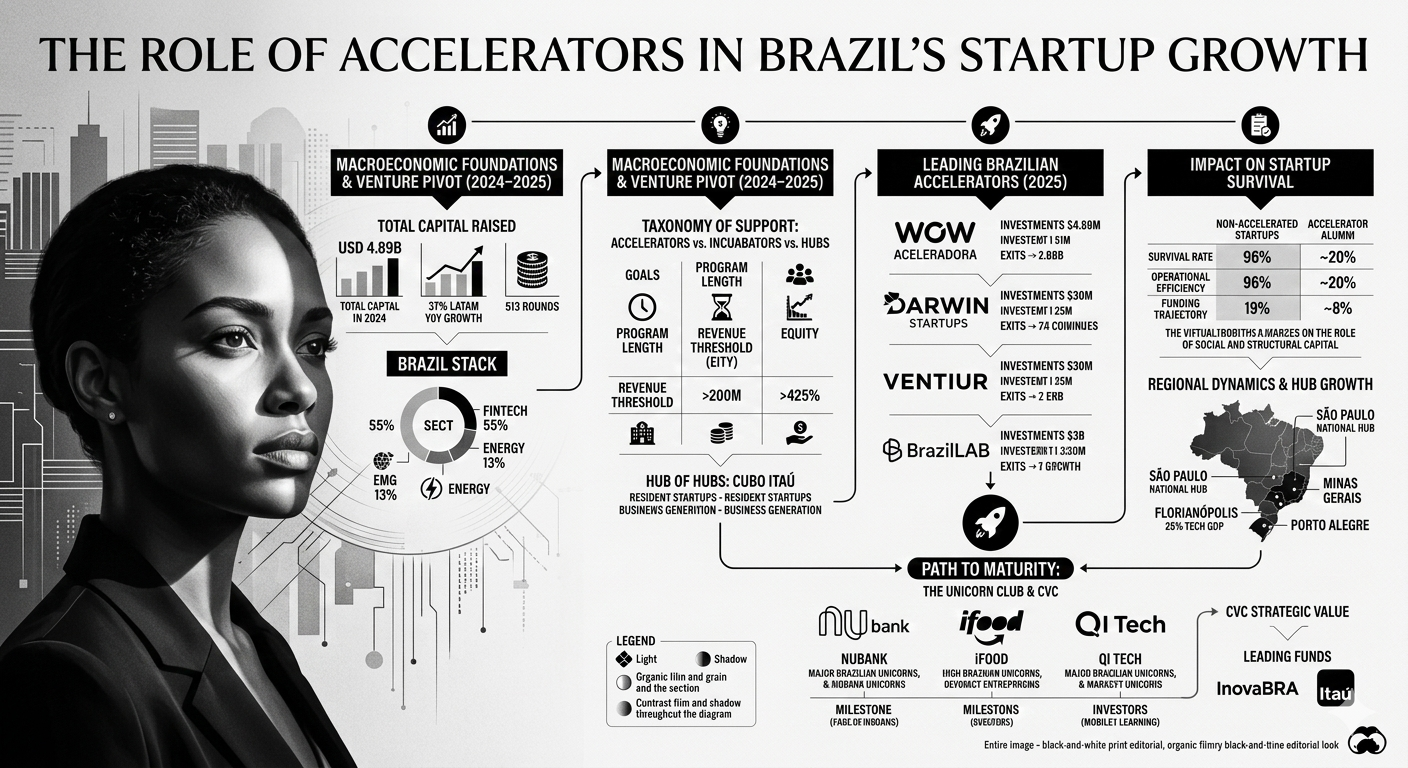
A major development in the Brazilian landscape is the emergence of innovation hubs, with Cubo Itaú (founded in 2015 by Itaú Unibanco and Redpoint eventures) serving as the regional benchmark. Unlike accelerators, Cubo does not take equity and does not follow a traditional acceleration curriculum. Instead, it acts as a non-profit "hub of hubs," curating startups with proven market traction (annual revenue typically exceeding R$ 1 million) and connecting them with a network of over 70 large corporations and dozens of investors.
The scale of this community is immense: Cubo Brazil occupies 20,000 square meters in São Paulo, hosting over 200 resident startups and seeing 700 visitors daily. In 2024, member startups collectively earned more than R$ 10 billion, highlighting the hub's role as a business generator rather than a mere training ground. This model prioritizes "open innovation," where the primary goal is to match startup solutions with the specific pain points of corporate partners.
Comparative Framework of Support Entities
Feature | Accelerator | Incubator | Innovation Hub (Cubo) |
Primary Goal | Rapid scale and fundraising | Resource and infra support | Business generation/Curation |
Program Length | 3–6 months | 1–4 years | Ongoing residency |
Revenue Threshold | Early-stage/Seed | Ideation/R&D | > R$ 1 Million |
Equity Required | Yes (historically 5-15%) | Rare/Fee-based | No |
Corporate Role | Mentorship/Investment | Service providers | Strategic partnership |
Profiles of Leading Brazilian Accelerators (2025)
The accelerator market in Brazil is segmented into private programs, regional government-backed initiatives, and vertical-specific hubs. The following entities represent the most active players in the 2024–2025 period.
Private Market Leaders
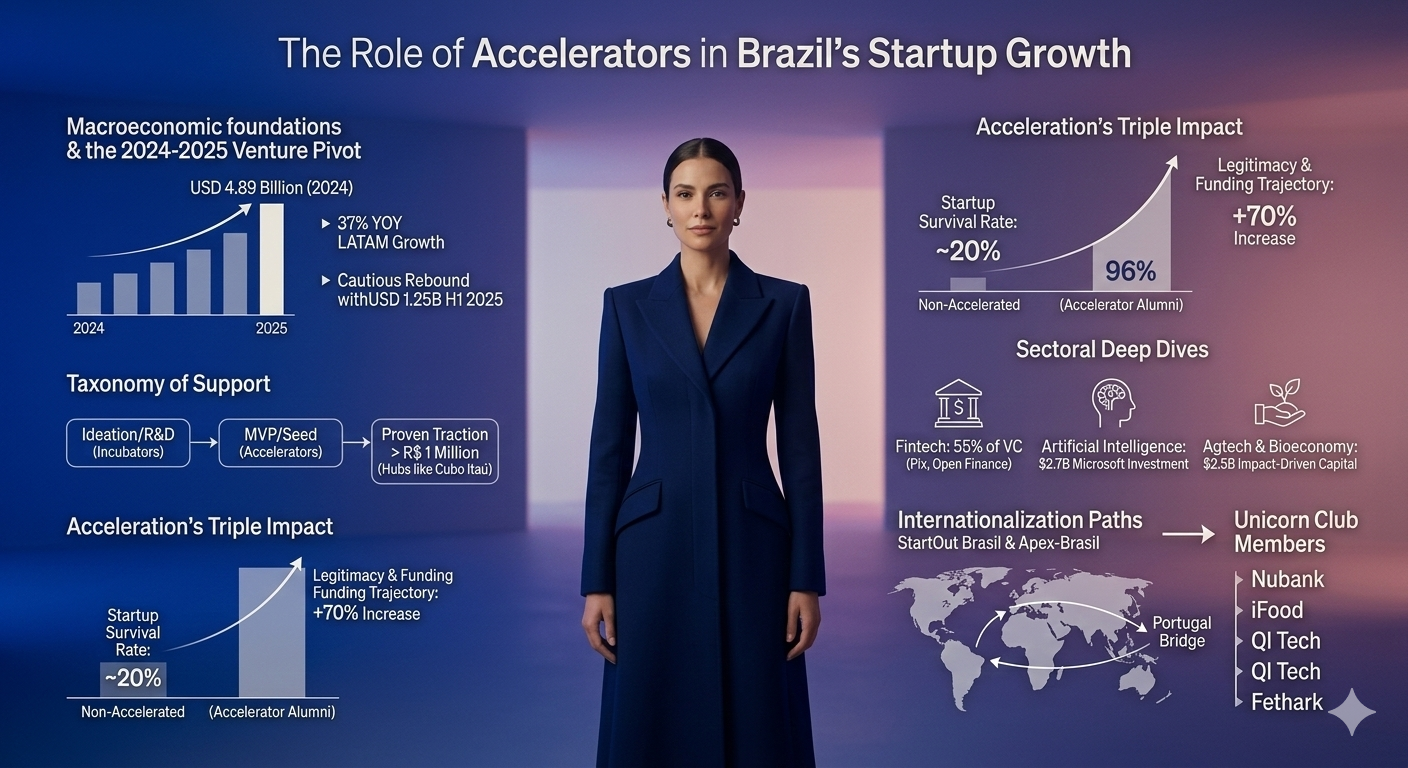
WOW Aceleradora stands as one of Brazil's most successful private programs. Founded in 2013, it has completed 185 investments with 10 exits. WOW operates a 24-week program combining capital (up to R$ 500k), networking, and intensive training, focusing on startups from the MVP stage to revenue growth.
Darwin Startups is specialized in B2B companies, particularly in fintech and enterprise software. With 103 investments and 7 exits, it differentiates itself through powerful corporate connections that facilitate market validation and business opportunities for its portfolio.
Ventiur has developed a niche in connecting early-stage entrepreneurs with established companies to facilitate Corporate Venture Capital (CVC) investments. It has a track record of 89 investments and 5 exits over a 24-week duration.
ACE Ventures (formerly ACE Startups) has transitioned from a traditional accelerator into a major early-stage investor and asset manager. Known for its "Branding" and ability to attract high-quality founders, ACE provides hands-on support in strategy, operations, and team development.
Government and Public Sector Initiatives
SEED (Startups and Entrepreneurship Ecosystem Development), an initiative from the Government of Minas Gerais, has accelerated 155 startups. It is designed to strengthen regional innovation by providing resources to diverse businesses, from environmental firms to small tech ventures.
Start-Up Brasil was a federal program launched in 2012 that used a decentralized model, partnering with private accelerators to equip startups with funding and market access. Although it has completed its original intensive cycles, its legacy continues through the professionalization of the accelerators it once supported.
BrazilLAB acts as the primary GovTech hub in Brazil, specializing in connecting startups with the public sector to solve civic challenges through technology. It has facilitated 116 investments, focusing on the unique regulatory and procurement needs of government-focused tech.
Summary of Active Brazilian Accelerators (2025 Data)
Accelerator/Incubator | Founded | Nº of Investments | Nº of Exits | Focus/Specialization |
WOW Aceleradora | 2013 | 185 | 10 | Sector-agnostic/Scaling |
SEED (MG) | 2013 | 155 | 10 | Regional growth/Diverse |
Darwin Startups | 2015 | 103 | 7 | B2B Fintech/Enterprise |
Ventiur | 2013 | 89 | 5 | CVC connections |
BrazilLAB | 2016 | 116 | 5 | GovTech/Public sector |
Start-Up Brasil | 2012 | 30 | 4 | National tech base |
21212 | 2011 | 42 | 2 | Early-stage Rio/SP |
FCJ Venture Builder | 2013 | 188 | 1 | Co-creation/CVC |
InovaBRA | 2017 | 20 | 1 | Bradesco Corporate VC |
BiotechTown | 2018 | 22 | 0 | Life sciences/Biotech |
The Impact of Intellectual Capital on Startup Survival
A critical dimension of the accelerator's role is its impact on the "Intellectual Capital" (IC) of the founding team. Research utilizing the Resource-Based View (RBV) theory and data from the Global Accelerator Learning Initiative (GALI) has isolated specific factors that drive longevity in the Brazilian and global contexts.
Social and Structural Capital vs. Human Capital
Counter-intuitively, empirical findings indicate that while social capital (networks and mentor relationships) and structural capital (organizational processes and data) positively influence startup survival, human capital—specifically a founder's prior entrepreneurial experience—does not necessarily enhance survival odds within an accelerator. This suggests that the accelerator environment itself acts as a de-risking mechanism, providing the external support systems (social and structural) that compensate for individual experience gaps.
Furthermore, accelerators provide "legitimacy" to stakeholders, particularly investors who might otherwise hesitate to invest in nascent ventures. This legitimacy is often converted into higher funding trajectories; startups in high-quality programs often see a 70% increase in future funding compared to non-accelerated peers.
Survival Rates and Efficiency Gains
Metric | Non-Accelerated Startups | Accelerator Alumni (Google) | Impact/Context |
Survival Rate (2 Years) | ~20% (80% fail) | 96% | Demonstrates the efficacy of curation and mentorship. |
Operational Efficiency | Baseline | +80% faster deforestation monitoring | Case of Carbonext (Google Accelerator). |
Funding Trajectory | Baseline | +70% increase in future funding | Based on global and Brazilian case studies. |
Employment Growth | Baseline | ~120,000 global jobs from alumni | Includes major Brazilian decacorns/unicorns. |
The survival of firms is analyzed through three pillars: personal attributes, firm-specific characteristics, and the external environment. Accelerators primarily address the latter two, creating a "meta-structure" that buffers the startup against the volatility of the Brazilian market.
Regional Dynamics: Hubs Beyond São Paulo
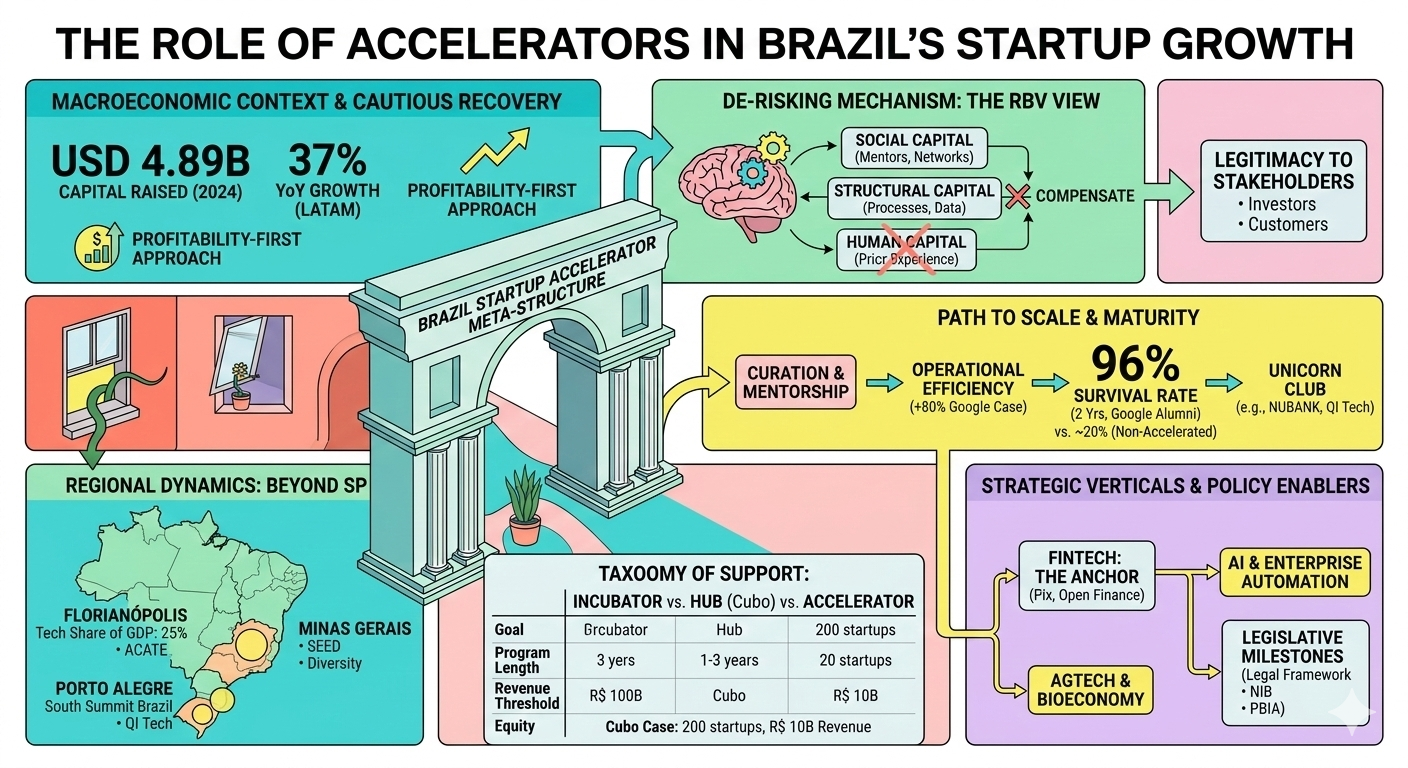
While São Paulo remains the central node of Brazilian innovation, concentrating nearly half of all funding and the majority of unicorns, other regions have developed specialized ecosystems supported by localized government and academic initiatives.
Florianópolis: The Tech Contribution Leader
In 2024, Florianópolis was recognized as the "Startup Capital of Brazil" by federal law. The city leads the nation in the tech sector's contribution to GDP (25%) and has grown its tech economy by 23.4% since 2018. It boasts up to ten times more startups per capita than São Paulo and is home to over 6,000 tech companies generating 38,400 direct jobs. The ecosystem’s growth has been driven by fintechs like Payface and Parcela Mais, attracting USD 298 million in venture capital between 2020 and 2024.
Porto Alegre and the South Summit Impact
Porto Alegre has established itself as the third strongest startup hub in South America. The South Summit Brazil 2025 event highlighted this maturity, injecting R$ 166 million into the national economy and creating nearly 4,000 jobs. The event also contributed R$ 13.7 million in tax revenues, demonstrating the socioeconomic impact of large-scale innovation gatherings. Success stories like QI Tech (Brazil’s first unicorn of 2024) and Trashin are closely linked to this regional momentum.
Regional Ecosystem Statistics (2024-2025)
Region | Tech Share of GDP | Key Characteristics | Notable Support Hubs |
São Paulo | National Hub | Concentrates 55% of Deep Tech ventures | Cubo, Google Campus, InovaBRA |
Florianópolis | 25% | National leader in tech density per capita | ACATE, local tech parks |
Porto Alegre | Regional leader | High hospitality and retail tech integration | South Summit, Cais Mauá |
Minas Gerais | Diverse base | Strong public sector acceleration focus | SEED, San Pedro Valley |
Recife | Creative/Deep Tech | Focus on cultural history and deep tech | Porto Digital |
Public Policy and the "Legal Framework for Startups"
The growth of the Brazilian ecosystem has been significantly bolstered by legislative progress. In 2021, Brazil passed the "Legal Framework for Startups" (Complementary Law 182/21) and the "Business Environment Law" (14,195/21), which aimed to simplify documentation, provide legal certainty for investors, and facilitate public sector procurement from startups.
Startup GOV.BR and State Innovation
The federal government has also moved to adopt startup methodologies internally through the Startup GOV.BR program. Since 2021, this program has supported 30 transversal projects, including Digital ID and the advance of the GOV.BR portal, by applying agile development models like the "Spotify model" to public administration. This initiative represents a "paradigm shift" in public management, focusing on incremental value generation for citizens even in scenarios of resource constraint.
Furthermore, the New Industrial Policy (Nova Indústria Brasil—NIB), launched in late 2024, prioritizes sectors like the bioeconomy, decarbonization, and energy transition. This policy alignment has directed both public funding (via BNDES and Finep) and private investment toward startups solving national strategic challenges.
Major Legislative and Policy Milestones
Law/Policy | Year | Primary Objective | Impact on Startups |
Innovation Law (Reformulated) | 2016 | Extend state-private risk sharing | Greater legal certainty for R&D. |
Legal Framework for Startups | 2021 | Regulatory favorability for innovation | Facilitated angel investment and public tenders. |
Business Environment Law | 2021 | Reduce bureaucracy/cost of doing business | Single window for imports/exports. |
New Industrial Policy (NIB) | 2024 | Bioeconomy and Decarbonization | Directional capital to sustainable sectors. |
PBIA (AI Investment Plan) | 2024 | R$ 23 Billion for AI autonomy | National expansion of AI research centers. |
The Verticalization of Growth: Sectoral Deep Dives
As the market matures, accelerators and hubs have verticalized their offerings. This is most evident in fintech, AI, and agtech, where Brazil holds a global competitive advantage.
Fintech: The Anchor of the Ecosystem
Fintech remains the dominant sector, absorbing 55% of all VC capital in 2024. This dominance is underpinned by the "Brazil Stack"—the combination of the Pix instant payment system, Open Finance, and the forthcoming Drex digital currency. Accelerators have been instrumental in preparing fintechs to navigate the complex regulatory environment of the Central Bank of Brazil (BCB). Key sub-sectors include digital banking (Nubank, C6), payments (CloudWalk), and credit (Creditas, QI Tech).
Artificial Intelligence and Enterprise Automation
By 2025, AI has shifted from an emerging topic to a core pillar of competitiveness in Brazil. National surveys indicate that 87% of Brazilian leaders consider generative AI essential, a significant leap from previous years. Major global players have responded: Microsoft announced a USD 2.7 billion investment in cloud and AI infrastructure in September 2024, the largest in its 36-year history in Brazil.
Accelerators have pivoted to support "AI-first" startups. For example, Arvo (healthcare AI) raised USD 20 million to revolutionize medical payments, while Enter (legal AI) raised USD 35 million at a USD 350 million valuation—one of Latin America’s largest AI Series A rounds.
Agtech and the Bioeconomy
Brazil's role as a global agricultural leader has made its agtech sector a magnet for "impact-driven" capital. In 2024, the sector attracted USD 2.5 billion, with startups leveraging AI, IoT, and blockchain to modernize supply chain efficiency and sustainable farming. Hubs like Cubo Agro provide a dedicated platform for these solutions, focusing on the decarbonization challenges of the agribusiness chain.
Internationalization: The Global Reach of Brazilian Startups
A primary role of modern accelerators is to provide "soft landing" pathways for startups to scale beyond the domestic market. Despite Brazil's massive home economy, the most successful companies seek early international exposure to achieve profitability and global competitive standing.
StartOut Brasil and Apex-Brasil
StartOut Brasil is a public-private program (Ministry of Foreign Affairs, Apex-Brasil, SEBRAE) that immerses Brazilian startups in global innovation hubs. Since its inception in 2017, the program has provided training in internationalization, market intelligence, and customized matchmaking with customers and investors abroad.
Apex-Brasil's Business Internationalization Program uses a proprietary method to evaluate eight dimensions of a startup's readiness for global markets. For companies like Pulsus and senhasegura, these programs were transformative, facilitating entry into over 60 countries and providing recognition from global research firms like Gartner.
The Portugal Bridge
Portugal has become a strategic "hub" for Brazilian internationalization due to linguistic ties, stable political environments, and specific R&D incentives designed for global scaling. Programs like Unicorn Factory Lisboa integrate Brazilian entrepreneurs into European networks, offering tax incentives and access to European hubs. This vision contrasts with domestic R&D incentives which, in Brazil, are often historically designed to meet internal needs rather than global ambition.
Path to Maturity: The Unicorn Landscape
Brazil’s maturity is best exemplified by its "Unicorn Club"—a group of 25 companies that have achieved valuations of USD 1 billion or more. These companies span fintech, mobility, e-commerce, and real estate, and their success has created a powerful feedback loop for the next generation of founders.
Profile of Select Brazilian Unicorns (as of 2025)
Company | Sector | Milestone Date | Top Investors |
Nubank | Banking Tech | March 2018 | DST Global, Berkshire Hathaway, monashees |
99 | Mobility | Jan 2018 | Qualcomm Ventures, DiDi |
iFood | Food Tech | Nov 2018 | Naspers, Prosus, Innova Capital |
QuintoAndar | Real Estate | Sept 2019 | SoftBank, Kaszek, General Atlantic |
EBANX | Payments | Oct 2019 | FTV Capital, Endeavor |
Loft | Proptech | Jan 2020 | Andreessen Horowitz, Thrive Capital |
VTEX | E-commerce | Sept 2020 | Tiger Global, SoftBank |
QI Tech | Fintech | Oct 2023 | General Atlantic, GIC |
The path to unicorn status has accelerated: while 99 took six years to reach the milestone, more recent ventures like QI Tech and CloudWalk achieved it in shorter cycles, benefit from the mature "Brazil Stack" and the pre-existing network of mentors and investors.
Corporate Venture Capital (CVC) and Open Innovation
The maturation of the CVC ecosystem is a defining trend of the 2024–2025 period. Corporate investors are no longer "tourists" in the startup space; they have become consistent early-stage investors in sectors like fintech, energy, and retail. CVC teams are becoming more professional and autonomous, focusing on core business adjacency and governance rather than just financial returns.
The Strategic Value of CVC
Corporate investment provides startups with something traditional VC cannot: direct distribution channels and "first customers". However, this comes with trade-offs; CVCs often operate on longer timelines and may seek commercial rights or strategic constraints that founders must manage carefully. Teams that combine corporate professionals with innovation market veterans have a significant advantage in bridging the cultural gap between startups and large parent companies.
CVC Fund/Player | Sector Focus | Strategic Advantage |
InovaBRA (Bradesco) | Fintech/Enterprise | Direct access to banking infrastructure |
Randon Ventures | Logistics/Mobility | Industrial value chain integration |
Oxygea (Braskem) | Cleantech/ESG | Chemical and sustainability sector expertise |
Itaú Unibanco | Fintech/ESG | Deep integration with Cubo community |
Vivo (Telefónica) | Digital/SaaS | Scale through massive customer base (Wayra) |
Challenges and Governance Corrections
Despite the ecosystem's success, significant hurdles remain. The 2024–2025 recovery has been characterized by "stricter standards" and an increased focus on governance.
Regulatory Scrutiny and Compliance
Regulators, including the National Data Protection Authority (ANPD) and the Central Bank, have intensified scrutiny on KYC/AML (Know Your Customer/Anti-Money Laundering) and data privacy. The suspension of Meta’s privacy policy in 2024 regarding data for AI training served as a warning that growth must be ethically and legally grounded. For startups, this means compliance is no longer an afterthought but a "defensible advantage".
The "Liability of Newness"
Early-stage ventures still face a 30% failure rate within their first two years due to operational and resource planning issues. The "liability of newness" remains a threat, particularly in unstable macroeconomic environments where capital can suddenly become scarce. Accelerators must continue to evolve their curricula to focus on "unit economics" and "capital efficiency" rather than pure user acquisition.
Future Horizons: 2026 and Beyond
As the Brazilian ecosystem moves toward 2026, several "macro-trends" are set to define the next era of growth. The convergence of AI, biotech, specialized fintech, and sustainability positions Brazil not just as a regional leader, but as a global technology hub.
The "Brazil Stack" and Drex
The rollout of Drex, Brazil’s Central Bank Digital Currency (CBDC), is expected to be a major catalyst for innovation in smart contracts and programmable money. Startups that can integrate with this infrastructure will be at the forefront of the next wave of fintech disruption.
Sustainability as a Business Model
Environmental solutions are attracting significant international capital. Startups like Mombak (carbon removal via Amazon reforestation) have secured contracts with Google, Microsoft, and Meta, demonstrating that Brazil can lead in the global transition to a net-zero economy.
Conclusion: The Indispensable Role of Accelerators
The analysis of Brazil’s startup trajectory confirms that accelerators have been the "connective tissue" of the innovation ecosystem. By providing social and structural capital, validating business models for cautious investors, and facilitating international expansion, these entities have transformed the "liability of newness" into a scalable advantage. While the model has shifted from high-equity stakes to strategic curation and CVC integration, the underlying function remains the same: to reduce friction for early entrants and provide a structured pathway toward scale. As the "Brazil Stack" continues to evolve and new sectors like AI and the bioeconomy emerge, the accelerator’s role as an ecosystem architect will only become more vital to the nation's economic progress and digital sovereignty.
Read More -
1. From Idea to MVP: A Step-by-Step Guide for Solo Founder
🔗 https://findnstart.com/blogs/from-idea-to-mvp-a-step-by-step-guide-for-solo-founder
2. How to Validate Your Startup Idea in 48 Hours for $0
🔗 https://findnstart.com/blogs/how-to-validate-your-startup-idea-in-48-hours-for-0
3. Remote vs. Local: Does Your Co-Founder Need to Live in the Same City?
🔗 https://findnstart.com/blogs/remote-vs-local-does-your-co-founder-need-to-live-in-the-same-city
4. The 2026 Startup Landscape: What Has Fundamentally Changed (and Why Founder Skills Matter More Than Ever)
5. The Most In-Demand Skills for Startup Founders in 2026
🔗 https://findnstart.com/blogs/the-most-in-demand-skills-for-startup-founders-in-2026
6. How to Find a Technical Co-Founder (Without a Six-Figure Salary)
🔗 https://findnstart.com/blogs/how-to-find-a-technical-co-founder-without-a-six-figure-salary
7. 5 Red Flags to Look for When Choosing a Startup Partner
🔗 https://findnstart.com/blogs/5-red-flags-to-look-for-when-choosing-a-startup-partner
8. How to Pitch Your Idea to Potential Co-Founders
🔗 https://findnstart.com/blogs/how-to-pitch-your-idea-to-potential-co-founders
9. How to Build a Portfolio that Attracts High-Growth Startup Founders
🔗 https://findnstart.com/blogs/how-to-build-a-portfolio-that-attracts-high-growth-startup-founders
10. Equity vs. Salary: How to Split Ownership with Your First Teammate
🔗 https://findnstart.com/blogs/equity-vs-salary-how-to-split-ownership-with-your-first-teammate
11. Why Joining an Early-Stage Startup is Better Than a Corporate Job
🔗 https://findnstart.com/blogs/why-joining-an-early-stage-startup-is-better-than-a-corporate-job
12. The Future of EdTech: Why Developers and Educators Need to Team Up Now
🔗 https://findnstart.com/blogs/the-future-of-edtech-why-developers-and-educators-need-to-team-up-now
13. The Architecture of Symbiosis: Analytical Perspectives on the Five Habits of Successful Startup Duos
14. Finding a Co-Founder in the AI Space: What Skills Should You Look For?
🔗 https://findnstart.com/blogs/finding-a-co-founder-in-the-ai-space-what-skills-should-you-look-for
15. Overcoming Analysis Paralysis and the Strategic Path to Execution
🔗 https://findnstart.com/blogs/overcoming-analysis-paralysis-and-the-strategic-path-to-execution
16. From College Project to Company: How to Find Your Student Co-Founder
🔗 https://findnstart.com/blogs/from-college-project-to-company-how-to-find-your-student-co-founder
17. How to Start a Startup While Working a Full-Time Job
🔗 https://findnstart.com/blogs/how-to-start-a-startup-while-working-a-full-time-job
18. How to Build a HealthTech Startup Without a Medical Degree
🔗 https://findnstart.com/blogs/how-to-build-a-healthtech-startup-without-a-medical-degree
19. The Solitary Architect: Executive Isolation in Entrepreneurship
20. The 2026 Guide to Launching a SaaS as a Solo Developer
21. What Sustainable Growth Actually Looks Like
🔗 https://findnstart.com/blogs/what-sustainable-growth-actually-looks-like
22. The Early Warning Signs Your Startup Is in Trouble
🔗 https://findnstart.com/blogs/the-early-warning-signs-your-startup-is-in-trouble
23. How to Grow Without Burning Out
🔗 https://findnstart.com/blogs/how-to-grow-without-burning-out
24. The Truth About “Runway” Most Founders Ignore
🔗 https://findnstart.com/blogs/the-truth-about-runway-most-founders-ignore
25. Revenue Solves More Problems Than Funding
🔗 https://findnstart.com/blogs/revenue-solves-more-problems-than-funding
26. What No One Tells You About Being a Solo Founder
🔗 https://findnstart.com/blogs/what-no-one-tells-you-about-being-a-solo-founder
27. Why Smart People Quit High-Paying Jobs to Build Startups (And Why Most Regret It)
28. Why Most Startup Advice on Twitter Is Dangerous
🔗 https://findnstart.com/blogs/why-most-startup-advice-on-twitter-is-dangerous
29. Decision Fatigue: The Silent Startup Killer
🔗 https://findnstart.com/blogs/decision-fatigue-the-silent-startup-killer
30. Fear vs Logic: How Founders Actually Make Decisions
🔗 https://findnstart.com/blogs/fear-vs-logic-how-founders-actually-make-decisions
31. How Overthinking Destroys Early Momentum
🔗 https://findnstart.com/blogs/how-overthinking-destroys-early-momentum
32. Ideas Don’t Scale. Systems Do.
🔗 https://findnstart.com/blogs/ideas-dont-scale-systems-do
33. The First Hire That Actually Matters
🔗 https://findnstart.com/blogs/the-first-hire-that-actually-matters
34. How the First 100 Users Decide Your Startup’s Fate
🔗 https://findnstart.com/blogs/how-the-first-100-users-decide-your-startups-fate
35. Why Your Startup Doesn’t Need Growth — It Needs Focus
🔗 https://findnstart.com/blogs/why-your-startup-doesnt-need-growthit-needs-focus
36. Why Most Startups Die Quietly
🔗 https://findnstart.com/blogs/why-most-startups-die-quietly
37. Lessons Learned Too Late by First-Time Founders
🔗 https://findnstart.com/blogs/lessons-learned-too-late-by-first-time-founders
38. The Myth of the “Overnight Success” Startup
🔗 https://findnstart.com/blogs/the-myth-of-the-overnight-success-startup
Want to calculate the equity for your cofounder?
Nail your cap table before you sign. Whether you're splitting equity with a co-founder or planning your next funding round, our Equity Calculator gives you precision in seconds
Equity calculator →