The Real Advantage of Building in Bangalore (It’s Not Just Talent)
April 25, 2026 by Harshit Gupta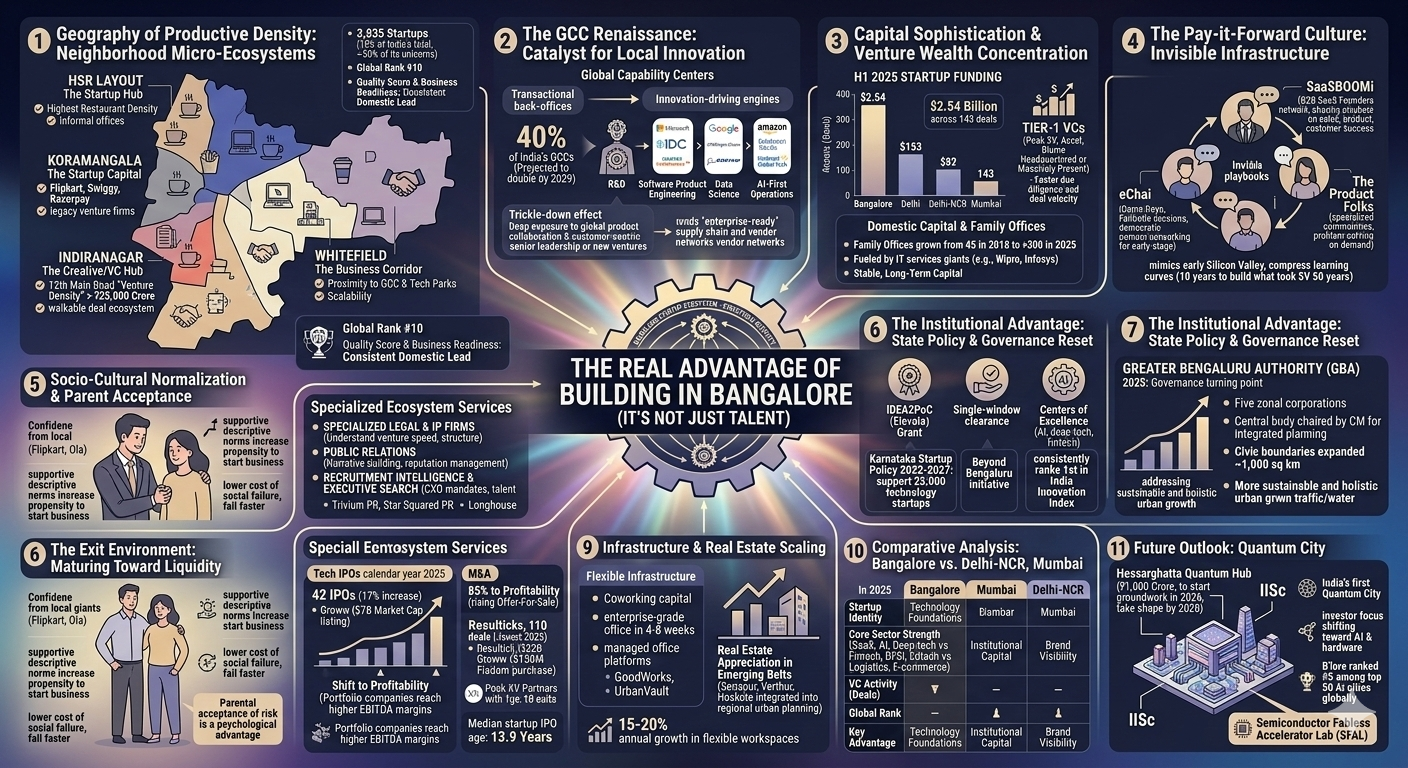
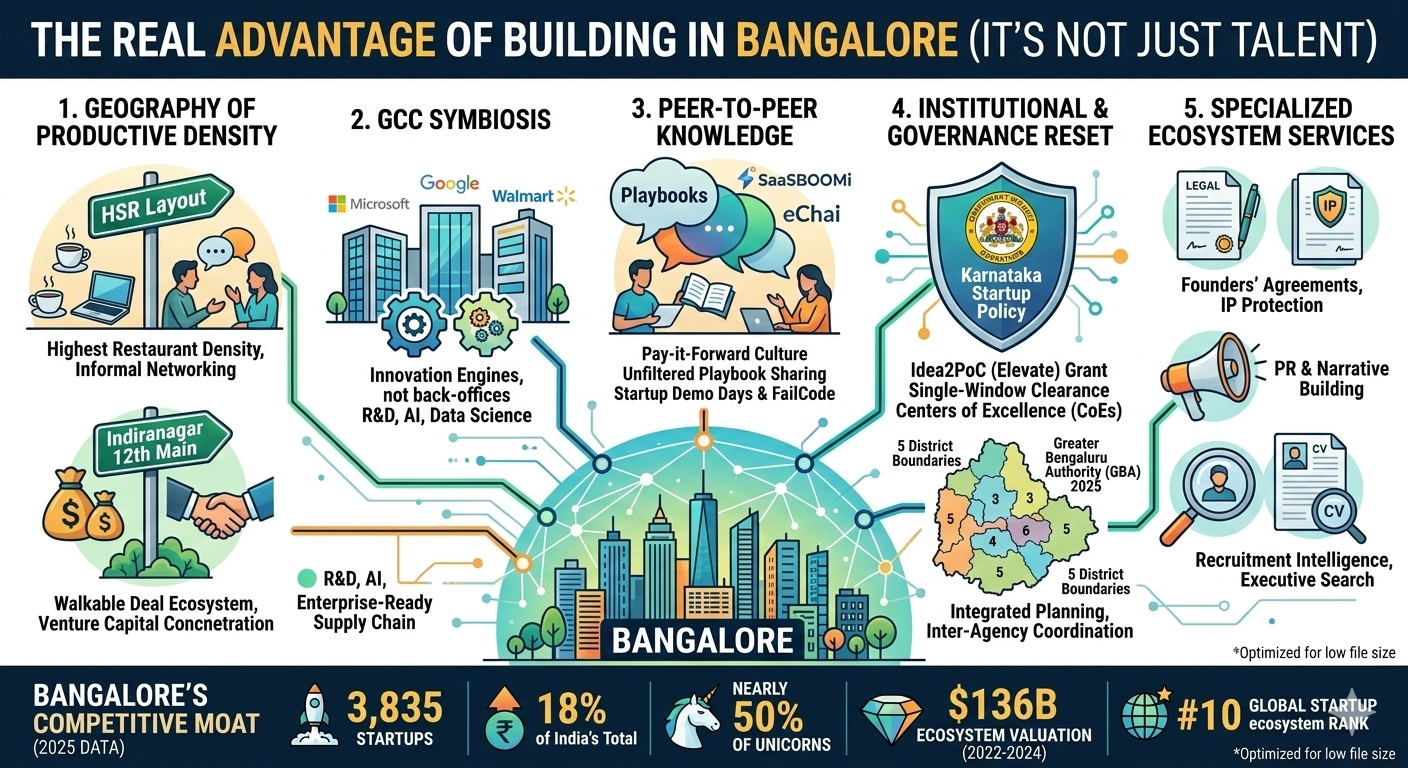
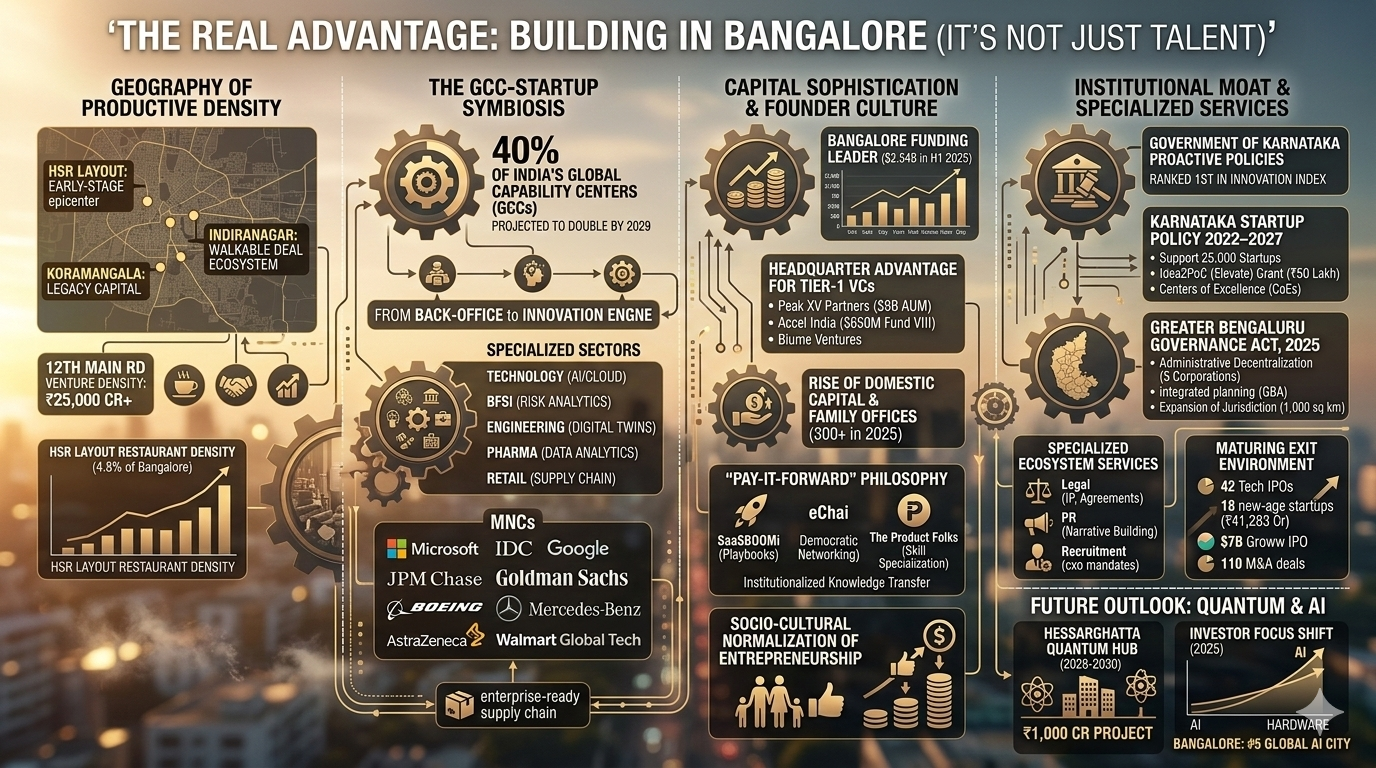
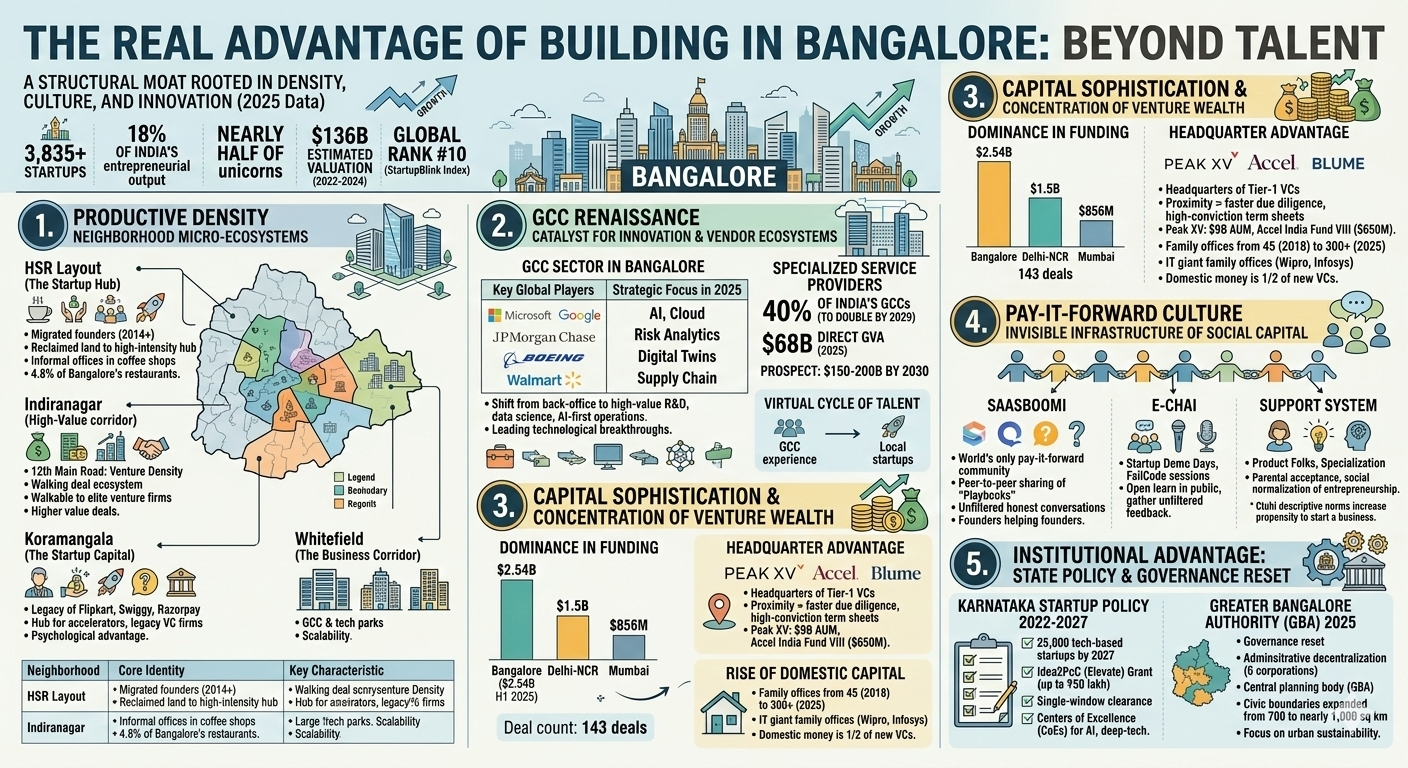
The Bangalore startup ecosystem, as of 2025, represents a singular phenomenon in the global landscape of innovation, characterized by a structural maturity that transcends the conventional narrative of an "engineering talent pool." While the availability of highly skilled human capital is a prerequisite, the city’s actual competitive advantage—its "moat"—is constructed from a sophisticated convergence of hyper-local density, an ingrained culture of peer-to-peer knowledge transfer, the evolution of Global Capability Centers (GCCs) into strategic innovation engines, and a pioneering governance overhaul that seeks to harmonize rapid economic expansion with urban sustainability. Bangalore currently hosts approximately 3,835 startups, accounting for 18% of India’s total entrepreneurial output and nearly half of its unicorns. With a global ranking of #10 in the StartupBlink Ecosystem Index, the city maintains a quality score and business environment readiness that consistently outperforms domestic peers like New Delhi and Mumbai.
The economic impact of this ecosystem is profound, with a total valuation estimated at $136 billion between 2022 and 2024. However, the "real" advantage is found in the invisible infrastructure of the city: the "venture density" of specific streets in Indiranagar, the "productive density" of HSR Layout, and the "pay-it-forward" philosophy that characterizes organizations like SaaSBOOMi and eChai. This report provides an exhaustive analysis of these systemic advantages, detailing how they function as accelerators for growth and resilience in a volatile global market.
The Geography of Productive Density: Neighborhood-Level Micro-Ecosystems
One of the most significant structural advantages of building in Bangalore is the existence of specific neighborhoods that act as self-contained, high-intensity micro-ecosystems. Unlike the dispersed startup activity in New York or the sprawling nature of Delhi-NCR, Bangalore’s entrepreneurial energy is concentrated in a handful of "high-velocity" grids: HSR Layout, Koramangala, and Indiranagar.
HSR Layout: The Reclaimed Epicenter of Early-Stage Innovation
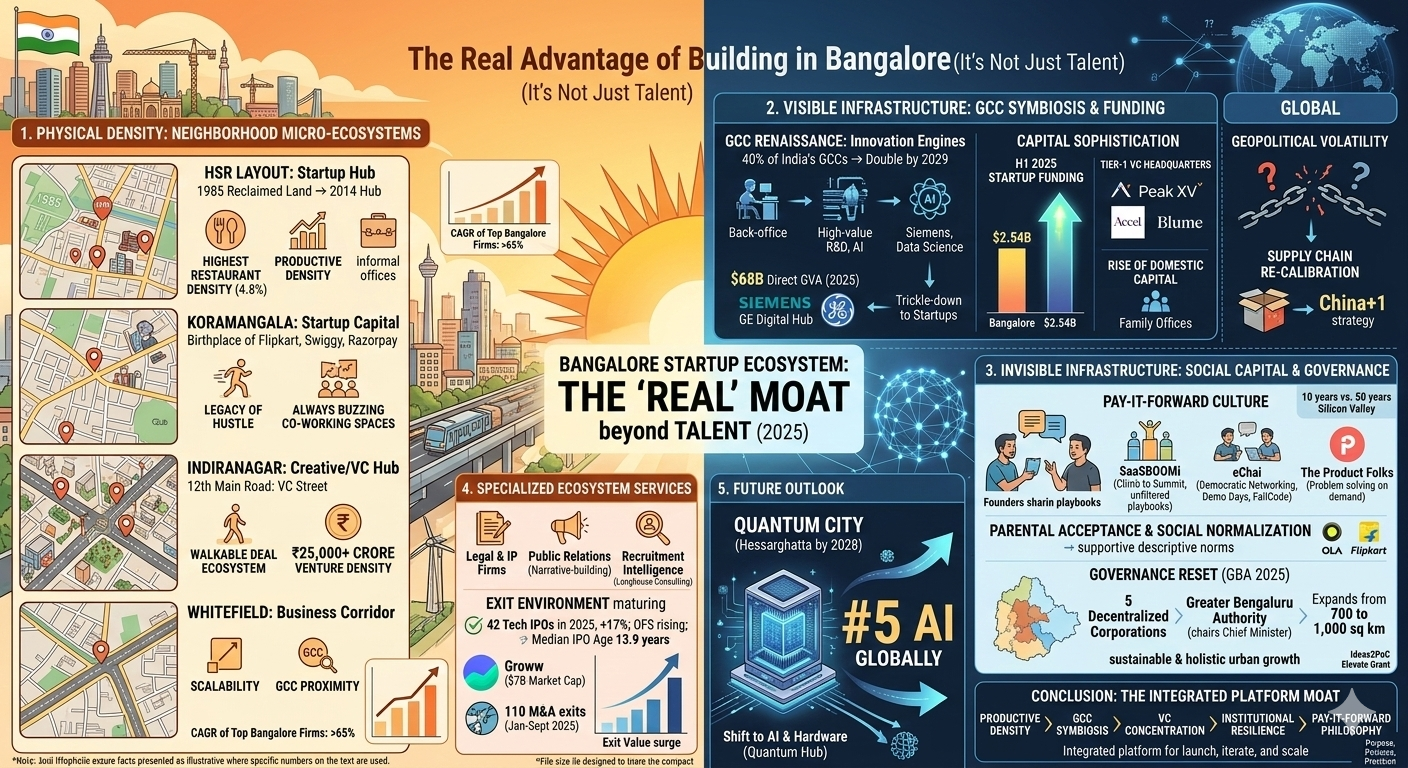
HSR Layout’s transformation from Agara Lake reclaimed land in 1985 to the city’s primary startup hub by 2014 illustrates the organic evolution of the Bangalore ecosystem. This neighborhood created what urban planners define as "productive density"—a concentration of people and activity sufficient to generate innovation and opportunity without overwhelming the community’s character. The migration of founders from the increasingly expensive Koramangala to HSR Layout was triggered in mid-2014, led by figures like NoBroker co-founder Saurabh Garg, who recognized the strategic value of maintaining ecosystem access at a fraction of the cost.
As of October 2025, HSR Layout hosts 4.8% of Bangalore’s total restaurants, the highest concentration in the city. These venues serve as more than just dining establishments; they are the informal offices where coffee shop conversations frequently catalyze co-founding partnerships or recruitment leads. The neighborhood’s seven-sector grid design allows for a seamless blend of residential and commercial spaces, ensuring that founders and employees are embedded in a 24/7 cycle of innovation.
Indiranagar and the 12th Main Road Phenomenon
If HSR Layout is the engine room, Indiranagar is the city’s "high-value" corridor. The 12th Main Road in Indiranagar has emerged as a street where the sheer volume of venture capital and startup market cap exceeds ₹25,000 crore. This "venture density" allows for a unique form of serendipity where deal-making often begins over casual meetings and concludes in boardrooms just a few meters away. The proximity of elite venture firms to high-growth startups creates a "walkable deal ecosystem" that reduces the friction of fundraising and strategic collaboration.
Neighborhood | Core Identity | Ecosystem Maturity | Key Characteristic |
HSR Layout | The Startup Hub | High (Emerging since 2014) | Highest restaurant density; "Productive Density" |
Koramangala | The Startup Capital | Legacy (Home to Flipkart, Swiggy) | Hub for accelerators and legacy venture firms |
Indiranagar | The Creative/VC Hub | Premium (High-value deals) | 12th Main Road "Venture Density" |
Whitefield | The Business Corridor | Scalability (GCC & Tech Parks) | Proximity to Global Capability Centers |
Koramangala and the Legacy of the Hustle
Koramangala remains the "startup capital" of Bangalore, having served as the birthplace for some of India’s most successful ventures, including Flipkart, Swiggy, and Razorpay. This legacy creates a powerful psychological advantage: for a new founder, being in Koramangala means being part of a community where billion-dollar success stories are part of the local history. The area is packed with incubators, investor offices, and co-working spaces that are "always buzzing," fostering a culture where networking is an everyday activity rather than a scheduled event.
The GCC Renaissance: A Catalyst for Local Innovation and Vendor Ecosystems
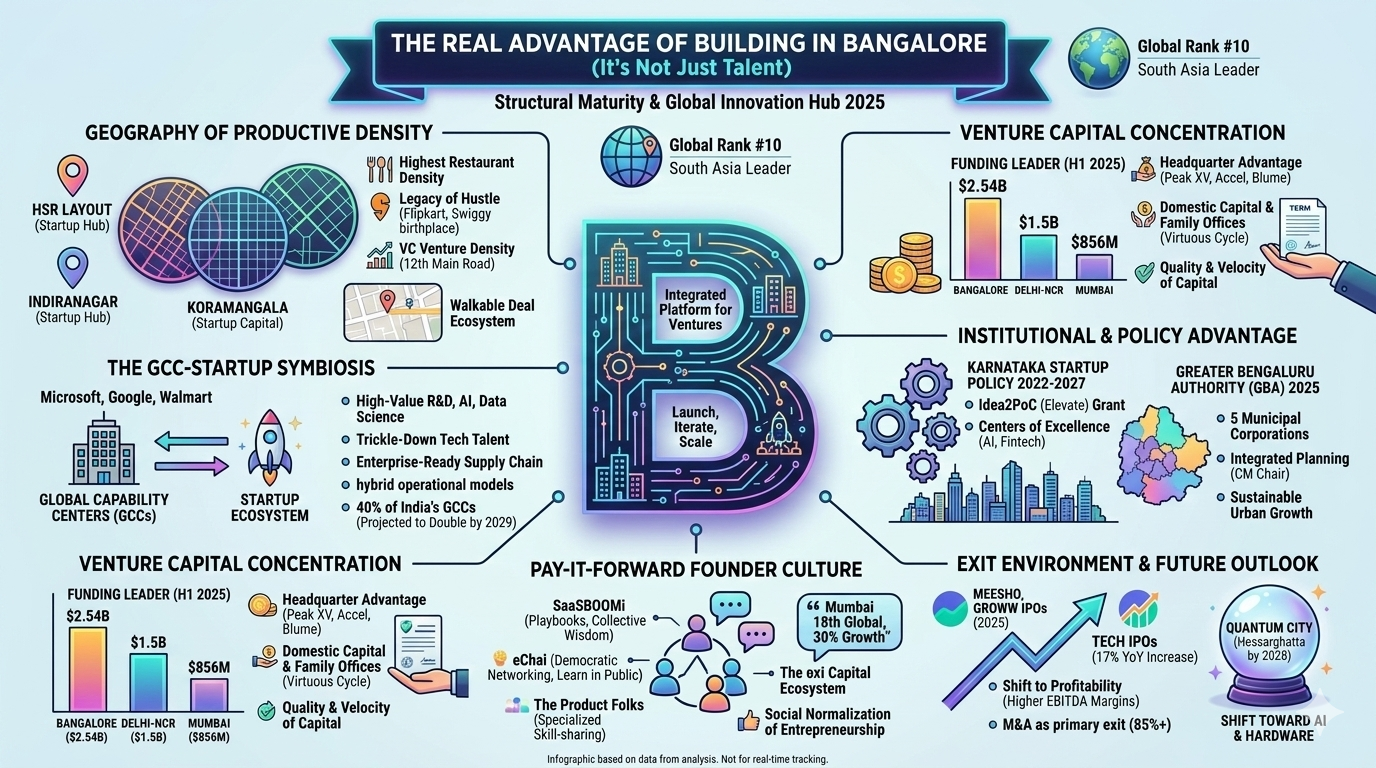
Bangalore currently hosts approximately 40% of India’s Global Capability Centers (GCCs), a figure that is projected to double by 2029. These centers have undergone a fundamental shift from their origins as cost-saving back-offices to becoming "innovation-driving engines" that propel Karnataka onto the global map.
From Transactional to Transformational Impact
Modern GCCs in Bangalore are responsible for high-value functions such as R&D, software product engineering, data science, and AI-first operations. The economic impact is substantial, with the GCC sector contributing $68 billion in direct gross value addition to the Indian economy in 2025, a figure that could reach $150–200 billion by 2030. These centers don't just execute global mandates; they lead technological breakthroughs for their multinational corporations (MNCs).
For instance, Siemens Healthineers and GE’s Bengaluru Digital Hub are developing data science and digital twin analytics that add billions in productivity for their global clients. This transformation has created a "trickle-down" effect into the local startup ecosystem. Professionals who spend their early careers in these vibrant GCC environments gain deep exposure to global product collaboration and customer-centric design, which they then apply to their own ventures or as senior leaders in local startups.
The Role of Specialized Service Providers and Vendor Networks
The presence of hundreds of GCCs has necessitated the growth of a robust secondary economy of specialized service providers. These include high-end IT vendors, cybersecurity firms, HR staffing partners, and facility management companies. Startups in Bangalore have the unique advantage of accessing this "enterprise-ready" supply chain, which allows them to scale their operations with a level of professional rigor that is often lacking in other cities.
Furthermore, GCCs are increasingly switching to hybrid operational models, bringing in finance, legal, and supply chain functions to their Bangalore centers. This has led to the emergence of "supply chain analytics pods" that aggregate internal and external data signals to create comprehensive visibility for global manufacturing and retail companies.
GCC Sector in Bangalore | Key Global Players | Strategic Focus in 2025 |
Technology | Microsoft IDC, Google, Amazon, SAP Labs | AI, Cloud, Agentic Security Workflows |
BFSI | JPMorgan Chase, Goldman Sachs, HSBC, Barclays | Risk Analytics, Digital Banking, Fintech R&D |
Engineering/Mfg | Boeing, Rolls-Royce, Bosch, Mercedes-Benz | Digital Twins, Autonomous Systems, Aero R&D |
Pharma/Health | AstraZeneca, Novartis, Roche, GSK | Digital Health platforms, Clinical Data Analytics |
Retail/CPG | Walmart Global Tech, Target, IKEA, Unilever | Supply Chain Optimization, AI-powered Merchandizing |
Capital Sophistication and the Concentration of Venture Wealth
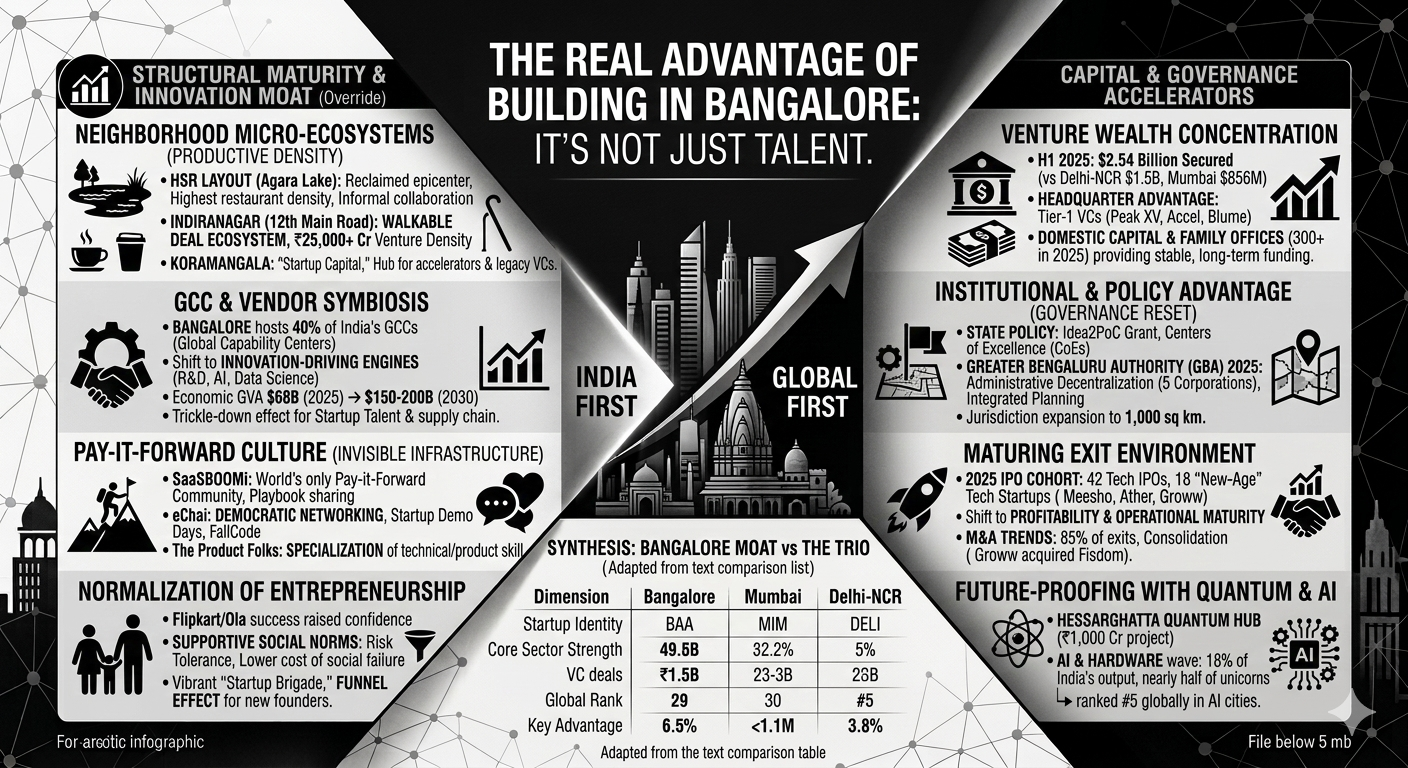
Bangalore remains the undisputed leader in startup funding in India. In the first half of 2025, the city secured $2.54 billion across 143 deals, significantly outpacing Delhi-NCR ($1.5 billion) and Mumbai ($856 million). This dominance is not merely a function of volume but of the quality and velocity of capital.
The Headquarter Advantage for Tier-1 VCs
Virtually every significant venture capital fund operating in India, including Peak XV Partners (formerly Sequoia India), Accel India, and Blume Ventures, has its headquarters or a massive presence in Bangalore. This proximity is crucial for deal velocity. Being in the same city as the primary decision-makers allows for faster due diligence and more frequent "low-stakes" interactions between founders and investors, which often lead to higher-conviction term sheets.
Peak XV Partners alone manages $9 billion in AUM across India and Southeast Asia. Accel India, with its new $650 million Fund VIII announced in 2025, maintains a technology-first approach, targeting roughly 40 investments per fund cycle. This concentration of capital creates a "capital crucible" where high-quality assets attract deployment even during global funding winters.
The Rise of Domestic Capital and Family Offices
A defining shift in 2024–2025 has been the ascendancy of domestic capital. Domestic money now accounts for half of the corpuses of most new VC funds. This shift is fueled by the rise of family offices, which have grown from 45 in 2018 to over 300 in 2025. Leading these are the family offices of IT services giants like Wipro and Infosys, which provide stable, long-term capital that is less sensitive to the "tourist" behavior of international funds. This "virtuous cycle" of local wealth being reinvested into local innovation is a structural advantage that provides Bangalore with a level of resilience not seen in other hubs.
The Pay-it-Forward Culture: The Invisible Infrastructure of Social Capital
The "real" advantage of Bangalore often cited by founders is its "pay-it-forward" culture—a philosophy of peer-to-peer support that mimics the early days of Silicon Valley.
SaaSBOOMi: The World’s Only Pay-it-Forward Community of Founders
SaaSBOOMi, born in late 2018, is the most successful manifestation of this culture. It is an exclusive network for B2B SaaS founders to plot their "climb to the summit". The community operates on the principle of sharing "playbooks"—unfiltered, honest conversations where founders who have crossed certain ARR milestones (e.g., $10 million) open up their sales, product, and customer success strategies to those just a few steps behind them. This collective wisdom allows the ecosystem to compress the learning curve, achieving in 10 years what took Silicon Valley 50 years to build.
eChai and the Democratic Networking Pulse
While SaaSBOOMi focuses on the mid-to-late stage, eChai provides the "steady rhythm" for the early-stage ecosystem. Through "Startup Demo Days" and "FailCode" sessions, eChai creates spaces for founders to learn in public and gather unfiltered feedback without "stagecraft". This culture of openness is particularly valuable for founders moving back from international markets like the USA; they often cite eChai as their primary space for learning how the Indian startup landscape actually works.
The Product Folks and the Specialization of Skill
Complementing the founder groups is a layer of specialized communities like The Product Folks, which focus on sharpening the city’s technical and product management edge. These groups provide "problem solving on demand," effectively acting as a professional safety net for engineers and PMs navigating high-growth environments.
The Socio-Cultural Normalization of Entrepreneurship
A profound psychological advantage of building in Bangalore is the social normalization of entrepreneurship. In many other Indian cities, starting a company is still viewed as a high-risk gamble that may lack social prestige compared to corporate or government roles.
Parental Acceptance and Risk Tolerance
In Bangalore, the success of homegrown giants like Flipkart and Ola has raised the confidence of the entire ecosystem. This success has led to a "funnel effect" where the employment and training of thousands of people in unicorns eventually leads them to start their own companies or join early-stage startups. The city has a "vibrant startup brigade" that is not afraid of taking risks, a trait that makes it the perfect hotbed for VCs.
Surveys indicate that supportive descriptive norms about entrepreneurship significantly increase an individual’s propensity to start a business. In Bangalore, where "everyone is either in a startup or starting one," the cost of social failure is significantly lower than in Mumbai or Delhi, allowing founders to iterate and fail faster without the weight of societal disapproval.
The Institutional Advantage: State Policy and Governance Reset
The Government of Karnataka has maintained a proactive stance in fostering the ecosystem, consistently ranking 1st in NITI Aayog’s India Innovation Index.
The Karnataka Startup Policy 2022–2027
The state’s current policy framework aims to support 25,000 technology-based startups by 2027, with a specific focus on maintaining Bangalore’s lead while elevating other cities to international standards through the "Beyond Bengaluru" initiative. Key features include:
Idea2PoC (Elevate) Grant: Provides early-stage funding of up to ₹50 lakh to validate innovative ideas, having benefited over 1,000 startups to date.
Institutional Support: A single-window clearance portal for approvals, compliance, and clearances.
Centers of Excellence (CoEs): Specialized labs in AI, deep-tech, and fintech that foster partnerships between GCCs, startups, and academia.
The Greater Bengaluru Authority (GBA) 2025: A Governance Turning Point
One of the most significant reforms in decades is the Greater Bengaluru Governance Act, 2025. This act acknowledges that the city’s economic footprint has outgrown its institutional design.
Administrative Decentralization: The previous single municipal body (BBMP) has been broken into five corporations (Central, North, East, West, and South) to manage zonal governance more efficiently.
The Greater Bengaluru Authority (GBA): A centralized body chaired by the Chief Minister tasked with integrated planning and inter-agency coordination for large-scale infrastructure projects.
Expansion of Jurisdiction: The act expands the city’s civic boundaries from 700 to nearly 1,000 square kilometers, integrating peripheral areas like Sarjapur and Varthur.
This governance reset is designed to address the "Bangalore paradox"—a city anchoring national economic performance while struggling with basic civic services like traffic and water. For startups, this means more predictable infrastructure development and a focus on "sustainable and holistic urban growth" that aligns with long-term investment confidence.
Specialized Ecosystem Services: Accelerating Growth Velocity
The maturity of the Bangalore ecosystem is further evidenced by its density of specialized support services that cater specifically to venture-backed growth.
Specialized Legal and IP Firms
Founders in Bangalore have access to law firms that understand the "breakneck speed" and unique structures of venture deals. These firms provide expertise in:
IP Protection: Strategic filing of patents and trademarks, which is increasingly critical for deep-tech ventures.
Founders’ Agreements: Drafting comprehensive ownership and equity distribution documents to avoid future conflicts.
Due Diligence: Specialized teams that can handle end-to-end registration and investment compliance with notable speed.
Public Relations for the Narrative-Driven Economy
PR in Bangalore has evolved beyond mere publicity into "reputation management" and "narrative building". Firms like Trivium PR and Star Squared PR specialize in data-driven storytelling that aligns with the goals of investors and the scale-up firms they back. This is particularly useful for global tech and consumer brands that need to manage multi-market narratives from a Bangalore hub.
Recruitment Intelligence and Executive Search
The "war for talent" in Bangalore is intense, but it is supported by specialized recruitment consultants who focus on the "high-growth digital sector". Firms like Longhouse Consulting and Han Digital provide CXO mandates and talent intelligence that help startups build "future-ready" leadership ecosystems. These firms often use time-tested "search methodologies" deployed across hundreds of CXO assignments to ensure cultural and technical fit.
The Exit Environment: Maturing Toward Liquidity and Profitability
A critical measure of any startup ecosystem is the ability to provide liquidity to its investors. The 2024–2025 period in Bangalore has signaled a structural shift in the exit environment, moving toward operational maturity and public market readiness.
The 2025 IPO Cohort
In calendar year 2025, tech companies recorded 42 IPOs, a 17% increase over 2024. Notably, 18 of these were "new-age" tech startups that raised ₹41,283 crore. Bangalore-based companies led this charge, including Meesho, Ather Energy, BlueStone, and Groww.
Groww: Emerged as one of the largest listings with an estimated $7 billion market capitalization.
Shift to Profitability: A defining feature of the 2025 IPOs was the rising share of Offer-For-Sale (OFS). As portfolio companies reached higher EBITDA margins, listings increasingly functioned as partial liquidity events for early investors rather than desperate capital-raising exercises.
M&A Trends and Sector Consolidation
Strategic acquisitions remained a healthy primary exit strategy, representing over 85% of venture-backed exits. In 2025, standout deals included the $2 billion acquisition of Resulticks and Groww’s $150 million purchase of Fisdom. These deals reflect a maturing market where strategic interest from both global MNCs and domestic giants (like the DS Group) is providing depth to the deal landscape.
Exit Metric (2025) | Data Point / Trend | Strategic Implication |
Total Tech IPOs | 42 (17% YoY increase) | Transition from "unicorn focus" to "liquidity focus" |
Median Startup IPO Age | 13.9 Years | Emphasis on operational maturity and long-term execution |
Largest Fintech IPO | Groww ($7B Market Cap) | Validation of domestic public market appetite for tech |
M&A Exit Count | 110 (Jan–Sept 2025) | Signals a healthy capital cycle and strategic interest |
Top Exit Investor | Peak XV Partners (10 exits) | Reaffirmation of the "virtuous cycle" of reinvestment |
Infrastructure and Real Estate: Scaling the Physical Hub
Despite its success, Bangalore faces the "weight of its own success," particularly in its infrastructure. However, this has created its own sub-ecosystem of "flexible infrastructure" solutions.
The Coworking and Managed Office Boom
Bangalore has become the "coworking capital of the country," with flexible workspaces growing at 15–20% annually. For a GCC or a fast-scaling startup, the ability to launch an "enterprise-grade" office in 4–8 weeks—compared to the 6–12 months of a traditional lease—is a significant operational advantage. Providers like GoodWorks and UrbanVault offer "managed office platforms" that include everything from SOC2-compliant IT infrastructure to legal and HR advisory.
Real Estate Appreciation in Emerging Belts
The introduction of the GBA and the expansion of the city limits have led to a structural shift in real estate. Areas like Sarjapur, Varthur, and Hoskote, previously seen as underdeveloped, are now being integrated into a "regional urban planning model" similar to Delhi-NCR or Mumbai-MMR. This integration is expected to boost infrastructure development and property values in newly included areas, offering real estate developers a layer of "clarity and predictability" that fosters long-term township-style projects.
Comparative Analysis: Bangalore vs. The Trio (Delhi-NCR and Mumbai)
While Bangalore remains the technology capital, the 2025 data shows a "selective" distribution of ecosystem strengths across India’s primary clusters.
Bangalore: The R&D and Technology Center
Bangalore thrives on deep technology talent and a "product-led growth" culture. It is the scale and research leader, particularly in AI and hardware startups, where investor confidence is shifting. The city’s software engineer salaries, while substantially lower than international peers ($12,000 median annual), are part of a talent engine that is the tech and human capital center of the nation.
Mumbai: The Financial Nerve Center
Mumbai benefits from financial depth and regulatory proximity, making it ideal for startups in fintech and consumer platforms that require monetisation discipline and trust. Mumbai’s startup growth rate in 2025 (30%) was the highest among major cities, rising to 18th globally, though its total funding still trails Bangalore significantly.
Delhi-NCR: The Mass-Market Gateway
Delhi-NCR stands out for its understanding of mass-market behavior and distribution. It accommodates over 1,000 technical startups and leads in commercial AI implementation for logistics, retail analytics, and edtech.
Dimension (2025) | Bangalore | Mumbai | Delhi-NCR |
Startup Identity | Silicon Valley of India | Financial Capital | Consumer/Distribution Hub |
Core Sector Strength | SaaS, AI, Deep-tech | Fintech, BFSI, Edtech | Logistics, E-commerce |
VC Activity (Deals) | 1st (143 deals) | 3rd (80 deals) | 2nd (116 deals) |
Global Rank (2025) | 10th | 18th | 11th |
Key Advantage | Technology Foundations | Institutional Capital | Brand Visibility |
Future Outlook: Quantum Computing and the "Quantum City"
The trajectory of the Bangalore ecosystem suggests a move toward even more complex, hardware-enabled, and dual-use innovations.
The Hessarghatta Quantum Hub
India’s first "Quantum City" is set to take shape in Hessarghatta by 2028, with the groundwork starting in 2026. This ₹1,000 crore project, led by institutions like IISc, aims to create a dedicated hub for quantum technologies, residential spaces, and office infrastructure. This follows the establishment of other specialized labs like the Semiconductor Fabless Accelerator Lab (SFAL), which focuses on developing the fabless ecosystem in India.
The Rise of AI and Hardware
Investor focus in 2025 is shifting decisively toward AI and hardware startups, signaling growing confidence in India’s deeptech and R&D landscape. Bangalore, already ranked #5 among the top 50 AI cities globally, is positioned to lead this wave through initiatives like the Bengaluru Innovation Report and specific government partnerships for AI-quantum computing hotspots.
Conclusions: The Persistence of the Bangalore Advantage
The analysis of the 2024–2025 data confirms that the advantage of building in Bangalore is rooted in a structural and cultural "moat" that is difficult to replicate. This moat consists of:
Productive Density: The concentrated character of neighborhoods like HSR Layout and Indiranagar, where informal interactions generate tangible business outcomes.
The GCC-Startup Symbiosis: A unique partnership where global MNCs and local innovators share knowledge, talent, and pilot projects, elevating the city’s economic resilience.
Venture Capital Concentration: The headquarters advantage of major VCs, which ensures that capital velocity remains high even during global headwinds.
Institutional Resilience: Proactive state policies and the 2025 governance reset (GBA) that signal a commitment to long-term urban and economic stability.
A "Pay-it-Forward" Philosophy: Communities like SaaSBOOMi and eChai that institutionalize knowledge transfer and social support among founders.
For any founder or investor, Bangalore is not just a location; it is an integrated platform for launching, iterating, and scaling ventures at a speed and quality that is unique in the South Asian region. The city’s evolution into a world-class innovation hub is no longer a cyclical boom but a structural reality grounded in deep foundations of talent, capital, and a relentless culture of innovation.
Read More -
1. From Idea to MVP: A Step-by-Step Guide for Solo Founder
🔗 https://findnstart.com/blogs/from-idea-to-mvp-a-step-by-step-guide-for-solo-founder
2. How to Validate Your Startup Idea in 48 Hours for $0
🔗 https://findnstart.com/blogs/how-to-validate-your-startup-idea-in-48-hours-for-0
3. Remote vs. Local: Does Your Co-Founder Need to Live in the Same City?
🔗 https://findnstart.com/blogs/remote-vs-local-does-your-co-founder-need-to-live-in-the-same-city
4. The 2026 Startup Landscape: What Has Fundamentally Changed (and Why Founder Skills Matter More Than Ever)
5. The Most In-Demand Skills for Startup Founders in 2026
🔗 https://findnstart.com/blogs/the-most-in-demand-skills-for-startup-founders-in-2026
6. How to Find a Technical Co-Founder (Without a Six-Figure Salary)
🔗 https://findnstart.com/blogs/how-to-find-a-technical-co-founder-without-a-six-figure-salary
7. 5 Red Flags to Look for When Choosing a Startup Partner
🔗 https://findnstart.com/blogs/5-red-flags-to-look-for-when-choosing-a-startup-partner
8. How to Pitch Your Idea to Potential Co-Founders
🔗 https://findnstart.com/blogs/how-to-pitch-your-idea-to-potential-co-founders
9. How to Build a Portfolio that Attracts High-Growth Startup Founders
🔗 https://findnstart.com/blogs/how-to-build-a-portfolio-that-attracts-high-growth-startup-founders
10. Equity vs. Salary: How to Split Ownership with Your First Teammate
🔗 https://findnstart.com/blogs/equity-vs-salary-how-to-split-ownership-with-your-first-teammate
11. Why Joining an Early-Stage Startup is Better Than a Corporate Job
🔗 https://findnstart.com/blogs/why-joining-an-early-stage-startup-is-better-than-a-corporate-job
12. The Future of EdTech: Why Developers and Educators Need to Team Up Now
🔗 https://findnstart.com/blogs/the-future-of-edtech-why-developers-and-educators-need-to-team-up-now
13. The Architecture of Symbiosis: Analytical Perspectives on the Five Habits of Successful Startup Duos
14. Finding a Co-Founder in the AI Space: What Skills Should You Look For?
🔗 https://findnstart.com/blogs/finding-a-co-founder-in-the-ai-space-what-skills-should-you-look-for
15. Overcoming Analysis Paralysis and the Strategic Path to Execution
🔗 https://findnstart.com/blogs/overcoming-analysis-paralysis-and-the-strategic-path-to-execution
16. From College Project to Company: How to Find Your Student Co-Founder
🔗 https://findnstart.com/blogs/from-college-project-to-company-how-to-find-your-student-co-founder
17. How to Start a Startup While Working a Full-Time Job
🔗 https://findnstart.com/blogs/how-to-start-a-startup-while-working-a-full-time-job
18. How to Build a HealthTech Startup Without a Medical Degree
🔗 https://findnstart.com/blogs/how-to-build-a-healthtech-startup-without-a-medical-degree
19. The Solitary Architect: Executive Isolation in Entrepreneurship
20. The 2026 Guide to Launching a SaaS as a Solo Developer
21. What Sustainable Growth Actually Looks Like
🔗 https://findnstart.com/blogs/what-sustainable-growth-actually-looks-like
22. The Early Warning Signs Your Startup Is in Trouble
🔗 https://findnstart.com/blogs/the-early-warning-signs-your-startup-is-in-trouble
23. How to Grow Without Burning Out
🔗 https://findnstart.com/blogs/how-to-grow-without-burning-out
24. The Truth About “Runway” Most Founders Ignore
🔗 https://findnstart.com/blogs/the-truth-about-runway-most-founders-ignore
25. Revenue Solves More Problems Than Funding
🔗 https://findnstart.com/blogs/revenue-solves-more-problems-than-funding
26. What No One Tells You About Being a Solo Founder
🔗 https://findnstart.com/blogs/what-no-one-tells-you-about-being-a-solo-founder
27. Why Smart People Quit High-Paying Jobs to Build Startups (And Why Most Regret It)
28. Why Most Startup Advice on Twitter Is Dangerous
🔗 https://findnstart.com/blogs/why-most-startup-advice-on-twitter-is-dangerous
29. Decision Fatigue: The Silent Startup Killer
🔗 https://findnstart.com/blogs/decision-fatigue-the-silent-startup-killer
30. Fear vs Logic: How Founders Actually Make Decisions
🔗 https://findnstart.com/blogs/fear-vs-logic-how-founders-actually-make-decisions
31. How Overthinking Destroys Early Momentum
🔗 https://findnstart.com/blogs/how-overthinking-destroys-early-momentum
32. Ideas Don’t Scale. Systems Do.
🔗 https://findnstart.com/blogs/ideas-dont-scale-systems-do
33. The First Hire That Actually Matters
🔗 https://findnstart.com/blogs/the-first-hire-that-actually-matters
34. How the First 100 Users Decide Your Startup’s Fate
🔗 https://findnstart.com/blogs/how-the-first-100-users-decide-your-startups-fate
35. Why Your Startup Doesn’t Need Growth — It Needs Focus
🔗 https://findnstart.com/blogs/why-your-startup-doesnt-need-growthit-needs-focus
36. Why Most Startups Die Quietly
🔗 https://findnstart.com/blogs/why-most-startups-die-quietly
37. Lessons Learned Too Late by First-Time Founders
🔗 https://findnstart.com/blogs/lessons-learned-too-late-by-first-time-founders
38. The Myth of the “Overnight Success” Startup
🔗 https://findnstart.com/blogs/the-myth-of-the-overnight-success-startup
Protect Your Future: The Precision Vesting Calculator
Don't let a "handshake deal" complicate your exit. Map out your ownership journey with our Vesting Calculator
Calculate Your Vesting Schedule →