The Cost of Expanding Too Early Outside India
March 9, 2026 by Harshit Gupta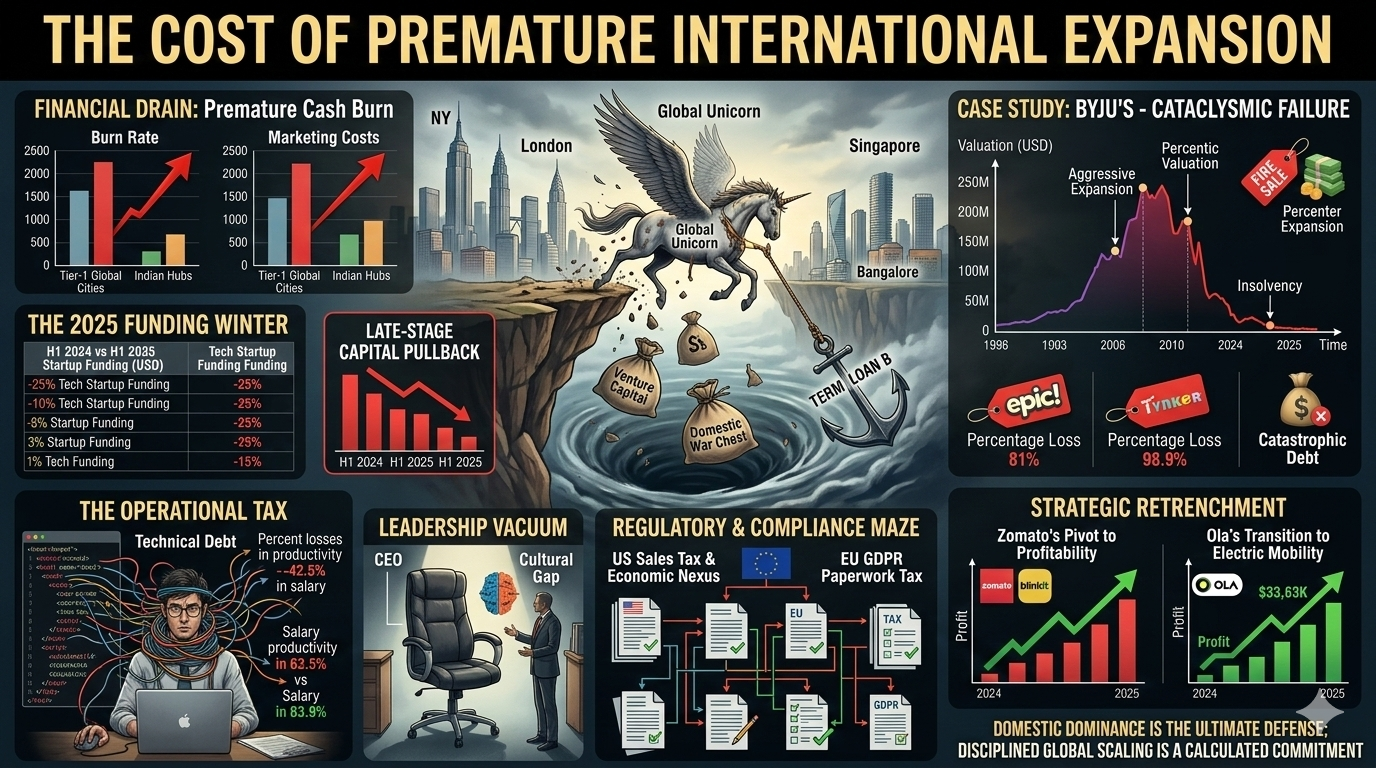
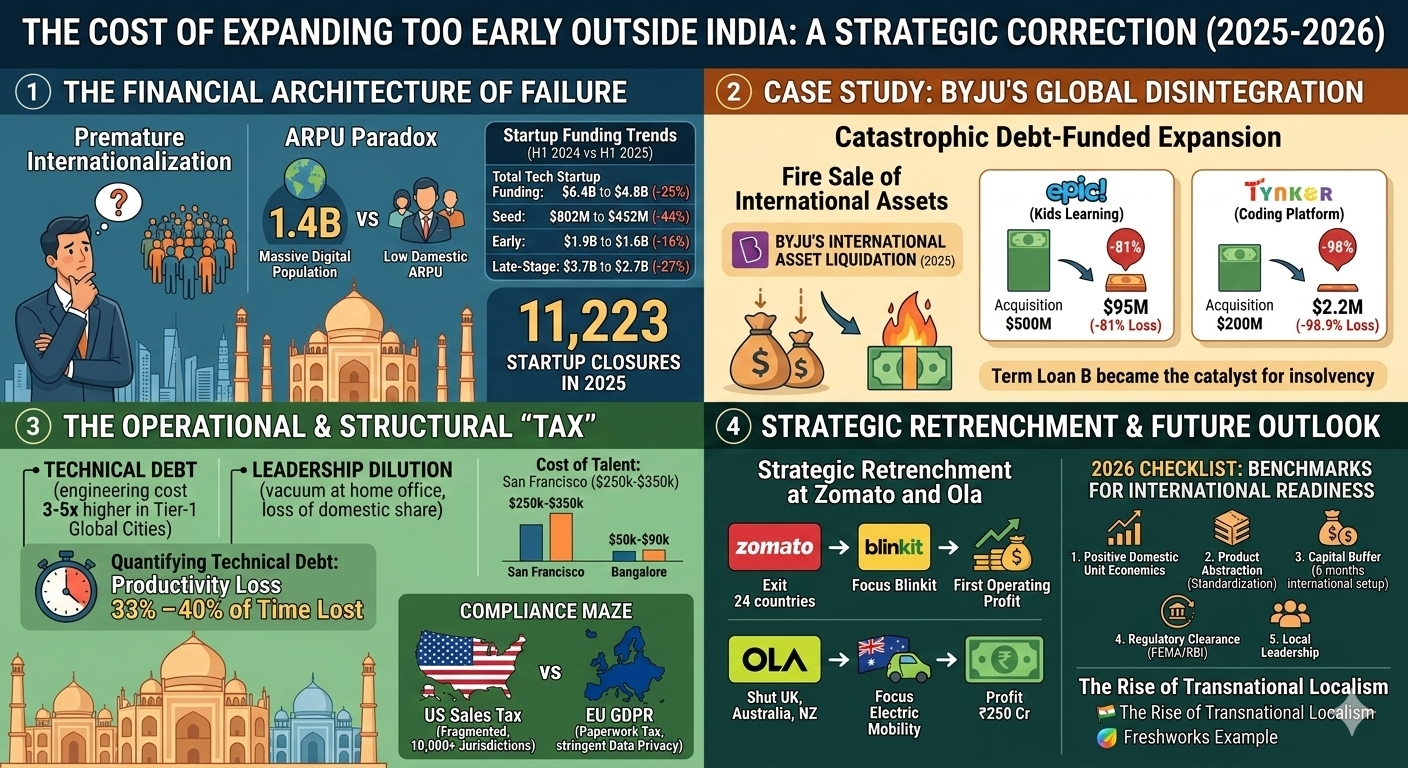
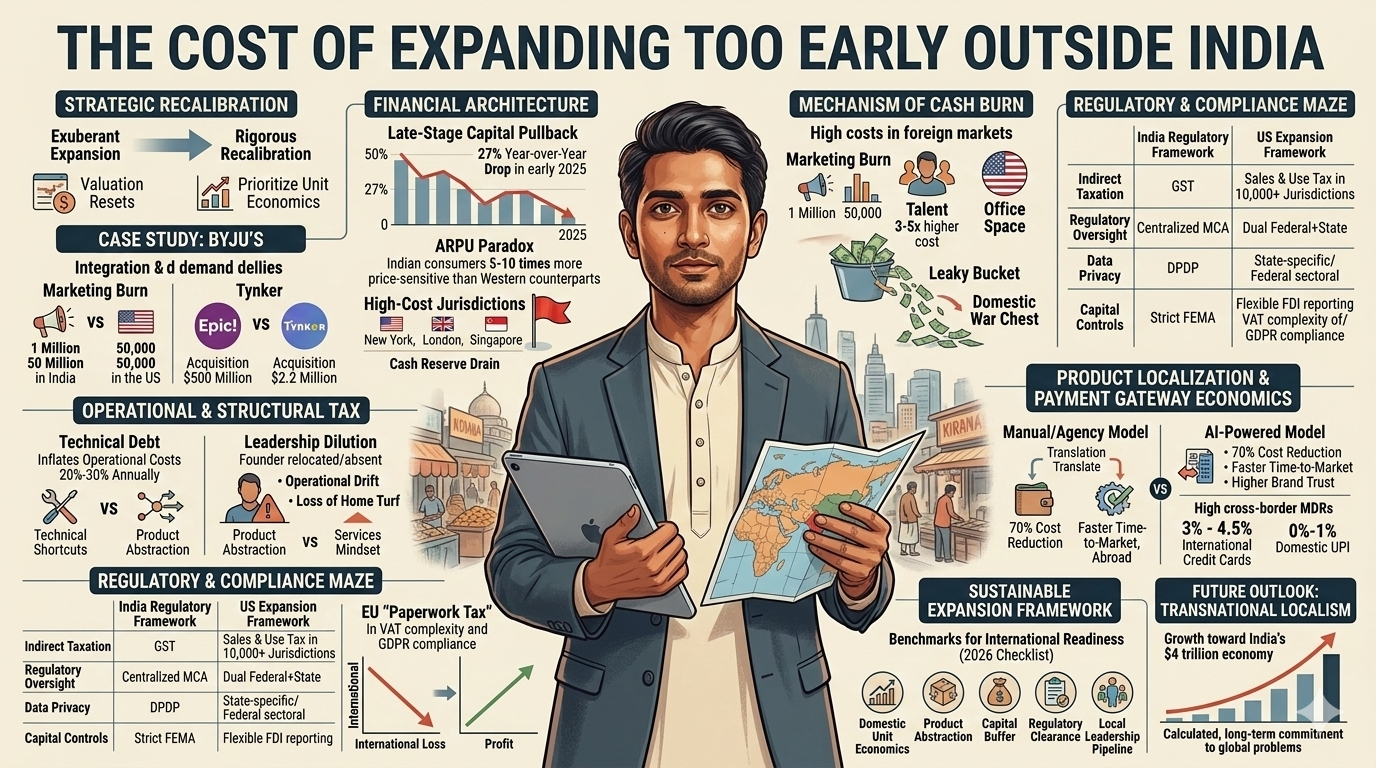
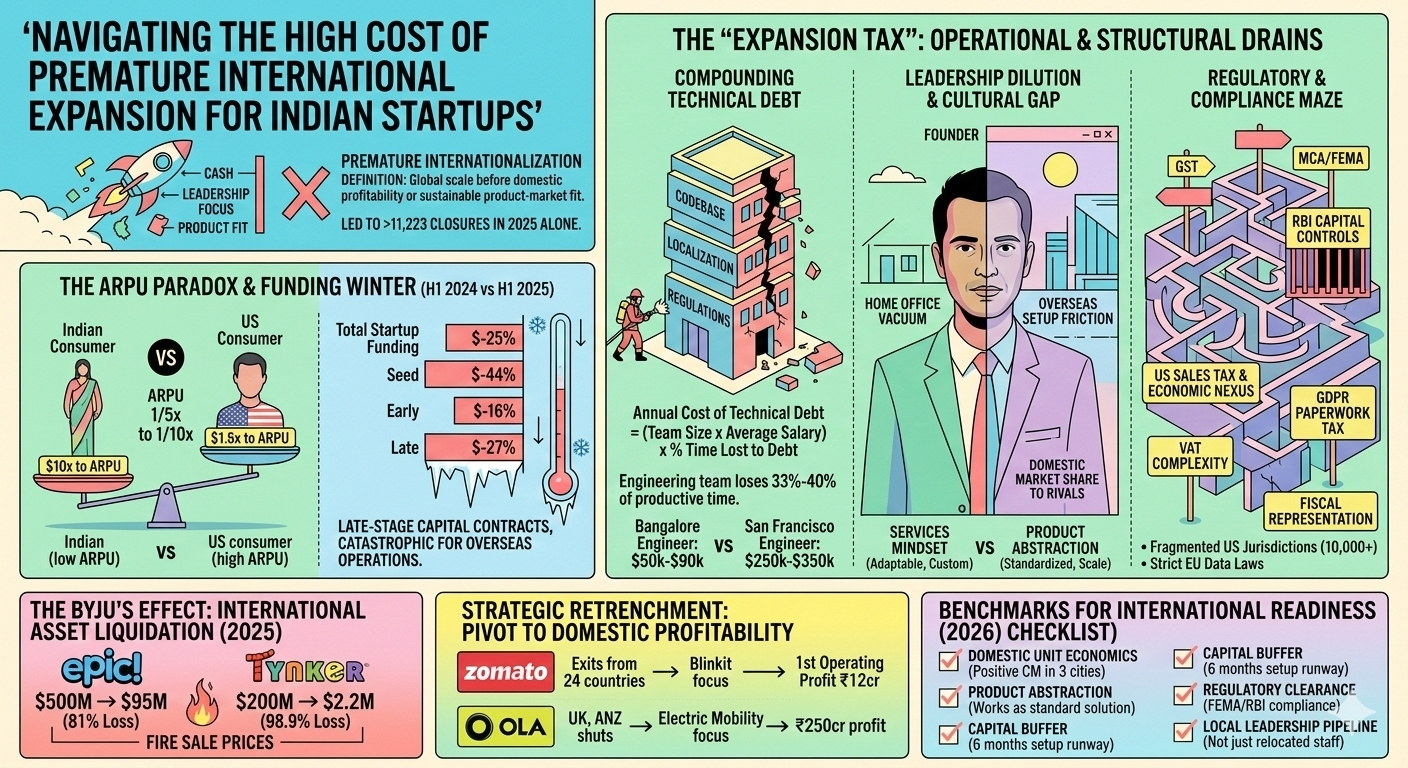
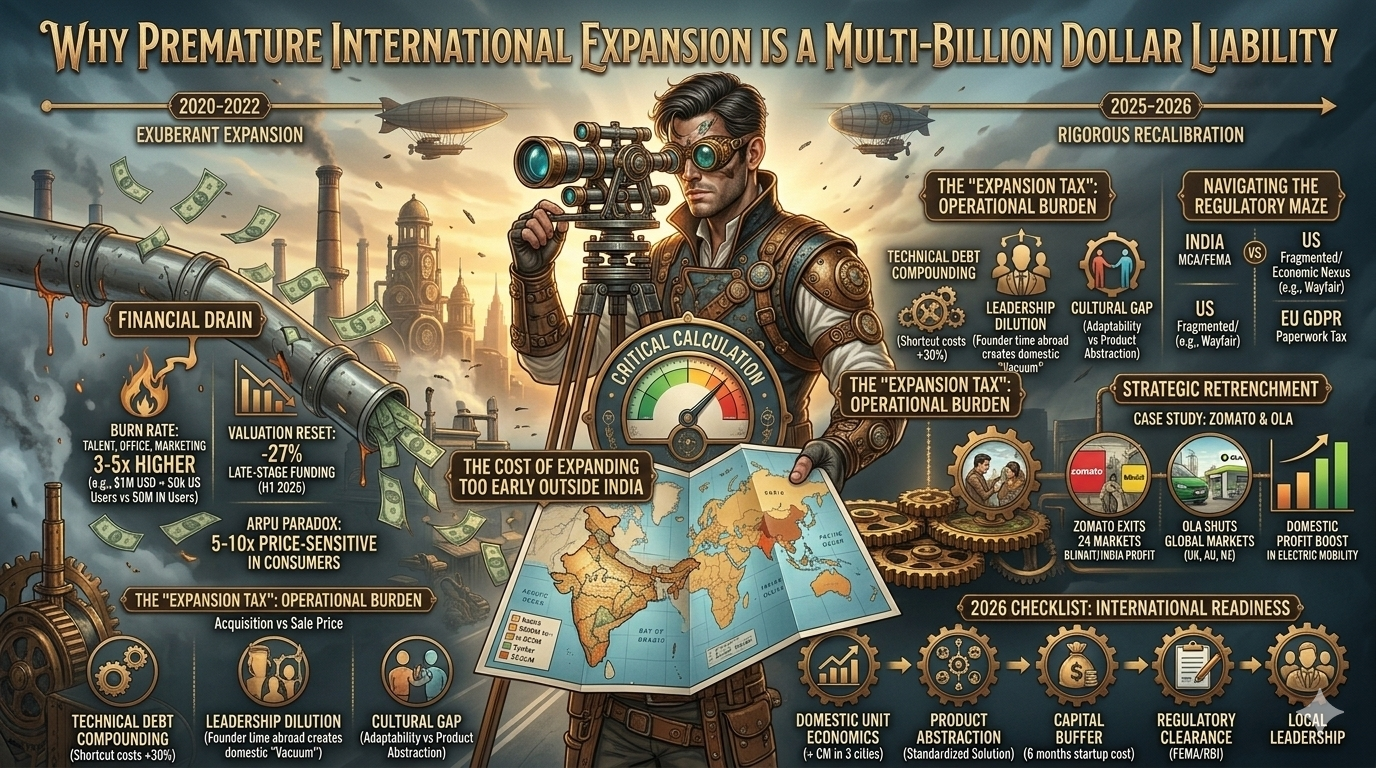
The Indian startup ecosystem, currently recognized as the third-largest in the world, is undergoing a profound structural transformation in 2025 and 2026. After a period of exuberant expansion fueled by record-high venture capital inflows between 2020 and 2022, a rigorous recalibration has emerged. This correction is most visible in the strategic shifts regarding international expansion, where the cost of moving too early beyond domestic borders has transitioned from a theoretical business risk to a multi-billion-dollar liability. Data from 2024 and 2025 indicates a significant pullback in late-stage capital, reflecting rising global interest rates and valuation resets that have forced founders to prioritize unit economics over vanity metrics such as global reach or geographic footprint. The phenomenon of premature internationalization—defined as seeking global scale before achieving domestic profitability or sustainable product-market fit—has led to a surge in startup failures, with over 11,223 closures recorded in 2025 alone.
The Financial Architecture of Expansion-Induced Failure
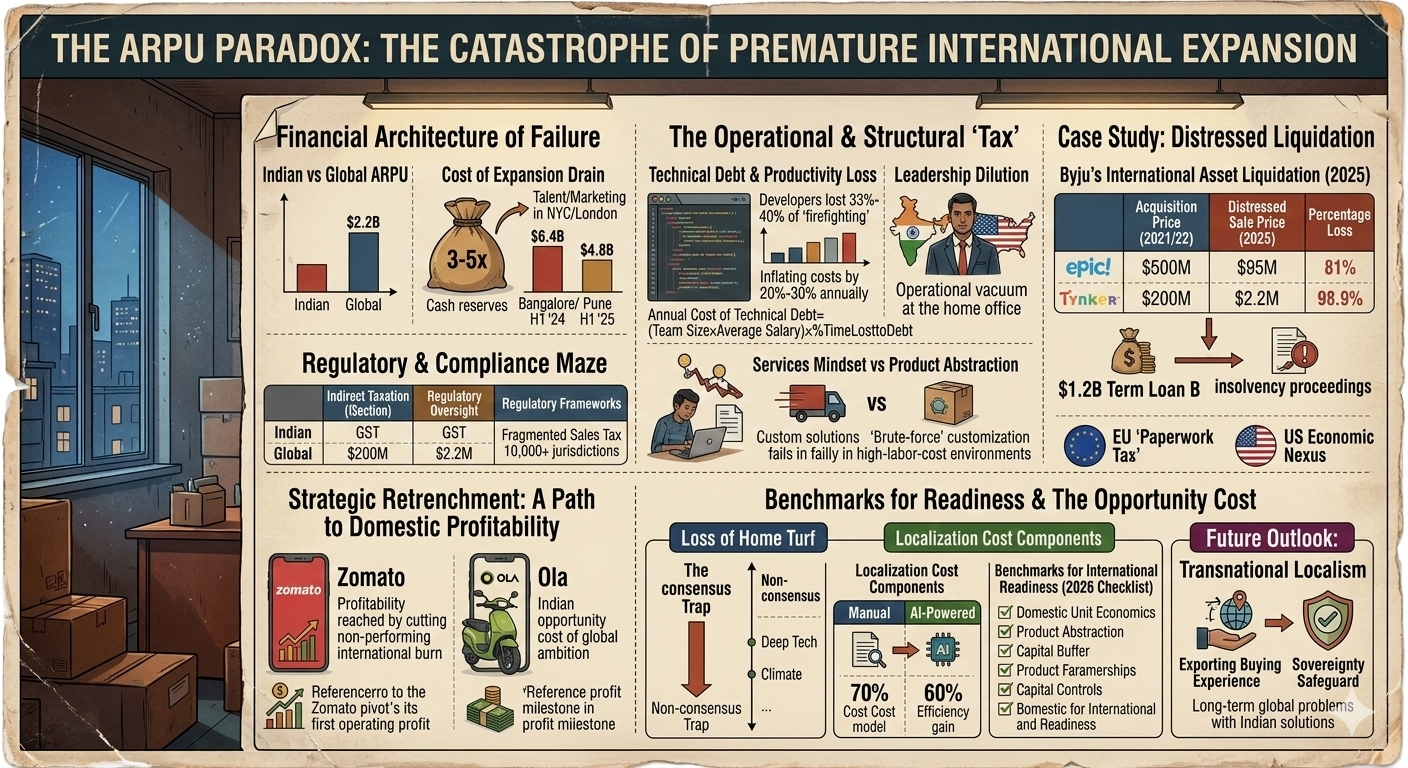
The impulse for Indian startups to expand internationally is often driven by the "ARPU Paradox." While India offers a massive digital-native population of nearly 1.4 billion people, the average revenue per user (ARPU) remains significantly lower than in Western markets. Specifically, Indian consumers are 5 to 10 times more price-sensitive than their counterparts in the United States or Europe. Consequently, founders often view international markets as the only path to high-margin profitability. However, the cost of accessing these high-ARPU users is frequently underestimated, leading to a terminal drain on cash reserves.
The Valuation Reset and the 2025-2026 Funding Reality
In the first half of 2025, the Indian tech startup ecosystem raised approximately $4.8 billion, representing a 25% decline from the first half of 2024. This dip is part of a broader "funding winter" that has seen unicorn creation drop sharply after the peaks of 2021 and 2022. For startups that expanded prematurely, this tightening of capital availability is catastrophic. Late-stage funding, which is essential for sustaining expensive overseas operations, saw a 27% year-over-year drop in early 2025.
Indian Startup Funding Trends (H1 2024 vs H1 2025) | H1 2024 (USD) | H1 2025 (USD) | Percentage Change |
Total Tech Startup Funding | $6.4 Billion | $4.8 Billion | -25% |
Seed-Stage Funding | $802 Million | $452 Million | -44% |
Early-Stage Funding | $1.9 Billion | $1.6 Billion | -16% |
Late-Stage Funding | $3.7 Billion | $2.7 Billion | -27% |
This funding contraction has direct implications for international expansion. Startups that rushed to establish offices in New York, London, or Singapore based on 2021 valuations now find themselves unable to raise the follow-on capital required to achieve break-even in those high-cost jurisdictions. The "cost of capital" has risen not just in interest rate terms, but in the dilution founders must accept to keep struggling international subsidiaries afloat.
The Mechanism of Cash Burn in Foreign Markets
Premature expansion accelerates the "burn rate" because the cost of talent, office space, and marketing in Tier-1 global cities is often 3 to 5 times higher than in Indian hubs like Bangalore or Pune. A startup that spends $1 million on marketing in India might reach 50 million users, whereas the same $1 million in the United States might only acquire 50,000 users in a competitive SaaS or Fintech category. When product-market fit is not perfectly aligned, this burn becomes a "leaky bucket" that can deplete the parent company's entire domestic war chest.
Case Study: The Disintegration of the Global EdTech Giant
Byju’s represents the most spectacular example of the catastrophic costs associated with aggressive, debt-funded international expansion. At its peak in 2022, Byju’s was valued at $22 billion, a figure driven by a relentless "growth-at-all-costs" philosophy and a dependency on foreign venture capital. The company’s strategy involved acquiring established international players to gain instant market share, but the integration costs and the subsequent demand decline in the post-pandemic era proved fatal.
The Fire Sale of International Assets
The extent of the value erosion at Byju’s is most visible in the distressed sale of its US-based subsidiaries, Epic and Tynker. In May 2025, a US bankruptcy court approved the sale of these assets for a fraction of their original acquisition prices.
Byju's International Asset Liquidation (2025) | Acquisition Price (2021/22) | Distressed Sale Price (2025) | Percentage Loss |
Epic! (Kids Learning) | $500 Million | $95 Million | 81% |
Tynker (Coding Platform) | $200 Million | $2.2 Million | 98.9% |
The fire sale prices underscore a critical lesson: international assets acquired at market peaks are highly volatile and can become liabilities if the parent company’s governance and financial health are compromised. Byju’s $1.2 billion Term Loan B, intended to fund this global expansion, became the primary catalyst for its insolvency proceedings in both Delaware and India. The legal and reputational costs associated with these international failures have effectively erased the equity value of one of India's most prominent unicorns.
The Operational and Structural "Tax" of Expansion
Beyond the direct financial loss, expanding too early imposes a heavy operational burden that can stifle a startup's core innovation. This is often referred to as the "expansion tax," manifesting as technical debt, talent management friction, and the dilution of leadership focus.
The Compounding Interest of Technical Debt
The pressure to "go global" frequently forces engineering teams to take architectural shortcuts to meet launch deadlines in new markets. These shortcuts accumulate as technical debt, which industry reports suggest can inflate operational costs by as much as 20% to 30% annually. In an international context, technical debt is compounded by the need for localization—handling multiple currencies, languages, and regional data privacy laws.
The financial impact of technical debt can be quantified through the productivity loss of the engineering team. According to Nasscom-referenced metrics, developers in high-debt environments lose 33% to 40% of their productive time to "firefighting" or fixing legacy issues.
AnnualCostofTechnicalDebt=(TeamSize×AverageSalary)×%TimeLosttoDebt
For an Indian startup expanding to the US, the engineering cost is further magnified if local hires are required to manage the debt-heavy codebase. A senior software engineer in San Francisco costs between $250,000 and $350,000 in total compensation, compared to $50,000 to $90,000 for a comparable role in Bangalore. If the Indian engineering team is bogged down by technical debt, the company is forced to hire expensive local talent to maintain velocity, creating a cycle of high burn and low output.
Leadership Dilution and the Cultural Gap
Premature expansion often requires the founder or key executives to relocate or spend significant time abroad, leading to a "leadership vacuum" at the home office. In a market as competitive and chaotic as India, the absence of the founding team can lead to operational drift, slower decision-making, and the loss of domestic market share to more focused rivals.
Furthermore, the "services mindset" prevalent in many Indian startups often clashes with the "product abstraction" required for global scale. Indian founders are trained to be highly adaptable, often offering custom solutions to close deals. However, global category leaders like Stripe or AWS succeed by removing complexity through standardization. When an Indian startup expands prematurely, it often tries to "brute-force" its way into the new market using people and customization rather than a standardized product, a strategy that does not scale in high-labor-cost environments like Europe or North America.
Navigating the Regulatory and Compliance Maze
The legal and regulatory burden of international expansion is perhaps the most underestimated cost for Indian founders. Moving from the centralized corporate oversight of India's Ministry of Corporate Affairs (MCA) to the fragmented, state-level regulatory landscape of the United States or the stringent GDPR-compliant environment of the European Union requires significant investment in legal and compliance infrastructure.
The US Sales Tax and Economic Nexus Hurdle
In the United States, startups must navigate both federal and state tax obligations. A critical development is the concept of economic nexus, established by the South Dakota v. Wayfair ruling. This requires companies to register and collect sales tax in states where they trigger an economic presence (through revenue or transaction thresholds), even if they have no physical office there.
Compliance Component | Indian Regulatory Framework | US Expansion Framework |
Indirect Taxation | GST (Unified/Flat Categories) | Sales & Use Tax (Fragmented/10,000+ Jurisdictions) |
Regulatory Oversight | Centralized (MCA/FEMA) | Dual (Federal + State-level) |
Data Privacy | DPDP Act (Emerging) | State-specific (e.g., CCPA) or Federal sectoral laws |
Capital Controls | Strict (FEMA/RBI) | Flexible, but high reporting requirements for FDI |
The "Paperwork Tax" in the European Union
For Indian SaaS founders targeting the EU, the compliance challenges are even more acute. The "paperwork tax" includes VAT complexity, local invoicing rules, and the stringent requirements of the General Data Protection Regulation (GDRP). Startups often face a dilemma: do they need an EU entity on Day 1, or can they sell through a lighter setup? A premature decision to formalize can lock a company into expensive fiscal representation requirements and annual audit costs before they have even acquired their first 20 customers.
Case Study: Strategic Retrenchment at Zomato and Ola
The period of 2023-2025 has been characterized by a "clean-up drive" among Indian unicorns. Recognizing the unsustainable costs of premature global ambition, market leaders like Zomato and Ola have systematically liquidated their international subsidiaries to protect their domestic profitability.
Zomato’s Pivot to Profitability
Between 2012 and 2019, Zomato expanded aggressively into 24 countries. However, by 2023, the company had exited nearly all international markets, including Lebanon, the UK, Singapore, and Vietnam. Zomato categorized this exit as a strategic effort to "channelise the money into more profitable ventures" within India, specifically its quick-commerce brand, Blinkit.
The result of this retrenchment was immediate and positive. Zomato reported its first operating profit of ₹12 crore in the June 2023 quarter, a milestone achieved by cutting the burn from non-performing international branches. In Lebanon, the exit was accelerated by a local financial crisis and fuel shortages that made delivery operations impossible, highlighting the geopolitical risks that Indian startups are often ill-equipped to hedge against.
Ola's Transition to Electric Mobility
Ola followed a similar trajectory, announcing in April 2024 that it would shut down its existing global markets in the UK, Australia, and New Zealand. The company cited the "immense opportunity for expansion" in India's electric mobility sector as the primary driver for this shift. By focusing on the domestic market, Ola’s mobility business reported a profit of ₹250 crore in FY23, compared to a loss of ₹66 crore in FY22. This demonstrates that the opportunity cost of international expansion—losing focus on the domestic market—can often be greater than the potential revenue from foreign operations.
The Opportunity Cost of Domestic Market Neglect
India's economy is projected to grow at 6.5% in 2026, outpacing most of its global peers. For many startups, the domestic market remains an untapped "gold mine," particularly in Tier-2 and Tier-3 cities where 50% of the 159,000 recognized startups are now based. Prematurely shifting focus to the US or Europe can lead to a "loss of the home turf."
Competitive Displacement in India
While a founder is distracted by the complexities of setting up a UK subsidiary or navigating US visa denials, domestic competitors can capture market share by leveraging India's digital public infrastructure (UPI, Aadhaar, ONDC). The "cost" of expansion is thus not just the cash burnt abroad, but the valuation lost at home. For example, Paytm's domestic dominance in digital payments was challenged by PhonePe and Google Pay during the period it was exploring international markets in Canada and Japan.
The Risk of the "Consensus Trap"
Venture capitalists have noted a "consensus trap" in the Indian ecosystem, where founders rush into trendy sectors (like international EdTech or global SaaS) to attract funding, leading to overcapitalization and unsustainable unit economics. The correction of 2025 has seen a shift toward "non-consensus" opportunities in deep tech, climate solutions, and manufacturing—sectors that address India's unique challenges and offer more resilient growth paths.
Product Localization and Language Technology Costs
Localization is often viewed as a simple translation task, but for Indian startups expanding into regional micro-markets or foreign countries, the costs can be prohibitive without the right technology.
The Cost of Multi-Market Content Operations
For years, Indian startups treated translation as a manual, project-based task, leading to "slow margin erosion" as content volumes exploded. When a startup expands to 24 countries, like Zomato did, every product update, app notification, and marketing email must be localized. Without automation, the content operations typically consume a significant portion of the marketing budget.
Localization Cost Components | Manual/Agency Model | AI-Powered Model (2025) | Impact of AI |
Translation Cost | Per-word fees (High) | Re-use/Translation memory | 70% Cost Reduction |
Turnaround Time | Weeks | Days/Hours | Faster Time-to-Market |
Consistency | Variable by Agency | Centralized GLossaries | Higher Brand Trust |
Engineering Effort | Spreadsheet Management | API-Integrated Workflows | 60% Efficiency Gain |
Startups that expand prematurely without investing in "language tech" often find themselves unable to communicate effectively with their new audience, leading to poor product-market fit and high churn.
Payment Gateway Economics for International Scaling
The "last mile" of international expansion is the ability to collect payments. Indian startups often rely on domestic gateways like Razorpay or Cashfree, which have established international solutions (e.g., RazorpayX), but the fee structure changes significantly for cross-border transactions.
Payment Method | Typical Domestic MDR | International Transaction MDR | Hidden Costs |
UPI | 0% - 1% | N/A (Limited Global Adoption) | None |
Credit Cards | 1.5% - 3% | 3% - 4.5% | Currency Conversion Fees |
PayPal | N/A | Variable (~4% + Fixed Fee) | High Exchange Rates |
Wire Transfers | Flat Fee | Variable | Intermediate Bank Charges |
Premature expansion into countries with low UPI penetration (like the US or EU) forces startups to accept higher MDRs (Merchant Discount Rates) and interchange fees, which can eat up to 5% of gross margins. Startups must also account for "Economic Nexus" requirements, where payment gateways may withhold taxes if the company is not properly registered in the customer's jurisdiction.
A Strategic Framework for Sustainable Expansion
To avoid the pitfalls of premature internationalization, the venture capital landscape has shifted toward more disciplined benchmarks. Peak XV (formerly Sequoia India) and other Tier-1 funds now emphasize a "staged" approach to global markets.
The "Seed-strapping" and "Venture Debt" Lever
Founders are increasingly using the "seed-strapping" model—combining modest early-stage funding with bootstrapped efficiency—to build a resilient domestic base before raising large rounds for global expansion. Additionally, venture debt has emerged as a strategic tool for managing the high setup costs of international entities without diluting equity at lower valuations.
Benchmarks for International Readiness (2026 Checklist)
Based on insights from industry analysts and McKinsey’s "winning company" factors, a startup should meet the following criteria before considering international expansion:
Domestic Unit Economics: Achieving positive contribution margins in at least three major Indian cities.
Product Abstraction: Proving that the product can work as a standardized solution without requiring heavy "services" or human intervention to manage complexity.
Capital Buffer: Maintaining at least six months of runway specifically for international setup costs, which can range from $50,000 to $100,000 for a basic entity abroad.
Regulatory Clearance: Ensuring full compliance with FEMA and RBI capital controls to allow for smooth profit repatriation.
Local Leadership Pipeline: Having a strategy to hire a "local senior leadership team" rather than merely relocating Indian junior staff who may lack market context.
Future Outlook: The Rise of "Transnational Localism"
The next decade for Indian startups will likely belong to those that practice "transnational localism"—the ability to act as a native player in every market they enter while maintaining the cost-efficiency of their Indian roots. This requires moving beyond "exporting software" to "exporting a buying experience".
As India moves toward a $4 trillion economy, the "sovereignty safeguard" of building foundational tech competence (in AI, Deep Tech, and Climate Solutions) will become as important as commercial expansion. The startups that survive the current correction will be those that view international expansion not as a "vanity project" to boost valuations, but as a calculated, long-term commitment to solving global problems with Indian-engineered solutions.
The 90% failure rate of Indian startups remains a stark reminder of the risks of entrepreneurship. However, for the 10% that manage to balance domestic dominance with disciplined global scaling, the rewards are immense. The emergence of firms like Freshworks—the first Indian SaaS firm to list on NASDAQ—proves that with the right "product-led" focus and operational resilience, Indian startups can indeed set the rules for the global market. The cost of expansion, while high, is a necessary investment for those who are truly ready; for those who are not, it is an avoidable tragedy.

Read More -
1. From Idea to MVP: A Step-by-Step Guide for Solo Founder
🔗 https://findnstart.com/blogs/from-idea-to-mvp-a-step-by-step-guide-for-solo-founder
2. How to Validate Your Startup Idea in 48 Hours for $0
🔗 https://findnstart.com/blogs/how-to-validate-your-startup-idea-in-48-hours-for-0
3. Remote vs. Local: Does Your Co-Founder Need to Live in the Same City?
🔗 https://findnstart.com/blogs/remote-vs-local-does-your-co-founder-need-to-live-in-the-same-city
4. The 2026 Startup Landscape: What Has Fundamentally Changed (and Why Founder Skills Matter More Than Ever)
5. The Most In-Demand Skills for Startup Founders in 2026
🔗 https://findnstart.com/blogs/the-most-in-demand-skills-for-startup-founders-in-2026
6. How to Find a Technical Co-Founder (Without a Six-Figure Salary)
🔗 https://findnstart.com/blogs/how-to-find-a-technical-co-founder-without-a-six-figure-salary
7. 5 Red Flags to Look for When Choosing a Startup Partner
🔗 https://findnstart.com/blogs/5-red-flags-to-look-for-when-choosing-a-startup-partner
8. How to Pitch Your Idea to Potential Co-Founders
🔗 https://findnstart.com/blogs/how-to-pitch-your-idea-to-potential-co-founders
9. How to Build a Portfolio that Attracts High-Growth Startup Founders
🔗 https://findnstart.com/blogs/how-to-build-a-portfolio-that-attracts-high-growth-startup-founders
10. Equity vs. Salary: How to Split Ownership with Your First Teammate
🔗 https://findnstart.com/blogs/equity-vs-salary-how-to-split-ownership-with-your-first-teammate
11. Why Joining an Early-Stage Startup is Better Than a Corporate Job
🔗 https://findnstart.com/blogs/why-joining-an-early-stage-startup-is-better-than-a-corporate-job
12. The Future of EdTech: Why Developers and Educators Need to Team Up Now
🔗 https://findnstart.com/blogs/the-future-of-edtech-why-developers-and-educators-need-to-team-up-now
13. The Architecture of Symbiosis: Analytical Perspectives on the Five Habits of Successful Startup Duos
14. Finding a Co-Founder in the AI Space: What Skills Should You Look For?
🔗 https://findnstart.com/blogs/finding-a-co-founder-in-the-ai-space-what-skills-should-you-look-for
15. Overcoming Analysis Paralysis and the Strategic Path to Execution
🔗 https://findnstart.com/blogs/overcoming-analysis-paralysis-and-the-strategic-path-to-execution
16. From College Project to Company: How to Find Your Student Co-Founder
🔗 https://findnstart.com/blogs/from-college-project-to-company-how-to-find-your-student-co-founder
17. How to Start a Startup While Working a Full-Time Job
🔗 https://findnstart.com/blogs/how-to-start-a-startup-while-working-a-full-time-job
18. How to Build a HealthTech Startup Without a Medical Degree
🔗 https://findnstart.com/blogs/how-to-build-a-healthtech-startup-without-a-medical-degree
19. The Solitary Architect: Executive Isolation in Entrepreneurship
20. The 2026 Guide to Launching a SaaS as a Solo Developer
21. What Sustainable Growth Actually Looks Like
🔗 https://findnstart.com/blogs/what-sustainable-growth-actually-looks-like
22. The Early Warning Signs Your Startup Is in Trouble
🔗 https://findnstart.com/blogs/the-early-warning-signs-your-startup-is-in-trouble
23. How to Grow Without Burning Out
🔗 https://findnstart.com/blogs/how-to-grow-without-burning-out
24. The Truth About “Runway” Most Founders Ignore
🔗 https://findnstart.com/blogs/the-truth-about-runway-most-founders-ignore
25. Revenue Solves More Problems Than Funding
🔗 https://findnstart.com/blogs/revenue-solves-more-problems-than-funding
26. What No One Tells You About Being a Solo Founder
🔗 https://findnstart.com/blogs/what-no-one-tells-you-about-being-a-solo-founder
27. Why Smart People Quit High-Paying Jobs to Build Startups (And Why Most Regret It)
28. Why Most Startup Advice on Twitter Is Dangerous
🔗 https://findnstart.com/blogs/why-most-startup-advice-on-twitter-is-dangerous
29. Decision Fatigue: The Silent Startup Killer
🔗 https://findnstart.com/blogs/decision-fatigue-the-silent-startup-killer
30. Fear vs Logic: How Founders Actually Make Decisions
🔗 https://findnstart.com/blogs/fear-vs-logic-how-founders-actually-make-decisions
31. How Overthinking Destroys Early Momentum
🔗 https://findnstart.com/blogs/how-overthinking-destroys-early-momentum
32. Ideas Don’t Scale. Systems Do.
🔗 https://findnstart.com/blogs/ideas-dont-scale-systems-do
33. The First Hire That Actually Matters
🔗 https://findnstart.com/blogs/the-first-hire-that-actually-matters
34. How the First 100 Users Decide Your Startup’s Fate
🔗 https://findnstart.com/blogs/how-the-first-100-users-decide-your-startups-fate
35. Why Your Startup Doesn’t Need Growth — It Needs Focus
🔗 https://findnstart.com/blogs/why-your-startup-doesnt-need-growthit-needs-focus
36. Why Most Startups Die Quietly
🔗 https://findnstart.com/blogs/why-most-startups-die-quietly
37. Lessons Learned Too Late by First-Time Founders
🔗 https://findnstart.com/blogs/lessons-learned-too-late-by-first-time-founders
38. The Myth of the “Overnight Success” Startup
🔗 https://findnstart.com/blogs/the-myth-of-the-overnight-success-startup

Want to calculate the equity for your cofounder?
Nail your cap table before you sign. Whether you're splitting equity with a co-founder or planning your next funding round, our Equity Calculator gives you precision in seconds
Equity calculator →