Solo Founders with Leverage Are Winning
June 29, 2026 by Harshit Gupta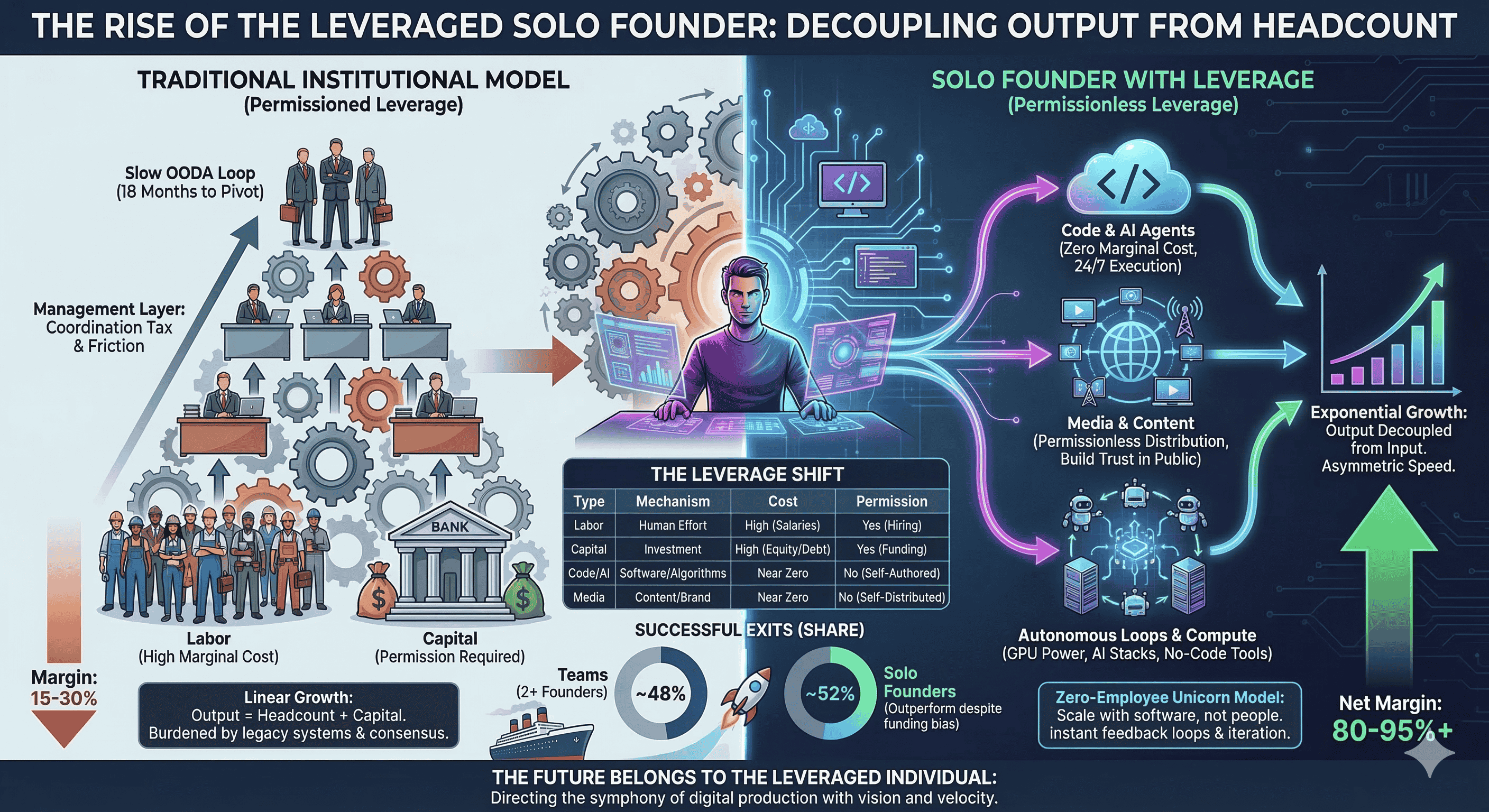
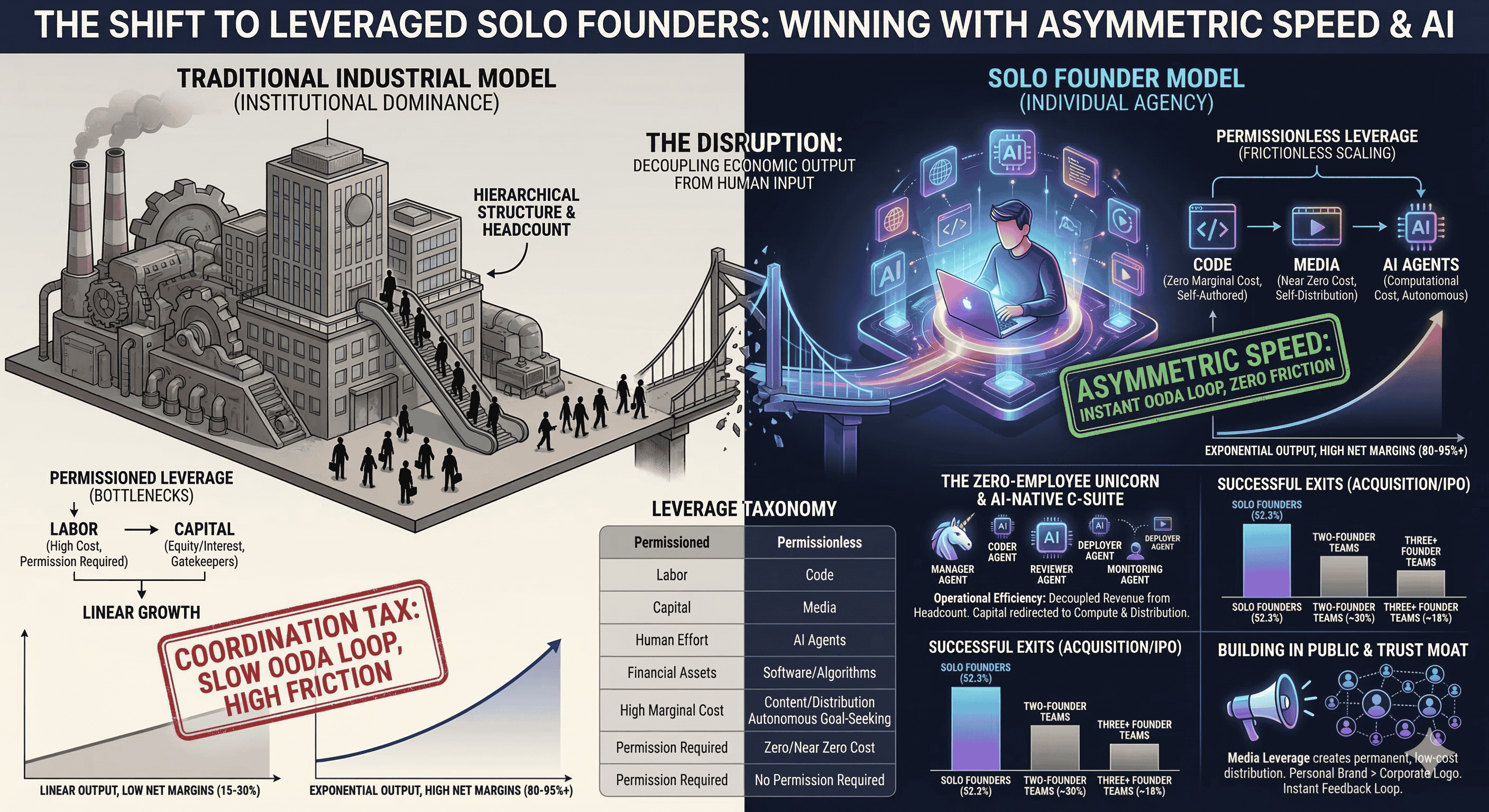
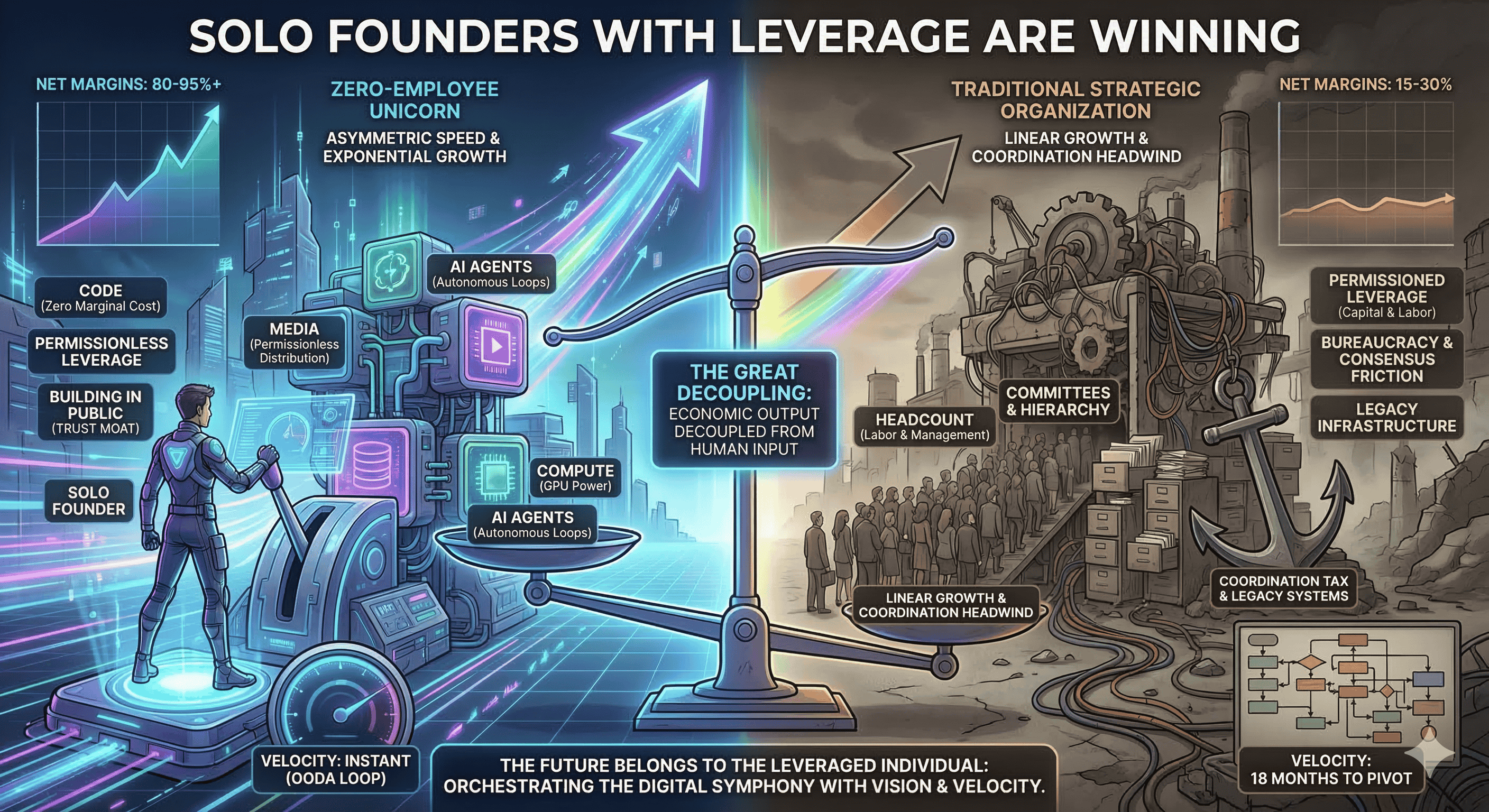
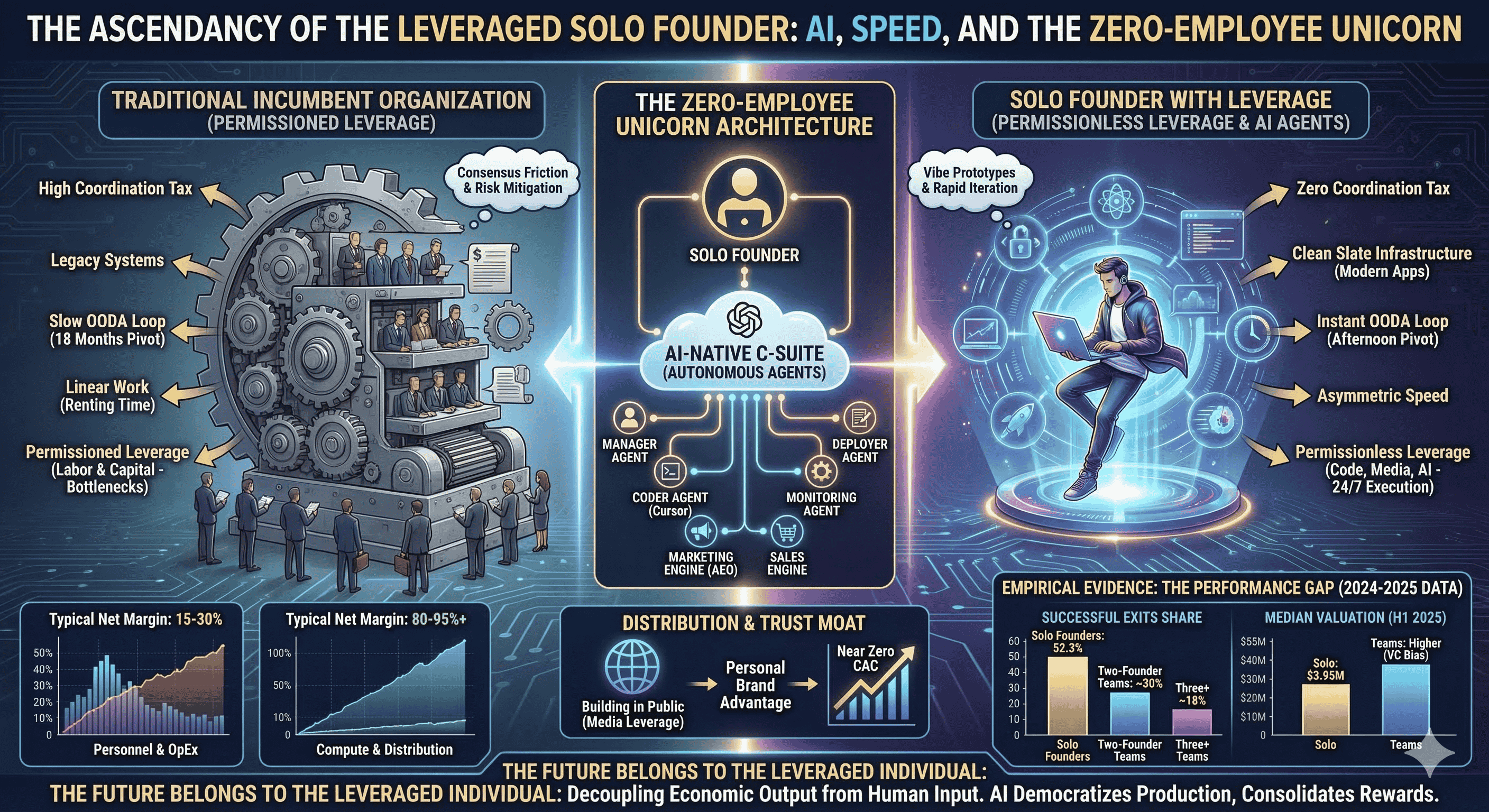
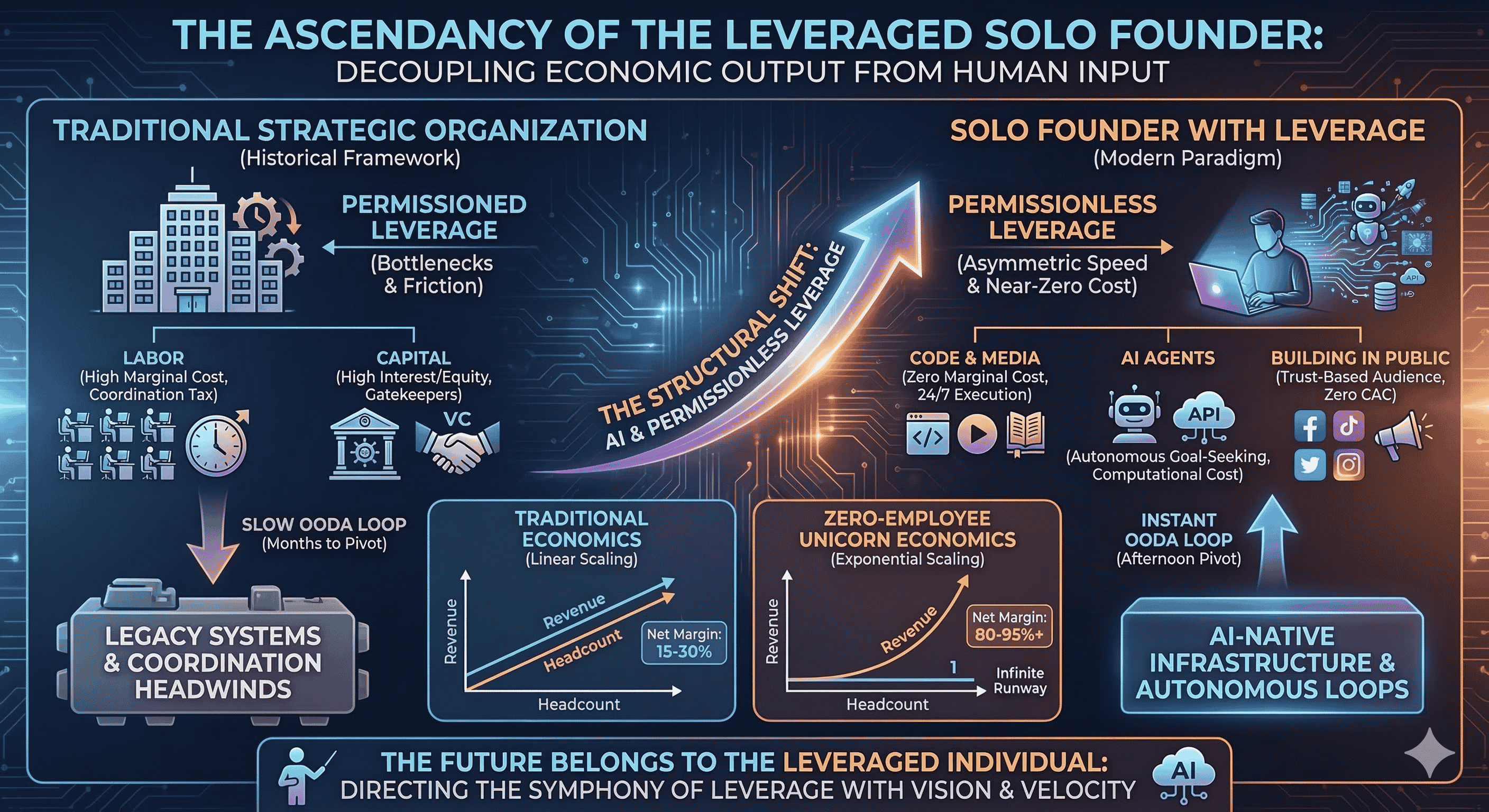
The historical narrative of industrial progress has long been defined by the accumulation of labor and capital within centralized, hierarchical structures. In this traditional framework, the ability to scale was inextricably linked to the ability to manage increasing headcount and coordinate complex multi-departmental operations. However, the emergence of permissionless leverage—defined by code, media, and increasingly, autonomous artificial intelligence—has fundamentally decoupled economic output from human input. This structural shift has empowered a new class of solo founders to outmaneuver traditional strategic organizations by operating with asymmetric speed and near-zero marginal costs. The current economic environment marks the transition from an era of institutional dominance to one of individual agency, where the conductor of a digital symphony can wield the productive capacity previously reserved for mid-sized corporations.
The Taxonomy of Leverage and the Disruption of Firm Theory
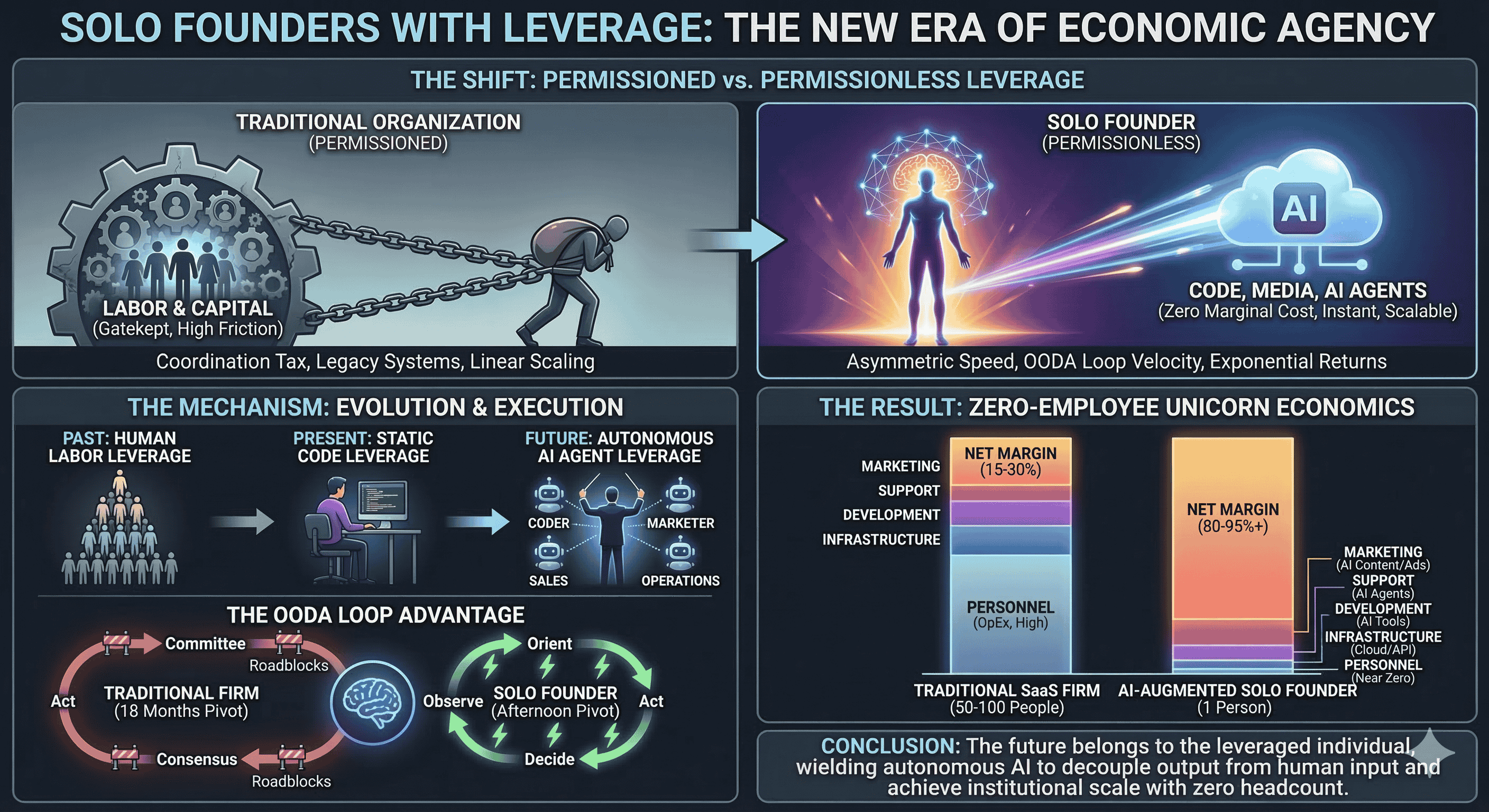
The foundation of modern solo founder success lies in the strategic application of leverage, a force multiplier that allows a single individual to achieve exponential returns. The framework of leverage has evolved from the ancient reliance on human labor to the modern reliance on digital robots. Traditional forms of leverage, such as labor and capital, are classified as permissioned leverage. To utilize labor, one must convince others to follow; to utilize capital, one must convince investors or banks to provide funding. These forms are inherently bottlenecks, subject to the friction of human negotiation and the gatekeeping of institutional interests. In contrast, the rise of code and media represents the advent of permissionless leverage. This form of leverage does not require a third party’s consent for deployment. A solo founder with a computer can write code or produce media that works 24/7 without additional costs or the need for a payroll department.
The economic significance of this shift cannot be overstated, as it democratizes the means of production while consolidating the rewards of successful execution. While traditional organizations remain trapped in linear work—renting out their time and their employees' time—solo founders leverage assets that earn while they sleep. This allows for a disconnect between input and output, where one correct decision or a single piece of high-quality code can generate returns that are orders of magnitude greater than the effort expended.
Form of Leverage | Type | Mechanism | Marginal Cost | Permission Required |
Labor | Permissioned | Human effort and execution | High (Salaries, Benefits) | Yes (Employees) |
Capital | Permissioned | Financial investment and assets | High (Interest/Equity) | Yes (Banks/VCs) |
Media | Permissionless | Content, books, video, podcasts | Near Zero | No (Self-distribution) |
Code | Permissionless | Software, scripts, algorithms | Zero | No (Self-authored) |
AI Agents | Permissionless | Autonomous goal-seeking logic | Computational (API/GPU) | No (Self-orchestrated) |
The transition from labor to code as the primary driver of value creation is particularly evident in the manufacturing sector. McKinsey reports indicate that as of 2015, approximately 64% of working hours in manufacturing were already automatable. Current projections suggest that up to 47% of U.S. jobs and 30% of global roles could be automated by the mid-2030s. This systemic replacement of labor with automated systems favors the solo operator who can orchestrate these technologies without the legacy overhead of managing a human workforce. The "coordination headwind" that plagues large firms—the time spent on meetings, alignment, and internal communication—is essentially a tax that solo founders no longer have to pay.

The Evolution from Static Code to Agentic Leverage
The most significant evolution in the leverage framework is the transition from static code to autonomous agentic leverage. In the era of traditional code leverage, a founder had to provide step-by-step instructions to a computer. The emergence of AI agents has shifted the paradigm from instructing the machine on how to act to providing the machine with a goal. This agentic leverage allows a single human to act as a conductor, managing a swarm of specialized AI entities that handle coding, marketing, sales, and operations.
This shift effectively replaces the traditional C-Suite with a technical stack. Where a traditional firm requires a Chief Technology Officer (CTO), a Chief Marketing Officer (CMO), and a Chief Operating Officer (COO), the modern solo founder utilizes autonomous coding assistants like Cursor, content generation engines, and automated sales funnels to perform these functions. This reduces the coordination tax of human interaction to nearly zero, as the founder communicates directly with systems designed for instant execution rather than committees designed for deliberation.
Mechanics of Asymmetric Speed: The OODA Loop in Solo Execution
The primary advantage of the solo founder over the institutional incumbent is the velocity of the decision-making cycle. In military and strategic theory, this is often conceptualized as the OODA loop: Observe, Orient, Decide, Act. Traditional organizations suffer from structural coordination headwinds, where every step of the OODA loop is slowed by hierarchy, reporting lines, and the need for consensus. A solo founder, by contrast, operates with an instant feedback loop, allowing them to change direction in an afternoon whereas an enterprise might take 18 months to pivot.
Decision-Making Without Consensus Friction
Institutional strategy is often a process of risk mitigation through collective accountability. While this prevents catastrophic errors, it also prevents the rapid iteration necessary for high-growth innovation. Solo founders embrace accountability under their own name, which society rewards with higher equity and leverage. Because they do not need to negotiate with partners or report to a board of directors, they can execute on "vibe prototypes"—functional versions of a product built in hours to test market demand—before a traditional firm has even finished drafting a project charter.
This speed is not merely a tactical advantage but a defensive moat. By shipping polished, opinionated products in weeks, solo founders create a moving target that larger firms cannot hit. By the time a corporate competitor has approved a budget to copy a feature, the solo founder has already iterated three times based on direct user feedback. The ability to "ship ugly and ship fast" ensures that the product-market fit is found through actual usage rather than theoretical spec writing. Perfect is the enemy of done, and in the high-stakes environment of tech entrepreneurship, done is often the only thing that prevents a startup from dying.
The Disruption of Institutional Legacy Systems
Strategic organizations are frequently burdened by legacy systems—both technological and cultural. Large-scale AI deployment in enterprises is often stalled by the need to clean siloed, decade-old data and integrate new tools with fragile existing infrastructure. Solo founders typically operate with a clean slate, utilizing a "lightweight" infrastructure of modern apps (e.g., Notion, Zapier, Slack, OpenAI API) that are natively designed to work together.
This lack of legacy creates a significant cost and time advantage. An enterprise AI project may spend 60% of its budget just on data engineering before a single model is run. A solo founder, utilizing tools that prioritize zero onboarding time, can achieve in a weekend what a corporate team achieves in a quarter. Furthermore, the feedback loop for a solo founder is instant. When an enterprise saves money through AI, it becomes a line item on a quarterly report. When a solo founder saves eight hours a week through automation, those are eight real hours they can immediately reinvest into product development or market expansion.
The Economic Architecture of the Zero-Employee Unicorn
The "Zero-Employee Unicorn" represents the ultimate realization of digital leverage. This model describes a company achieving a billion-dollar valuation or multi-million dollar Monthly Recurring Revenue (MRR) with a headcount of one. While previously considered an edge case—with historical examples like Minecraft or Bitcoin—the rapid adoption of generative AI has made this a plausible path for elite founders.
Operational Efficiency and Profit Margins
The unit economics of a solo-led, AI-augmented enterprise are fundamentally different from those of traditional firms. In a traditional SaaS model, scaling revenue requires scaling operations, which historically meant scaling headcount. This introduction of human labor brings with it rising costs in the form of salaries, benefits, office space, and HR overhead. The Zero-Employee Unicorn decouples revenue from headcount, leading to net margins that can exceed 95%.
Cost Category | Traditional Firm (50-100 Employees) | Solo Founder (AI-Augmented) |
Personnel (OpEx) | High (Salaries, Benefits, HR) | Near Zero |
Infrastructure | Medium (Office, Enterprise Software) | Low (SaaS Subscriptions, Cloud) |
Development | High (Engineering Teams) | Low (AI Coding Tools, LLM APIs) |
Customer Support | High (Support Teams/BPO) | Low (Autonomous Support Agents) |
Marketing | High (Agencies, Marketing Teams) | Medium (High Ad Spend, AI Content) |
Typical Net Margin | 15% - 30% | 80% - 95%+ |
The capital that would have been spent on payroll is instead redirected toward two primary levers: Compute and Distribution. The solo founder buys massive amounts of GPU processing power and aggressively spends on advertising to capture market share before competitors can react. This capital efficiency allows for an "infinite runway," enabling the founder to iterate indefinitely without the pressure of a high-burn rate that kills traditional startups.
The AI-Native C-Suite and Autonomous Loops
In this model, the founder transitions from being a worker to being a systems architect. The organizational chart of a modern solo unicorn is composed of specialized agents rather than people. The implementation of "Autonomous Loops" is the secret sauce of these operations. Unlike a human using ChatGPT as a tool, an autonomous loop involves an agent where one action triggers another, operating on the OODA loop without constant human prompting.
A typical agentic "Swarm" in a solo business might include:
A Manager Agent to break down projects into tasks.
A Coder Agent to write the scripts.
A Reviewer Agent to critique code for security flaws.
A Deployer Agent to push the code to live infrastructure.
A Monitoring Agent to watch for production issues.
This structure allows the solo founder to focus entirely on vision and judgment, while the execution is handled by "digital robots" that do not suffer from burnout or the need for cultural integration.
Distribution and the Trust Moat: Building in Public
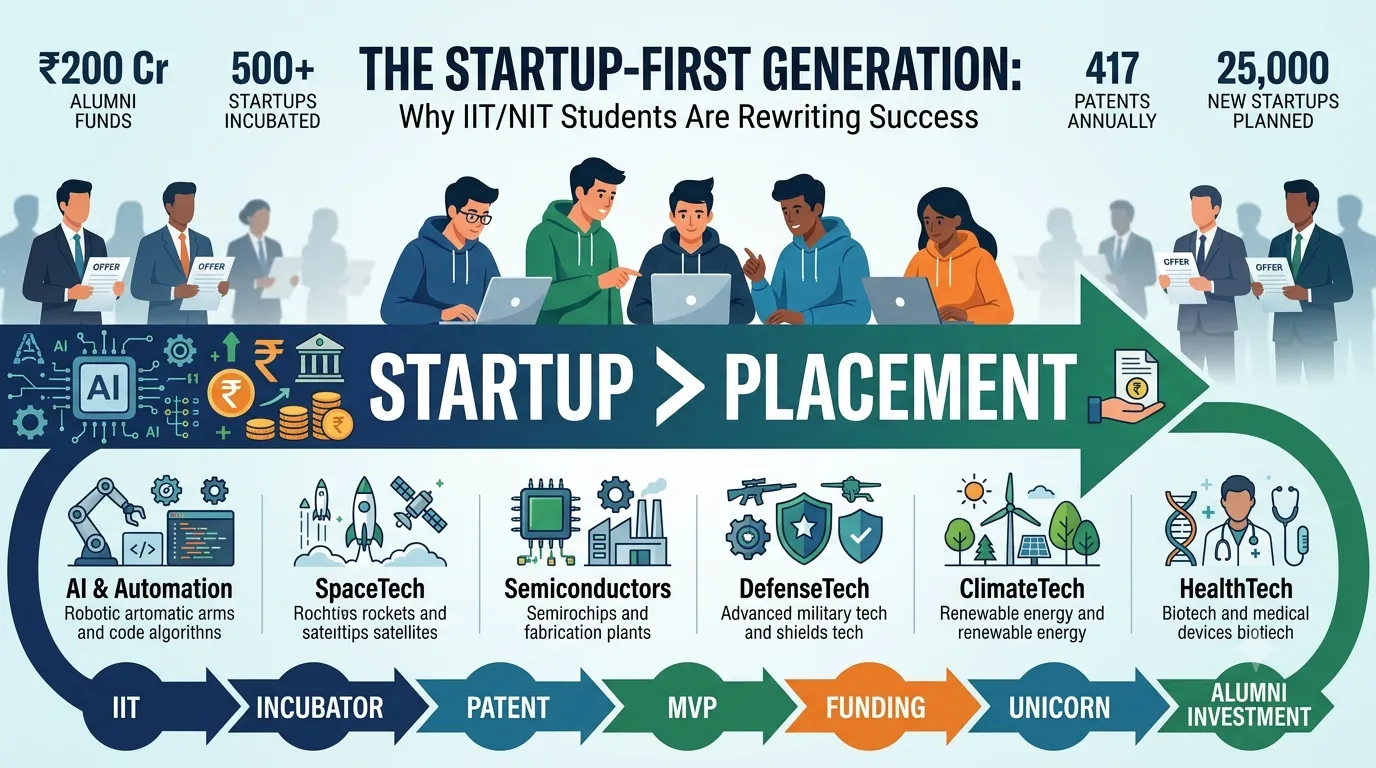
As the marginal cost of producing code and content trends toward zero due to AI, the bottleneck for success shifts from production to distribution. Solo founders have pioneered the "Building in Public" strategy, utilizing media leverage to build a trust-based audience that serves as a permanent, low-cost distribution channel.
The Personal Brand Advantage
Large organizations often struggle with media leverage because corporate brands are perceived as opaque and disconnected. Audiences increasingly favor human-to-human connection over corporate logos. Solo founders like Pieter Levels or Justin Welsh leverage their personal narratives—including their failures and specific revenue metrics—to build high levels of credibility.
This transparency creates a distribution engine where the Customer Acquisition Cost (CAC) is effectively zero. A founder with 500,000 followers on social media can launch a product and generate thousands of dollars in revenue within the first hour, a feat that would require a traditional firm months of marketing spend and agency coordination. For example, Pieter Levels’ audience enabled his product, Photo AI, to generate $5.4K in its first week, eventually scaling to over $130K MRR with zero traditional advertising spend.
Media as Permissionless Distribution
Media leverage—encompassing blogs, podcasts, newsletters, and social media—is a force multiplier because the cost of reaching an additional person is zero. Once a piece of content is created, it can be distributed to millions forever. Successful solo founders use this to create "compound interest" in their reputation. Unlike a marketing campaign that ends when the budget is exhausted, a founder’s media assets continue to drive traffic and trust long after they are published.
Distribution Strategy | Traditional Org | Solo Founder |
Primary Channel | Paid Ads, PR Agencies | Personal Social Media, "Building in Public" |
Trust Factor | Low (Corporate Speak) | High (Transparency, Real Metrics) |
Cost Structure | High (Linear spend for linear reach) | Near Zero (Viral reach, Organic growth) |
Feedback Loop | Slow (Agency reports) | Instant (Comments, DMs, Demos) |
Moat | Brand Recognition | Direct Audience Relationship |
Empirical Analysis: The Data-Driven Case for the Solo Founder
The prevailing wisdom in the venture capital industry has long favored multi-founder teams, often citing the need for diverse skill sets and mutual emotional support. However, emerging data from 2024 and 2025 suggests that this bias may not reflect the actual success rates of startups.
The Performance and Survival Gap
Research from organizations such as the Wharton School and analysis of datasets like Crunchbase and Kickstarter reveal that solo founders often outperform teams, particularly in terms of survival and revenue generation. A study of 7,348 companies that raised over $10 million found that nearly half were started by solo founders. Even more strikingly, among companies that achieved a successful exit (IPO or acquisition), 52.3% had a single founder.
Metric | Solo Founders | Two-Founder Teams | Three+ Founder Teams |
Share of All Startups (2025 H1) | 36.3% | ~37% | ~26% |
Share of VC Funding (2024) | 14.7% | 37% | 48.3% |
Percentage of Successful Exits | 52.3% | ~30% | ~18% |
High-Revenue (>$1M) Share | 42% | 33% | 15% |
Median Valuation (H1 2025) | $3.95M | Higher (due to bias) | Higher (due to bias) |
This data highlights a significant "venture capital bias." While solo founders are highly effective at reaching exits and generating revenue, they face a "self-fulfilling prophecy" where investors favor pairs, making it easier for teams to raise funds and appear more successful, despite lower overall exit rates. The Carta 2025 Solo Founders Report indicates that while solo-led companies represent 30% of startups founded in 2024, they received only 14.7% of the total cash raised in priced equity rounds.
Regional and Industry Nuances in Solo Founding
The trend toward solo founding is accelerating globally, driven by lower barriers to entry and the proliferation of AI. The US continues to lead in pre-seed valuations, but other regions are showing unique dilution and growth patterns as solo founders utilize global talent networks and remote-first operations.
Region (H1 2025) | Median Valuation | Implied Dilution | Capital Requirement |
United States | $5.27M | 19.69% | $1.04M |
Middle East | $3.70M | ~15% | Moderate |
Europe | $3.24M | 21.00% | Moderate |
Oceania | $3.32M | 11.67% | Low |
Africa | $2.28M | 10.69% | Low |
Industries with the highest percentage of solo founders in 2025 include creative professionals, digital consultants, and SaaS developers. Among these, business professionals (consultants, IT specialists, marketing strategists) are the most financially prepared, with 40% maintaining more than six months of savings. However, adoption of AI varies: while 64% of digital solopreneurs use generative AI for marketing, only 14% of solo tradespeople (electricians, plumbers) utilize these tools, representing a significant technological gap in non-digital sectors.
Case Studies: Displacement of Corporate Incumbents
The displacement of established corporate players by lean, AI-augmented firms is no longer theoretical. Specific examples from 2024 and 2025 demonstrate how speed beats institutional strategy in real-world scenarios.
Precision Manufacturing vs. Global Heavyweights
A precision manufacturing company with only 120 employees successfully competed against industry giants like Honeywell and 3M for aerospace contracts. Traditional quality control methods were insufficient to meet zero-defect standards, and hiring additional human inspectors would have increased costs by 40%. Instead of embarking on a three-year, $2.8 million enterprise AI project, the firm implemented an AI-driven visual inspection system in eight weeks for just $85,000. The results included:
Defect rates falling from 0.8% to 0.12% in 90 days.
Downtime slashed by 85% through predictive maintenance.
Processing of 15,000 quality checkpoints per hour (5x faster than manual methods).
Securing $12 million in new aerospace contracts within six months.
Consulting and Service Firm Displacement
Service firms are utilizing AI to reduce proposal timelines and out-pitch "Big 4" consulting incumbents. One boutique firm reduced its proposal development time from six weeks to 10 days by using an AI platform to analyze 500 industry reports and regulatory filings in hours. This enabled a win rate increase from 23% to 67%, leading to $8.4 million in new contracts, including a $2.1 million deal previously held by a major global consulting firm.
Clients are increasingly wary of "complacency" and "aggressive pipelines" from larger incumbents. Boutique solo-led or micro-team firms build trust by providing high-touch attention and "safe pair of hands" governance that large firms, with their often-offshored and over-leveraged resources, cannot match.
The Solo Founder Tech Stack: Tools of the Agentic Era
The ability of a single individual to compete with traditional firms is made possible by a specific category of "agentic" and "no-code" tools. These tools compress the development lifecycle from months to days.
AI Agent Orchestration Platforms
The use of AI agent builders allows solo founders to create autonomous workflows that perform complex tasks across multiple applications. These systems are not merely tools but "digital employees" that can be scaled up or down by adjusting computing power.
Platform | Category | Key Strength for Solo Founders |
n8n | Workflow Automation | 400+ integrations; visual node builder; self-hostable |
Gumloop | Research & Insights | Scrapes Reddit/Social Media; modular architecture |
MindStudio | Rapid Prototyping | Natural language app creation (15-60 min build time) |
Lindy | Business Operations | 4,000+ integrations; natural language setup for ops |
ArahiAI | Autonomous Agents | Goal-driven agents; memory management; enterprise security |
Cursor / Lovable | Development | AI-first coding; allows non-technical founders to ship SaaS |
The Six-Step AI SaaS Playbook
Modern solo founders follow a standardized playbook to build $1M+ ARR businesses without teams:
AI Discovery: Using tools like Perplexity and Reddit scrapers to find "raw frustration" mentioned over 50 times in threads.
Vibe Prototype: Building functional interfaces in hours using Bolt or v0 to validate value with 10–15 real users.
Production Pipeline: Implementing AI-assisted architecture for security, authentication, and database migrations.
Operations OS: Systematizing everything repeatable using tools like Notion AI and Lindy.
Marketing Engine: Using agents for AEO (AI Engine Optimization) and autonomous social media distribution.
Sales Engine: Personalizing interactive demos and using AI agents to qualify and nurture leads 24/7.
Challenges, Vulnerabilities, and the Antifragility of the Individual
While the solo founder model offers unprecedented speed and leverage, it is not without significant risk. The "Single Point of Failure" is the primary structural vulnerability. If the founder suffers from illness, burnout, or personal crisis, the entire enterprise is at risk.
Psychological Burnout and Solo Founder Syndrome
Solo founders face a high risk of psychological burnout due to the "Many Hats" syndrome. Shifting between creative, technical, and administrative tasks is mentally exhausting. Furthermore, "Solo Founder Syndrome" can occur even when a small team exists, if the founder remains the bottleneck for every key decision. This omnipresence slows the organization down and prevents it from building the capacity needed for true scale.
Warning Sign | Impact on Solo Enterprise | Severity |
Decision Paralysis | Slower iteration and missed opportunities | High |
Social Isolation | Loss of perspective and mental health decline | Critical |
Performative Delegation | Failure to truly offload tasks to AI/Contractors | High |
Chronic Insomnia | Impaired judgment and poor decision-making | High |
Omnipresence | Founder becomes a bottleneck for every Slack/Email | High |
Mitigation and the Path to Antifragility
To survive the "solo journey," successful founders transition from being the operator to being the system designer. They utilize "performative delegation" initially but eventually build "autonomous loops" where AI agents or global freelancers handle repetitive tasks without oversight. Strategic solo founders also build external support networks consisting of mentors, advisors, and peer communities to replace the emotional and strategic support typically provided by a co-founder.
Despite the burdens, the solo path creates "antifragility." Surviving the "feast and famine" cycles of solo entrepreneurship develops a resilience that corporate roles cannot replicate. By navigating tax seasons, server crashes, and marketing failures alone, solo founders develop a deep professional fulfillment and a realization that they can generate value from "thin air" without institutional support.
Conclusion: The Ascendancy of the Leveraged Individual
The shift from traditional strategic organizations to leveraged solo founders is not a temporary trend but a fundamental restructuring of the global economy. The emergence of AI as the ultimate permissionless leverage has collapsed the timeline from idea to execution and eliminated the historical requirement for human-heavy operational structures. Traditional organizations, hindered by coordination tax, legacy systems, and a reliance on permissioned leverage, will increasingly find themselves unable to compete with the iteration speed and profit margins of AI-augmented solo operators.
The Zero-Employee Unicorn is no longer a theoretical concept but an emerging reality, validated by exit data showing that single founders comprise over half of successful exits. For the modern founder, the path to wealth and impact no longer requires a workforce of hundreds. It requires the strategic application of "Specific Knowledge"—the unique intersection of personal curiosity and technical expertise—paired with the mastery of an "army of robots" working silently in the cloud. As technology continues to democratize consumption while consolidating production, the economic rewards will increasingly accrue to those who can direct the symphony of leverage with the greatest vision and the highest velocity. The future belongs to the leveraged individual, and for the first time in history, that future can be built entirely by a single person with a laptop and a goal.
Want to calculate the equity for your cofounder?
Nail your cap table before you sign. Whether you're splitting equity with a co-founder or planning your next funding round, our Equity Calculator gives you precision in seconds
Equity calculator →