Retaining Talent in Canadian Startups
March 13, 2026 by Harshit Gupta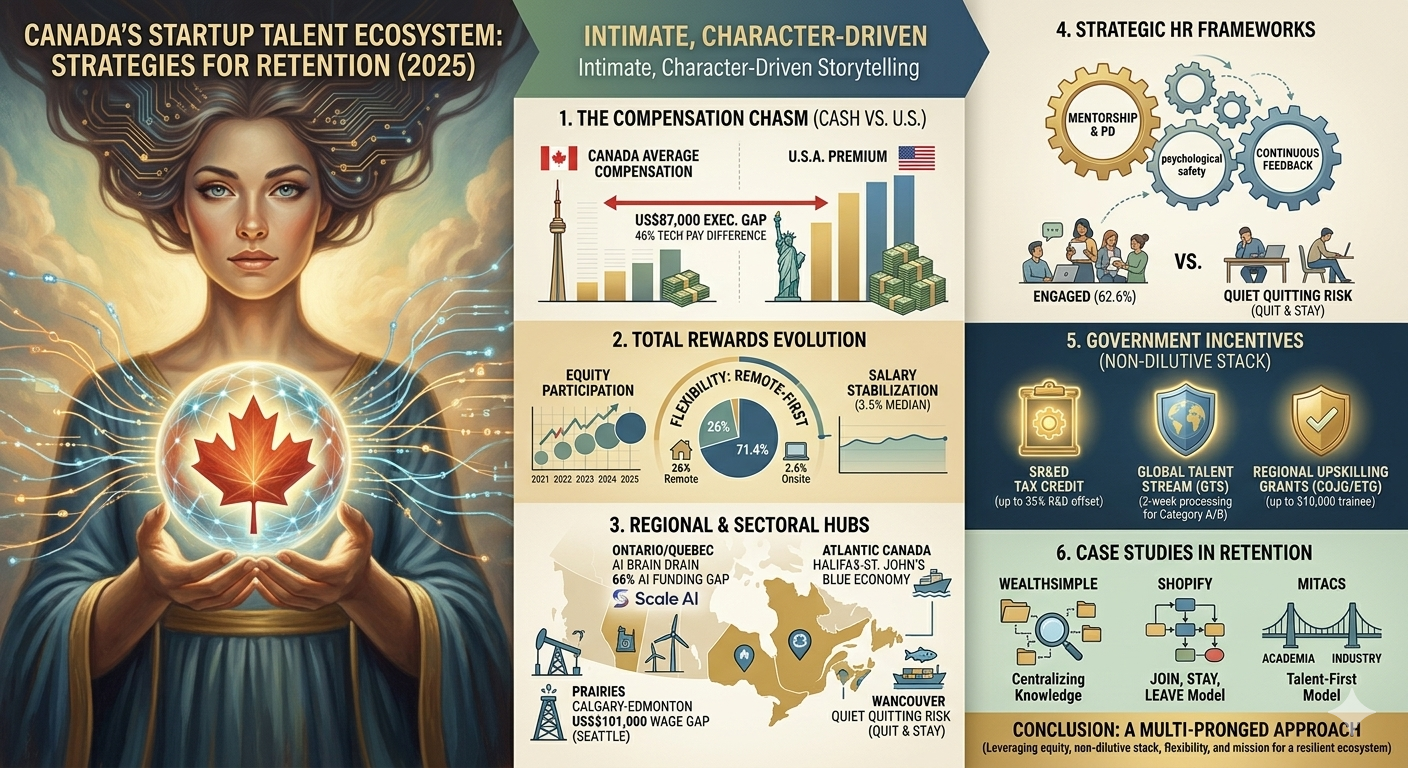
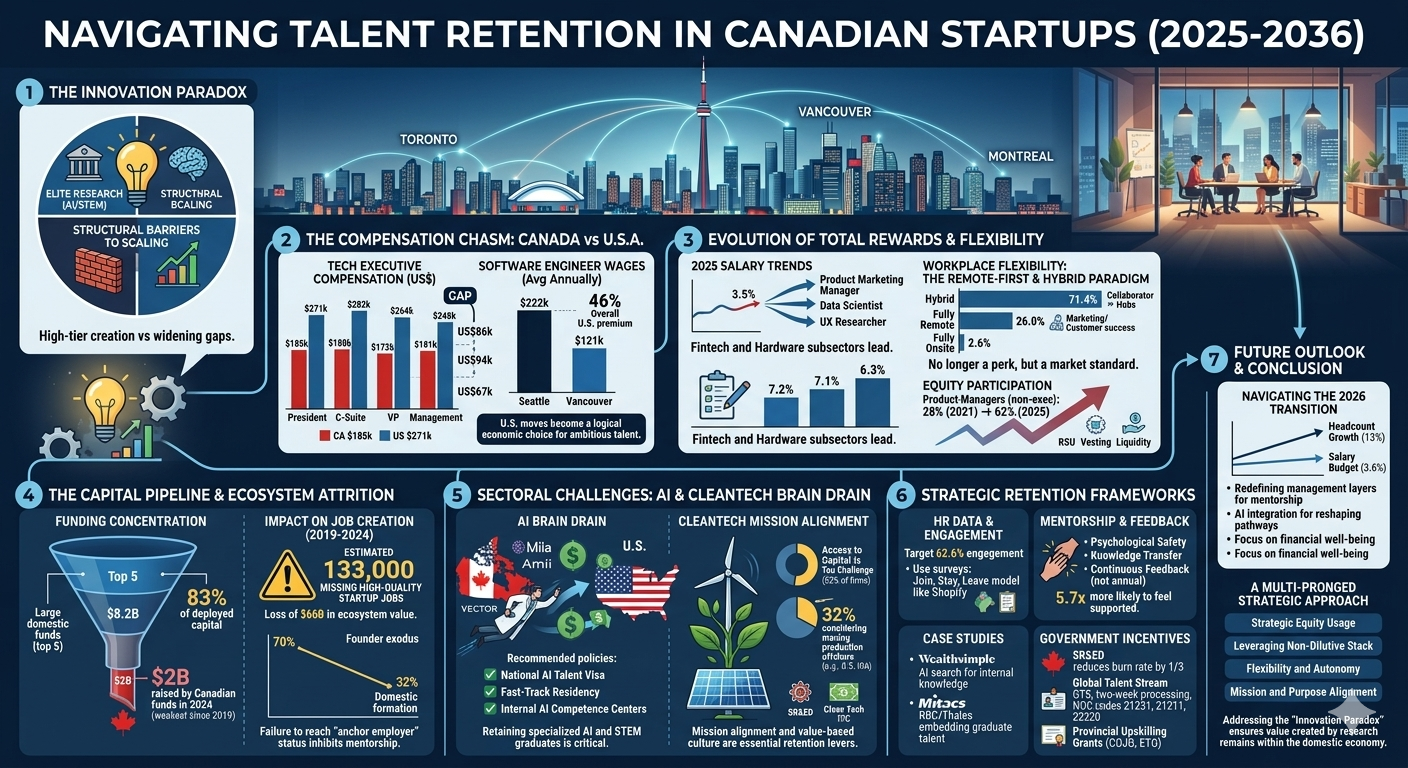
The Canadian startup ecosystem in the mid-2020s serves as a profound example of the "innovation paradox," wherein high-tier academic research and early-stage venture formation coexist with significant structural barriers to scaling and long-term talent retention. As of 2025, Canada remains a global innovation powerhouse, ranking fifth in StartupBlink’s Global Startup Ecosystem Index, with Toronto, Vancouver, and Montreal maintaining their status as critical North American hubs. However, this momentum is increasingly threatened by a widening compensation gap with the United States, a systemic "brain drain" of specialized AI and STEM talent, and a maturation of the venture market that demands higher operational efficiency and more sophisticated retention frameworks.
The Macroeconomic Context: Funding Concentration and Ecosystem Attrition
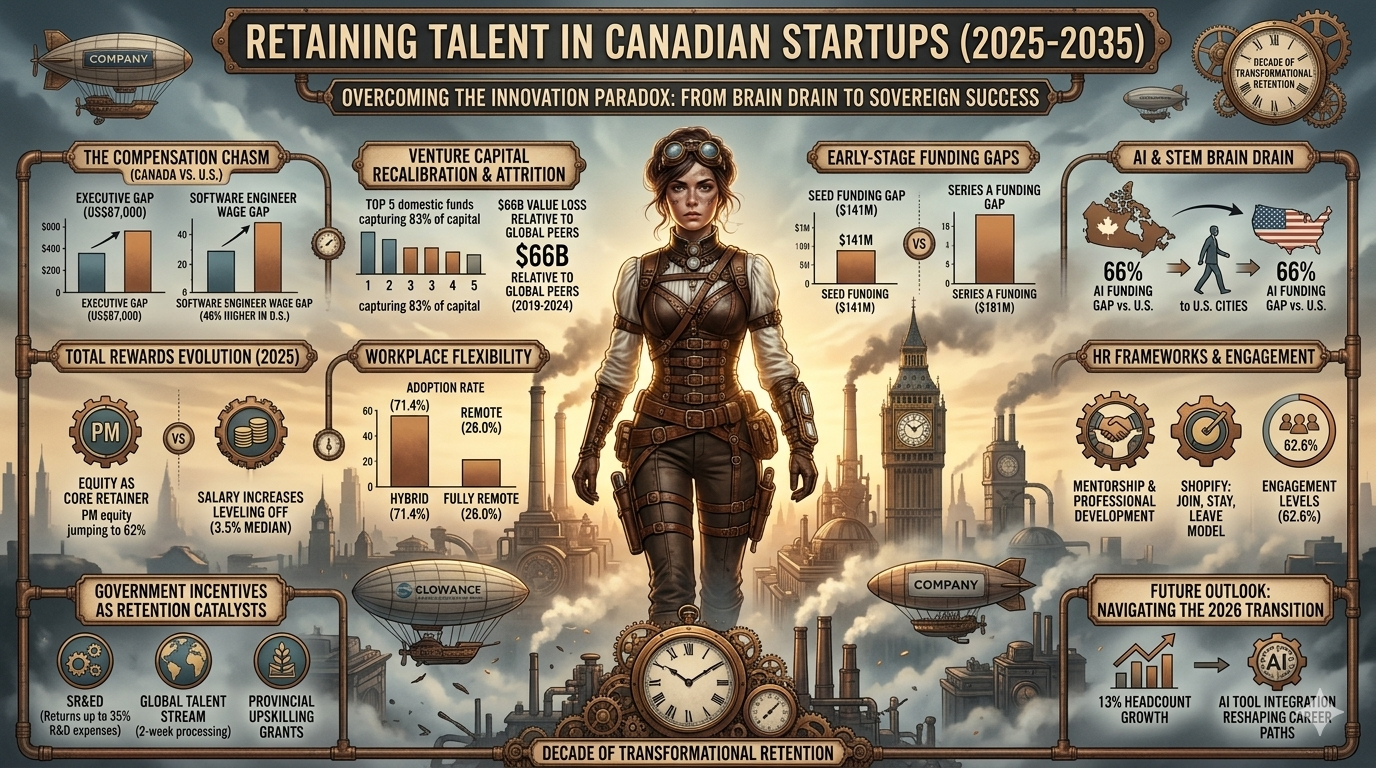
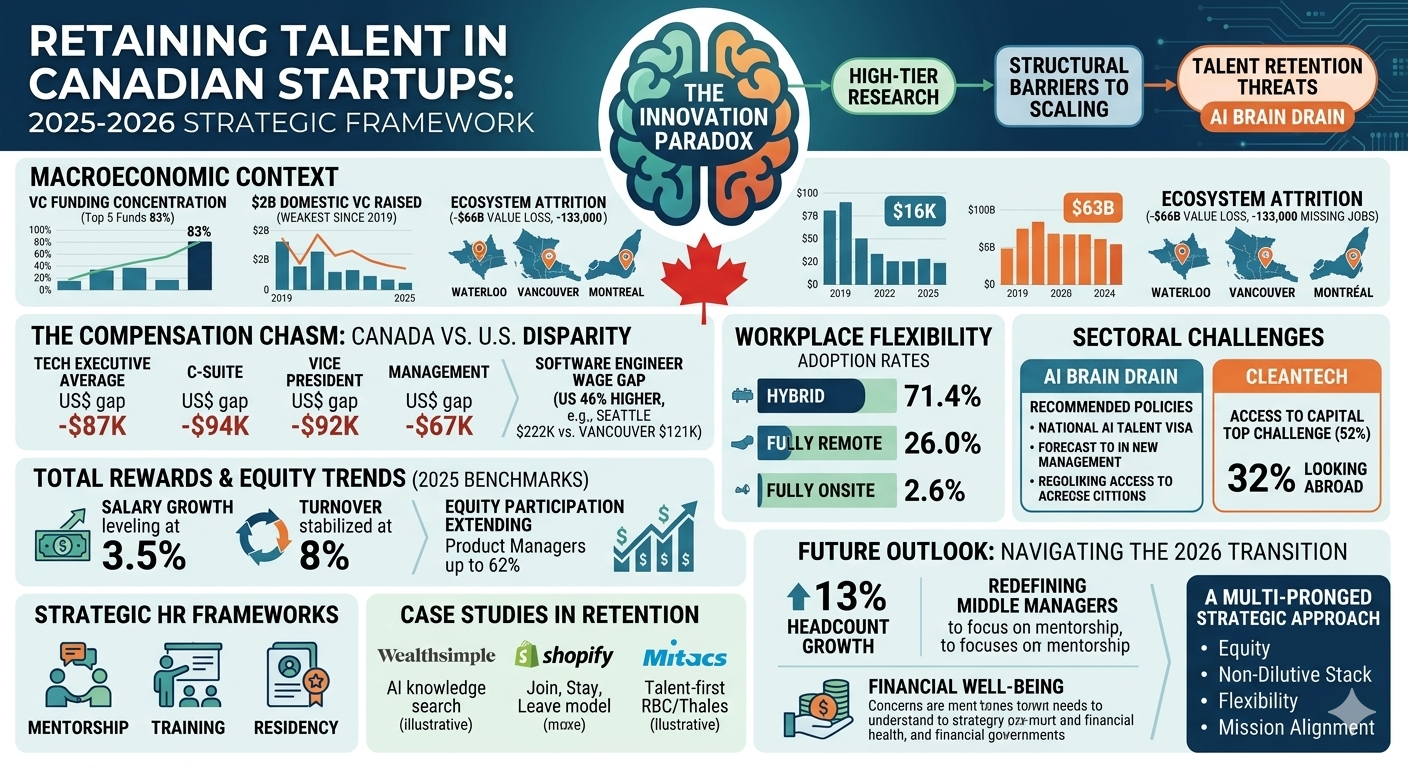
The health of the Canadian startup ecosystem is intrinsically tied to its ability to capitalize high-potential firms. In 2024, the deployment of $8.2 billion in venture capital reflected a resilient investment environment; however, this figure belies a concerning trend of capital concentration. The top five domestic funds captured approximately 83% of all capital deployed, a phenomenon that forces founders into hyper-competitive cycles for the attention of a limited pool of decision-makers. For early-stage companies, the fundraising environment for domestic VCs themselves proved challenging, with only $2 billion raised by Canadian funds in 2024—the weakest fundraising year since 2019.
This contraction in the "capital pipeline" has direct implications for talent retention. Research indicates that Canada’s largest startup ecosystems—Waterloo, Vancouver, and Montreal—lost approximately $66 billion in ecosystem value relative to global peers between 2019 and 2024. This value erosion corresponds to roughly 133,000 missing high-quality startup jobs. The mechanism of this decline is rooted in funding gaps at the pre-seed and seed stages (estimated at $141 million) and at the Series A stage ($181 million). These deficits are not merely financial; they are the primary driver of the "founder exodus," with domestic company formation dropping from 70% to 32% over a four-year period. When firms cannot secure the capital necessary to reach "anchor employer" status, they lose the ability to maintain the mentorship networks and follow-on hiring cycles that keep an ecosystem vibrant.
Growth and Investment Benchmarks
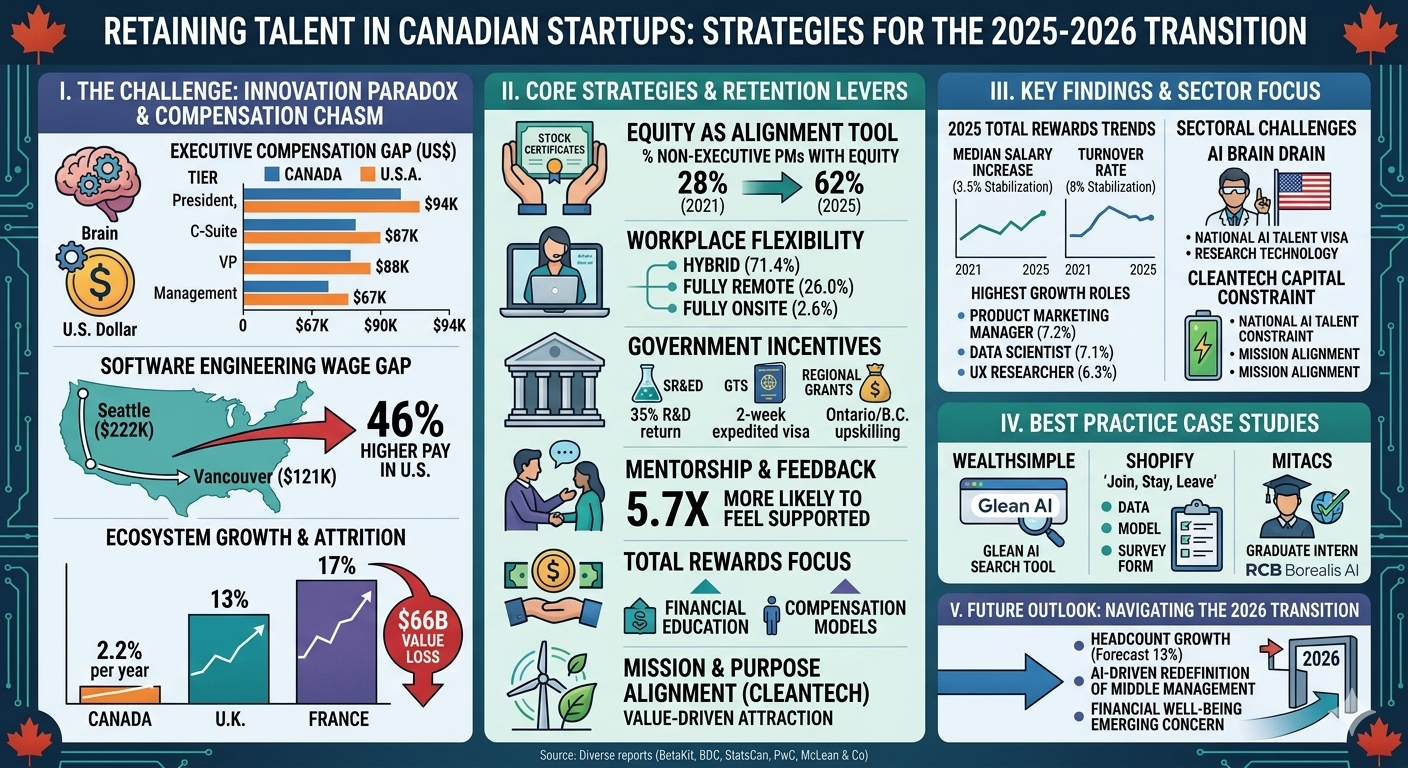
The contrast between Canadian and international peers is stark when examining annual growth rates. While Canadian ecosystems grew at a rate of 2.2% per year, the United Kingdom and France saw growth rates of 13% and 17%, respectively. This slower growth pace means Canadian startups access seed funding 15% to 40% slower than their U.S. peers.
Ecosystem Metric | Canada (Top Hubs) | United States | United Kingdom |
Annual Growth Rate (2019-2024) | 2.2% | N/A | 13% |
Series A Inflation (2023 vs 2025) | $15M to $22M | N/A | N/A |
Tech Talent Growth (Calgary 5-year) | 78% | N/A | N/A |
Seed Stage Investment Trend (2025) | -4% Capital | N/A | N/A |
Source:
In sectors like Artificial Intelligence, the disparity is even more pronounced. AI-native startups in Canada face a 66% funding gap and a 31% lag in the timing of seed deals compared to U.S. firms. This delay in capitalization directly limits the ability of Canadian founders to offer the competitive salaries and equity packages required to retain the very researchers who were often educated at Canada’s world-class institutions.
The Compensation Chasm: Quantitative Analysis of the Canada-U.S. Disparity
The most persistent obstacle to talent retention is the significant compensation disparity between the Canadian and American technology sectors. Data from the Business Development Bank of Canada (BDC) reveals that the average compensation for a Canadian tech executive is US$87,000 less than their American counterpart. This gap is pervasive across all levels of seniority and all funding stages. Even after controlling for firm characteristics, executive experience, and labor market tightness, a substantial "U.S. premium" remains.
Executive Compensation Benchmarks
The executive gap tends to widen as companies move through subsequent funding rounds. For example, at the management level, the gap sits at approximately US$67,000, but it increases to US$92,000 for Vice Presidents and US$85,000 for C-suite roles.
Role Tier | Average Canada (US$) | Average U.S.A. (US$) | Compensation Gap (US$) |
President | $185,000 | $271,000 | $86,000 |
C-Suite | $188,000 | $282,000 | $94,000 |
Vice President | $172,000 | $264,000 | $92,000 |
Management | $181,000 | $248,000 | $67,000 |
Source:
Regionally, the disparity is highest in Eastern Canada, where American executives can expect to earn $273,400 compared to $168,000 for their counterparts in Central or Eastern Canada. This is partly explained by the efficiency of resource allocation in the U.S.; American firms raise significantly more venture capital dollars per employee than Canadian firms, allowing them to capitalize on the relative abundance of tech talent in Canada by offering higher wages that the domestic market cannot match.
The Software Engineering Wage Gap
Beyond the executive level, the salary gap for technical contributors is even more dramatic. Research suggests that overall tech pay in the U.S. is 46% higher than in Canada, even when purchasing power parity and cost of living are taken into account. While some of this gap (approximately 10%) is attributable to a higher proportion of part-time or part-year work in the Canadian sector, the core disparity remains a function of market competition.
Case studies comparing major hubs illustrate the financial pressure on Canadian talent. In Seattle, a software engineer earns an average of $222,000 annually, while a counterpart in Vancouver earns $121,000. Although Vancouver’s cost of living is high, the "real income" after expenses is significantly lower than in U.S. hubs. Similarly, while a one-bedroom rental in Toronto costs roughly $2,300 compared to twice that in San Francisco, the salaries in San Francisco more than double those in Toronto, making the U.S. move a logical economic choice for ambitious talent.
The Evolution of Total Rewards: 2025 Benchmarks and Equity Trends
Despite these challenges, the Canadian tech sector has shown signs of stabilization in 2025. Median salary increases have leveled off at 3.5%, perfectly aligning with organizational salary budgets. This suggests the market is finding an equilibrium after several years of rapid, unsustainable growth. Turnover rates have also stabilized, sliding from a peak of 13% three years ago to 8% in early 2025.
High-Demand Roles and Sectoral Leaders
Salary growth is concentrated in subsectors demonstrating high profitability or specialized skill requirements. The Fintech subsector led with a 5.8% median salary increase, followed by Hardware Design and Manufacturing at 5.0%. Functions that directly influence revenue and retention have seen the most significant upward pressure.
Role (Intermediate Level) | Year-over-Year Salary Increase | 2025 Market Focus |
Product Marketing Manager | 7.2% | Acquisition and Retention Efficiency |
Data Scientist | 7.1% | AI Integration and Business Intelligence |
UX Researcher | 6.3% | Product User Experience and Engagement |
Technical Support Manager | Top 10 Growth | Retention and Customer Success |
Source:
Conversely, roles such as Senior Animators and Research Scientists saw increases of less than 2%, indicating a shift in demand away from content creation toward strategic and operational roles.
Equity Participation as a Core Retention Lever
As Canadian startups struggle to match the base salaries of U.S. giants, equity has become a critical tool for aligning long-term talent with company success. Equity participation is no longer exclusive to the executive level; it has extended deeply into Product, Engineering, and Finance functions. For instance, the percentage of non-executive Product Managers receiving equity jumped from 28% in 2021 to 62% in 2025.
Candidates in the 2025 market are increasingly sophisticated regarding equity, seeking clarity on vesting structures, liquidity events, and the long-term projected value of shares. In earlier-stage startups, equity is often used as a direct offset for lower cash compensation, whereas later-stage and public companies are increasingly bolstering packages with Restricted Stock Units (RSUs) to provide more immediate, tangible value in a volatile market.
Workplace Flexibility: The Remote-First and Hybrid Paradigm
In the 2025 talent market, flexibility is no longer a perk but a market standard. Startups with rigid in-office requirements are experiencing slower hiring pipelines and significantly reduced candidate interest. The data confirms a dominant shift toward hybrid and remote models across all tech functions.
Work Model | Adoption Rate (2025) | Functional Trend |
Hybrid | 71.4% | Preferred for People, Culture, and Product roles. |
Fully Remote | 26.0% | Dominant in Marketing (47%) and Customer Success (50%). |
Fully Onsite | 2.6% | Historically low; primarily in niche hardware or manufacturing. |
Source:
For functions like People and Culture, the hybrid model has increased in prevalence to 62.9%, up from 49% the previous year, suggesting that while remote work is valued, "collaborator hubs" are becoming essential for building organizational culture. Candidates now assess a company’s flexibility early in the recruitment process, making it a critical factor in the final decision-making journey.

The Crisis of Executive Turnover and Leadership Maturation
A significant trend observed in 2024 and early 2025 was the "tidal wave" of executive leadership changes. BetaKit reported on nearly 50 CEO changes alone in 2024, affecting both small startups and large innovation hubs like MaRS and Communitech. This turnover is reflective of a mature, tougher market where the free-for-all pursuit of growth has been replaced by a demand for operational discipline and strategic performance.
This maturation brings higher standards for the C-suite. Modern leaders are expected to operate cross-functionally and contribute directly to business outcomes such as ROI and customer retention. The "quiet quitting" trend has notably moved up the hierarchy, with executives disengaging or seeking new roles when the alignment with organizational vision or the ability to influence strategy is compromised.
Sectoral Challenges: Retaining Specialized Talent in AI and Cleantech
The AI Brain Drain and Sovereign Compute
Canada faces a critical challenge in retaining AI talent, losing a significant portion of its top graduates and researchers to the U.S. market. While early leadership in AI research (driven by world-renowned researchers and public investment) gave Canada a head start, the pace of global progress has accelerated. Experts suggest that Canada’s narrow window to define its AI future depends on a bold national talent strategy that includes attraction, retention, and national mobility.
Recommendations for the federal government include fast-tracking residency for top AI engineers and researchers, introducing a "National AI Talent Visa" with two-week processing, and funding elite graduate fellowships to keep academic talent in the country. Furthermore, business leaders are encouraged to treat AI talent development as a core strategy rather than a side project, investing in "internal AI competence centers" rather than one-off projects to provide clear career paths and budgets.
Cleantech: Mission Alignment and Market Pressures
The Canadian cleantech sector is also at a crossroads. While the ecosystem is reaching market maturity—with firms like the "Foresight 50" raising billions in capital—structural barriers remain. Access to capital is cited as the top challenge by 52% of firms, up from 35% in 2022.
Cleantech Industry Data | Value / Percentage | Impact on Retention |
Top Challenge: Access to Capital | 52% of firms | Limits wage competitiveness and R&D budgets. |
Considering Moving Production | 50% of firms | Risks talent moving offshore to follow capital. |
Benefiting from SR&ED | 84% of firms | Critical for subsidizing technical staff salaries. |
Benefiting from Clean Tech ITC | 34% of firms | Encourages domestic infrastructure development. |
Source:
A concerning 32% of cleantech firms are looking abroad due to stronger market demand and more favorable foreign policies like the U.S. Inflation Reduction Act. For cleantech startups, retention is increasingly tied to "mission alignment." Employees in this sector prioritize working for organizations that clearly communicate their purpose and environmental impact. Leading with values and embedding sustainability into the everyday cultural experience are essential for retaining high performers in a capital-constrained environment.
Strategic HR Frameworks: Engagement, Mentorship, and Training
Effective employee retention requires a transition from reactive measures to proactive, data-driven strategies. Analysis from McLean & Company shows that while overall engagement levels have remained stable at roughly 62.6%, organizations cannot afford complacency.
Mentorship and Professional Development
Career development remains one of the most influential factors in retention. Employees who receive meaningful feedback from their managers are 5.7 times more likely to feel supported in their career advancement. Startups are increasingly utilizing mentorship programs to bridge the gap between junior staff and tenured leaders. For example, PwC Canada’s "Women in Technology" program provides networking and leadership development opportunities that foster a sense of belonging and community.
Effective mentorship programs often focus on:
Psychological Safety: Creating an environment where it is safe to ask questions and show vulnerability.
Knowledge Transfer: Ensuring that the expertise of senior leaders is disseminated throughout the organization to build internal resilience.
Continuous Feedback: Moving away from annual reviews toward real-time feedback that promotes alignment and reinforces the value of an employee’s work in the moment.
The Disengagement Risk: "Quiet Quitting" and "Quit and Stay"
Canada’s ongoing labor shortage has created a "quit and stay" risk, where employees remain in their roles for stability but disengage from meaningful contributions. Only 18% of global employees report being "extremely satisfied" with their jobs, highlighting a critical need for Canadian startups to foster deeper connections. Rebuilding cultural touchpoints—through celebrations, recognition programs, and transparent leadership communication—is essential for differentiating great workplaces in 2025.
Government Incentives as Retention Catalysts: SR&ED, Grants, and the GTS
Government support programs are not merely financial additions; they are integral to the funding stack of successful Canadian startups. These programs provide non-dilutive capital that can be used to offset high technical salaries and invest in upskilling.
The Scientific Research and Experimental Development (SR&ED) Program
The SR&ED program is a cornerstone of Canadian innovation policy, returning up to 35% of eligible R&D expenses. This effectively reduces a startup’s burn rate by a third, allowing them to stretch their capital further and maintain a larger headcount of high-skilled engineers and researchers. The program is industry-agnostic, supporting work in software, biotech, manufacturing, and more, as long as the work aims for technological advancement through systematic investigation.

The Global Talent Stream (GTS)
For startups unable to find domestic talent, the GTS provides an expedited immigration pathway. Under Category A, high-growth companies can be referred by designated partners, while Category B targets specific occupations on the Global Talent Occupations List.
GTS Occupation (NOC 2021) | Prevailing Wage Requirement (Avg) | Retention Role |
Software Engineer (21231) | $55.00/hr | Essential for AI and core development. |
Data Scientist (21211) | $50.00/hr | Vital for analytics and scaling. |
Computer Network Tech (22220) | $40.87/hr | Foundation for remote work infrastructure. |
Source:
The GTS establishes a two-week standard for processing work permits, allowing startups to move at a "global speed" to secure talent before they are poached by U.S. competitors.
Regional Upskilling Grants
Provincial grants like the Canada-Ontario Job Grant (COJG) and the B.C. Employer Training Grant (ETG) allow startups to invest in their existing workforce, which is a key driver of loyalty.
COJG: Provides up to $10,000 per trainee for existing staff and up to $15,000 for new hires. Small employers (under 100 staff) contribute only one-sixth of the training costs, making it highly accessible for early-stage startups.
B.C. ETG: Offers 80% reimbursement for training costs, capped at $10,000 per employee and $300,000 per employer annually. The grant specifically targets upskilling needed due to automation and enhancing productivity, which directly supports retention by providing employees with "better jobs".
Case Studies in Retention: Wealthsimple, Shopify, and Mitacs
Wealthsimple: Centralizing Knowledge to Reduce Frustration
As Wealthsimple transitioned to a remote-first organization, surveys revealed that "information discovery" was a primary pain point for employees. Finding the knowledge needed to perform tasks was manual and arduous, leading to frustration and burnout among tenured leaders who spent significant time "wayfinding" for others. By integrating Glean, an AI-powered search tool that connects Docs, Slack, Jira, and GitHub, Wealthsimple empowered contributors to find answers independently. This centralization led to a 73% adoption rate among engineers and significantly improved the onboarding experience for new hires.
Shopify: The "Join, Stay, Leave" Model
Shopify utilizes a robust data model to understand employee retention. By surveying employees on why they join, why they stay, and why they leave, they can refine their employer value proposition. A critical insight from this model is that 31% of new hires quit within six months if the position does not match their expectations, emphasizing the need for transparent hiring and onboarding. Shopify also advocates for expanding responsibilities and rotating learning opportunities to prevent the stagnation that often drives millennials to seek external promotions.
The Mitacs "Talent-First" Model
Mitacs provides a strategic bridge between academia and industry. By embedding highly qualified personnel (HQP) directly into businesses for internships, they de-risk the hiring process. For example, RBC Borealis AI uses Mitacs to embed graduate and post-doctoral talent into their labs, creating a specialized pipeline that retains researchers within Canada. Similarly, at Thales’s AI R&D hub, former Mitacs interns now account for one-third of the full-time staff.
Future Outlook: Navigating the 2026 Transition
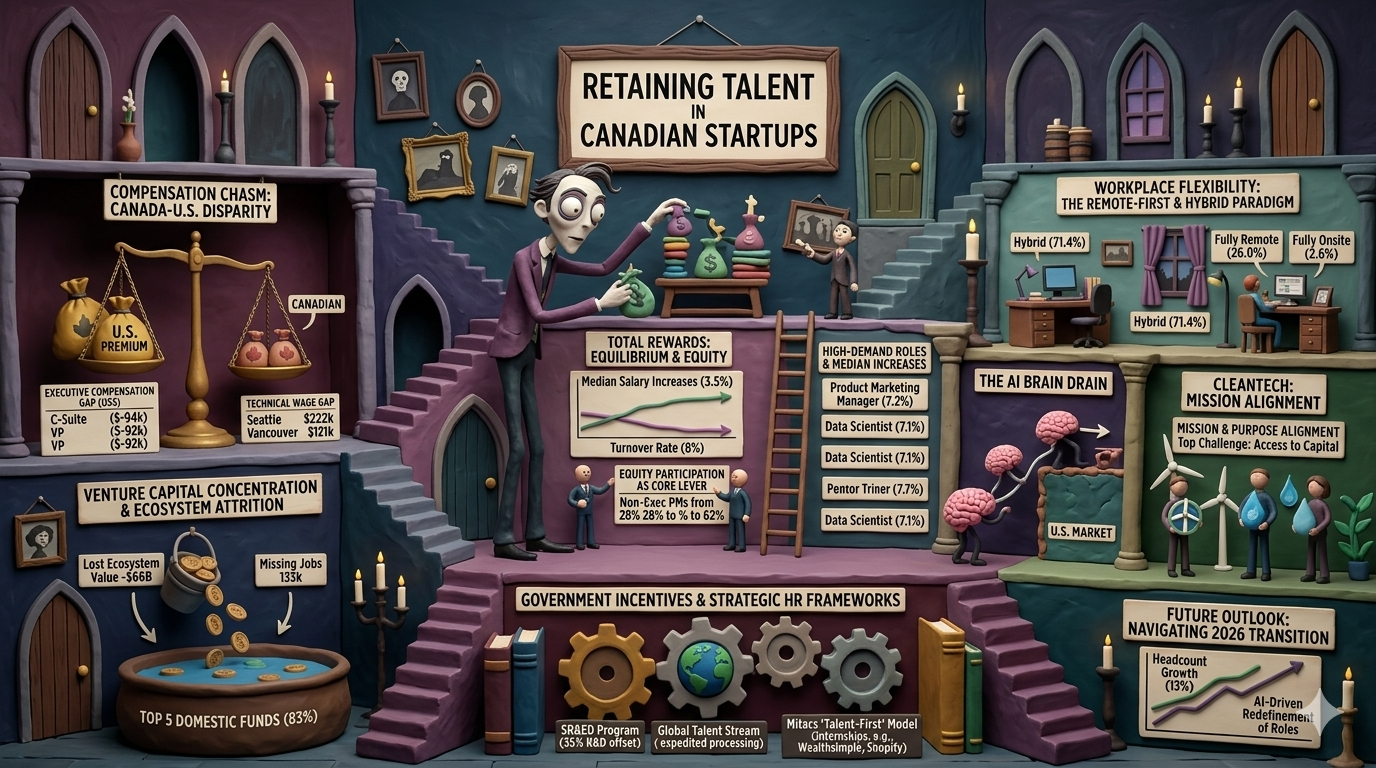
As the Canadian tech sector moves toward 2026, several factors will define the future of retention. Organizations are forecasting a 13% headcount growth and salary increase budgets of 3.6%. However, the integration of AI tools will reshape leadership roles and career pathways. Middle managers, who connect executive vision with frontline execution, are under immense pressure as AI streamlines processes and reduces traditional management layers. The best companies will focus on redefining these roles toward mentorship and collaboration rather than elimination.
Financial well-being is also emerging as a dominant concern for Canadian workers, driven by inflation and housing costs in major hubs like Toronto and Vancouver. Startups that provide financial education and flexible compensation models will gain a competitive edge in attracting and retaining younger talent who are increasingly worried about retirement and home ownership.
Conclusion: A Multi-Pronged Strategic Approach
Retention in the Canadian startup ecosystem for 2025 and beyond is no longer a localized HR concern but a fundamental business strategy. The analysis suggests that while Canada possesses an elite talent pool, the structural funding gaps and the overwhelming proximity of the U.S. market necessitate a more aggressive and creative approach to total rewards and cultural development.
Startups must move beyond the "base salary" competition and focus on:
Strategic Use of Equity: Expanding participation and providing transparency to create a genuine "ownership culture".
Leveraging the Non-Dilutive Stack: Integrating SR&ED, GTS, and provincial training grants into the financial and talent planning from day one.
Prioritizing Flexibility and Autonomy: Formalizing remote and hybrid models to tap into borderless talent pools while rebuilding cultural connections.
Mission and Purpose Alignment: Especially in high-impact sectors like Cleantech, leading with values to attract and retain high-performing individuals who seek meaning in their work.
By addressing the "innovation paradox" through a combination of sovereign compute infrastructure, specialized talent visas, and a "talent-first" industrial model, Canada can stem the brain drain and ensure that the value created by its world-class research remains within the domestic economy. The maturation of the ecosystem in 2025 signals a shift toward sustainability and resilience—a transition that, if navigated correctly, will cement Canada’s position as a global leader in the 21st-century digital economy.
Read More -
1. From Idea to MVP: A Step-by-Step Guide for Solo Founder
🔗 https://findnstart.com/blogs/from-idea-to-mvp-a-step-by-step-guide-for-solo-founder
2. How to Validate Your Startup Idea in 48 Hours for $0
🔗 https://findnstart.com/blogs/how-to-validate-your-startup-idea-in-48-hours-for-0
3. Remote vs. Local: Does Your Co-Founder Need to Live in the Same City?
🔗 https://findnstart.com/blogs/remote-vs-local-does-your-co-founder-need-to-live-in-the-same-city
4. The 2026 Startup Landscape: What Has Fundamentally Changed (and Why Founder Skills Matter More Than Ever)
5. The Most In-Demand Skills for Startup Founders in 2026
🔗 https://findnstart.com/blogs/the-most-in-demand-skills-for-startup-founders-in-2026
6. How to Find a Technical Co-Founder (Without a Six-Figure Salary)
🔗 https://findnstart.com/blogs/how-to-find-a-technical-co-founder-without-a-six-figure-salary
7. 5 Red Flags to Look for When Choosing a Startup Partner
🔗 https://findnstart.com/blogs/5-red-flags-to-look-for-when-choosing-a-startup-partner
8. How to Pitch Your Idea to Potential Co-Founders
🔗 https://findnstart.com/blogs/how-to-pitch-your-idea-to-potential-co-founders
9. How to Build a Portfolio that Attracts High-Growth Startup Founders
🔗 https://findnstart.com/blogs/how-to-build-a-portfolio-that-attracts-high-growth-startup-founders
10. Equity vs. Salary: How to Split Ownership with Your First Teammate
🔗 https://findnstart.com/blogs/equity-vs-salary-how-to-split-ownership-with-your-first-teammate
11. Why Joining an Early-Stage Startup is Better Than a Corporate Job
🔗 https://findnstart.com/blogs/why-joining-an-early-stage-startup-is-better-than-a-corporate-job
12. The Future of EdTech: Why Developers and Educators Need to Team Up Now
🔗 https://findnstart.com/blogs/the-future-of-edtech-why-developers-and-educators-need-to-team-up-now
13. The Architecture of Symbiosis: Analytical Perspectives on the Five Habits of Successful Startup Duos
14. Finding a Co-Founder in the AI Space: What Skills Should You Look For?
🔗 https://findnstart.com/blogs/finding-a-co-founder-in-the-ai-space-what-skills-should-you-look-for
15. Overcoming Analysis Paralysis and the Strategic Path to Execution
🔗 https://findnstart.com/blogs/overcoming-analysis-paralysis-and-the-strategic-path-to-execution
16. From College Project to Company: How to Find Your Student Co-Founder
🔗 https://findnstart.com/blogs/from-college-project-to-company-how-to-find-your-student-co-founder
17. How to Start a Startup While Working a Full-Time Job
🔗 https://findnstart.com/blogs/how-to-start-a-startup-while-working-a-full-time-job
18. How to Build a HealthTech Startup Without a Medical Degree
🔗 https://findnstart.com/blogs/how-to-build-a-healthtech-startup-without-a-medical-degree
19. The Solitary Architect: Executive Isolation in Entrepreneurship
20. The 2026 Guide to Launching a SaaS as a Solo Developer
21. What Sustainable Growth Actually Looks Like
🔗 https://findnstart.com/blogs/what-sustainable-growth-actually-looks-like
22. The Early Warning Signs Your Startup Is in Trouble
🔗 https://findnstart.com/blogs/the-early-warning-signs-your-startup-is-in-trouble
23. How to Grow Without Burning Out
🔗 https://findnstart.com/blogs/how-to-grow-without-burning-out
24. The Truth About “Runway” Most Founders Ignore
🔗 https://findnstart.com/blogs/the-truth-about-runway-most-founders-ignore
25. Revenue Solves More Problems Than Funding
🔗 https://findnstart.com/blogs/revenue-solves-more-problems-than-funding
26. What No One Tells You About Being a Solo Founder
🔗 https://findnstart.com/blogs/what-no-one-tells-you-about-being-a-solo-founder
27. Why Smart People Quit High-Paying Jobs to Build Startups (And Why Most Regret It)
28. Why Most Startup Advice on Twitter Is Dangerous
🔗 https://findnstart.com/blogs/why-most-startup-advice-on-twitter-is-dangerous
29. Decision Fatigue: The Silent Startup Killer
🔗 https://findnstart.com/blogs/decision-fatigue-the-silent-startup-killer
30. Fear vs Logic: How Founders Actually Make Decisions
🔗 https://findnstart.com/blogs/fear-vs-logic-how-founders-actually-make-decisions
31. How Overthinking Destroys Early Momentum
🔗 https://findnstart.com/blogs/how-overthinking-destroys-early-momentum
32. Ideas Don’t Scale. Systems Do.
🔗 https://findnstart.com/blogs/ideas-dont-scale-systems-do
33. The First Hire That Actually Matters
🔗 https://findnstart.com/blogs/the-first-hire-that-actually-matters
34. How the First 100 Users Decide Your Startup’s Fate
🔗 https://findnstart.com/blogs/how-the-first-100-users-decide-your-startups-fate
35. Why Your Startup Doesn’t Need Growth — It Needs Focus
🔗 https://findnstart.com/blogs/why-your-startup-doesnt-need-growthit-needs-focus
36. Why Most Startups Die Quietly
🔗 https://findnstart.com/blogs/why-most-startups-die-quietly
37. Lessons Learned Too Late by First-Time Founders
🔗 https://findnstart.com/blogs/lessons-learned-too-late-by-first-time-founders
38. The Myth of the “Overnight Success” Startup
🔗 https://findnstart.com/blogs/the-myth-of-the-overnight-success-startup
Want to calculate the equity for your cofounder?
Nail your cap table before you sign. Whether you're splitting equity with a co-founder or planning your next funding round, our Equity Calculator gives you precision in seconds
Equity calculator →