Infrastructure and Energy Startups Are Back
February 25, 2026 by Harshit GuptaThe global energy and infrastructure sectors are currently navigating a profound structural realignment, marked by the convergence of unprecedented capital deployment, accelerating computational power requirements, and a fundamental shift in the geopolitical logic of industrial policy. By the dawn of 2026, the narrative surrounding clean technology and infrastructure startups has transitioned from one of speculative "Cleantech 1.0" experimentation to a robust "Climate 3.0" era defined by commercial execution, revenue visibility, and capital efficiency. Global investment in the energy transition reached a record $2.3 trillion in 2025, an 8% increase from the prior year, despite the persistence of high interest rates and regulatory fragmentation. This expansion is underpinned by a widening gap between clean energy and fossil fuel supply investment, which reached $102 billion in 2025 as traditional upstream oil and gas spending experienced its first decline since the post-pandemic recovery.
This resurgence is not merely a quantitative increase in capital; it represents a qualitative evolution in how startups, legacy energy giants, and technology firms interact within the "Age of Electricity". The massive power hunger of generative artificial intelligence has turned electricity access into a strategic resource, compelling hyperscale technology companies to act as primary financiers and off-takers for advanced nuclear, geothermal, and long-duration storage technologies. Concurrently, the legislative landscape has been reshaped by the passage of the One Big Beautiful Bill Act (OBBBA) in the United States, which has pivoted federal support toward baseload reliability and supply chain onshoring while placing stringent restrictions on foreign entities of concern. As these forces coalesce, the startup ecosystem is maturing, with venture capital becoming more institutionalized and corporate venture capital (CVC) units emerging as critical partners in the scaling of "hard tech" infrastructure.
The Macro-Investment Environment: A $2.3 Trillion Supercycle
The trajectory of global energy transition investment illustrates a resilient, albeit slowing, growth pattern. While the annual growth rate moderated from 27% in 2021 to 8% in 2025, the absolute volume of capital is now sufficient to drive systemic changes across power generation, transport, and heavy industry. The Asia-Pacific region remains the epicenter of this activity, accounting for nearly half of global investment, driven largely by China’s aggressive expansion of its clean energy supply chain and India’s burgeoning public equity markets for green energy firms.
Region | 2025 Investment ($ Billion) | 2024 Investment ($ Billion) | Year-on-Year Growth |
Asia-Pacific | 1,081 | 1,000 | 8.1% |
European Union | 455 | 385 | 18.2% |
United States | 378 | 365 | 3.5% |
India | 68 | 59 | 15.2% |
Rest of World | 318 | 321 | -0.9% |
The dominance of electrified transport remains a primary driver, with $893 billion spent on electric vehicles and charging infrastructure in 2025, a 21% increase from the previous year. However, renewable energy investment faced headwinds, particularly in China, where changing market regulations introduced uncertainty, leading to a 9.5% decline in global renewable spending compared to 2024. This decline highlights a critical transition phase where the industry is shifting from subsidized deployment to market-driven integration. Grid investment, conversely, surged to $483 billion as the necessity of modernizing transmission and distribution networks became a prerequisite for both renewable integration and data center expansion.
The Shift Toward Clean Energy Supply Chains
Investment in the clean energy supply chain—encompassing equipment factories for solar, batteries, wind, and electrolyzers—reached $127 billion in 2025. This figure reflects the value of newly commissioned factories and processing facilities for battery metals. The growth in this sector is increasingly concentrated in battery manufacturing and materials, signaling a global race to secure the storage capacity needed for a decentralized grid. China continues to lead this segment, accounting for approximately 76% of all clean-tech factory investment, although US and EU policies are beginning to incentivize a more distributed manufacturing footprint.
The resilience of the supply chain is being tested by inflationary pressures. While solar module prices fell significantly—with global averages dropping 35% to less than 9 cents/kWh in 2024—the cost of grid materials like cables and transformers nearly doubled over the five-year period ending in 2025. This divergence suggests that while generation technologies are achieving massive economies of scale, the infrastructure required to deliver that power remains constrained by raw material costs and manufacturing bottlenecks.
The Evolution of the Startup Lifecycle: From 1.0 to 3.0
The current resurgence of energy and infrastructure startups is best understood through the lens of historical maturation. The "Climate 3.0" era represents a departure from the "Cleantech 1.0" wave of 2005–2011, which was characterized by venture capital enthusiasm for biofuels and early-stage solar that largely failed due to poor unit economics and the 2008 financial crisis.
Lessons from Previous Cycles
Cleantech 1.0 taught the industry that commercialization is more important than innovation alone and that government support cannot substitute for commercial viability. The subsequent "Climate 2.0" wave (2014–2021) rebranding the sector as "climate tech," attracted a more sophisticated investor base and significantly reduced the costs of solar and wind technologies. However, this period also introduced valuation bubbles and misaligned incentives that led to market corrections in 2022 and 2023.
The current "Climate 3.0" environment is defined by several key shifts:
Execution and Deployment: Investors now prioritize revenue visibility, customer traction, and deployment certainty over broad experimentation.
Capital Efficiency: In a higher interest rate environment, startups must demonstrate a faster path to profitability and better unit economics.
Focus on Hard Tech: There is a clear move toward technologies with credible commercial pathways, particularly in sectors like SMRs, long-duration energy storage, and green industrial materials.
The Narrowing of the Startup Pipeline
A notable trend in 2025 is the "narrowing" of the startup pipeline. While overall climate-tech investment rose to record levels, capital is increasingly concentrated in later-stage, technology-ready companies. Globally, seed-stage funding decreased by 20% and Series A funding by 7% in 2025, as investors shifted their focus toward "later-stage" bets that could immediately address current needs, such as powering the AI industry. This shift suggests a more cautious investment climate where the "foundational" layers of the ecosystem are under-resourced compared to established scale-ups.
The AI-Infrastructure Intersection: Power, Water, and Strategic Resource Demand
The emergence of generative artificial intelligence has created an unprecedented demand for firm, high-density power, effectively rewiring the infrastructure investment landscape. The International Energy Agency (IEA) estimated that global electricity demand from data centers could double between 2022 and 2026, driven by the massive compute requirements of large language models (LLMs). By 2030, data centers are projected to consume 945 TWh of electricity—surpassing the combined current usage of Germany and France.
The Gigawatt-Scale Challenge
Individual AI training runs are becoming increasingly energy-intensive. A single location could require 1 GW of power by 2028 and up to 8 GW—equivalent to eight nuclear reactors—by 2030 if current scaling trends persist. This "power crunch" is already straining US grids, where the rapid build-out of "AI factories" is outpacing the ability of utilities to provide grid connections. In Northern Virginia’s "Data Center Alley," grid operator PJM is under extreme strain, with interconnection backlogs causing delays of four to seven years for new projects.
Data Center Metric | 2022-2024 Average | 2028-2030 Projection | Growth Driver |
Global Power Demand | 415 TWh | 945 TWh | Generative AI Adoption |
Single-Site Capacity | 100-200 MW | 1-8 GW | Massive Training Runs |
US Grid Share | 2-5% of Peak | 10-21% of Peak | Domestic AI Leadership |
Interconnection Wait | 2-3 Years | 4-7 Years | Grid Infrastructure Lag |
This mismatch between digital ambition and physical infrastructure has created a "phantom data center" phenomenon, where developers submit duplicate proposals to bloat queues in hopes of securing any available capacity. If these bottlenecks are not addressed, US companies may be compelled to relocate AI infrastructure abroad, potentially compromising national security and technological leadership.
The Resource Nexus: Water and Minerals
The AI boom is also a water and mineral boom. By 2030, global data center water use is projected to reach 450 million gallons per day, up from 292 million gallons in 2022. Two-thirds of US data centers are located in high-stress water regions, creating significant risks for stranded assets as regulatory crackdowns on water diversions for cooling become more common. Furthermore, the physical hardware required for AI—including semiconductors, transformers, and power equipment—depends on a wide array of critical minerals like copper, silicon, and rare earth elements. The production of these materials requires significant energy and water, creating a compounding environmental and operational pressure that necessitates more integrated resource strategies.
The SMR and Advanced Nuclear Frontier
The need for carbon-free, baseload power for data centers has catalyzed a historic resurgence in nuclear energy, specifically Small Modular Reactors (SMRs). Unlike traditional gigawatt-scale plants, SMRs are designed to be factory-built, modular, and scalable, allowing for shorter construction timelines and lower financial risks. The global SMR market was valued at $7.5 billion in 2024 and is poised to grow at a CAGR of 8.9% through 2033.
Technological Diversity and Market Leaders
The SMR landscape in 2025 features over 80 diverse designs, with water-cooled reactors (LWRs) leading the near-term deployment due to their regulatory familiarity. NuScale’s VOYGR design, featuring 77 MW modules, remains at the forefront after receiving US NRC approval. However, advanced designs like high-temperature gas-cooled reactors (HTGRs) and molten salt reactors are gaining traction for their ability to provide high-temperature process heat for heavy industry.
Developer | Technology | Capacity per Module | Primary Use Case |
NuScale Power | Light Water (VOYGR) | 77 MW | Grid-connected baseload |
TerraPower | Natrium (Sodium-Cooled) | 345 MW | Grid stability with storage |
X-energy | High-Temp Gas (Xe-100) | 80 MW | Industrial process heat |
Oklo | Liquid Metal / Microreactor | 15 MW | Data center co-location |
Radiant | Portable Microreactor | 1.2 MW | Defense and remote mining |
The Role of Tech Giants as Modern Utilities
A defining characteristic of the 2025 energy market is the direct involvement of technology firms in nuclear development. Amazon has secured agreements with Dominion Energy and X-energy for 5 GW of SMR capacity, while Google has partnered with Kairos Power for 500 MW. Microsoft is famously working to revive the Three Mile Island site to secure power for its AI operations, and Meta is pursuing 4 GW of nuclear capacity. These agreements are moving SMRs from experimental projects to essential infrastructure assets, with the first operational units dedicated to data centers expected to come online as early as 2026.
Legislative Reconfiguration: The US Transition from IRA to OBBBA
In the United States, the legislative framework for energy and infrastructure has undergone a seismic shift with the enactment of the One Big Beautiful Bill Act (OBBBA) on July 4, 2025. The OBBBA significantly modifies the 2022 Inflation Reduction Act (IRA), accelerating the phase-out of certain clean energy credits while preserving or enhancing incentives for baseload technologies and domestic manufacturing.
Restructuring Tax Incentives and Credits
The OBBBA terminates technology-neutral tax credits for wind and solar much earlier than the IRA’s original schedule. Projects must be placed in service by December 31, 2027, to remain eligible for Section 45Y (Production Tax Credit) or Section 48E (Investment Tax Credit), or have begun construction by July 4, 2026. Conversely, geothermal, nuclear, and battery storage credits remain largely intact through 2032–2033, reflecting a policy preference for "firm" power sources.
OBBBA Provision | Impact on Technology | Timing / Effective Date |
100% Bonus Depreciation | Permanent for all capital property | After Jan 19, 2025 |
§45X Manufacturing Credit | Solar/Battery continued; Wind phased out | July 4, 2025 |
New EV Credit (§30D) | Entirely terminated | Sept 30, 2025 |
Nuclear/Geothermal Credits | Preserved through original timelines | 2028-2032 |
Fuel Cell Credit | Fixed 30% ITC regardless of GHG | After 2025 |
The bill also reinstates 100% bonus depreciation for property acquired and placed in service after January 19, 2025. This allows infrastructure providers and hyperscale data center operators to expense the full cost of capital equipment in the first year, providing a massive incentive for large-scale construction projects across the economy.
Foreign Entity of Concern (FEOC) and Prohibited Foreign Entity (PFE) Rules
Perhaps the most disruptive element of the OBBBA is the imposition of "FEOC on steroids" rules. These restrictions disqualify facilities or projects from claiming tax credits if they receive "material assistance" from a Prohibited Foreign Entity (PFE)—specifically those linked to China, Russia, Iran, and North Korea. For electrical generation facilities starting construction after December 31, 2025, a minimum "Material Assistance Cost Ratio" (MACR) of 40% (non-PFE) is required to qualify for credits. These rules are intended to decouple the US energy supply chain from geopolitical adversaries, although they have created significant short-term volatility as developers scramble to find alternative sources for PV panels, battery cells, and rare earth components.
The Physical Chokepoint: Interconnection and Grid Modernization
The rapid deployment of energy technologies is colliding with the physical limitations of the power grid. By late 2024, US transmission operators reported more than 2,600 GW of proposed generation and storage waiting in interconnection queues—more than twice the country’s total installed capacity.
Analyzing the Backlog
The Lawrence Berkeley National Laboratory (LBNL) report "Queued Up" (2025 Edition) highlights the growing severity of the backlog. As of the end of 2024, there were ~10,300 active projects in the queue, representing 1,400 GW of generation and 890 GW of storage. However, the completion rate remains alarmingly low; only 13% of projects that entered the queue between 2000 and 2019 had reached commercial operation by the end of 2024.
Interconnection Status | Generation (GW) | Storage (GW) | Withdrawal Rate |
Active Projects | 1,400 | 890 | High (77-80%) |
With Executed IA | 408 (Total) | - | Increasing |
Natural Gas (Active) | 136 | - | +72% Year-over-Year |
Solar (Active) | 956 | - | -12% Year-over-Year |
Wait times are also stretching. The typical project built in 2024 took 55 months from the initial interconnection request to commercial operation, compared to 36 months in 2015 and just 22 months in 2008. In the PJM market, the cost for projects that successfully completed the process averaged $240/kW, while projects that withdrew faced prohibitive estimated costs of $599/kW.
Policy and Technical Responses
To address these bottlenecks, the Federal Energy Regulatory Commission (FERC) has implemented Order No. 2023, which replaces "first-come, first-served" with "first-ready, first-served" cluster studies. Furthermore, in December 2025, FERC directed grid operators to establish new pathways for "co-location," allowing large loads like data centers to connect directly with on-site power generation to reduce their reliance on the regional grid. Some developers are also experimenting with "connect and manage" models, which allow for limited interconnection while longer-term upgrades are planned, as seen in the ERCOT market in Texas.
Sustainable Materials and the Circular Construction Economy
The resurgence in infrastructure includes a revolution in the materials used to build it. The construction sector contributes roughly 40% of global CO2 emissions, and the drive to decarbonize the "built environment" is fueling a new wave of materials science startups. The sustainable construction materials market, valued at $312.4 billion in 2025, is projected to reach $687 billion by 2035.
Low-Carbon Cement and Green Steel
Cement production alone is a massive source of emissions, primarily due to limestone calcination. Startups and major manufacturers like Holcim and CRH are increasingly using supplementary cementitious materials (SCMs)—such as fly ash, slag, or silica fume—to replace carbon-intensive clinker, achieving emission cuts of up to 40%. In November 2025, CRH completed its $2.1 billion acquisition of Eco Material Technologies, a leader in SCM production, signaling a massive consolidation of the green materials supply chain.
Recycled steel is also gaining traction, as it requires 75% less energy to produce than steel made from raw iron ore. ArcelorMittal is leading the transformation of steel production with low-carbon metallurgy, while engineering firms are increasingly mandating recycled steel for structural applications in high-performance infrastructure like data centers.
Bio-Based and Regenerative Materials
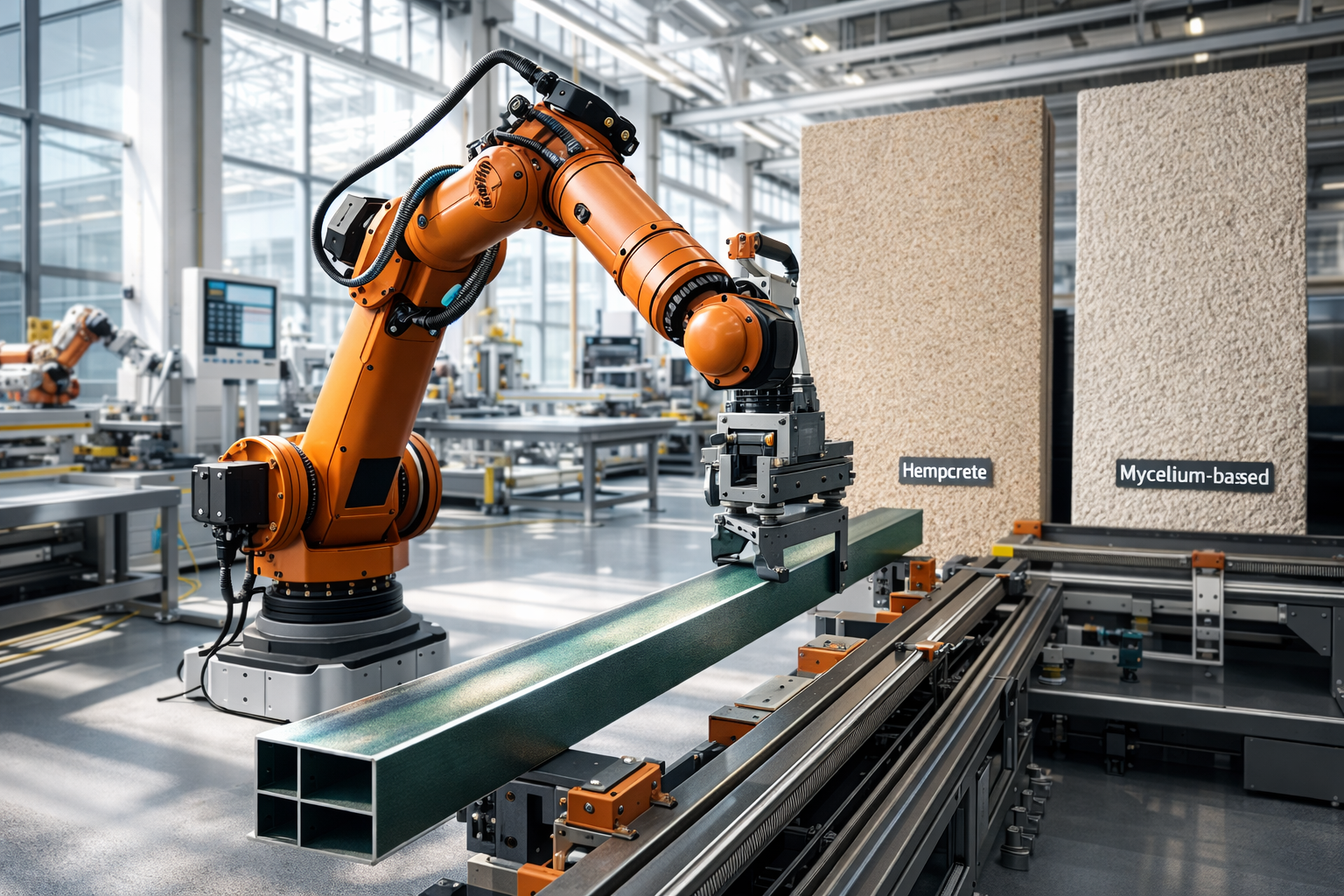
Innovation is thriving in the "bio-design" segment, with materials like hempcrete and mycelium (fungi root networks) emerging as viable alternatives for insulation and finishing. Hempcrete is a bio-composite of hemp fibers and lime that locks in carbon dioxide and provides superior thermal efficiency. Mycelium-based materials, such as MycoWood and Mycopanel, are being developed as biodegradable alternatives to timber and synthetic panels.
Sustainable Material | Key Advantage | GWP (kg CO2/m2) | Water Use (L) |
Straw Panels (EcoCocon) | Carbon sequestration | -94.06 | 1.24 |
Straw Boards (Ekopanely) | Renewable energy mix | -47.60 | 23.20 |
Hemp Fibre (Ekolution) | Thermal insulation | Negative | Minimal |
Mycelium (COMU Labs) | Regenerative building | Emerging data | Minimal |
By late 2025, regulatory pressure reached a tipping point, with the European Commission releasing updated EU Taxonomy guidelines that raised the bar for embodied-carbon reporting, compelling manufacturers to adopt digital traceability for all materials.
The New Geopolitical Industrial Logic: China, EU, and the Global North
The energy transition has become the primary theater of global industrial competition. China, the European Union, and the United States are each deploying national capital and regulatory frameworks to secure leadership in "future industries."
China’s Venture Capital and Manufacturing Blueprint
In December 2025, China launched a national venture capital guidance fund to mobilize "patient capital" for future industries, including quantum technology, aerospace, brain-computer interfaces, and future energy. This fund adopts a 20-year lifespan to provide the long-term support required for hard-tech innovation, with at least 70% of capital directed toward seed-stage and early-stage enterprises. This "investing early, investing small, and investing in hard technology" principle is designed to align financial capital with the country's 15th Five-Year Plan (2026–2030).
Furthermore, China’s Ministry of Industry and Information Technology (MIIT) has formalized a Scenario-based Reference Guide for industrial digital transformation, which details how digital tools should enhance energy efficiency and safety across key production scenarios through 2026. New "Made in China" rules for government procurement, effective January 1, 2026, will give a 20% bidding discount to domestic products, further strengthening China’s domestic industrial and supply chains.
The EU Green Deal and Industrial Accelerator Act
The EU has responded with the Net-Zero Industry Act (NZIA), which sets a binding target for 40% of the EU’s annual deployment needs for net-zero technologies to be produced domestically by 2030. The act streamlines permitting for "Strategic Projects," capping approval times at 12 to 18 months to match the pace of global competition. In addition, the proposed European Union Industrial Accelerator Act (IAA) marks a shift away from the bloc’s traditional free-trade philosophy toward an integrated industrial strategy that mandates local workforce recruitment and technology transfers for foreign investments over €100 million.
Investor Behavioral Shifts and Capital Efficiency
The investment landscape for infrastructure and energy has become more deliberate and institutionalized. While the number of deals has dropped, the average deal size has surged as capital consolidates around AI-capable and infrastructure-ready companies.
The Institutionalization of Corporate Venture Capital
In 2025, Corporate Venture Capital (CVC) units from companies like Nvidia, Alphabet (GV), and BP are acting less as opportunistic investors and more as strategic partners. NVentures has backed nuclear and fusion startups including Commonwealth Fusion Systems and TerraPower in rounds totaling $1.5 billion, reflecting a corporate realization that powering AI requires breakthroughs in primary energy generation. However, internal bureaucracy remains a challenge; 51% of CVCs cite speed and efficiency as persistent roadblocks, leading 66% of financial CVCs to move "off-balance sheet" to gain independence from their corporate parents.
The Rise of the Secondary Market
As traditional Initial Public Offering (IPO) markets remained constrained in 2024 and 2025, the secondary market has emerged as the primary liquidity mechanism for unicorns. The secondary market is projected to handle $122 billion in assets in 2025, with elite startups commanding average premiums of 6% for the first time since 2022. This provides a critical exit pathway for early investors and founders in the energy space, where capital-intensive hardware projects often have longer maturation cycles.
VC Metric (Q2 2025) | United States | European Union | Global Total |
Capital Invested | $100 Billion | $13.5 Billion | $115 Billion |
Deal Count | ~3,700 | ~2,200 | ~6,000 |
Average Deal Size | $27 Million | $6.1 Million | $19.2 Million |
AI Share of Funding | >70% | High (Frontier Tech) | Dominant |
Integrated Strategic Conclusions
The data from 2024, 2025, and projections for 2026 confirm that infrastructure and energy startups have not only returned to the forefront of the global economy but have done so with a more mature industrial logic. The convergence of AI power demand and the transition to a low-carbon energy system has turned infrastructure into a strategic asset class, attracting the world’s largest pools of capital and the attention of its most powerful technology firms.
The transition from the IRA to the OBBBA in the United States, along with the enactment of the NZIA in Europe and the VC guidance fund in China, signals a new era of "strategic green industrialism." For startups, this means that the "Age of Experiments" is over. To thrive in 2026 and beyond, companies must navigate complex supply chain onshoring requirements, secure high-density power access, and demonstrate unit economics that can withstand a higher interest rate environment. The "winners" in this renaissance are no longer those with the most innovative software, but those who can successfully build and scale the physical infrastructure that underpins the modern world.
The persistence of the interconnection backlog and the resource nexus constraints (water and minerals) remain the most significant threats to this resurgence. Without a comprehensive overhaul of permitting processes and a more circular approach to industrial materials, the "Age of Electricity" risks being delayed by the very physical world it seeks to rewire. However, with the entrance of "patient capital" and the institutionalization of the climate-tech investor base, the industry is better equipped to solve these bottlenecks than at any point in its history. Infrastructure and energy startups are indeed back, and they are now the primary engines of global economic and technological progress.
Read More -
1. From Idea to MVP: A Step-by-Step Guide for Solo Founder
🔗 https://findnstart.com/blogs/from-idea-to-mvp-a-step-by-step-guide-for-solo-founder
2. How to Validate Your Startup Idea in 48 Hours for $0
🔗 https://findnstart.com/blogs/how-to-validate-your-startup-idea-in-48-hours-for-0
3. Remote vs. Local: Does Your Co-Founder Need to Live in the Same City?
🔗 https://findnstart.com/blogs/remote-vs-local-does-your-co-founder-need-to-live-in-the-same-city
4. The 2026 Startup Landscape: What Has Fundamentally Changed (and Why Founder Skills Matter More Than Ever)
5. The Most In-Demand Skills for Startup Founders in 2026
🔗 https://findnstart.com/blogs/the-most-in-demand-skills-for-startup-founders-in-2026
6. How to Find a Technical Co-Founder (Without a Six-Figure Salary)
🔗 https://findnstart.com/blogs/how-to-find-a-technical-co-founder-without-a-six-figure-salary
7. 5 Red Flags to Look for When Choosing a Startup Partner
🔗 https://findnstart.com/blogs/5-red-flags-to-look-for-when-choosing-a-startup-partner
8. How to Pitch Your Idea to Potential Co-Founders
🔗 https://findnstart.com/blogs/how-to-pitch-your-idea-to-potential-co-founders
9. How to Build a Portfolio that Attracts High-Growth Startup Founders
🔗 https://findnstart.com/blogs/how-to-build-a-portfolio-that-attracts-high-growth-startup-founders
10. Equity vs. Salary: How to Split Ownership with Your First Teammate
🔗 https://findnstart.com/blogs/equity-vs-salary-how-to-split-ownership-with-your-first-teammate
11. Why Joining an Early-Stage Startup is Better Than a Corporate Job
🔗 https://findnstart.com/blogs/why-joining-an-early-stage-startup-is-better-than-a-corporate-job
12. The Future of EdTech: Why Developers and Educators Need to Team Up Now
🔗 https://findnstart.com/blogs/the-future-of-edtech-why-developers-and-educators-need-to-team-up-now
13. The Architecture of Symbiosis: Analytical Perspectives on the Five Habits of Successful Startup Duos
14. Finding a Co-Founder in the AI Space: What Skills Should You Look For?
🔗 https://findnstart.com/blogs/finding-a-co-founder-in-the-ai-space-what-skills-should-you-look-for
15. Overcoming Analysis Paralysis and the Strategic Path to Execution
🔗 https://findnstart.com/blogs/overcoming-analysis-paralysis-and-the-strategic-path-to-execution
16. From College Project to Company: How to Find Your Student Co-Founder
🔗 https://findnstart.com/blogs/from-college-project-to-company-how-to-find-your-student-co-founder
17. How to Start a Startup While Working a Full-Time Job
🔗 https://findnstart.com/blogs/how-to-start-a-startup-while-working-a-full-time-job
18. How to Build a HealthTech Startup Without a Medical Degree
🔗 https://findnstart.com/blogs/how-to-build-a-healthtech-startup-without-a-medical-degree
19. The Solitary Architect: Executive Isolation in Entrepreneurship
20. The 2026 Guide to Launching a SaaS as a Solo Developer
21. What Sustainable Growth Actually Looks Like
🔗 https://findnstart.com/blogs/what-sustainable-growth-actually-looks-like
22. The Early Warning Signs Your Startup Is in Trouble
🔗 https://findnstart.com/blogs/the-early-warning-signs-your-startup-is-in-trouble
23. How to Grow Without Burning Out
🔗 https://findnstart.com/blogs/how-to-grow-without-burning-out
24. The Truth About “Runway” Most Founders Ignore
🔗 https://findnstart.com/blogs/the-truth-about-runway-most-founders-ignore
25. Revenue Solves More Problems Than Funding
🔗 https://findnstart.com/blogs/revenue-solves-more-problems-than-funding
🆕 Newly Added Articles
26. What No One Tells You About Being a Solo Founder
🔗 https://findnstart.com/blogs/what-no-one-tells-you-about-being-a-solo-founder
27. Why Smart People Quit High-Paying Jobs to Build Startups (And Why Most Regret It)
28. Why Most Startup Advice on Twitter Is Dangerous
🔗 https://findnstart.com/blogs/why-most-startup-advice-on-twitter-is-dangerous
29. Decision Fatigue: The Silent Startup Killer
🔗 https://findnstart.com/blogs/decision-fatigue-the-silent-startup-killer
30. Fear vs Logic: How Founders Actually Make Decisions
🔗 https://findnstart.com/blogs/fear-vs-logic-how-founders-actually-make-decisions
31. How Overthinking Destroys Early Momentum
🔗 https://findnstart.com/blogs/how-overthinking-destroys-early-momentum
32. Ideas Don’t Scale. Systems Do.
🔗 https://findnstart.com/blogs/ideas-dont-scale-systems-do
33. The First Hire That Actually Matters
🔗 https://findnstart.com/blogs/the-first-hire-that-actually-matters
34. How the First 100 Users Decide Your Startup’s Fate
🔗 https://findnstart.com/blogs/how-the-first-100-users-decide-your-startups-fate
35. Why Your Startup Doesn’t Need Growth — It Needs Focus
🔗 https://findnstart.com/blogs/why-your-startup-doesnt-need-growthit-needs-focus
36. Why Most Startups Die Quietly
🔗 https://findnstart.com/blogs/why-most-startups-die-quietly
37. Lessons Learned Too Late by First-Time Founders
🔗 https://findnstart.com/blogs/lessons-learned-too-late-by-first-time-founders
38. The Myth of the “Overnight Success” Startup
🔗 https://findnstart.com/blogs/the-myth-of-the-overnight-success-startup
Protect Your Future: The Precision Vesting Calculator
Don't let a "handshake deal" complicate your exit. Map out your ownership journey with our Vesting Calculator
Calculate Your Vesting Schedule →