Founder-Led Media as a Distribution Strategy
February 25, 2026 by Harshit GuptaThe contemporary commercial landscape is witnessing a fundamental reconfiguration of the relationship between corporate entities and their target audiences. As traditional performance marketing channels reach saturation and trust in institutional messaging undergoes a secular decline, a new distribution paradigm has emerged: Founder-Led Media. This strategy represents the systematic leveraging of a founder’s personal brand, expertise, and authentic narrative as the primary engine for audience acquisition, trust-building, and revenue generation. Unlike conventional marketing models that prioritize faceless brand equity, founder-led distribution recognizes that in a "trust economy," a human voice is the most potent tool for cutting through digital noise and shortening the distance between a brand and its buyer.
The Genesis of the Trust Economy and the Decline of Performance Marketing
The shift toward founder-centricity is not merely a trend in social media behavior but a structural response to the declining efficiency of traditional digital advertising. By 2025, Customer Acquisition Costs (CAC) have surged by an estimated 40% to 60%, driven by intensified competition, stringent privacy regulations (such as the sunsetting of third-party cookies), and the inflation of digital ad bidding. For instance, Google Ads' cost per lead reached an average of $70.11 in 2025, a significant increase that challenges the unit economics of early-stage and growth-stage ventures alike.
In this environment, consumers have developed what researchers term "marketing blindness." The 2023 Edelman Trust Barometer revealed that 81% of consumers require trust in a brand before making a purchase, yet 71% report permanently losing that trust if they perceive a brand cares more about profits than people. Founder-led media addresses this gap by replacing polished corporate abstractions with radical transparency and vulnerability. Data indicates that brands with an active founder presence experience up to 2.3 times higher engagement rates across social platforms compared to those without. This engagement is not purely aesthetic; it is a leading indicator of pipeline velocity, as prospects are 82% more likely to trust companies whose leadership team engages on social channels.
Metric | Traditional Brand-Led Marketing | Founder-Led Distribution Strategy |
Engagement Rate | Baseline (1.0x) | 2.3x Higher |
Trust Factor | Low/Institutional | High/Personal |
Reach Efficiency | Linear (based on spend) | Exponential (viral/organic) |
Decision Speed | Slow (corporate approval) | Rapid/Agile |
Retention Impact | Standard | 33% Higher |
The emergence of founder-led media is also a byproduct of the democratization of high-fidelity production tools. In previous decades, creating a media-grade presence required significant capital investment in studios and agencies. Today, a founder with a smartphone and a strategic content system can achieve a global footprint that rivals multi-billion dollar incumbents.
The Psychological Foundations of Founder-Led Authority
The effectiveness of founder-led media is rooted in deep-seated human psychology. People are biologically predisposed to respond to other people, not abstract logos. Research into "authority bias" and "relatability" suggests that audiences instinctively respond to eye contact, vocal delivery, and visible emotion—elements that are naturally embedded in founder-recorded content. When a founder shares a personal frustration that triggered the creation of their product, it activates an emotional weight that corporate copy cannot replicate.
Furthermore, founder-led content leverages the "proximity of the expert." When a founder speaks about their industry, they are not perceived as a marketer; they are the individual who identified a systemic problem, built a solution, and lives the daily challenges of that specific market. This inherent credibility collapses the skepticism that often meets traditional sales outreach. Buyers trust people faster than they trust brands, and this familiarity compounds quietly over time, long before a formal buying decision exists.
The mechanism of this trust-building is described as a "repetition without pressure" loop. By showing up consistently with a clear worldview and industry insights, a founder occupies mental space in their target audience's mind. When the prospect eventually encounters a problem the founder’s product solves, the founder’s name surfaces as a reference point, not because of a specific campaign, but because of accumulated trust.
Comparative Economics: CAC, LTV, and the Organic Multiplier
From a financial perspective, founder-led media acts as a "GTM lubricant" that reduces the friction and cost of every other channel in the marketing mix. For cash-constrained startups, the ROI difference between paid advertising and content-driven organic strategies is significant. SEO-driven content, often spearheaded by founder-led thought leadership, can yield a 748% ROI when focused on high-intent keywords.
Channel Category | Average Cost Per Lead (CPL) | Conversion Rate (Average) |
PPC (Paid Search) | $181 | 1.3% - 1.7% |
Trade Shows | $811 | Low/Variable |
Organic (Founder-Led SEO) | $31 | 2.4% - 14.6% |
Referral Programs | $150 | High/Trust-Based |
The discrepancy between $181 per lead for PPC and $31 for founder-led organic efforts represents a nearly 6-to-1 cost advantage. Moreover, paid leads are ephemeral—they stop the moment the budget is depleted. In contrast, founder-led media creates a compounding asset library that generates traffic at zero marginal cost for years. For early-stage SaaS founders, implementing this approach has led to 2-3 times faster customer acquisition and inbound demo requests increasing by 340% within 90 days.
The strategic objective of founder-led media is to optimize the LTV:CAC ratio. In 2025, B2B SaaS companies target an LTV:CAC of 3:1 for sustainability, though high-performing founder-led organizations often achieve ratios of 7:1 or higher by significantly depressing the denominator through organic distribution.
Operationalizing the Founder: Content Frameworks and Systems
For a founder-led distribution strategy to be sustainable, it must be treated as a deliberate system rather than a spontaneous habit. Successful founders transition from being content creators to content strategists by implementing repeatable workflows.
The 65/25/10 Content Pillar Framework
High-performing founders maintain their authority while fostering personal connection by adhering to a specific content split:
65% Authority Content: Focuses on industry insights, deep expertise, and education. This builds technical credibility and SEO value.
25% Personal Content: Shares the founder’s "aha" moments, struggles, failures, and personal journey. This builds the emotional connection and relatability that 70% of consumers demand.
10% Sales Content: Subtle, context-driven messaging about the product. Because trust has been established by the previous 90%, these messages convert at much higher rates than standard ads.
The Averi.ai Marketing Routine
Operationalizing this strategy requires rigorous time management. A standard "Founder-Marketer" routine involves:
Daily (30 min): Engagement with social mentions, responding to 2-3 industry comments to stay part of the "dark social" conversation.
Weekly (2-3 hrs): Content "sprints" to produce 3-5 high-quality pieces, such as a LinkedIn long-form post, a video update, or a newsletter draft.
Monthly (half-day): Strategic review of metrics (DMs, inbound leads) and planning major themes or "building in public" updates for the next month.
A critical component of this system is the "low-lift content system," which utilizes interviews or weekly "brain dumps" transcribed into polished posts by a support team. This ensures the founder’s unique voice is preserved while minimizing their actual writing time.
The Scale Challenge: Transitioning to the "Founder-Plus" Model
While founder-led media is highly effective early on, it inevitably encounters "ceilings" of growth. Trust is often concentrated in one individual, which creates a reach limit as organic algorithms eventually saturate the founder’s immediate network. To scale beyond these limits, companies must adopt the "Founder–Brand Framework," also known as the Founder-Plus model.
The Four Engines of Scalable Trust
The Trust Engine (Founder-Led): The founder continues to act as the primary trust catalyst, establishing worldview and competence.
The Memory Engine (Brand-Led): The company encodes the trust created by the founder into recognizable brand assets—specific colors, mascots, or nomenclature—that trigger recall even when the founder is not present.
The Reach Engine (Paid Amplification): Once organic founder posts prove they resonate, they are repurposed as "Thought Leader Ads." Paid media is used to push these high-trust messages beyond the founder’s organic bubble.
The Legitimacy Engine (Organic Momentum): The final stage turns founder-led trust into market-wide legitimacy, where word-of-mouth and customer advocacy validate the brand independently.
This transition is often concurrent with Series B and C funding rounds. At these stages, investors look for evidence that the business model is "repeatable" and "commercially viable" beyond the founder's personality. The shift involves building robust marketing and sales operations that can amplify the founder’s message rather than relying on the founder to do the heavy lifting themselves.
The AI Frontier: Synthetic Avatars and Automated Authenticity
By 2025, the rise of "Human AI" has radically transformed the mechanics of founder-led media. AI is no longer just a tool for automation but a partner in maintaining a founder’s presence across multiple channels.
Digital Twins and Synthetic Video
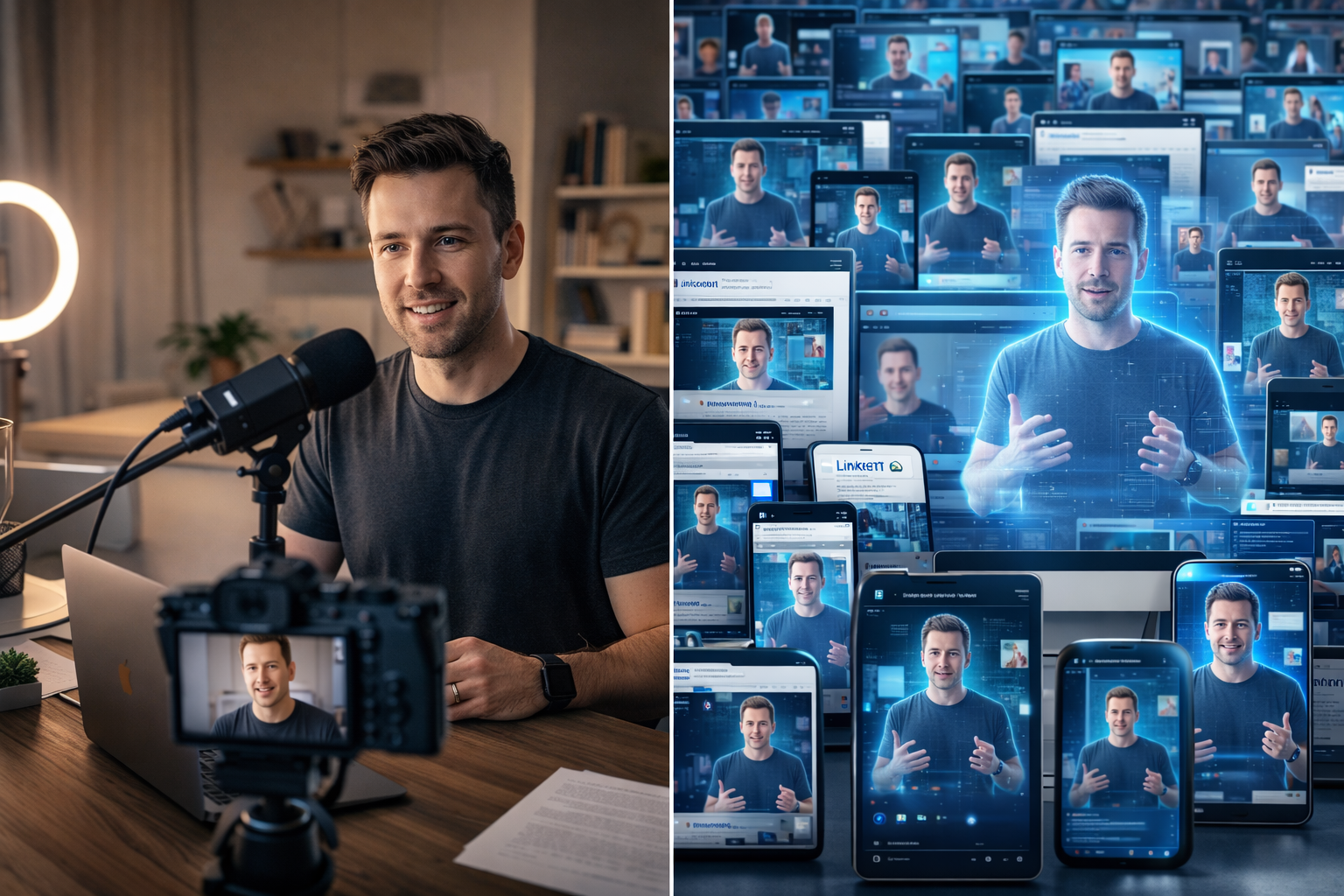
Platforms like HeyGen have enabled founders to create "digital twins"—AI video clones that replicate their facial movements, voice, and cadence with lifelike precision. Founders use these avatars for product explainers, CEO announcements, and localized content in over 70 languages. The impact on efficiency is profound: traditional video production that took two days can now be completed in minutes, representing a 560% increase in work efficiency.
Personalization at Scale
AI also facilitates hyper-personalization, allowing founders to send one-to-one video messages or tailored email content to thousands of subscribers simultaneously. Research shows that advanced personalization can reduce CAC by up to 50% while achieving 202% higher conversion rates. Successful brands in 2025 use AI to research and structure content, but ensure a "human touch" adds the final layer of storytelling to maintain authenticity.
Case Study Analysis: Successful Founder-Led Entities
Drift and the "Hero’s Journey" Strategy
David Cancel, co-founder of Drift, transformed the conversational marketing category by focusing on storytelling rather than feature lists. Cancel operationalized storytelling internally, training every employee on the "Hero’s Journey" framework and using internal video courses to maintain a consistent brand voice. By positioning Drift as a movement (the "no-forms" movement) rather than just software, he built a competitive moat that institutionalized the trust he earned as a founder.
Adam Robinson (RB2B) and Building in Public
Adam Robinson utilized a radical transparency model on LinkedIn, sharing real-time revenue numbers and the struggles of scaling a SaaS company. His focus on relationship building rather than broadcasting allowed him to grow his audience to over 80,000 followers and his ARR to $20 million in under two years. His strategy proves that "building in public" creates a proprietary distribution channel that rivals multi-million dollar ad budgets.
The Milk Road: Voice as a Moat
The crypto newsletter "The Milk Road" achieved an eight-figure exit in under 10 months by prioritizing a unique brand voice. Founders Shaan Puri and Ben Levy utilized a "cheeky" tone, a friendly mascot (a cartoon milk carton), and "stunt marketing"—such as a public $1 million crypto wallet—to build trust in a volatile industry. Their success highlights that in a commodity information market, "personality is a monopoly".
Critical Risk Assessment: Key Person Risk and Valuation Liabilities
Despite the high ROI, a founder-led distribution strategy introduces a unique set of vulnerabilities known as "Key Person Risk." If a business relies too heavily on its founder for revenue generation and brand identity, it can significantly erode the company’s valuation.
Valuation and Exit Challenges
Prospective buyers and private equity firms often apply a "key man risk discount" to companies where the founder is indispensable. In many owner-managed businesses, the founder is the business. If they leave, they take their industry relationships and "halo effect" with them. To mitigate this, founders must transition from being "founder-led" to "founder-supported," ensuring that internal systems and a strong leadership team can sustain operations independently.
Dimension of Risk | Financial Impact | Mitigation Strategy |
Earnings Limitation | Capped growth due to founder bottleneck | Delegate decision-making power |
Value Erosion | Red flag for investors/lower multiples | Documented processes and systems |
Employee Loyalty | Risk of high turnover if founder exits | Focus on shared values over personality |
Relationship Loss | Loss of key customer/vendor ties | Multichannel touchpoints for clients |
PR Hazards and Scandals
Founder-led media ties the company’s reputation to the founder’s personal behavior. Historical data from the 2023 Weber Shandwick Reputation Report shows that companies lose an average of 22% of their market value during major reputation crises.
Recent textbook failures include:
Better.com (Vishal Garg): The firing of 900 employees over a Zoom call right before Christmas caused a "DEEP dive" in company culture and the mass resignation of high-ranking marketing and PR executives.
Tesla (Elon Musk): The founder’s polarizing presence on X has led to regulatory pressure and eroded public trust in certain brand claims, even while the technical innovation remains a market leader.
MillerKnoll (Andi Owen): A leaked video of the CEO telling employees to "leave Pity City" regarding bonuses while she received a multi-million dollar payout triggered widespread public backlash and damaged the brand’s equity.
Academic Insights into CEO Branding and Market Value
Academic research supports the notion that a CEO’s personal brand has measurable effects on a company’s financial health. A study of over 3,000 S&P 1500 companies analyzed the "Big Five" personality traits of CEOs through machine learning algorithms applied to video transcripts.
The Impact of Personality on Stock Volatility
Conscientiousness: Firms led by conscientious (dependable, cautious) CEOs experienced 2.59% lower stock risk and achieved a 3.83% increase in shareholder returns.
Neuroticism: Firms led by impulsive or emotionally unstable CEOs experienced 2.04% higher stock risk and were less able to translate that risk into returns.
Extroversion: While often viewed as a positive trait for founders, highly extroverted CEOs’ firms experienced 2.40% higher stock risk, and increasing levels of risk actually reduced returns by 3.30%, as the market often interprets high extroversion as a signal of excessive risk-taking.
These findings suggest that while a "larger-than-life" founder brand (e.g., Richard Branson or Steve Jobs) can generate immense initial attention, long-term market value is preserved through a brand of "humble charisma"—a combination of personal magnetism and strategic restraint.
Strategy Implementation: A 90-Day Roadmap for Founders
To effectively transition to a founder-led distribution model, organizations should follow a structured implementation plan:
Phase 1: Foundation (Days 1-30): Define the founder’s unique voice and 3-5 content pillars. Establish a "Brand Kit" that includes high-quality photography, consistent typography, and an authentic tone guide.
Phase 2: Systematization (Days 31-60): Implement the weekly content sprint and engagement routines. Set up an AI content partner (e.g., for transcription and repurposing) to minimize founder time investment. Launch the primary distribution channel (e.g., LinkedIn or a Newsletter).
Phase 3: Optimization & Scaling (Days 61-90): Analyze engagement signals to identify "winning hooks." Begin repurposing these as Thought Leader Ads. Introduce the leadership team into the content mix to begin de-risking the "key person" factor.
The Future of Founder-Led Media: Narrative Integrity in the Age of AI
As we look toward 2026 and beyond, the dominant challenge for founder-led media will be maintaining "narrative integrity." As the market is flooded with AI-generated personal content, the premium on real-world market knowledge and authentic human insight will only increase. The winners will not be the brands with the largest production budgets, but those with founders who are "in the arena"—using their hands-on experience to deliver value that no machine can replicate.
The most effective distribution strategies will blend the speed of AI automation with the emotional resonance of human storytelling. In this new era, a founder's face and voice are no longer just "marketing assets"—they are the most resilient competitive moat a company can build.
Synthesis of Actionable Recommendations
For professional peers looking to navigate this shift, the evidence points toward a dual-track strategy:
Aggressively Humanize: Deploy founder presence across high-impact video and audio channels to build the "Trust Engine." The data supports that human presence converts significantly better than abstract logos.
Systematically Institutionalize: Simultaneously build the "Memory Engine" and a robust management team. The goal is to create a business that is fueled by the founder but not fragile to their absence.
By treating founder-led media as a rigorous distribution lever rather than a vanity project, companies can achieve a sustainable, trust-rich growth model that is uniquely positioned for the complexities of the 21st-century market.
Read More -
1. From Idea to MVP: A Step-by-Step Guide for Solo Founder
🔗 https://findnstart.com/blogs/from-idea-to-mvp-a-step-by-step-guide-for-solo-founder
2. How to Validate Your Startup Idea in 48 Hours for $0
🔗 https://findnstart.com/blogs/how-to-validate-your-startup-idea-in-48-hours-for-0
3. Remote vs. Local: Does Your Co-Founder Need to Live in the Same City?
🔗 https://findnstart.com/blogs/remote-vs-local-does-your-co-founder-need-to-live-in-the-same-city
4. The 2026 Startup Landscape: What Has Fundamentally Changed (and Why Founder Skills Matter More Than Ever)
5. The Most In-Demand Skills for Startup Founders in 2026
🔗 https://findnstart.com/blogs/the-most-in-demand-skills-for-startup-founders-in-2026
6. How to Find a Technical Co-Founder (Without a Six-Figure Salary)
🔗 https://findnstart.com/blogs/how-to-find-a-technical-co-founder-without-a-six-figure-salary
7. 5 Red Flags to Look for When Choosing a Startup Partner
🔗 https://findnstart.com/blogs/5-red-flags-to-look-for-when-choosing-a-startup-partner
8. How to Pitch Your Idea to Potential Co-Founders
🔗 https://findnstart.com/blogs/how-to-pitch-your-idea-to-potential-co-founders
9. How to Build a Portfolio that Attracts High-Growth Startup Founders
🔗 https://findnstart.com/blogs/how-to-build-a-portfolio-that-attracts-high-growth-startup-founders
10. Equity vs. Salary: How to Split Ownership with Your First Teammate
🔗 https://findnstart.com/blogs/equity-vs-salary-how-to-split-ownership-with-your-first-teammate
11. Why Joining an Early-Stage Startup is Better Than a Corporate Job
🔗 https://findnstart.com/blogs/why-joining-an-early-stage-startup-is-better-than-a-corporate-job
12. The Future of EdTech: Why Developers and Educators Need to Team Up Now
🔗 https://findnstart.com/blogs/the-future-of-edtech-why-developers-and-educators-need-to-team-up-now
13. The Architecture of Symbiosis: Analytical Perspectives on the Five Habits of Successful Startup Duos
14. Finding a Co-Founder in the AI Space: What Skills Should You Look For?
🔗 https://findnstart.com/blogs/finding-a-co-founder-in-the-ai-space-what-skills-should-you-look-for
15. Overcoming Analysis Paralysis and the Strategic Path to Execution
🔗 https://findnstart.com/blogs/overcoming-analysis-paralysis-and-the-strategic-path-to-execution
16. From College Project to Company: How to Find Your Student Co-Founder
🔗 https://findnstart.com/blogs/from-college-project-to-company-how-to-find-your-student-co-founder
17. How to Start a Startup While Working a Full-Time Job
🔗 https://findnstart.com/blogs/how-to-start-a-startup-while-working-a-full-time-job
18. How to Build a HealthTech Startup Without a Medical Degree
🔗 https://findnstart.com/blogs/how-to-build-a-healthtech-startup-without-a-medical-degree
19. The Solitary Architect: Executive Isolation in Entrepreneurship
20. The 2026 Guide to Launching a SaaS as a Solo Developer
21. What Sustainable Growth Actually Looks Like
🔗 https://findnstart.com/blogs/what-sustainable-growth-actually-looks-like
22. The Early Warning Signs Your Startup Is in Trouble
🔗 https://findnstart.com/blogs/the-early-warning-signs-your-startup-is-in-trouble
23. How to Grow Without Burning Out
🔗 https://findnstart.com/blogs/how-to-grow-without-burning-out
24. The Truth About “Runway” Most Founders Ignore
🔗 https://findnstart.com/blogs/the-truth-about-runway-most-founders-ignore
25. Revenue Solves More Problems Than Funding
🔗 https://findnstart.com/blogs/revenue-solves-more-problems-than-funding
🆕 Newly Added Articles
26. What No One Tells You About Being a Solo Founder
🔗 https://findnstart.com/blogs/what-no-one-tells-you-about-being-a-solo-founder
27. Why Smart People Quit High-Paying Jobs to Build Startups (And Why Most Regret It)
28. Why Most Startup Advice on Twitter Is Dangerous
🔗 https://findnstart.com/blogs/why-most-startup-advice-on-twitter-is-dangerous
29. Decision Fatigue: The Silent Startup Killer
🔗 https://findnstart.com/blogs/decision-fatigue-the-silent-startup-killer
30. Fear vs Logic: How Founders Actually Make Decisions
🔗 https://findnstart.com/blogs/fear-vs-logic-how-founders-actually-make-decisions
31. How Overthinking Destroys Early Momentum
🔗 https://findnstart.com/blogs/how-overthinking-destroys-early-momentum
32. Ideas Don’t Scale. Systems Do.
🔗 https://findnstart.com/blogs/ideas-dont-scale-systems-do
33. The First Hire That Actually Matters
🔗 https://findnstart.com/blogs/the-first-hire-that-actually-matters
34. How the First 100 Users Decide Your Startup’s Fate
🔗 https://findnstart.com/blogs/how-the-first-100-users-decide-your-startups-fate
35. Why Your Startup Doesn’t Need Growth — It Needs Focus
🔗 https://findnstart.com/blogs/why-your-startup-doesnt-need-growthit-needs-focus
36. Why Most Startups Die Quietly
🔗 https://findnstart.com/blogs/why-most-startups-die-quietly
37. Lessons Learned Too Late by First-Time Founders
🔗 https://findnstart.com/blogs/lessons-learned-too-late-by-first-time-founders
38. The Myth of the “Overnight Success” Startup
🔗 https://findnstart.com/blogs/the-myth-of-the-overnight-success-startup
Protect Your Future: The Precision Vesting Calculator
Don't let a "handshake deal" complicate your exit. Map out your ownership journey with our Vesting Calculator
Calculate Your Vesting Schedule →