Why Vancouver Attracts Global Tech Talent
March 11, 2026 by Harshit Gupta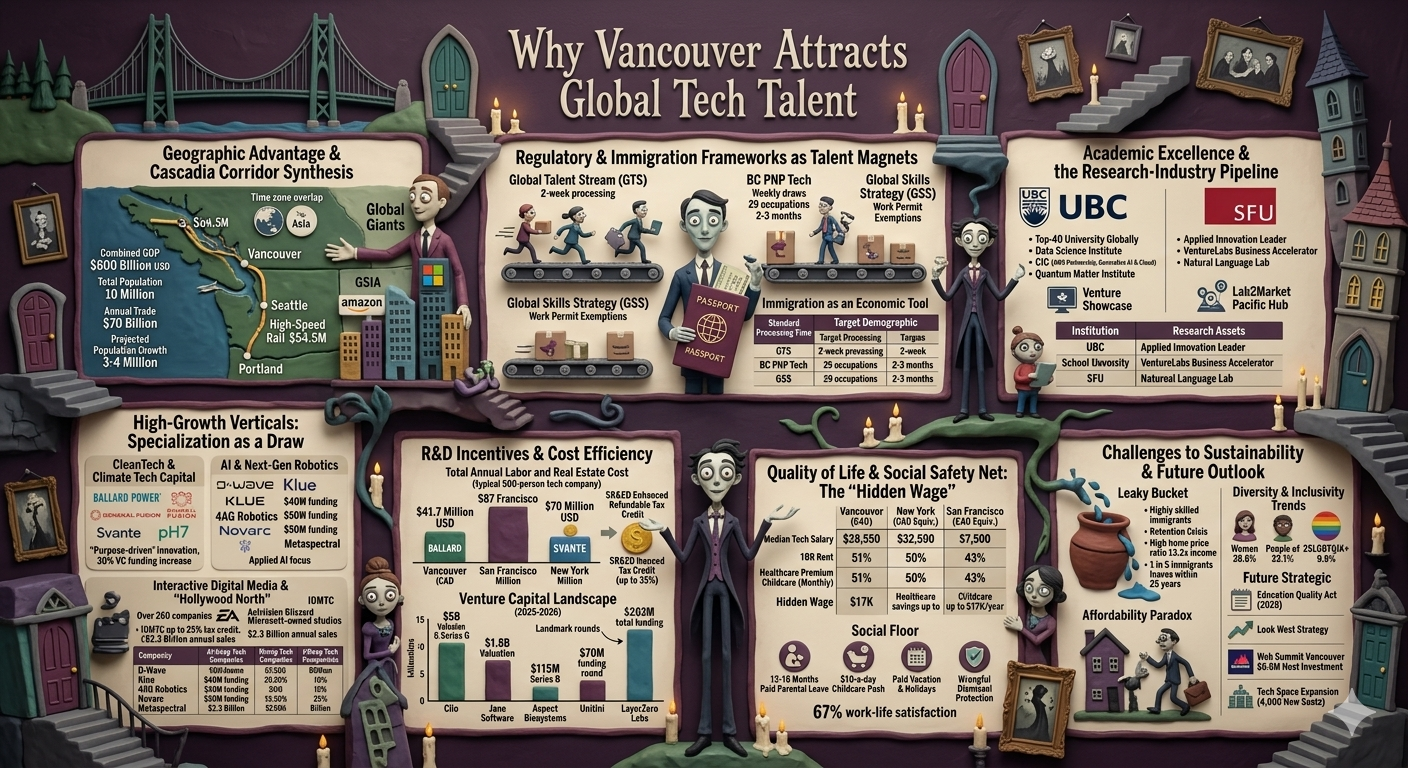
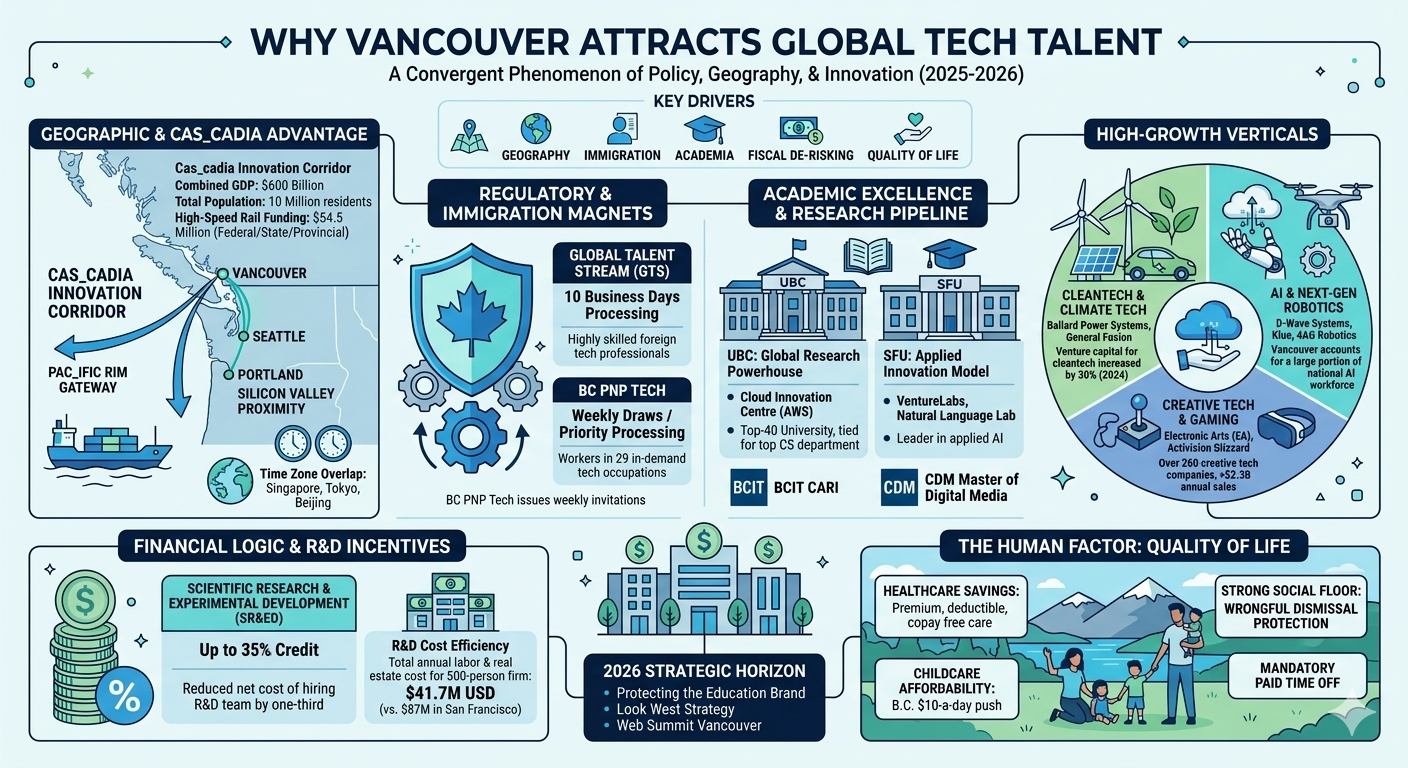
The transformation of Vancouver into a primary destination for global technology talent is an multifaceted phenomenon driven by a rare convergence of favorable geography, aggressive immigration policy, a robust educational infrastructure, and a fiscal environment designed to de-risk innovation. As of 2025 and 2026, the city has solidified its status as one of North America’s most significant innovation hubs, ranking 11th globally in startup ecosystem strength. This ascent is not merely an extension of the broader Canadian tech boom but a distinct regional success story defined by its role as a gateway between the Pacific Rim and the North American continent. The city's tech sector now accounts for over 10% of its total workforce, a metric that reflects a decade of rapid acceleration in both venture capital inflow and human capital migration.
Geographic Advantage and the Cascadia Corridor Synthesis
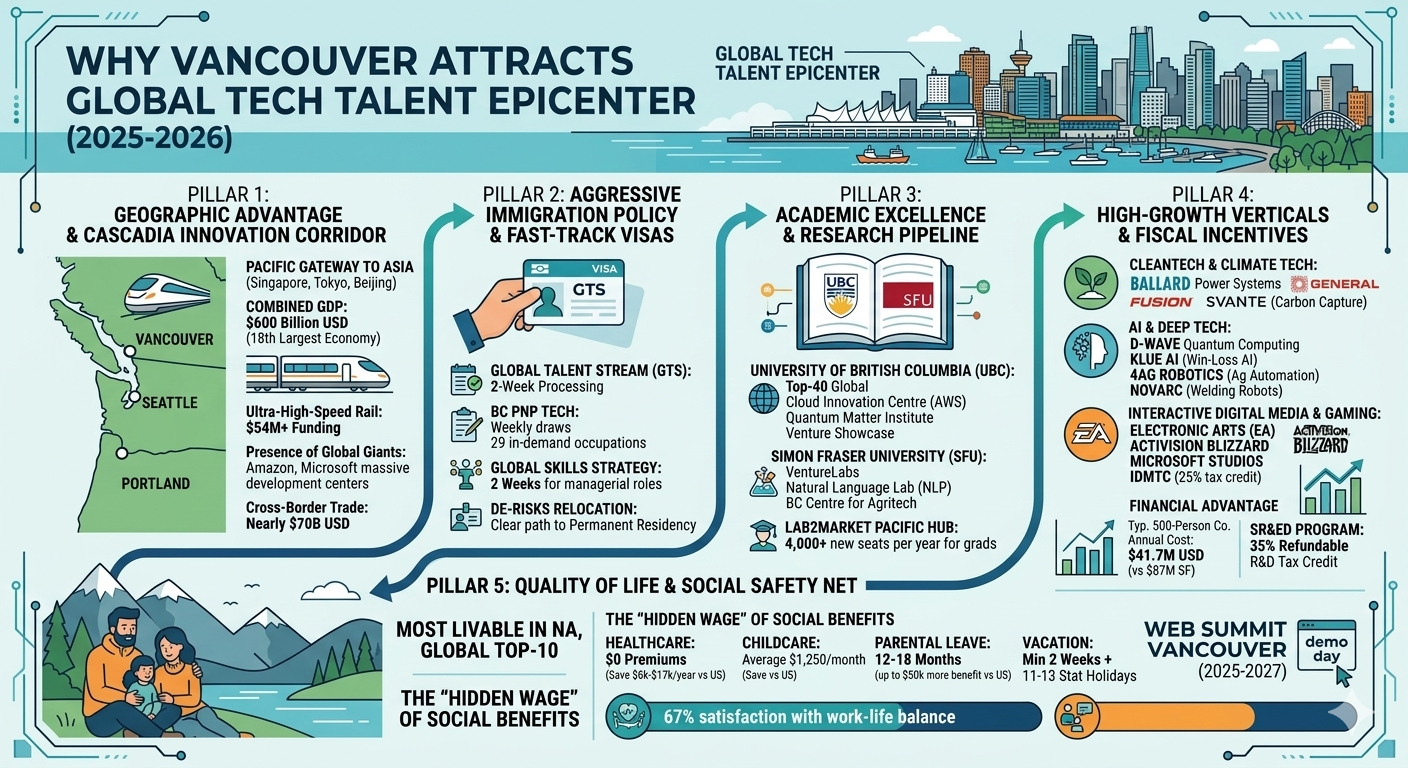
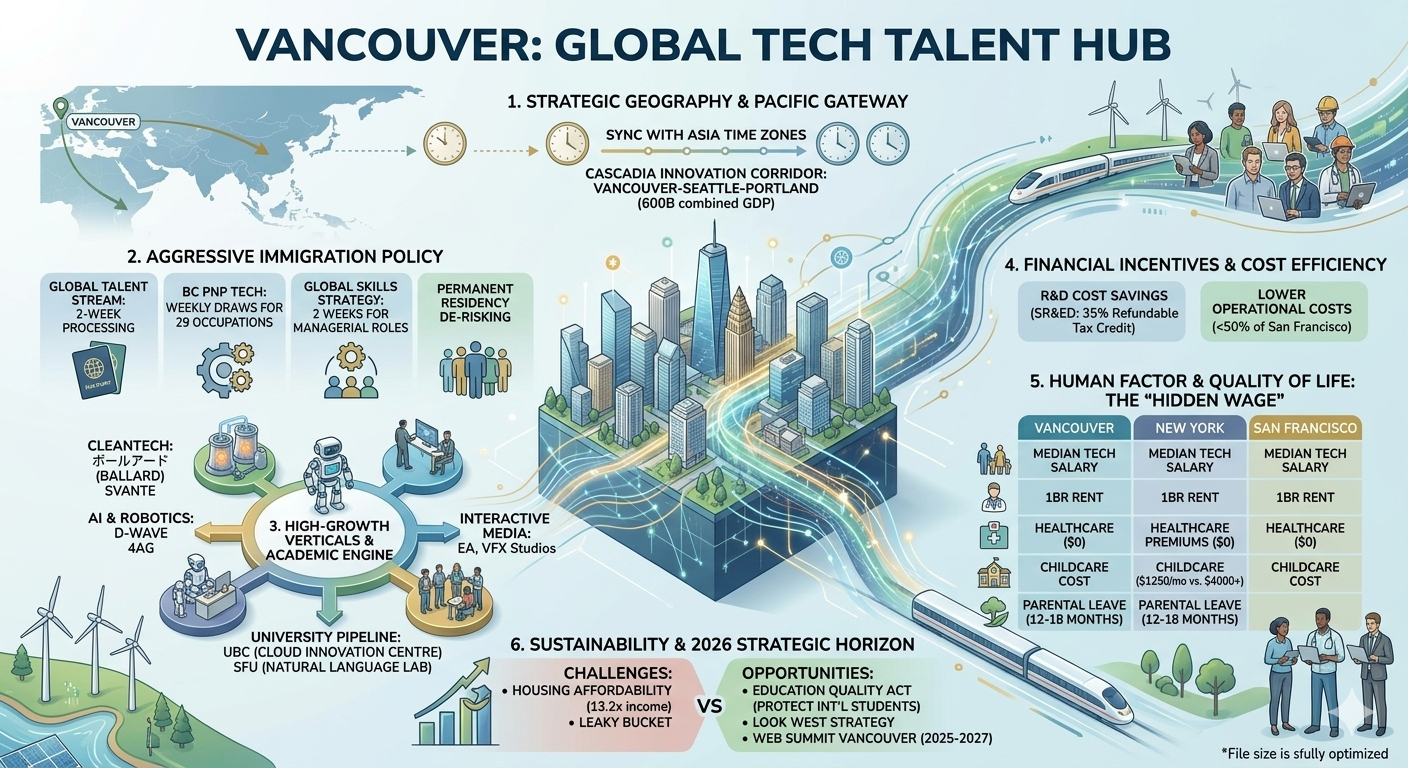
The geographic positioning of Vancouver provides a strategic utility that few other North American cities can replicate. Located on the Pacific Ocean, the city serves as the primary gateway for businesses focusing on trade, logistics, and consumer products flowing between Asia and North America. This positioning has profound implications for tech talent; companies that require high degrees of collaboration with Asian markets find Vancouver’s time zone overlap with Singapore, Tokyo, and Beijing to be a critical operational asset. For international founders, the city serves as a perfect launchpad to scale startups globally while maintaining proximity to both Silicon Valley and the emerging markets of the Indo-Pacific.
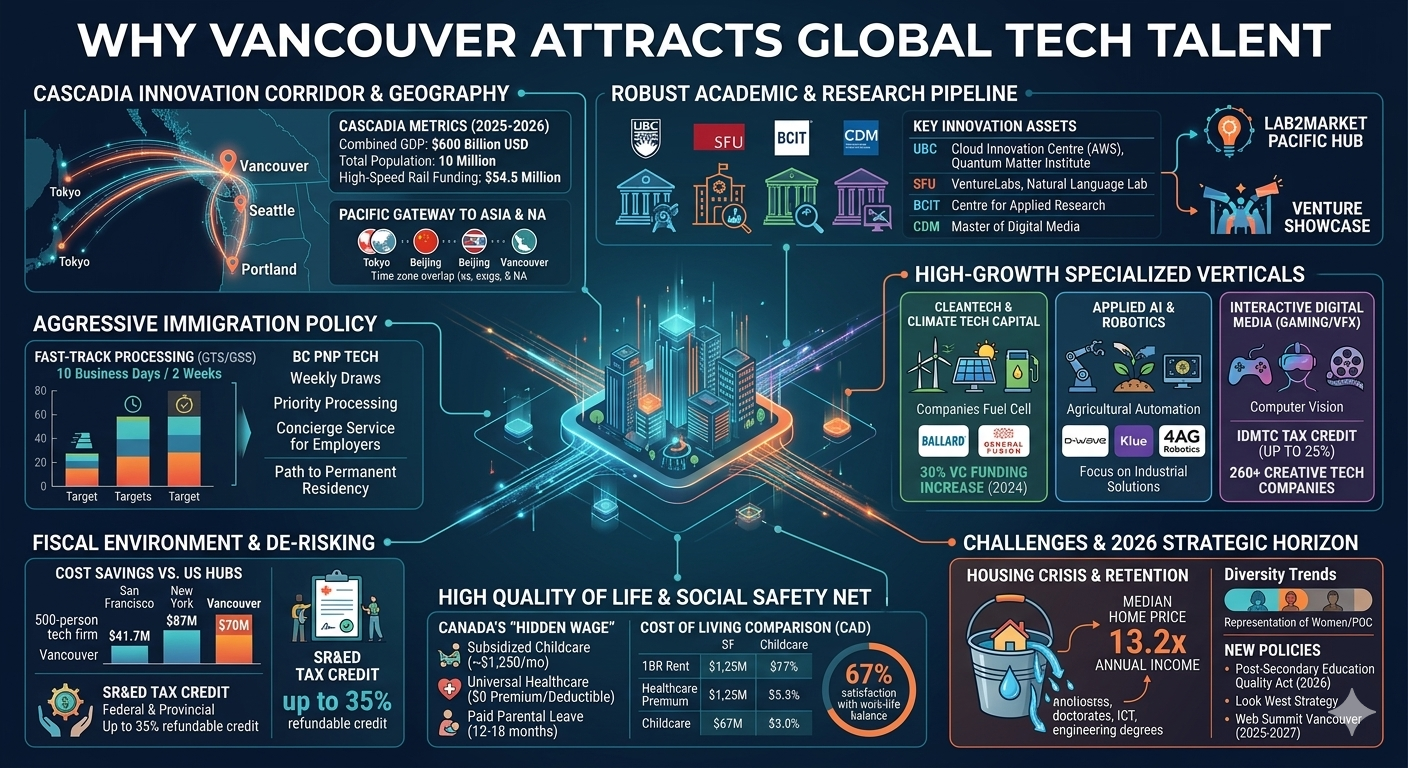
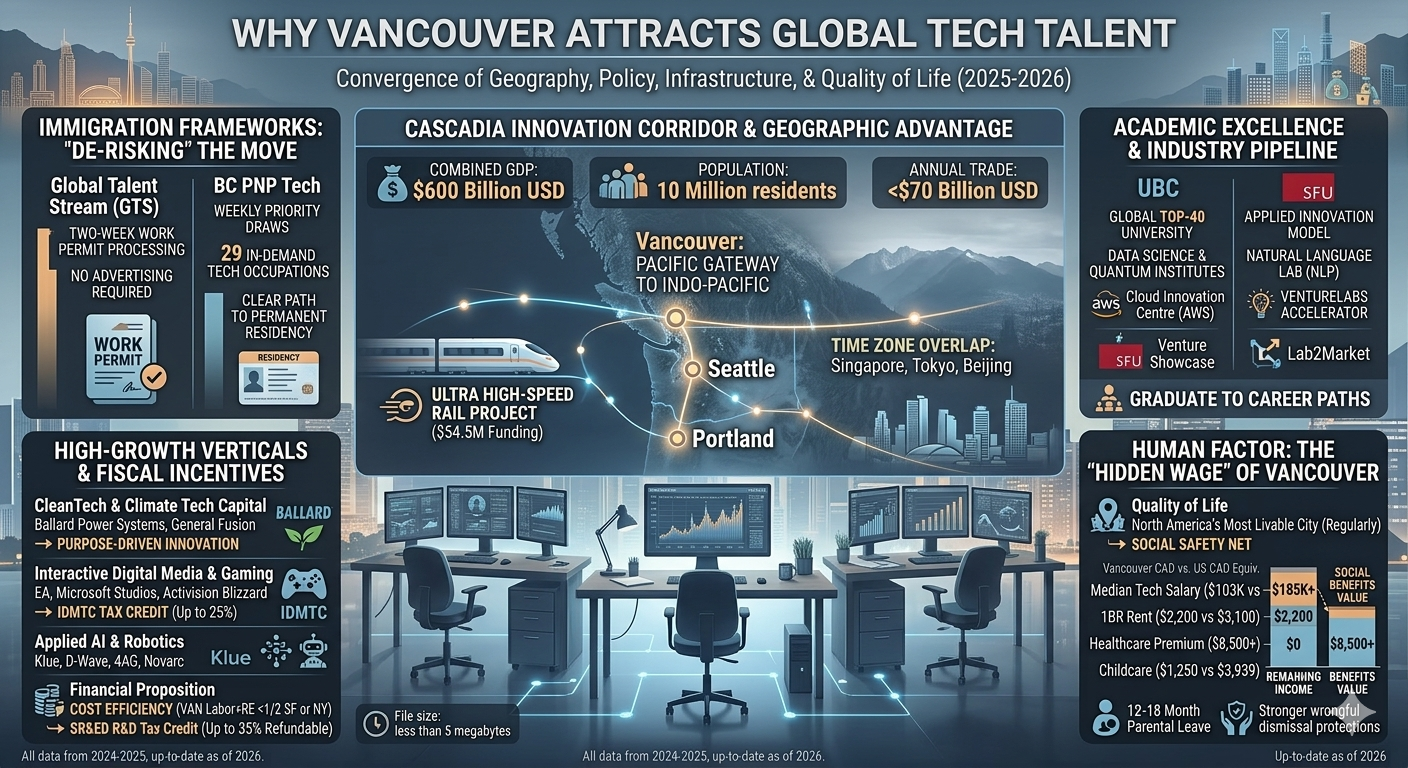
A significant driver of Vancouver’s attractiveness is its integration into the Cascadia Innovation Corridor, a "mega-region" initiative that links Vancouver with Seattle, Washington, and Portland, Oregon. This corridor facilitates a cross-border exchange of ideas, capital, and labor, effectively creating a super-region with a combined GDP of approximately $600 billion, which would rank as the 18th largest economy in the world if it were a sovereign nation. The synergy within this corridor is exemplified by the presence of global giants like Amazon and Microsoft, which have established massive development centers in Vancouver to tap into a labor market that is both highly skilled and cost-effective compared to their Seattle headquarters.
Economic Indicator | Cascadia Innovation Corridor (2025-2026) |
Combined GDP | $600 Billion USD |
Total Population | 10 Million residents |
Annual Cross-Border Trade | Nearly $70 Billion USD |
Projected High-Speed Rail Funding | $54.5 Million (Federal/State/Provincial) |
Projected Population Growth by 2050 | 3-4 Million additional residents |
The momentum of this corridor is further bolstered by infrastructure projects aimed at reducing physical friction between the hubs. The planning for an ultra-high-speed rail system connecting Vancouver, Seattle, and Portland received nearly $50 million in federal grants in late 2024, with state matching funds bringing the total to over $54 million. This project aims to address the regional challenges of traffic congestion and housing affordability by enabling a more distributed and mobile workforce across the three cities. For tech talent, this means the prospect of a integrated labor market where residency in Vancouver does not preclude participation in the high-velocity corporate environments of Seattle or Portland.
Regulatory and Immigration Frameworks as Talent Magnets
Perhaps the most decisive factor in Vancouver’s ability to siphon talent from the global pool is the Canadian government's use of immigration as a competitive economic tool. While many traditional tech hubs in the United States grapple with restrictive visa quotas and long processing delays, Canada has implemented a suite of programs designed to facilitate the rapid entry of highly skilled workers.
The Global Talent Stream and Fast-Track Processing
The Global Talent Stream (GTS), part of Canada’s Global Skills Strategy (GSS), has revolutionized the hiring process for tech companies in Vancouver. This program provides a two-week processing standard for work permit applications, allowing firms to hire specialized international talent with a speed that is virtually unmatched in other G7 nations. For an employer to qualify, they must demonstrate that the hire will bring significant benefits to the Canadian labor market, such as knowledge transfer or job creation for local workers.
Immigration Pathway | Standard Processing Time | Target Demographic |
Global Talent Stream (GTS) | 10 Business Days | Highly skilled foreign tech professionals |
BC PNP Tech | Weekly Draws / Priority Processing | Workers in 29 in-demand tech occupations |
Global Skills Strategy (GSS) | 2 Weeks | Managerial and professional roles (TEER 0 & 1) |
GSS Work Permit Exemptions | Immediate (Short-term) | High-skilled workers (up to 30 days per year) |
The GTS covers a broad spectrum of in-demand roles, including data scientists, cybersecurity specialists, and software engineers. Crucially, the program does not require the traditional labor market testing that mandates advertising a position for a month before hiring a foreign national, provided the role is on the Global Talent Occupations List. This flexibility allows Vancouver-based startups to scale rapidly by filling critical technical gaps in a matter of weeks rather than months.
The BC Provincial Nominee Program (BC PNP) Tech
At the provincial level, the BC PNP Tech stream offers a structured and predictable path to permanent residency for international workers already contributing to the local ecosystem. Unlike broader immigration categories, BC PNP Tech issues weekly invitations to candidates with job offers in one of 29 designated occupations. This program provides a dedicated concierge service for tech employers and priority processing for applications, which are typically finalized within two to three months. By offering a clear and expedited route to permanent status, British Columbia effectively "de-risks" the move for global talent, who often cite residency security as a primary factor in their relocation decisions.
Academic Excellence and the Research-Industry Pipeline
Vancouver’s talent ecosystem is anchored by world-class academic institutions that serve as primary engines for both domestic skill development and international research collaboration. The University of British Columbia (UBC) and Simon Fraser University (SFU) are central to this infrastructure, consistently ranking among the top institutions in Canada for computer science and software engineering.
UBC: A Global Research Powerhouse
UBC is recognized as a top-40 university globally and a leader in technical research. Its Department of Computer Science is tied for the top spot in Canada and is home to numerous specialized research centers that act as magnets for graduate-level talent from around the world. These include the Data Science Institute (DSI), the Institute for Computing, Information and Cognitive Systems (ICICS), and the Stewart Blusson Quantum Matter Institute.
A critical component of UBC’s industry integration is the Cloud Innovation Centre (CIC), a partnership with Amazon Web Services (AWS) that focuses on applying generative AI and cloud technologies to public sector challenges. This center provides students with hands-on experience in cutting-edge fields, ensuring that the local talent pool is proficient in the technologies most in demand by global firms. The university also hosts annual events like the Venture Showcase, which connects student entrepreneurs with over 250 industry partners and funders, fostering a culture of commercialization that translates research into economic value.
SFU and the Applied Innovation Model
Simon Fraser University (SFU) complements UBC’s research focus with a strong emphasis on applied innovation and entrepreneurship. SFU’s VentureLabs is a leading business accelerator that supports science and technology-based companies as they scale. The university is also a national leader in natural language processing (NLP), with its Natural Language Lab being one of the largest in North America.
The collaboration between these institutions is formalized through programs like the Lab2Market Pacific Hub, co-led by SFU and UBC. This initiative helps graduate and postdoctoral researchers test the commercial potential of their inventions, creating a robust pipeline of "deep tech" startups in fields like biotechnology and robotics. For global talent, the presence of such a high-functioning academic-industry interface provides both educational opportunities and a diverse array of potential career paths upon graduation.
Institution | Key Research & Innovation Assets | Regional Impact |
UBC | Cloud Innovation Centre (AWS), Quantum Matter Institute | Top-ranked CS department in Canada; global research leader |
SFU | VentureLabs, Natural Language Lab, BC Centre for Agritech | Leader in applied AI and startup acceleration |
BCIT | Centre for Applied Research and Innovation (CARI), SMART | Hub for product development and smart grid research |
CDM | Master of Digital Media (UBC, SFU, ECU, BCIT Partnership) | World-class training for the creative tech and gaming sectors |
High-Growth Verticals: Specialization as a Draw
Vancouver’s tech sector is not a monolith but a collection of high-performing clusters, each with its own gravity for specialized talent. The region has moved beyond general software development to become a global leader in several niche but critical industries.
The CleanTech and Climate Tech Capital
Vancouver is widely recognized as the cleantech capital of North America. This sector is driven by a deep cultural commitment to environmental stewardship and supported by the provincial government’s CleanBC plan, which provides incentives for green innovation. Companies like Ballard Power Systems and General Fusion are pioneering solutions in fuel cells and nuclear fusion, respectively, while newer startups like Svante and pH7 Technologies are scaling carbon capture and critical mineral extraction technologies.
The concentration of cleantech firms creates a unique opportunity for engineers and scientists who wish to align their careers with sustainability goals. In 2024, venture capital funding for Vancouver startups saw a 30% increase, with a significant portion directed toward climate solutions and ocean technology. This "purpose-driven" innovation is a powerful attractor for younger professionals who prioritize social and environmental impact alongside financial compensation.
Artificial Intelligence and the Next-Gen Robotics
The artificial intelligence (AI) scene in Vancouver is one of the most robust in Canada, with the city accounting for a large portion of the national AI workforce alongside Toronto and Montreal. This cluster is characterized by its focus on applied AI—using machine learning to solve specific industrial and business problems.
Notable AI/Deep Tech Companies | Industry Application | Funding / Status |
D-Wave Systems | Quantum Computing | Global leader in quantum hardware |
Klue | Competitive Intelligence | Recently acquired Goldpan for win-loss AI |
4AG Robotics | Agricultural Automation | Raised $40M for autonomous harvesting robots |
Novarc | Industrial Robotics | Raised $50M for AI-automated welding |
Metaspectral | Computer Vision | Real-time hyperspectral data processing |
The maturity of Vancouver’s AI sector is evidenced by companies like Klue, which has expanded through acquisitions and now competes on a global stage, and 4AG Robotics, which is applying autonomous systems to traditional industries like agriculture. This diversity of application ensures that AI talent can find roles in sectors ranging from fintech to advanced manufacturing.
Interactive Digital Media and "Hollywood North"
Vancouver has long been known as a hub for film and television, but the convergence of this creative expertise with interactive technology has made it a global powerhouse for gaming and visual effects (VFX). The city is home to over 260 creative tech companies, including industry giants like Electronic Arts (EA), Activision Blizzard, and Microsoft-owned studios.
This sector benefits from the Interactive Digital Media Tax Credit (IDMTC), which provides a refundable credit of up to 25% on eligible BC salary and wages incurred after September 1, 2025. This incentive, combined with the presence of the Centre for Digital Media (CDM), ensures a continuous flow of specialized talent into a market that produces over $2.3 billion in annual sales. The creative tech sector acts as a significant "training ground" for senior product and engineering talent, many of whom eventually move into other tech verticals like fintech or healthtech.
The Financial Logic: R&D Incentives and Cost Efficiency
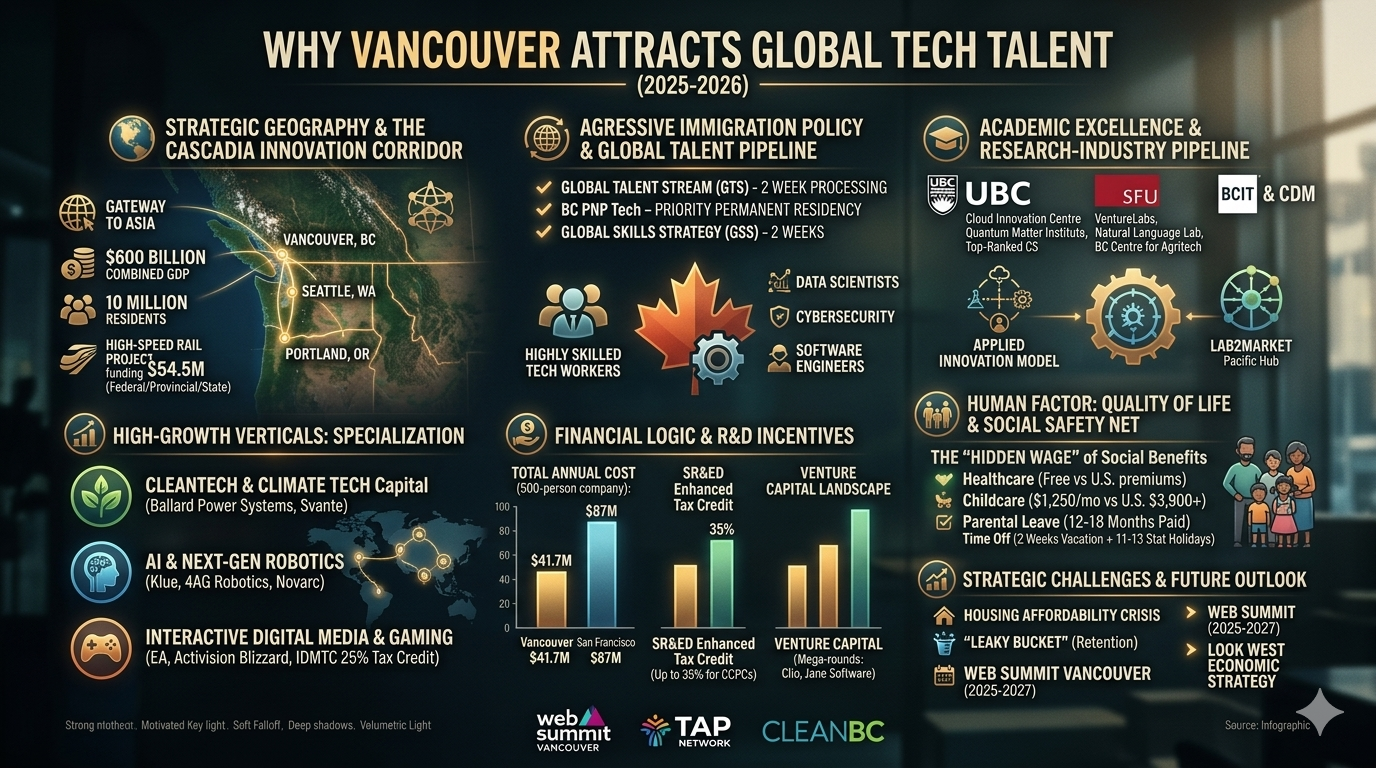
For global companies and startups, Vancouver offers a compelling financial proposition. The total annual labor and real estate cost for a typical 500-person tech company in Vancouver is estimated at $41.7 million USD, which is less than half the cost of operating in San Francisco ($87 million) or New York ($70 million).
Scientific Research and Experimental Development (SR&ED)
The federal SR&ED program is one of the world’s most generous incentives for industrial R&D. For Canadian-controlled private corporations (CCPCs), the program offers an enhanced refundable tax credit of up to 35% on qualifying research expenses, effectively reducing the net cost of hiring an R&D team by one-third. Public and foreign-owned corporations can also claim the credit, albeit at a lower non-refundable rate. This fiscal de-risking allows Vancouver startups to maintain larger engineering teams than their peers in more expensive jurisdictions.
The Venture Capital Landscape (2025-2026)
The Vancouver ecosystem has matured to the point where it is now producing "centaurs" (private companies with over $100 million in annual revenue) and high-valuation leaders. In 2024 and 2025, several local companies raised landmark rounds that reset expectations for the region’s scale.
Company | Sector | Valuation / Funding | Strategic Impact |
Clio | Legal Tech | $5 Billion Valuation | Raised $500M Series G; $1B acquisition of vLex |
Jane Software | HealthTech | $1.8 Billion Valuation | $500M secondary deal; >$100M ARR |
Aspect Biosystems | Biotechnology | $115M Series B | Leading the bio-printed tissue field |
UniUni | E-commerce Logistics | $202M Total Funding | Raised $70M round; generating $500M revenue |
LayerZero Labs | Web3 / Networking | $263M Total Funding | Focus on omnichain interoperability |
These mega-rounds indicate that Vancouver is no longer just a source of early-stage talent but a place where companies can scale into global category leaders. The presence of these high-valuation firms creates a secondary market for talent, as early employees from successful exits provide the capital and mentorship for the next generation of startups.
The Human Factor: Quality of Life and Social Safety Net
While the technical and financial aspects are significant, the personal value proposition for tech professionals in Vancouver is centered on a high standard of living and a comprehensive social safety net. Vancouver regularly ranks as the most livable city in North America and top-ten globally.
The "Hidden Wage" of Social Benefits
A critical insight for global talent comparing Vancouver to U.S. hubs like Seattle or San Francisco is the concept of the "hidden wage" provided by Canadian social systems. When factoring in the total cost of living, the absence of high healthcare premiums and the presence of subsidized childcare significantly alter the math of professional compensation.
Healthcare Savings: Canadian residents do not pay premiums, deductibles, or copays for essential medical care. This effectively provides a savings of $6,000 to $17,000 per year compared to U.S. workers, who often face high out-of-pocket costs even with employer-sponsored plans.
Childcare Affordability: British Columbia has led the national push for $10-a-day daycare. In Vancouver, the average monthly cost of childcare is approximately $1,250, compared to $3,900 in San Francisco or $4,300 in New York.
Parental Leave: The Canadian system provides 12 to 18 months of paid parental leave via Employment Insurance, with job protection for the entire period. A family with two children can receive $35,000 to $50,000 more in benefits over their careers compared to an equivalent family in the U.S..
Time Off and Security: Canadian federal law mandates at least two weeks of vacation (increasing with tenure) and 11 to 13 statutory holidays, whereas the U.S. has no federal requirement for paid time off. Furthermore, Canadian workers benefit from stronger wrongful dismissal protections and mandatory notice periods.
Compensation Element | Vancouver (CAD) | New York (CAD Equiv.) | San Francisco (CAD Equiv.) |
Median Tech Salary | $103,000 | $185,000+ | $215,000+ |
1BR Rent (Monthly) | $2,200 | $3,100 | $3,800 |
Healthcare Premium | $0 | $8,500+ | $9,200+ |
Childcare (Monthly) | $1,250 | $4,343 | $3,939 |
Rent/Income % | 51% | 50% | 43% |
This social "floor" creates a high level of mental well-being and security, which 67% of Canadian workers cite as a reason for their satisfaction with work-life balance, compared to only 52% of their American counterparts. For global talent, particularly those with families, this safety net acts as a powerful counterbalance to the higher gross salaries offered in the United States.
Challenges to Sustainability: The Affordability Paradox
Despite its many advantages, Vancouver’s ascent as a tech talent hub is threatened by structural economic challenges, most notably the extreme cost of real estate.
The Housing Crisis and the "Leaky Bucket"
Vancouver is the most expensive housing market in North America relative to income, with a median home price that is 13.2x the annual income. This ratio has created a significant "wealth divide," where even high-earning tech professionals find it difficult to enter the property market without existing family wealth.
This affordability gap contributes to the "Leaky Bucket" phenomenon—a persistent trend where one in five immigrants leaves Canada within 25 years of landing, with the peak risk occurring within the first five years. Alarmingly, the risk of onward migration increases with education level; immigrants with doctorates are nearly twice as likely to leave Canada within five years compared to those with bachelor’s degrees. The fields most impacted by this lack of retention include information and communications technology, engineering, and manufacturing.
Diversity and Inclusivity Trends
The tech sector in Vancouver is more diverse than that of the U.S., but it has seen recent uneven progress. Representation of people of color and Black people in the Canadian tech sector decreased to 33.1% in 2024 from 37.5% in 2023, according to reports from the TAP Network. However, representation of women in tech increased to 38.6%, and the 2SLGBTQIA+ community remains well-represented at 9.9% of the sector—significantly higher than national census data.
To address pay equity, British Columbia has implemented legislation requiring all employers with over 50 employees to report on gender pay discrepancies by 2026. These policy measures aim to maintain Vancouver’s reputation as an inclusive environment, which is a key factor for international talent looking to settle in a progressive society.
The 2026 Strategic Horizon: New Policies and Future Outlook
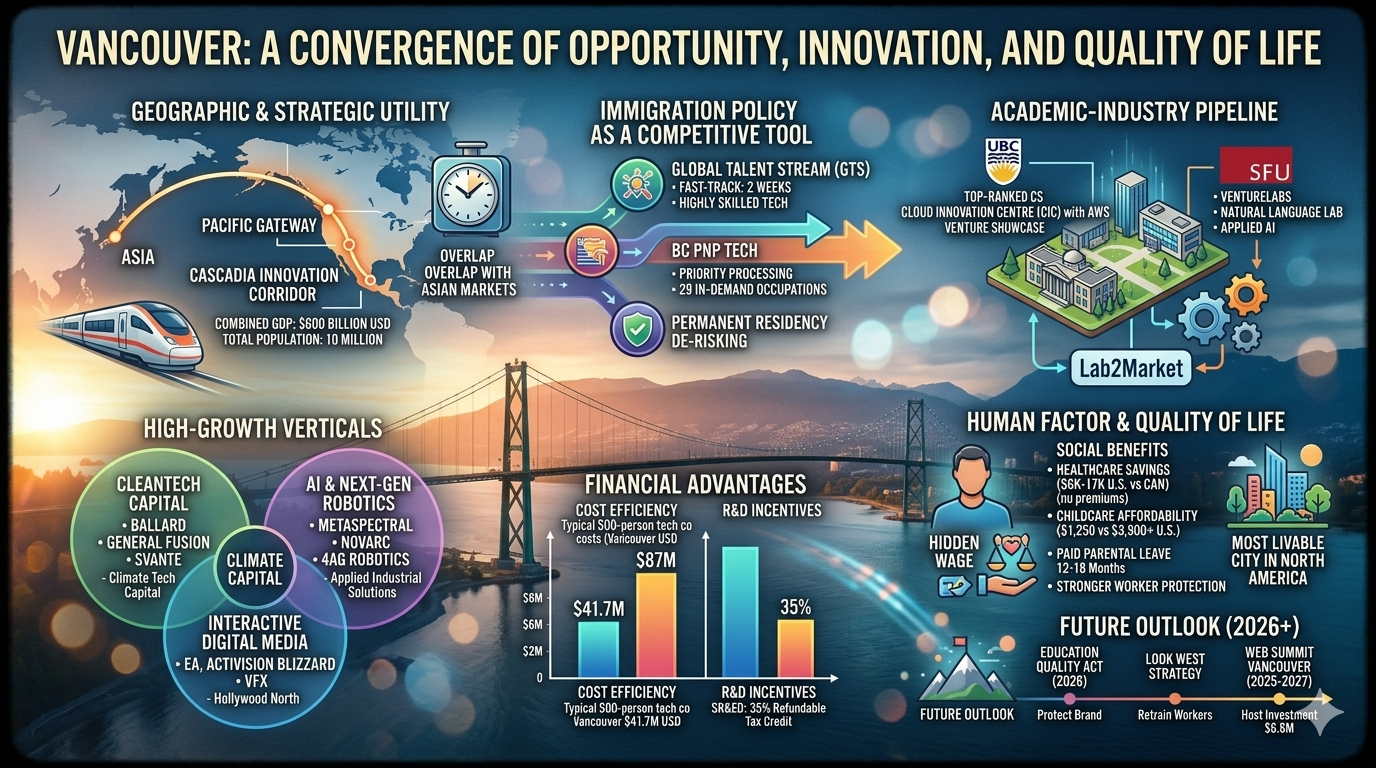
As the city moves through 2026, the provincial and federal governments are pivoting to address the dual challenges of international student protection and workforce resilience.
Protecting the Education Brand
On February 19, 2026, the B.C. government introduced the Post-Secondary International Education (Designated Institutions) Act. This legislation codifies the Education Quality Assurance (EQA) program into law, providing the government with tools to inspect and hold "bad actors" accountable in the international education sector. This move is designed to protect the legal status and educational experience of international students, ensuring that Vancouver remains a "world-class education destination" and that the talent pipeline is not compromised by unscrupulous institutions.
The "Look West" Strategy and Workforce Adaptation
The B.C. government’s "Look West" economic strategy is a multi-year plan to strengthen the workforce through credential recognition and targeted training streams. This strategy includes a $70.4 million partnership with the federal government to retrain workers impacted by global market shifts and tariffs, ensuring that the labor force remains adaptable to new opportunities in emerging sectors.
Future Strategic Initiative | Target / Funding | Expected Outcome |
Education Quality Act (2026) | Legislative Oversight | Eliminate predatory student recruitment |
Look West Strategy | Streamlined Credential Recognition | Facilitate easier labor mobility for skilled professionals |
Web Summit Vancouver | $6.6M Host Investment | 3-year global spotlight (2025-2027) on the ecosystem |
Tech Space Expansion | 4,000 Annual New Seats | 33% increase in engineering/applied science grads |
The hosting of Web Summit Vancouver from 2025 to 2027 represents a critical moment for the ecosystem. By bringing thousands of international founders, investors, and talent to the city, the event will serve as a global "demo day" for Vancouver’s innovation strengths. This visibility is expected to catalyze a new wave of foreign direct investment and further solidify the city’s role as a strategic launchpad for global technology firms.
Conclusion: A Resilient Ecosystem of Entrepreneurs
Vancouver’s ability to attract global tech talent is the result of a deliberate and successful synthesis of policy, geography, and institutional strength. The city has positioned itself not just as a lower-cost alternative to the United States, but as a specialized hub for the technologies that will define the next decade—AI, cleantech, and creative media. The integration into the Cascadia Innovation Corridor provides the scale and connectivity of a global mega-region, while Canadian social systems provide a unique quality-of-life proposition that attracts families and long-term residents.
While the housing affordability crisis and retention issues among the most highly skilled immigrants present significant long-term risks, the proactive policy responses of 2025 and 2026 suggest a regional commitment to addressing these structural bottlenecks. For the global tech professional, Vancouver offers a compelling package: a clear path to residency, access to world-class research and industrial clusters, and a standard of living that prioritizes security and well-being. As the ecosystem continues to mature, and with the global spotlight of Web Summit imminent, Vancouver is poised to remain a premier destination for the world’s most ambitious innovators.
Read More -
1. From Idea to MVP: A Step-by-Step Guide for Solo Founder
🔗 https://findnstart.com/blogs/from-idea-to-mvp-a-step-by-step-guide-for-solo-founder
2. How to Validate Your Startup Idea in 48 Hours for $0
🔗 https://findnstart.com/blogs/how-to-validate-your-startup-idea-in-48-hours-for-0
3. Remote vs. Local: Does Your Co-Founder Need to Live in the Same City?
🔗 https://findnstart.com/blogs/remote-vs-local-does-your-co-founder-need-to-live-in-the-same-city
4. The 2026 Startup Landscape: What Has Fundamentally Changed (and Why Founder Skills Matter More Than Ever)
5. The Most In-Demand Skills for Startup Founders in 2026
🔗 https://findnstart.com/blogs/the-most-in-demand-skills-for-startup-founders-in-2026
6. How to Find a Technical Co-Founder (Without a Six-Figure Salary)
🔗 https://findnstart.com/blogs/how-to-find-a-technical-co-founder-without-a-six-figure-salary
7. 5 Red Flags to Look for When Choosing a Startup Partner
🔗 https://findnstart.com/blogs/5-red-flags-to-look-for-when-choosing-a-startup-partner
8. How to Pitch Your Idea to Potential Co-Founders
🔗 https://findnstart.com/blogs/how-to-pitch-your-idea-to-potential-co-founders
9. How to Build a Portfolio that Attracts High-Growth Startup Founders
🔗 https://findnstart.com/blogs/how-to-build-a-portfolio-that-attracts-high-growth-startup-founders
10. Equity vs. Salary: How to Split Ownership with Your First Teammate
🔗 https://findnstart.com/blogs/equity-vs-salary-how-to-split-ownership-with-your-first-teammate
11. Why Joining an Early-Stage Startup is Better Than a Corporate Job
🔗 https://findnstart.com/blogs/why-joining-an-early-stage-startup-is-better-than-a-corporate-job
12. The Future of EdTech: Why Developers and Educators Need to Team Up Now
🔗 https://findnstart.com/blogs/the-future-of-edtech-why-developers-and-educators-need-to-team-up-now
13. The Architecture of Symbiosis: Analytical Perspectives on the Five Habits of Successful Startup Duos
14. Finding a Co-Founder in the AI Space: What Skills Should You Look For?
🔗 https://findnstart.com/blogs/finding-a-co-founder-in-the-ai-space-what-skills-should-you-look-for
15. Overcoming Analysis Paralysis and the Strategic Path to Execution
🔗 https://findnstart.com/blogs/overcoming-analysis-paralysis-and-the-strategic-path-to-execution
16. From College Project to Company: How to Find Your Student Co-Founder
🔗 https://findnstart.com/blogs/from-college-project-to-company-how-to-find-your-student-co-founder
17. How to Start a Startup While Working a Full-Time Job
🔗 https://findnstart.com/blogs/how-to-start-a-startup-while-working-a-full-time-job
18. How to Build a HealthTech Startup Without a Medical Degree
🔗 https://findnstart.com/blogs/how-to-build-a-healthtech-startup-without-a-medical-degree
19. The Solitary Architect: Executive Isolation in Entrepreneurship
20. The 2026 Guide to Launching a SaaS as a Solo Developer
21. What Sustainable Growth Actually Looks Like
🔗 https://findnstart.com/blogs/what-sustainable-growth-actually-looks-like
22. The Early Warning Signs Your Startup Is in Trouble
🔗 https://findnstart.com/blogs/the-early-warning-signs-your-startup-is-in-trouble
23. How to Grow Without Burning Out
🔗 https://findnstart.com/blogs/how-to-grow-without-burning-out
24. The Truth About “Runway” Most Founders Ignore
🔗 https://findnstart.com/blogs/the-truth-about-runway-most-founders-ignore
25. Revenue Solves More Problems Than Funding
🔗 https://findnstart.com/blogs/revenue-solves-more-problems-than-funding
26. What No One Tells You About Being a Solo Founder
🔗 https://findnstart.com/blogs/what-no-one-tells-you-about-being-a-solo-founder
27. Why Smart People Quit High-Paying Jobs to Build Startups (And Why Most Regret It)
28. Why Most Startup Advice on Twitter Is Dangerous
🔗 https://findnstart.com/blogs/why-most-startup-advice-on-twitter-is-dangerous
29. Decision Fatigue: The Silent Startup Killer
🔗 https://findnstart.com/blogs/decision-fatigue-the-silent-startup-killer
30. Fear vs Logic: How Founders Actually Make Decisions
🔗 https://findnstart.com/blogs/fear-vs-logic-how-founders-actually-make-decisions
31. How Overthinking Destroys Early Momentum
🔗 https://findnstart.com/blogs/how-overthinking-destroys-early-momentum
32. Ideas Don’t Scale. Systems Do.
🔗 https://findnstart.com/blogs/ideas-dont-scale-systems-do
33. The First Hire That Actually Matters
🔗 https://findnstart.com/blogs/the-first-hire-that-actually-matters
34. How the First 100 Users Decide Your Startup’s Fate
🔗 https://findnstart.com/blogs/how-the-first-100-users-decide-your-startups-fate
35. Why Your Startup Doesn’t Need Growth — It Needs Focus
🔗 https://findnstart.com/blogs/why-your-startup-doesnt-need-growthit-needs-focus
36. Why Most Startups Die Quietly
🔗 https://findnstart.com/blogs/why-most-startups-die-quietly
37. Lessons Learned Too Late by First-Time Founders
🔗 https://findnstart.com/blogs/lessons-learned-too-late-by-first-time-founders
38. The Myth of the “Overnight Success” Startup
🔗 https://findnstart.com/blogs/the-myth-of-the-overnight-success-startup