Why Every Second Engineer in Bangalore Wants to Build a Startup
March 9, 2026 by Harshit Gupta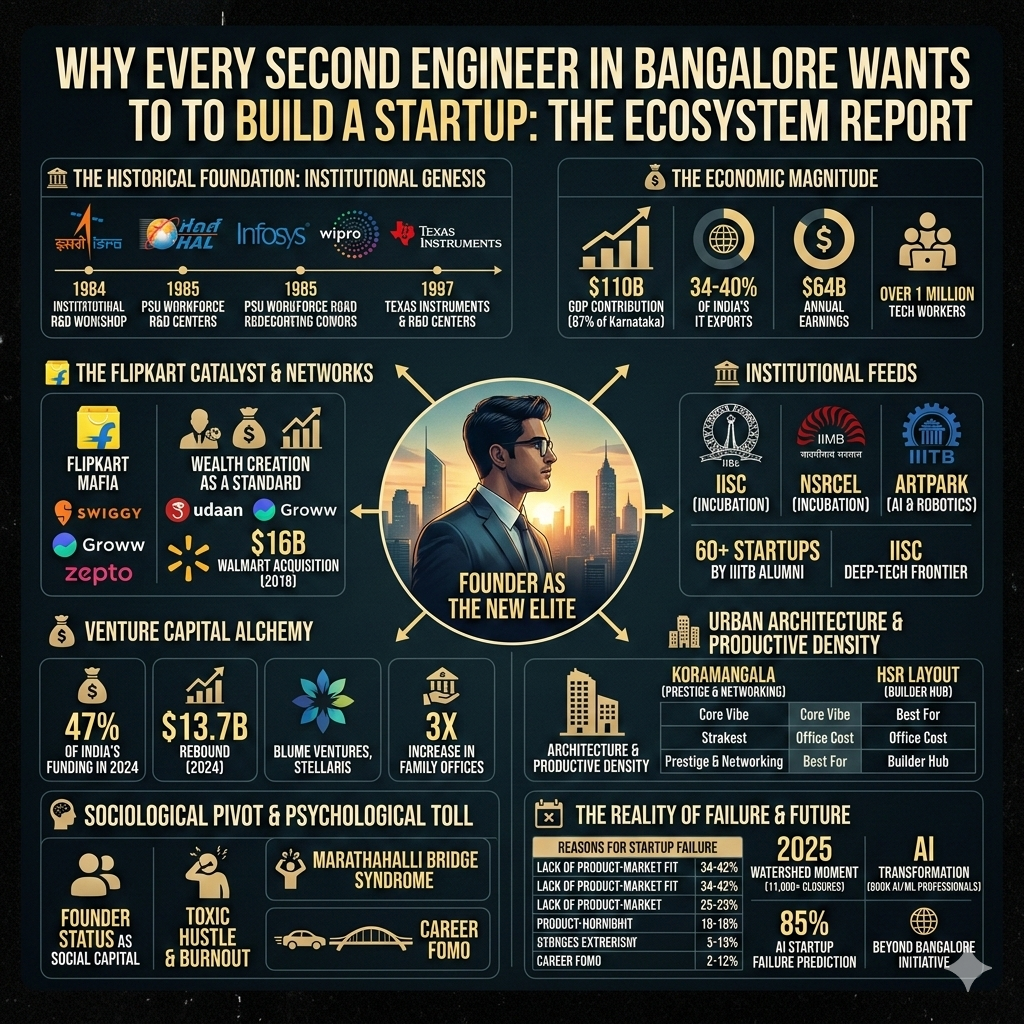
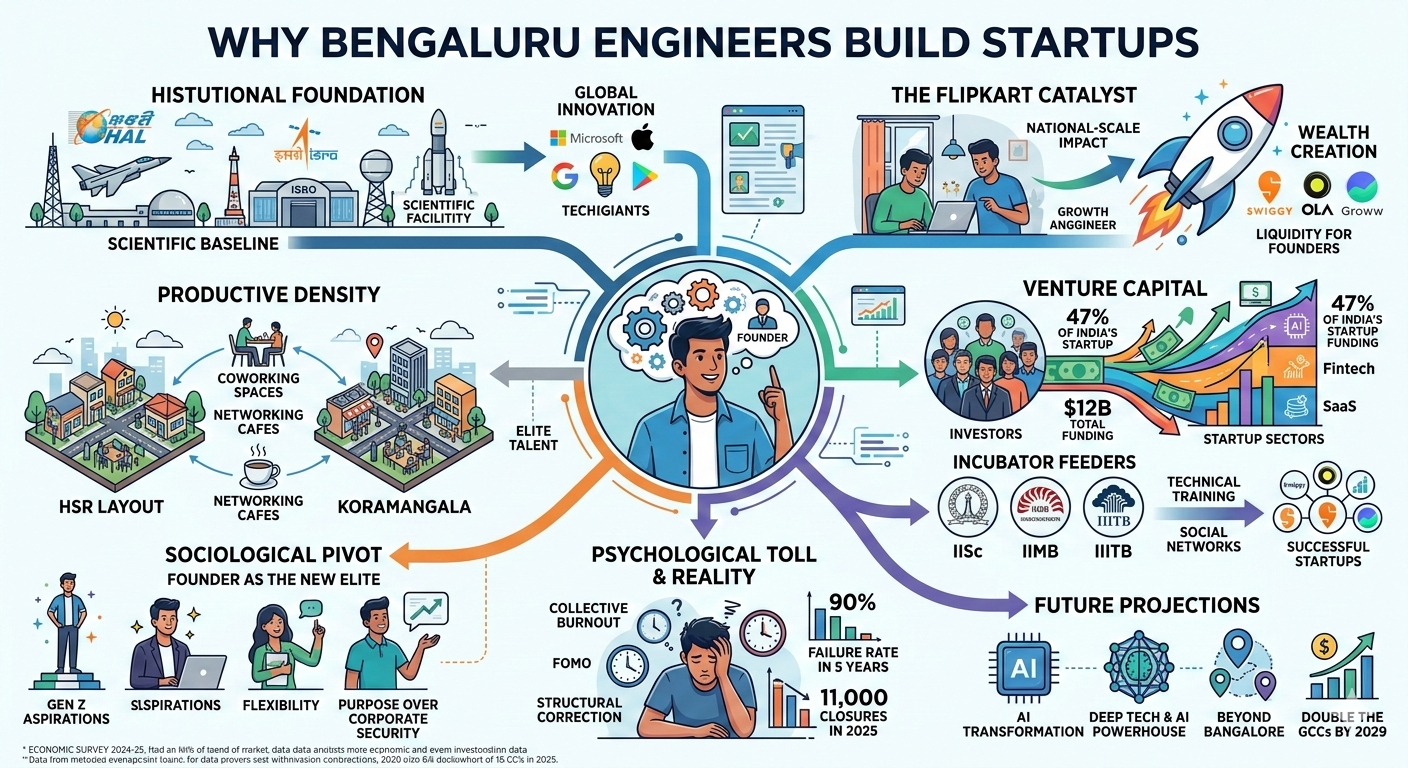
The evolution of Bengaluru—formerly Bangalore—from its origins as a colonial-era military outpost and a subsequent "pensioner’s paradise" into the gravitational center of the global technology landscape represents one of the most profound economic transformations in modern history. Often hailed as the "Silicon Valley of Asia," the city now acts as a primary magnet for innovation, drawing in a population that exceeds 12.5 million residents and fostering an environment where technological skill sets intersect with speculative venture capital. At the heart of this transformation is a specific demographic phenomenon: the pervasive aspiration of the engineering class to abandon corporate security in favor of building startups. This report investigates the multi-dimensional factors driving this ambition, exploring the historical institutional foundations, the cultural pivot triggered by landmark success stories, the unparalleled density of capital and infrastructure, and the sociological stratification that defines the "founder" as the new elite in Indian society.
The assertion that nearly every second engineer in Bangalore harbors entrepreneurial dreams is supported by recent labor market shifts. According to the Economic Survey 2024-25, self-employment among India’s workforce has surged from 52.2% in 2017-18 to 58.4% in 2023-24, a trend most acutely observed in high-density technology hubs like Bangalore. This shift reflects a systemic movement away from the traditional "factory-bell" culture of the legacy IT services era toward a preference for autonomy, flexible work arrangements, and the potential for immense wealth creation. As Bangalore houses approximately 25-30% of India’s deep-tech startups—specifically in Artificial Intelligence (AI), Blockchain, and Robotics—the city has become a crucible for those looking to disrupt global markets from a local base.
The Historical Foundation: Institutional Genesis and the Scientific Baseline
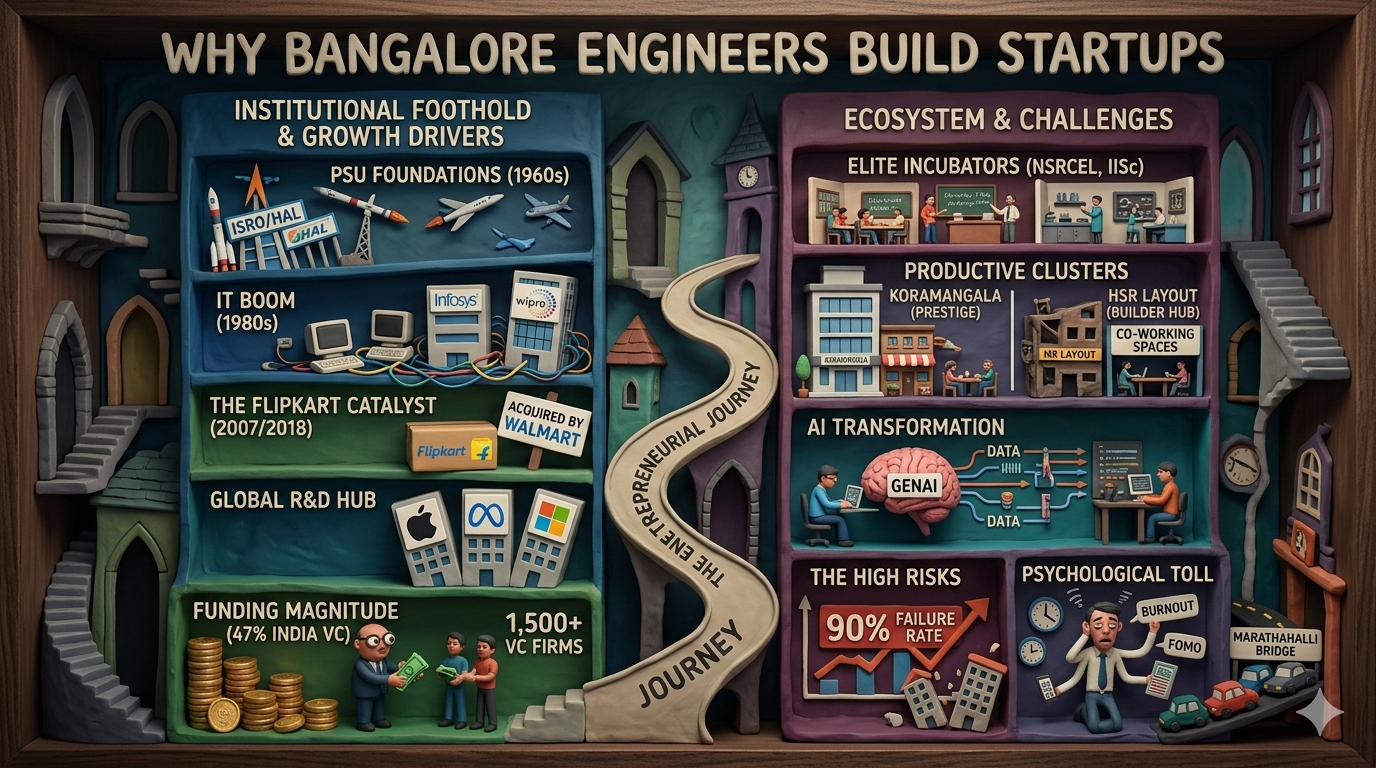
The current entrepreneurial fever in Bangalore did not emerge spontaneously; it is the result of over six decades of strategic public-sector investment and institutional shaping. In the 1960s and 1970s, the Indian government identified Bangalore as a strategic hub for aerospace and defense, headquartering massive public sector undertakings (PSUs) such as the Indian Space Research Organisation (ISRO) and Hindustan Aeronautics Limited (HAL). These organizations were not merely employers; they were centers of rigorous research and development that created a massive baseline of technical talent, researchers, and high-end manufacturing expertise. HAL, which today manufactures advanced fighter aircraft under license, remains one of the largest public sector employers with over 9,500 dedicated staff, contributing to a total PSU workforce of more than 36,000 engineers in the city.
This concentration of scientific talent provided the fertile ground necessary for the IT boom of the 1980s. A pivotal regulatory shift occurred in 1984 when India introduced new computer and software policies that liberalized imports and exports. This single policy adjustment allowed homegrown firms like Infosys and Wipro to begin hiring software engineers at scale to export services. The subsequent entry of Texas Instruments in 1985—the first multinational company to establish a development center in Bangalore—opened the floodgates for global giants. Today, over 400 global corporations, including Apple, Meta, Microsoft, and Amazon, have established sophisticated R&D centers in the city, transitioning Bangalore’s identity from a "back office" for outsourced labor into a primary center for global innovation.
Historical Milestone | Year | Significance | Source |
Foundation of Bangalore | 1537 | Founded by Kempe Gowda as a modest city | |
Incorporation of HAL | 1940s/60s | Established Bangalore as an aerospace hub | |
Incorporation of NAL | 1960 | Focused on civil aviation technologies | |
Liberalized Computer Policy | 1984 | Enabled software export boom | |
Texas Instruments Entry | 1985 | First MNC R&D center in the city | |
STPI Bangalore Centre | Early '90s | Provided tax breaks and infrastructure for tech |
The Economic Magnitude of the Tech Capital
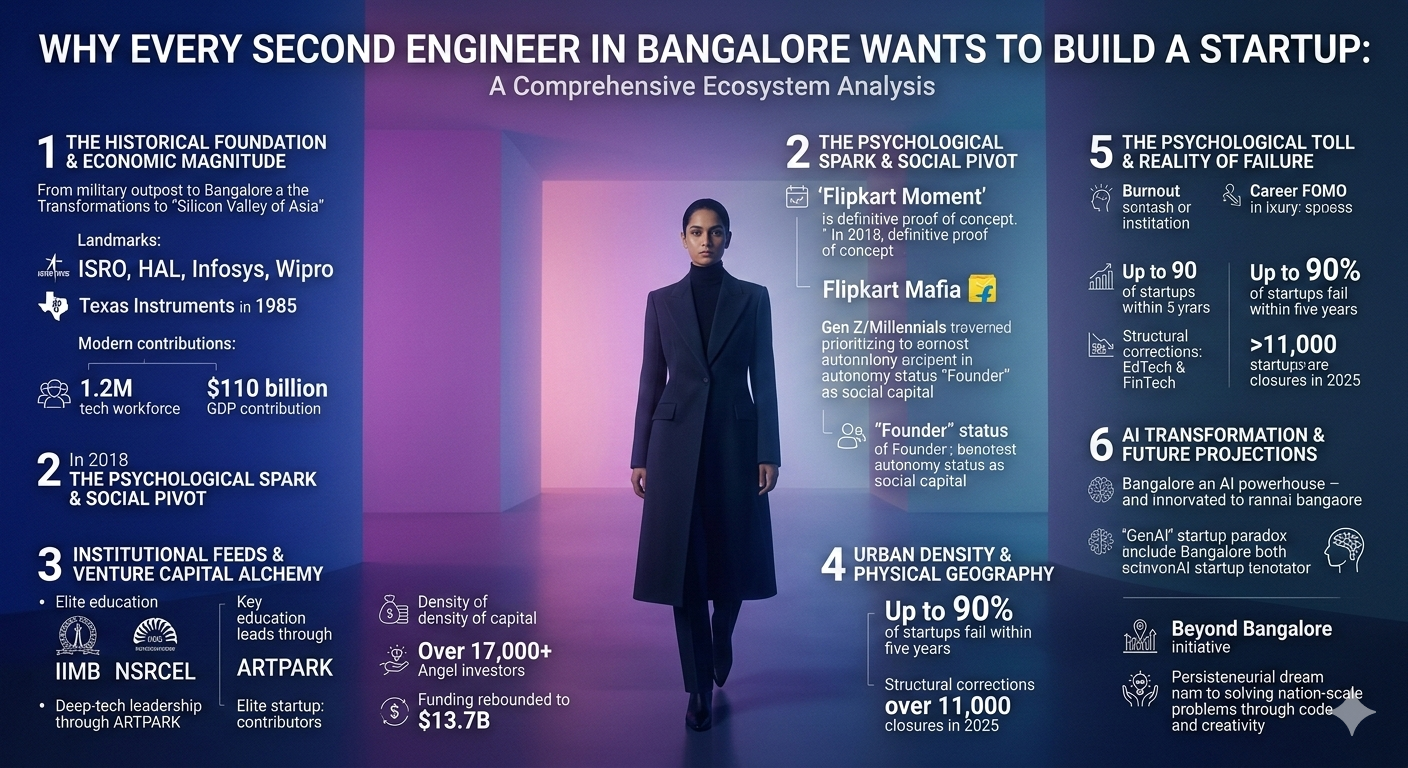
The scale of Bangalore’s dominance in the technology sector is evidenced by its macroeconomic indicators. The city contributes a staggering $110 billion to the GDP, which accounts for over 87% of Karnataka’s total economic output. Furthermore, the city is responsible for 34% to 40% of India’s total IT exports, earning approximately $64 billion annually through software and services. This economic concentration is supported by a tech workforce that has recently surpassed the 1 million milestone, placing Bangalore alongside elite global powerhouses such as San Francisco, Beijing, and London. The city’s demographic profile is also uniquely geared toward productivity, with 75.5% of its residents belonging to the working-age group.
The existence of over 30 Special Economic Zones (SEZs) and numerous software technology parks provides the physical infrastructure necessary for this growth. These zones offer unrestricted power and advanced facilities, making it highly desirable for both local giants and global MNCs to set up bases. For the aspiring engineer, these parks are not just workplaces; they are professional habitats where they gain exposure to world-class engineering standards before launching their own ventures.
The Flipkart Catalyst: Wealth Creation as a Professional Standard
While the scientific and IT booms laid the foundation, the "Flipkart Moment" served as the primary psychological spark for the current startup frenzy. In 2007, two software engineers from IIT Delhi quit their stable positions at Amazon to build an e-commerce platform from a small two-bedroom apartment in Bangalore. Their journey, which involved manually restarting servers in the middle of the night and obsessive attention to customer delivery, created a new engineering culture centered on "full-stack ownership".
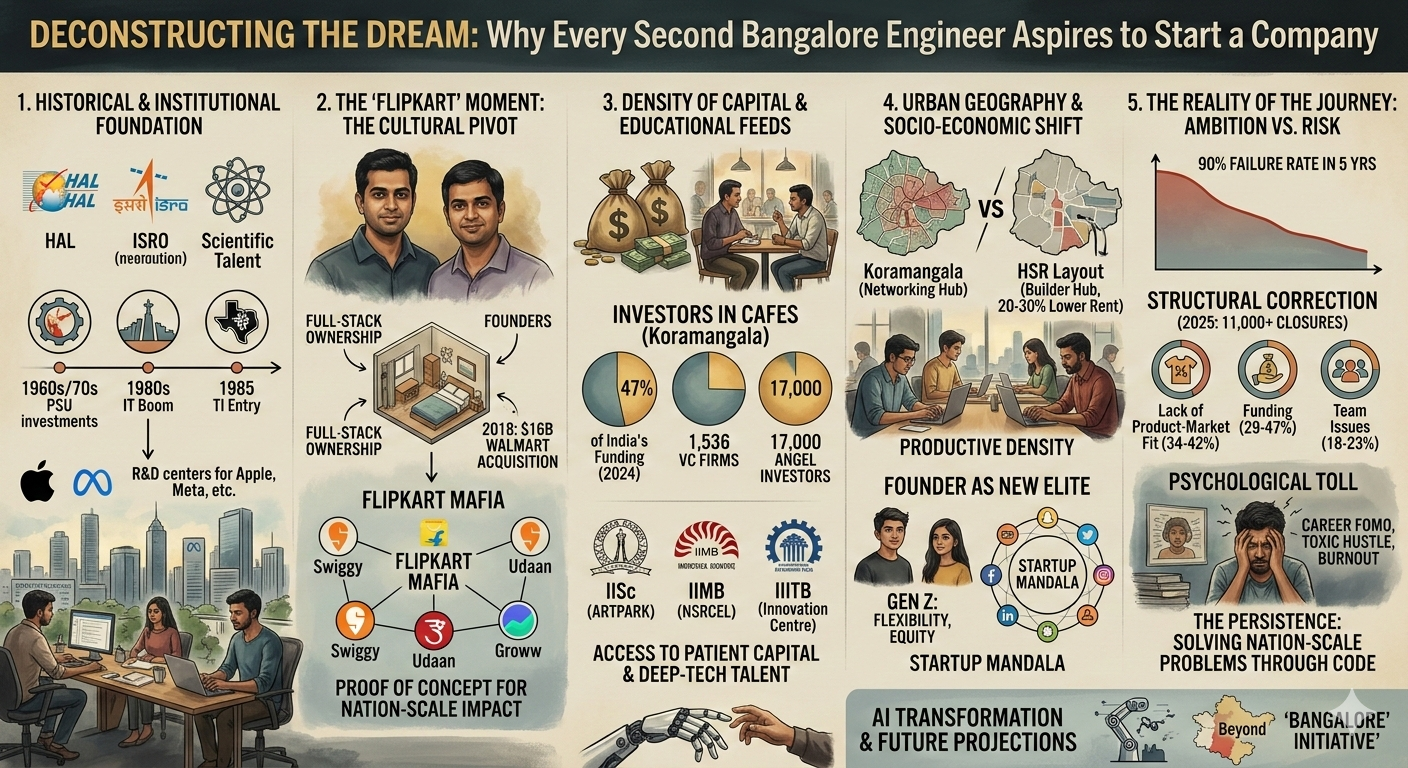
The significance of Flipkart’s $16 billion acquisition by Walmart in 2018 cannot be overstated. It was a definitive proof of concept that an Indian startup could achieve a nation-scale impact and result in massive liquidity for founders and early employees. This event triggered a cultural pivot where engineering graduates began choosing startups over the perceived safety of corporate jobs at Google or Microsoft. The "Flipkart Mafia"—the first generation of engineers who worked in that scrappy apartment—went on to found or lead many of India’s current unicorns, including Swiggy, Udaan, Groww, and Zepto. This network effect has institutionalized entrepreneurship, providing role models who prove that coding can be a path to billionaire status.
Success Stories and the Copy-to-Improve Strategy
The narrative of success in Bangalore has been further bolstered by companies like Ola, Swiggy, and Razorpay. These firms often adopted business models from developed markets—such as Uber for Ola or Amazon for Flipkart—and improved upon them with India-specific innovations. For example, Flipkart’s introduction of Cash on Delivery (CoD) was an industry-defining innovation that addressed the specific lack of prolific credit card usage among Indian consumers. Similarly, Swiggy’s success was driven by its ability to leverage technology to organize the previously unorganized hyperlocal logistics sector, eventually tying up with over 25,000 restaurants.
These precedents have lowered the perceived entry barrier for engineers. The realization that one does not necessarily need a fundamentally unique technology but rather a superior execution of a proven model adapted to local constraints has encouraged thousands to attempt building their own "Indian version" of global successes. This has led to a highly vibrant consumer tech sector, which remains the most profitable segment for venture capital investments in India.
Institutional Feeds: The Role of Elite Education and Incubators
The density of elite educational institutions in Bangalore acts as a primary feeder for its startup ecosystem. The Indian Institute of Science (IISc), the Indian Institute of Management Bangalore (IIMB), and the International Institute of Information Technology Bangalore (IIITB) provide the technical training and the social networks essential for entrepreneurial ventures. Many IIITB alumni, for example, have leveraged the institute’s innovation center to conceptualize and validate ventures, leading to more than 60 startups founded by its graduates since 2000.
NSRCEL and the IIMB Influence
IIM Bangalore’s NSRCEL (NS Raghavan Centre for Entrepreneurial Learning) is a critical node in the city's networking infrastructure. Having operated for a quarter of a century, NSRCEL has transitioned from a university incubator into a sophisticated support system that "buys trust" for founders in a market where credibility is as valuable as cash. The center’s strength lies in its ability to provide "patient capital" and access to corporate partners like Toyota and Maruti, which can be the difference between a stalled prototype and a successful pilot. NSRCEL has been recognized as one of the 12 "top performers" out of 67 incubators in India by NITI Aayog, a testament to its role in professionalizing the entrepreneurial process.
IISc and the Deep-Tech Frontier
While IIMB focuses on business and scaling, IISc has become the engine for Bangalore’s deep-tech leadership. Initiatives like ARTPARK—India’s first AI and robotics hub—are backed by significant state and DST funding to bridge the gap between academic research and market application. There has been a consistent 20–30% annual rise in startups founded by professors from top institutions, suggesting a shift where academic prestige is increasingly linked to entrepreneurial output. Startups like Bellatrix Aerospace and OrbitAID, founded by IISc researchers, are pushing the boundaries of satellite propulsion and in-orbit refueling, attracting engineers who want to solve "hard" scientific problems rather than building consumer apps.
Institution / Program | Focus Area | Impact Metric | Source |
NSRCEL (IIM Bangalore) | General Incubation | $1B total valuation of 55 active companies | |
ARTPARK (IISc) | AI and Robotics | world's second-largest AI talent hub (600k) | |
IIITB Innovation Centre | IT and Product | 60+ startups founded by alumni | |
Axilor Ventures | Early-stage Accelerator | 60% success rate for program graduates | |
ELEVATE (Govt of Karnataka) | Grant-in-aid | Funded over 1,000 startups up to ₹50 lakh |
Venture Capital: The Alchemy of Liquidity
The availability of venture capital is the most tangible reason why every second engineer looks toward entrepreneurship. Bangalore is an absolute magnet for funding, attracting 47% of India’s $12 billion in startup funding in 2024. The city hosts a massive investor community, including 1,536 venture capital firms, 2,256 corporate venture arms, and over 17,000 angel investors. This concentration of capital means that a team of talented engineers with a viable proof of concept is statistically more likely to secure funding in Bangalore than anywhere else in the Asia-Pacific region outside of Beijing and Shanghai.
The 2024 Recovery and Sector Consolidation
After a challenging "funding winter" in 2022-2023, where deal flow dropped by nearly 65%, the venture capital landscape demonstrated remarkable resilience in 2024. Funding rebounded to $13.7 billion, driven by a 45% increase in deal activity. Small- and medium-ticket deals (less than $50 million) led this recovery, comprising nearly 95% of all transactions. This resurgence signaled a shift toward high-quality assets and sustainable business models, with software, SaaS, and generative AI attracting $1.7 billion in funding.
For the Bangalore engineer, this volatility has resulted in a more disciplined ecosystem. Investors have shifted from "growth at all costs" to a "founder-first" philosophy that emphasizes unit economics and path to profitability. Specialized early-stage funds like Blume Ventures and Stellaris Venture Partners have stepped up, with Blume being among the most active seed investors, making 55 investments in 2024 alone. The ecosystem now also benefits from a 3x increase in family office investments since 2019, reflecting a broader domestic confidence in the long-term potential of Bangalore’s startups.

Urban Architecture and Productive Density: HSR vs. Koramangala
The physical geography of Bangalore is designed for innovation. The city has developed distinct startup clusters that provide "productive density"—an urban planning phenomenon where a high concentration of like-minded professionals generates constant opportunities for networking and collaboration.
Koramangala: The Prestigious deal Room
Koramangala remains the historic heart of the startup scene. A Koramangala address on a Certificate of Incorporation signals credibility to venture capitalists and elite talent. The area is known for its "billionaire’s street" (Blocks 3 and 4), where wealth created by the startup economy is concentrated in exclusive housing. Cafes like Third Wave and Starbucks in Koramangala are effectively informal deal rooms where term sheets are often initiated. However, the rising costs of this neighborhood have led to a migration of earlier-stage teams toward newer hubs.
HSR Layout: The Planned Powerhouse
HSR Layout, developed by the Bangalore Development Authority in the 1980s, has emerged as the "builder hub". Known for its planned seven-sector grid layout and wider roads, HSR offers 20-30% lower commercial rents than Koramangala, making it a favorite for bootstrapped and product-focused teams. Sector 7 of HSR, located closest to Koramangala, acts as the primary gateway for tech-savvy professionals seeking an alternative to the city’s more expensive neighborhoods. With 4.8% of the city’s restaurants and numerous parks, HSR provides the lifestyle that young, risk-tolerant engineers crave.
Feature | Koramangala | HSR Layout | Whitefield | Source |
Core Vibe | Prestige & Networking | Building & Growth | Enterprise & GCC | |
Office Cost | High (Starts ₹95/sq. ft) | Moderate (₹60/sq. ft) | Scalable / Managed | |
Commute | Traffic Heavy | Best overall access | Easier for East residents | |
Networking | Established VCs/Scale-ups | Early-stage founders | Socially isolated | |
Best For | Community-driven startups | Growth-stage teams | Enterprise operations |
Coworking as a Scalable Solution
The rise of coworking spaces has democratized access to high-end infrastructure. In early 2023, flexible coworking facilities accounted for 27% of net office space absorption in Bangalore. Modern spaces like BHIVE and WeWork offer startups fully managed, scalable environments that allow them to expand seating without the financial risks of traditional commercial leases. Beyond physical space, these hubs provide a built-in community; 90% of members report feeling more confident in their work, and 75% of startups report increased productivity due to the spontaneous interactions that occur in shared lounges.
The Sociological Pivot: The Founder as the New Elite
The aspiration to start a company is also driven by a profound sociological shift in Indian society. In the traditional economy, job security and corporate title were the primary markers of status. However, in the Bangalore tech ecosystem, the "Founder" title has become a powerful form of social capital.
The Identity of Gen Z and Millennials
Modern professionals in Bangalore are redefining career choices by prioritizing flexibility, purpose, and non-linear trajectories over purely financial rewards. Gen Z, in particular, views startups as "laboratories" for new ways of working, favoring equity-based incentives and "no-designation" models. This demographic is highly risk-tolerant, with 80% prioritizing mentorship and career growth above immediate compensation. The startup role, characterized by broad scope and fast-paced chaos, is seen as more rewarding than the narrow, process-oriented roles found in large corporates.
The "Startup Mandala" and Social Stratification
Despite the ecosystem’s portrayal as a pure meritocracy, a deeper sociological analysis reveals that it is producing new forms of social stratification, often termed the "Startup Mandala". Success is often dependent on belonging to elite networks of IIT/IIM alumni and well-connected angel investors, creating a digital version of the "old boys' club". For an engineer from a Tier-2 city, the structural exclusion from these circuits of influence remains a significant barrier, leading to a "brain drain" as talent migrates to Bangalore to acquire the necessary social capital.
Furthermore, gender disparities remain a stark reality. While women-led startups in India saw an 81% surge in capital inflow in H1 2024, they still received less than 10% of total VC funding. This cultural context often transposes patriarchal norms into the startup sphere, where women founders face a "prove-it-again" bias. This social environment creates a unique pressure where becoming a founder is not just an economic choice but a path to entering a new elite class that is redefining what it means to be a "successful" Indian.
The Psychological Toll: Burnout, Toxic Hustle, and FOMO
The high-stakes nature of the Bangalore startup scene carries a heavy psychological burden that is often obscured by flashy headlines. The city’s workforce is facing what founders have described as a "deep, collective burnout". This is physically manifested in "Marathahalli Bridge Syndrome," where professionals spend more time stuck in traffic than in their homes, and "Calendar Fatigue," where breezy weather is ironically used as a pretext for napping breaks in overbooked schedules.
Career FOMO and the LinkedIn Paradox
The proliferation of professional oversharing on platforms like LinkedIn has supercharged "Career FOMO" (Fear of Missing Out). Seeing curated success stories of "founders at 19" or rapid-fire promotions creates an anxious feeling among engineers that they are falling behind their peers, even when they are technically excelling. This culture breeds "ambition envy" and impostor syndrome, leading to "toxic productivity" where professionals feel they cannot rest without being overtaken by the next wave of innovators.
Toxic Work Culture and Performance Compliance
The "growth-at-all-costs" philosophy has, in some cases, led to abusive work environments. Some founders have been reported to use surveillance software to track employee activity down to the minute, resulting in "performative compliance" rather than genuine productivity. Viral reports have surfaced of engineers suffering panic attacks before entering their offices due to harassment and impossible client demands. One harrowing experience detailed a tech professional joining a startup after decades with US firms, only to suffer a heart attack due to the constant availability requirements and psychological abuse from leadership. These incidents suggest that the prestige of working for a high-growth startup often comes at the cost of physical and mental integrity.
The Reality of Failure: 2025 as a Watershed Moment
While the ambition to build a startup is high, the statistical reality is sobering. Up to 90% of startups fail within their first five years, a rate that has remained consistent despite technological advances. The failure rate is even higher in the technology sector, with 63% of tech startups collapsing within five years.
The Structural Correction of 2025
The year 2025 is emerging as a "watershed moment" of market maturity in India. Over 11,000 startups shuttered in 2025, a 30% increase from the 8,649 closures in 2024. Karnataka alone accounted for 845 closed startups as of November 2025, the highest among all states, contributing 13% to the national total of dissolved ventures. This surge in closures represents a structural correction rather than a collapse, as the market transitions from unchecked growth to sustainable business models.
Reason for Startup Failure | Impact Percentage | Key Context | Source |
Lack of Product-Market Fit | 34% - 42% | Building solutions nobody wants or needs | |
Funding/Running Out of Cash | 29% - 47% | Cash flow stress and poor runway planning | |
Team and Management Issues | 18% - 23% | Founder conflict, poor hiring, burnout | |
Being Outcompeted | 19% | Most likely between years three and five | |
Regulatory and Legal Hurdles | 2% - 19% | Licensing, KYC norms, compliance barriers |
This correction has been particularly acute in sectors like EdTech (60% failure rate) and FinTech (75% failure rate), where post-pandemic demand vanished or regulatory tightening by the RBI made discount-based models unsustainable. For engineers, this has meant that the "flexibility to test multiple models" seen in 2021 has vanished; the quality of surviving startups and founder discipline is now improving significantly.
The AI Transformation and Future Projections
The aspiration of Bangalore engineers is currently pivoting toward Artificial Intelligence (AI). The city has cemented its position as a global AI powerhouse, with its tech workforce leading in AI talent development and hosting over 600,000 AI/ML professionals. Three in four tech workers now depend on AI to hit their performance goals, with common applications including automated coding, research, and data analysis.
The AI Startup Paradox
Despite the enthusiasm, the path for AI startups is fraught with specific challenges. Approximately 85% of AI startups are predicted to fail within their first three years, a rate similar to traditional ventures. The high compute and integration costs of enterprise AI mean that many "GenAI" startups are moonshot projects valued at 33 times their actual revenue, with only a few players currently making money.
Beyond Bangalore and the 2029 Vision
To address the limitations of city infrastructure and the rising cost of living, the state government has launched the "Beyond Bangalore" initiative. The target is to create 10,000 new startups in smaller cities like Kalaburagi, Mangaluru, and Hubballi-Dharwad within the next five years. Concurrently, a draft policy aims to double the number of Global Capability Centres (GCCs) to 1,000 by 2029, potentially creating 350,000 new jobs. These GCCs are increasingly attracting elite engineers who prefer full-time roles over the contract services positions that dominated the city’s previous era.
Conclusion: The Persistence of the Entrepreneurial Dream
The phenomenon of every second engineer in Bangalore wanting to build a startup is the culmination of half a century of institutional development and a massive cultural realignment. Driven by the success of predecessors like Flipkart, the density of world-class incubators like NSRCEL, and an unparalleled concentration of venture capital, the city has created an environment where the perceived reward of entrepreneurship outweighs the significant statistical risks.
However, the ecosystem is entering a new phase of maturity. The 2025 structural correction has highlighted the necessity of sustainable business models and product-market fit over vanity metrics. The psychological toll of burnout and the pressures of achievement culture are increasingly part of the public dialogue, leading to a demand for healthier work environments. As Bangalore transitions into a global hub for Deep Tech and AI, the entrepreneurial drive of its engineers remains the engine of India’s economic transformation. The dream of the "Founder" persists because Bangalore is not just a location; it is an experience that nurtures the ambition to solve nation-scale problems through code, creativity, and calculated risk.

Read More -
1. From Idea to MVP: A Step-by-Step Guide for Solo Founder
🔗 https://findnstart.com/blogs/from-idea-to-mvp-a-step-by-step-guide-for-solo-founder
2. How to Validate Your Startup Idea in 48 Hours for $0
🔗 https://findnstart.com/blogs/how-to-validate-your-startup-idea-in-48-hours-for-0
3. Remote vs. Local: Does Your Co-Founder Need to Live in the Same City?
🔗 https://findnstart.com/blogs/remote-vs-local-does-your-co-founder-need-to-live-in-the-same-city
4. The 2026 Startup Landscape: What Has Fundamentally Changed (and Why Founder Skills Matter More Than Ever)
5. The Most In-Demand Skills for Startup Founders in 2026
🔗 https://findnstart.com/blogs/the-most-in-demand-skills-for-startup-founders-in-2026
6. How to Find a Technical Co-Founder (Without a Six-Figure Salary)
🔗 https://findnstart.com/blogs/how-to-find-a-technical-co-founder-without-a-six-figure-salary
7. 5 Red Flags to Look for When Choosing a Startup Partner
🔗 https://findnstart.com/blogs/5-red-flags-to-look-for-when-choosing-a-startup-partner
8. How to Pitch Your Idea to Potential Co-Founders
🔗 https://findnstart.com/blogs/how-to-pitch-your-idea-to-potential-co-founders
9. How to Build a Portfolio that Attracts High-Growth Startup Founders
🔗 https://findnstart.com/blogs/how-to-build-a-portfolio-that-attracts-high-growth-startup-founders
10. Equity vs. Salary: How to Split Ownership with Your First Teammate
🔗 https://findnstart.com/blogs/equity-vs-salary-how-to-split-ownership-with-your-first-teammate
11. Why Joining an Early-Stage Startup is Better Than a Corporate Job
🔗 https://findnstart.com/blogs/why-joining-an-early-stage-startup-is-better-than-a-corporate-job
12. The Future of EdTech: Why Developers and Educators Need to Team Up Now
🔗 https://findnstart.com/blogs/the-future-of-edtech-why-developers-and-educators-need-to-team-up-now
13. The Architecture of Symbiosis: Analytical Perspectives on the Five Habits of Successful Startup Duos
14. Finding a Co-Founder in the AI Space: What Skills Should You Look For?
🔗 https://findnstart.com/blogs/finding-a-co-founder-in-the-ai-space-what-skills-should-you-look-for
15. Overcoming Analysis Paralysis and the Strategic Path to Execution
🔗 https://findnstart.com/blogs/overcoming-analysis-paralysis-and-the-strategic-path-to-execution
16. From College Project to Company: How to Find Your Student Co-Founder
🔗 https://findnstart.com/blogs/from-college-project-to-company-how-to-find-your-student-co-founder
17. How to Start a Startup While Working a Full-Time Job
🔗 https://findnstart.com/blogs/how-to-start-a-startup-while-working-a-full-time-job
18. How to Build a HealthTech Startup Without a Medical Degree
🔗 https://findnstart.com/blogs/how-to-build-a-healthtech-startup-without-a-medical-degree
19. The Solitary Architect: Executive Isolation in Entrepreneurship
20. The 2026 Guide to Launching a SaaS as a Solo Developer
21. What Sustainable Growth Actually Looks Like
🔗 https://findnstart.com/blogs/what-sustainable-growth-actually-looks-like
22. The Early Warning Signs Your Startup Is in Trouble
🔗 https://findnstart.com/blogs/the-early-warning-signs-your-startup-is-in-trouble
23. How to Grow Without Burning Out
🔗 https://findnstart.com/blogs/how-to-grow-without-burning-out
24. The Truth About “Runway” Most Founders Ignore
🔗 https://findnstart.com/blogs/the-truth-about-runway-most-founders-ignore
25. Revenue Solves More Problems Than Funding
🔗 https://findnstart.com/blogs/revenue-solves-more-problems-than-funding
26. What No One Tells You About Being a Solo Founder
🔗 https://findnstart.com/blogs/what-no-one-tells-you-about-being-a-solo-founder
27. Why Smart People Quit High-Paying Jobs to Build Startups (And Why Most Regret It)
28. Why Most Startup Advice on Twitter Is Dangerous
🔗 https://findnstart.com/blogs/why-most-startup-advice-on-twitter-is-dangerous
29. Decision Fatigue: The Silent Startup Killer
🔗 https://findnstart.com/blogs/decision-fatigue-the-silent-startup-killer
30. Fear vs Logic: How Founders Actually Make Decisions
🔗 https://findnstart.com/blogs/fear-vs-logic-how-founders-actually-make-decisions
31. How Overthinking Destroys Early Momentum
🔗 https://findnstart.com/blogs/how-overthinking-destroys-early-momentum
32. Ideas Don’t Scale. Systems Do.
🔗 https://findnstart.com/blogs/ideas-dont-scale-systems-do
33. The First Hire That Actually Matters
🔗 https://findnstart.com/blogs/the-first-hire-that-actually-matters
34. How the First 100 Users Decide Your Startup’s Fate
🔗 https://findnstart.com/blogs/how-the-first-100-users-decide-your-startups-fate
35. Why Your Startup Doesn’t Need Growth — It Needs Focus
🔗 https://findnstart.com/blogs/why-your-startup-doesnt-need-growthit-needs-focus
36. Why Most Startups Die Quietly
🔗 https://findnstart.com/blogs/why-most-startups-die-quietly
37. Lessons Learned Too Late by First-Time Founders
🔗 https://findnstart.com/blogs/lessons-learned-too-late-by-first-time-founders
38. The Myth of the “Overnight Success” Startup
🔗 https://findnstart.com/blogs/the-myth-of-the-overnight-success-startup