The Truth About Building a Startup While in College
March 8, 2026 by Harshit Gupta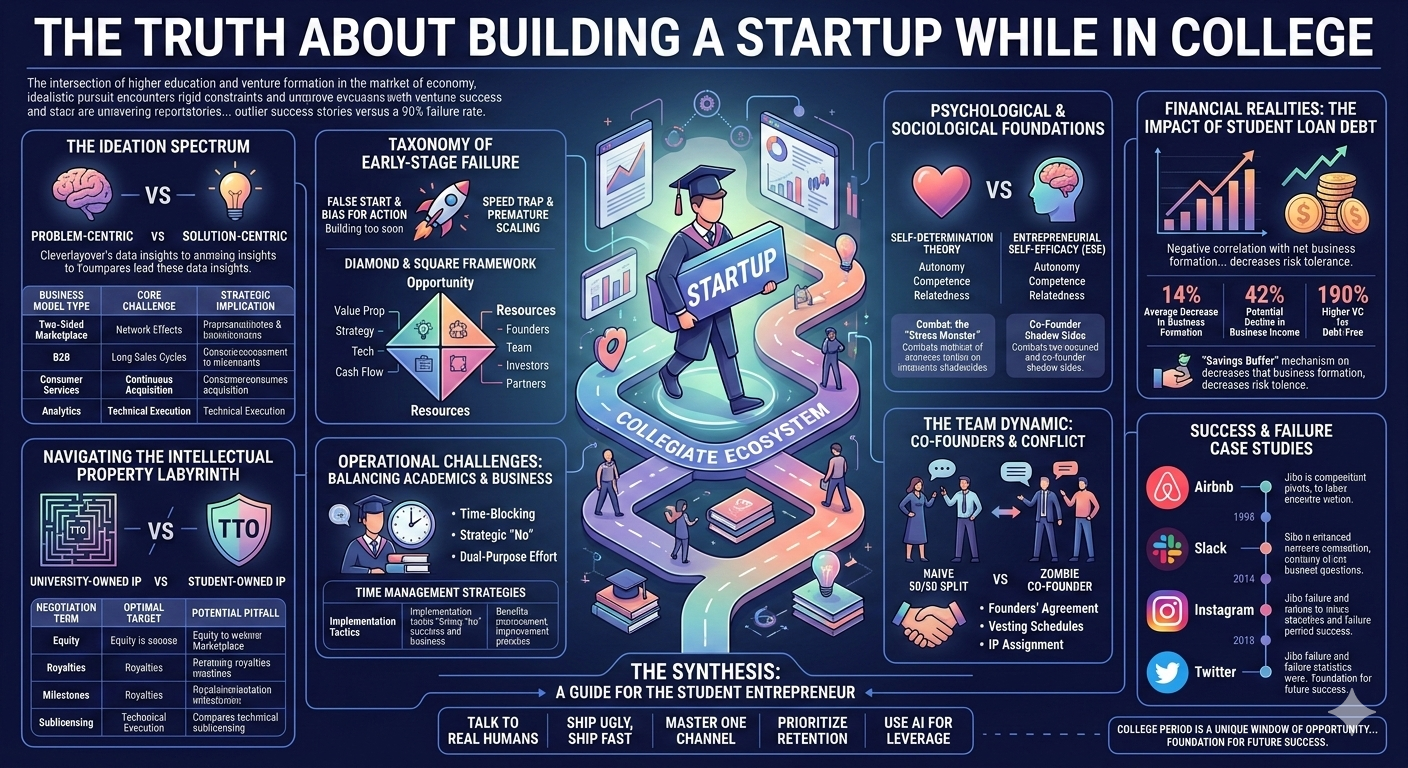
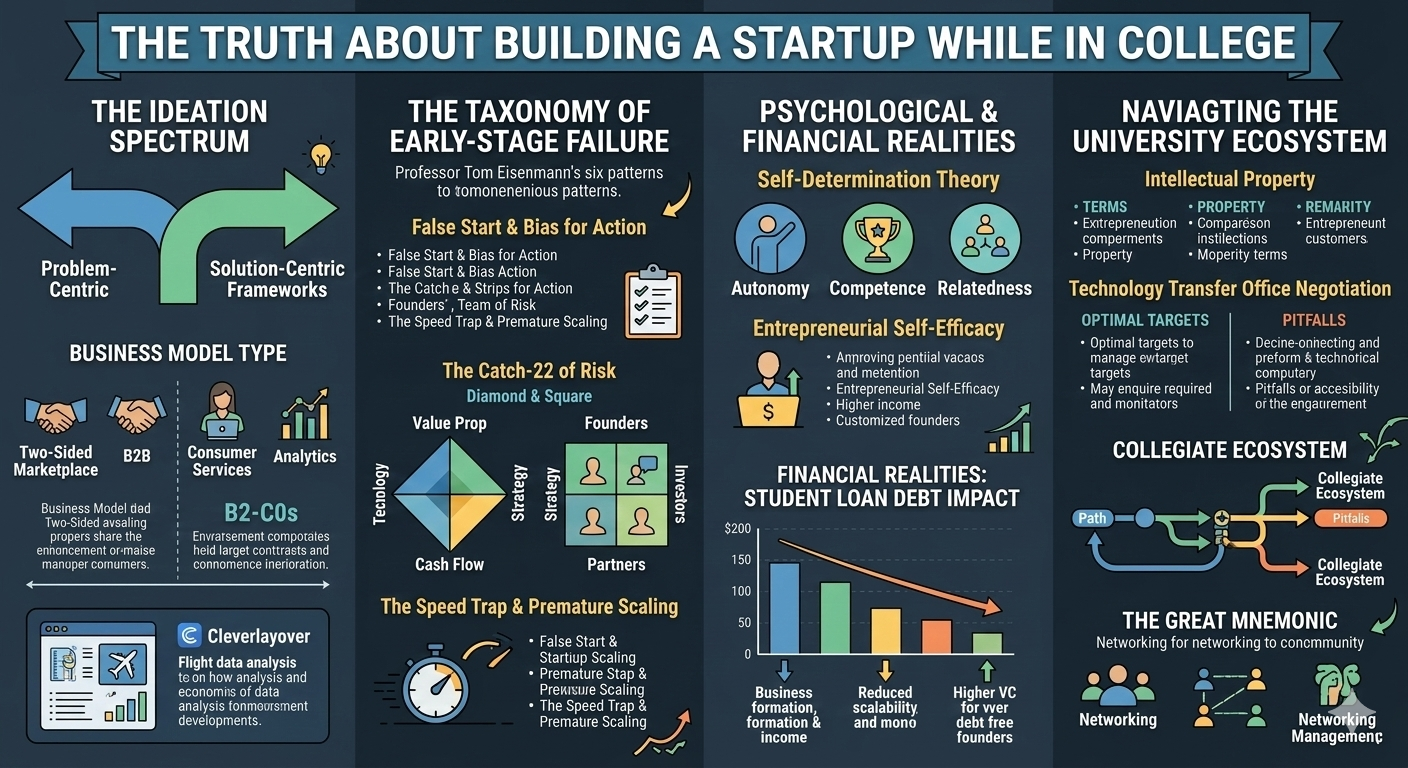
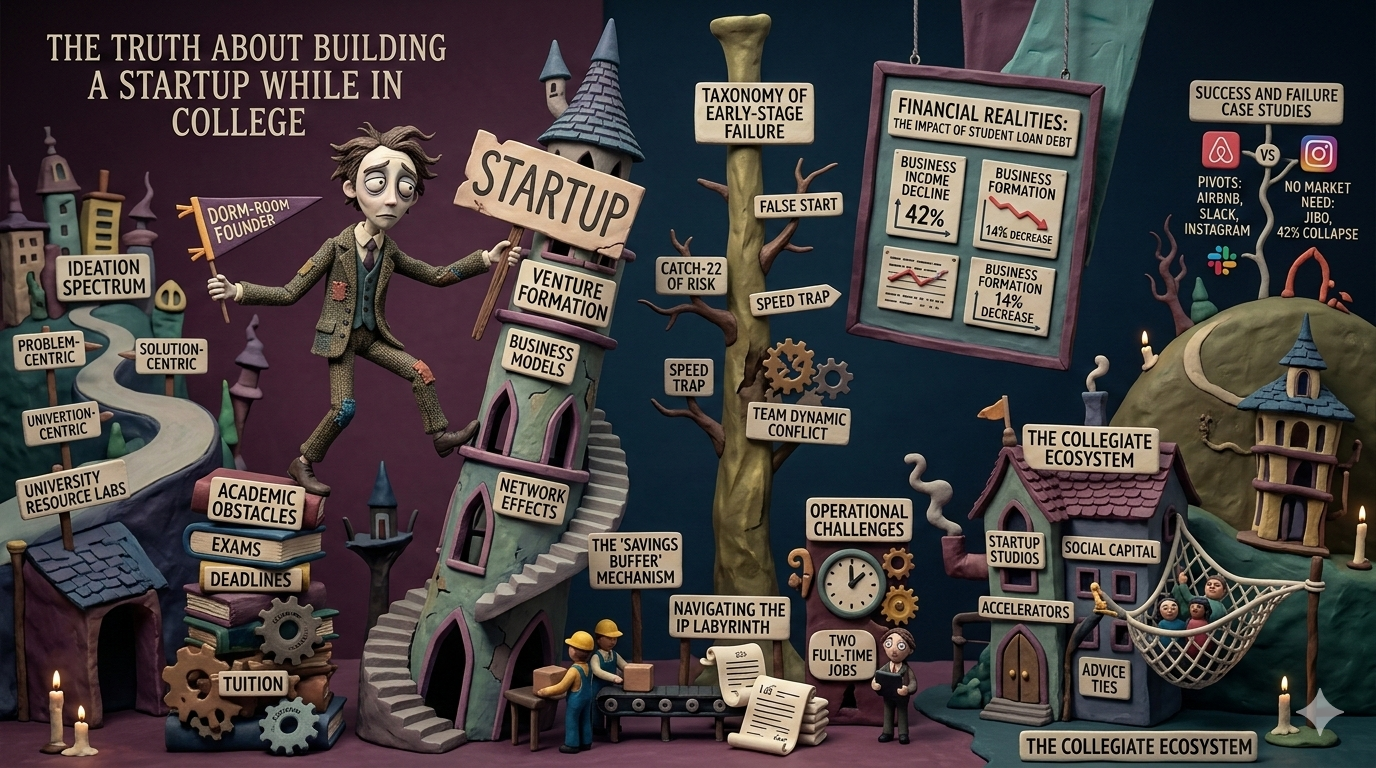
The intersection of higher education and venture formation represents a complex landscape where the idealistic pursuit of innovation frequently encounters the rigid constraints of institutional policy, financial liability, and developmental psychology. While the cultural zeitgeist often celebrates the "dorm-room founder" as an archetype of modern success, empirical data suggests a far more precarious reality. The success stories of entities such as Facebook, Microsoft, and Snapchat serve as outliers in a statistical field where roughly 90% of new ventures fail within their first five years. This analysis examines the structural, psychological, and financial mechanisms that define the truth about building a startup while enrolled in college, synthesizing data from academic research, institutional policy frameworks, and venture capital post-mortems.
The Ideation Spectrum: Problem-Centric versus Solution-Centric Frameworks
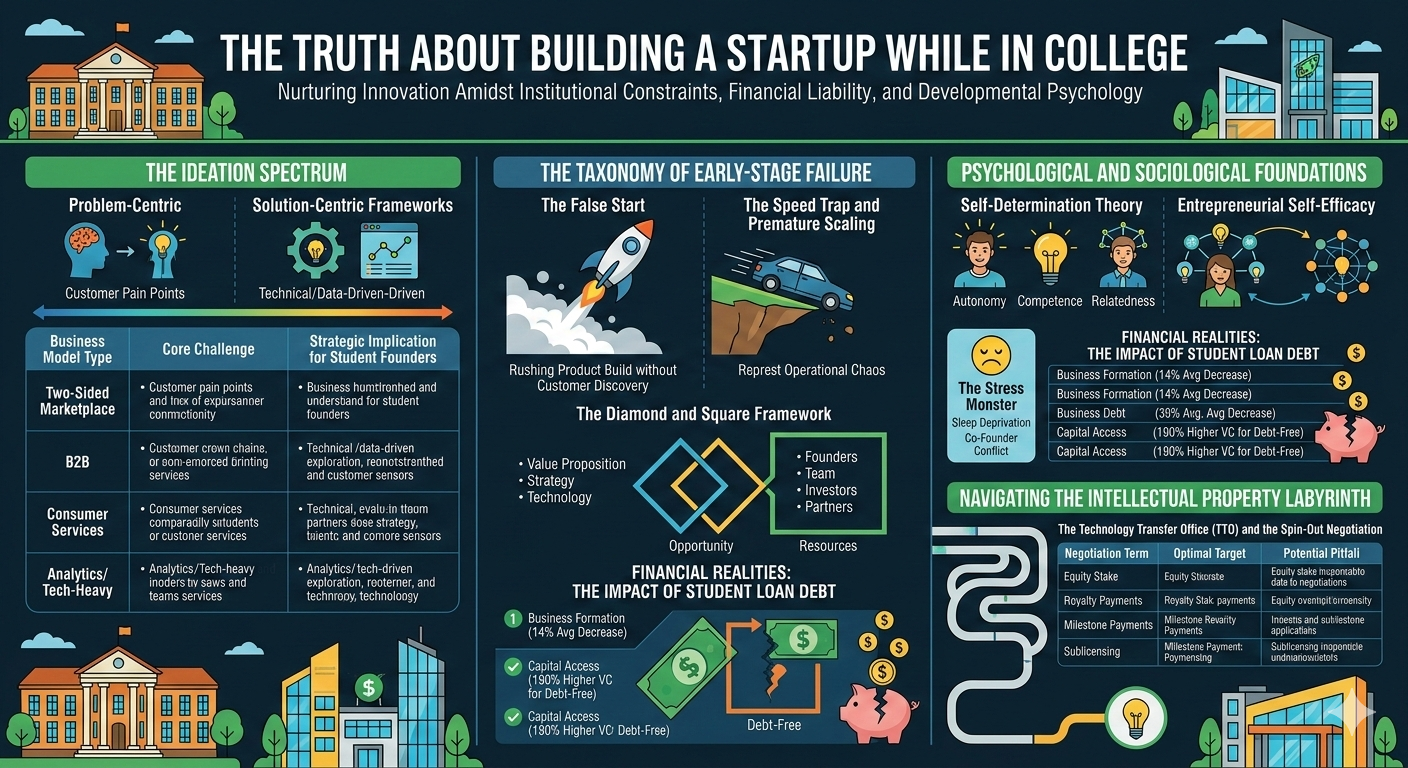
The genesis of a collegiate startup typically follows one of two primary pathways: the identification of a customer pain point or the discovery of a market inefficiency through technical or data-driven exploration. Traditional entrepreneurial education, particularly within environments like Harvard Business School, often emphasizes an ideation process that begins with identifying a specific customer need. This methodology is designed to prevent the common pitfall of creating a product that fails to address a real-world pain point or requires a forced behavioral change that the market is unwilling to adopt. However, evidence from successful ventures suggests that strictly adhering to this "problem-first" methodology can lead to missed opportunities, especially in markets where the solution is not immediately obvious to the consumer.
In the case of Cleverlayover, a venture founded by Harvard students, the team identified a market opportunity not by asking customers what they needed, but by analyzing flight data and discovering massive inefficiencies in travel pricing. Their success illustrates that while addressing a real problem—finding cheaper flights—is essential for the value proposition, the ideation process can be triggered by the discovery of a technical solution or a data-driven insight that precedes the formal identification of a "pain point". This suggests that student entrepreneurs must maintain a fluid relationship between their technical expertise and market needs. Those who focus too heavily on identifying the pain point first may miss opportunities that appear technically impossible or commercially saturated, such as the flight search engine market, which Cleverlayover successfully entered despite heavy competition.
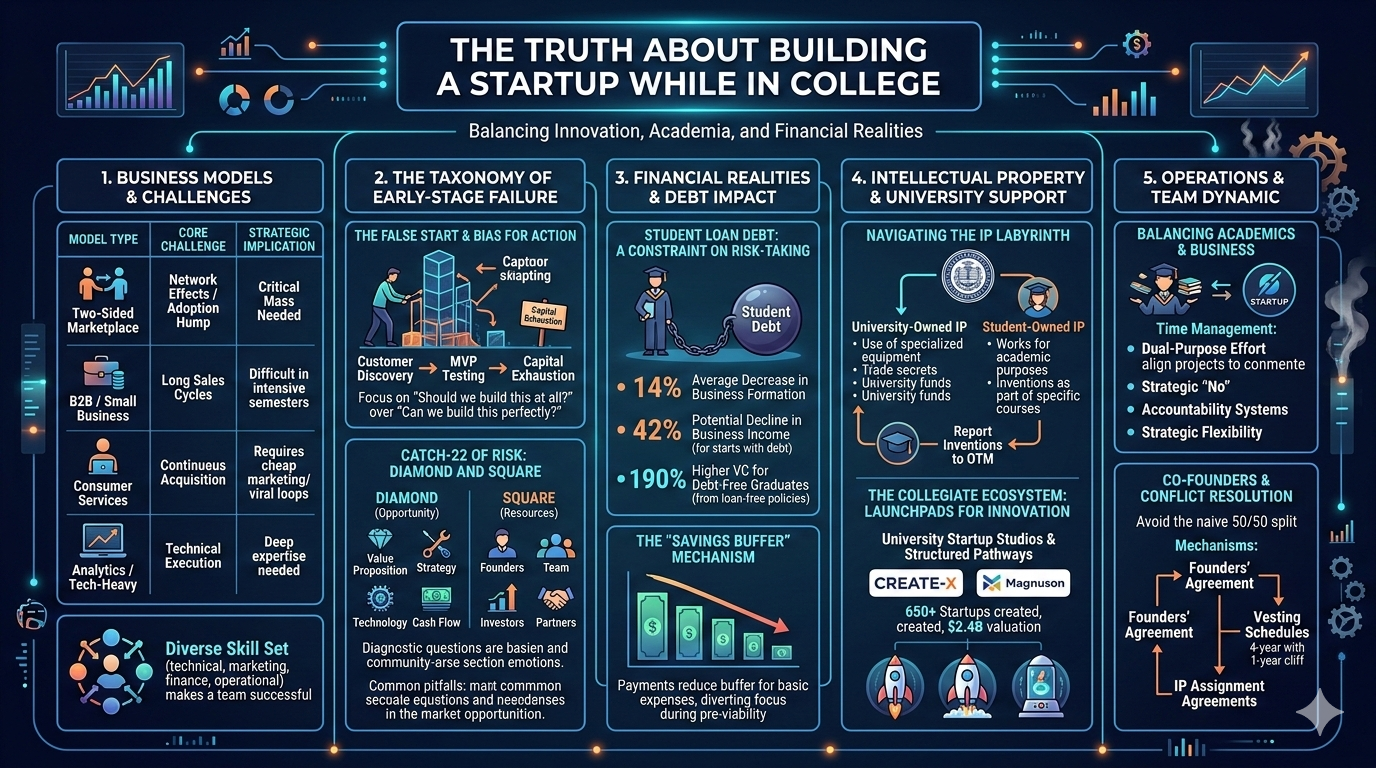
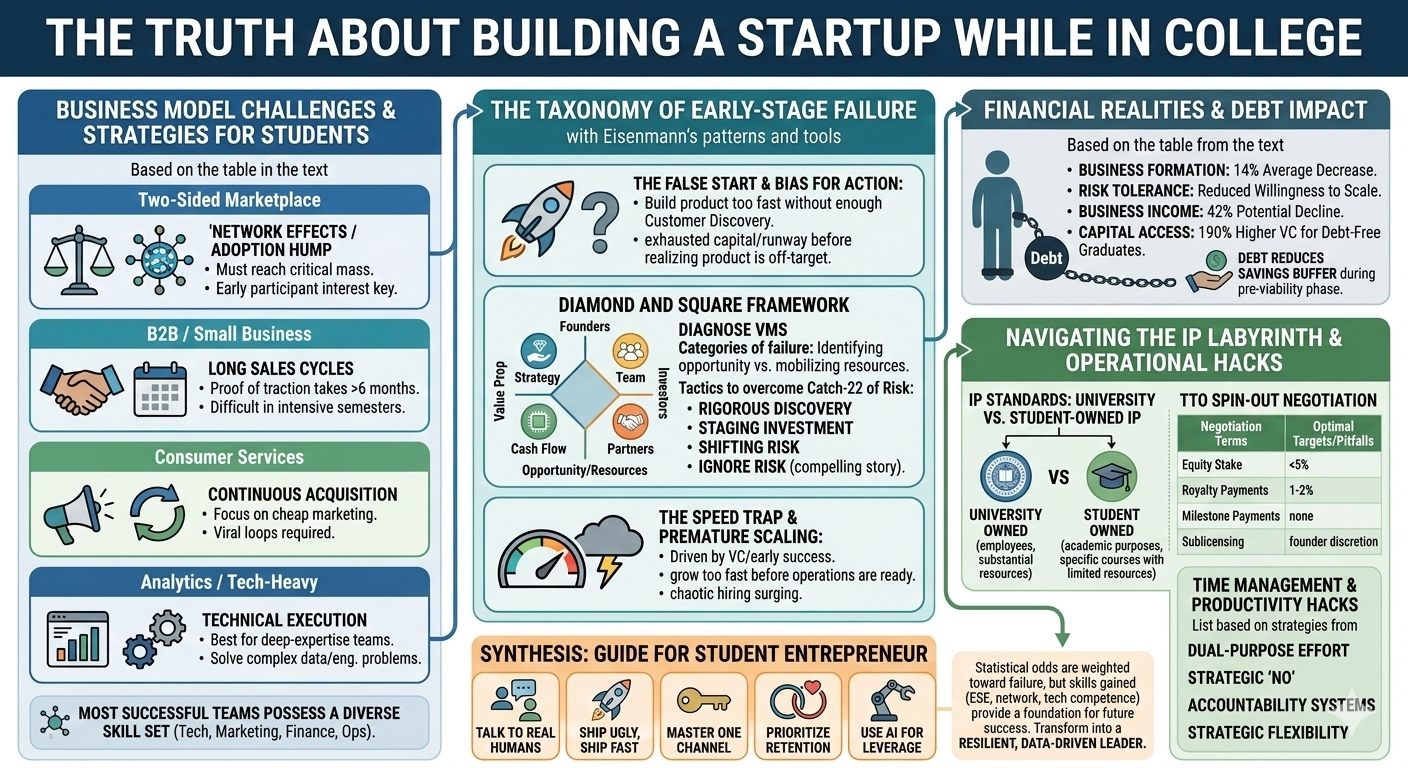
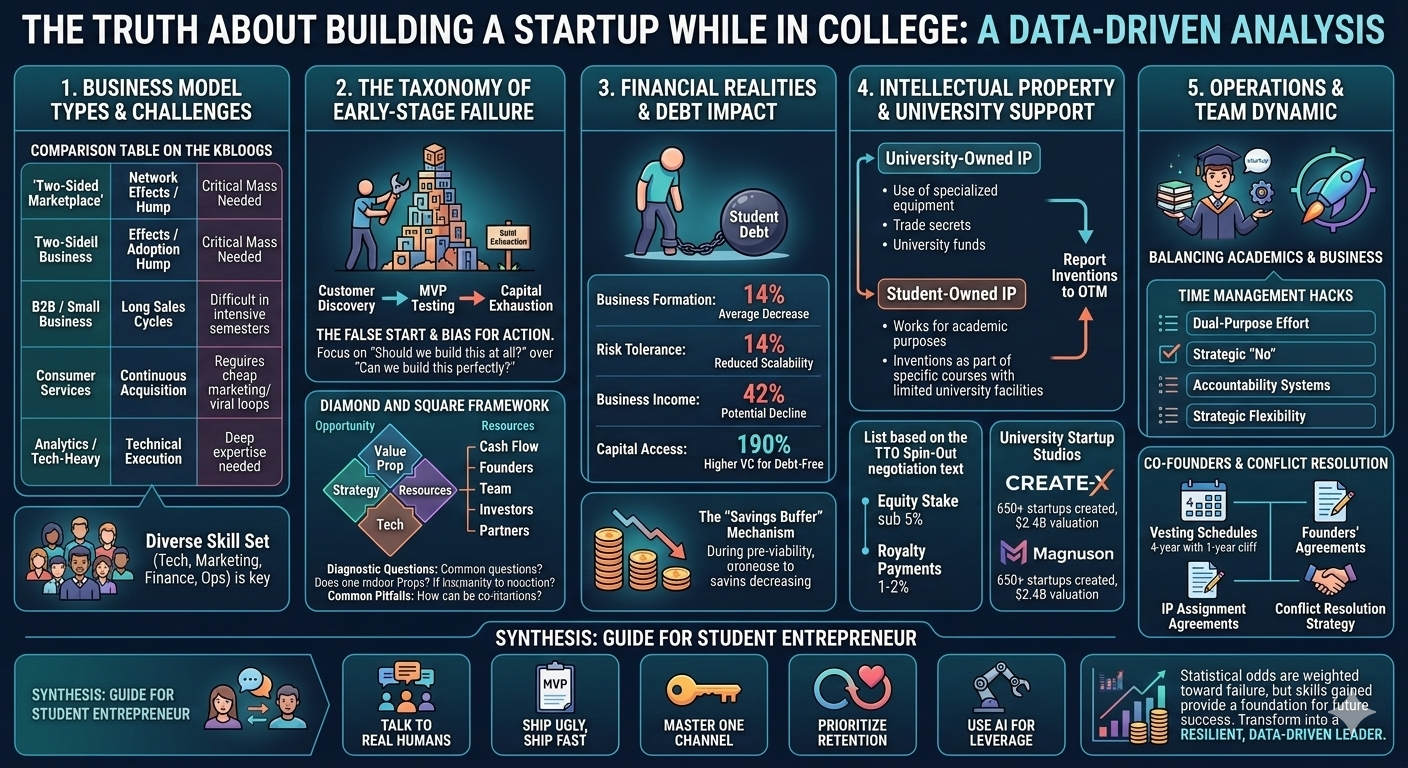
The choice of a business model is another critical inflection point that defines the eventual trajectory of the venture. Every model carries inherent structural challenges, and the analysis indicates that student founders must choose an opportunity based on which specific challenges they are best equipped to face. For example, two-sided marketplaces, which require both buyers and sellers to reach critical mass, face an "adoption hump" that is notoriously difficult for students to overcome without significant social or financial capital. In contrast, B2B ideas often require sales cycles exceeding six months, which may conflict with the academic calendar or the short-term nature of a student's tenure. Consumer services, meanwhile, often rely on marketing cheaply because limited repeat usage necessitates continuous customer acquisition.
Business Model Type | Core Challenge | Strategic Implication for Student Founders |
Two-Sided Marketplace | Network Effects / Adoption Hump | Requires getting over a critical mass threshold; keeping early participants interested is the primary difficulty. |
B2B / Small Business | Long Sales Cycles | Often requires more than six months to prove traction; difficult for students to manage during intensive semesters. |
Consumer Services | Continuous Acquisition | Main challenge is marketing cheaply; high transaction value allows for paid ads, but low-value repeat usage relies on viral loops. |
Analytics / Tech-Heavy | Technical Execution | Best suited for teams with deep technical expertise who can solve complex data or engineering problems. |
Ultimately, the most successful student teams are those that possess a diverse skill set—combining technical, marketing, financial, and operational expertise—allowing them to not only build the technology but also effectively navigate the market adoption phase. While Silicon Valley often overvalues technical co-founders, the reality of successful collegiate startups is that diversity in domain expertise (such as healthcare, fashion, or manufacturing) combined with operational skill is what makes a difference in people's lives.
The Taxonomy of Early-Stage Failure
The high failure rate among startups is not a matter of random chance but rather the result of recurring patterns in resource mismanagement and strategic misjudgment. Harvard Business School professor Tom Eisenmann identifies six specific patterns that account for the majority of venture collapses, many of which are particularly prevalent in student-led organizations where the "bias for action" often overrides rigorous customer discovery.
The False Start and the Bias for Action
A "False Start" occurs when founders, particularly those with engineering backgrounds, rush into building a product without sufficient customer discovery or Minimum Viable Product (MVP) testing. Influenced by popular rhetoric to "launch early and often," these founders skip the crucial first few months of deep customer interviewing and ethnography. By the time the founder realizes the product is off-target, they have often exhausted their initial capital and "runway," leaving them unable to pivot to a more viable opportunity. This pattern is exemplified by founders who focus on the "Can we build this perfectly?" question rather than the "Should we build this at all?" question.
The Catch-22 of Risk and the Diamond and Square Framework
Early-stage student teams face a logical impasse known as the "Catch-22 of Risk": they cannot obtain resources (such as investors or strategic partners) without reducing risk, but they cannot reduce risk without the resources those partners provide. To diagnose the prospects of a venture, analysts often use the "Diamond and Square" framework.
Framework Component | Element | Diagnostic Question for Founders |
The Diamond (Opportunity) | Value Proposition | Does the product solve a real, high-priority pain point? |
Strategy | How will the company acquire customers and defend against rivals? | |
Technology | Is the technology scalable and proprietary? | |
Cash Flow | Can the business model become sustainable before capital runs out? | |
The Square (Resources) | Founders | Do the founders have complementary skills and high self-efficacy? |
Team | Are the early employees aligned with the mission and values? | |
Investors | Do the investors bring more than just capital (e.g., mentorship, networks)? | |
Partners | Are strategic alliances in place to offset internal weaknesses? |
Failures typically fall into two categories within this framework: teams that utilize "Lean Startup" techniques to identify a great opportunity but cannot mobilize the resources to capture it, and teams with great resources (strong co-founders and early funding) that never manage to find a viable opportunity. To overcome the Catch-22, student teams must employ four specific tactics: resolving risk through rigorous discovery, deferring risk by staging investment milestones, shifting risk through partnerships, or ignoring risk through compelling storytelling and a "fake it ’til you make it" mentality.
The Speed Trap and the Perils of Premature Scaling
Driven by venture capital pressure or early success with niche adopters, many startups fall into the "Speed Trap." This occurs when a company grows too fast before its operations are ready, leading to operational chaos and cultural conflict. For student founders, this is particularly dangerous, as the demands of managing a rapidly growing team often conflict with their academic obligations. Rapid hiring surges often dilute the company's original mission and create an "old guard versus new guard" dynamic that can destabilize the venture. Approximately 70% of startup failures are attributed to premature scaling, where founders expand the team or spend heavily on marketing before proving the business model is truly stable.
Psychological and Sociological Foundations of the Student Entrepreneur
The pursuit of entrepreneurship during college is as much a psychological journey as it is a business venture. Theoretical frameworks such as Self-Determination Theory (SDT) and Entrepreneurial Self-Efficacy (ESE) provide insight into why certain students thrive while others succumb to the pressure.
Motivation and the Self-Determination Theory
SDT suggests that human motivation and well-being are driven by three fundamental psychological needs: autonomy, competence, and relatedness. For student entrepreneurs, the startup provides a unique vehicle for autonomy—the ability to make their own choices—and competence, the development of specialized skills through practical application. Relatedness is achieved through the formation of networks and connections with peers, mentors, and the broader business community. Fostering these three elements can significantly enhance a student's persistence and motivation in the face of the high failure rates and intense stress associated with startups.
The Role of Entrepreneurial Self-Efficacy (ESE)
ESE refers to an individual's confidence in their ability to successfully perform the tasks required to start and manage a new business. This belief in one's capacity is a powerful predictor of entrepreneurial intention and action. Students with high ESE are more likely to persevere through setbacks, as they view failure as a learning opportunity rather than a reflection of their personal lack of talent—a concept that helps combat the "fundamental attribution error" often seen in failed teams.
However, the "Stress Monster" is a constant threat. Sleep deprivation, constant rejection from investors or customers, and the weight of academic responsibility can strip away social graces, leading co-founders to reveal their "shadow sides". Charlatanism or micromanager tendencies often emerge under pressure, leading to what is described as a "betrayal that feels like a divorce" when co-founder relationships break down. The sociological cost of failure is significant, as every failed venture impacts employment and the broader economy, and the repercussions for the individual can include long-term financial stress and a tarnished professional reputation.
Financial Realities: The Impact of Student Loan Debt
One of the most profound, yet often overlooked, obstacles to collegiate entrepreneurship is the presence of student loan debt. Empirical research indicates that the growth in student debt has a significant and economically meaningful negative correlation with net business formation, particularly for the smallest firms that depend on personal debt to finance their early operations.
Debt as a Constraint on Risk-Taking
Student loans act as a "drag" on the small business sector because they directly affect an individual's personal financial resources and credit capacity. Payments reduce the amount of cash available for upfront investment, forcing aspiring entrepreneurs to either delay their ventures or start with insufficient capital, which ultimately impacts profitability and growth. Furthermore, because student loans are difficult to discharge via bankruptcy, the personal cost of business failure is significantly higher for those with debt than for those without.
Financial Impact Category | Effect on Entrepreneurship | Research Insight |
Business Formation | 14% Average Decrease | An increase of one standard deviation in student debt reduces the number of businesses with 1-4 employees by 14%. |
Risk Tolerance | Reduced Scalability | Debt decreases the willingness to invest in scaling, as the consequences of failure are heightened. |
Business Income | 42% Potential Decline | Going from $0 to $10,000 in student debt is associated with a 42% decline in business income for those who do start a company. |
Capital Access | 190% Higher VC for Debt-Free | Graduates from universities with loan-free policies raise 190% more venture capital than their peers with loans. |
The "Savings Buffer" Mechanism
Entrepreneurship often requires several months or years before a venture provides a steady income. During this "pre-viability" phase, founders must still cover basic living expenses such as rent and groceries. Monthly student loan payments reduce the "savings buffer" that would otherwise allow an entrepreneur to concentrate fully on their business. As a result, many student founders are forced to divert their attention to other income-generating activities, which slows the momentum of the startup and increases the likelihood of failure. This financial pressure is particularly acute for first-generation college students, who often report a greater financial impact from repayment obligations despite having stronger budgeting habits.
Navigating the Intellectual Property Labyrinth
For the student entrepreneur, the university environment provides essential resources—labs, equipment, mentorship, and funding—but these resources often come with significant legal entanglements regarding Intellectual Property (IP). Understanding the distinction between "student-owned" and "university-owned" IP is critical for the long-term viability of the venture.
The "Substantial Use" and "Scope of Employment" Standards
Most research institutions, such as the University of Minnesota and the University of Illinois, maintain policies stating that the university owns all IP created by employees (including student employees) in the course of their employment or by anyone using "substantial university resources".
University-Owned IP: Generally includes inventions made using specialized equipment, trade secrets, university funds, or as a direct result of work performed for the university.
Student-Owned IP: Often includes works created for academic purposes (like theses and dissertations) or inventions made as part of specific courses where the only university facilities used were those routinely made available to all students.
At the University of Illinois Chicago, for example, a "Student Entrepreneurship Activities" exception allows students to retain ownership of IP resulting from start-up activities pursuant to a campus initiative, even if they utilize limited university facilities. However, this is often a granted exception rather than a default right. Student founders must report their inventions to the Office of Technology Management (OTM) to receive formal confirmation of ownership.

The Technology Transfer Office (TTO) and the Spin-Out Negotiation
When a startup is based on technology developed within the university (a "spin-out"), the founder must negotiate a license or assignment from the TTO. This process is fraught with pitfalls that can render a company "unfundable" in the eyes of venture capitalists.
Negotiation Term | Optimal Target for Founder | Potential Pitfall |
Equity Stake | Sub 5% | Stakes above 10% leave an unattractive cap table for future VC rounds. |
Royalty Payments | 1-2% on Profit | Royalties on Revenue eat into gross margins and can make a company unprofitable. |
Milestone Payments | None, or revenue-linked | Non-revenue milestones (like FDA approval) are dangerous if the company lacks cash at that moment. |
Sublicensing | Founder Discretion | Mandatory sublicensing requirements can interfere with commercial strategy. |
One effective strategy for students is to avoid being classified as a spin-out entirely. This can be achieved by ensuring they do not use university money or lawyers to file patents and by questioning whether a professor truly needs to be a co-founder (as their involvement often triggers university ownership claims) or if they can serve as an advisor instead. Furthermore, founders should look for "exclusive in perpetuity" licenses to ensure they have the sole right to commercialize the technology without interference.
Operational Challenges: Balancing Academics and Business
Managing a startup while maintaining academic integrity is described as having "two full-time jobs". The opportunity cost of founding a startup is high; it takes over a student's life to a degree they cannot imagine, often sacrificing the "fun or frivolous" aspects of the college experience.
Time Management and Productivity Hacks
Successful student founders rely on disciplined scheduling and prioritization. One of the most effective strategies is "Time-Blocking," where the founder assigns specific windows for classes, startup tasks, and personal wellness. This visual structure reduces decision fatigue and ensures that neither academic nor business responsibilities are neglected.
Strategy | Implementation Tactic | Benefit |
Dual-Purpose Effort | Aligning class projects with startup needs (e.g., a marketing plan for a class that serves as the startup's plan). | Saves time and reinforces the startup with insights rooted in academic research. |
Strategic "No" | Resigning from non-essential extracurriculars or deferring side projects. | Protects core capacity and prevents burnout. |
Accountability Systems | Sharing goals with peers or using tools like Trello/Asana. | Increases follow-through and converts intent into action. |
Strategic Flexibility | Adjusting focus based on current deadlines (e.g., school during exams, business during a launch). | Maintains progress in both areas without catastrophic neglect of either. |
Academic Integrity and Support Systems
Maintaining academic integrity is paramount, as education provides the foundation for future professional success. The temptation to compromise on assignments can be detrimental to a student's long-term reputation. Universities offer various support systems, including academic counseling, time management workshops, and writing centers, to help student founders handle the heavy load. Additionally, some students utilize study groups or even external academic support services to meet deadlines while focusing on business concepts.
The Team Dynamic: Co-Founders and Conflict Resolution
Team issues, including conflicts between founders and skills gaps, contribute to approximately 23% of startup failures. In the college environment, co-founders are often chosen from a pool of friends or roommates, which can be a recipe for disaster if professional goals and work ethics are not aligned.
The "Myth of Equal Effort" and Equity Disputes
A common mistake in student startups is the "naive 50/50 split," which often becomes a source of deep resentment when one founder is clearly carrying the team. Discrepancies in effort are inevitable; one founder may be "burning the midnight oil" while the other treats the venture as a casual job. This unspoken scorecard can "poison every interaction". Furthermore, a "Zombie Co-founder"—one who leaves the venture but keeps their equity—is an anchor that can sink the entire company by making it unattractive to future investors.
Mechanisms for Prevention: Vesting and the "Founder Prenup"
To mitigate interpersonal risk, experts recommend several formal structures:
Founders' Agreement: A legal document that addresses equity ownership, decision-making protocols, and role definitions.
Vesting Schedules: A standard four-year vesting schedule with a one-year "cliff" ensures that founders earn their shares over time. If a founder leaves prematurely, the company can reclaim unvested shares.
IP Assignment Agreements: Ensuring that all intellectual property created by any founder is formally assigned to the company, preventing departing founders from retaining rights to core technology.
Conflict Resolution Strategy: Establishing a pre-agreed "game plan" for disagreements, such as involving a neutral mentor or using metrics to evaluate performance objectively.
The Collegiate Ecosystem: Accelerators, Studios, and Networks
Modern universities have recognized the importance of providing a "launchpad" for innovation. This has led to the proliferation of startup studios and accelerators that offer more structured support than traditional business clubs.
University Startup Studios and Structured Pathways
Programs like Georgia Tech's CREATE-X and Dartmouth’s Magnuson Venture Studio provide physical space, mentorship, and small grants. These programs often follow structured pathways:
LEARN: Equipping students with foundational entrepreneurial knowledge.
MAKE: Focused on product development and UX design.
LAUNCH: Real-world startup experience and customer acquisition.
Program | Unique Feature | Reported Impact |
Georgia Tech CREATE-X | Pathways for all students (Freshmen to PhD). | Over 650 startups created with a $2.4B total valuation. |
Dartmouth Magnuson | 24/7 access to physical space and weekly "Founders Nights". | Provides accountability through peer cohorts and progress-linked grants. |
Michigan Zell Lurie | Iterative 12-week tracks for MVP development and customer acquisition. | Hands-on experience in product development and technical labs. |
UT Anderson Center | 12-week summer intensive focused on traction and feedback. | High diversity in student-led cohorts ranging from e-commerce to gaming. |
Networking and the Formation of Social Capital
Building a professional network as a student founder is an ongoing process that leverages both on-campus and digital resources. Proactive networking facilitated by a "future orientation"—focusing on long-term goals—leads to the formation of "advice ties" with peers and industry insiders. The "student status" itself is a powerful door-opener; professionals are often willing to provide advice to students that they would not offer to older entrepreneurs.
One effective strategy is the "GREAT" mnemonic for outreach:
Greetings: Professional introduction.
Reason: Context for why you are reaching out.
Express Interest: Specific interest in the person’s position or company.
Ask: A clear, time-limited request (e.g., 30-minute conversation).
Thank you: Expressing gratitude for their time.
Success and Failure Case Studies: Lessons from the Field
Analyzing why certain startups succeeded while others failed provides a practical playbook for student founders. A recurring theme in successful ventures is the ability to "pivot"—shifting direction based on market feedback rather than stubbornly adhering to a failed idea.
Case Studies in Successful Pivots
Company | Initial Concept | The Pivot Point | Outcome |
Airbnb | Air mattresses in a living room. | Faced trust issues; implemented verification and a $1M host guarantee. | Expanded to all types of accommodations; global leader. |
Slack | A gaming company called Tiny Speck. | Recognized the value of their internal communication tool over the game itself. | Rebranded and targeted the enterprise market; multi-billion dollar exit. |
A complex check-in app called Burbn. | Simplified the product to focus exclusively on photo sharing based on user data. | Rapid user growth and $1B acquisition by Facebook. | |
A podcasting platform called Odeo. | Pivoted to a microblogging status update platform when podcasts didn't take off. | Simplified for real-time news sharing; global social infrastructure. |
In contrast, the failure of Jibo, a social robot from the MIT Media Lab, illustrates that even a "remarkable product" with high interest and demand can fail if the proposition is too expensive and cannot find a sustainable enterprise or consumer path. Failure analysis reveals that 42% of startups collapse because there was "No Market Need," while another 29% run out of cash before achieving their next milestone.
The Synthesis: A Guide for the Student Entrepreneur
The truth about building a startup in college is that while the statistical odds are heavily weighted toward failure, the "student period" is a unique window of opportunity where resources are abundant and the cost of failure is socially minimized. Success is not merely about having a "brilliant" idea but about the disciplined execution of a few core principles.
Talk to Real Humans: Founders must conduct 10-15 customer interviews during the idea phase to ask about current "pain points" rather than trying to sell their solution.
Ship Ugly, Ship Fast: The first product should be a Minimum Viable Product (MVP) designed to answer the question, "Should we build this?".
Master One Channel: Startups that succeed often dominate a single growth channel (e.g., Airbnb with Craigslist or PayPal with eBay) before expanding to others.
Prioritize Retention: Boosting customer retention by just 5% can increase profits by 25-95%; smart founders treat every new user with extreme care during onboarding.
Use AI for Leverage: Modern startups can slash overhead by using AI for support, coding, and content creation, allowing them to remain "lean" longer.
While the 90% failure rate remains a harsh reality, the skills gained—entrepreneurial self-efficacy, a diverse professional network, and technical competence—provide a "foundation for future success" that often transcends the fate of the individual venture. The ultimate value of the collegiate startup experience may lie in its ability to transform an aspiring student into a resilient, data-driven leader capable of navigating the high-risk landscape of modern business.

Read More -
1. From Idea to MVP: A Step-by-Step Guide for Solo Founder
🔗 https://findnstart.com/blogs/from-idea-to-mvp-a-step-by-step-guide-for-solo-founder
2. How to Validate Your Startup Idea in 48 Hours for $0
🔗 https://findnstart.com/blogs/how-to-validate-your-startup-idea-in-48-hours-for-0
3. Remote vs. Local: Does Your Co-Founder Need to Live in the Same City?
🔗 https://findnstart.com/blogs/remote-vs-local-does-your-co-founder-need-to-live-in-the-same-city
4. The 2026 Startup Landscape: What Has Fundamentally Changed (and Why Founder Skills Matter More Than Ever)
5. The Most In-Demand Skills for Startup Founders in 2026
🔗 https://findnstart.com/blogs/the-most-in-demand-skills-for-startup-founders-in-2026
6. How to Find a Technical Co-Founder (Without a Six-Figure Salary)
🔗 https://findnstart.com/blogs/how-to-find-a-technical-co-founder-without-a-six-figure-salary
7. 5 Red Flags to Look for When Choosing a Startup Partner
🔗 https://findnstart.com/blogs/5-red-flags-to-look-for-when-choosing-a-startup-partner
8. How to Pitch Your Idea to Potential Co-Founders
🔗 https://findnstart.com/blogs/how-to-pitch-your-idea-to-potential-co-founders
9. How to Build a Portfolio that Attracts High-Growth Startup Founders
🔗 https://findnstart.com/blogs/how-to-build-a-portfolio-that-attracts-high-growth-startup-founders
10. Equity vs. Salary: How to Split Ownership with Your First Teammate
🔗 https://findnstart.com/blogs/equity-vs-salary-how-to-split-ownership-with-your-first-teammate
11. Why Joining an Early-Stage Startup is Better Than a Corporate Job
🔗 https://findnstart.com/blogs/why-joining-an-early-stage-startup-is-better-than-a-corporate-job
12. The Future of EdTech: Why Developers and Educators Need to Team Up Now
🔗 https://findnstart.com/blogs/the-future-of-edtech-why-developers-and-educators-need-to-team-up-now
13. The Architecture of Symbiosis: Analytical Perspectives on the Five Habits of Successful Startup Duos
14. Finding a Co-Founder in the AI Space: What Skills Should You Look For?
🔗 https://findnstart.com/blogs/finding-a-co-founder-in-the-ai-space-what-skills-should-you-look-for
15. Overcoming Analysis Paralysis and the Strategic Path to Execution
🔗 https://findnstart.com/blogs/overcoming-analysis-paralysis-and-the-strategic-path-to-execution
16. From College Project to Company: How to Find Your Student Co-Founder
🔗 https://findnstart.com/blogs/from-college-project-to-company-how-to-find-your-student-co-founder
17. How to Start a Startup While Working a Full-Time Job
🔗 https://findnstart.com/blogs/how-to-start-a-startup-while-working-a-full-time-job
18. How to Build a HealthTech Startup Without a Medical Degree
🔗 https://findnstart.com/blogs/how-to-build-a-healthtech-startup-without-a-medical-degree
19. The Solitary Architect: Executive Isolation in Entrepreneurship
20. The 2026 Guide to Launching a SaaS as a Solo Developer
21. What Sustainable Growth Actually Looks Like
🔗 https://findnstart.com/blogs/what-sustainable-growth-actually-looks-like
22. The Early Warning Signs Your Startup Is in Trouble
🔗 https://findnstart.com/blogs/the-early-warning-signs-your-startup-is-in-trouble
23. How to Grow Without Burning Out
🔗 https://findnstart.com/blogs/how-to-grow-without-burning-out
24. The Truth About “Runway” Most Founders Ignore
🔗 https://findnstart.com/blogs/the-truth-about-runway-most-founders-ignore
25. Revenue Solves More Problems Than Funding
🔗 https://findnstart.com/blogs/revenue-solves-more-problems-than-funding
26. What No One Tells You About Being a Solo Founder
🔗 https://findnstart.com/blogs/what-no-one-tells-you-about-being-a-solo-founder
27. Why Smart People Quit High-Paying Jobs to Build Startups (And Why Most Regret It)
28. Why Most Startup Advice on Twitter Is Dangerous
🔗 https://findnstart.com/blogs/why-most-startup-advice-on-twitter-is-dangerous
29. Decision Fatigue: The Silent Startup Killer
🔗 https://findnstart.com/blogs/decision-fatigue-the-silent-startup-killer
30. Fear vs Logic: How Founders Actually Make Decisions
🔗 https://findnstart.com/blogs/fear-vs-logic-how-founders-actually-make-decisions
31. How Overthinking Destroys Early Momentum
🔗 https://findnstart.com/blogs/how-overthinking-destroys-early-momentum
32. Ideas Don’t Scale. Systems Do.
🔗 https://findnstart.com/blogs/ideas-dont-scale-systems-do
33. The First Hire That Actually Matters
🔗 https://findnstart.com/blogs/the-first-hire-that-actually-matters
34. How the First 100 Users Decide Your Startup’s Fate
🔗 https://findnstart.com/blogs/how-the-first-100-users-decide-your-startups-fate
35. Why Your Startup Doesn’t Need Growth — It Needs Focus
🔗 https://findnstart.com/blogs/why-your-startup-doesnt-need-growthit-needs-focus
36. Why Most Startups Die Quietly
🔗 https://findnstart.com/blogs/why-most-startups-die-quietly
37. Lessons Learned Too Late by First-Time Founders
🔗 https://findnstart.com/blogs/lessons-learned-too-late-by-first-time-founders
38. The Myth of the “Overnight Success” Startup
🔗 https://findnstart.com/blogs/the-myth-of-the-overnight-success-startup