The Role of Waterloo in Producing World-Class Founders
March 11, 2026 by Harshit Gupta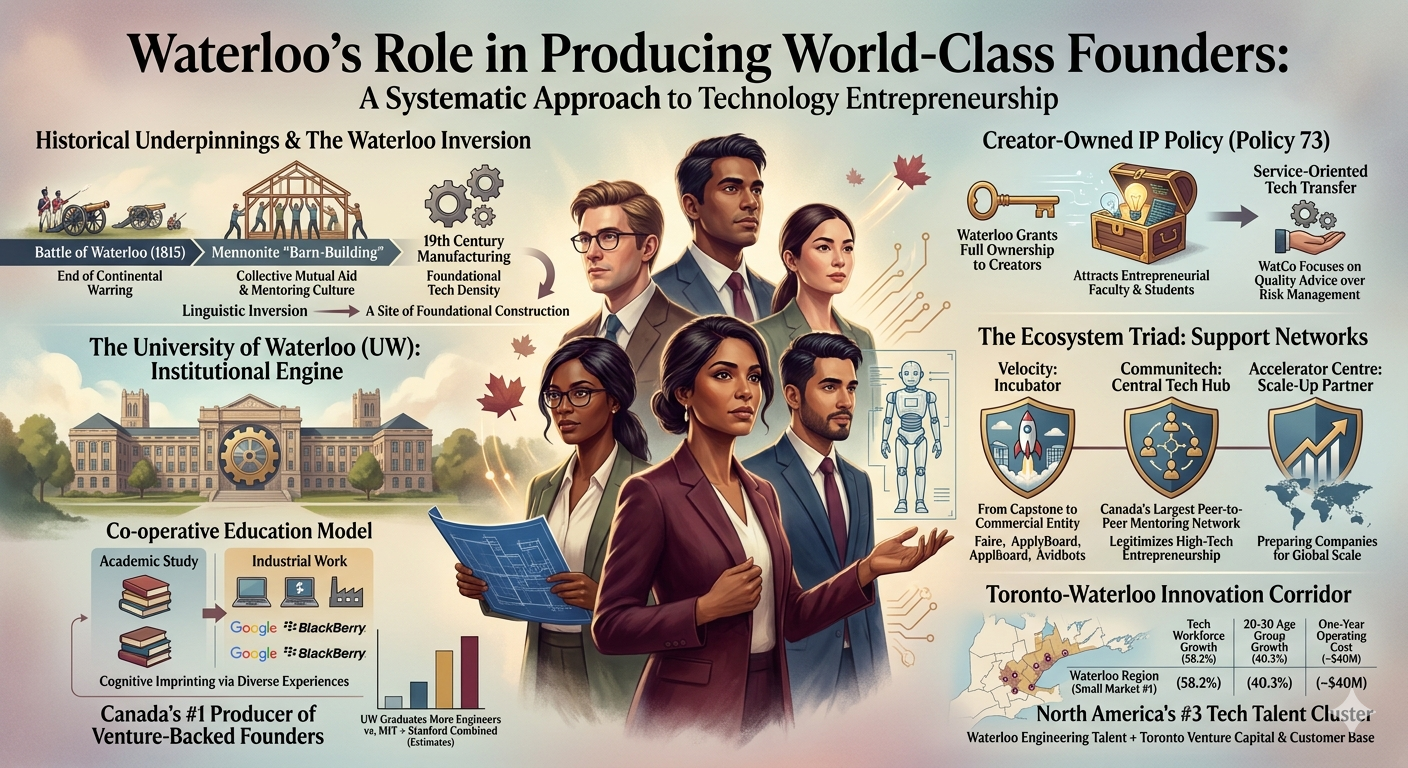
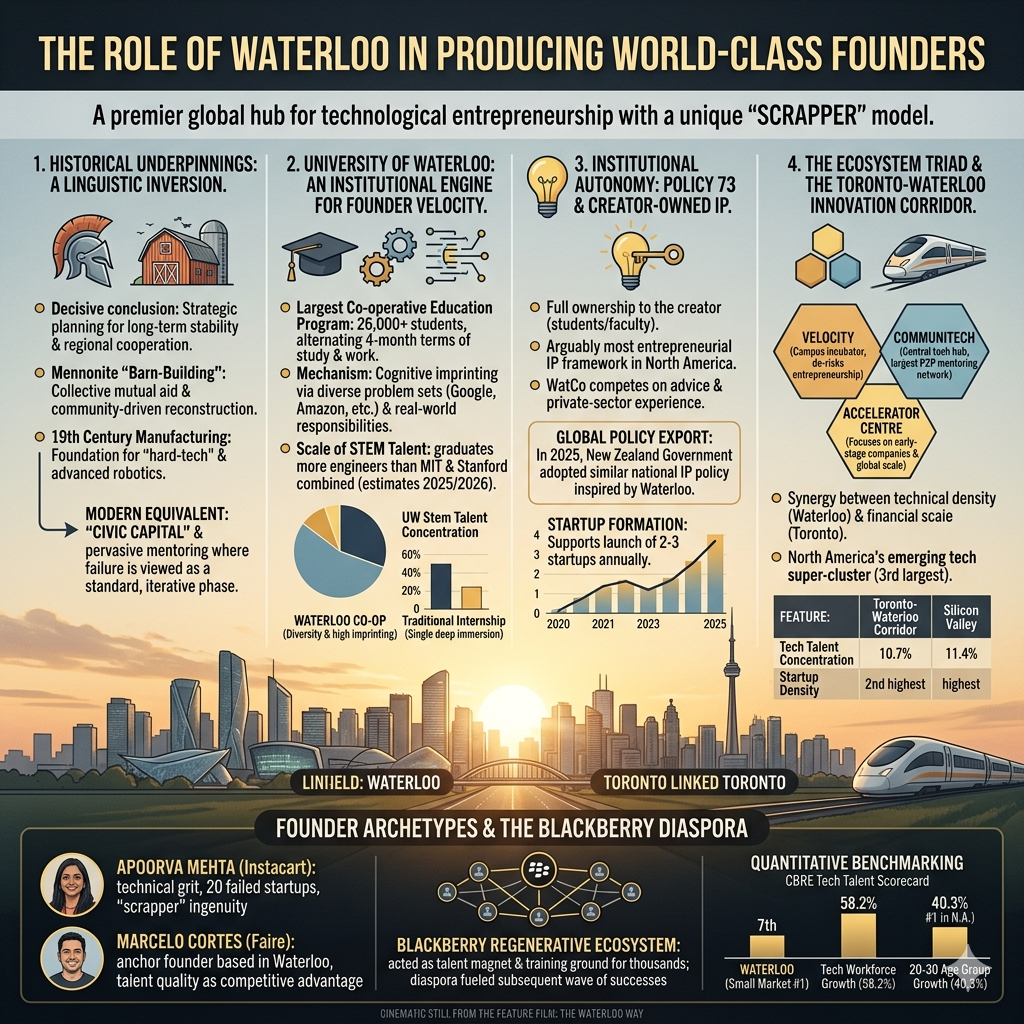
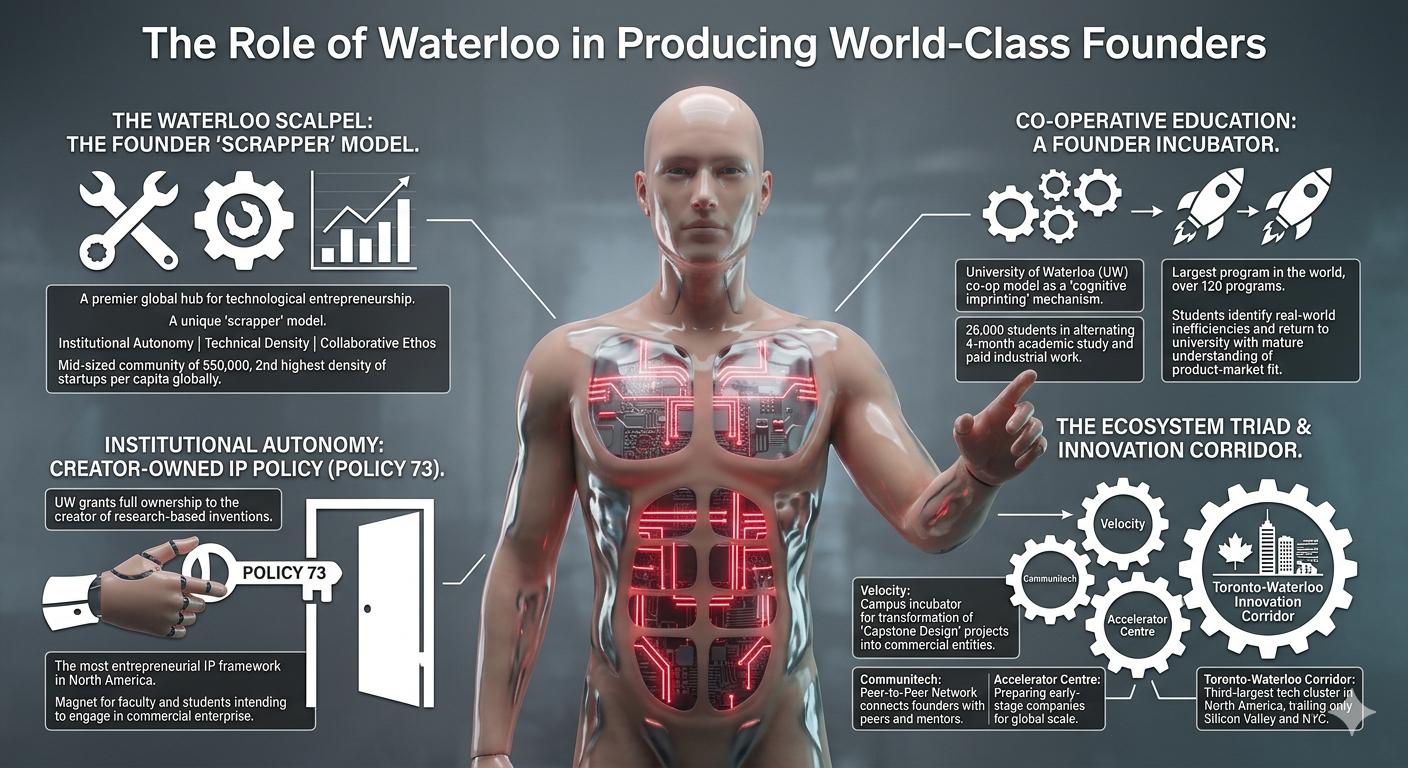
The emergence of the Waterloo region in Ontario, Canada, as a premier global hub for technological entrepreneurship represents one of the most significant anomalies in modern economic geography. While traditional tech hubs like Silicon Valley, New York, and London benefit from massive concentrations of venture capital and proximity to established financial centers, the Waterloo ecosystem has systematically engineered a "scrapper" model of founder production that thrives on institutional autonomy, technical density, and a deeply rooted collaborative ethos. This report examines the multi-faceted role of the Waterloo region in producing world-class founders, analyzing the historical, educational, and policy-driven mechanisms that have transformed a mid-sized community of 550,000 people into the world’s second-highest density of startups per capita.
Historical Underpinnings and the Linguistic Inversion of Waterloo
The very name "Waterloo" carries a historical weight that, in any other context, would suggest the finality of defeat. On June 18, 1815, the Battle of Waterloo saw the French Imperial Army under Napoleon Bonaparte defeated by a Seventh Coalition led by the Duke of Wellington and Marshal Blücher. This engagement was the decisive conclusion to twenty-three years of warring that had convulsed the European continent, ending Napoleon’s imperial aspirations and ushering in the Pax Britannica—a century of relative peace and British preeminence. In popular culture and the English lexicon, "meeting one's Waterloo" became an expression for a catastrophic reversal of fortune or a final undoing.
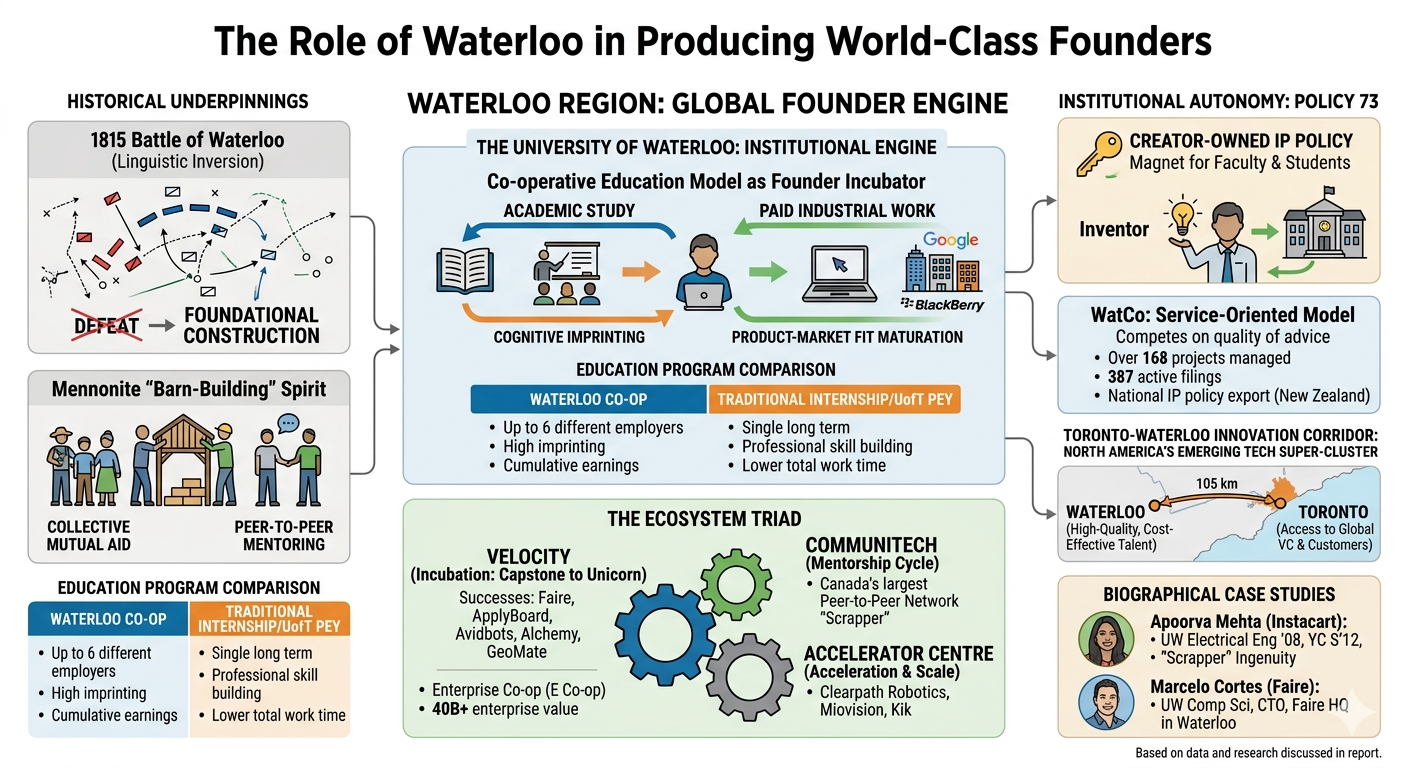
However, in the context of global entrepreneurship, the Waterloo region has affected a profound linguistic inversion. Rather than representing a site of strategic collapse, Waterloo has become a site of foundational construction. This transition began in the early 19th century with the arrival of Mennonite families from Pennsylvania, who settled in the region and brought with them the "barn-building" spirit. In its original Mennonite context, this spirit dictated that if a neighbor's barn collapsed or was destroyed by fire, the entire community would rally to rebuild it. This cultural substrate has been secularized and institutionalized into what contemporary scholars call "civic capital"—the formal and informal networks that connect individuals and associations to create public goods. In the modern tech ecosystem, this manifests as a pervasive mentoring culture where failure is viewed as a standard, iterative phase of a business journey rather than a terminal "Waterloo".
Historical Influence | Mechanism of Action | Modern Ecosystem Equivalent |
Battle of Waterloo (1815) | End of continental warring; shift to stability and alliances. | Strategic planning for long-term stability and regional cooperation. |
Mennonite "Barn-Building" | Collective mutual aid and community-driven reconstruction. | Peer-to-peer mentoring networks and shared resource allocation. |
19th Century Manufacturing | Foundation of textiles and automotive assembly as early industries. | Shift toward "hard-tech" and advanced manufacturing robotics. |
The cultural imprinting of this "barn-building" ethic is a primary reason why Waterloo remains a high-density outlier in high-technology markets. It allows founders to rely on a distributed regional entrepreneurial mentoring network (REMN) that legitimizes high-technology entrepreneurship even in a national environment that has historically prioritized natural resource dependence and branch-plant manufacturing.
The University of Waterloo: An Institutional Engine for Founder Velocity
The epicenter of this transformation is the University of Waterloo (UW), founded in 1957 as an innovative experiment in higher education. UW was established to address the need for a highly skilled technical workforce in post-war Canada, emphasizing a radical new model of work-integrated learning. Today, the university is recognized as Canada’s top institution for producing venture-backed founders, currently ranking 18th to 21st globally, depending on the metric used.
The Co-operative Education Model as a Founder Incubator
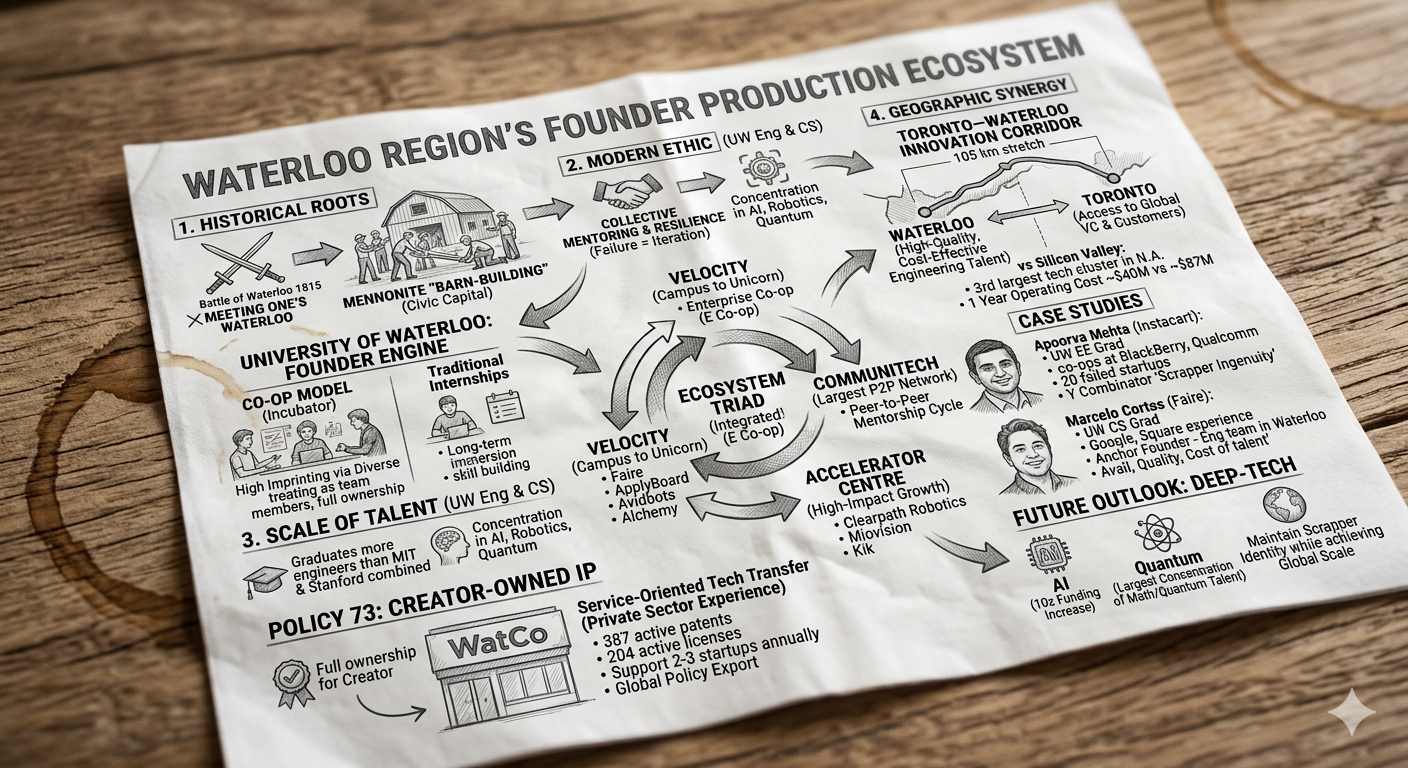
The most distinctive feature of the Waterloo system is its co-operative education program, which is the largest of its kind in the world. With over 26,000 students enrolled across 120 programs, the university facilitates alternating four-month terms of academic study and paid industrial work. This model does not merely provide financial support; it serves as a mechanism for "cognitive imprinting". Academic studies by professors Nada Basir and Dalziel at the Conrad School of Entrepreneurship and Business reveal that student entrepreneurs often start companies in fields directly related to their co-op placements.
The study found that even short-term exposure—often less than four months—to specific industries or technologies can have a lasting influence on a student's behavior and decision-making. This imprinting effect is most potent when the student possesses strong foundational capabilities, such as software engineering skills, which allow them to absorb multiple layers of insight from diverse sources. Unlike structured entrepreneurship programs that focus on measurable classroom progress, the co-op model fosters entrepreneurial development by chance and serendipity. Students identify real-world inefficiencies within established companies like Google, Amazon, or BlackBerry and return to the university with a mature understanding of product-market fit.
Education Program Comparison | Waterloo Co-op | Traditional Internship / UofT PEY |
Structure | Alternating 4-month terms throughout degree. | Long-term 12-16 month single term (PEY). |
Diversity of Experience | Up to 6 different employers and industries. | Single deep immersion in one corporate environment. |
Founder Impact | High imprinting via diverse problem sets. | Professional skill building for long-term employment. |
Financial Outcome | Cumulative earnings help defray tuition costs. | Single lump-sum earnings; often lower total work time. |
The co-op program has produced a generation of "mature" founders who understand the corporate world before they enter it as entrepreneurs. For instance, Mark Widish, an engineering lead at Faire and a UW alumnus, notes that co-op students are treated as full members of engineering teams, gaining ownership over real product features that ship to production. This high level of responsibility creates a psychological bridge between being a student and being a founder.
The Faculty of Engineering and the Scale of Talent
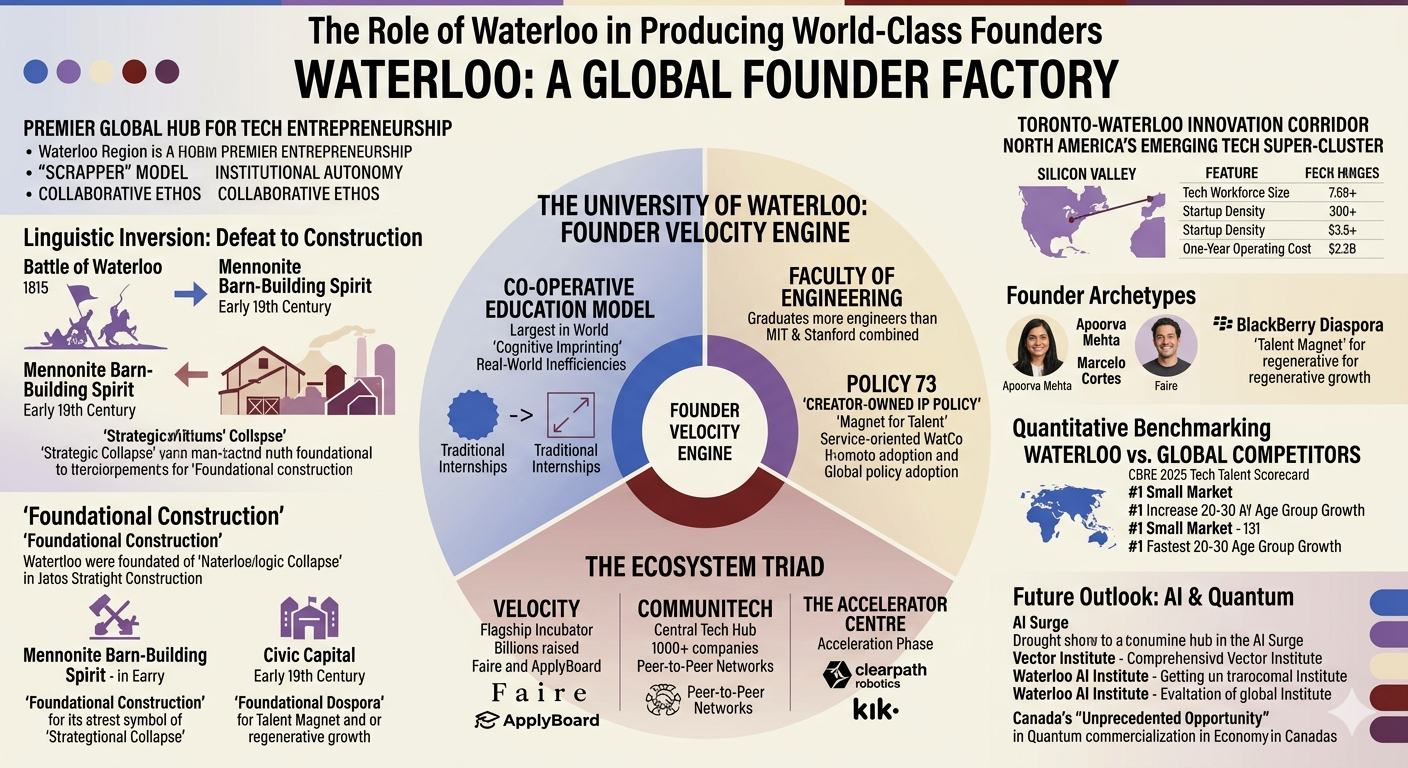
The scale of talent production at Waterloo is a critical factor in its global standing. The University of Waterloo graduates more engineers every year than MIT and Stanford combined. This sheer volume of STEM talent creates a high-density workforce that attracts multinational corporations and fuels the local startup ecosystem.
Talent Metric (2025/2026 Estimates) | Waterloo Region |
Total Post-Secondary Students | 80,000+ |
Engineering Students at UW | 10,000+ |
Computer Science Students at UW | 4,000+ |
Annual Tech Degree Completions | 5,291 (Corridor) |
Total Tech Workforce | 39,400 (Local) / 373,600 (Corridor) |
The presence of Canada’s largest engineering school and largest computer science program provides a "nucleus" for regional development. This concentration allows for a high degree of specialization in fields such as artificial intelligence, robotics, and quantum computing, which are less susceptible to the market volatility seen in consumer-facing software.
Institutional Autonomy: The Competitive Advantage of Policy 73
A primary driver of founder attraction to Waterloo is the university's "creator-owned" intellectual property (IP) policy, known as Policy 73. While most North American universities claim ownership or a significant equity stake in research-based inventions, Waterloo grants full ownership to the creator. This policy is arguably the most entrepreneurial IP framework in North America, acting as a magnet for faculty and students who intend to engage in commercial enterprise.
The Service-Oriented Technology Transfer Model
The existence of Policy 73 fundamentally shifts the role of the Waterloo Commercialization Office (WatCo). Because researchers are not contractually required to work with the university, WatCo must compete on the quality of its advice and execution to earn the trust of founders. This has created a service-oriented culture staffed by individuals with extensive private-sector experience in startups and venture capital.
The impacts of this model are both domestic and international:
Commercialization Metrics: WatCo currently manages over 168 technology projects, with 387 active patent filings and 204 active licensing agreements.
Startup Formation: The office supports the launch of two to three startups annually, a high rate for a mid-sized institution.
Global Policy Export: In 2025, the New Zealand Government adopted a national IP management policy inspired by Waterloo’s principles, signaling a global shift toward researcher empowerment.
This "creator-centric" approach fosters an environment where innovation is not stalled by institutional bureaucracy. As Scott Inwood, Director of Commercialization, explains, the goal is to provide advice grounded in how businesses actually operate, rather than merely managing institutional risk. This transparency and autonomy are foundational to the "scrapper" culture of Waterloo founders, who often prefer to build lean, self-funded ventures before seeking external capital.
The Ecosystem Triad: Velocity, Communitech, and the Accelerator Centre
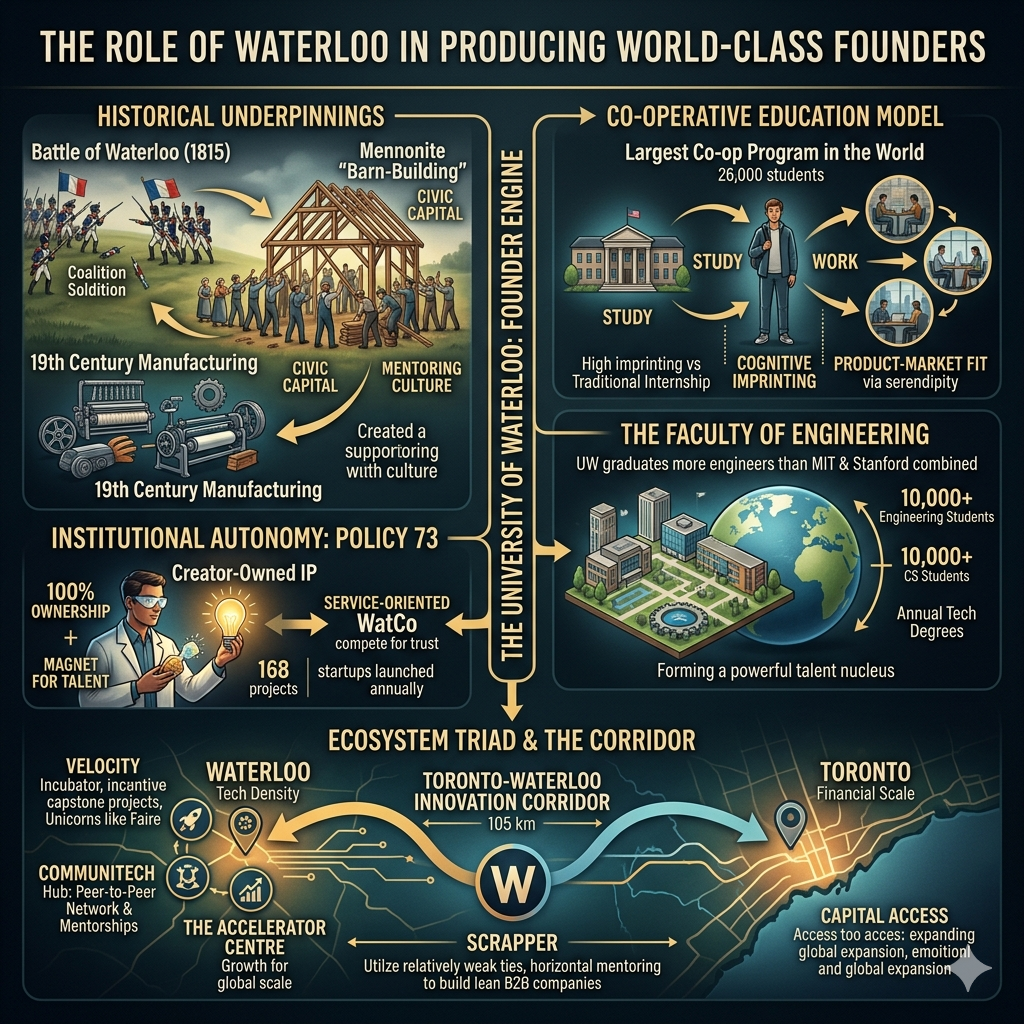
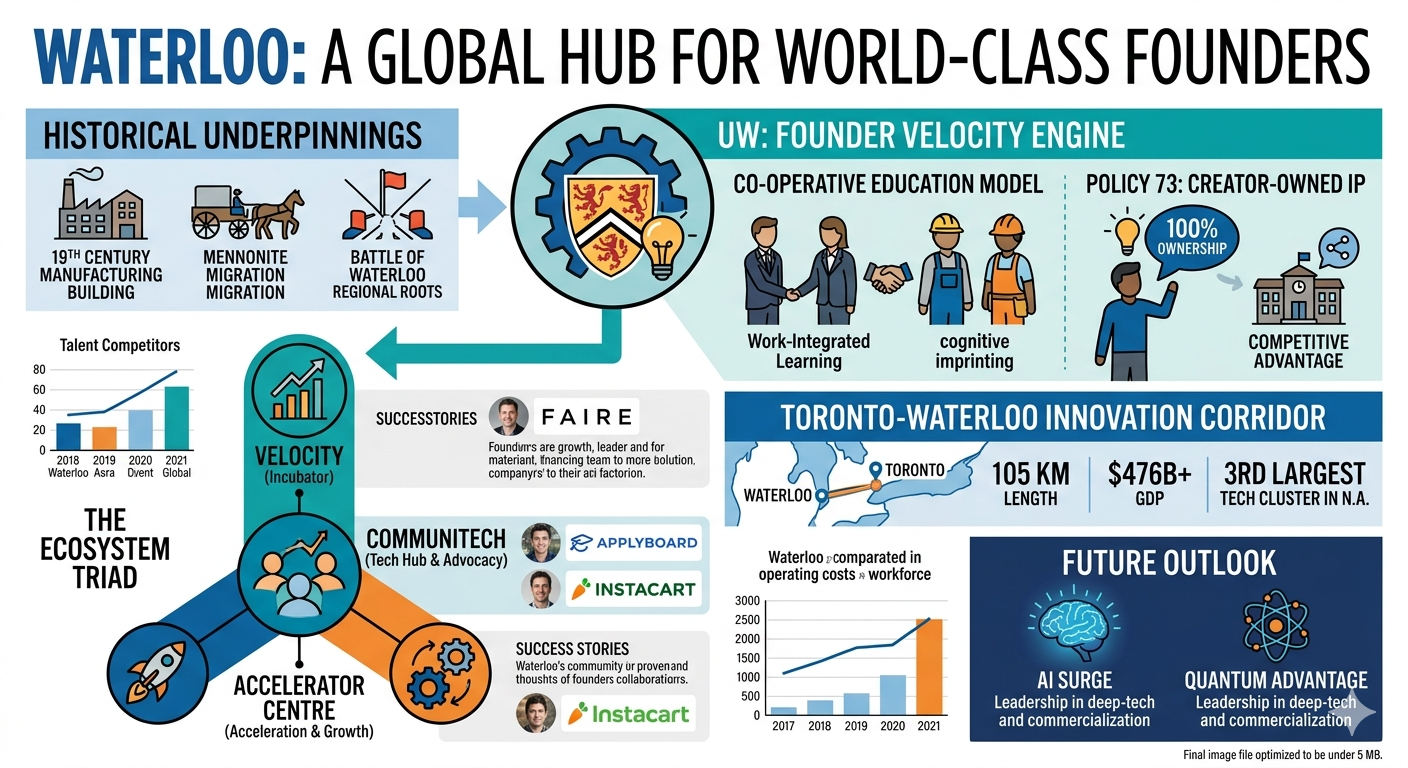
The Waterloo founder journey is supported by a robust triad of organizations that provide incubation, acceleration, and community mentorship. These entities—Velocity, Communitech, and the Accelerator Centre—form the structural backbone of the regional tech hub.
Velocity: From Capstone to Global Unicorn
Velocity is the university's flagship incubator, providing students and researchers with the lab space, funding, and mentorship needed to transform a "Capstone Design" project into a commercial entity. Velocity companies have collectively raised billions in capital and have an estimated enterprise value of $40 billion.
Notable Velocity Successes | Founder(s) and UW Background | Success / Impact |
Faire | Marcelo Cortes (Math/CS) | Global retail marketplace; $12.4B valuation. |
ApplyBoard | Metin, Martin, Massi Basiri (Eng/Bus) | EdTech unicorn; simplifies study abroad. |
Avidbots | Pablo Molina, Faizan Sheikh (Eng '11) | Autonomous floor scrubbing robots. |
Alchemy | Chong Shen, Khanjan Desai (Eng '13) | Nanotech for automotive and defense. |
GeoMate | Dr. Nastaran Saberi (PhD '19) | AI-driven urban mapping and accessibility. |
The Velocity model is unique because it integrates deeply with the academic cycle. Many founders begin their journey during their fourth-year Capstone Design project, which provides a technical foundation for their future startup. Velocity also operates the Enterprise Co-op (E Co-op) program, which allows students to earn co-op credit while starting their own businesses, effectively de-risking the entrepreneurship path during their undergraduate years.
Communitech and the Mentorship Cycle
Communitech, founded in 1997 by local entrepreneurs, serves as the region’s central tech hub and advocacy group. It was created to attract talent and capital to a region that, at the time, lacked a formal startup infrastructure. Today, it supports a community of over 1,000 companies, from first-time founders to large global players.
One of the most critical functions of Communitech is its Peer-to-Peer Network, which is the largest in Canada. This network facilitates the "barn-raising" culture by connecting founders with their peers and experienced mentors. Academic analysis suggests that this horizontal, widely distributed mentoring network allows Waterloo founders to circumvent national institutional constraints, such as a risk-averse banking sector and a dearth of venture capital. By sharing "generic" business knowledge and "scrapper" survival strategies, the network teaches founders how to target technical B2B niches that require less initial capital than consumer-facing ventures.
The Accelerator Centre: A Decade of High-Impact Growth
The Accelerator Centre (AC), founded in 2006, focuses on the "acceleration" phase, taking early-stage companies and preparing them for global scale. Supported by local universities and all levels of government, the AC has been a critical partner in the region’s rise as a global innovation powerhouse. Standout graduates from the AC program include Clearpath Robotics, Miovision, and Kik, all of which have gone on to achieve significant international success.
The Toronto-Waterloo Innovation Corridor: North America’s Emerging Tech Super-Cluster
Waterloo’s ability to produce world-class founders is amplified by its location within the Toronto-Waterloo Innovation Corridor. This 105-kilometer stretch connects the technical density of Waterloo with the financial and cultural scale of Toronto, creating an economic engine with a GDP of over $476 billion.
Comparative Metrics and Geographic Synergy
The corridor is now the third-largest tech cluster in North America, trailing only Silicon Valley and New York City. It possesses a talent density similar to Silicon Valley but offers a much lower cost of operation.
Feature | Toronto-Waterloo Corridor | Silicon Valley (Comparison) |
Tech Workforce Size | 373,600+ | 405,330 |
Tech Talent Concentration | 10.7% | 11.4% |
Startup Density | 2nd highest in world | Highest in world |
One-Year Operating Cost | ~$40M (Waterloo) | ~$87M |
Immigrant Population | 25.8% (Waterloo) / 46.6% (Toronto) | High, but declining recently |
The synergy between the two ends of the corridor is vital. Waterloo provides the high-quality, cost-effective engineering talent, while Toronto provides the access to global venture capital and a massive customer base. This relationship allows founders to "Start in Waterloo" to build their technology in a lean environment and then leverage Toronto’s infrastructure for global expansion.
The "Scrapper" vs. "Venture" Culture
Academic research distinguishes Waterloo’s "scrapper" culture from the more traditional venture-backed culture of Silicon Valley. While Silicon Valley founders often rely on "strong ties" to elite capital networks, Waterloo founders rely on "relatively weak ties" that facilitate rapid knowledge diffusion across the community. In one study, 75% of Waterloo entrepreneurs did not know their mentors in advance, compared to other cities where founders relied on pre-existing relationships. This horizontal mentoring legitimizes entrepreneurship as a career path for "rebels" and "grassroots" actors who might otherwise be isolated in a resource-constrained environment.
Biographical Case Studies: The Waterloo Founder Archetype
The success of Waterloo is best understood through the narratives of the founders it has produced. These individuals often share a common path: technical training at UW, exposure to the global market via co-op, and a subsequent return to the ecosystem to build high-impact ventures.
Apoorva Mehta (Instacart)
Apoorva Mehta’s journey from a teenage immigrant in Hamilton to the billionaire founder of Instacart is a masterclass in the Waterloo "fail-fast" and technical grit philosophy. Mehta graduated from the University of Waterloo with a degree in electrical engineering in 2008. His undergraduate experience included co-op terms at BlackBerry and Qualcomm, which provided early exposure to mobile technology and telecommunications.
After working as a supply-chain engineer at Amazon, Mehta moved to San Francisco and launched an astonishing 20 different startups between 2010 and 2012. Each venture failed, but each provided lessons in market research and user validation—lessons that were deeply rooted in his UW technical background. Instacart was born out of a personal pain point: a lack of groceries in a cold climate, a memory from his youth in Canada. He eventually gained entry to Y Combinator’s Summer 2012 batch by using his own app to deliver a six-pack of beer to a YC partner, demonstrating the "scrapper" ingenuity that Waterloo celebrates.
Marcelo Cortes (Faire)
Marcelo Cortes, the CTO and co-founder of Faire, represents the "anchor" founder who remains committed to the Waterloo region. A graduate of UW’s computer science program, Cortes previously held senior roles at Google and Square. When starting Faire, he convinced his co-founders that the engineering team should be based in Waterloo.
Cortes explicitly cites the "availability, quality, and cost of talent" in the region as Faire's greatest competitive advantage. By hiring several UW co-op students each term, Faire has created a internal pipeline of talent that is "comparable to what you could find in Silicon Valley". The success of Faire—achieving unicorn status in under three years—has solidified Waterloo’s reputation as a location where global-scale companies can be built using local talent.
The BlackBerry Diaspora and the Regenerative Ecosystem
The historical significance of BlackBerry (Research In Motion) in Waterloo cannot be overstated. Founded by UW alumni Mike Lazaridis and Douglas Fregin, the company revolutionized the mobile industry and put Waterloo on the global tech map. While BlackBerry’s dominance in the smartphone market declined, the company acted as a "talent magnet" and a "training ground" for thousands of engineers.
The "BlackBerry diaspora" has fueled the next wave of successes in the region. For example, Magnet Forensics (formerly JADSoftware) was founded by Jad Saliba, a former local police constable who had previously studied computer science and worked at OpenText. Arctic Wolf, Faire, and ApplyBoard all benefited from the influx of experienced talent that hit the market during BlackBerry’s restructuring phases. This "regenerative power" is a key indicator of a mature ecosystem that can weather the decline of a major anchor.
Quantitative Benchmarking: Waterloo vs. Global Competitors
When compared against other mid-sized and major tech hubs, Waterloo’s performance in talent growth and cost-efficiency is a "wipe-out" in several categories.
The CBRE 2025 Tech Talent Scorecard
In the most recent CBRE scoring, Waterloo jumped to the 7th spot in North America, ranking ahead of larger cities like Dallas, Boston, and Vancouver.
Metric | Waterloo (Small Market #1) | Chicago | Seattle |
Tech Workforce Growth | 58.2% | 4.7% | High, but lower % |
20-30 Age Group Growth | 40.3% (#1 in N.A.) | -7.1% | - |
Office Vacancy Rate | 17.9% | 27.3% | - |
Payroll Tax Difference | ~$4.7k per engineer | ~$6.3k | - |
Median 2-BR Rent (USD) | $1,569 | Higher | ~$2.7k (Silicon Valley) |
Waterloo’s population growth in the 20-30 and 30-40 demographic is the fastest of any of the 50 communities profiled in the CBRE report. This indicates that the region is not just producing talent but actively retaining and attracting young professionals from across the continent. The "scrapper" city is becoming a "magnet" city.
Future Outlook: AI, Quantum, and the Challenge of Global Scale
The next phase for Waterloo founders is defined by a shift toward foundational deep-tech. The region has moved beyond mobile and enterprise SaaS into the realms of artificial intelligence and quantum computing.
The AI Surge and the Golden Age of Entrepreneurship
Toronto-Waterloo holds a high "AI-Native Transition" score of 8 out of 10, reflecting a ten-fold increase in AI-related funding between 2022 and 2024. The presence of world-class research institutes, such as the Vector Institute in Toronto and the Waterloo Artificial Intelligence Institute, provides founders with the theoretical depth needed to lead the AI wave. However, the region faces "rising pressure" to deliver global scale and move beyond early-stage research into high-value exits.
The Quantum Advantage
Waterloo is home to the world’s largest concentration of quantum and math talent. As Kevin Tuer, CTO of Communitech, suggests, Canada has an "unprecedented opportunity" to lead the world in the commercialization of quantum technology. The "barn-building" spirit will be essential here, as quantum development cycles are longer and require more patient capital and cross-sectoral collaboration than previous tech waves.
Conclusions and Strategic Implications
The role of Waterloo in producing world-class founders is the result of a deliberate, 70-year institutional experiment. By prioritizing student autonomy through Policy 73 and integrating real-world work through the co-op model, the University of Waterloo has created a "founder factory" that is resilient, technically dense, and culturally unique.
The key takeaways for policymakers and global ecosystem builders include:
Institutional Autonomy over Control: Waterloo’s creator-owned IP policy proves that relinquishing university control can lead to higher overall commercialization success.
Work-Integrated Learning as Imprinting: Short, diverse industrial exposures are more effective at producing founders than single long-term placements.
Civic Capital as Infrastructure: A horizontal, peer-led mentoring network is a powerful substitute for large-scale venture capital in mid-sized regions.
Geographic Agglomeration: The link between the technical depth of Waterloo and the financial scale of Toronto (the Corridor) is a template for non-American hubs to compete globally.
Waterloo’s legacy is no longer one of defeat, but of a collaborative "barn-building" victory that continues to reshape the global technology landscape. As the ecosystem matures into AI and Quantum, its ability to maintain its "scrapper" identity while achieving global scale will be the final test of its enduring model.
Read More -
1. From Idea to MVP: A Step-by-Step Guide for Solo Founder
🔗 https://findnstart.com/blogs/from-idea-to-mvp-a-step-by-step-guide-for-solo-founder
2. How to Validate Your Startup Idea in 48 Hours for $0
🔗 https://findnstart.com/blogs/how-to-validate-your-startup-idea-in-48-hours-for-0
3. Remote vs. Local: Does Your Co-Founder Need to Live in the Same City?
🔗 https://findnstart.com/blogs/remote-vs-local-does-your-co-founder-need-to-live-in-the-same-city
4. The 2026 Startup Landscape: What Has Fundamentally Changed (and Why Founder Skills Matter More Than Ever)
5. The Most In-Demand Skills for Startup Founders in 2026
🔗 https://findnstart.com/blogs/the-most-in-demand-skills-for-startup-founders-in-2026
6. How to Find a Technical Co-Founder (Without a Six-Figure Salary)
🔗 https://findnstart.com/blogs/how-to-find-a-technical-co-founder-without-a-six-figure-salary
7. 5 Red Flags to Look for When Choosing a Startup Partner
🔗 https://findnstart.com/blogs/5-red-flags-to-look-for-when-choosing-a-startup-partner
8. How to Pitch Your Idea to Potential Co-Founders
🔗 https://findnstart.com/blogs/how-to-pitch-your-idea-to-potential-co-founders
9. How to Build a Portfolio that Attracts High-Growth Startup Founders
🔗 https://findnstart.com/blogs/how-to-build-a-portfolio-that-attracts-high-growth-startup-founders
10. Equity vs. Salary: How to Split Ownership with Your First Teammate
🔗 https://findnstart.com/blogs/equity-vs-salary-how-to-split-ownership-with-your-first-teammate
11. Why Joining an Early-Stage Startup is Better Than a Corporate Job
🔗 https://findnstart.com/blogs/why-joining-an-early-stage-startup-is-better-than-a-corporate-job
12. The Future of EdTech: Why Developers and Educators Need to Team Up Now
🔗 https://findnstart.com/blogs/the-future-of-edtech-why-developers-and-educators-need-to-team-up-now
13. The Architecture of Symbiosis: Analytical Perspectives on the Five Habits of Successful Startup Duos
14. Finding a Co-Founder in the AI Space: What Skills Should You Look For?
🔗 https://findnstart.com/blogs/finding-a-co-founder-in-the-ai-space-what-skills-should-you-look-for
15. Overcoming Analysis Paralysis and the Strategic Path to Execution
🔗 https://findnstart.com/blogs/overcoming-analysis-paralysis-and-the-strategic-path-to-execution
16. From College Project to Company: How to Find Your Student Co-Founder
🔗 https://findnstart.com/blogs/from-college-project-to-company-how-to-find-your-student-co-founder
17. How to Start a Startup While Working a Full-Time Job
🔗 https://findnstart.com/blogs/how-to-start-a-startup-while-working-a-full-time-job
18. How to Build a HealthTech Startup Without a Medical Degree
🔗 https://findnstart.com/blogs/how-to-build-a-healthtech-startup-without-a-medical-degree
19. The Solitary Architect: Executive Isolation in Entrepreneurship
20. The 2026 Guide to Launching a SaaS as a Solo Developer
21. What Sustainable Growth Actually Looks Like
🔗 https://findnstart.com/blogs/what-sustainable-growth-actually-looks-like
22. The Early Warning Signs Your Startup Is in Trouble
🔗 https://findnstart.com/blogs/the-early-warning-signs-your-startup-is-in-trouble
23. How to Grow Without Burning Out
🔗 https://findnstart.com/blogs/how-to-grow-without-burning-out
24. The Truth About “Runway” Most Founders Ignore
🔗 https://findnstart.com/blogs/the-truth-about-runway-most-founders-ignore
25. Revenue Solves More Problems Than Funding
🔗 https://findnstart.com/blogs/revenue-solves-more-problems-than-funding
26. What No One Tells You About Being a Solo Founder
🔗 https://findnstart.com/blogs/what-no-one-tells-you-about-being-a-solo-founder
27. Why Smart People Quit High-Paying Jobs to Build Startups (And Why Most Regret It)
28. Why Most Startup Advice on Twitter Is Dangerous
🔗 https://findnstart.com/blogs/why-most-startup-advice-on-twitter-is-dangerous
29. Decision Fatigue: The Silent Startup Killer
🔗 https://findnstart.com/blogs/decision-fatigue-the-silent-startup-killer
30. Fear vs Logic: How Founders Actually Make Decisions
🔗 https://findnstart.com/blogs/fear-vs-logic-how-founders-actually-make-decisions
31. How Overthinking Destroys Early Momentum
🔗 https://findnstart.com/blogs/how-overthinking-destroys-early-momentum
32. Ideas Don’t Scale. Systems Do.
🔗 https://findnstart.com/blogs/ideas-dont-scale-systems-do
33. The First Hire That Actually Matters
🔗 https://findnstart.com/blogs/the-first-hire-that-actually-matters
34. How the First 100 Users Decide Your Startup’s Fate
🔗 https://findnstart.com/blogs/how-the-first-100-users-decide-your-startups-fate
35. Why Your Startup Doesn’t Need Growth — It Needs Focus
🔗 https://findnstart.com/blogs/why-your-startup-doesnt-need-growthit-needs-focus
36. Why Most Startups Die Quietly
🔗 https://findnstart.com/blogs/why-most-startups-die-quietly
37. Lessons Learned Too Late by First-Time Founders
🔗 https://findnstart.com/blogs/lessons-learned-too-late-by-first-time-founders
38. The Myth of the “Overnight Success” Startup
🔗 https://findnstart.com/blogs/the-myth-of-the-overnight-success-startup