The Rise of “AI Employees” in US Companies
July 1, 2026 by Harshit Gupta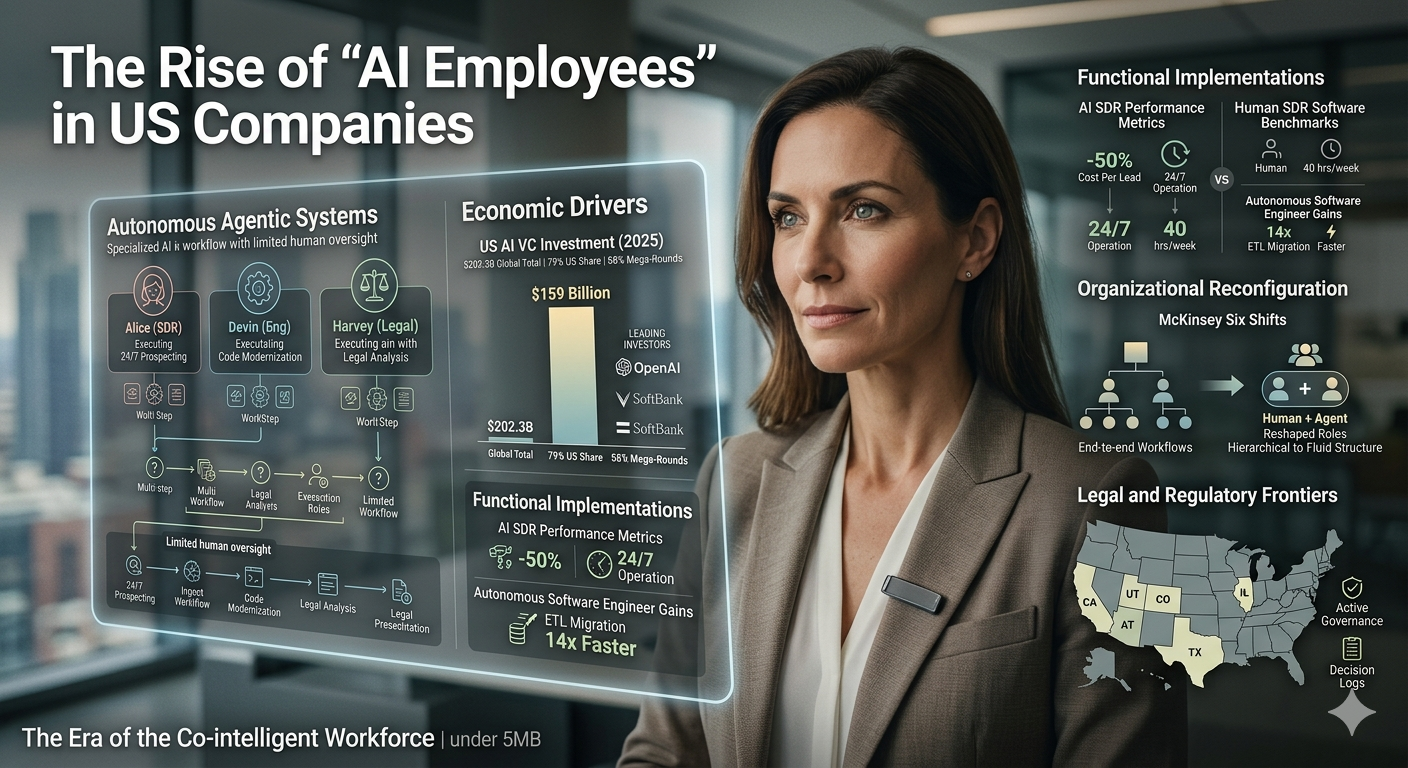
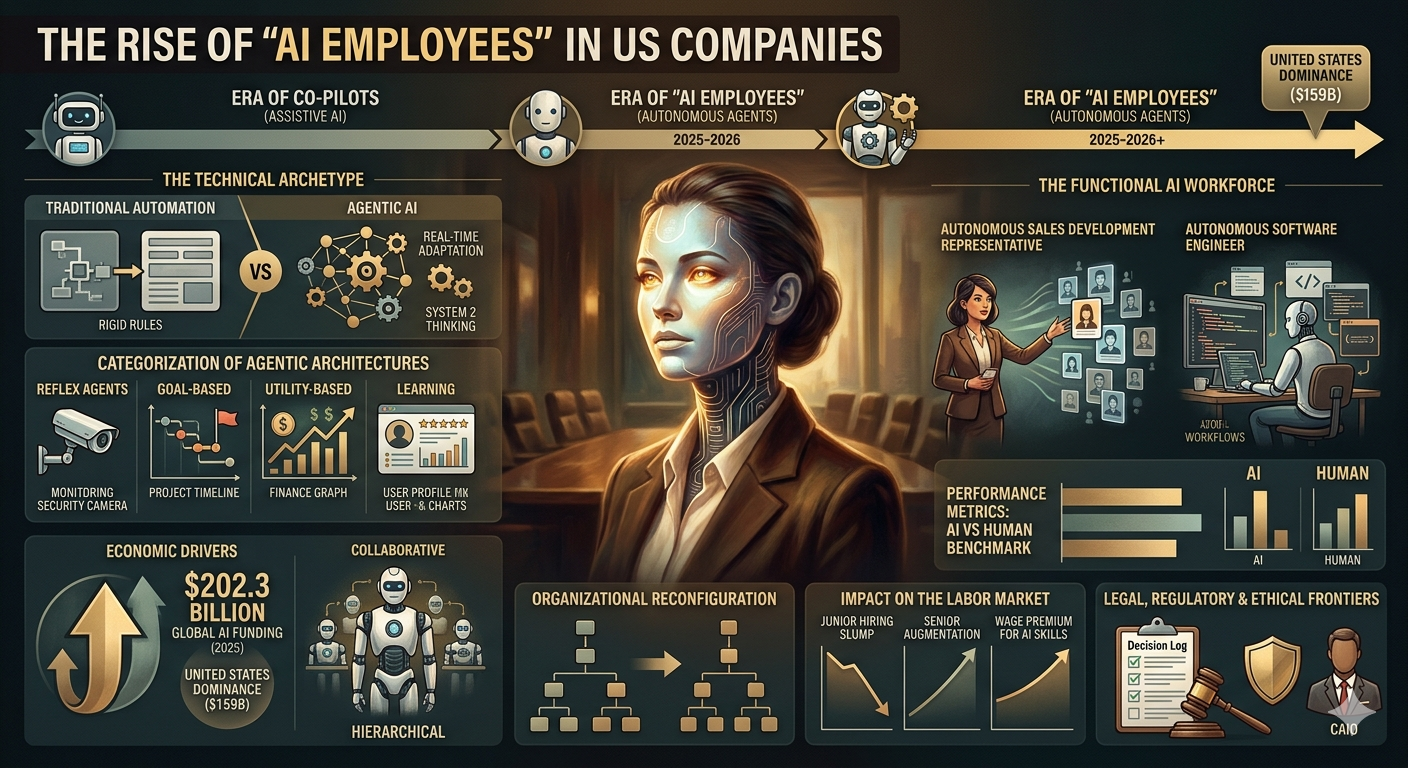
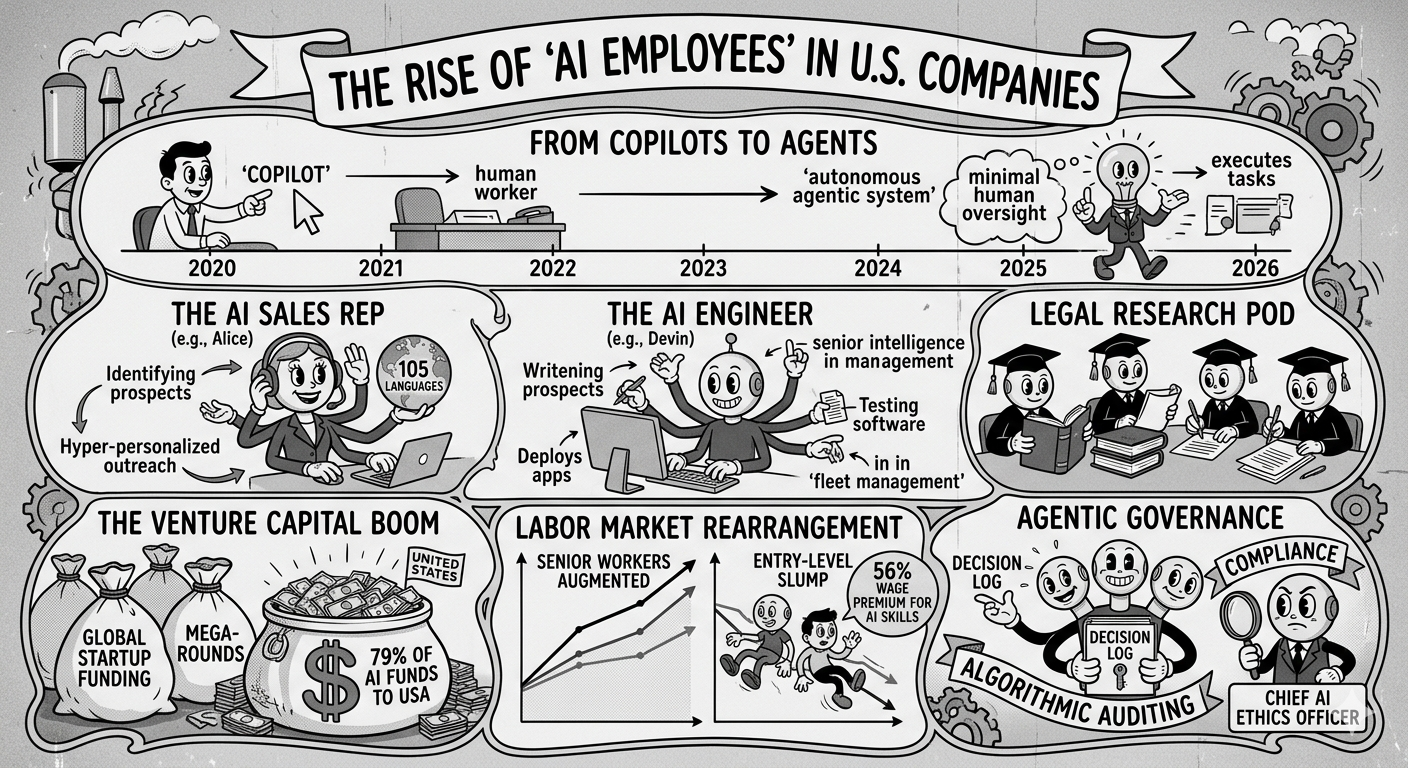
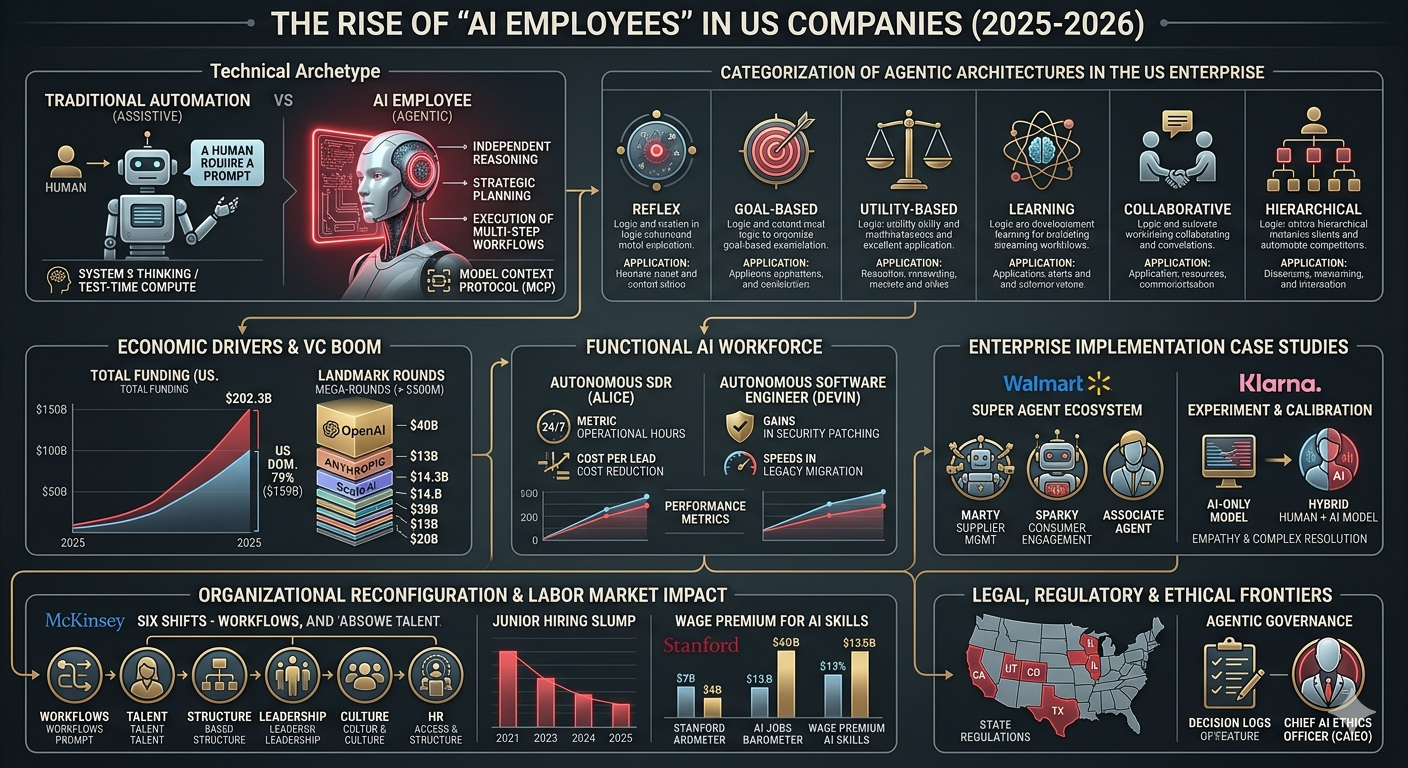
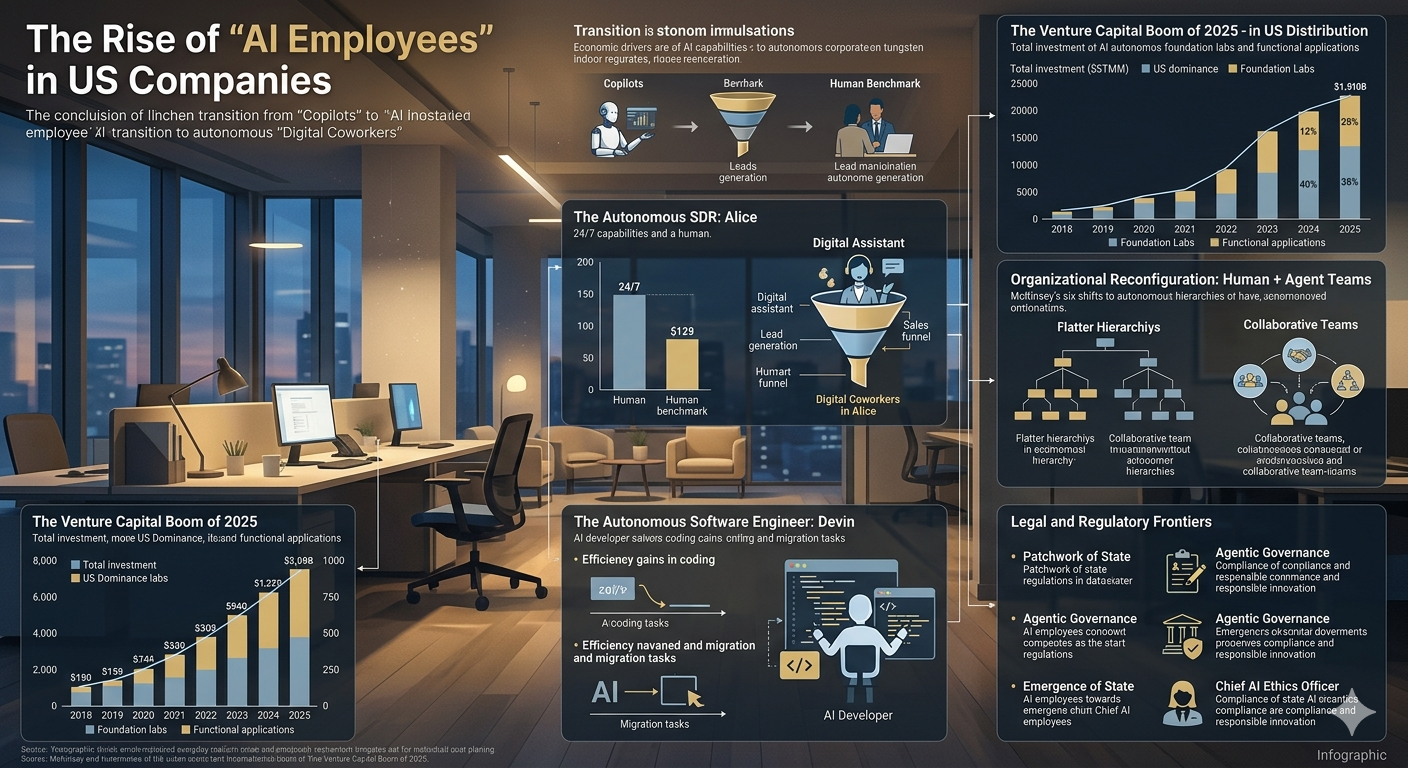
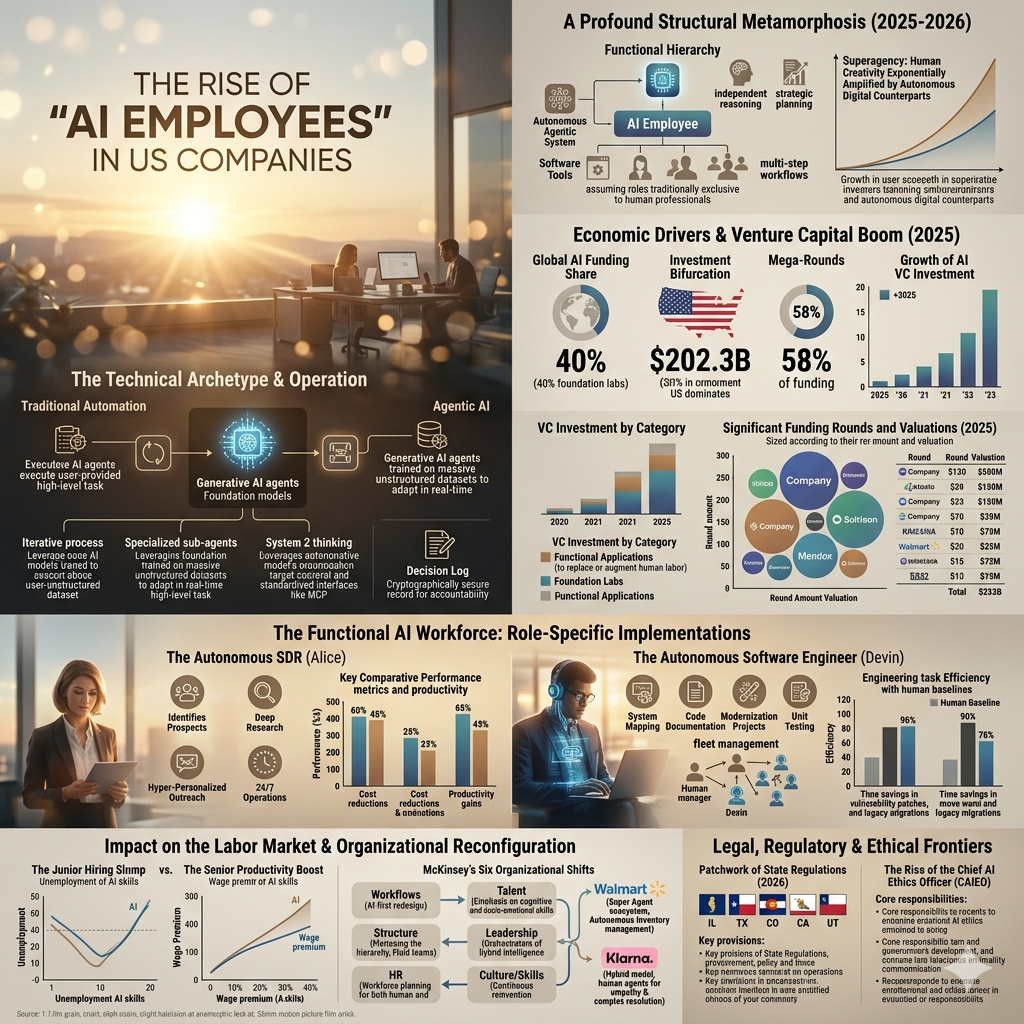
The American corporate landscape is currently navigating a period of profound structural metamorphosis, transitioning from the era of assistive artificial intelligence to the era of the "AI Employee". While the previous decade was defined by "Copilots" and digital assistants that required constant human prompting to produce discrete outputs, the years 2025 and 2026 have witnessed the emergence of autonomous agentic systems capable of independent reasoning, strategic planning, and the execution of multi-step workflows with minimal human oversight. These "AI Employees" are no longer viewed merely as software tools but as digital coworkers integrated into the functional hierarchy of the firm, assuming roles that were traditionally the exclusive domain of human professionals. This shift is underpinned by significant breakthroughs in frontier foundation models, a massive redirection of venture capital toward agentic startups, and an organizational imperative to achieve "superagency"—a state where human creativity and productivity are exponentially amplified by autonomous digital counterparts.
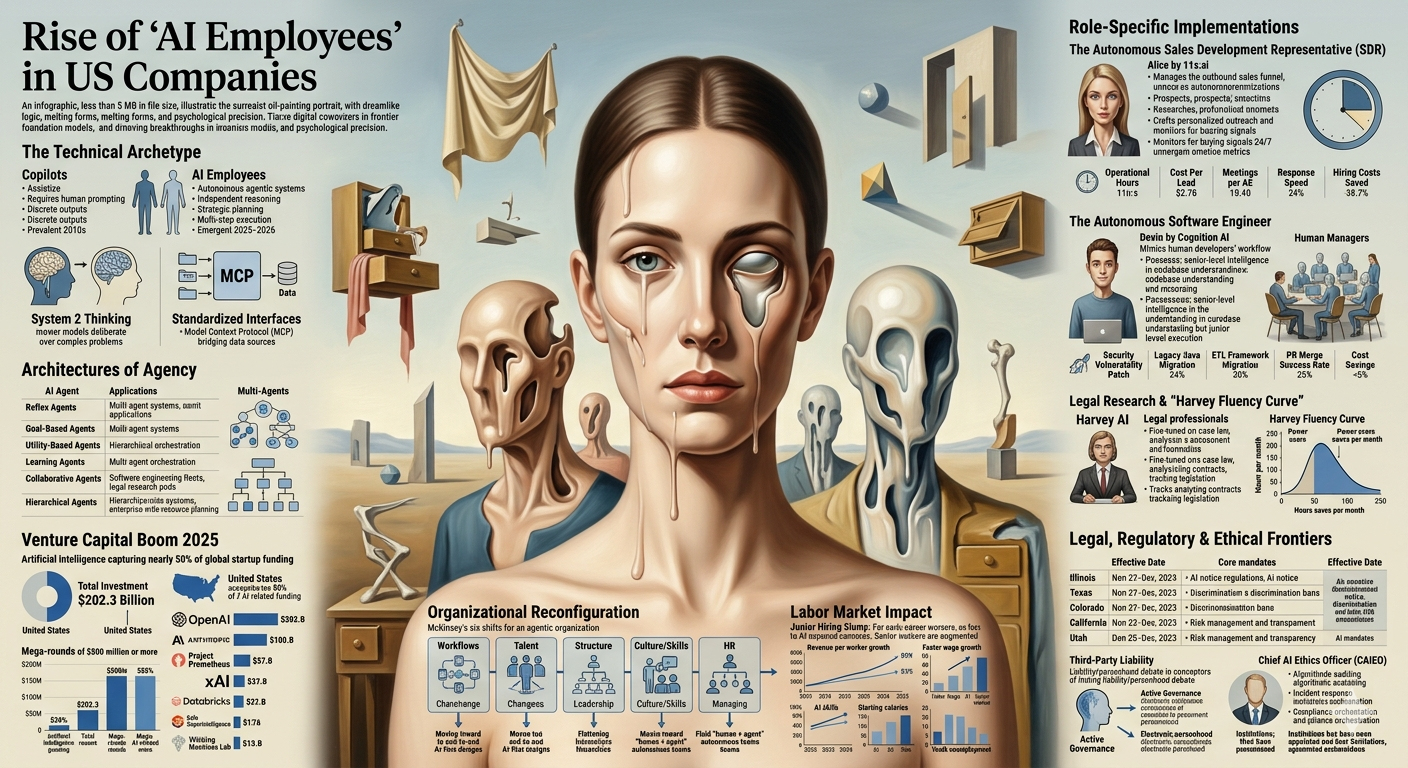
The Technical Archetype of the AI Employee
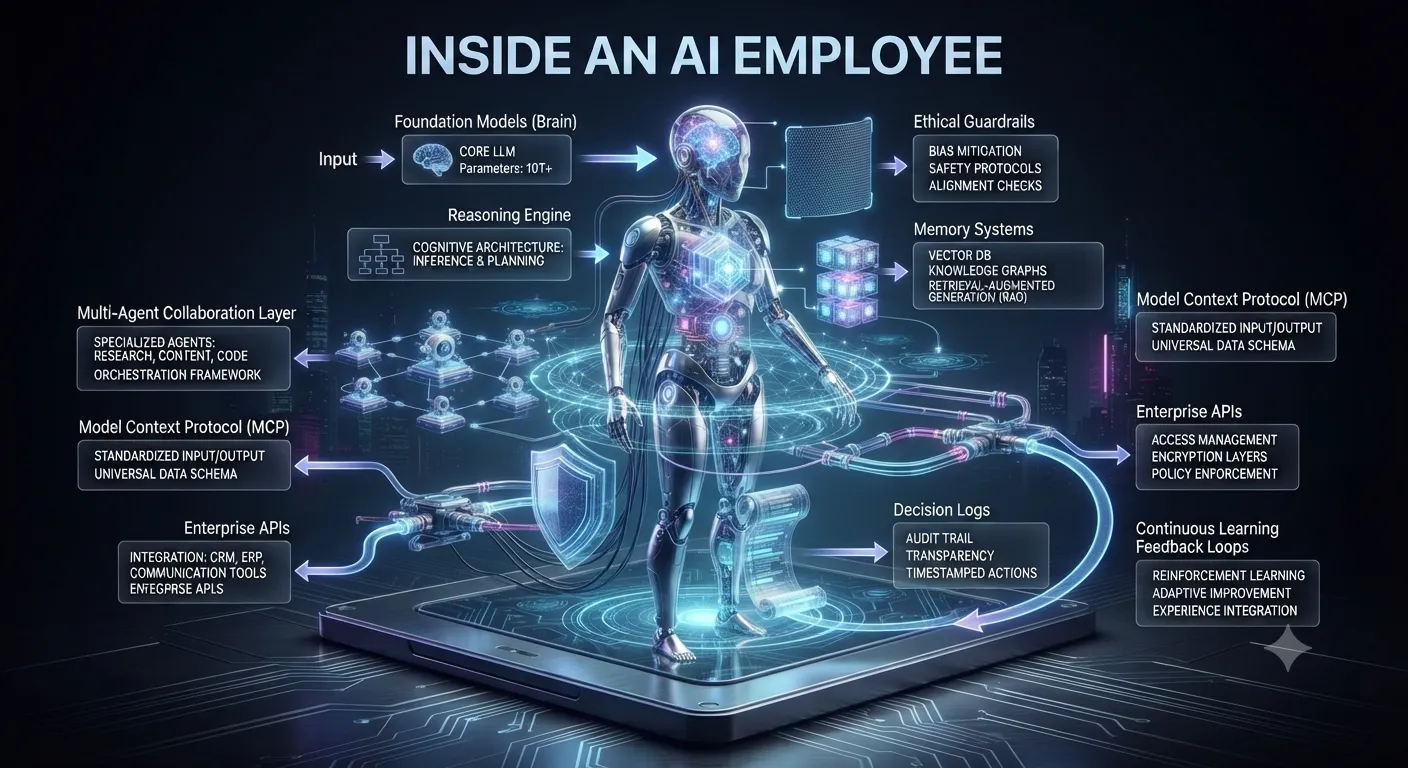
The conceptual distinction between traditional automation and agentic AI is rooted in the capacity for agency and the ability to operate across unstructured environments. Traditional rule-based systems tend to collapse when encountering scenarios anticipated by their designers; in contrast, generative AI agents leverage foundation models trained on massive, unstructured datasets to adapt in real-time. These agents are software components possessing the agency to act on behalf of a user or a broader system to achieve defined outcomes. This involves a sophisticated iterative process where a user provides a high-level task, and the agentic system autonomously plans, allocates sub-tasks to specialized sub-agents, and executes the necessary actions across a digital ecosystem.
The mechanics of these systems are increasingly characterized by "System 2 thinking," or test-time compute, allowing models to deliberate over complex problems rather than simply predicting the next token in a sequence. Furthermore, the introduction of standardized interfaces like the Model Context Protocol (MCP) has enabled agents to interact seamlessly with enterprise APIs, social graphs, and internal documentation, effectively bridging the gap between siloed data sources and actionable outcomes.
Categorization of Agentic Architectures in the US Enterprise
The deployment of AI agents within US companies typically follows one of several architectural patterns, each suited to different levels of complexity and environmental interaction.
Agent Type | Core Operational Logic | Primary Enterprise Application |
Reflex Agents | Immediate action based on current perceptions. | Real-time security monitoring; basic routing. |
Goal-Based Agents | Action selection based on desirable future states. | Project management; supply chain optimization. |
Utility-Based Agents | Decision-making based on maximizing a specific utility. | High-frequency trading; algorithmic advertising. |
Learning Agents | Improvement of performance over time via feedback. | Personalized customer experience; adaptive SDRs. |
Collaborative Agents | Multi-agent systems working toward a shared goal. | Software engineering fleets; legal research pods. |
Hierarchical Agents | Orchestration of specialized sub-agents by a manager agent. | Enterprise-wide resource planning; ETL migrations. |
This shift toward hierarchical and collaborative architectures has allowed AI to move into "high-stakes" employment functions. As these agents become more capable of executing code, signing contracts, and managing financial transactions, they are testing the limits of traditional agency law and corporate liability frameworks. The rise of "agentic governance" has necessitated that boards of directors view AI risk as a systemic liability, leading to the creation of the "Decision Log"—a cryptographically secure record of the inputs and logic used by autonomous agents to reach specific outcomes.
Economic Drivers and the Venture Capital Boom of 2025
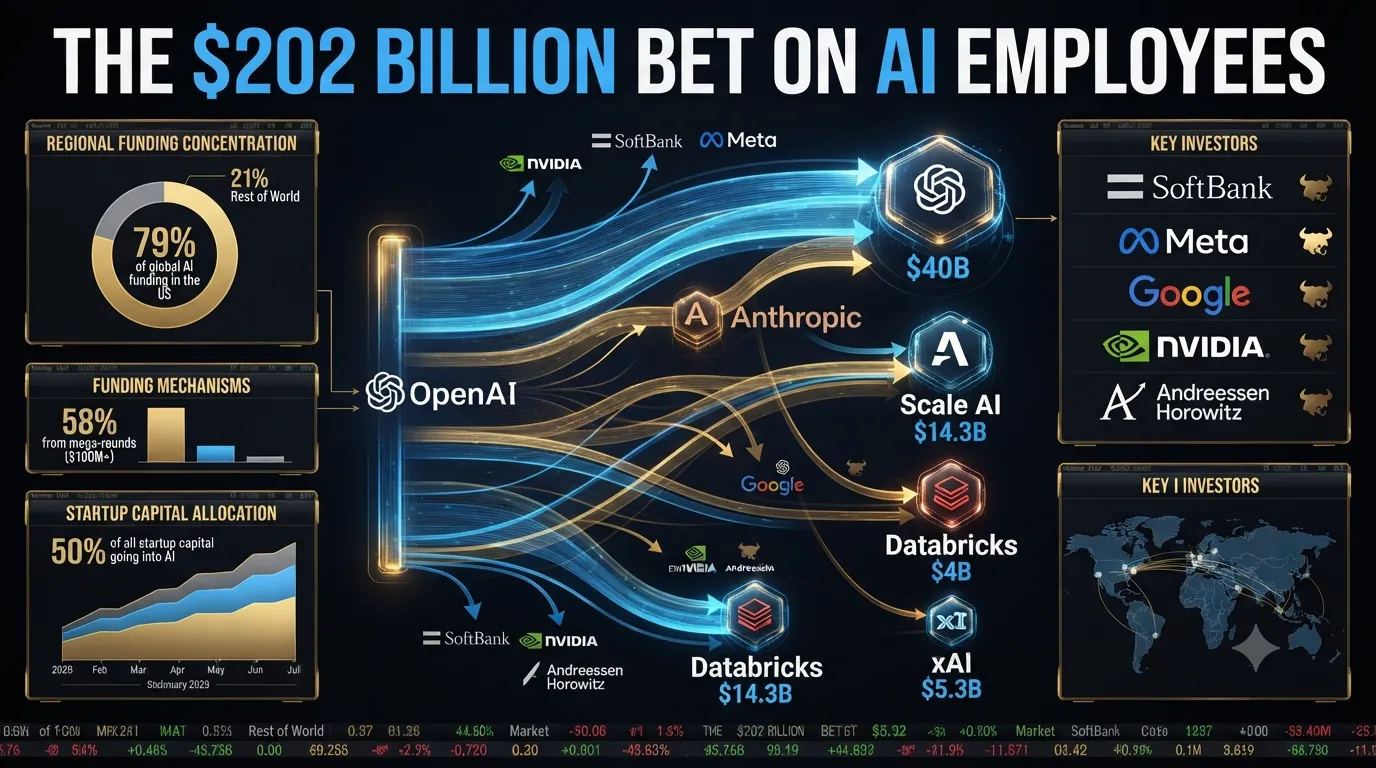
The rise of AI employees is further propelled by an unprecedented surge in venture capital and private equity investment. In 2025, artificial intelligence captured nearly 50% of all global startup funding, a significant increase from 34% in 2024. Total investment in the sector reached an all-time high of $202.3 billion, with the United States dominating the landscape by securing 79% of these funds, totaling approximately $159 billion.
This concentration of capital is particularly evident in "mega-rounds" of $500 million or more, which accounted for 58% of all AI-related funding in 2025. The investment is bifurcated between foundation labs, which raised $80 billion (40% of global AI funding), and functional applications designed to replace or augment human labor.
Landmark AI Funding Rounds and Valuations (2025)
Recipient Company | Sector | Primary Focus | Round Amount | Leading Investor(s) | Reported Valuation |
OpenAI | Infrastructure/Agents | General Purpose AI & Agents | $40.0B | SoftBank | $500B |
Anthropic | Frontier Models/Agents | Safety-Centric Agentic AI | $13.0B | Iconiq, Fidelity, Lightspeed | $183B |
Scale AI | Data/Inference | AI Training and Validation Data | $14.3B | Meta | N/A |
Project Prometheus | Physical/Robotics AI | AI for Physical Task Execution | $6.2B | Undisclosed | N/A |
xAI | Frontier AI | Generative AI & Reasoning | $5.3B | Various | N/A |
Databricks | Data Infrastructure | Data/AI Hybrid Platforms | $4.0B | Insight Partners, J.P. Morgan | $134B |
Safe Superintelligence | Research | Alignment and Safety Research | $2.0B | Greenoaks Capital | $32B |
Thinking Machines Lab | General AI | Foundational Intelligence | $2.0B | Andreessen Horowitz | $10B |
The strategic significance of these rounds extends beyond simple liquidity. Corporate strategic investors, including Meta, Nvidia, and Google, have increasingly led these rounds to secure access to the talent and infrastructure necessary to build internal AI workforces. For instance, Meta's $14.3 billion investment in Scale AI was accompanied by the strategic "acqui-hire" of key leadership to bolster Meta's internal agentic capabilities. Meanwhile, private equity and alternative investors have dominated the largest late-stage rounds, signaling that AI employees are now seen as a stable, albeit high-growth, asset class within the broader enterprise software market.
The Functional AI Workforce: Role-Specific Implementations
The adoption of AI employees is most pronounced in functional areas characterized by high volumes of digital work, repetitive tasks, and well-defined success metrics. US companies are increasingly hiring digital workers for roles in sales development, software engineering, legal research, and customer support.
The Autonomous Sales Development Representative (SDR)
Sales organizations were among the first to adopt fully autonomous digital workers. Companies such as 11x.ai have introduced "Alice," an AI SDR that manages the entire outbound sales funnel. Unlike traditional sales automation tools that send templated sequences, Alice functions on "autopilot," identifying prospects, conducting deep research into their social and professional backgrounds, and crafting hyper-personalized outreach in over 105 languages.
Alice represents a fundamental shift in sales operations. She monitors the market in real-time for "buying signals," such as job changes, funding rounds, or intent signals from website visits. By automating the "early-stage grind" of prospecting and research, she allows human account executives to focus exclusively on closing deals.
Performance Metric | Alice AI SDR Capability | Human SDR Benchmark |
Operational Hours | 24/7 (No breaks/vacation) | 40 hours/week |
Cost Per Lead | 50% Reduction | Baseline |
Meetings per AE | 30% Increase | Baseline |
Meeting-to-Qualified Opp | 80% Increase | Baseline |
Response Speed (Inbound) | < 20 Seconds (via Julian) | Minutes to Hours |
Hiring Costs Saved | $500,000+ per cohort | N/A |
However, user reviews indicate that the transition is not without friction. While Alice excels at high-volume outreach, her personalization can occasionally feel templated if the underlying data quality is poor, and she currently stops at the point of a prospect’s reply, necessitating a hand-off to human reps for nuanced negotiation. Despite these limitations, the ROI for firms like Unitech, Canibuild, and Questex has been substantial, with Unitech generating 35% of its pipeline through AI agents within 90 days.
The Autonomous Software Engineer: Devin and the Rise of "Fleet" Management
In the software development lifecycle, Cognition AI’s "Devin" has emerged as the premier autonomous AI engineer. Devin is designed to mimic the entire workflow of a human developer, taking a high-level problem and turning it into a working, deployed solution with minimal intervention.
The 2025 performance review for Devin highlights a unique "polarized" skill set. It possesses senior-level intelligence in codebase understanding and system mapping, capable of documenting repositories with over 500GB of data, yet its execution remains at a "junior" level, excelling most at tasks that would take a human developer 4-8 hours. This has led to the emergence of "fleet management" in engineering departments, where a single human manager oversees a fleet of Devins working in parallel on modernization projects, security fixes, and unit testing.
Engineering Task | Devin Efficiency Gain | Human Baseline |
Security Vulnerability Patch | 1.5 Minutes | 30 Minutes |
Legacy Java Migration | 14x Faster | Baseline |
ETL Framework Migration | 3-4 Hours | 30-40 Hours |
PR Merge Success Rate | 67% (2025) | 34% (2024) |
Cost Savings (Migration) | 20x | Baseline |
Despite these gains, Devin struggles with "soft skills" and mid-task requirement changes. Management strategies for AI engineers differ from human juniors; while humans can be coached through iterative problem-solving, Devin’s performance typically degrades if new information is added after it has already begun a task. This places a higher burden on the human manager to ensure work is perfectly scoped upfront.
Legal Research and the "Harvey Fluency Curve"
The legal profession, traditionally resistant to automation, has been reshaped by Harvey AI. Harvey is a platform engineered specifically for legal professionals, fine-tuned on a massive library of case law, statutes, and a firm’s own proprietary document library. It can perform analysis of voluminous contracts, track real-time legislative developments, and draft complex legal memoranda.
A significant finding from Harvey's usage data is the "Harvey Fluency Curve". Power users—attorneys who have mastered prompting and workflow design—save nearly 37 hours per month, double the productivity gain of standard users. This has created a new class of "change agents" within law firms: the AI power users. Unlike historical leadership shifts based on social charisma, the lawyers leading current firm transformations are those who can restructure workflows to be AI-first, often creating a "flywheel effect" in their practices.
Enterprise Implementation Case Studies: Walmart and Klarna
The adoption of AI employees by major US corporations provides a blueprint for the future of "human + agent" organizations.
Walmart’s "Super Agents" and Autonomous Logistics
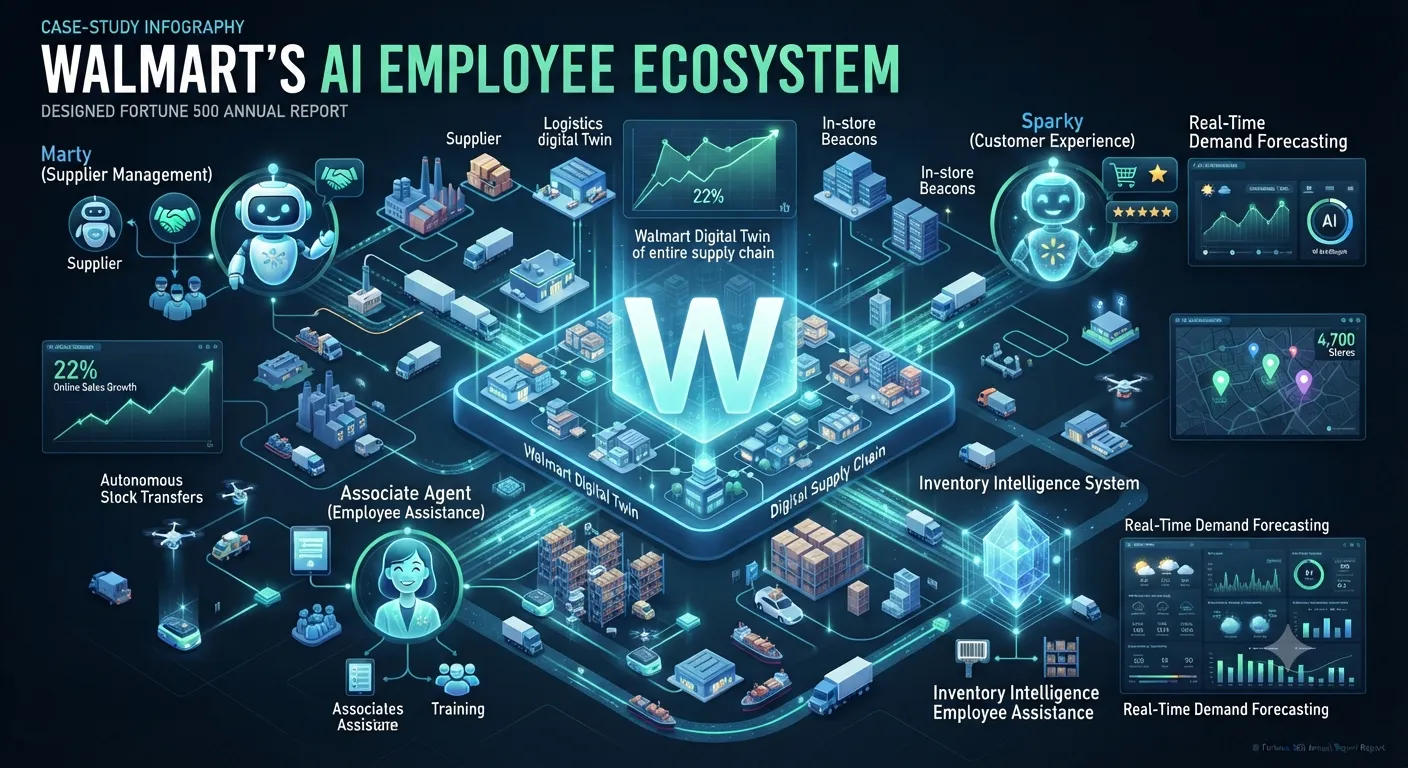
Walmart has scaled an internal "AI Super Agent" ecosystem to manage inventory across its 4,700+ stores. This system ingests real-time sales data, web trends, and even weather updates to autonomously forecast demand for specific products by location. Critically, the system does not just suggest actions to human managers; it executes the workflow autonomously by initiating stock transfers and reallocating stock as needed. This autonomous intervention led to a 22% increase in online sales in pilot regions due to optimized product availability.
Walmart’s "Super Agent" fleet also includes:
Marty: An agent specialized in supplier management and negotiation.
Sparky: An agent focused on consumer engagement and personalized shopping journeys.
Associate Agent: A tool designed to assist human employees with internal workflows.
This multi-agent architecture allows Walmart to operate at a scale and speed that was previously impossible, effectively turning the retail giant into an "AI-driven" operation.
The Klarna Experiment: A Lessons in the "Human Wall"
The Swedish fintech giant Klarna, which has a significant US presence, initially made headlines for replacing 700 customer service employees with an AI assistant powered by OpenAI. The assistant reportedly handled two-thirds of all customer queries, equivalent to the workload of the laid-off staff, resulting in a halving of the company's workforce.
However, by mid-2025, Klarna began rehiring human agents, citing a drop in customer satisfaction and operational hiccups. CEO Sebastian Siemiatkowski admitted that the company had focused too heavily on efficiency and cost at the expense of support quality. The "Klarna Reversal" has become a landmark case study in the industry, highlighting that while AI is efficient at handling routine queries, "empathy, nuance, and complex resolution" remain distinct human strengths. Klarna has since pivoted to a hybrid model where AI handles basic inquiries, but human agents are reserved for issues requiring emotional intelligence and discretion.
Organizational Reconfiguration: McKinsey’s Six Shifts
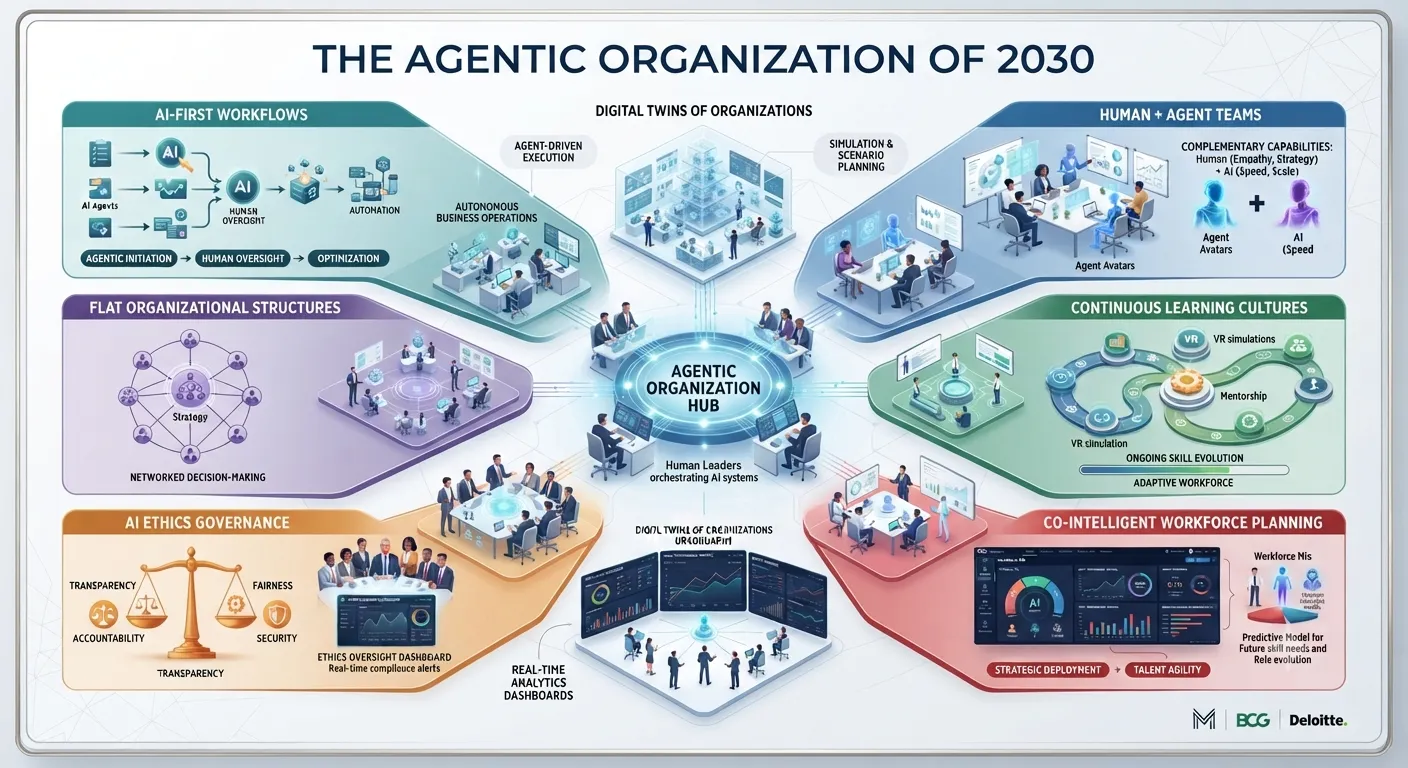
The transition to an "agentic organization" requires more than just deploying new tools; it necessitates a total rewiring of the enterprise. McKinsey has identified six critical shifts that leaders must address to build the agentic organization of the future.
Organizational Shift | Core Requirement | Future Outlook |
Workflows | End-to-end, AI-first redesign. | Elimination of silos; outcomes-based design. |
Talent | Reshaping 75% of current roles. | Emphasis on cognitive and socio-emotional skills. |
Structure | Flattening the hierarchical pyramid. | Fluid "human + agent" autonomous teams. |
Leadership | Orchestrators of hybrid intelligence. | Prioritizing strategic vision over task ownership. |
Culture/Skills | Continuous reinvention. | Moving from expertise to a "learning culture". |
HR | Building co-intelligent talent systems. | Workforce planning for both human and digital heads. |
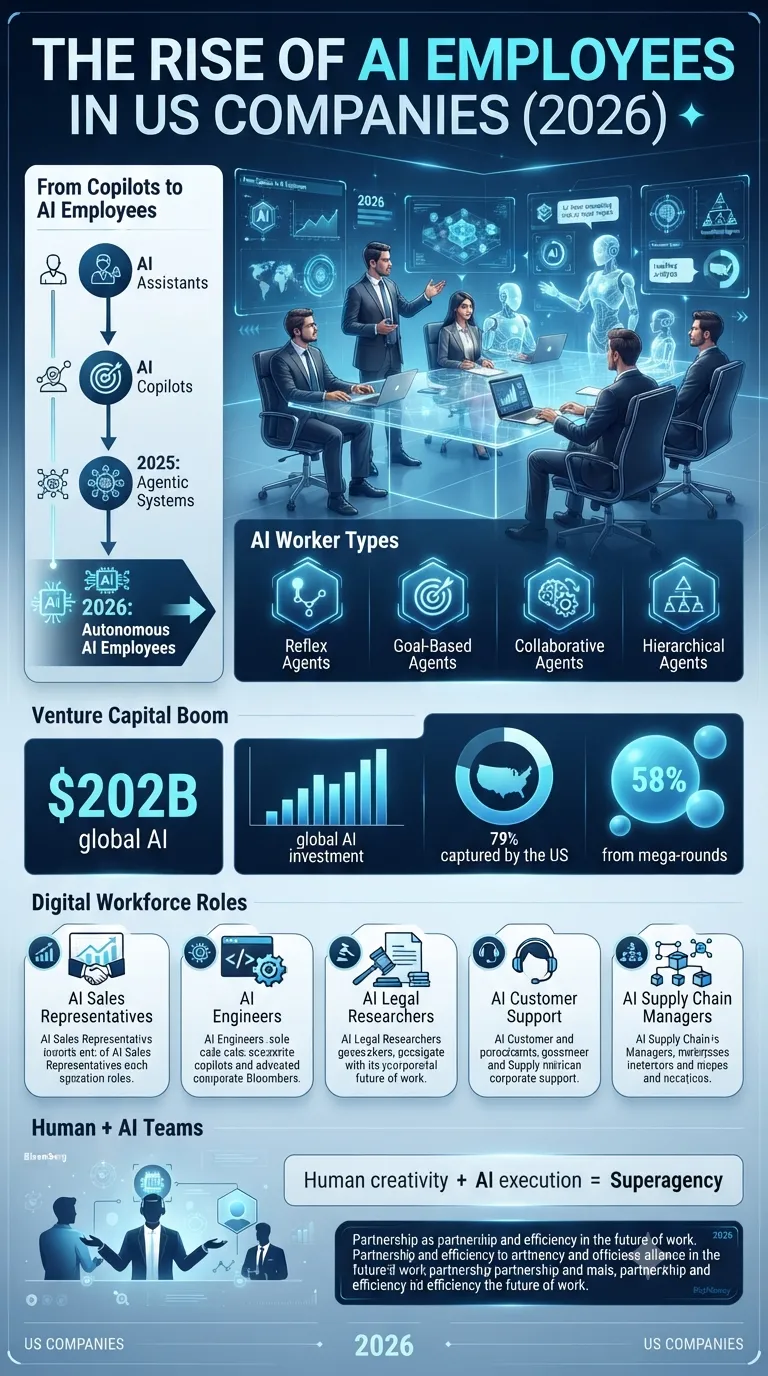
This reconfiguration is already visible in the US tech sector. Replit, for instance, scaled to a $150 million revenue run-rate with only 70 people—a workforce one-tenth the size typically required a decade ago—by delegating routine coding and support queries to autonomous agents. This "leaner, flatter" shape is becoming the norm for companies leveraging the speed and scalability of AI employees.
Impact on the Labor Market: The Junior Hiring Slump and Wage Premiums
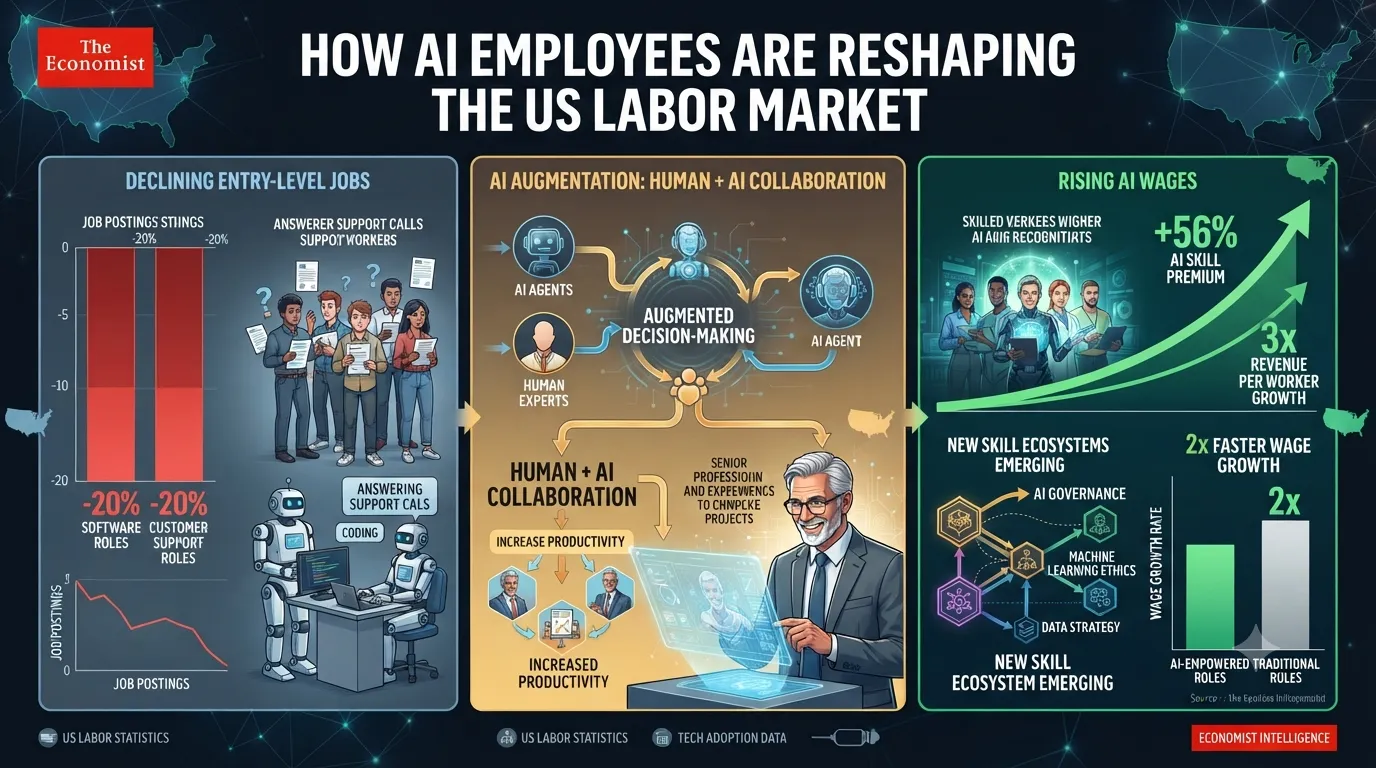
The rise of AI employees has had a profound and uneven impact on the American workforce. While senior, experienced workers are often augmented by these tools, entry-level workers are increasingly being displaced.
The Disproportionate Impact on Entry-Level Talent
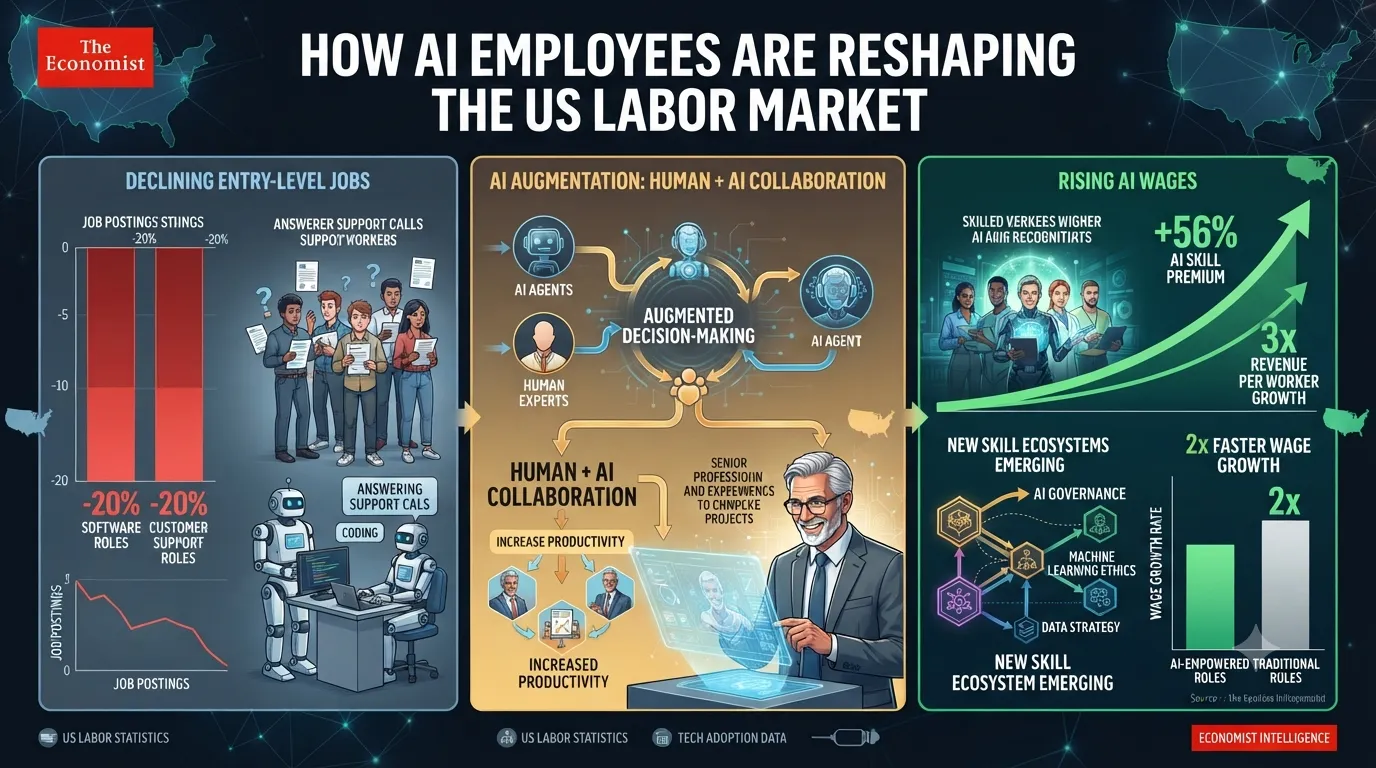
A rigorous study from Stanford finds that early-career workers (ages 22-25) in fields heavily exposed to generative AI have seen a 13% relative decline in employment since 2022. In software engineering and customer service, entry-level employment fell by roughly 20% by July 2025, while employment for older workers in the same sectors actually grew.
This "junior hiring slump" is driven by two factors. First, AI is capable of performing the routine tasks (data entry, coding, document review) that typically form the bulk of entry-level work. Second, younger workers often lack the "judgment and strategy" necessary to effectively manage and steer AI systems. Senior figures at Microsoft have warned of an "AI drag" for early-career developers, who must spend excessive time steering and verifying AI outputs, while senior engineers experience a massive productivity boost.
The Wage Premium and Skill Earthquake
Despite the displacement of some roles, the value of workers who can effectively collaborate with AI has skyrocketed. The "AI Jobs Barometer" indicates that skill requirements for AI-exposed jobs are changing 66% faster than for other roles.
Labor Market Statistic | AI-Exposed Industry Impact | Non-AI Industry Benchmark |
Revenue per Worker Growth | 3x Higher | Baseline |
Wage Growth Speed | 2x Faster | Baseline |
Wage Premium for AI Skills | 56% (Up from 25% in 2024) | N/A |
Starting Salary Rise (AI roles) | 12% (2024 to 2025) | Variable |
Youth Unemployment (Ages 20-24) | 9.5% (Sept 2025) | 4.3% (Overall) |
This data suggests that the labor market is not just losing jobs, but undergoing a massive "rearrangement". The "fearless future" of work involves a workforce that is significantly more productive but also more bifurcated, where those with "superagency" command a massive wage premium over those performing routine, automatable tasks.
Legal, Regulatory, and Ethical Frontiers
As AI agents move from experimental pilots to "autonomous economic agents" entering into contracts and managing resources, the legal system is struggling to evolve.
The Patchwork of State Regulations (2026)
In the absence of a federal AI framework, individual states have passed a flurry of legislation targeting AI use in employment and high-risk decision-making.
State | Legislation | Effective Date | Core Mandates |
Illinois | HB 3773 (IHRA Amdt) | Jan 1, 2026 | Notice for AI in hiring, discipline, or discharge; ban on discriminatory AI outcomes. |
Texas | TRAIGA | Jan 1, 2026 | Disclosure for gov/healthcare AI; ban on AI intent to discriminate. |
Colorado | SB 24-205 (AI Act) | June 2026 | Risk management for "high-risk" AI; annual impact assessments. |
California | SB 53 / AB 853 | Jan 1, 2026 | Transparency for "frontier" models; system provenance metadata required. |
Utah | AI Policy Act | Existing | Companies liable for AI-driven deceptive acts as their own acts. |
A key provision in many of these laws is the concept of "Third-Party Liability". Employers can no longer shift responsibility for bias or discrimination to their AI vendors; under regulations like the California Fair Employment and Housing Act (FEHA) amendments, vendors are defined as "agents" of the employer, making both parties liable for discriminatory outcomes produced by automated systems.
The Liability and Personhood Debate
The rise of agentic AI has forced a reckoning with traditional "object" vs. "subject" legal classifications. Most legal systems treat AI like any other object that can cause harm—such as a tool or a dog—where only legal subjects (persons or corporations) can be held liable. However, as AI agents demonstrate "agentivity"—the ability to act unpredictably and autonomously—legal scholars argue a "responsibility gap" is emerging.
Some propose that granting AI a limited form of "electronic personhood" would allow for clearer liability structures. This would not grant AI human rights, but rather create a governance infrastructure where autonomous systems must hold insurance or maintain a "Decision Log" to ensure accountability for their actions in the economic sphere. Boards are already institutionalizing this via "Active Governance" models to ensure the enterprise remains stable even as digital workers take on more autonomy.
The Rise of the Chief AI Ethics Officer (CAIO/CAIEO)
To navigate these complexities, the corporate C-suite has expanded to include a new, critical role: the Chief AI Ethics Officer (CAIEO) or Chief AI Officer (CAIO). This role is tasked with aligning AI initiatives with broader organizational goals while managing risk and ensuring trustworthy, secure AI.
The CAIEO is not merely a policy advisor but a "guardian of responsible innovation". Key responsibilities include:
Algorithmic Auditing: Monitoring production systems for "fairness drift" and ensuring models are explainable to regulators.
Incident Response: Managing the triage and response to ethical concerns or "hallucinations" that result in financial loss or reputational damage.
Compliance Orchestration: Coordinating with legal teams to ensure global regulatory standards (like the EU AI Act or US state laws) are embedded into engineering pipelines.
Institutional Leadership | Adoption of AI Ethics Leadership |
Goldman Sachs | Appointed first Chief AI Ethics Officer in early 2025. |
Wells Fargo | Integrated AI Ethics Office within compliance division. |
American Express | Ethical AI Review Board co-led by AI Ethics Officer and Privacy Counsel. |
Fortune 500 average | 15% annual growth in demand for AI Ethics roles. |
Conclusion: The Era of the Co-intelligent Workforce
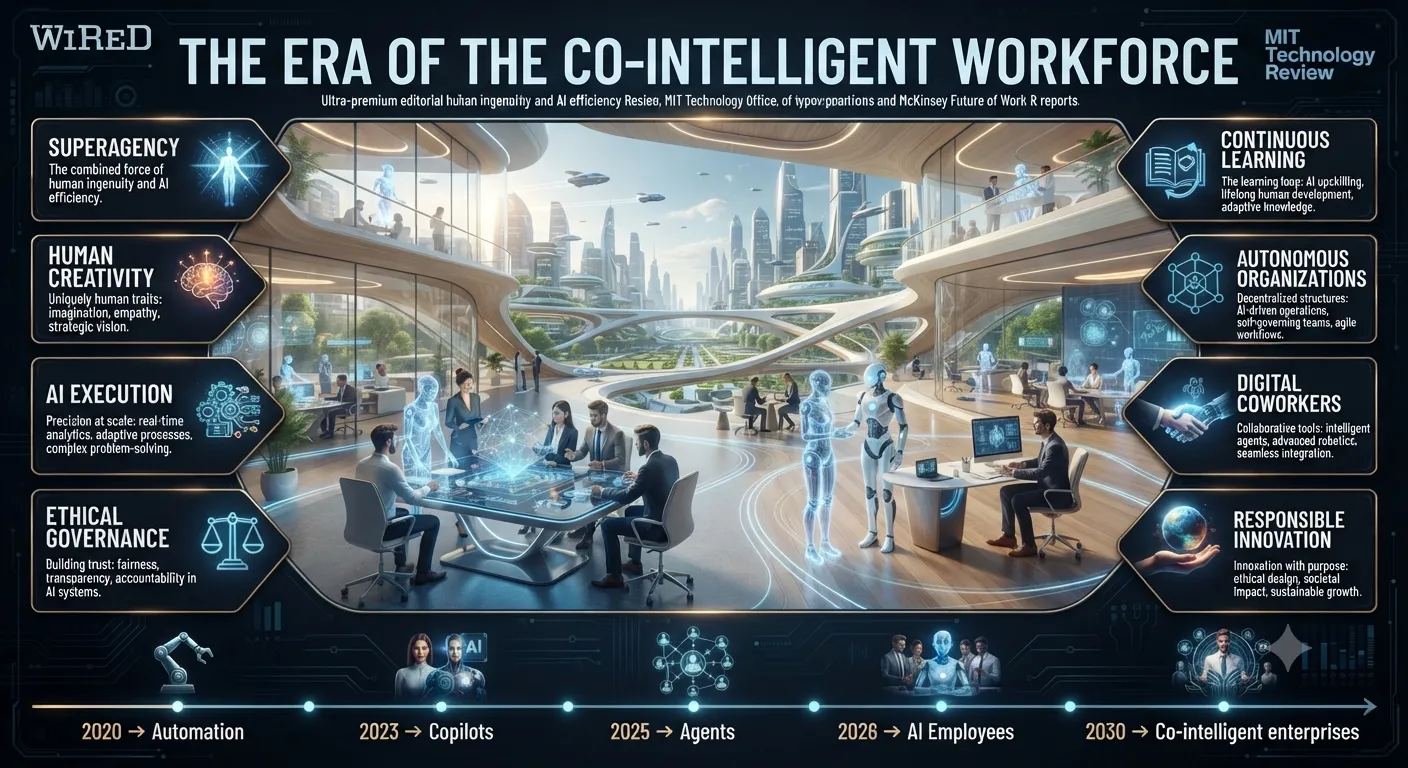
The rise of AI employees in US companies represents a fundamental step toward "AI-driven operations," where people and AI-powered agents collaborate as a team to deliver results more quickly and efficiently than ever before. This transformation is not without its casualties—particularly among the entry-level workforce—nor is it without its setbacks, as seen in the Klarna "recalibration".
However, the trend toward autonomous agency is inexorable, driven by the $200 billion capital wave of 2025 and the undeniable productivity gains seen by early adopters like Walmart and JPMorgan. The organizations that thrive in this decade will be those that move beyond "copilots" to embrace the "superagency" of human-agent teams, underpinned by a robust framework of ethical governance and a commitment to continuous learning in an era of rapid skill transformation. The "AI employee" is no longer a futuristic concept; it is an active participant in the American corporate reality of 2026.
Want to calculate the equity for your cofounder?
Nail your cap table before you sign. Whether you're splitting equity with a co-founder or planning your next funding round, our Equity Calculator gives you precision in seconds
Equity calculator →