The Real Advantage IIT/NIT Students Have in Startups
June 29, 2026 by Harshit Gupta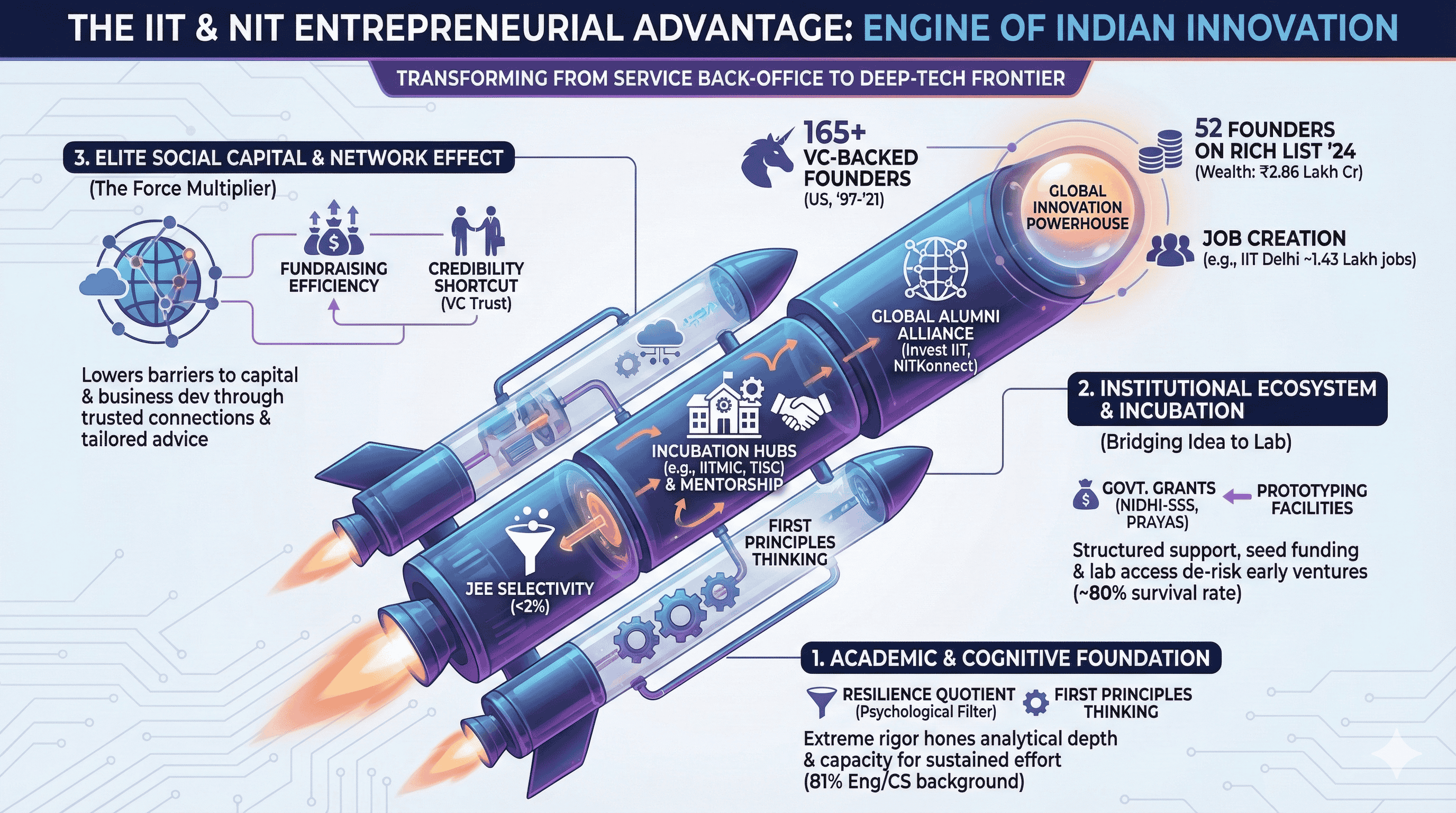
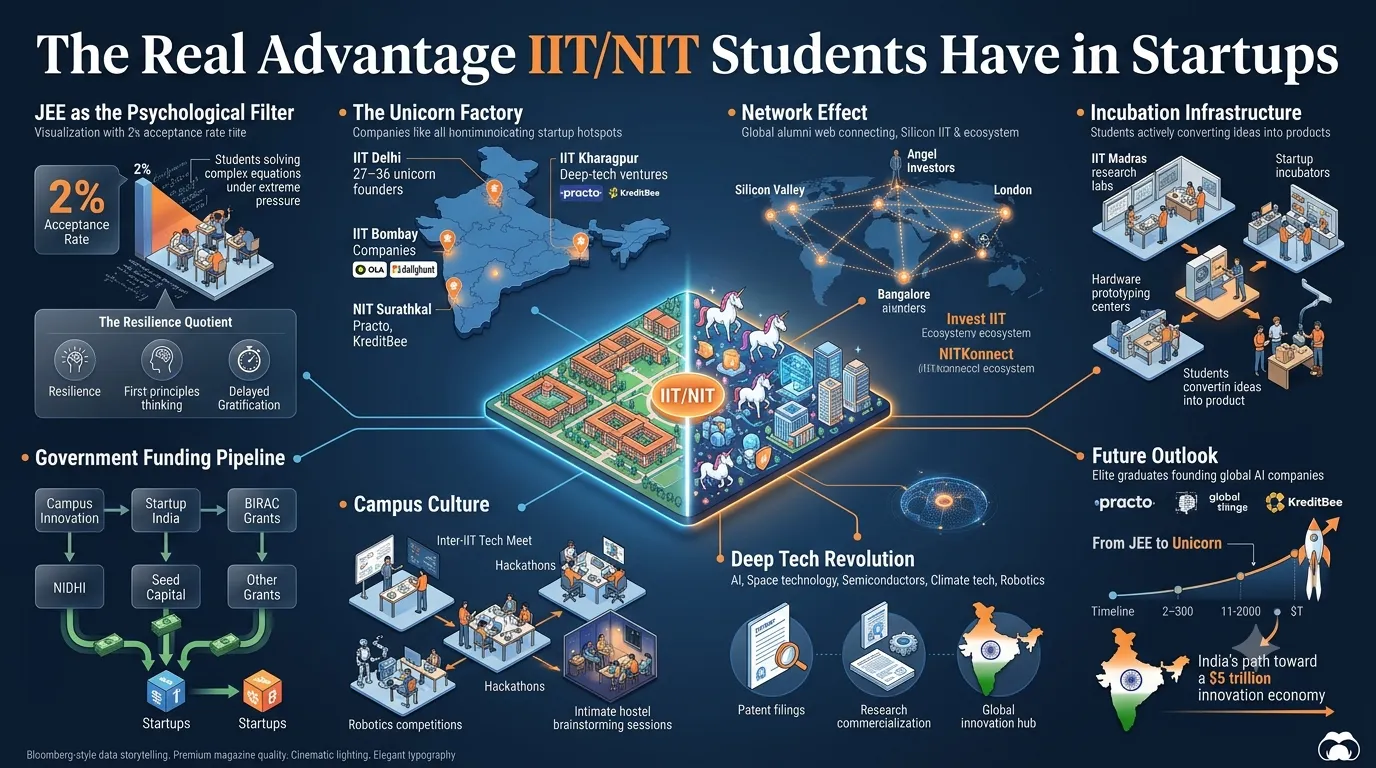
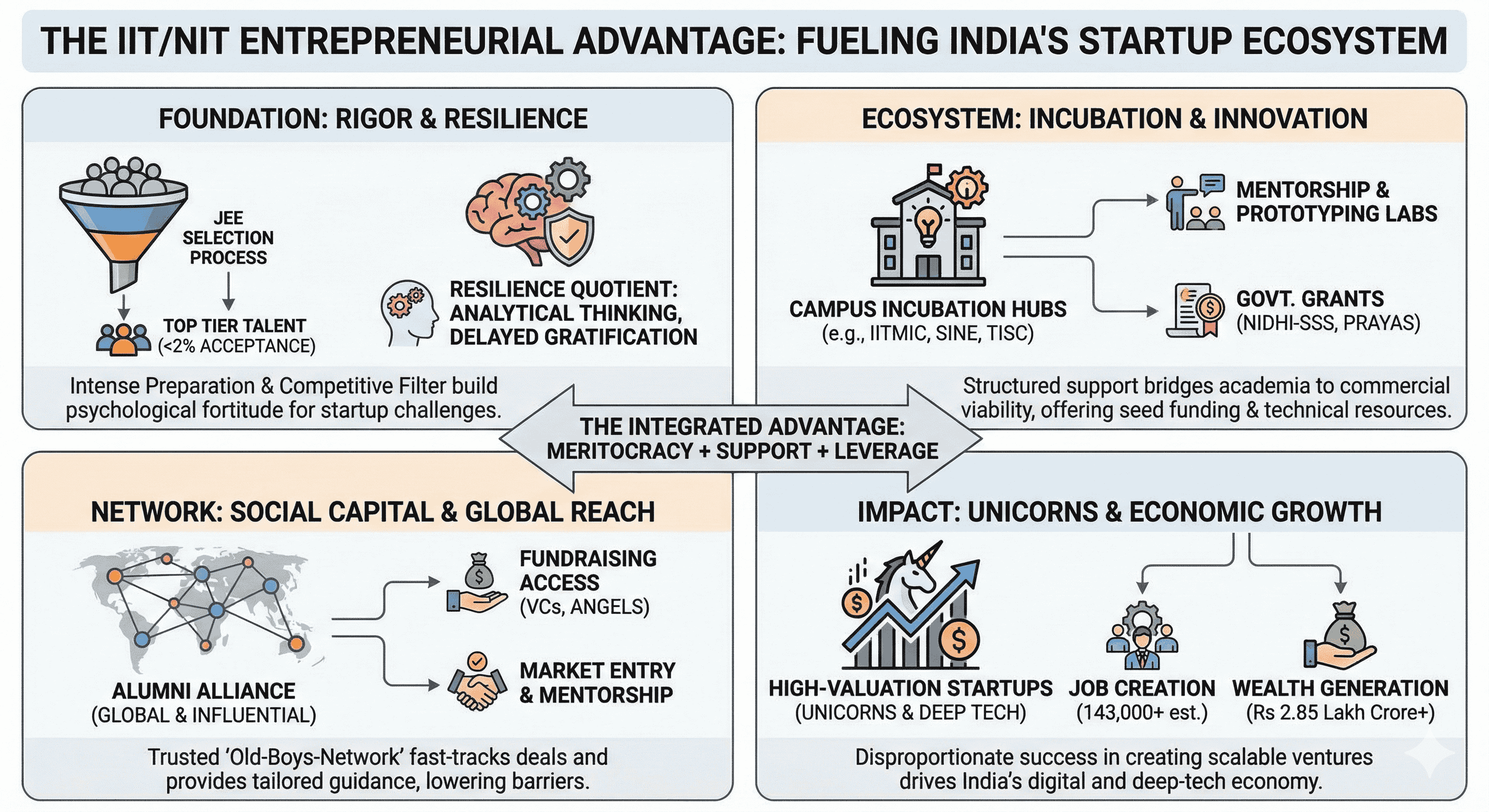
The landscape of Indian entrepreneurship has undergone a seismic shift over the last three decades, evolving from a service-oriented back-office paradigm into a global powerhouse of innovation and deep-tech development. At the epicenter of this transformation lies a specific institutional phenomenon: the disproportionate success of alumni from the Indian Institutes of Technology (IITs) and the National Institutes of Technology (NITs). These premier technical institutions do not merely produce engineers; they act as a sophisticated filtration and grooming system that equips founders with a unique combination of technical rigor, psychological resilience, and access to elite social capital. The advantage these students possess is not a singular trait but a multifaceted ecosystem of benefits that begins with one of the world's most competitive entrance examinations and extends into a lifelong network of influence and investment.
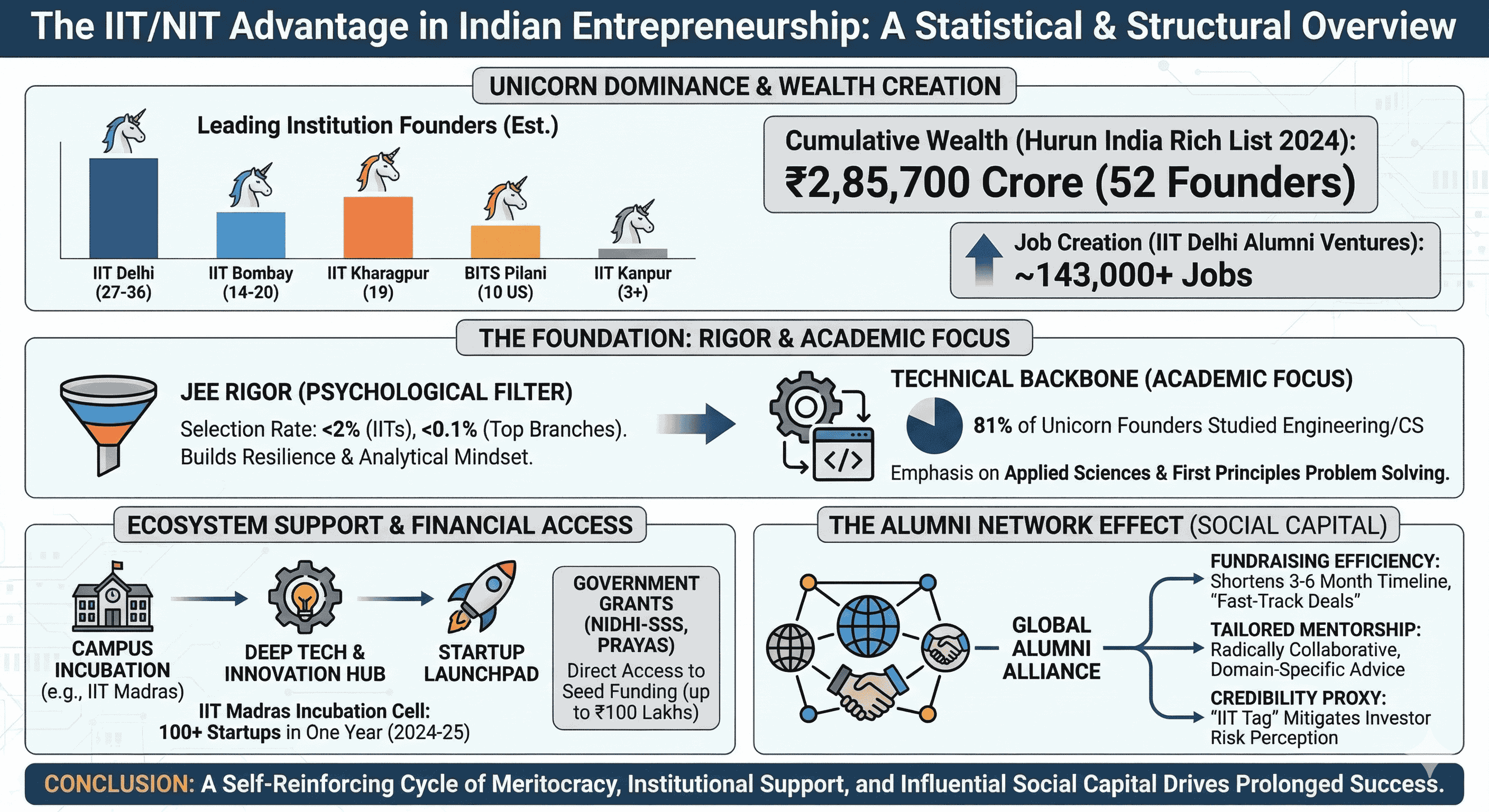
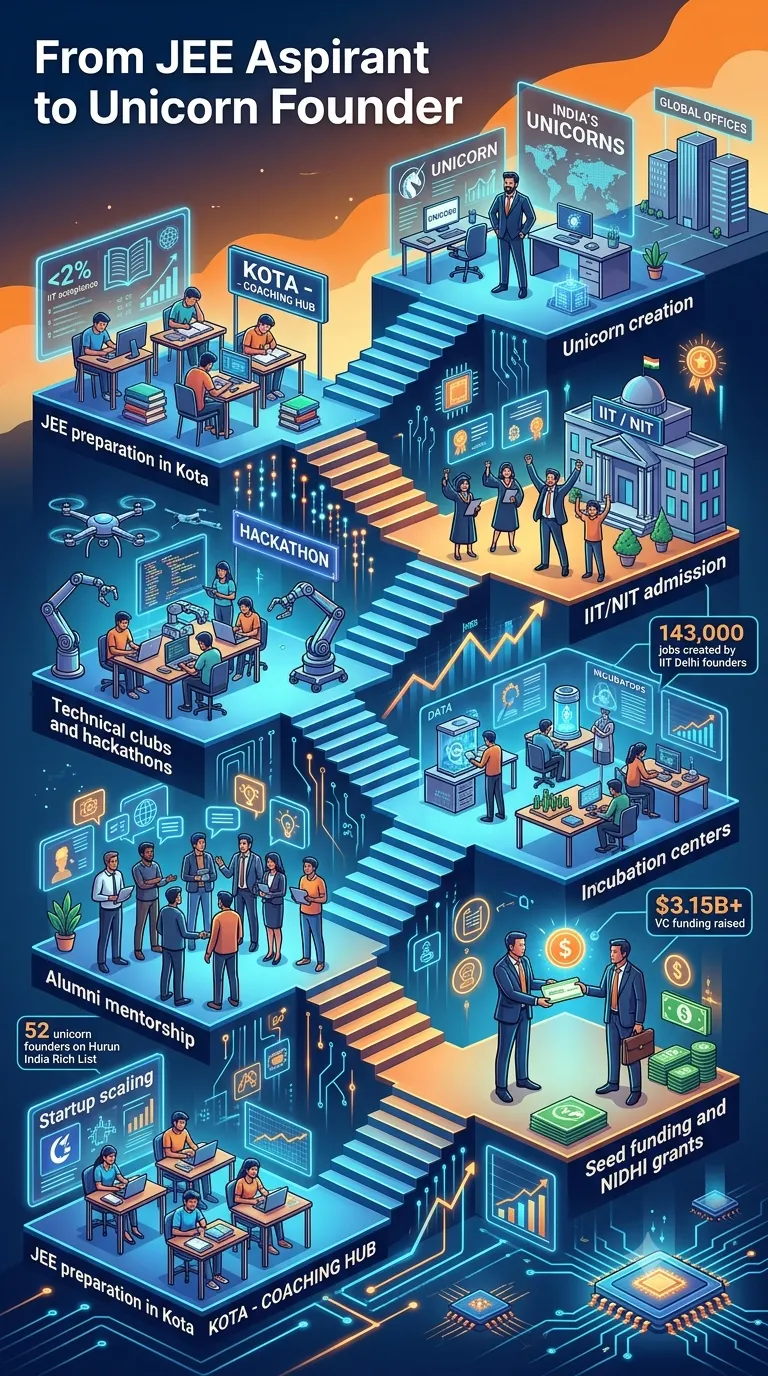
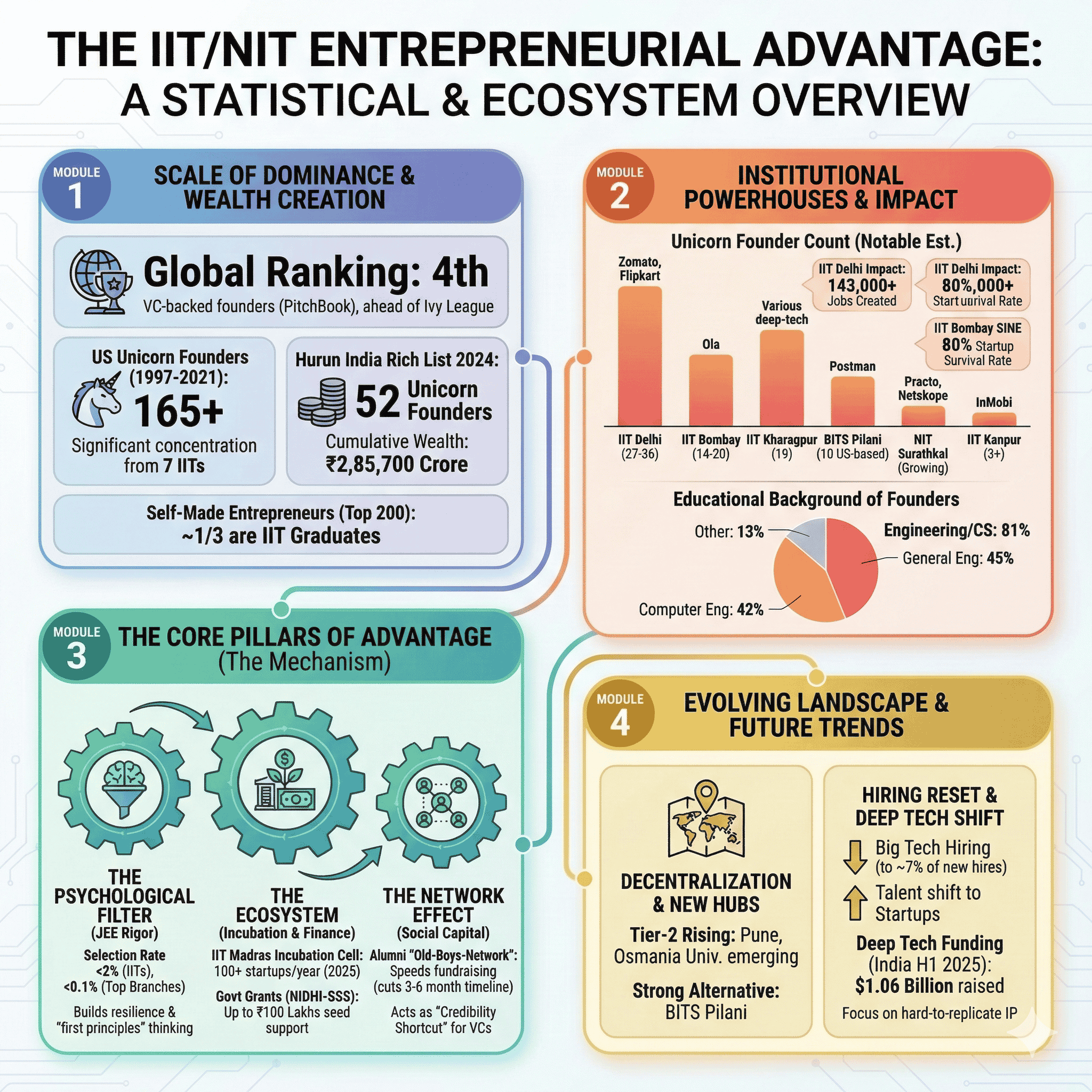
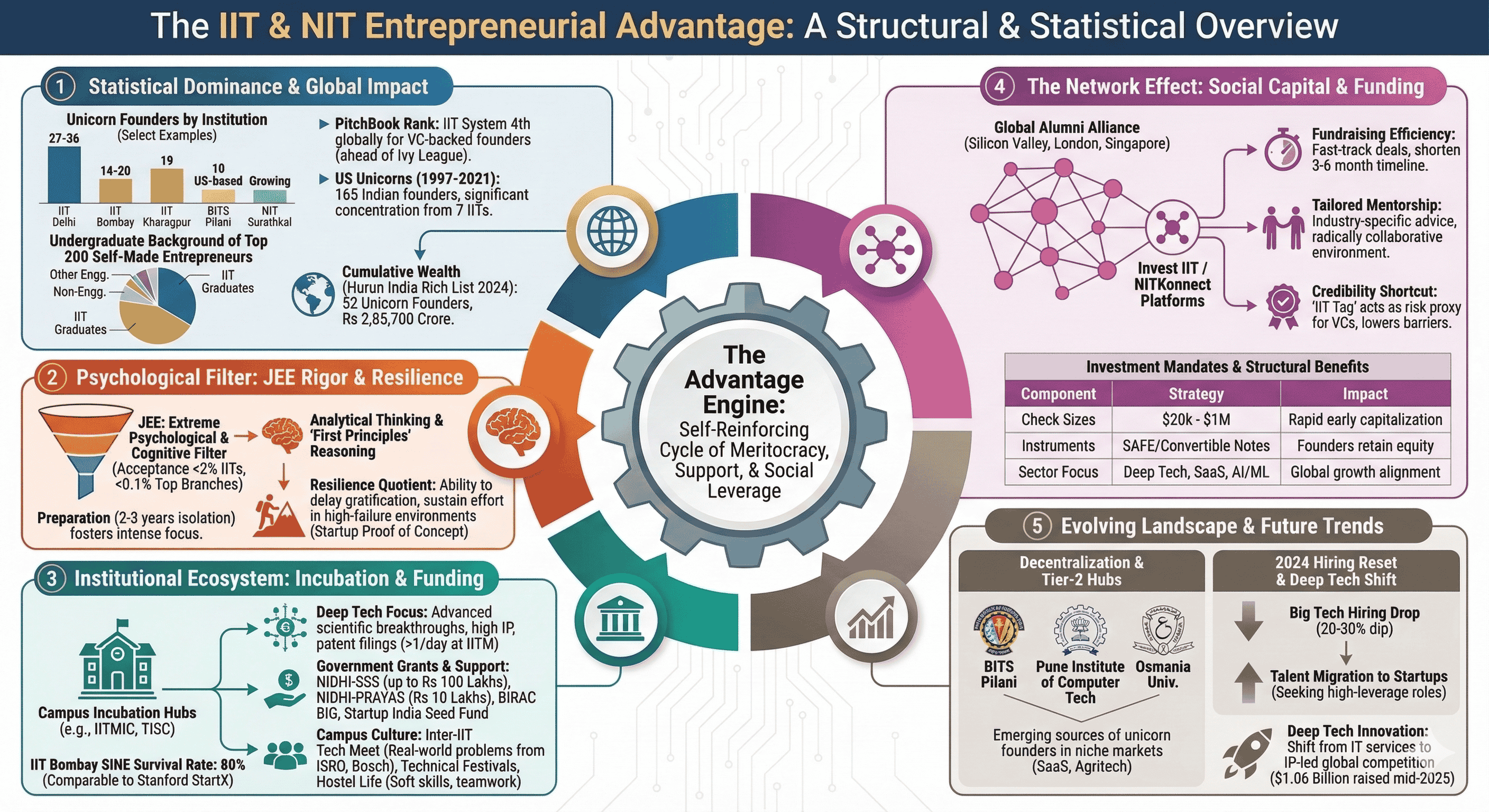
The statistical dominance of these institutions is well-documented but warrants a deeper examination of the underlying causal mechanisms. Between 1997 and 2021, a study identified 165 Indian founders or co-founders running venture capital-backed unicorns in the United States alone, with a significant concentration from seven specific IITs. Within India, the data is even more skewed toward these premier institutions. IIT Delhi, for instance, has emerged as a national leader, producing 27 unicorn founders and facilitating the creation of approximately 143,000 jobs through its alumni-led ventures. This institutional dominance is reflected in the broader economic landscape, where 52 unicorn founders featured on the Hurun India Rich List 2024, contributing to a cumulative wealth of Rs 2,85,700 crore. To understand why this concentration exists, one must look past the brand name and into the rigorous academic, social, and financial structures that define the IIT and NIT experience.
The Quantitative Dominance of Premier Technical Institutions
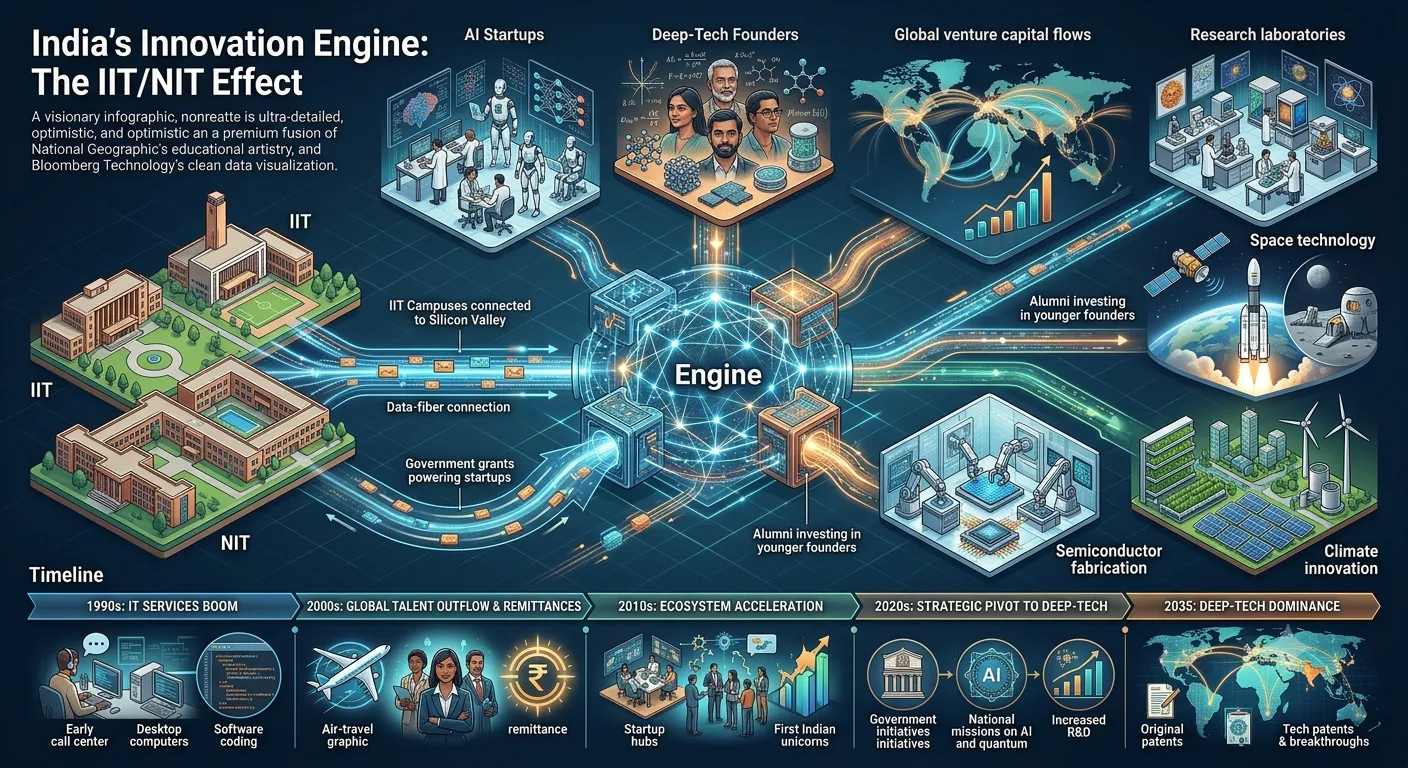
The numerical evidence of the "IIT/NIT advantage" is overwhelming when analyzed through the lens of high-valuation startups. While the startup ecosystem is beginning to decentralize, the historical and contemporary concentration of high-value founders within these campuses remains a defining feature of the Indian economy. A longitudinal study conducted by PitchBook Data ranked the IIT system fourth globally in terms of producing venture capital-backed founders, positioning it ahead of prestigious Ivy League institutions such as Princeton, Yale, and Cornell. Between 2009 and 2014, the IIT system produced 264 entrepreneurs who founded 205 companies and raised over $3.15 billion in capital.
The concentration of wealth and innovation is particularly evident when examining the undergraduate backgrounds of India's most successful self-made entrepreneurs. IIT Delhi leads this category with 36 founders, followed closely by IIT Bombay with 20 and IIT Kharagpur with 19. Collectively, nearly one-third of the individuals on the list of India's top 200 self-made entrepreneurs are IIT graduates, cementing their status as a cradle of innovation and entrepreneurial talent.
Institutional Contributions to the Global Startup Ecosystem
The following data outlines the institutional distribution of unicorn founders and the specific ventures associated with these premier colleges. The data suggests that while the "Old IITs" (Delhi, Bombay, Kharagpur) maintain a significant lead, the NIT system and newer IITs are rapidly scaling their output.
Institution | Number of Unicorn Founders | Notable Startups / Founders | Primary Economic Impact |
IIT Delhi | 27 - 36 | Zomato (Deepinder Goyal), Oxyzo (Ruchi Kalra), Flipkart (Bansals) | 143,000+ jobs created |
IIT Bombay | 14 - 20 | Ola (Bhavish Aggarwal), Dailyhunt (Virendra Gupta) | High concentration in mobility and content |
IIT Kharagpur | 19 | 9Stacks, various deep-tech ventures | Core engineering leadership |
IIT Kanpur | 3+ | InMobi (Naveen Tewari) | Mobile advertising and global SaaS |
IIT Roorkee | Notable contributors | InMobi (Mohit Saxena) | Technical infrastructure leadership |
NIT Surathkal | Growing source | Practo, Netskope, KreditBee | 45,000+ global alumni network |
NIT Warangal | Vibrant source | Diverse tech-enabled startups | Key regional entrepreneurship hub |
BITS Pilani | 10 (US-based) | Postman, various Silicon Valley startups | Strongest non-IIT technical source |
The academic focus of these founders is overwhelmingly technical, which provides a significant advantage in an era where software and deep tech dominate venture capital interest. Research reveals that 81% of unicorn founders studied engineering, computer science, or both. Specifically, 45% focused on general engineering while 42% specialized in computer engineering, demonstrating that a background in applied sciences is almost a prerequisite for building a scalable unicorn in the modern era.
The Psychological Filter: JEE Rigor and the Resilience Quotient
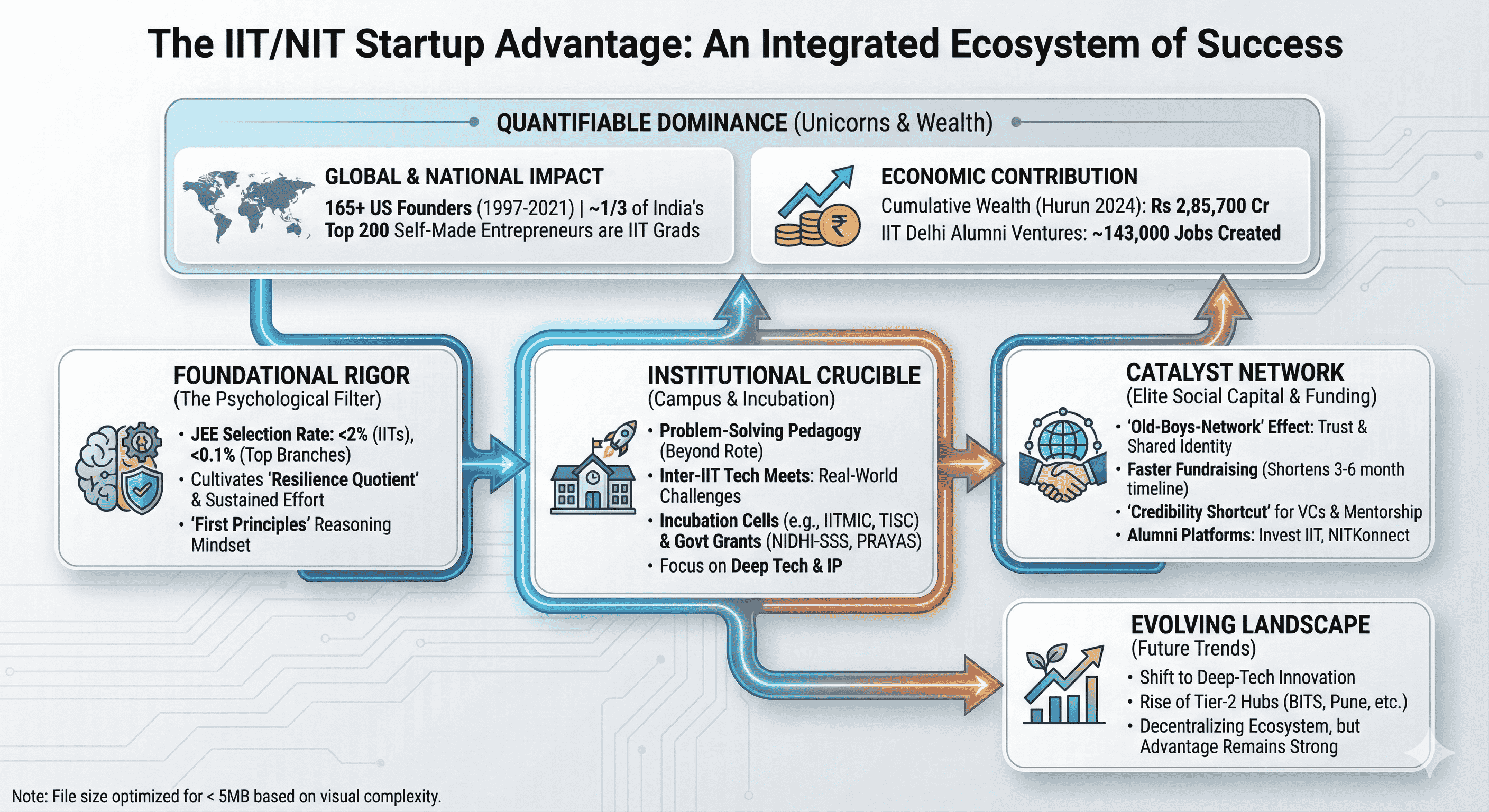
The advantage of an IIT/NIT student begins long before they set foot on campus. The Joint Entrance Examination (JEE) serves as an extreme psychological and cognitive filter. With a selection rate of less than 2% for the IITs—and less than 0.1% for top-tier branches like Computer Science—the exam identifies individuals who possess not only high intelligence but an extraordinary capacity for sustained effort. This process is not merely about testing academic knowledge; it is about testing the "Resilience Quotient" of the individual.
The preparation for this examination, which often begins in the early teenage years, requires students to move to coaching hubs like Kota and spend 2-3 years in near-total isolation from normal social life. This period of extreme focus creates a mindset built on analytical thinking and "first principles" reasoning. From an entrepreneurial perspective, the JEE grind acts as a proof of concept for the ability to delay gratification. Venture capitalists often view the "IIT tag" as a signal that the founder is capable of working intensely on a single, difficult problem for years without any guarantee of success—a fundamental requirement for navigating the high-failure environment of a startup.
The Evolution of Academic Merit into Entrepreneurial Logic
The pedagogical shift within these institutions from rote memorization to application-based problem solving further hones this entrepreneurial mindset. The JEE itself has redefined learning standards, pushing students to go beyond textbooks to develop a scientific approach to learning. This cognitive flexibility is a direct precursor to the "pivot" in startup strategy. A student who has spent years evaluating multiple approaches to a complex physics problem is naturally more prepared to evaluate multiple business models when their initial hypothesis fails.
Furthermore, the "middle-class drive" prevalent among many IITians provides a potent motivational engine. Ashish Gupta of Helion Advisors notes that many of these students come from families where academic success is the primary vehicle for upward mobility, fostering a hunger for success that translates well into the high-stakes world of venture-backed startups. This demographic dividend, when converted into quality technical human resource, is expected to accelerate India’s goal of becoming a $5 trillion economy.
The Network Effect: Institutionalized Social Capital
Perhaps the most tangible advantage held by IIT and NIT students is the "old-boys-network" effect. This social structure operates on a principle of trust and shared identity, significantly lowering the barriers to entry for fundraising and business development. Research into online social networks of founders confirms that universities with more central positions in national networks—and those with a high density of links between their own alumni—tend to produce more successful startups.
Tapping the Global Alumni Alliance
The IIT alumni network is described as "incredibly powerful and influential," spanning major industries and geographic hubs like Silicon Valley, London, Singapore, and Bangalore. Platforms like "Invest IIT" have been established to capitalize on this connection, offering centralized access to pooled alumni capital. For a first-time founder, this network provides a significant advantage in three key areas:
Fundraising Efficiency: Tapping into alumni networks can significantly shorten the 3-6 month timeline typically required for fundraising. The platform serves as a mechanism to "fast-track deals," which is crucial for lean teams requiring immediate working capital.
Tailored Mentorship: Unlike generic startup accelerators, alumni backing offers "tailored advice." Founders gain access to mentors who understand the specific technical and cultural rigors of their background, fostering a "radically collaborative" environment.
The Risk Proxy: VCs often use the alumni badge as a "credibility shortcut." In the absence of hard revenue data, an IIT pedigree suggests a baseline level of intelligence and work ethic. As noted by industry observers, "if an investor goes wrong with an IITian, there is very little blame on them," making it a safer bet for low-risk-calibre Indian VCs.
The NIT alumni ecosystem, while historically less centralized than the IIT network, is witnessing a rapid expansion. Events like "NITKonnect" draw thousands of alumni founders, CXOs, and angel investors to collaborate on new ventures. Notable startups like Practo and KreditBee, founded by NIT Surathkal alumni, illustrate that these networks are becoming increasingly proficient at fostering high-growth enterprises.
Investment Mandates and Structural Benefits
Investment Component | Strategy for IIT/NIT Alumni | Impact on Startup Success |
Mandatory Requirement | At least one co-founder must be an IIT graduate | High-signal filtering |
Check Sizes | $20,000 to $1,000,000 per deal | Rapid early-stage capitalization |
Instruments | Primarily SAFE or Convertible Notes | Founders retain more equity early on |
Mentorship | Global alliance of alumni experts | Reduces "CEO distraction" |
Sector Focus | Deep Tech, SaaS, AI/ML, Fintech | Alignment with global growth sectors |
This structured approach to alumni investing creates a "funding-first" advantage where promising concepts are less likely to stall due to a lack of initial guidance or capital.
The Incubation Ecosystem: Bridging Academia and Industry
The physical infrastructure for entrepreneurship on IIT and NIT campuses has evolved from simple clubs into sophisticated, multi-stage incubation hubs. These centers provide the critical link between academic research and commercial viability, offering resources that are often unavailable to students at Tier-3 colleges.
IIT Madras: A Benchmark for Deep Tech
The IIT Madras Incubation Cell (IITMIC) serves as a benchmark for university-affiliated support systems. Focusing on "deep tech"—technologies grounded in advanced scientific breakthroughs that are hard to replicate—it has fostered more than 100 startups in a single year ending March 2025. This momentum mirrors a national shift to redefine India as a global technology innovation powerhouse.
The ecosystem at IIT Madras includes specialized labs and prototyping facilities, allowing startups to develop products efficiently without massive upfront costs. Furthermore, the "Nirmaan" program acts as a pre-incubator where students can "walk in with an idea and walk out with a product," providing seed funding and mentorship at the earliest stages of conceptualization. Success stories from this environment include Ather Energy and Hyperverge, which have raised significant venture capital and created disruptive market solutions.
IIT Jammu and Newer Institutions
Even newer institutions like IIT Jammu are prioritizing startup culture through Technology Innovation and Startup Centers (TISC). These centers focus on emerging sectors like AI, Blockchain, IoT, and Clean Energy, bridging the gap between academia and industry through structured incubation programs and grants. This ensures that the "IIT advantage" is not limited to legacy campuses but is being institutionalized across the entire network.
Government Grants and Institutional Preference
A significant portion of India's startup-focused government grants is channeled through Technology Business Incubators (TBIs) at IITs and NITs. Programs like the National Initiative for Developing and Harnessing Innovations (NIDHI) utilize these institutes as their primary disbursement vehicles.
Grant/Scheme | Financial Quantum | Targeted Outcome |
NIDHI-SSS (Seed Support) | Up to Rs 100 Lakhs | Market entry and scaling |
NIDHI-PRAYAS | Rs 10 Lakhs | Prototype development |
BIRAC BIG (Biotech) | Up to Rs 50 Lakhs | High-risk biotech innovation |
Startup India Seed Fund | Variable | Early-stage proof of concept |
GENESIS (MeitY) | Up to Rs 10 Lakhs | Digital innovation in Tier-II/III |
This institutional linkage ensures that students at these colleges have a direct path to public capital. The NIDHI-SSS scheme alone provides a maximum of Rs 1,000 lakhs to host TBIs to ensure timely seed support for deserving incubatees.
Campus Technical Culture and Soft Skill Development
Beyond the classroom and the incubator, the very fabric of campus life at IITs and NITs is designed to foster an entrepreneurial spirit. Technical festivals and inter-institutional competitions provide a simulated high-pressure environment where students must solve real-world industry problems.
The Inter-IIT Tech Meet: An Entrepreneurial Sandbox
The Inter-IIT Tech Meet is a prestigious annual event where the 23 IITs compete in challenges set by leading organizations like ISRO, Bosch, and Jaguar Land Rover. These competitions differ from academic exams in several critical ways that favor future founders:
Interdisciplinary Collaboration: Problems often require a "perfect knowledge transfer" between members from disparate fields such as Mechanical Engineering, Electrical, and Strategy-making.
Real-World Problem Statements: Unlike theoretical exercises, these challenges focus on practical issues, such as developing tech-led solutions for rural entrepreneurs or energy harvesting systems for automotive dampers.
Pressure and Presentation: Teams must present their solutions to panels of industry experts, honing their ability to communicate complex technical ideas to non-technical stakeholders—a vital skill for any founder pitching to VCs.
Quantitative Thinking: Algorithmic trading or robotics challenges teach students to remain calm and analytical when things go wrong, preventing them from being "bogged down by wrong decisions".
Hostel life further contributes to this growth by encouraging self-discipline, time management, and emotional maturity through constant peer interaction and shared responsibilities. This "living ecosystem" ensures that students are not just learning theory but are constantly being tested in a competitive, intellectually stimulating environment.
The Shifting Landscape: Decentralization and New Challenges
While the IIT/NIT advantage remains robust, the Indian startup ecosystem is beginning to democratize. Data suggests that while elite pedigree is a powerful signal, the decentralization of entrepreneurial processes is allowing Tier-2 and Tier-3 cities to incubate innovation in niche markets such as agritech and edtech.
The Rise of Tier-2 Hubs and Alternative Institutions
Institutions like BITS Pilani, Savitribai Phule Pune University, and Osmania University are emerging as significant sources of unicorn founders. Pune, in particular, has become a vibrant hub, with institutes like the Pune Institute of Computer Technology producing alumni who built startups in the US.
Tier-2 / Alternative Source | Unicorn Founders (US Data) | Key Niche Markets |
BITS Pilani | 10 | SaaS, Developer Tools |
Pune Institute of Computer Tech | 6 (combined with SPPU) | Computer Engineering |
Osmania University | 6 | Diverse engineering sectors |
Ramrao Adik Institute of Tech | 3 | Regional tech leadership |
This shift is driven by the realization that while the "IIT tag" helps open doors, execution, adaptability, and real-world traction are the ultimate determinants of success. Many students from non-IIT backgrounds focus on building "something real with actual users" to stand out in the absence of institutional pedigree.
The Impact of the 2024 Hiring Reset
The year 2024 marked a pivotal change in the career aspirations of IIT/NIT graduates. A global economic slowdown led to a 20-30% dip in campus placements, with "Big Tech" firms like Amazon and IBM making limited hires compared to previous years. This reduction in corporate safety nets has inadvertently pushed more top-tier talent toward startups.
Talent Migration: New grad hiring at major tech companies dropped to just 7% of new hires, down from over 50% pre-pandemic. Companies are now optimizing for "productive on Day 1" hires, which often leaves new grads out of the big tech funnel.
Startup Appeal: Students increasingly view startups as offering more "enriching" learning opportunities than traditional corporate roles. This shift is driven by the ambition to eventually start their own ventures.
Hiring Evolution: Early-stage startups, leveraging AI tools to handle routine tasks, are focusing on hiring fewer but "exceptional" candidates, paying premium rates (upwards of Rs 50 lakh CTC) for top-tier talent from premier institutes.
This "hiring reset" is consolidating the relationship between elite engineering talent and early-stage ventures, as graduates seek high-leverage technical roles that only startups can currently provide.
Deep Tech and the Future of Indian Innovation
One of the most profound advantages IIT/NIT students have is their ability to lead India's transition into deep-tech innovation. While India has long been a global IT services powerhouse, the current generation of founders is shifting into high gear, moving beyond back-end support into the frontier of deep-tech.
The institutional research culture at the IITs—characterized by a pace of more than one patent filing a day at campuses like IIT Madras—is mobilizing capital for technologies that are "hard to replicate". As of mid-2025, deep-tech companies in India raised $1.06 billion in equity funding, nearly double the amount from the previous year. This shift allows IIT/NIT founders to compete on a global stage where intellectual property (IP) is the primary competitive advantage.
Comparative Success Outcomes: Survival and Valuation
The support ecosystems at these institutions directly correlate with higher survival rates for startups. IIT Bombay, for example, reports an 80% survival rate for its incubated ventures, a figure that mirrors elite global institutions like Stanford University.
Survival / Growth Metric | IIT Bombay (SINE) | Stanford (StartX) | National Average (India) |
Startup Survival Rate | 80% | 83% | Significantly lower (est. <10%) |
Avg. Funding Raised | High (facilitated) | $42 Million | Varies by sector |
Unicorn Generation | High (20+ founders) | High (20+ unicorns) | concentrated in metro hubs |
This data suggests that the "advantage" is not merely in starting a company but in the institutionalized support that prevents failure during the critical "valley of death" period for early-stage ventures.
Institutional Divergence: IITs vs. NITs
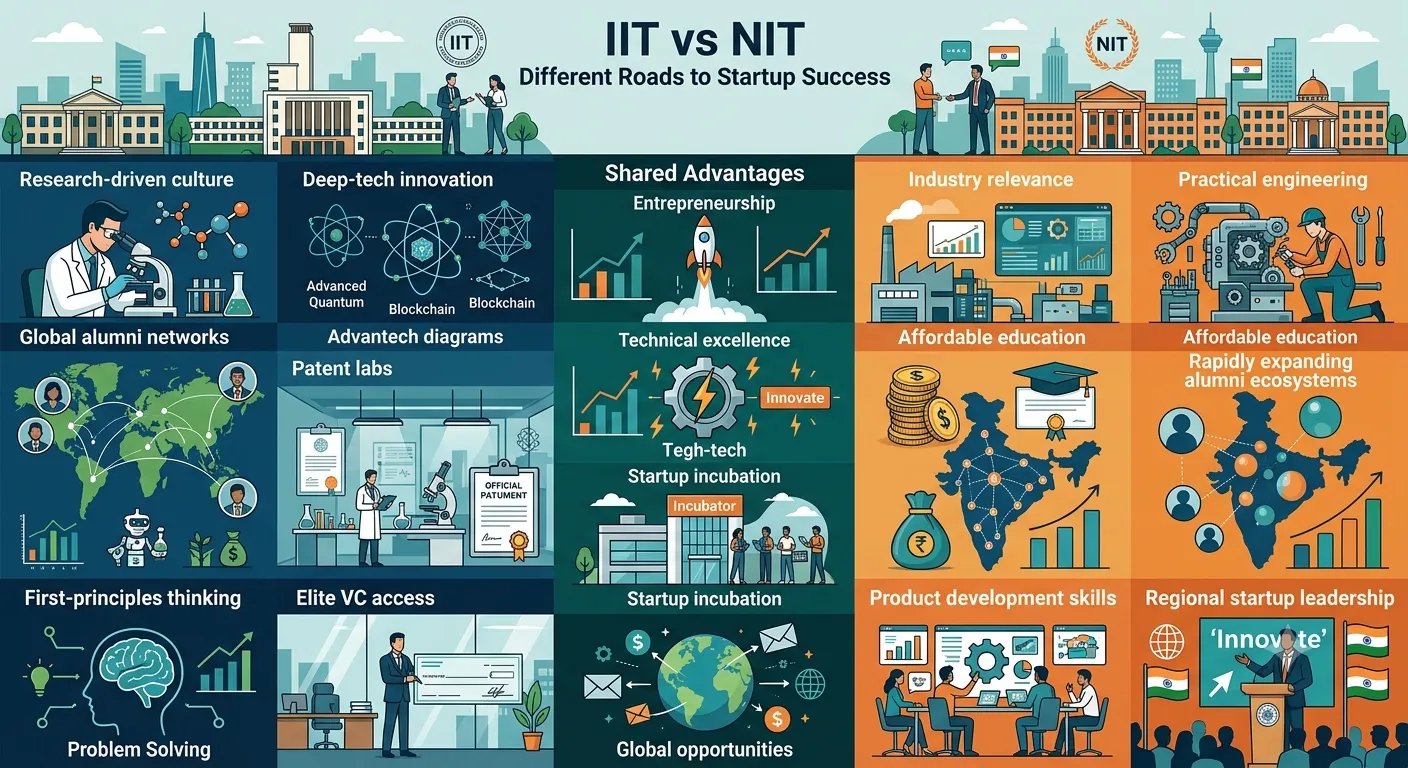
While often grouped together, the "Real Advantage" differs slightly between the IIT and NIT systems. The IIT system is traditionally more research and innovation-oriented, with a focus on establishing multiple research labs and fostering new inventions for global recognition. In contrast, NITs are often viewed as more productivity-driven institutions, focusing on the practical aspects of production and industry relevance.
Theoretical Depth vs. Practical Application
The IIT curriculum emphasizes in-depth conceptual learning and research-driven assignments, producing students who "invent feasible solutions for the nation's sustainable development". Conversely, NITs excel in providing practical, hands-on training that directly translates to immediate employability. If the goal is to "quickly enter the job market and start contributing to industry with practical skills," an NIT might offer a more direct path.
Feature | IIT Advantage | NIT Advantage |
Admission Basis | JEE Advanced (Toughest) | JEE Mains (Accessible) |
Core Focus | Research, Innovation, Invention | Productivity, Industrial Relevance |
Alumni Network | Established, Global, Influential | Rapidly expanding, Practical |
Financial Burden | Higher fees, more grants | Lower fees, highly affordable |
Curriculum | Theoretical, first principles | Hands-on, application-focused |
Despite these differences, both institutes are equally competent in providing placement opportunities due to their strong global alumni networking. The choice often depends on whether a founder aims to build a deep-tech research-heavy company or a market-relevant, production-efficient enterprise.
The Structural and Psychological Architecture of Success
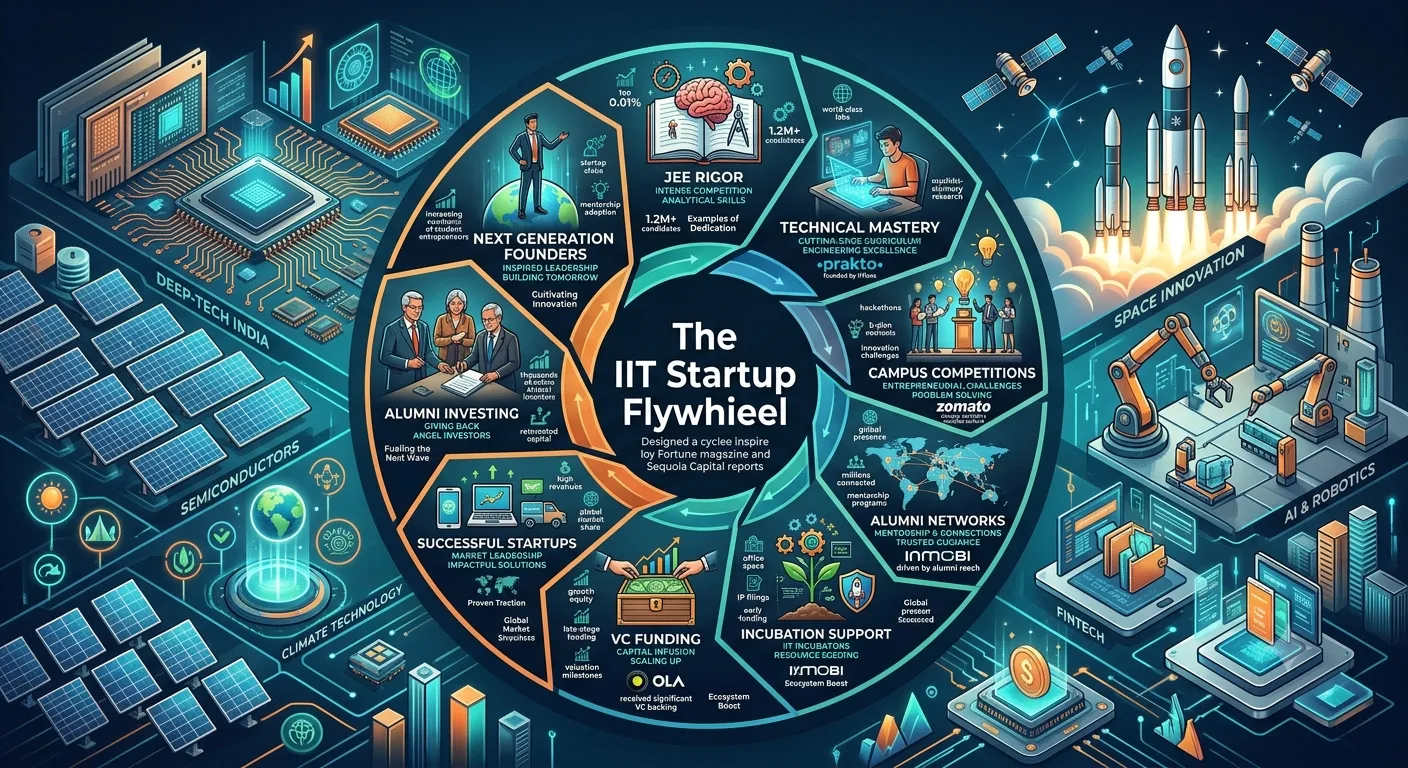
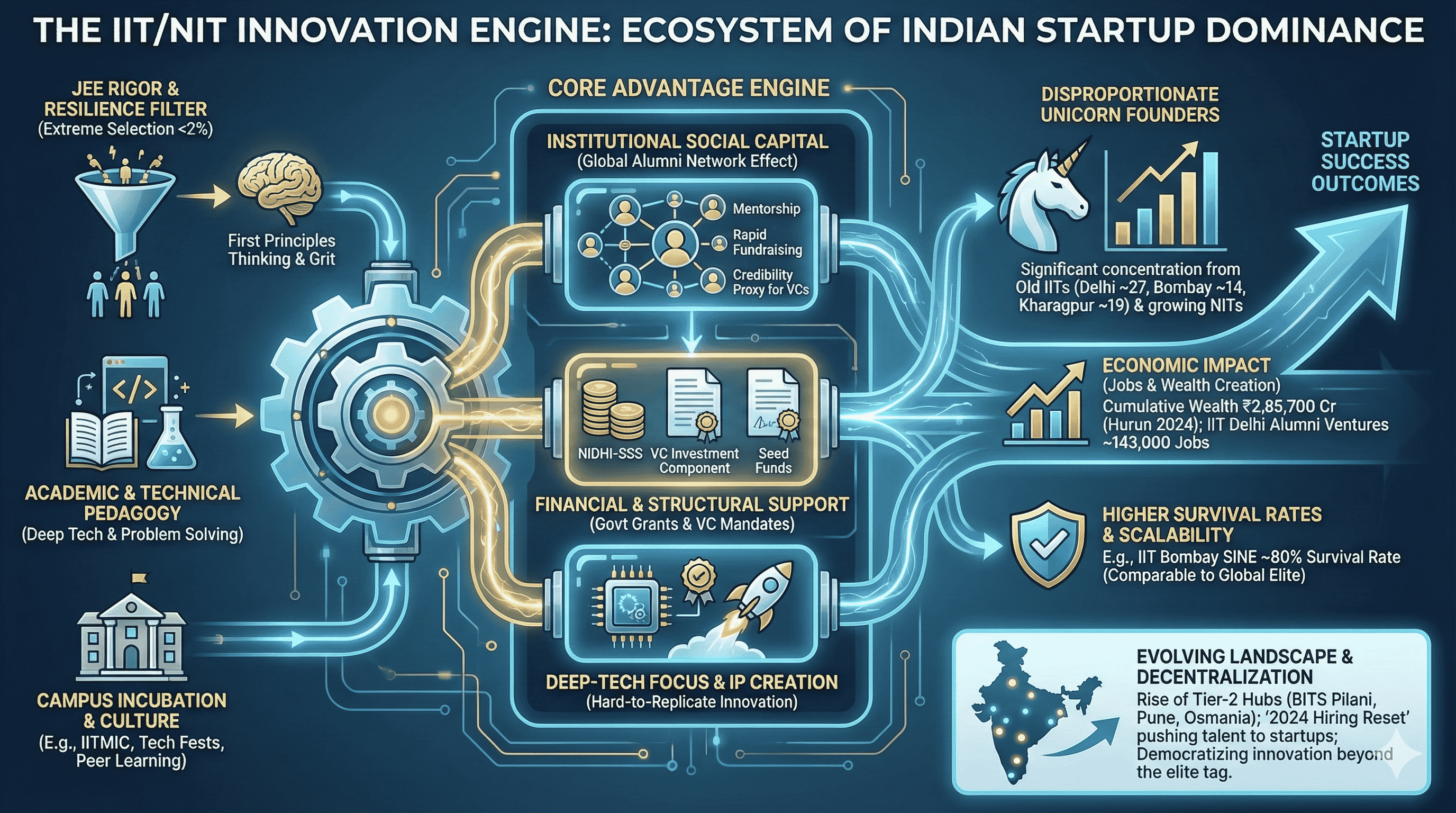
The real advantage IIT and NIT students possess in the startup world is an integrated, self-reinforcing cycle of meritocracy, institutional support, and social leverage. It begins with the Psychological Foundation established during the JEE preparation, which filters for the resilience and analytical depth required to survive the volatility of entrepreneurship. This is nurtured by the Campus Technical Culture, where high-pressure competitions and technical societies simulate real-world challenges and develop essential soft skills such as teamwork and strategic presentation.
The Institutional Bridge provided by incubation cells and prioritized government grants ensures that these students have the financial and technical resources to move from concept to MVP. Once in the market, the Alumni Network Effect provides a critical advantage in fundraising and business development, as the "IIT/NIT tag" acts as a proxy for risk mitigation for venture capitalists.
However, the landscape is evolving. The 2024 hiring reset has accelerated the movement of elite talent toward startups, while the rise of Tier-2 institutions indicates that the "pedigree shortcut" is no longer the only path to success. The future of the Indian startup ecosystem will likely see a blend of this elite institutional rigor with a more decentralized, nationwide innovation engine. For the time being, the IIT and NIT advantage remains the most potent combination of human and social capital in the global entrepreneurial arena, redefining India’s role as an innovation powerhouse and deep-tech leader.
The Long-Term Trajectory and Economic Implications
The concentration of entrepreneurial talent within the IIT/NIT ecosystem has far-reaching implications for India's economic future. As the country strives to reach a $5 trillion GDP, the conversion of its "demographic dividend" into "quality technical human resource" becomes paramount. The current trajectory suggests that these premier institutions will continue to be the primary engine for this growth, particularly as the focus shifts toward "Bharat Unbound" through innovation in AI and global scaling.
The success of these alumni is not a matter of luck but a result of a highly structured environment that rewards merit, fosters collaboration, and provides a safety net for risk-taking. As long as the "old-boys-network" continues to institutionalize its social capital through platforms like Invest IIT and NITKonnect, the alumni of these institutions will maintain a significant lead in the startup race. The "real advantage" is thus an ecosystemic one—a combination of the toughest entry gate, the most rigorous training ground, and the most influential exit network in the world of engineering and technology.
The convergence of global venture capital interest, government support through the NIDHI program, and a shifting job market that favors startups over big tech has created a perfect storm for IIT and NIT founders. Their ability to solve complex, real-world problems using first principles, backed by a global network of mentors and investors, ensures that they remain the vanguard of India's entrepreneurial revolution. As deep-tech innovation becomes the new benchmark for global success, the research-driven focus of these premier campuses will only become more critical, cementing the "IIT/NIT advantage" for the next generation of global innovators.
This research indicates that the structural advantages provided by these institutions—ranging from financial grants like NIDHI-SSS to psychological conditioning through JEE—create a unique class of founders who are better equipped to handle the stresses of startup creation. While the ecosystem is democratizing, the institutionalized benefits of being an IIT or NIT alumnus continue to offer a "credibility shortcut" that is unmatched in the Indian economic landscape. The integration of technical depth, financial access, and social capital makes these students a potent force, capable of driving not just regional startups but global technology powerhouses.
Want to calculate the equity for your cofounder?
Nail your cap table before you sign. Whether you're splitting equity with a co-founder or planning your next funding round, our Equity Calculator gives you precision in seconds
Equity calculator →