The Mistake of Copying US SaaS Models in India
March 9, 2026 by Harshit Gupta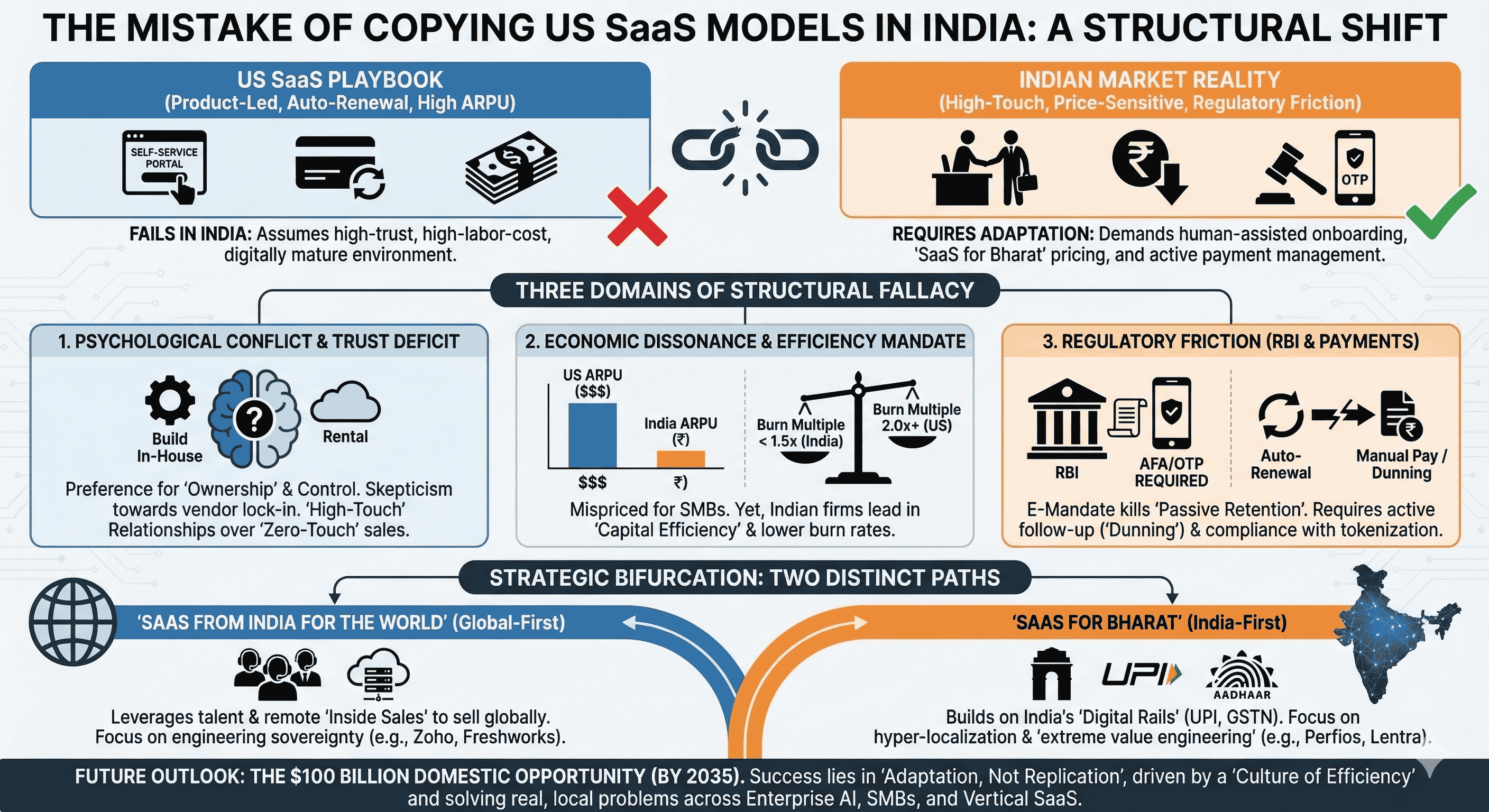
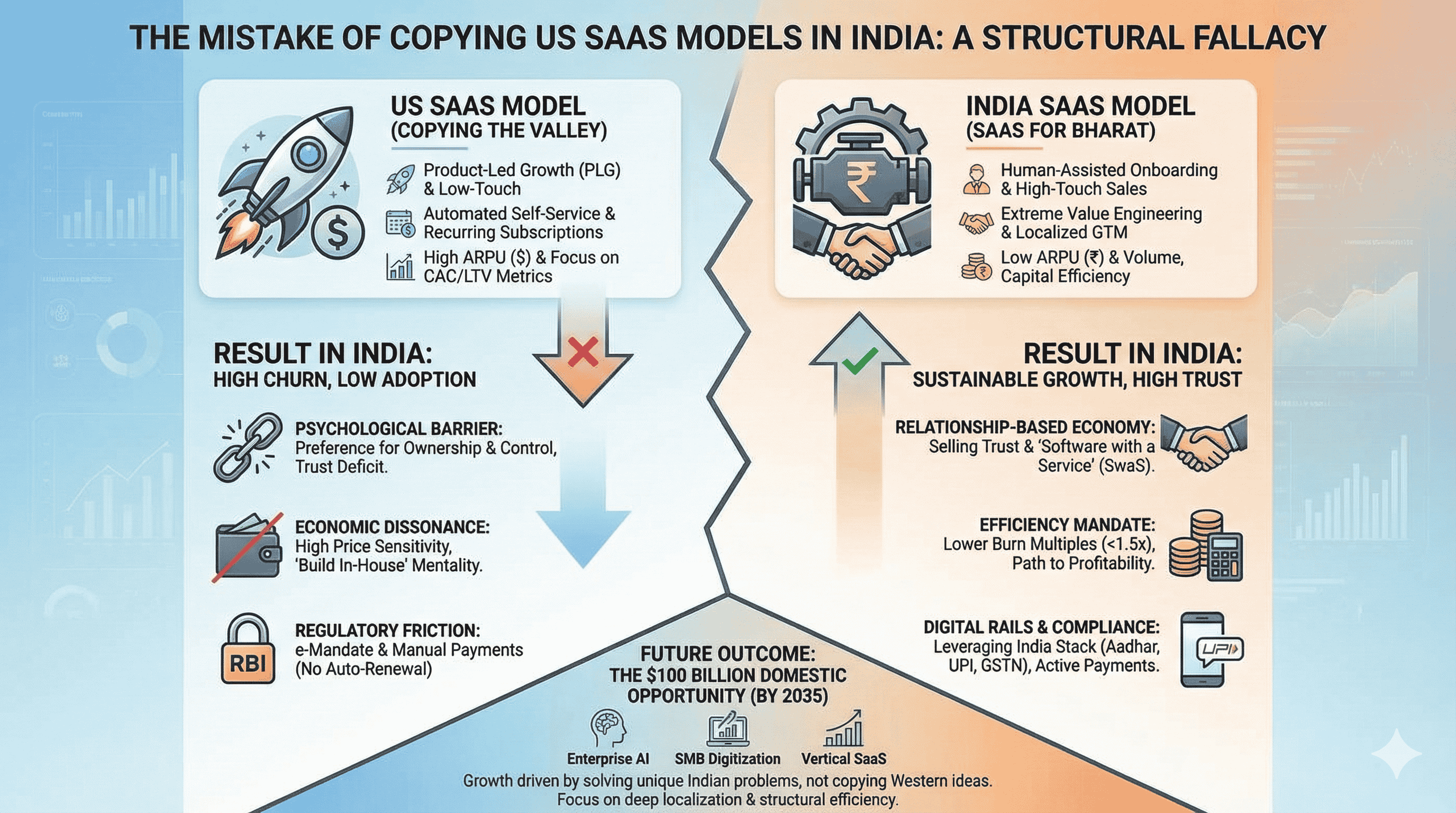
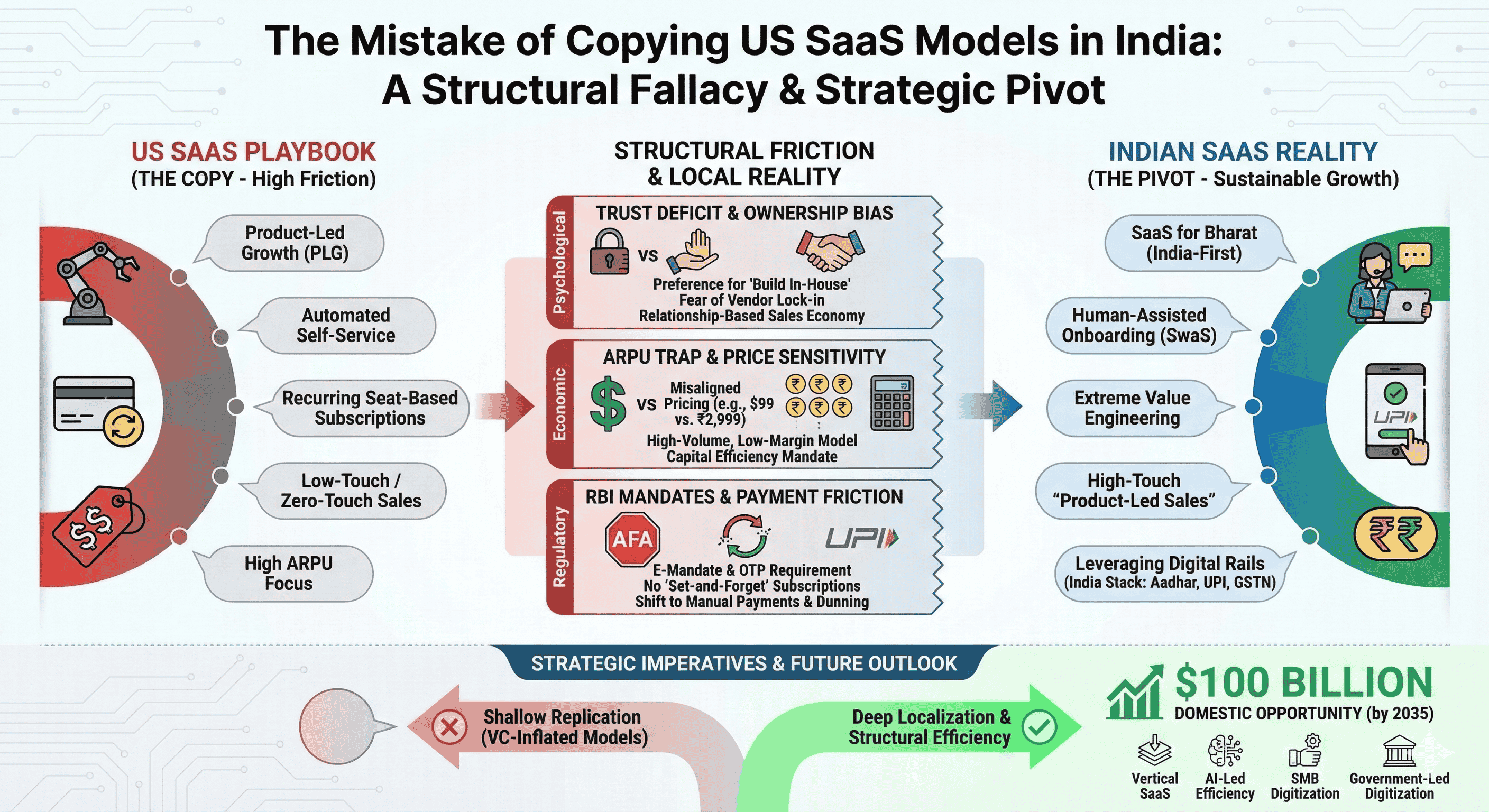
The evolution of India’s software landscape, transitioning from a global hub for Information Technology (IT) services to a prolific generator of Software as a Service (SaaS) products, has been heralded as a paradigm shift in the nation’s economic trajectory. However, this transition is increasingly defined by a realization that the traditional US SaaS playbook—predicated on product-led growth, automated self-service, and recurring seat-based subscriptions—frequently founders when applied without modification to the Indian domestic market. The fundamental error lies in the assumption that the structural drivers of software adoption in the high-labor-cost, high-trust, and digitally mature environment of North America can be replicated in a geography characterized by affordable technical labor, deep-seated risk aversion, and a uniquely restrictive regulatory environment for recurring payments.
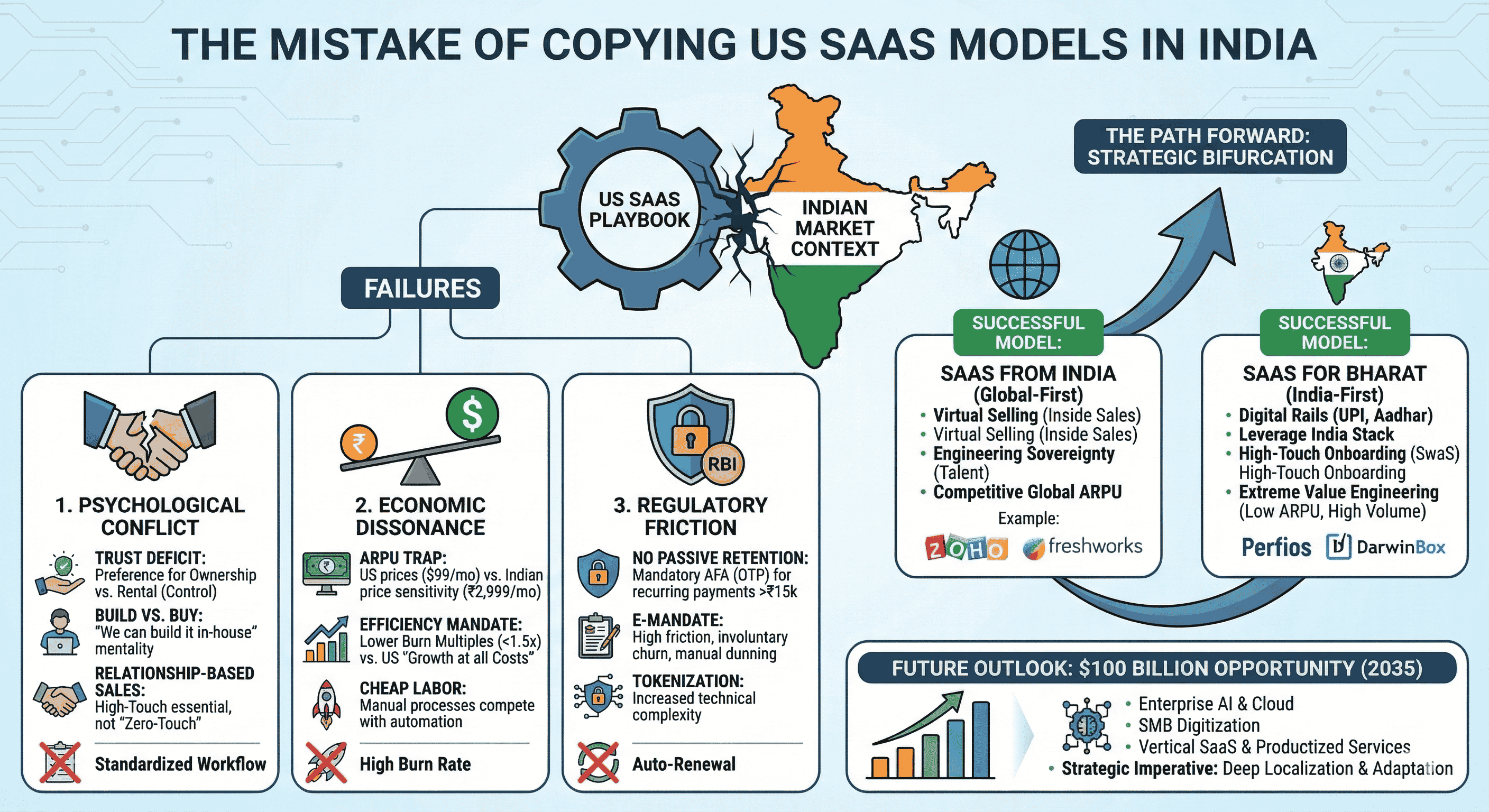
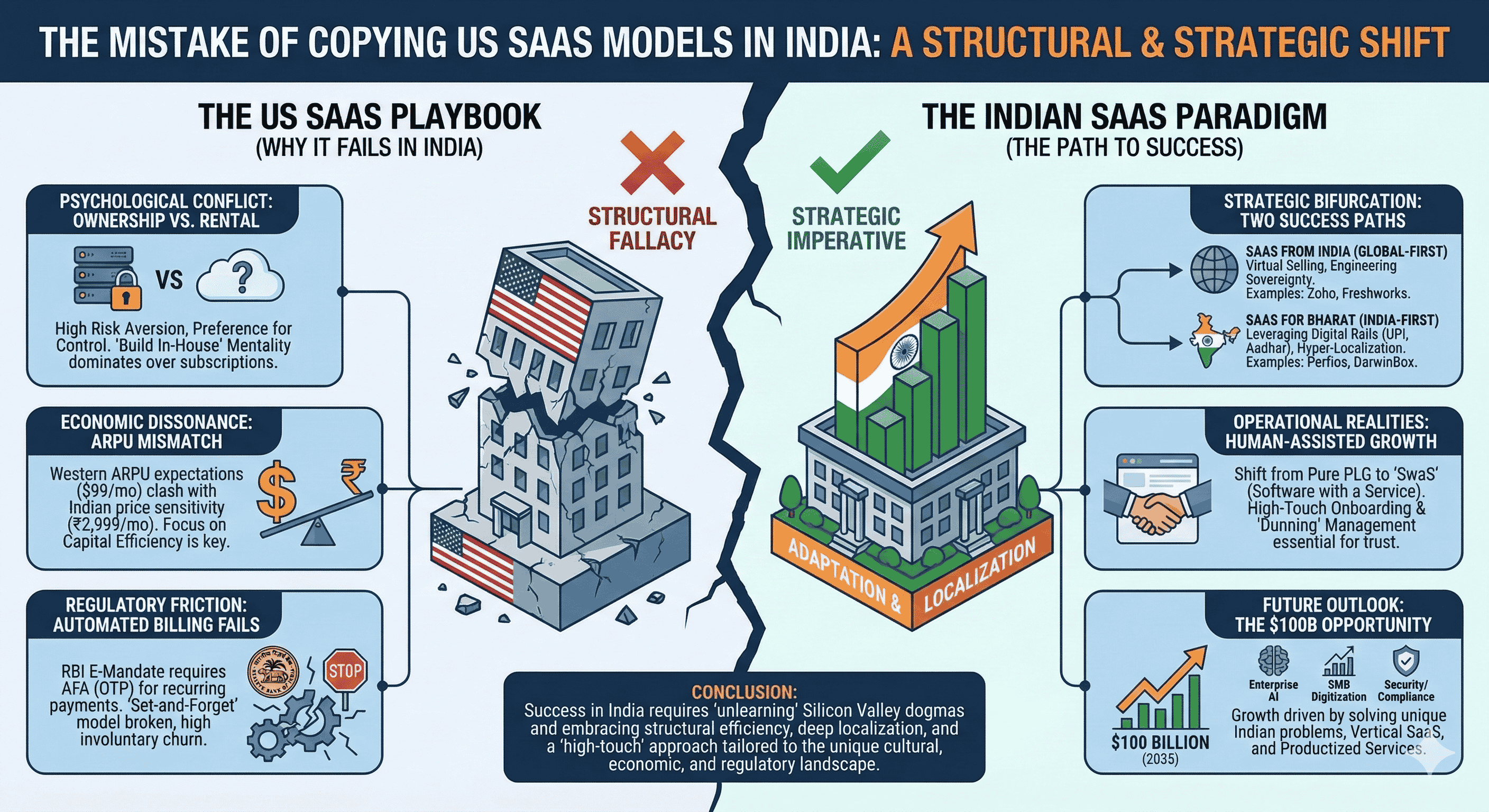
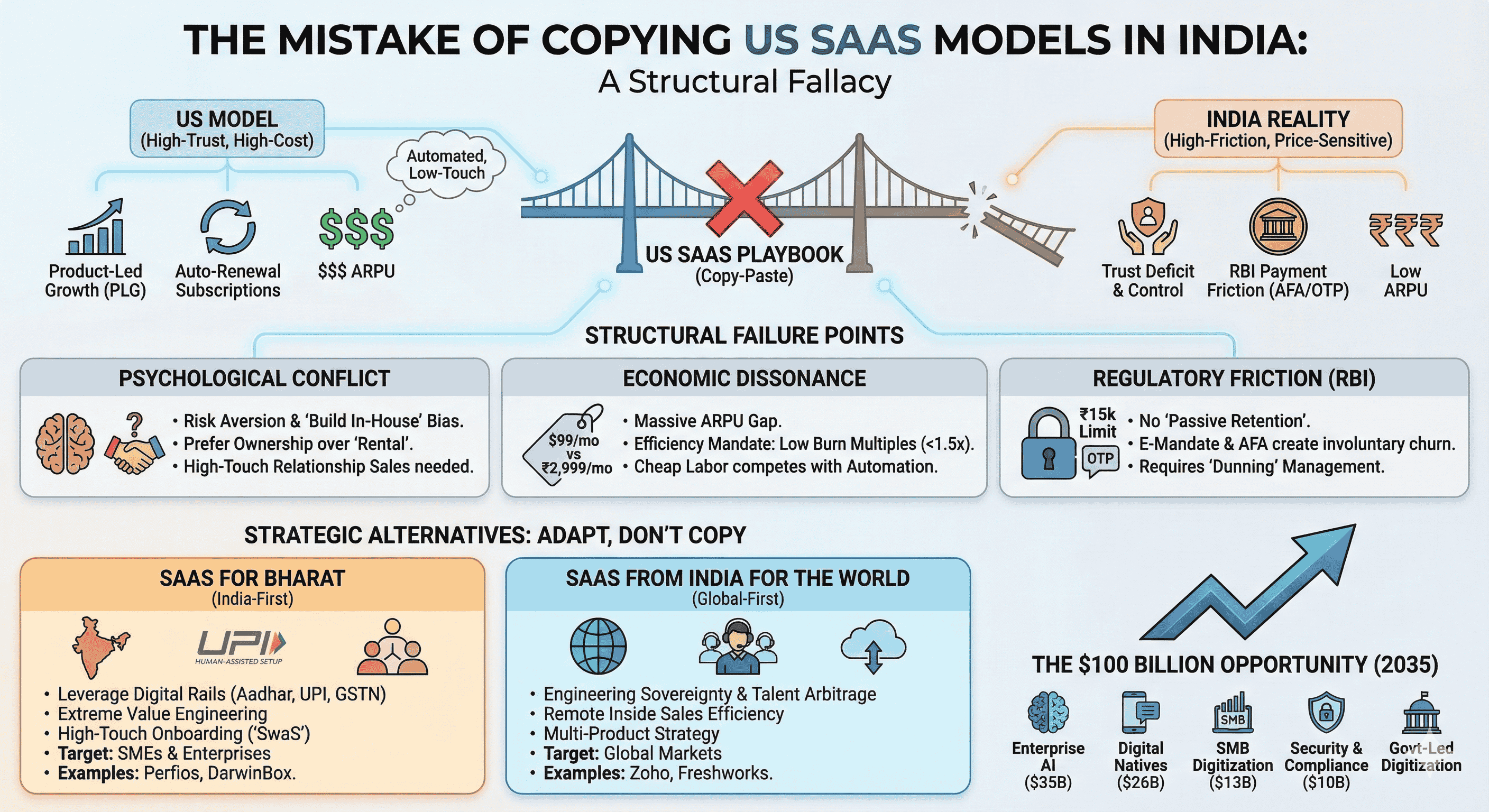
The structural fallacy of copying US models manifests in three primary domains: the psychological conflict regarding ownership versus rental, the economic dissonance between Western Average Revenue Per User (ARPU) expectations and Indian price sensitivity, and the regulatory chokepoints imposed by the Reserve Bank of India (RBI) on automated billing. For Indian SaaS founders, the path to sustainable growth requires a "unlearning" of Silicon Valley dogmas and an embrace of "SaaS for Bharat" principles, which prioritize human-assisted onboarding, extreme value engineering, and localized go-to-market strategies that leverage India’s idiosyncratic "digital rails".
The Psychological Conflict: Control, Ownership, and the Trust Deficit
The primary barrier to SaaS adoption in the Indian domestic market is not purely economic but deeply psychological, rooted in a culture of risk aversion and a preference for tangible ownership over service-based rental models. In mature markets like the United States, the SaaS model is embraced for its flexibility and lower upfront capital expenditure. In contrast, many Indian businesses perceive the recurring payment model as a loss of control and an invitation to vendor lock-in. This skepticism leads to a fixation on long-term costs and an overestimation of the risks associated with building a dependency on a third-party product.
The Sovereignty of the "Build In-House" Mentality
A recurring objection faced by SaaS sales teams in India is the assertion that the business can build the solution in-house. This is not an empty boast; given India’s large pool of skilled developers and the proliferation of affordable software development agencies, many companies genuinely possess the capacity to create custom tools. This creates a competitive landscape where a SaaS platform is not just competing against other software vendors, but against the internal IT department or a specialized external agency.
The preference for in-house development is driven by a desire for a solution that aligns perfectly with unique, often idiosyncratic, internal workflows. US SaaS products, designed for a "broadest common denominator" global market, often lack the flexibility required by Indian stakeholders who demand full control over every functionality. This desire for customization is a double-edged sword; while it reflects a genuine need for specificity, it often blinds businesses to the long-term operational burdens of maintaining custom code, including the costs of upgrades, security patches, and talent turnover.
Psychological Factor | Impact on SaaS Sales | Behavioral Manifestation |
Risk Aversion | High Stakes Perception | Fixation on worst-case scenarios and vendor failure. |
Preference for Ownership | Resistance to Subscription | Viewing SaaS as "renting" rather than "owning" assets. |
Desire for Control | High Customization Demand | Rejection of standardized, "out-of-the-box" workflows. |
Build vs. Buy Bias | In-house Talent Advantage | Leveraging local developer availability to create custom tools. |
The Relationship-Based Sales Economy
In the US, the trend toward "Zero-Touch" or "Low-Touch" sales models allows companies to scale rapidly with minimal human intervention. In India, however, software is rarely just a product; it is a promise of trust. Establishing this trust is a slow, relationship-heavy process that US models are ill-equipped to handle. Indian buyers want to feel that there is a person or a team they can hold accountable, leading to a scenario where "selling SaaS" effectively means "selling a relationship".
This trust deficit extends to the fear of "wasted investment." Stakeholders worry that if a product does not perfectly integrate with their legacy systems or if the vendor goes out of business, the capital spent will be entirely lost. Consequently, the most successful Indian SaaS founders do not shy away from human interaction; they integrate it into their core go-to-market strategy, using a "high-touch" approach to navigate the complex web of skepticism that precedes a sale.
Economic Dissonance: The ARPU Trap and the Efficiency Mandate
The metrics used to evaluate SaaS health in the West—Customer Acquisition Cost (CAC), Lifetime Value (LTV), and Net Dollar Retention (NDR)—often translate poorly into the Indian context due to the dramatic disparity in ARPU. A globally validated SaaS product priced at $99 per month is often completely mis-priced for the Indian Small and Medium Business (SMB) market, where a localized equivalent priced at ₹2,999 per month (~$36) is more likely to find traction.
The Mathematics of Indian SaaS Efficiency
Despite the lower price points, Indian SaaS companies have emerged as leaders in capital efficiency. The "culture of efficiency" inherent in the Indian ecosystem allows startups to reach product-market fit (PMF) with significantly lower burn rates than their US counterparts. While a US startup might burn tens of millions of dollars to reach a $10 million Annual Recurring Revenue (ARR) milestone, many Indian firms reach breakeven at that scale, raising capital only when they are primed for hyper-growth.
One of the primary drivers of this efficiency is the ARR-to-funding ratio. Indian SaaS firms have demonstrated the ability to scale while maintaining a burn multiple (the ratio of net burn to net new ARR) well below the global average. For instance, while a burn multiple of 2.0x is considered acceptable for a growth-stage company in the US, 80% of growth-stage Indian SaaS companies maintain a burn multiple of less than 1.5x.
The standard formula for calculating the burn multiple is:
Burn Multiple=Net New ARRNet Burn
Metric | US SaaS Benchmark ($10M-$30M ARR) | Indian SaaS Benchmark ($10M-$30M ARR) |
Sales Efficiency | ~70% | 80% - 100%+. |
Burn Multiple | 2.0x - 3.0x | < 1.5x. |
Early Stage NDR | 100% - 120% | 140%+. |
ARR-to-Funding Ratio | Moderate | High/Superior. |
The Impact of Cheap Labor on the Build vs. Buy Equation
The availability of cheap labor in India acts as a significant deterrent to SaaS adoption. In the US, automation is an economic necessity because human time is the most expensive resource. In India, many manual processes—tracking inventory on Excel, managing payroll through manual entry, or using WhatsApp for customer support—are surprisingly resilient because they can be managed by low-cost staff.
The cost-effectiveness of hiring a junior employee to perform a task manually often competes directly with the subscription cost of a SaaS tool. Consequently, Indian SaaS providers cannot simply sell "automation"; they must sell "scale" and "compliance," solving problems that humans cannot solve easily, such as complex GST calculations or large-scale data analytics.
Regulatory Friction: The RBI and the Death of "Passive Retention"
The US SaaS model relies heavily on the "set-and-forget" nature of subscriptions, where auto-renewal is the default state. This ensures a predictable revenue stream and maintains high LTV by minimizing the number of active "re-buying" decisions a customer has to make. In India, this engine of growth has been structurally dismantled by the Reserve Bank of India (RBI) through its mandates on recurring payments.
The E-Mandate and AFA Requirements
The RBI’s e-mandate guidelines, which became effective in late 2021, require an Additional Factor of Authentication (AFA) for all recurring transactions. For transactions exceeding ₹15,000, customers must manually authorize every single billing cycle via an One-Time Password (OTP). Even for transactions below this threshold, merchants must send a notification at least 24 hours prior to the debit, providing a link for the customer to opt-out or cancel the transaction.
This regulatory environment creates immense friction:
Involuntary Churn: Subscriptions frequently lapse because customers miss notifications or fail to authorize payments on time.
Tokenization Burdens: Merchants are no longer allowed to store actual card details, requiring them to implement tokenization systems that add technical complexity.
Mandate Management: Users must be able to view, modify, or cancel mandates through a central portal provided by their bank, shifting the power dynamic significantly toward the consumer.
Payment Limit | Requirement | Impact on Retention |
< ₹5,000 | Initial AFA only; subsequent debits with 24h pre-notification. | Relatively seamless for entry-level tools. |
₹5,000 - ₹15,000 | AFA for mandate; pre-notification mandatory. | Increased risk of transaction decline. |
> ₹15,000 | AFA (OTP) required for every renewal cycle. | High friction; effectively a "re-buying" decision every month. |
The Shift to Manual Payments and "Dunning" Management
Because of the friction in auto-debits, many large SaaS providers in India, including Google and AWS, have shifted their customers toward manual payments or lower-threshold billing. This change fundamentally alters the "unit economics of attention." Instead of the product silently delivering value, the business must now actively chase the customer for payment, increasing the operational cost of retention and introducing multiple "exit points" in the customer lifecycle.
Smart Indian SaaS companies have responded by investing in sophisticated "dunning" management—automated systems that remind customers to pay, handle failed authorizations, and offer alternative payment methods like UPI (Unified Payments Interface). This represents a significant divergence from the US model, where payment processing is largely invisible to the customer.
Strategic Bifurcation: "SaaS from India" vs. "SaaS for Bharat"
Indian SaaS can be categorized into two distinct archetypes, each requiring a fundamentally different strategy. "SaaS from India for the World" (Global-First) leverages India’s cost and talent advantages to serve Western markets, while "SaaS for Bharat" (India-First) focuses on solving local problems using domestic digital infrastructure.
The Global-First Model: Virtual Selling and Engineering Sovereignty
Companies like Zoho, Freshworks, BrowserStack, and Icertis pioneered the model of building in India and selling to the world. This model thrives on the "Inside Sales" engine, where teams based in cities like Chennai or Bengaluru use virtual selling tools (Zoom, LinkedIn, Email) to close deals with customers in North America and Europe.
The success of this model is predicated on:
Talent Portability: Engineers trained in global standards who can build world-class products at a fraction of the cost.
Remote GTM Efficiency: The ability to conduct the entire sales cycle—from lead generation to closing—without a physical office in the target market.
Multi-Product Strategies: Indian companies tend to build multiple products earlier in their lifecycle than US firms, allowing them to capture more of the customer’s budget through cross-selling and upselling.
The India-First Model: Leveraging Digital Rails and Hyper-Localization
"SaaS for Bharat" companies like Perfios, Lentra, and DarwinBox are built on India’s unique "digital rails"—Aadhar (identity), UPI (payments), and GSTN (taxation). These companies do not copy US models because the problems they are solving do not exist in the US.
For example, a US HR-tech tool might focus on "company culture" or "employee engagement," whereas an Indian HR tool like Craze or DarwinBox must focus on "payroll compliance," "statutory filings," and "attendance tracking" for a workforce that often includes contract labor. The strategy here is "extreme value engineering": building products that are 10x cheaper and 10x faster to implement than multinational alternatives.
Feature | SaaS for Bharat (India-First) | SaaS from India for the World (Global-First) |
Primary Customer | Indian SMEs and Enterprises | Global Businesses (US/EMEA) |
Key Enablers | India Stack (Aadhar, UPI, GST) | Inside Sales, Talent Arbitrage |
Pricing Strategy | Low ARPU, High Volume (Rupee-based) | Competitive ARPU, High Efficiency (USD-based) |
Onboarding | High-Touch, Human-Assisted | Low-Touch, Product-Led |
Examples | Perfios, Lentra, DarwinBox. | Zoho, Freshworks, BrowserStack. |
Operational Realities: The Failure of Pure PLG in India
In the United States, Product-Led Growth (PLG) is considered the "gold standard" for SaaS efficiency. The assumption is that users can discover value organically, onboard themselves, and eventually convert to a paid tier. In India, however, pure PLG often fails because it underestimates the complexity of the "activation" phase in a low-trust environment.
The Necessity of "Software with a Service" (SwaS)
The high-touch expectation of Indian buyers leads to the adoption of the "SwaS" model, where software is bundled with expert implementation and support services. While US companies might view a high ratio of services-to-software revenue as a sign of a non-scalable business, Indian SaaS founders recognize it as a necessary moat.
Human-assisted onboarding serves several critical functions:
Overcoming the "Blank Slate" Problem: Indian users often struggle to set up complex systems alone, leading to high drop-off rates during the trial period.
Workflow Mapping: Helping the customer understand how the standardized product fits into their manual or non-standardized workflows.
Data Cleansing: Many Indian businesses have unstructured or "dirty" data on spreadsheets that must be audited and cleaned before migration to a SaaS platform.
Personalized onboarding can increase user retention by up to 50%, as users feel more supported and engaged from the start. For Indian companies, the goal is not to eliminate humans but to layer "human touch" after the product has signaled intent, creating a "Product-Led Sales" motion.
The "Aha!" Moment and Time to Value (TTV)
Because of the high friction in payment and adoption, the "Time to Value" (TTV) must be exceptionally short in India. US products often have a long "onboarding trail" before the user experiences the core benefit. Indian SaaS products must identify the "activation milestone" and guide the user there as fast as possible, often using contextual nudges, checklists, and video tutorials.
In a market where "copying" feels like survival for some, those who focus on the "Aha!" moment create true differentiation. If a user can see immediate ROI—such as a generated GST report or a successful UPI payment—within minutes of signing up, the barrier to the "buying" decision is significantly lowered.
Structural Critique: Sridhar Vembu and the Vulnerability of VC-Led Models
The most profound critique of the copied US SaaS model comes from Sridhar Vembu, the founder of Zoho. Vembu argues that the traditional SaaS industry is built on a "fundamentally flawed, unsustainable model" that prioritizes sales and marketing over engineering and product development.
The Sales-Heavy Trap
Vembu points out that many venture-capital-backed SaaS firms spend vastly more on acquiring customers than on building the technology itself. This was manageable during a period of low interest rates and high "VC hype," but it becomes a liability when the cost of capital rises and growth slows. He contends that the "venture capital bubble" funded an ecosystem that is now ripe for consolidation.
In his view, Artificial Intelligence (AI) is the "pin that is popping this inflated balloon". AI-assisted coding significantly reduces the barrier to building software, potentially making the traditional, high-priced subscription model obsolete for many categories. If a non-technical user can "vibe-code" a custom solution in a weekend, the justification for paying $30 per seat per month for a bloated CRM starts to vanish.
The Zoho Philosophy: Engineering Sovereignty and Resilience
Zoho’s approach—bootstrapped, engineering-led, and rooted in rural India—represents the antithesis of the Silicon Valley model. By avoiding external funding, Zoho is not pressured to chase "growth at all costs" and can focus on building a deep, integrated ecosystem of over 50 products. This "Operating System for Business" approach creates a unified experience that even giants like Microsoft and Salesforce struggle to match, providing a moat that is resilient to both economic downturns and AI disruption.
Vembu encourages his employees to "calmly contemplate our death," arguing that embracing existential risks fosters the fearlessness needed to chart a course in the post-GPT world. This cultural resilience is a far cry from the "blitzscaling" mentality of US startups and is perhaps better suited to the long-term, relationship-based nature of the Indian market.
The $100 Billion Domestic Opportunity: Forces Shaping the Future
Despite the challenges, the Indian domestic software market is at an inflection point, projected to grow from $20 billion today to $100 billion by 2035. This growth is not driven by copying Western ideas but by solving for the unique scale and constraints of the Indian economy.
Five Forces of Growth
Enterprise AI & Cloud Adoption ($35B): Large Indian corporations are finally moving past legacy systems to embrace cloud-first, AI-driven strategies to improve operational efficiency.
Digital Native Powerhouses ($26B): India’s own thriving startup ecosystem is a massive consumer of B2B software, spending 3x more as a percentage of revenue on software than traditional sectors.
SMB Digitization ($13B): India’s 63 million SMEs are increasingly reliant on SaaS for operational efficiency, seeking "India-native" solutions that are affordable and mobile-first.
Security & Compliance ($10B): Stringent data localization policies and regulatory demands from the Ministry of Electronics and Information Technology (MeitY) are spurring innovation in domestic cybersecurity and compliance tools.
Government-Led Digitization: Large-scale digital public infrastructure (DPI) projects are creating massive downstream opportunities for software providers to build on top of national platforms.
Segment | Estimated Opportunity (2035) | Key Success Driver |
Enterprise AI | $35 Billion | Predictable forecasting and automation. |
Digital Natives | $26 Billion | Speed, scalability, and API-first integration. |
SMB Digitization | $13 Billion | Voice-enabled, vertical-specific, hyper-local apps. |
Security/Compliance | $10 Billion | Data localization and sovereign cloud solutions. |
The Rise of Vertical SaaS and "Productized Services"
We are witnessing a shift from horizontal SaaS (which serves broad functions like CRM or ERP) to vertical SaaS (tailored for specific industries like healthcare, logistics, or edtech). Vertical SaaS in India often follows a "wedge" strategy—starting with one entry-level product that solves a critical local pain point (like GST billing) and then expanding into a full suite of services.
Furthermore, "productizing services" is becoming a winning model. Companies like Gushwork are exploring how AI can enable a new model of company building by productizing agency operations into outcome-driven systems. This allows businesses to scale without the need to assemble complex internal teams, effectively bridging the gap between "outsourcing" and "SaaS."
Conclusion: Strategic Imperatives for the Next Decade
The mistake of copying US SaaS models in India is ultimately a mistake of context. To succeed in this dynamic and challenging market, founders and investors must move beyond shallow replication and focus on deep localization and structural efficiency.
For the "SaaS for Bharat" player, the path forward is defined by "extreme value": building products that are affordable, compliant, and integrated with the India Stack, while providing the "high-touch" support that local businesses demand. For the "SaaS from India for the World" player, the opportunity lies in leveraging India’s engineering sovereignty and remote sales efficiency to build global category leaders that are more resilient than their VC-inflated competitors.
The next decade of Indian SaaS will not be defined by who can copy the best, but by who can adapt the fastest. In a world upended by AI and shifting macroeconomic realities, the "culture of efficiency" that has always characterized the Indian ecosystem may well become the global standard for the future of software. The $100 billion prize is tangible, but it belongs to those who act with "urgency, creativity, and unity," building a homegrown software ecosystem that solves real problems for a billion people.
Read More -
1. From Idea to MVP: A Step-by-Step Guide for Solo Founder
🔗 https://findnstart.com/blogs/from-idea-to-mvp-a-step-by-step-guide-for-solo-founder
2. How to Validate Your Startup Idea in 48 Hours for $0
🔗 https://findnstart.com/blogs/how-to-validate-your-startup-idea-in-48-hours-for-0
3. Remote vs. Local: Does Your Co-Founder Need to Live in the Same City?
🔗 https://findnstart.com/blogs/remote-vs-local-does-your-co-founder-need-to-live-in-the-same-city
4. The 2026 Startup Landscape: What Has Fundamentally Changed (and Why Founder Skills Matter More Than Ever)
5. The Most In-Demand Skills for Startup Founders in 2026
🔗 https://findnstart.com/blogs/the-most-in-demand-skills-for-startup-founders-in-2026
6. How to Find a Technical Co-Founder (Without a Six-Figure Salary)
🔗 https://findnstart.com/blogs/how-to-find-a-technical-co-founder-without-a-six-figure-salary
7. 5 Red Flags to Look for When Choosing a Startup Partner
🔗 https://findnstart.com/blogs/5-red-flags-to-look-for-when-choosing-a-startup-partner
8. How to Pitch Your Idea to Potential Co-Founders
🔗 https://findnstart.com/blogs/how-to-pitch-your-idea-to-potential-co-founders
9. How to Build a Portfolio that Attracts High-Growth Startup Founders
🔗 https://findnstart.com/blogs/how-to-build-a-portfolio-that-attracts-high-growth-startup-founders
10. Equity vs. Salary: How to Split Ownership with Your First Teammate
🔗 https://findnstart.com/blogs/equity-vs-salary-how-to-split-ownership-with-your-first-teammate
11. Why Joining an Early-Stage Startup is Better Than a Corporate Job
🔗 https://findnstart.com/blogs/why-joining-an-early-stage-startup-is-better-than-a-corporate-job
12. The Future of EdTech: Why Developers and Educators Need to Team Up Now
🔗 https://findnstart.com/blogs/the-future-of-edtech-why-developers-and-educators-need-to-team-up-now
13. The Architecture of Symbiosis: Analytical Perspectives on the Five Habits of Successful Startup Duos
14. Finding a Co-Founder in the AI Space: What Skills Should You Look For?
🔗 https://findnstart.com/blogs/finding-a-co-founder-in-the-ai-space-what-skills-should-you-look-for
15. Overcoming Analysis Paralysis and the Strategic Path to Execution
🔗 https://findnstart.com/blogs/overcoming-analysis-paralysis-and-the-strategic-path-to-execution
16. From College Project to Company: How to Find Your Student Co-Founder
🔗 https://findnstart.com/blogs/from-college-project-to-company-how-to-find-your-student-co-founder
17. How to Start a Startup While Working a Full-Time Job
🔗 https://findnstart.com/blogs/how-to-start-a-startup-while-working-a-full-time-job
18. How to Build a HealthTech Startup Without a Medical Degree
🔗 https://findnstart.com/blogs/how-to-build-a-healthtech-startup-without-a-medical-degree
19. The Solitary Architect: Executive Isolation in Entrepreneurship
20. The 2026 Guide to Launching a SaaS as a Solo Developer
21. What Sustainable Growth Actually Looks Like
🔗 https://findnstart.com/blogs/what-sustainable-growth-actually-looks-like
22. The Early Warning Signs Your Startup Is in Trouble
🔗 https://findnstart.com/blogs/the-early-warning-signs-your-startup-is-in-trouble
23. How to Grow Without Burning Out
🔗 https://findnstart.com/blogs/how-to-grow-without-burning-out
24. The Truth About “Runway” Most Founders Ignore
🔗 https://findnstart.com/blogs/the-truth-about-runway-most-founders-ignore
25. Revenue Solves More Problems Than Funding
🔗 https://findnstart.com/blogs/revenue-solves-more-problems-than-funding
26. What No One Tells You About Being a Solo Founder
🔗 https://findnstart.com/blogs/what-no-one-tells-you-about-being-a-solo-founder
27. Why Smart People Quit High-Paying Jobs to Build Startups (And Why Most Regret It)
28. Why Most Startup Advice on Twitter Is Dangerous
🔗 https://findnstart.com/blogs/why-most-startup-advice-on-twitter-is-dangerous
29. Decision Fatigue: The Silent Startup Killer
🔗 https://findnstart.com/blogs/decision-fatigue-the-silent-startup-killer
30. Fear vs Logic: How Founders Actually Make Decisions
🔗 https://findnstart.com/blogs/fear-vs-logic-how-founders-actually-make-decisions
31. How Overthinking Destroys Early Momentum
🔗 https://findnstart.com/blogs/how-overthinking-destroys-early-momentum
32. Ideas Don’t Scale. Systems Do.
🔗 https://findnstart.com/blogs/ideas-dont-scale-systems-do
33. The First Hire That Actually Matters
🔗 https://findnstart.com/blogs/the-first-hire-that-actually-matters
34. How the First 100 Users Decide Your Startup’s Fate
🔗 https://findnstart.com/blogs/how-the-first-100-users-decide-your-startups-fate
35. Why Your Startup Doesn’t Need Growth — It Needs Focus
🔗 https://findnstart.com/blogs/why-your-startup-doesnt-need-growthit-needs-focus
36. Why Most Startups Die Quietly
🔗 https://findnstart.com/blogs/why-most-startups-die-quietly
37. Lessons Learned Too Late by First-Time Founders
🔗 https://findnstart.com/blogs/lessons-learned-too-late-by-first-time-founders
38. The Myth of the “Overnight Success” Startup
🔗 https://findnstart.com/blogs/the-myth-of-the-overnight-success-startup