The Challenge of Scaling in Canada’s Smaller Domestic Market
March 13, 2026 by Harshit Gupta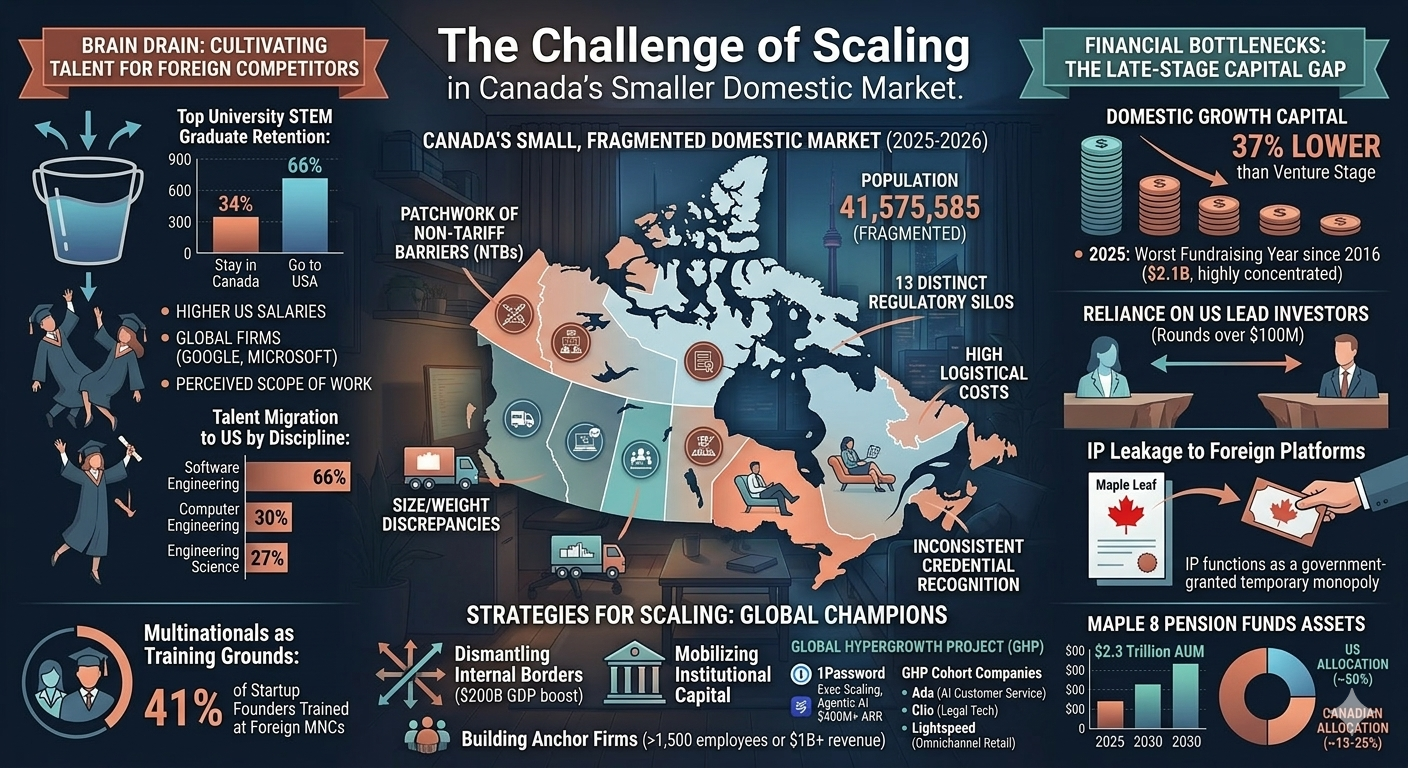
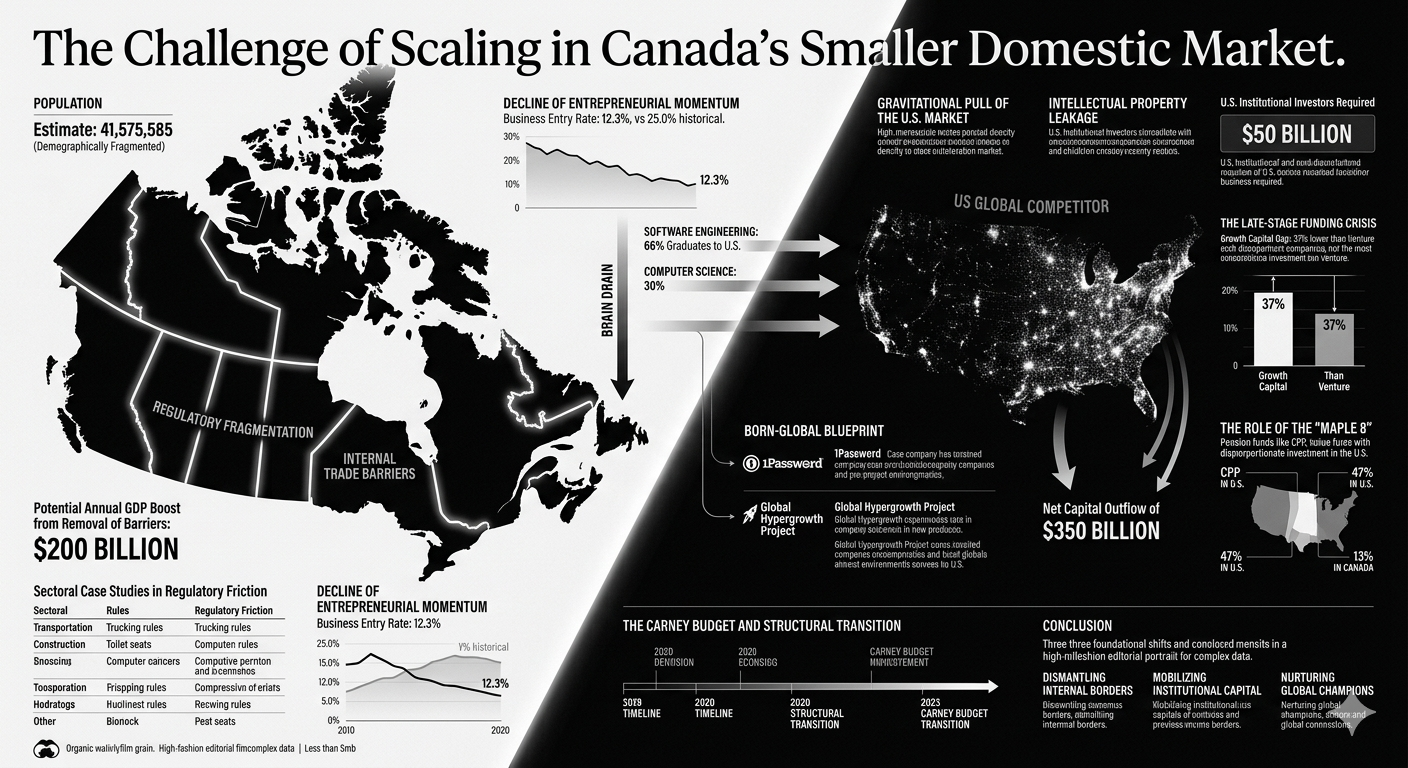
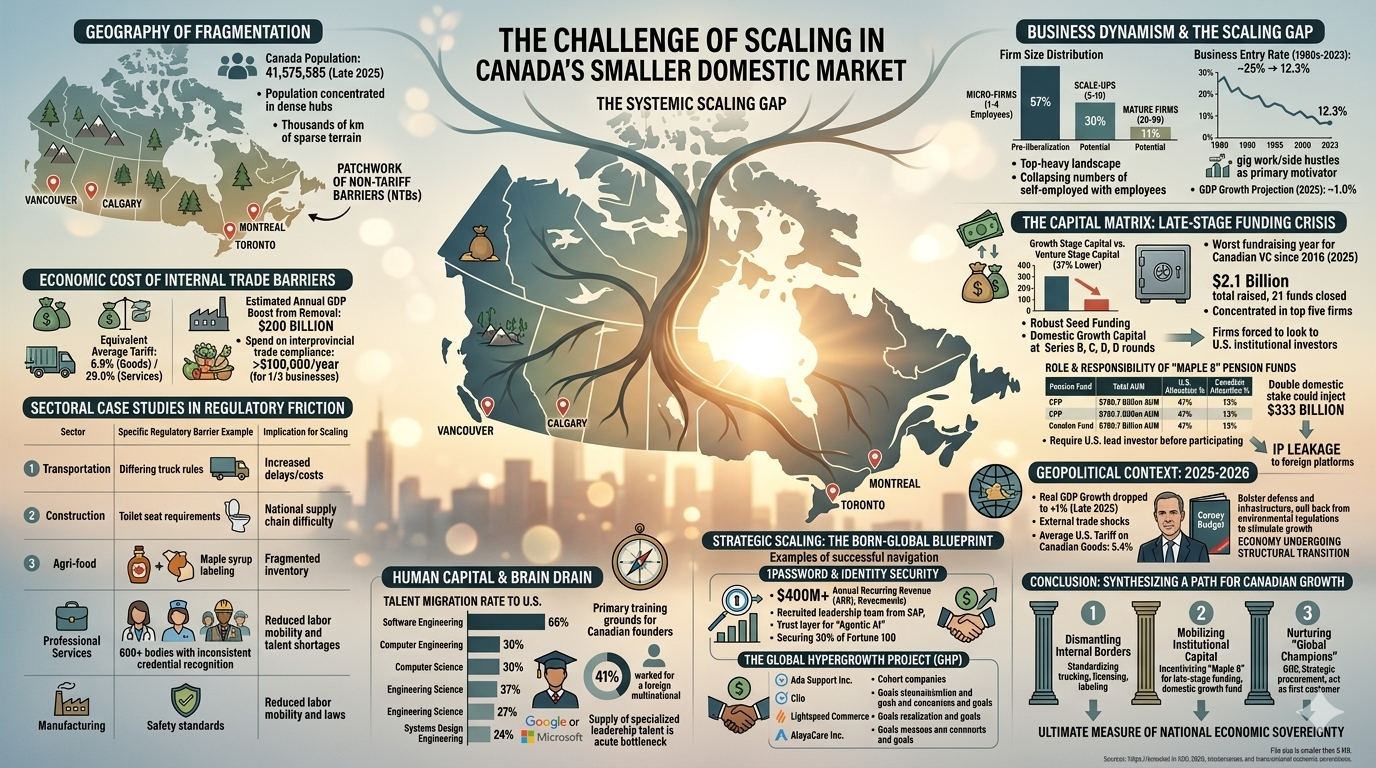
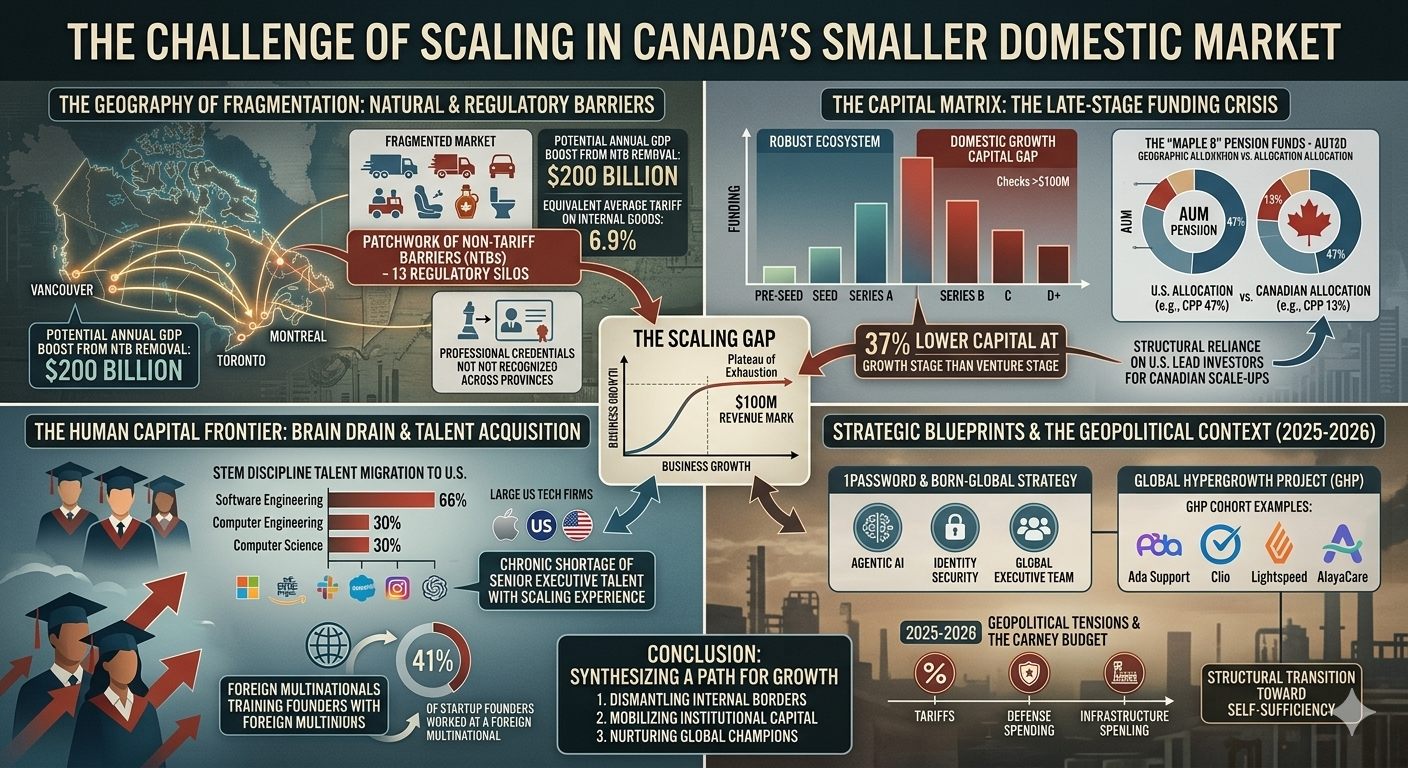
The economic trajectory of Canada in the mid-2020s is defined by a profound structural paradox. While the nation consistently ranks among the global elite in early-stage entrepreneurial activity and world-class research output, it faces a systemic inability to transition these nascent ventures into large-market-cap "Global Champions." This phenomenon, often termed the "scaling gap," is a direct consequence of a domestic market that is geographically vast yet demographically fragmented. With a population estimate of 41,575,585 as of late 2025, the Canadian market lacks the critical mass and density required to sustain high-growth firms through their middle stages of expansion. Consequently, Canadian firms often hit a "plateau of exhaustion" at the $100 million revenue mark, a point where the constraints of internal trade barriers, a lack of late-stage domestic capital, and the gravitational pull of the United States market converge to force either a foreign acquisition or a relocation of headquarters.
The Geography of Fragmentation: Natural and Regulatory Barriers
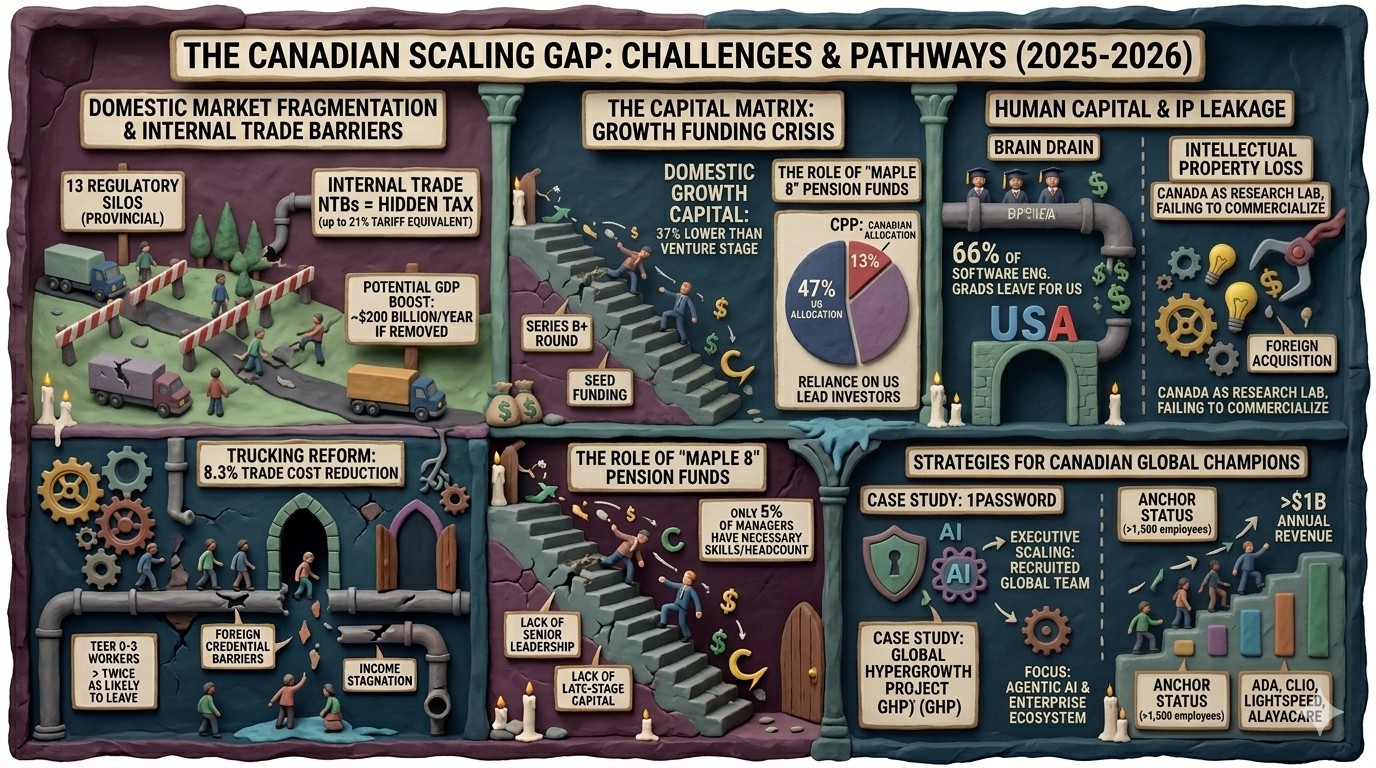
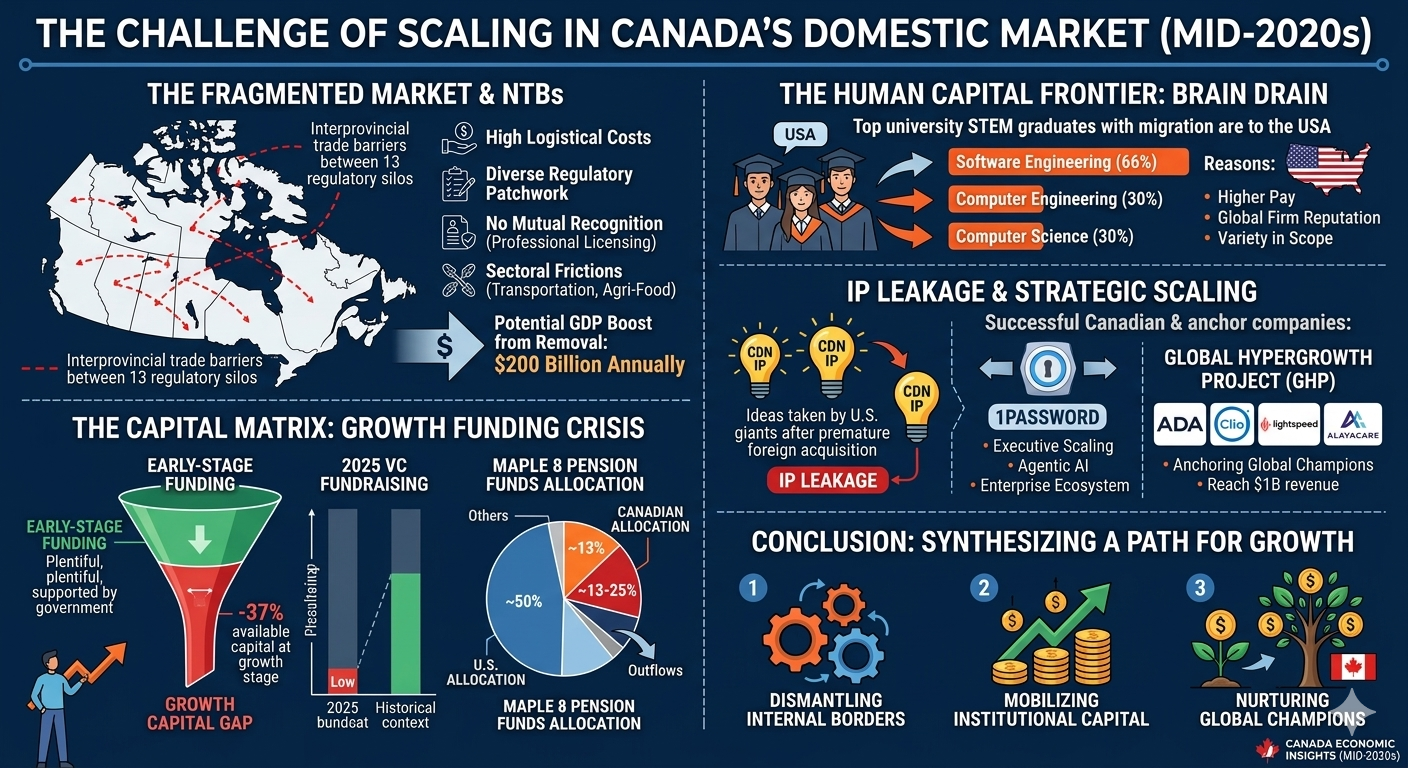
Canada’s domestic market challenges begin with its physical and demographic profile. The nation’s population is concentrated in a few highly dense economic hubs—Toronto, Montreal, Vancouver, and Calgary—separated by thousands of kilometers of sparsely populated terrain. This low population density imposes inherent logistical costs that are significantly higher than those in more compact European or Asian markets. However, the primary impediment to scaling is not the physical distance itself, but the regulatory fragmentation that mirrors it. The division of powers between federal, provincial, and territorial governments has resulted in a patchwork of non-tariff barriers (NTBs) that effectively divide the 41 million-person market into thirteen distinct regulatory silos.
The Economic Cost of Internal Trade Barriers
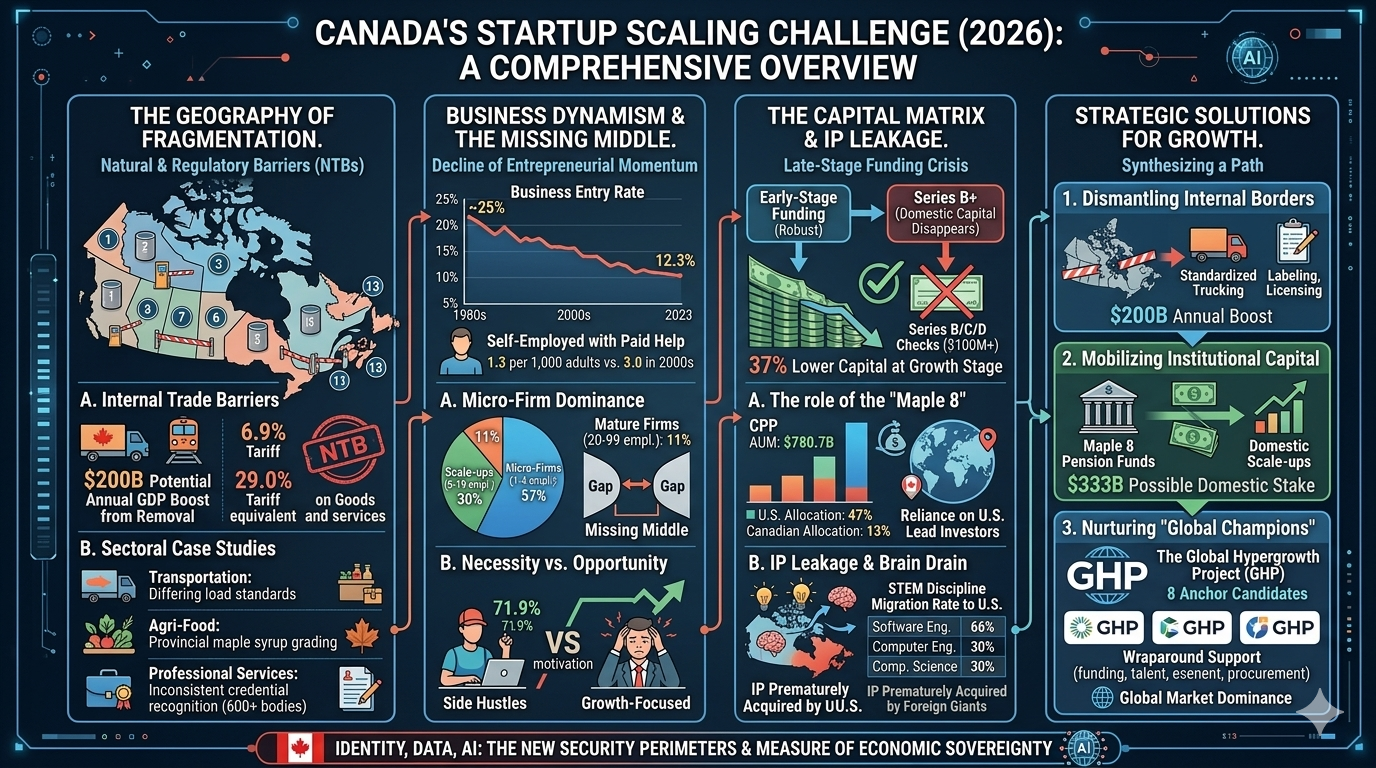
The fiscal implications of these internal barriers are substantial. Research indicates that the elimination of non-geographic internal trade barriers could increase Canada’s GDP per capita by approximately 4%, potentially adding up to $200 billion annually to the national economy. For individual businesses, the cost of navigating this regulatory maze is a significant drain on resources. More than one-third of businesses engaged in interprovincial trade estimate spending upwards of $100,000 annually just to meet compliance requirements.
Impact Metric of Internal Trade Barriers | Estimated Economic Value | Source |
Potential Annual GDP Boost from Removal | $200 Billion | |
Equivalent Average Tariff on Internal Goods | 6.9% | |
Equivalent Average Tariff on Internal Services | 29.0% | |
Estimated Cost to Agri-Food Sector | $1.7 Billion | |
Reduction in Trade Costs from Trucking Reform | 8.3% |
These barriers act as a "hidden tax" that suppresses productivity and inflates consumer prices. In some sectors, the regulatory burden is equivalent to a 21% tariff on trade flows. This fragmentation prevents firms from achieving the economies of scale necessary to compete on a global stage. A scaling firm in Canada often finds that expanding from Ontario to Quebec involves more regulatory complexity than expanding from Ontario to New York, yet the latter offers a market nearly ten times the size.
Sectoral Case Studies in Regulatory Friction
The granular reality of interprovincial barriers is often found in the seemingly mundane details of provincial law. In the transportation sector, a primary driver of the $500 million annual cost to the trucking industry is the lack of harmonization in vehicle weight, size, and safety standards. A truck permitted to operate under specific load safety regulations in Alberta may find those same regulations illegal upon crossing the border into British Columbia, necessitating costly and time-consuming adjustments.
Sector | Specific Regulatory Barrier Example | Implication for Scaling | Source |
Transportation | Differing daytime/nighttime driving rules for specific trucks | Increased logistics costs and transit delays | |
Construction | "Open-front" vs. "neutral" toilet seat requirements | Difficulty in managing national supply chains | |
Agri-Food | Province-specific labeling for maple syrup grading | Fragmented inventory management | |
Professional Services | 600+ bodies with inconsistent credential recognition | Reduced labour mobility and talent shortages | |
Manufacturing | Differing safety standards for car seat stuffing | Inability to use single-production runs for all provinces |
The lack of mutual recognition in professional licensing is particularly detrimental to high-growth firms. When a psychologist certified in Alberta must undergo additional training to practice in Nova Scotia, or a nurse from Ontario faces coursework barriers in Manitoba, the national labour pool remains fragmented. This is a critical failure for a nation facing acute shortages in technical and executive leadership roles.
The Scaling Gap and Business Dynamism
The Canadian entrepreneurial landscape is top-heavy with micro-firms and struggling to produce "Global Champions." As of early 2026, firms with 1 to 4 employees represented 57% of all businesses in Canada, while "scale-ups" (5-19 employees) and "mature" firms (20-99 employees) represented 30% and 11% respectively. This firm size distribution highlights a "missing middle" in the Canadian economy. While the nation is adept at starting companies, it fails to nurture them through the mid-market transition.
The Decline of Entrepreneurial Momentum
The rate of business entry in Canada has seen a long-term decline, falling from nearly 25% in the early 1980s to approximately 12.3% in 2023. Perhaps more concerning is the collapse in the number of self-employed Canadians who have paid employees, a figure that dropped by 57% between 2000 and 2022. These trends suggest that Canadian entrepreneurship is increasingly driven by necessity—such as "side hustles" or gig work—rather than by opportunity-oriented, growth-focused ventures. In fact, 71.9% of Canadian entrepreneurs cite "earning a living because jobs are scarce" as their primary motivator.
Business Dynamism Indicator | Value (2023/2025) | Historical Context (1980s/2000s) | Source |
Business Entry Rate | 12.3% | ~25.0% | |
Self-Employed with Paid Help | 1.3 per 1,000 adults | 3.0 per 1,000 adults | |
Micro-Firm Share of Market | 57.0% | N/A | |
GDP Growth Projection (2025) | ~1.0% | ~2.0% (2024 Forecast) |
This environment creates a fragile ecosystem where small businesses are twice as likely as large firms to experience revenue drops during economic downturns, such as the pandemic. Without the buffers of scale, these micro-firms remain vulnerable to technological shocks and interest rate fluctuations, further discouraging long-term growth planning.
The Capital Matrix: The Late-Stage Funding Crisis
Access to capital is the primary constraint for firms attempting to scale past the initial venture stage. Canada possesses a robust ecosystem for pre-seed and seed funding, often supported by government-backed incubators and domestic angel investors. However, as firms transition to Series B, C, and D rounds—where checks often exceed $100 million—domestic capital formation effectively disappears.
The Domestic Growth Capital Gap
In high-potential sectors like agri-food, Canada is losing its position as a preferred place to start and scale due to an undercapitalized domestic growth environment. While early-stage firms are relatively well-supported, the capital available at the growth stage is 37% lower than at the venture stage. Domestic venture firms are rarely positioned to lead rounds larger than $30 million, which forces high-growth companies to look to U.S. institutional investors for survival.
The year 2025 marked one of the worst fundraising years for Canadian VC since 2016, with only 21 funds closing and a total of $2.1 billion raised—a figure that is heavily concentrated in the top five firms. This concentration creates a "top-heavy" ecosystem where emerging managers are marginalized, further stifling the pipeline of new startups.
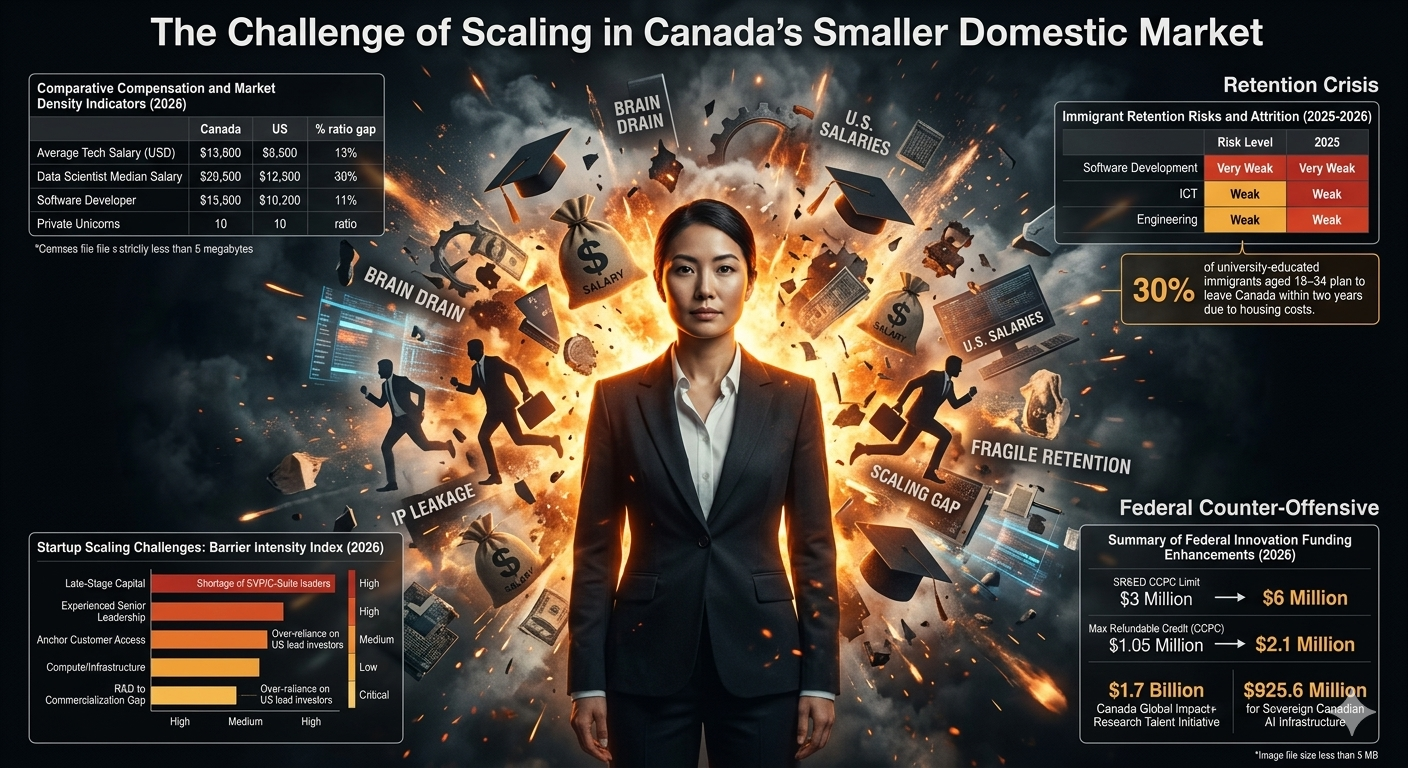
The Role and Responsibility of the "Maple 8"
A central tension in Canada’s capital landscape is the investment behaviour of the "Maple 8"—the country’s largest public sector pension funds, managing $2.3 trillion in assets. These funds are global leaders in institutional investment, yet they are increasingly absent from the domestic scaling ecosystem. The Canada Pension Plan (CPP), for example, has 47% of its $780 billion in assets invested in the U.S., while only 13% is allocated to Canada.
Pension Fund | Total Assets Under Management | U.S. Allocation % | Canadian Allocation % | Source |
Maple 8 (Collective) | $2.3 Trillion | ~50.0% | ~13.0% - 25.0% | |
CPP | $780.7 Billion | 47.0% | 13.0% | |
OMERS | N/A | 55.0% | N/A | |
PSP Investments | N/A | 40.5% | N/A |
The structural reliance on non-domestic capital is exemplified by the CPPIB’s practice of typically requiring a U.S. investor to lead a funding round before participating in a Canadian scale-up. This creates a vulnerability where the future of Canada’s most promising firms is dependent on American validation. Critics argue that doubling the domestic stake of these pension funds across real estate, equity, and infrastructure could inject nearly $333 billion into the Canadian economy, potentially reversing the $350 billion in net capital outflows observed since 2016.
Intellectual Property: The Currency of Sovereignty
In the 21st-century knowledge economy, intellectual property (IP) has replaced natural resources as the primary driver of wealth. However, Canada’s inability to support scaling firms leads to a massive "IP leakage" to foreign platforms. IP functions as a government-granted temporary monopoly; when Canadian firms are acquired prematurely by U.S. giants, the economic dividends of that IP—including tax revenue and high-value jobs—flow out of the country.
The Structural Weakness of IP Retention
Canadian firms often lack the "freedom-to-operate" mentorship and capital necessary to defend their IP globally. Countries like Israel and South Korea use sophisticated public-private frameworks to capture wealth from domestic ideas, whereas Canada often acts as a research lab for the global market—producing world-class innovation but failing to capture the commercialization phase. The Strategic Response Fund (SRF), which replaced the Strategic Innovation Fund with a $5 billion investment, is one attempt to help firms adapt and grow in the face of global competition and tariff pressures, yet the gap in private sector IP management remains.
The Human Capital Frontier: Brain Drain and Talent Acquisition
The supply of specialized leadership talent is the most acute bottleneck for Canadian scale-ups. While Canada is a "talent magnet" for junior roles, it suffers from a chronic shortage of senior executive talent with experience scaling firms past $100 million in revenue. This shortage is exacerbated by a persistent "brain drain" to the United States, particularly among STEM graduates.
The "Cali or Bust" Paradigm
Talent migration in critical tech sectors has reached levels previously identified as detrimental to economic growth. In software engineering, as many as 66% of graduates from top Canadian universities leave for the U.S. immediately following their post-secondary education. The primary drivers are not just higher pay, but the reputation of global firms like Google and Microsoft and a perceived greater variety in the scope of work.
STEM Discipline | Talent Migration Rate to U.S. | Source |
Software Engineering | 66% | |
Computer Engineering | 30% | |
Computer Science | 30% | |
Engineering Science | 27% | |
Systems Design Engineering | 24% |
Interestingly, foreign multinationals operating in Canada often serve as the primary training grounds for Canadian founders. A review of 300 Canadian startup founders found that 41% had previously worked for a foreign multinational. While this provides critical skills and global networks, it also means that the Canadian ecosystem is heavily dependent on foreign entities to develop its future entrepreneurial leaders.
Strategic Scaling: The Born-Global Blueprint
Despite these structural hurdles, a select group of Canadian firms has achieved global dominance. These companies, such as Shopify, 1Password, and Lightspeed, share a common strategic orientation: they are "born-global".
Case Study: 1Password and Identity Security
1Password, headquartered in Toronto, exemplifies the successful navigation of the scaling gap. By early 2026, the company had surpassed $400 million in Annual Recurring Revenue (ARR) while maintaining positive free cash flow. Their strategy involves three key pillars:
Executive Scaling: 1Password aggressively recruited a leadership team with global experience, including a President and Chief Business Officer from major U.S. platforms like SAP and Barracuda Networks.
Focus on "Agentic AI": The company positioned itself as the "trust layer" for the AI era, securing not just human passwords but the identities used by AI agents to perform tasks.
Enterprise Ecosystem: By securing 30% of the Fortune 100, the company moved beyond a niche tool to become an essential layer of global identity security infrastructure.
Case Study: The Global Hypergrowth Project (GHP)
The federal government’s GHP represents a new, targeted approach to scaling. Rather than spreading support thin across thousands of startups, GHP concentrates resources on eight "anchor" candidates with the potential to reach $1 billion in annual revenue.
GHP Cohort Company | Specialization | Scaling Goal | Source |
Ada Support Inc. | AI Customer Service | Anchor status (>1,500 employees) | |
Clio (Themis Solutions) | Legal Technology | $1B+ in annual revenue | |
Lightspeed Commerce | Omnichannel Retail | Global market dominance | |
AlayaCare Inc. | Home Health Software | International expansion |
This project provides "wraparound" support, helping firms navigate funding, talent acquisition, and procurement—areas where the Canadian domestic market has traditionally failed to provide adequate momentum.
The Geopolitical Context: 2025-2026
The Canadian scaling challenge is currently unfolding against a backdrop of intense trade tensions and economic uncertainty. Real GDP growth in Canada dropped to an annual rate of less than 1% in late 2025, largely due to external trade shocks and the implementation of U.S. tariffs. The average U.S. tariff on Canadian goods now stands at 5.4%, which, while lower than the global average of 17%, still diminishes Canada’s productive capacity and inflates costs.
The Carney Budget and Structural Transition
The 2026 budget, introduced under Prime Minister Mark Carney, aims to bolster defense and infrastructure while pulling back from certain environmental regulations to stimulate growth. However, experts suggest that fiscal policy alone cannot offset the drag from trade tensions. The Canadian economy is described as undergoing a "structural transition" where it must find ways to increase its self-sufficiency and internal trade efficiency to hedge against a volatile North American trading bloc.
Conclusion: Synthesizing a Path for Canadian Growth
The challenge of scaling in Canada is not a symptom of a lack of innovation, but a result of an ecosystem designed for birth rather than growth. To overcome the constraints of a small domestic market, Canada must undertake three foundational shifts:
Dismantling Internal Borders: The $200 billion annual boost promised by internal trade liberalization is the most accessible path to increasing domestic scale. Standardizing trucking, professional licensing, and labeling is an economic imperative that requires federal and provincial alignment.
Mobilizing Institutional Capital: The "Maple 8" must be incentivized to participate in late-stage domestic funding rounds. Moving from a structural reliance on U.S. lead investors to a domestic growth fund model would ensure that high-value IP and talent remain in Canada.
Nurturing "Global Champions": Programs like the Global Hypergrowth Project must be expanded and institutionalized. By focusing resources on proven winners and acting as a "first customer" through strategic procurement, the government can help domestic firms build the track record necessary to dominate international markets.
As Canada enters the latter half of the decade, the urgency of these reforms has never been higher. In an era where identity, data, and AI are the new security perimeters, the ability to build and retain globally competitive firms is the ultimate measure of national economic sovereignty.
Read More -
1. From Idea to MVP: A Step-by-Step Guide for Solo Founder
🔗 https://findnstart.com/blogs/from-idea-to-mvp-a-step-by-step-guide-for-solo-founder
2. How to Validate Your Startup Idea in 48 Hours for $0
🔗 https://findnstart.com/blogs/how-to-validate-your-startup-idea-in-48-hours-for-0
3. Remote vs. Local: Does Your Co-Founder Need to Live in the Same City?
🔗 https://findnstart.com/blogs/remote-vs-local-does-your-co-founder-need-to-live-in-the-same-city
4. The 2026 Startup Landscape: What Has Fundamentally Changed (and Why Founder Skills Matter More Than Ever)
5. The Most In-Demand Skills for Startup Founders in 2026
🔗 https://findnstart.com/blogs/the-most-in-demand-skills-for-startup-founders-in-2026
6. How to Find a Technical Co-Founder (Without a Six-Figure Salary)
🔗 https://findnstart.com/blogs/how-to-find-a-technical-co-founder-without-a-six-figure-salary
7. 5 Red Flags to Look for When Choosing a Startup Partner
🔗 https://findnstart.com/blogs/5-red-flags-to-look-for-when-choosing-a-startup-partner
8. How to Pitch Your Idea to Potential Co-Founders
🔗 https://findnstart.com/blogs/how-to-pitch-your-idea-to-potential-co-founders
9. How to Build a Portfolio that Attracts High-Growth Startup Founders
🔗 https://findnstart.com/blogs/how-to-build-a-portfolio-that-attracts-high-growth-startup-founders
10. Equity vs. Salary: How to Split Ownership with Your First Teammate
🔗 https://findnstart.com/blogs/equity-vs-salary-how-to-split-ownership-with-your-first-teammate
11. Why Joining an Early-Stage Startup is Better Than a Corporate Job
🔗 https://findnstart.com/blogs/why-joining-an-early-stage-startup-is-better-than-a-corporate-job
12. The Future of EdTech: Why Developers and Educators Need to Team Up Now
🔗 https://findnstart.com/blogs/the-future-of-edtech-why-developers-and-educators-need-to-team-up-now
13. The Architecture of Symbiosis: Analytical Perspectives on the Five Habits of Successful Startup Duos
14. Finding a Co-Founder in the AI Space: What Skills Should You Look For?
🔗 https://findnstart.com/blogs/finding-a-co-founder-in-the-ai-space-what-skills-should-you-look-for
15. Overcoming Analysis Paralysis and the Strategic Path to Execution
🔗 https://findnstart.com/blogs/overcoming-analysis-paralysis-and-the-strategic-path-to-execution
16. From College Project to Company: How to Find Your Student Co-Founder
🔗 https://findnstart.com/blogs/from-college-project-to-company-how-to-find-your-student-co-founder
17. How to Start a Startup While Working a Full-Time Job
🔗 https://findnstart.com/blogs/how-to-start-a-startup-while-working-a-full-time-job
18. How to Build a HealthTech Startup Without a Medical Degree
🔗 https://findnstart.com/blogs/how-to-build-a-healthtech-startup-without-a-medical-degree
19. The Solitary Architect: Executive Isolation in Entrepreneurship
20. The 2026 Guide to Launching a SaaS as a Solo Developer
21. What Sustainable Growth Actually Looks Like
🔗 https://findnstart.com/blogs/what-sustainable-growth-actually-looks-like
22. The Early Warning Signs Your Startup Is in Trouble
🔗 https://findnstart.com/blogs/the-early-warning-signs-your-startup-is-in-trouble
23. How to Grow Without Burning Out
🔗 https://findnstart.com/blogs/how-to-grow-without-burning-out
24. The Truth About “Runway” Most Founders Ignore
🔗 https://findnstart.com/blogs/the-truth-about-runway-most-founders-ignore
25. Revenue Solves More Problems Than Funding
🔗 https://findnstart.com/blogs/revenue-solves-more-problems-than-funding
26. What No One Tells You About Being a Solo Founder
🔗 https://findnstart.com/blogs/what-no-one-tells-you-about-being-a-solo-founder
27. Why Smart People Quit High-Paying Jobs to Build Startups (And Why Most Regret It)
28. Why Most Startup Advice on Twitter Is Dangerous
🔗 https://findnstart.com/blogs/why-most-startup-advice-on-twitter-is-dangerous
29. Decision Fatigue: The Silent Startup Killer
🔗 https://findnstart.com/blogs/decision-fatigue-the-silent-startup-killer
30. Fear vs Logic: How Founders Actually Make Decisions
🔗 https://findnstart.com/blogs/fear-vs-logic-how-founders-actually-make-decisions
31. How Overthinking Destroys Early Momentum
🔗 https://findnstart.com/blogs/how-overthinking-destroys-early-momentum
32. Ideas Don’t Scale. Systems Do.
🔗 https://findnstart.com/blogs/ideas-dont-scale-systems-do
33. The First Hire That Actually Matters
🔗 https://findnstart.com/blogs/the-first-hire-that-actually-matters
34. How the First 100 Users Decide Your Startup’s Fate
🔗 https://findnstart.com/blogs/how-the-first-100-users-decide-your-startups-fate
35. Why Your Startup Doesn’t Need Growth — It Needs Focus
🔗 https://findnstart.com/blogs/why-your-startup-doesnt-need-growthit-needs-focus
36. Why Most Startups Die Quietly
🔗 https://findnstart.com/blogs/why-most-startups-die-quietly
37. Lessons Learned Too Late by First-Time Founders
🔗 https://findnstart.com/blogs/lessons-learned-too-late-by-first-time-founders
38. The Myth of the “Overnight Success” Startup
🔗 https://findnstart.com/blogs/the-myth-of-the-overnight-success-startup