Quantum Computing Startups Emerging from Canadian Universities
March 14, 2026 by Harshit Gupta
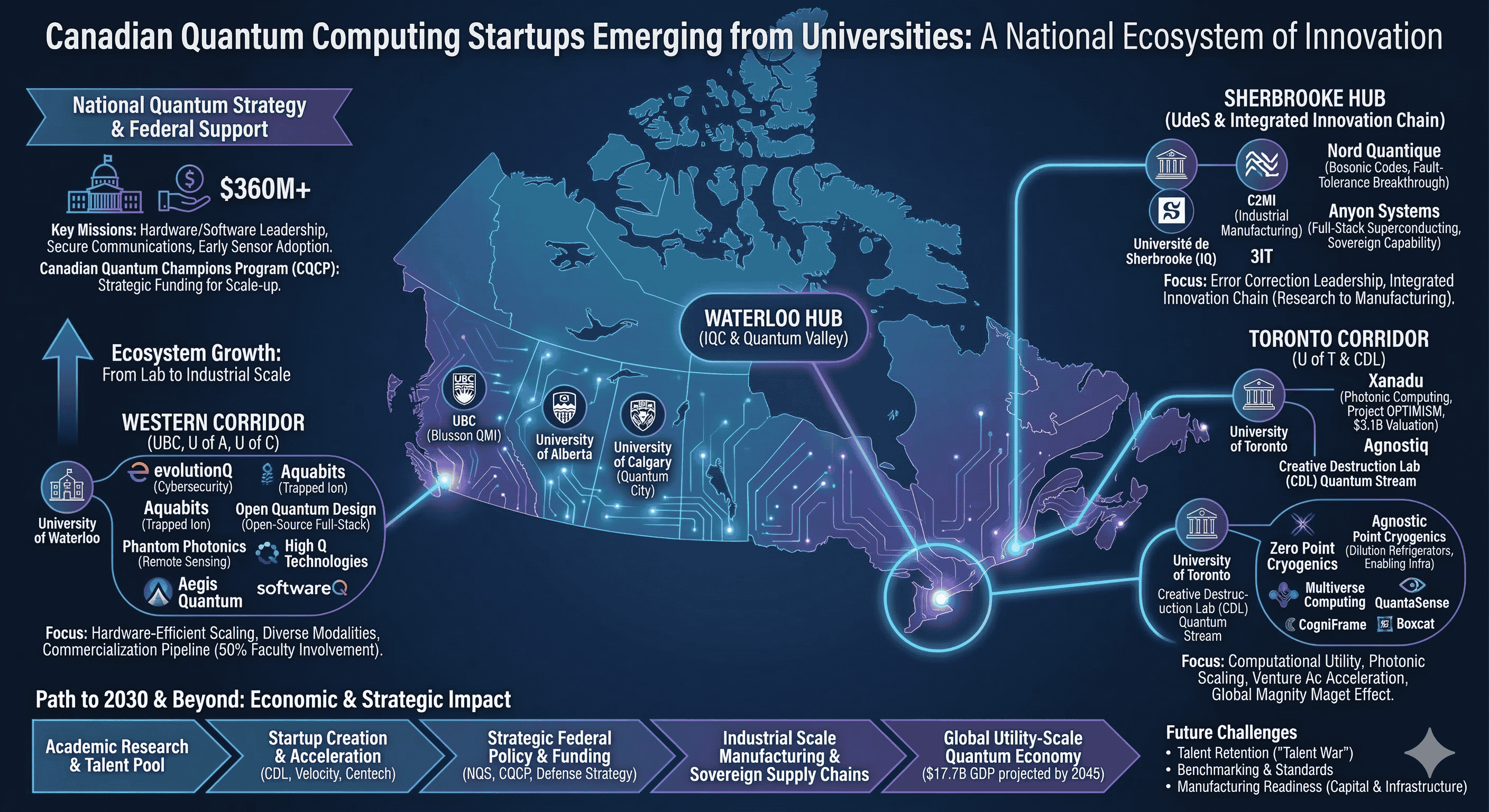
The Canadian quantum ecosystem represents a sophisticated paradigm of technology transfer, where the transition from foundational quantum information science to industrial application is facilitated by a multi-decade commitment to institutional infrastructure. This evolution is not merely a collection of isolated successes but a coordinated expansion across regional hubs that leverage university-based research to address the most critical barriers to quantum utility: error correction, scalability, and secure communication. The structural maturity of this sector is evidenced by the shift from laboratory-scale proofs-of-concept to the development of utility-scale manufacturing capabilities and sovereign supply chains. As the global race for quantum advantage intensifies, the Canadian model—rooted in the deep integration of academic inquiry, venture acceleration, and strategic federal policy—positions the nation as a primary architect of the forthcoming quantum economy.
The Waterloo Paradigm: The Institute for Quantum Computing and the Birth of the Quantum Valley
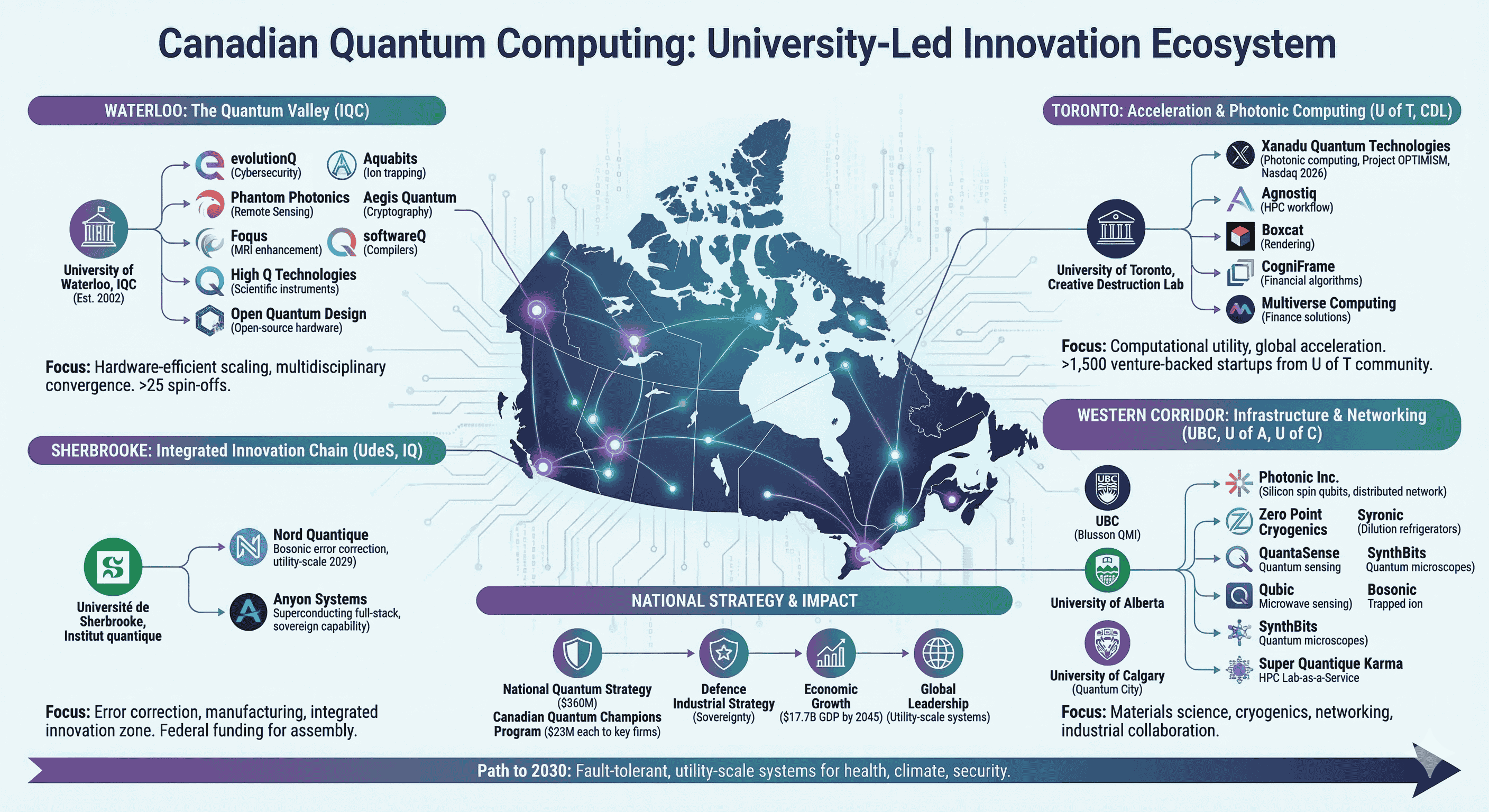
The University of Waterloo’s Institute for Quantum Computing (IQC) is the historical and intellectual cornerstone of the Canadian quantum landscape. Founded in 2002, the institute was designed as a multidisciplinary environment where physics, mathematics, and engineering converge to solve the complexities of quantum states. This institutional design has catalyzed more than 25 research spin-offs, creating a regional "Quantum Valley" that accounts for a significant portion of the technology-driven job growth in Ontario.
The mechanism of commercialization at Waterloo is characterized by high faculty involvement, with approximately fifty percent of researchers engaged in translation activities. This creates a unique pipeline where doctoral and post-doctoral research often serves as the direct technical foundation for new ventures. The regional ecosystem is further reinforced by the Velocity incubator and the presence of the Perimeter Institute, allowing for a rich cross-pollination of theoretical and experimental science.
Diversity of Technological Modalities in the Waterloo Hub
The startups emerging from the Waterloo hub represent a broad spectrum of the quantum value chain, ranging from novel hardware architectures to quantum-resistant cybersecurity solutions. These ventures do not merely iterate on existing technologies but often introduce disruptive methods to circumvent traditional scaling limitations.
Startup | Founding Origin | Core Technical Focus | Strategic Application |
evolutionQ | IQC Faculty | Quantum-safe cryptography and risk assessment | Cybersecurity and future-proofing digital systems |
Phantom Photonics | IQC Photonics Lab | Quantum coherence-based 3D remote sensing | Defense, undersea asset monitoring, and satellite anti-collision |
Foqus | IQC Research | Quantum/ML algorithms for MRI enhancement | Early disease detection and clinical diagnostic efficiency |
Aquabits | IQC-inspired | Artificial water channels for ion trapping | Scalable multi-qubit systems with reduced hardware complexity |
High Q Technologies | IQC Microwave Optics | Quantum-enabled scientific instrumentation | Protein structure determination and drug discovery |
Open Quantum Design | IQC/Perimeter Institute | Open-source, full-stack trapped-ion systems | Collaborative hardware development and algorithm testing |
Aegis Quantum | IQC Spin-off | Quantum cryptography systems and consulting | Secure communication design and vulnerability testing |
softwareQ | IQC Members | Quantum software and hardware-efficient compilers | Optimizing algorithms for near-term quantum processors |
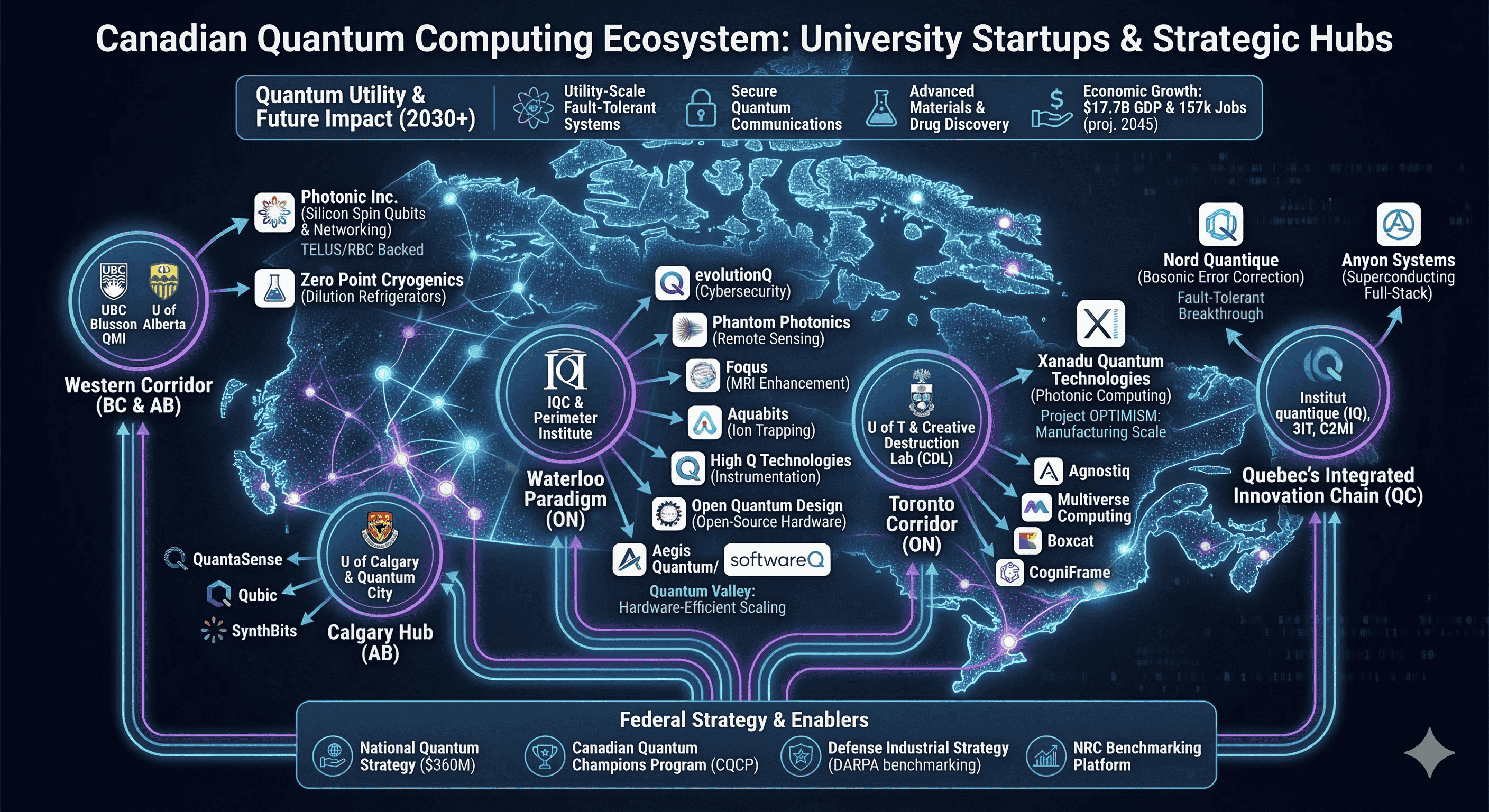
A critical insight into the Waterloo ecosystem is its pursuit of "hardware-efficient" scaling. For instance, Aquabits utilizes the transport of water molecules in artificial channels—a method inspired by biological Aquaporins—to trap ions. This innovation is significant because it potentially eliminates the requirement for bulky laser systems and expensive micro-fabrication, addressing the physical footprint challenges that often hinder the scaling of trapped-ion computers. Similarly, Phantom Photonics leverages quantum coherence to extend the operational range of 3D remote sensors while ensuring resilience against adversarial disabling, commonly referred to as "blinding attacks". This emphasizes a second-order trend: Canadian quantum startups are increasingly focusing on the intersection of quantum mechanics and industrial resilience, creating products that are not only more sensitive but also inherently more secure.
The Evolution of Collaborative Hardare: Open Quantum Design
The establishment of Open Quantum Design (OQD) in 2024 represents a fundamental shift in how quantum research is shared and commercialized. Founded by faculty members Crystal Senko, Rajibul Islam, and Roger Melko, OQD operates as a non-profit organization that provides the world's first open-source, full-stack quantum computer. This initiative addresses a primary bottleneck in the global quantum industry: the lack of accessible hardware for testing and refining algorithms.
OQD’s stack includes the hardware itself—isolated charged atoms manipulated by lasers—and the electronic layers and software needed to run it. By recruiting organizational partners like Xanadu and the Unitary Foundation, OQD creates a shared hub where research progress is transparent, free from the immediate commercial pressures that often silo information in private startups. This collaborative model reflects an underlying theme in the Canadian strategy: fostering a "quantum-ready" workforce and ecosystem that can build faster on shared foundations than by working in isolation.
The Toronto Corridor: Acceleration through the Creative Destruction Lab and the Rise of Photonic Computing
The University of Toronto (U of T) has positioned itself as a global nexus for quantum entrepreneurship, largely through the impact of the Creative Destruction Lab (CDL). Founded at the Rotman School of Management, CDL’s Quantum Stream has become one of the most successful accelerators for science-based ventures, attracting teams from around the world. The Toronto hub is characterized by its focus on "computational utility," where the objective is to move beyond experimental demonstrations toward solving real-world problems in finance, logistics, and chemistry.
U of T’s success is quantifiable: entrepreneurs from its community have launched over 1,500 venture-backed startups, raising more than $14 billion in the past five years. In the quantum sector, this momentum is exemplified by the growth of companies like Xanadu and the broader software ecosystem developed through the university’s computer science and physics departments.
Xanadu Quantum Technologies: Scaling Photonics for Global Markets
Xanadu Quantum Technologies, founded by former U of T post-doctoral researcher Christian Weedbrook, is perhaps the most prominent example of a Canadian university spin-off reaching global scale. Xanadu’s primary technical differentiator is its use of a photonic substrate for quantum computing. Unlike superconducting systems that require extreme cryogenic cooling for the entire processor, photonic systems use particles of light (photons) which can be manipulated at room temperature, although the detectors may still require cooling.
Milestones | Data and Financial Projections |
Public Listing | Expected Nasdaq/TSX listing in Q1 2026 under ticker "XNDU" |
Enterprise Value | Pro forma valuation of approximately $3.1 billion |
Capital Raised | Total funding of $250M over 9 rounds prior to business combination |
Federal Support | Awarded $23M under the Canadian Quantum Champions Program |
Project OPTIMISM | Negotiations for up to $390M in government support for manufacturing |
Software Impact | PennyLane library used widely for quantum machine learning |
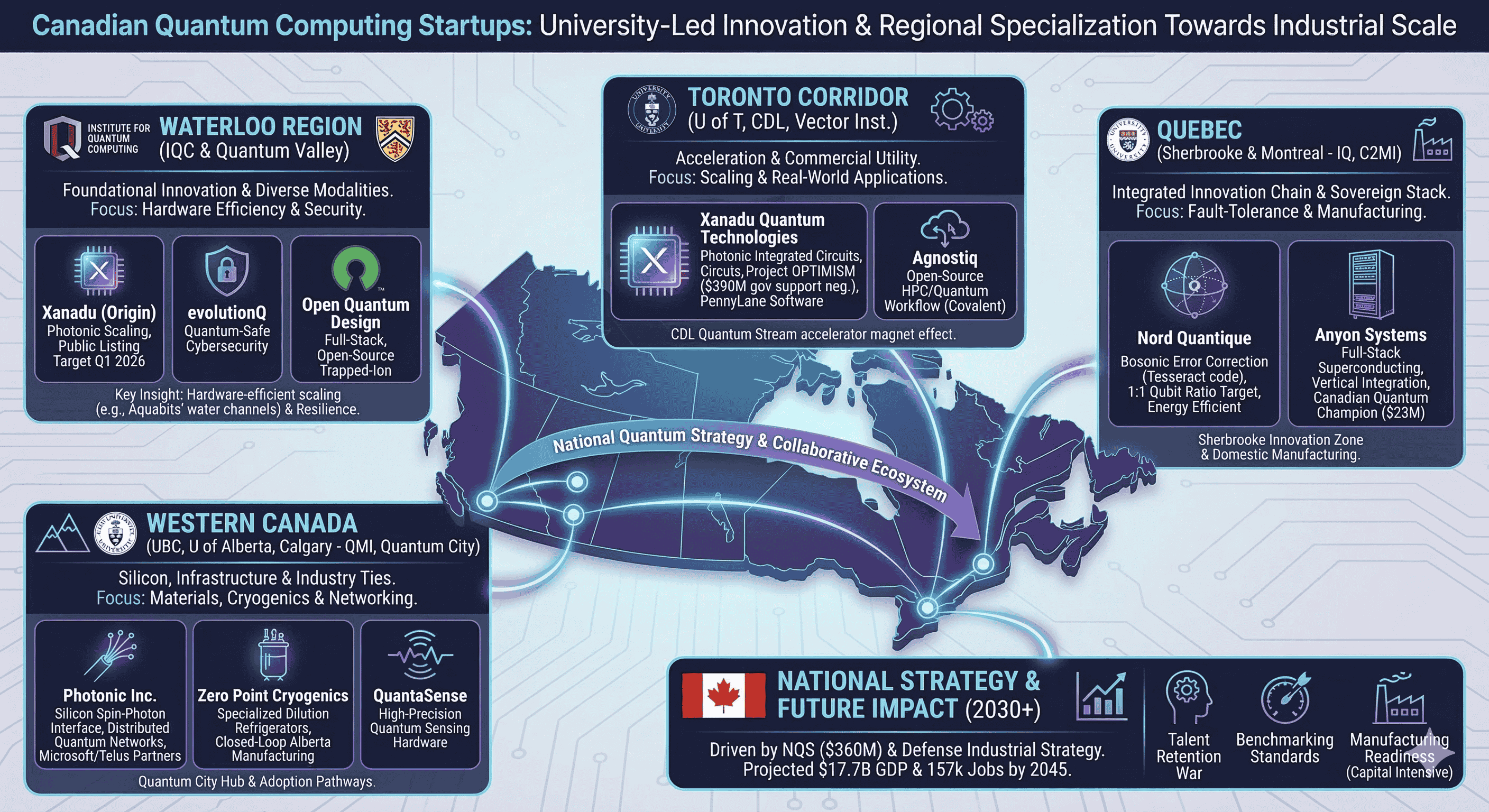
The strategic implications of Xanadu’s "Project OPTIMISM" are profound. By negotiating for $390 million in support to establish advanced semiconductor and photonic manufacturing capabilities in Canada, Xanadu is moving from a research-focused startup to a core infrastructure provider. This project encompasses domestic capabilities for heterogeneous integration, photonic integrated circuit packaging, and quantum module assembly. This transition signifies a third-order insight into the Canadian ecosystem: the realization that long-term leadership requires not just brilliant algorithms but also the domestic physical infrastructure to manufacture the chips and systems that run them.
CDL’s Role in Global Ecosystem Integration
The CDL Quantum stream provides an intensive technical and business bootcamp, often involving figures like John Martinis, which helps founders refine their technology roadmaps and prioritize actions for scaling. This has led to the successful launch and support of numerous ventures that have since become significant players.
CDL Alumni/Affiliate | Headquarters | Technology Segment |
Agnostiq | Toronto | Open-source HPC/Quantum workflow manager (Covalent) |
Boxcat | Toronto | Quantum rendering and image processing algorithms |
CogniFrame | Toronto | Quantum algorithms for financial optimization |
Multiverse Computing | Toronto (Int'l) | Quantum-inspired solutions for finance and industry |
Zero Point Cryogenics | Edmonton (Alumni) | Advanced dilution refrigerators for research |
The presence of companies like Multiverse Computing, which opened operations in Toronto despite being headquartered in Spain, illustrates the "magnet effect" of the Toronto-Waterloo corridor. The combination of U of T’s talent pipeline and the CDL’s mentorship network creates a self-sustaining cycle of innovation where global startups find it necessary to have a presence in Canada to remain competitive.
Quebec’s Integrated Innovation Chain: Sherbrooke’s Excellence in Error Correction and Hardware Manufacturing
Sherbrooke, Quebec, has emerged as a world-class center for quantum technology, anchored by the Institut quantique (IQ) at the Université de Sherbrooke (UdeS). The Sherbrooke model is uniquely characterized by its "Integrated Innovation Chain," which bridges the gap between basic research and industrial production. This chain involves the IQ for research, the 3IT for technological innovation, and the MiQro Innovation Collaborative Centre (C2MI) for industrial-scale manufacturing.
In February 2022, Sherbrooke was officially designated as an "Innovation Zone" for quantum sciences, a status that has unlocked hundreds of millions in investment and created a "Quantum Space" (Espace Quantique) for startups and international firms.
Nord Quantique and the Breakthrough in Fault-Tolerant Computing
Nord Quantique, a spin-off from the IQ founded in 2020 by CEO Julien Camirand Lemyre and Philippe St-Jean, has gained international recognition for its hardware-efficient approach to quantum error correction (QEC). While traditional models of QEC require thousands of physical qubits to create a single reliable logical qubit—a ratio that poses massive scaling and energy challenges—Nord Quantique utilizes bosonic encoding to protect quantum information directly within individual qubits.
In May 2025, the company announced a "first in applied physics" by demonstrating multimode encoding with their proprietary Tesseract code. This milestone showed that logical qubits could be stabilized against bit flips, phase flips, and control errors without the massive overhead associated with standard surface codes.
Metric | Nord Quantique Technical Milestone | Comparative Industry Standard |
Qubit Ratio | Aiming for a 1:1 ratio between physical cavities and logical qubits | Often 1,000+:1 in traditional architectures |
Stability | 32 error correction cycles with no measurable decay | Rapid decay without active correction |
Footprint | 1,000+ logical qubits projected to fit in 20 square meters | Monolithic systems can be 1450x larger for QEC |
Energy Consumption | ~120 kWh to crack RSA-830 (projected) | ~280,000 kWh for classical high-performance computing |
Timeline | First utility-scale systems (>100 logical qubits) by 2029 | Often early 2030s for utility-scale systems |
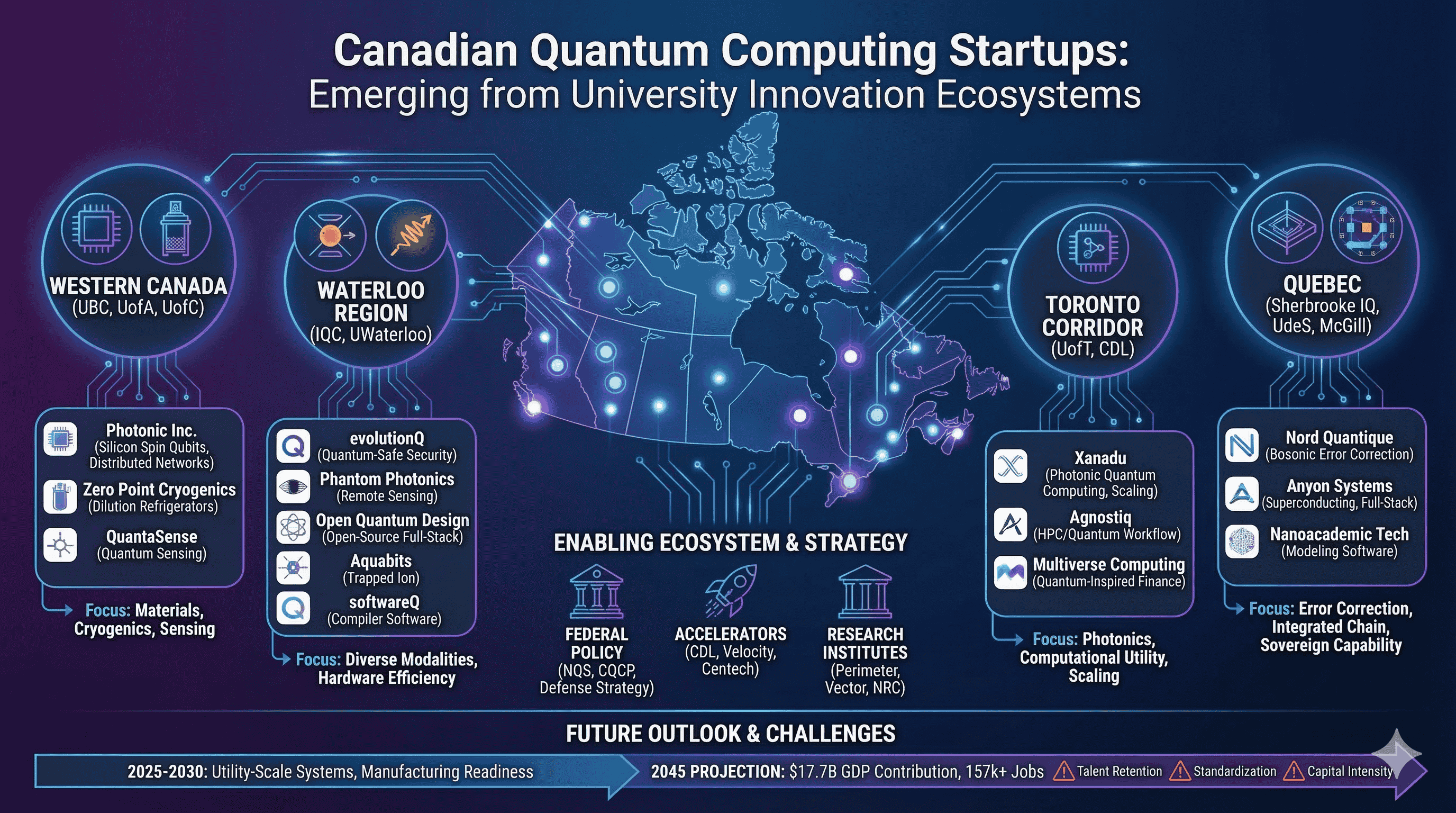
The implications of Nord Quantique's work are transformative for the energy sector and the environment. By reducing the energy requirements for complex computations by orders of magnitude, their bosonic systems address the sustainability concerns of the growing data center industry. This technical leadership has been validated by a $1.8 million federal contribution to establish an assembly laboratory in Sherbrooke, reinforcing the company's role as a domestic manufacturer of quantum computers.
Anyon Systems and the Strategic Value of the Full-Stack
Anyon Systems Inc., based in Montreal and deeply connected to the Sherbrooke ecosystem, specializes in superconducting quantum processors. A key aspect of Anyon’s strategy is its insistence on vertical integration. By developing its proprietary qubit technology and every major subsystem—from cryogenics to control electronics—in-house, Anyon aims to ensure that Canada retains "sovereign capability" in quantum technology.
This sovereign capability is not merely a point of national pride but a critical security requirement. In December 2025, Anyon was awarded $23 million under the Canadian Quantum Champions Program to accelerate its roadmap toward a commercially useful, fault-tolerant quantum computer. This funding supports the development of technical cores needed to move beyond laboratory demonstrations toward practical machines that can be used for defense, cryptography, and advanced materials. The trend here is clear: the Canadian government is actively funding companies that maintain control over the full hardware stack to protect critical know-how and ensure domestic security.
The Western Corridor: Silicon Spin Qubits and Enabling Infrastructure in BC and Alberta
British Columbia and Alberta have developed a robust quantum infrastructure focused on materials science, silicon photonics, and specialized cryogenic engineering. This region is home to some of the most capital-intensive and technically complex quantum hardware projects in North America.
Photonic Inc. and the Distributed Quantum Network
Photonic Inc., based in Coquitlam and founded in 2016, represents a significant departure from monolithic quantum computing architectures. Their Entanglement First™ Architecture combines silicon-based spin qubits with native photonic connectivity. By using "T center" defects in silicon—optically linked silicon spin qubits—Photonic enables powerful computation and efficient error correction that can scale across existing global telecom infrastructure.
Financial and Strategic Data | Photonic Inc. Milestone Analysis |
Capital Raised (Jan 2026) | $180M CAD ($130M USD) in first close of latest round |
Total Capital | $375M CAD ($271M USD) |
Strategic Partners | Microsoft (Azure integration), RBC, TELUS, BCI |
Federal Recognition | Selected for Phase 1 of Canadian Quantum Champions Program ($23M) |
Technical Goal | Building fault-tolerant quantum systems using distributed networking |
The involvement of TELUS and RBC as investors highlight a burgeoning second-order trend: the active participation of major telecommunications and financial institutions in the quantum sector. For TELUS, Photonic’s technology offers a path toward a secure quantum internet using existing fiber networks. For RBC, the potential for quantum-enhanced risk modeling and portfolio optimization is a key driver. This integration of "receptor industries" into the funding rounds of hardware startups suggests a maturing market where end-users are investing in the infrastructure they will eventually adopt.
The UBC Blusson QMI and Industry Engagement
The Stewart Blusson Quantum Matter Institute (QMI) at the University of British Columbia serves as the primary engine for quantum materials research in the west. Their approach is heavily focused on industrial collaboration, maintaining active partnerships with over 20 private companies.
Emerging Venture | Technology/Application | Institutional Origin |
Dream Photonics | Innovative circuitry for on-chip light integration | Lukas Chrostowski's lab |
ThorTech Reactors | Cleaner hydrogenation via electrochemical reactors | Curtis Berlinguette’s lab |
AweSEM | Affordable desktop electron microscopes ($hundreds) | Alireza Nojeh’s lab |
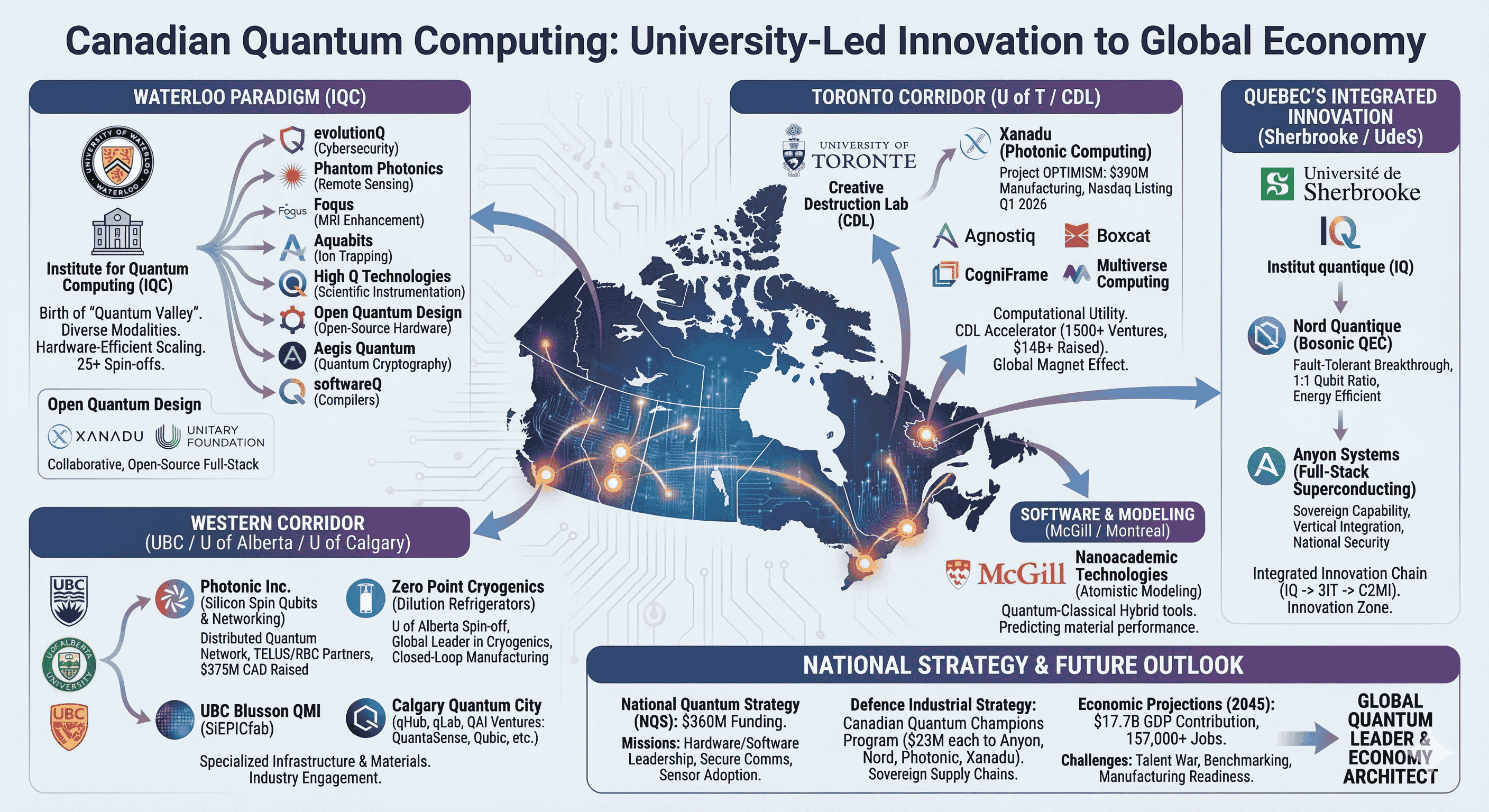
The SiEPICfab consortium at UBC is particularly noteworthy, as it brings together 20 companies and five universities to manage the entire lifecycle of silicon electronics-photonics integrated circuits. This creates a hub for circuit prototyping in Canada, allowing researchers and startups to iterate on their designs using world-class nanofabrication facilities without the need to build their own multi-million dollar cleanrooms.
Alberta’s Specialized Manufacturing: Zero Point Cryogenics
A critical but often overlooked component of the quantum ecosystem is the enabling infrastructure, specifically the cryogenic systems required to reach absolute zero. Zero Point Cryogenics (ZPC), an Edmonton-based spin-off from the University of Alberta, has become a global leader in this niche. Founded in 2017 by Dr. John P. Davis, ZPC is one of only six companies in the world that commercially manufacture the dilution refrigerators necessary for quantum research.
ZPC’s growth illustrates the transition from academic exercise to industrial power. By 2026, the company had grown from 4 to 40 employees and established a 6,300-square-foot manufacturing facility. Their "Model I" and "Model L" refrigerators are designed to be intuitive and modular, removing the requirement for a facility-sized room to house them. A key insight into ZPC’s competitive advantage is its "closed-loop" manufacturing: they do all their own machining, welding, and polishing in Alberta, tracing their skilled labor back to the province's energy sector. This allows them to assure quality on every component and meet the stringent security needs of government and defense clients.
The Calgary Hub: Quantum City and the QAI Ventures Accelerator
The University of Calgary has established Quantum City as a strategic hub to bridge the gap between quantum science and real-world solutions. This initiative involves a partnership with the Government of Alberta and Mphasis to create a vibrant economic hub in Calgary. Quantum City’s infrastructure includes qHub, a 17,000-square-foot collaborative space, and qLab, which features advanced cleanrooms for precision fabrication of quantum devices.
Startup (Calgary Cohort) | Technical Focus | Institutional Connection |
QuantaSense | High-precision quantum sensing hardware | University of Calgary Spin-out |
Qubic | Microwave-sensing with quantum amplifiers | QAI Ventures Accelerator |
SynthBits | Quantum microscopes for biomedical research | QAI Ventures Accelerator |
Bosonic | Trapped ion architecture for high-fidelity ops | QAI Ventures Accelerator |
Super Quantique Karma | HPC Quantum Computing Lab-as-a-Service | QAI Ventures Accelerator |
The emergence of QuantaSense as an Alberta-based sensing company underscores the province’s strength in hardware. Furthermore, Calgary’s hosting of the qConnect conference and the Quantum City Global Challenge Series has created an accessible platform for industry—including sectors like finance, utilities, and energy—to explore quantum use cases. This focus on "adoption pathways" is a distinguishing feature of the Calgary hub, ensuring that the technology developed in labs finds immediate application in the province’s core industrial sectors.
Software and Modeling: The McGill Contribution and the National Digital Strategy
While hardware dominates headlines, the Canadian ecosystem also features a robust quantum software and simulation sector, much of it emerging from McGill University and Montreal-based accelerators like Centech.
Nanoacademic Technologies, founded in 2008 by McGill Professor Hong Guo, provides atomistic and quantum modeling tools. Their software allows researchers to perform experiments in silico, predicting the performance of next-generation materials and reducing R&D costs for a broad range of applications. Similarly, PreFab AI Photonics uses machine learning models to predict nanofabrication errors, allowing designers to verify their circuits without costly prototyping cycles.
This software layer is essential for the "quantum-classical hybrid" era, where quantum processors will work in tandem with classical high-performance computers. Startups in this space are increasingly focusing on:
Atomistic Modeling: Understanding the behavior of matter at the quantum scale to design better qubits.
Quantum Compilation: Translating high-level algorithms into machine instructions that account for noise and error.
Workflow Orchestration: Managing tasks across heterogeneous computing resources, as seen with Agnostiq’s Covalent platform.
Strategic Synthesis: Policy, Defense, and the Path to 2030
The rapid proliferation of quantum startups in Canada is the result of a coordinated national strategy that recognizes quantum technology as a matter of both economic growth and national security. The National Quantum Strategy (NQS), launched in January 2023 with $360 million in funding, sets out three key missions: leading in quantum computing hardware and software, ensuring secure quantum communications, and enabling early adoption of quantum sensors.
The Defense Industrial Strategy and Quantum Sovereignty
In late 2025, the launch of the Canadian Quantum Champions Program (CQCP) signaled a shift toward a more aggressive industrial policy. By allocating up to $23 million each to Anyon Systems, Nord Quantique, Photonic, and Xanadu, the government is effectively "picking winners" to ensure these firms reach utility scale and remain headquartered in Canada.
This funding is explicitly linked to the forthcoming Defence Industrial Strategy, which aims to strengthen domestic supply chains and improve access to funds for small and medium-sized defense businesses. The involvement of DARPA (Defense Advanced Research Projects Agency) in benchmarking Canadian firms like Xanadu, Nord Quantique, and Photonic further validates the strategic importance of these companies on the global stage. The third-order implication is clear: quantum computing has moved from the realm of academic curiosity into the critical infrastructure of national defense, and Canada is securing its position as a key ally and provider in this domain.
Economic Projections and Future Challenges
The domestic quantum sector is projected to contribute $17.7 billion to the GDP and support over 157,000 jobs by 2045. However, several challenges remain:
The "Talent War": While Canadian universities are excellent at training quantum scientists, retaining them against competition from U.S. and European tech giants requires ongoing investment and the presence of world-leading domestic firms.
Benchmarking and Validation: As companies move from research to industry, there is a growing need for internationally recognized standards to ensure that quantum technologies perform as advertised. The NRC Benchmarking Quantum Platform will play a critical role in this transition.
Manufacturing Readiness: Transitioning from single-chip prototypes to mass-produced modules requires significant capital and infrastructure, as highlighted by Xanadu’s Project OPTIMISM.
Conclusion
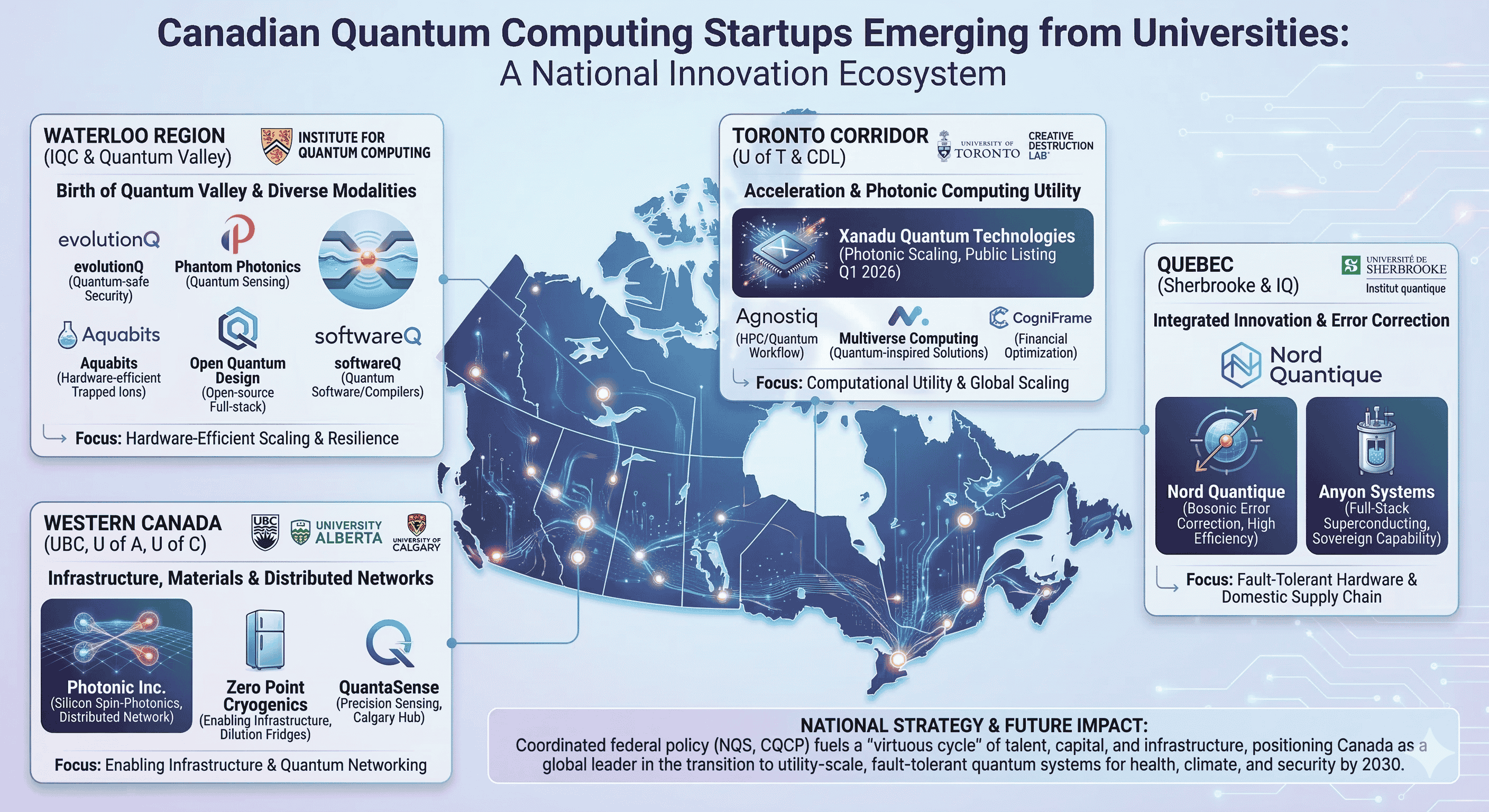
The evolution of quantum computing startups emerging from Canadian universities represents one of the most successful examples of deep-tech commercialization in the nation’s history. From the foundational work at the Institute for Quantum Computing in Waterloo to the industrial-scale manufacturing projects in Toronto and Sherbrooke, and the specialized hardware and networking in Western Canada, the ecosystem is characterized by a sophisticated regional specialization. The integration of federal strategic funding with world-class academic research has created a "virtuous cycle" where talent, capital, and infrastructure combine to solve the most difficult problems in quantum science. As these firms transition from the laboratory to the Nasdaq and into the defense industrial base, the Canadian model of university-led innovation stands as a global benchmark for the development of the quantum economy. The path to 2030 will be defined by the success of these spin-offs in achieving fault-tolerant, utility-scale systems that can address humanity’s most pressing challenges in health, climate, and security.
Read More -
1. From Idea to MVP: A Step-by-Step Guide for Solo Founder
🔗 https://findnstart.com/blogs/from-idea-to-mvp-a-step-by-step-guide-for-solo-founder
2. How to Validate Your Startup Idea in 48 Hours for $0
🔗 https://findnstart.com/blogs/how-to-validate-your-startup-idea-in-48-hours-for-0
3. Remote vs. Local: Does Your Co-Founder Need to Live in the Same City?
🔗 https://findnstart.com/blogs/remote-vs-local-does-your-co-founder-need-to-live-in-the-same-city
4. The 2026 Startup Landscape: What Has Fundamentally Changed (and Why Founder Skills Matter More Than Ever)
5. The Most In-Demand Skills for Startup Founders in 2026
🔗 https://findnstart.com/blogs/the-most-in-demand-skills-for-startup-founders-in-2026
6. How to Find a Technical Co-Founder (Without a Six-Figure Salary)
🔗 https://findnstart.com/blogs/how-to-find-a-technical-co-founder-without-a-six-figure-salary
7. 5 Red Flags to Look for When Choosing a Startup Partner
🔗 https://findnstart.com/blogs/5-red-flags-to-look-for-when-choosing-a-startup-partner
8. How to Pitch Your Idea to Potential Co-Founders
🔗 https://findnstart.com/blogs/how-to-pitch-your-idea-to-potential-co-founders
9. How to Build a Portfolio that Attracts High-Growth Startup Founders
🔗 https://findnstart.com/blogs/how-to-build-a-portfolio-that-attracts-high-growth-startup-founders
10. Equity vs. Salary: How to Split Ownership with Your First Teammate
🔗 https://findnstart.com/blogs/equity-vs-salary-how-to-split-ownership-with-your-first-teammate
11. Why Joining an Early-Stage Startup is Better Than a Corporate Job
🔗 https://findnstart.com/blogs/why-joining-an-early-stage-startup-is-better-than-a-corporate-job
12. The Future of EdTech: Why Developers and Educators Need to Team Up Now
🔗 https://findnstart.com/blogs/the-future-of-edtech-why-developers-and-educators-need-to-team-up-now
13. The Architecture of Symbiosis: Analytical Perspectives on the Five Habits of Successful Startup Duos
14. Finding a Co-Founder in the AI Space: What Skills Should You Look For?
🔗 https://findnstart.com/blogs/finding-a-co-founder-in-the-ai-space-what-skills-should-you-look-for
15. Overcoming Analysis Paralysis and the Strategic Path to Execution
🔗 https://findnstart.com/blogs/overcoming-analysis-paralysis-and-the-strategic-path-to-execution
16. From College Project to Company: How to Find Your Student Co-Founder
🔗 https://findnstart.com/blogs/from-college-project-to-company-how-to-find-your-student-co-founder
17. How to Start a Startup While Working a Full-Time Job
🔗 https://findnstart.com/blogs/how-to-start-a-startup-while-working-a-full-time-job
18. How to Build a HealthTech Startup Without a Medical Degree
🔗 https://findnstart.com/blogs/how-to-build-a-healthtech-startup-without-a-medical-degree
19. The Solitary Architect: Executive Isolation in Entrepreneurship
20. The 2026 Guide to Launching a SaaS as a Solo Developer
21. What Sustainable Growth Actually Looks Like
🔗 https://findnstart.com/blogs/what-sustainable-growth-actually-looks-like
22. The Early Warning Signs Your Startup Is in Trouble
🔗 https://findnstart.com/blogs/the-early-warning-signs-your-startup-is-in-trouble
23. How to Grow Without Burning Out
🔗 https://findnstart.com/blogs/how-to-grow-without-burning-out
24. The Truth About “Runway” Most Founders Ignore
🔗 https://findnstart.com/blogs/the-truth-about-runway-most-founders-ignore
25. Revenue Solves More Problems Than Funding
🔗 https://findnstart.com/blogs/revenue-solves-more-problems-than-funding
26. What No One Tells You About Being a Solo Founder
🔗 https://findnstart.com/blogs/what-no-one-tells-you-about-being-a-solo-founder
27. Why Smart People Quit High-Paying Jobs to Build Startups (And Why Most Regret It)
28. Why Most Startup Advice on Twitter Is Dangerous
🔗 https://findnstart.com/blogs/why-most-startup-advice-on-twitter-is-dangerous
29. Decision Fatigue: The Silent Startup Killer
🔗 https://findnstart.com/blogs/decision-fatigue-the-silent-startup-killer
30. Fear vs Logic: How Founders Actually Make Decisions
🔗 https://findnstart.com/blogs/fear-vs-logic-how-founders-actually-make-decisions
31. How Overthinking Destroys Early Momentum
🔗 https://findnstart.com/blogs/how-overthinking-destroys-early-momentum
32. Ideas Don’t Scale. Systems Do.
🔗 https://findnstart.com/blogs/ideas-dont-scale-systems-do
33. The First Hire That Actually Matters
🔗 https://findnstart.com/blogs/the-first-hire-that-actually-matters
34. How the First 100 Users Decide Your Startup’s Fate
🔗 https://findnstart.com/blogs/how-the-first-100-users-decide-your-startups-fate
35. Why Your Startup Doesn’t Need Growth — It Needs Focus
🔗 https://findnstart.com/blogs/why-your-startup-doesnt-need-growthit-needs-focus
36. Why Most Startups Die Quietly
🔗 https://findnstart.com/blogs/why-most-startups-die-quietly
37. Lessons Learned Too Late by First-Time Founders
🔗 https://findnstart.com/blogs/lessons-learned-too-late-by-first-time-founders
38. The Myth of the “Overnight Success” Startup
🔗 https://findnstart.com/blogs/the-myth-of-the-overnight-success-startup