Koramangala vs HSR: Does Location Still Matter?
March 11, 2026 by Harshit Gupta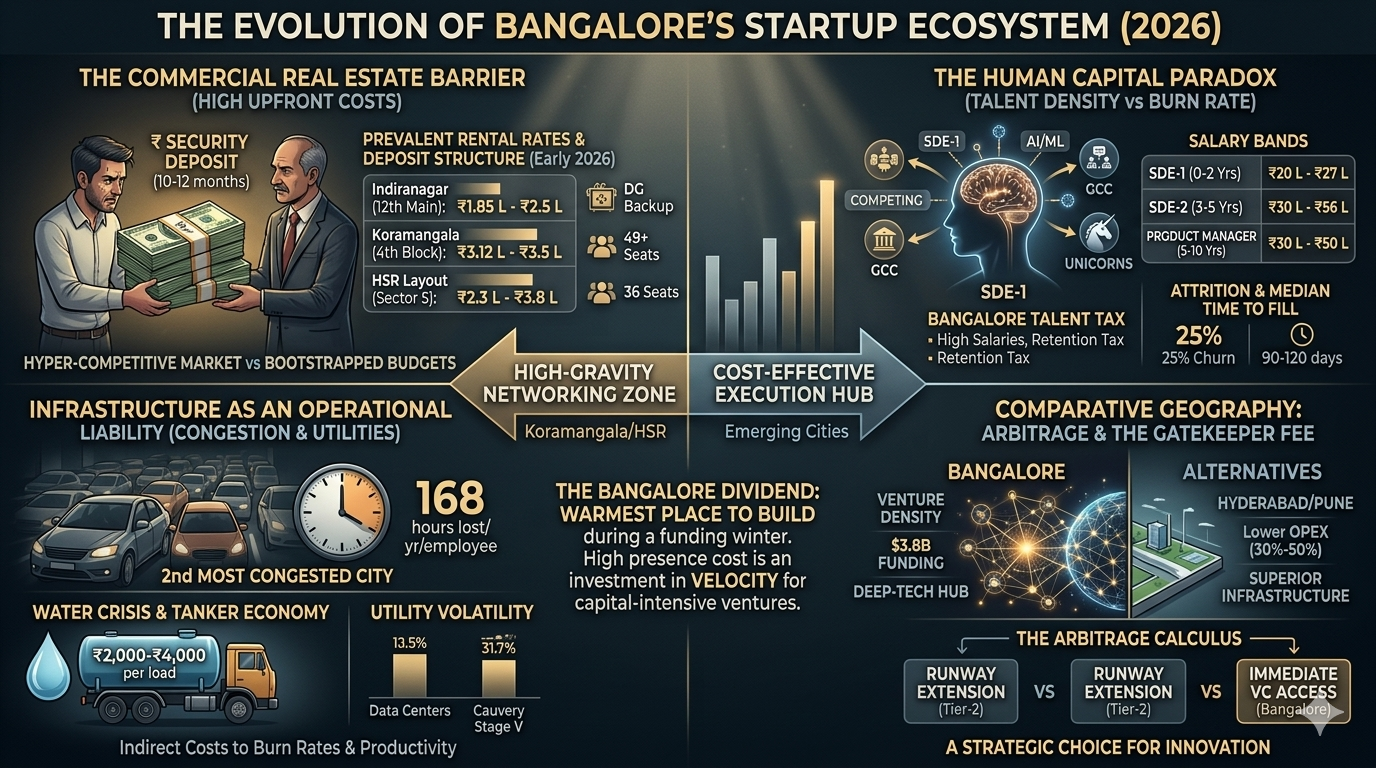
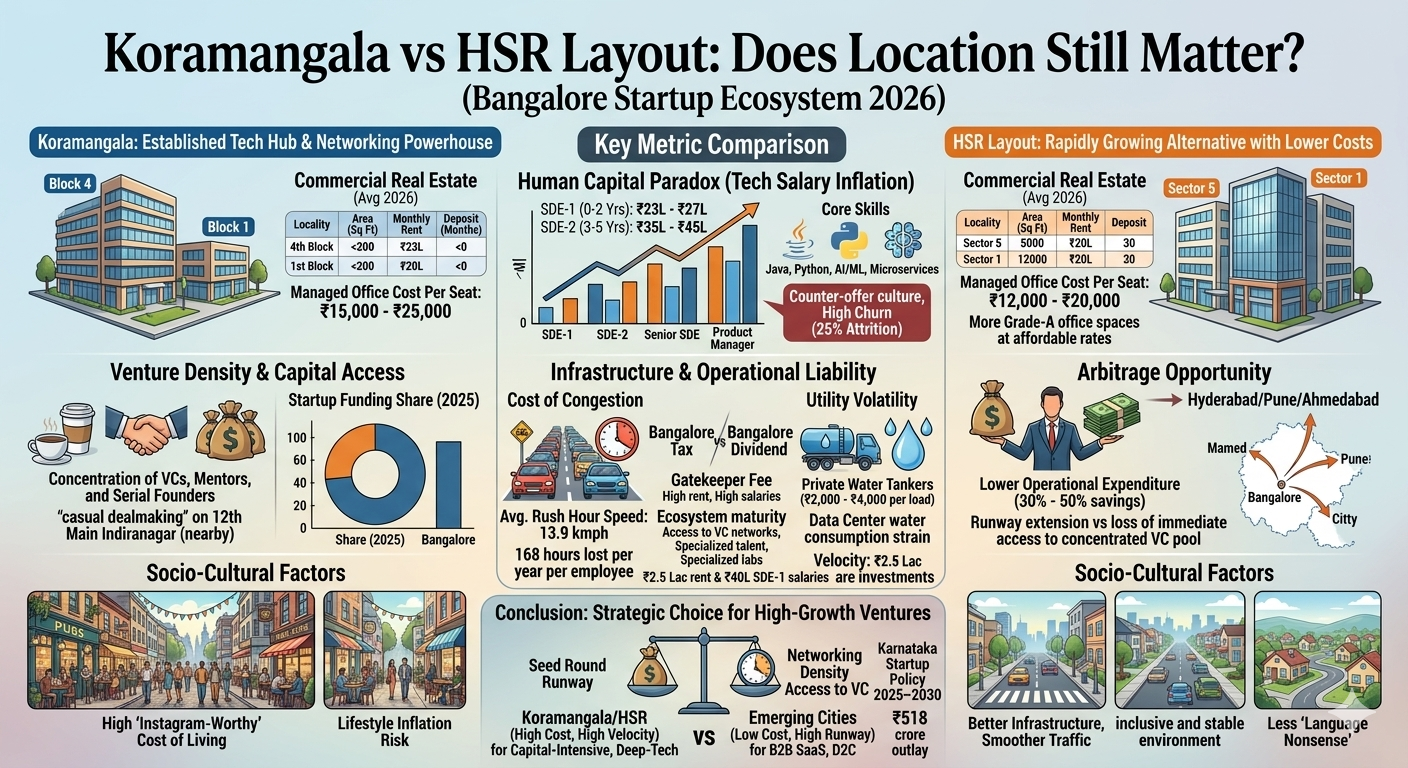
The structural evolution of Bangalore from a regional administrative center to a global technology powerhouse has reached a critical inflection point in 2026. For over a decade, the city has been the undisputed capital of Indian innovation, a status solidified by its unparalleled venture density and a self-sustaining ecosystem of talent and capital. However, as the ecosystem matures, the cost of entry for early-stage founders has escalated to levels that challenge the traditional "garage startup" narrative. The convergence of hyper-competitive talent markets, volatile commercial real estate, and a deepening infrastructure deficit has created what is colloquially termed the "Bangalore Tax"—a premium that founders must pay simply to exist within the city’s high-gravity networking zones. This analysis evaluates whether the diminishing returns of Bangalore’s ecosystem now outweigh the historical advantages of its network effects, examining the operational realities of early-stage ventures through the lenses of real estate, human capital, infrastructure, and regional competition.
The Commercial Real Estate Barrier: Dead Capital and the Managed Shift
The most immediate barrier for early-stage founders in 2026 is the cost of physical infrastructure. In the prime corridors of Indiranagar, Koramangala, and HSR Layout, commercial rental rates have decoupled from the budget constraints of bootstrapped or seed-stage ventures. A granular examination of the rental landscape reveals that even modest office footprints in these areas command significant monthly outlays and heavy security deposits, which often act as a significant drag on capital efficiency.
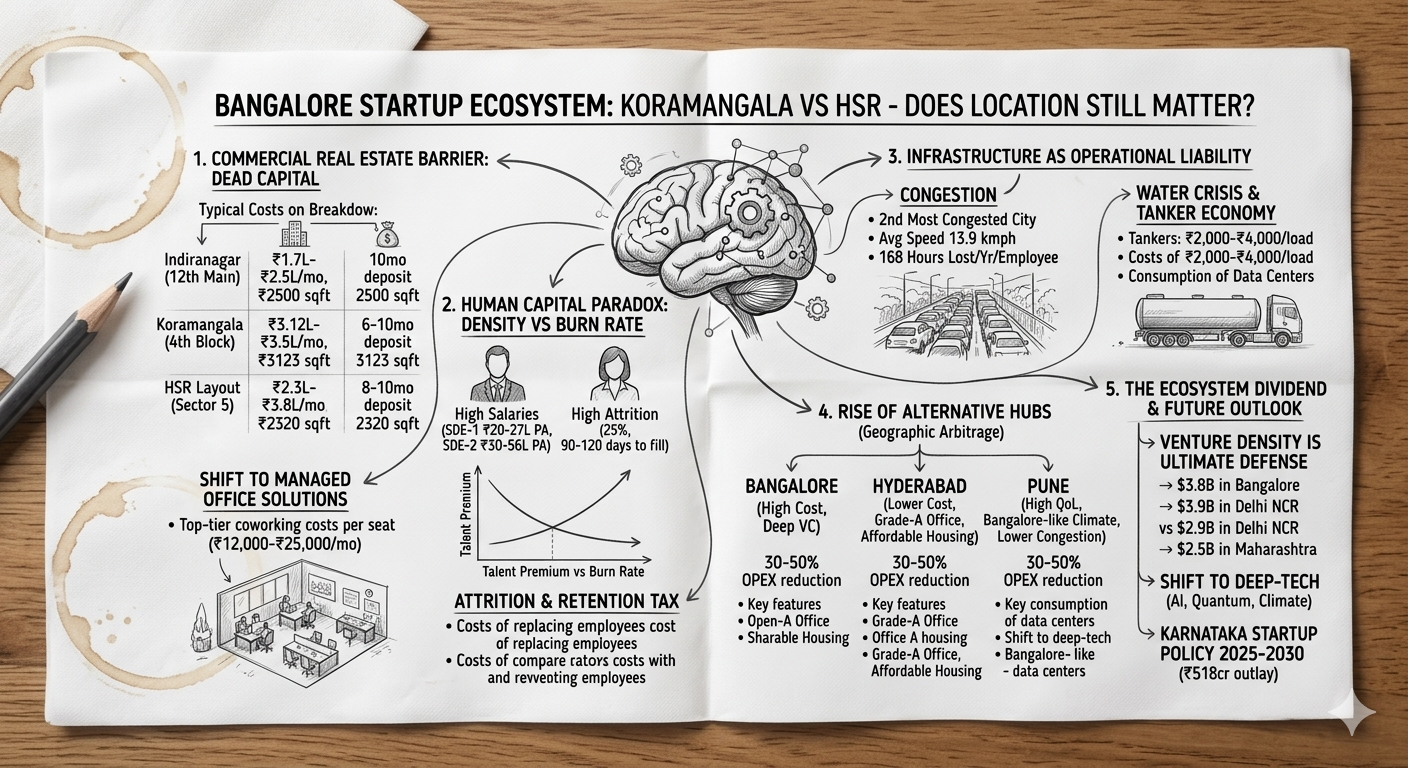
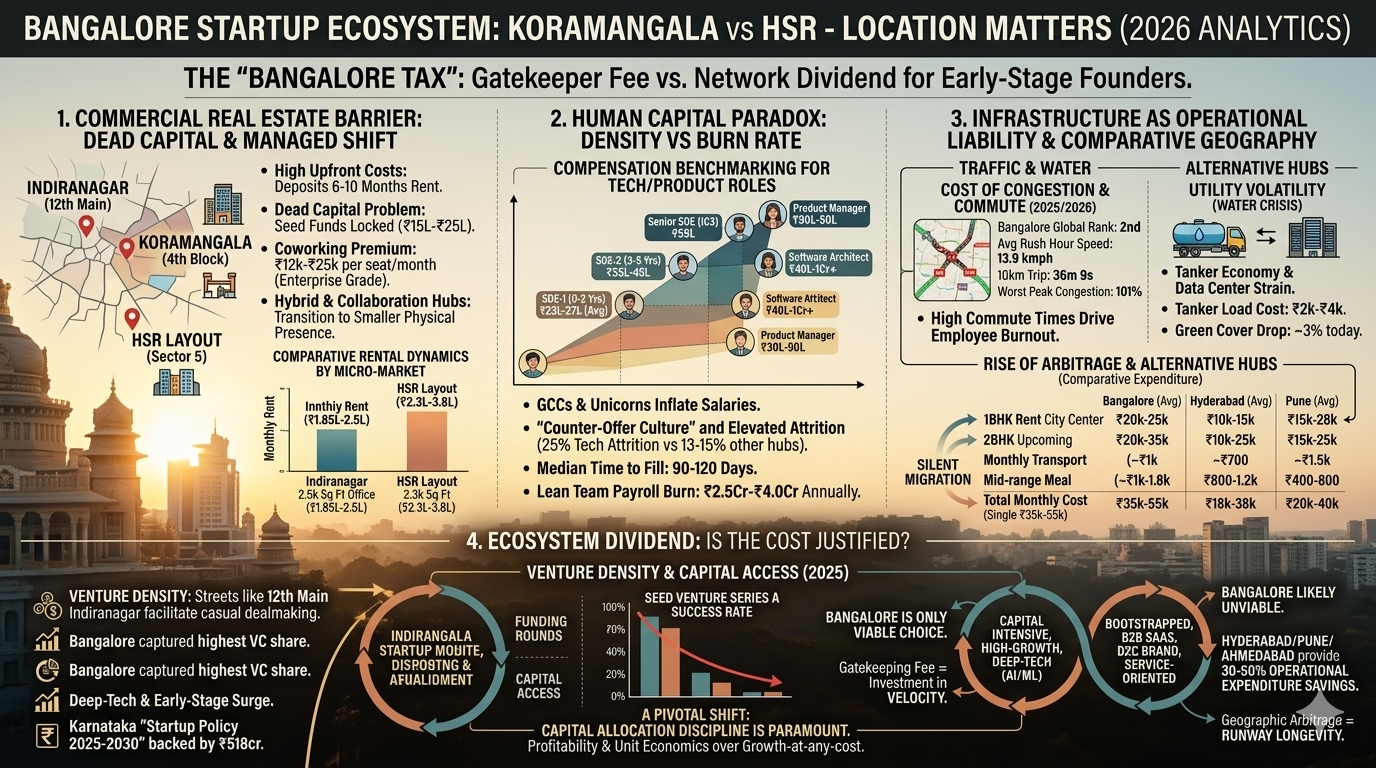
In Indiranagar, particularly around the 12th Main Road—often described as "India's shortest Sand Hill Road"—commercial spaces for a small team of 30 to 35 people range from ₹1.7 Lac to ₹2.5 Lac per month. These properties often require security deposits equivalent to six to ten months of rent, effectively locking up significant portions of early-stage capital that would otherwise be allocated to product development or talent acquisition. For a seed-stage startup raising between ₹50 Lacs to ₹3 Crores, the requirement to park ₹15 Lac to ₹25 Lac in a non-interest-bearing security deposit creates a "dead capital" problem that can shorten a startup's runway by several critical months.
Comparative Commercial Rental Dynamics by Micro-Market
The following table outlines the prevalent rental rates and deposit structures across Bangalore's primary startup hubs as of early 2026. These figures represent the high overhead founders face when attempting to secure a physical base in the city's "gravity centers."
Locality | Typical Space Type | Area (Sq Ft) | Monthly Rent Range | Security Deposit (Months) | Amenities Included |
Indiranagar (12th Main) | Fully Furnished Office | 2,500 | ₹1.85 L - ₹2.5 L | 10 Months | DG Backup, AC, Lift |
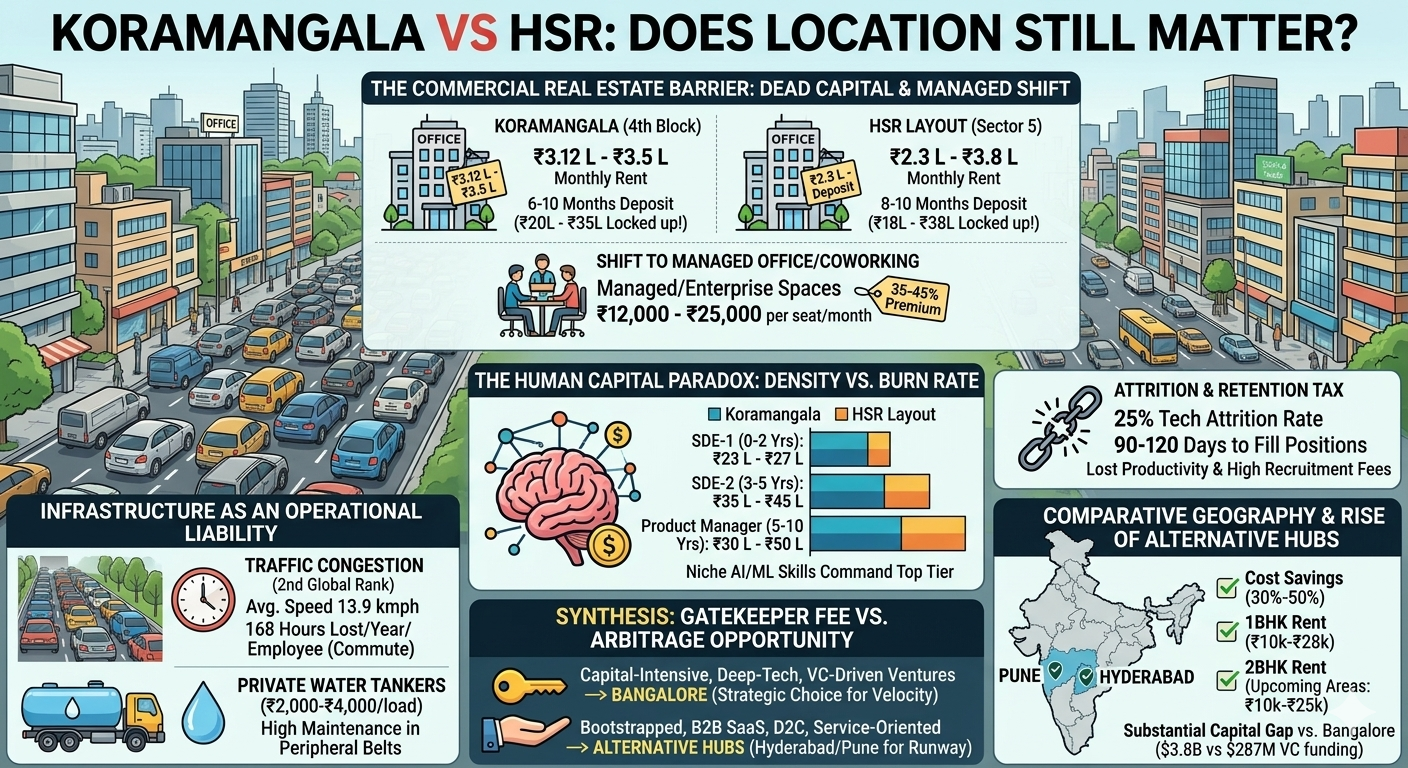
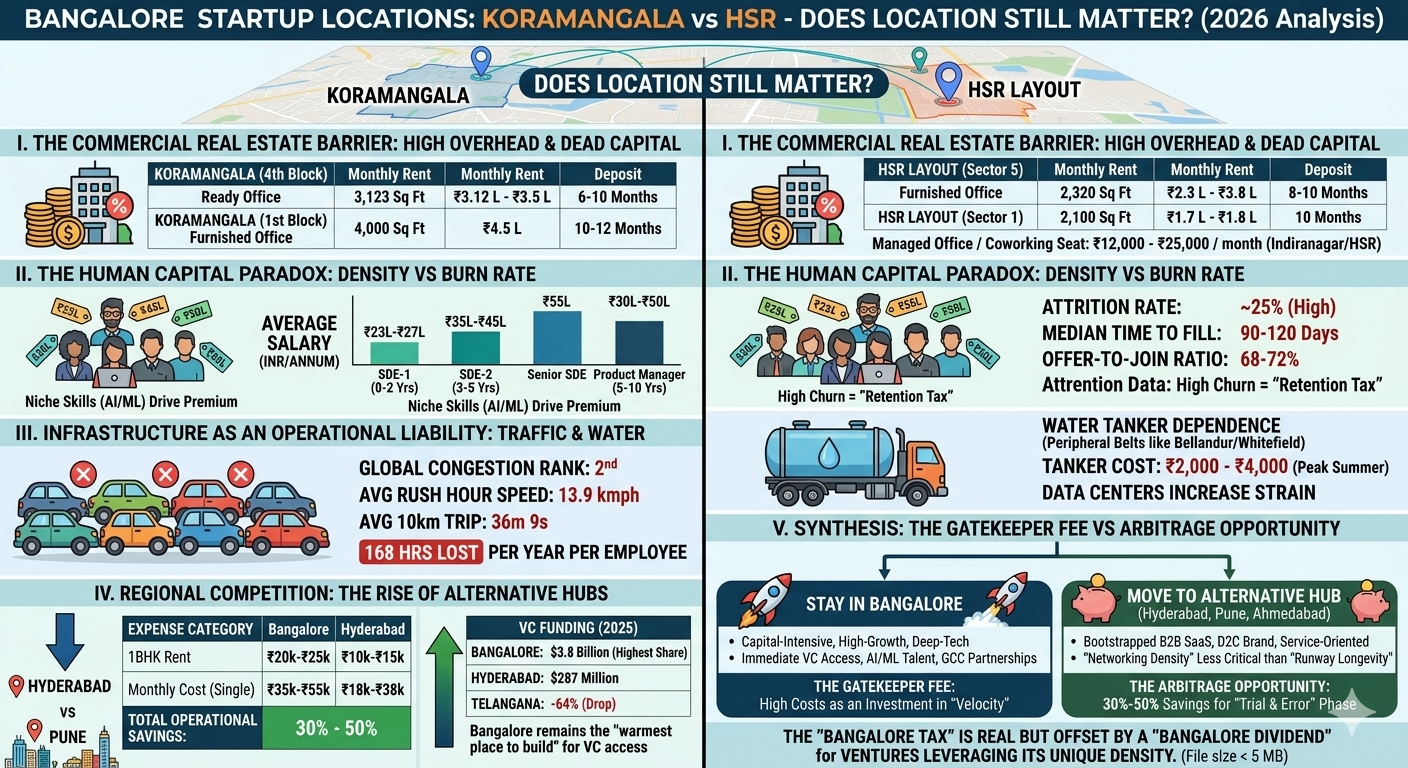
Koramangala (4th Block) | Ready-to-Move Office | 3,123 | ₹3.12 L - ₹3.5 L | 6-10 Months | 49+ Seats, Comm. Zone |
HSR Layout (Sector 5) | Furnished Office | 2,320 | ₹2.3 L - ₹3.8 L | 8-10 Months | 36 Seats, Pantry |
Koramangala (1st Block) | Furnished Office | 4,000 | ₹4.5 L | 10-12 Months | Director Room, Conf. |
HSR Layout (Sector 1) | Semi-Furnished Office | 2,100 | ₹1.7 L - ₹1.8 L | 10 Months | 40 Workstations |
Kudlu Main Road | Bare Shell Space | 4,000 | ₹1.2 L | Negotiable | Ground Floor, Basic |
The shift towards managed office solutions and coworking spaces is a direct response to these high upfront costs. Coworking in Bangalore has transitioned from simple hot-desks for freelancers to enterprise-grade, fully managed environments that minimize the risk of long-term liabilities. In 2026, the cost per seat in top-tier coworking hubs in Indiranagar or HSR Layout ranges from ₹12,000 to ₹25,000 per month. While these spaces eliminate the need for managing IT, security, and maintenance, the operational expenditure (OPEX) remains high, often representing a 35-45% premium over traditional leases when calculated on a per-seat basis.
The rise of hybrid work models has further complicated the real estate calculus. Founders must now balance the need for a collaborative physical presence with the reality that many top-tier engineers prefer remote or flexible arrangements to avoid the city's notorious traffic. Consequently, many startups are opting for smaller, high-end "collaboration hubs" rather than large permanent offices, though even these smaller footprints in prime locations remain expensive.

The Human Capital Paradox: Density vs. Burn Rate
Bangalore continues to host the deepest and most diverse tech talent pool in India, with specialists across AI, product management, and core engineering. Yet, for an early-stage founder, this density is a double-edged sword. The presence of global capability centers (GCCs) and large-scale unicorns has inflated salary expectations and exacerbated a "counter-offer culture" that drives up the cost of hire.
Compensation Benchmarking for Tech and Product Roles
By early 2026, salary bands for software development engineers (SDEs) in Bangalore have reached unprecedented levels, driven by the intense competition for niche skills in AI/ML and deep-tech. An SDE-1 with zero to two years of experience now commands an average salary of ₹20L to ₹27L per annum at high-growth startups and product companies. Mid-level engineers (SDE-2) with three to five years of experience often earn between ₹30L and ₹56L, frequently supplemented by stock options and performance bonuses.
Job Role | Experience Level | Average Salary (INR/Annum) | Salary Range (25th-75th Pct) | Core Skills in Demand |
SDE-1 | 0-2 Years | ₹23 L - ₹27 L | ₹15 L - ₹39 L | Java, Python, React |
SDE-2 | 3-5 Years | ₹35 L - ₹45 L | ₹25 L - ₹65 L | Node, AWS, Microservices |
Senior SDE (IC3) | 5-8 Years | ₹55 L | ₹45 L - ₹75 L | Architecture, Backend |
Software Architect | 10+ Years | ₹24 L - ₹40 L* | ₹40 L - ₹1.0 Cr+ | Cloud, Security |
Product Manager | 5-10 Years | ₹30 L - ₹50 L | ₹25 L - ₹70 L | GTM, Data, AI |
Backend Engineer | 4-6 Years | ₹45 L | ₹31 L - ₹67 L | Go, Spark, Big Data |
Note: Figures for Architects and senior management vary significantly between traditional firms and high-paying product giants like Google or Amazon, where total compensation often exceeds ₹1 Crore.
The financial impact on a seed-stage venture is stark. A lean team of five engineers and two product leads can result in an annual payroll burn of ₹2.5 Cr to ₹4.0 Cr, depending on the seniority and niche expertise required. When compared to cities like Hyderabad or Pune, where salary rates for similar roles are consistently 10% to 20% lower, the "Bangalore Tax" on talent becomes a primary driver of high burn rates.
Attrition and the Retention Tax
Beyond the initial salary, founders face a "retention tax" driven by the city’s high churn rates. The tech attrition rate in Bangalore remains elevated at approximately 25%, significantly higher than the 13-15% observed in more stable hubs like Hyderabad. The median time to fill critical positions in Bangalore ranges from 90 to 120 days, and the "offer-to-join" ratio hovers between 68% and 72%, indicating that three out of ten candidates likely accept a counter-offer or a competing bid before their start date.
This high-churn environment forces founders into a perpetual cycle of recruitment and onboarding. Replacing a frontline employee can cost approximately 40% of their yearly compensation in direct and indirect costs, while replacing leadership positions can cost up to 200% of their annual salary. For a founder, this translates to lost productivity, increased recruitment fees, and a constant state of organizational instability that can delay product milestones.
Infrastructure as an Operational Liability: Traffic and Water
In 2026, the physical and utility challenges of Bangalore have moved beyond being mere inconveniences to becoming genuine operational risks. Infrastructure deficits impose indirect costs that founders must factor into their burn rates and productivity models.
The Cost of Congestion and Commute
Bangalore was ranked as the second most congested city globally in 2025, trailing only Mexico City. The average rush hour speed has plummeted to 13.9 kmph, which is one kmph slower than the previous year. For a startup, this means a typical 10 km commute takes approximately 36 minutes and 9 seconds, leading to a staggering 168 hours lost per year per employee during peak periods.
Congestion Metric (2025/2026) | Bangalore Performance | Global Context / Trend |
Global Congestion Rank | 2nd | After Mexico City |
Avg. Rush Hour Speed | 13.9 kmph | Slower than 2024 (14.9 kmph) |
Time for 10km Trip | 36m 9s | 2m 4s more than 2024 |
Congestion Level (Avg) | 74.4% | 1.7% increase from 2024 |
Worst Peak Congestion | 101% (May 17, 2025) | Rain and broken infrastructure |
This congestion forces founders to either invest in premium office locations near metro stations (further driving up rent) or adopt hybrid work models that can dilute the intense collaborative energy essential for early-stage ideation. Many founders report that high commute times are a primary driver of employee burnout and a reason for talent to prefer "Tier-2" hubs or remote roles where they can reclaim two to three hours of their day.
Utility Volatility: The Water Crisis and Tanker Economy
The water crisis of 2024 serves as a case study for the city's utility fragility. While the situation improved slightly by 2025 due to better rainfall and the partial commissioning of Cauvery Stage V, significant portions of the startup corridors—including Bellandur, Whitefield, and Sarjapur Road—remain dependent on private water tankers.
The operational cost of water is no longer negligible. In some peripheral IT belts, a single tanker load can cost between ₹2,000 and ₹4,000 during peak summer months, and rates can double for emergency orders. For the apartment complexes and office parks where founders and their employees live and work, these costs are passed down through high maintenance fees. Furthermore, the rapid rise of data centers to support the AI boom is putting additional strain on resources; a typical 20 MW facility consumes roughly 1.4 million liters of water daily—equivalent to the needs of 27,000 urban households. This competition for resources is likely to keep utility costs high and unpredictable, particularly as the city’s green cover has dropped from 68% in the 1970s to roughly 3% today.
Comparative Geography: The Rise of Arbitrage and Alternative Hubs
The financial and infrastructural pressures of Bangalore have catalyzed a "silent migration" of founders toward more cost-effective ecosystems. Cities like Hyderabad, Pune, and Ahmedabad are positioning themselves as viable alternatives by offering a superior balance of affordability, infrastructure, and policy support.
The Hyderabad and Pune Alternatives
Hyderabad, in particular, has emerged as a formidable rival for Bangalore's dominance. It offers Grade-A office spaces at more affordable rates and significantly lower residential costs. While Bangalore traditionally delivers slightly higher rental yields (3.5–4%), Hyderabad’s lower acquisition costs and faster infrastructure moves make it a more budget-friendly city for housing and daily operations.
Expense Category | Bangalore (Avg INR) | Hyderabad (Avg INR) | Pune (Avg INR) |
1BHK Rent (City Center) | ₹20,000 - ₹25,000 | ₹10,000 - ₹15,000 | ₹15,000 - ₹28,000 |
2BHK Rent (Upcoming Areas) | ₹20,000 - ₹35,000 | ₹10,000 - ₹25,000 | ₹15,000 - ₹25,000 |
Monthly Transport Pass | ~₹1,000 | ~₹700 | ~₹1,500 |
Mid-range Meal for Two | ₹1,000 - ₹1,800 | ₹800 - ₹1,200 | ₹400 - ₹800 |
Annual Int'l School Fees | ₹2,00,000+ | ₹1,50,000 - ₹2,50,000 | ₹60,000 - ₹1.5 L |
Total Monthly Cost (Single) | ₹35,000 - ₹55,000 | ₹18,000 - ₹38,000 | ₹20,000 - ₹40,000 |
Pune is also gaining traction, particularly for founders who prioritize a high quality of life and a "Bangalore-like" climate without the extreme congestion. Testimonials from founders like Kaushik Mukherjee suggest that "language tensions" and infrastructure woes in Bangalore are actively driving entrepreneurs to relocate operations to Pune, where they perceive a more inclusive and stable environment for non-local staff.
The Arbitrage Calculus for Founders
For an early-stage founder, moving to a city like Hyderabad or Ahmedabad can reduce overall operational expenditure by 30% to 50%. This "geographic arbitrage" allows a seed round to last significantly longer. In Ahmedabad, for instance, a startup can save up to 60-70% on living and office costs compared to Bangalore, though this comes at the cost of a less mature local networking ecosystem.
Despite these advantages, the gap between emerging cities and the "Top Three" (Bangalore, Mumbai, Delhi-NCR) remains substantial in terms of capital depth and exit opportunities. Hyderabad raised approximately $287 million across 32 deals in 2025, which, while significant, is a fraction of the $3.8 billion raised by Bangalore-based companies in the same period. The decision to relocate is therefore a trade-off between runway extension and the loss of immediate access to the country's most concentrated pool of venture capital.
The Ecosystem Dividend: Is the Cost Justified?
Despite the escalating costs, Bangalore remains the "warmest place to build" during a funding winter. The concentration of venture capital and the maturity of the founder-led ecosystem provide a "dividend" that many argue justifies the high cost of entry.
Venture Density and Capital Access
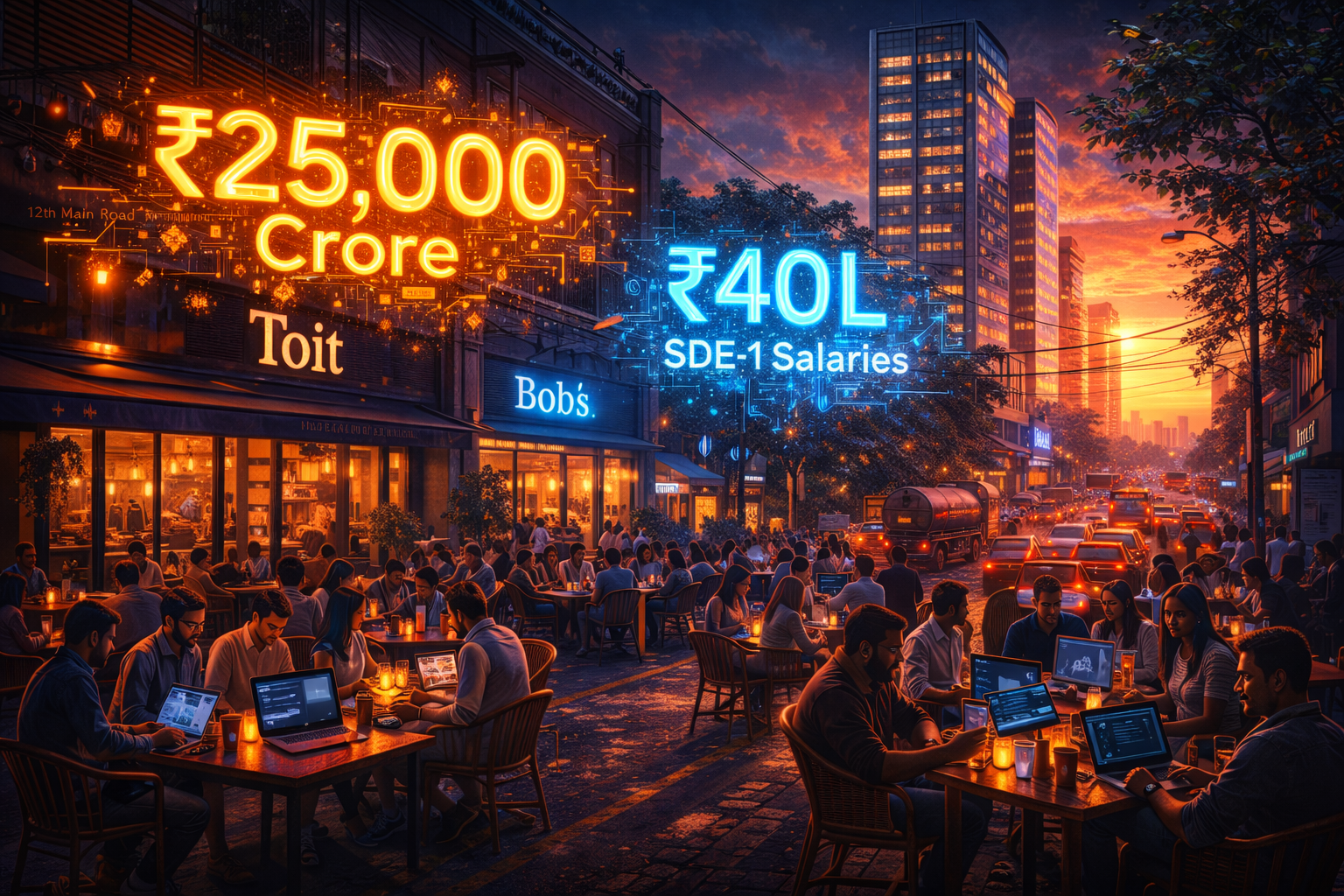
Bangalore’s startups drew nearly half of all VC funding in India over the past decade. In 2025, even as national funding slowed, Bangalore captured the highest share of both deal count and funding value. The "venture density" of streets like 12th Main in Indiranagar facilitates "casual dealmaking" that is difficult to replicate in other cities; a quick tally of the funds and startups anchored on this short stretch suggests a cumulative market cap and fund value exceeding ₹25,000 crore.
Funding Segment (2025) | Bangalore/Karnataka | Delhi NCR | Telangana | Maharashtra |
Total Tech Funding Raised | $3.8 Billion | $2.9 Billion | $236.4 Million | $2.5 Billion |
Funding Trend (YoY) | -28% (Drop) | +7% (Rise) | -64% (Drop) | -7% (Drop) |
Early-Stage Funding | $1.6 Billion | - | - | - |
Seed-Stage Funding | $434 Million | - | - | - |
The data indicates a pivotal shift: while late-stage funding contracted significantly in 2025, early-stage and deep-tech investments are surging. Bangalore is the primary beneficiary of this trend, hosting over 4,200 deep-tech startups and seeing a 32% rise in early-stage funding compared to the previous year. For a founder building in AI, blockchain, or quantum computing, the "ecosystem maturity" of Bangalore—which includes access to specialized labs and mentor-operators—often outweighs the raw financial costs.
Government Intervention and Policy Buffers
Recognizing the cost pressures, the Karnataka government has introduced the "Startup Policy 2025–2030," backed by an outlay of ₹518 crore. This policy aims to foster 25,000 startups, with a specific focus on deep-tech sectors. Initiatives like the "Beyond Bengaluru" Cluster Seed Fund are also attempting to develop regional hubs in Mysuru and Hubballi to provide lower-cost alternatives with government-funded incubation.
However, for most high-growth founders, these state-backed funds—often providing grants of ₹10L to ₹30L through programs like ELEVATE—act more as a signal of intent than a total solution to the high-burn environment of the city proper. The policy’s success in "de-risking" the city for early-stage founders will depend on its ability to improve basic infrastructure as much as its direct financial support.
Socio-Cultural Factors and Founder Retention
Personal accounts from Bangalore-based founders paint a sobering picture of life in the hub. There is a growing divide between those "silently building wealth" by avoiding lifestyle inflation and those caught in a cycle of "financial self-sabotage" to keep up with the city’s cosmopolitan standards.
Lifestyle Inflation and the "Middle Class Split"
Startup founders and young professionals in Bangalore are increasingly struggling with the "Instagram-worthy" cost of living. A monthly salary of ₹50,000 can vanish instantly when ₹20,000 goes to rent and weekend social spending in high-end pubs tops ₹5,000, leaving little for savings or investment. Founders like Shyam Achuthan advise a radical departure from this culture, emphasizing that health and mental well-being are the "ultimate compounding assets" being sacrificed in the city’s hyper-hustle environment.
The Networking vs. Execution Trade-off
The decision to stay in Bangalore often boils down to a trade-off between "networking density" and "execution efficiency."
The Networking Case: 12th Main Indiranagar offers an "unhurried aura" where an intern can code beside a founder who just closed a Series A. The ability to meet a VC for coffee at Toit or Bob’s without a scheduled appointment is a unique Bangalore advantage.
The Execution Case: Founders moving to Hyderabad or Pune cite better infrastructure, smoother traffic management, and less "language nonsense" as factors that allow their teams to focus entirely on product development rather than urban survival.
The "language row" involving a bank manager’s refusal to speak Kannada served as a catalyst for some founders to plan their exit, citing the need to protect non-local staff from becoming "victims" of a polarizing linguistic climate. While some locals viewed these departures as "good riddance" that would help decongest the city, the loss of these ventures represents a direct drain on the city’s talent and capital pool.
Strategic Implications for Early-Stage Ventures
As the Bangalore ecosystem reaches a state of "execution-led maturity," founders must be more disciplined in their capital allocation than their predecessors were in the previous decade. The "growth-at-any-cost" era has been replaced by an era where profitability and unit economics are paramount, even at the seed stage.
Burn Rate Optimization and Strategic Maneuvers
To survive the Bangalore environment, early-stage ventures are increasingly adopting several strategic maneuvers:
Managed Office Adoption: Avoiding long-term leases and heavy deposits in favor of managed workspaces that offer flexibility and predictable monthly costs.
Distributed and Hybrid Models: Maintaining a small high-gravity "collaboration hub" in Indiranagar or HSR while allowing core engineering teams to work remotely or from Tier-2 cities like Jaipur or Kochi to reduce the "talent premium".
Niche Sector Alignment: Shifting away from general consumer tech toward AI, Climate-Tech, and Deep-Tech, where Bangalore’s specialized talent and policy support provide a clear competitive moat.
The Resilience of the Hub
Despite the escalating costs, the "venture density" of Bangalore remains its ultimate defense. Scarcity of capital in other regions often multiplies their disadvantages, while the concentration of capital in Bangalore multiplies the advantages of its existing hubs. Investors rationally react to weak deal flow in other cities by concentrating their "super-sized rounds" in hubs with repeat founders and institutional capacity, which currently remains a Bangalore-centric phenomenon.
Synthesis: The Gatekeeper Fee vs. the Arbitrage Opportunity
The question of whether Bangalore has become "too expensive" for early-stage founders does not yield a binary answer. Instead, it reveals a structural shift in the type of founder the city is best suited to support.
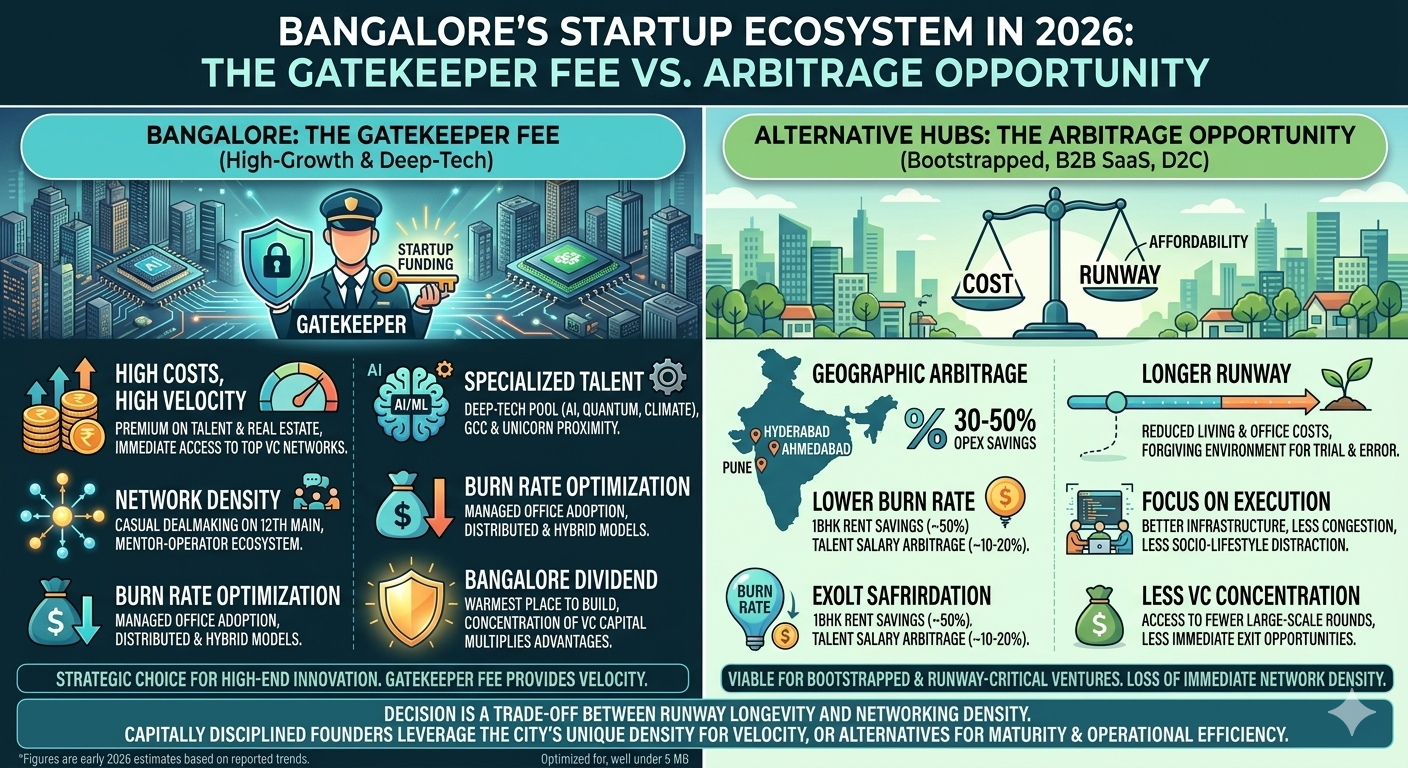
For a founder building a capital-intensive, high-growth, or deep-tech venture that requires immediate access to top-tier VC networks, specialized AI/ML talent, and global capability partnerships, Bangalore remains the only viable choice in India. The high cost of presence is a "gatekeeping fee" that provides access to the country’s most mature innovation flywheel. In this context, the ₹2.5 Lac rent and ₹40L SDE-1 salaries are not just expenses; they are investments in "velocity".
Conversely, for a bootstrapped founder building a B2B SaaS tool, a D2C brand, or a service-oriented startup where "networking density" is less critical than "runway longevity," Bangalore has likely become unviable. The 30% to 50% savings offered by Hyderabad, Pune, or even Ahmedabad provide a much more forgiving environment for the "trial and error" phase of early entrepreneurship.
The "Bangalore Tax" is a reality that necessitates a high degree of capital discipline. However, it is currently offset by a "Bangalore Dividend" for ventures that can leverage the city's unique density. As we move through 2026, the city is transitioning from a "default" choice for all startups to a "strategic" choice for high-end, innovation-led enterprises. Founders who fail to recognize this distinction and enter the Bangalore ecosystem without a clear plan to leverage its network effects risk burning through their seed capital before they can achieve the traction necessary to reach a Series A—a milestone that 85% of seed ventures now fail to achieve.
Read More -
1. From Idea to MVP: A Step-by-Step Guide for Solo Founder
🔗 https://findnstart.com/blogs/from-idea-to-mvp-a-step-by-step-guide-for-solo-founder
2. How to Validate Your Startup Idea in 48 Hours for $0
🔗 https://findnstart.com/blogs/how-to-validate-your-startup-idea-in-48-hours-for-0
3. Remote vs. Local: Does Your Co-Founder Need to Live in the Same City?
🔗 https://findnstart.com/blogs/remote-vs-local-does-your-co-founder-need-to-live-in-the-same-city
4. The 2026 Startup Landscape: What Has Fundamentally Changed (and Why Founder Skills Matter More Than Ever)
5. The Most In-Demand Skills for Startup Founders in 2026
🔗 https://findnstart.com/blogs/the-most-in-demand-skills-for-startup-founders-in-2026
6. How to Find a Technical Co-Founder (Without a Six-Figure Salary)
🔗 https://findnstart.com/blogs/how-to-find-a-technical-co-founder-without-a-six-figure-salary
7. 5 Red Flags to Look for When Choosing a Startup Partner
🔗 https://findnstart.com/blogs/5-red-flags-to-look-for-when-choosing-a-startup-partner
8. How to Pitch Your Idea to Potential Co-Founders
🔗 https://findnstart.com/blogs/how-to-pitch-your-idea-to-potential-co-founders
9. How to Build a Portfolio that Attracts High-Growth Startup Founders
🔗 https://findnstart.com/blogs/how-to-build-a-portfolio-that-attracts-high-growth-startup-founders
10. Equity vs. Salary: How to Split Ownership with Your First Teammate
🔗 https://findnstart.com/blogs/equity-vs-salary-how-to-split-ownership-with-your-first-teammate
11. Why Joining an Early-Stage Startup is Better Than a Corporate Job
🔗 https://findnstart.com/blogs/why-joining-an-early-stage-startup-is-better-than-a-corporate-job
12. The Future of EdTech: Why Developers and Educators Need to Team Up Now
🔗 https://findnstart.com/blogs/the-future-of-edtech-why-developers-and-educators-need-to-team-up-now
13. The Architecture of Symbiosis: Analytical Perspectives on the Five Habits of Successful Startup Duos
14. Finding a Co-Founder in the AI Space: What Skills Should You Look For?
🔗 https://findnstart.com/blogs/finding-a-co-founder-in-the-ai-space-what-skills-should-you-look-for
15. Overcoming Analysis Paralysis and the Strategic Path to Execution
🔗 https://findnstart.com/blogs/overcoming-analysis-paralysis-and-the-strategic-path-to-execution
16. From College Project to Company: How to Find Your Student Co-Founder
🔗 https://findnstart.com/blogs/from-college-project-to-company-how-to-find-your-student-co-founder
17. How to Start a Startup While Working a Full-Time Job
🔗 https://findnstart.com/blogs/how-to-start-a-startup-while-working-a-full-time-job
18. How to Build a HealthTech Startup Without a Medical Degree
🔗 https://findnstart.com/blogs/how-to-build-a-healthtech-startup-without-a-medical-degree
19. The Solitary Architect: Executive Isolation in Entrepreneurship
20. The 2026 Guide to Launching a SaaS as a Solo Developer
21. What Sustainable Growth Actually Looks Like
🔗 https://findnstart.com/blogs/what-sustainable-growth-actually-looks-like
22. The Early Warning Signs Your Startup Is in Trouble
🔗 https://findnstart.com/blogs/the-early-warning-signs-your-startup-is-in-trouble
23. How to Grow Without Burning Out
🔗 https://findnstart.com/blogs/how-to-grow-without-burning-out
24. The Truth About “Runway” Most Founders Ignore
🔗 https://findnstart.com/blogs/the-truth-about-runway-most-founders-ignore
25. Revenue Solves More Problems Than Funding
🔗 https://findnstart.com/blogs/revenue-solves-more-problems-than-funding
26. What No One Tells You About Being a Solo Founder
🔗 https://findnstart.com/blogs/what-no-one-tells-you-about-being-a-solo-founder
27. Why Smart People Quit High-Paying Jobs to Build Startups (And Why Most Regret It)
28. Why Most Startup Advice on Twitter Is Dangerous
🔗 https://findnstart.com/blogs/why-most-startup-advice-on-twitter-is-dangerous
29. Decision Fatigue: The Silent Startup Killer
🔗 https://findnstart.com/blogs/decision-fatigue-the-silent-startup-killer
30. Fear vs Logic: How Founders Actually Make Decisions
🔗 https://findnstart.com/blogs/fear-vs-logic-how-founders-actually-make-decisions
31. How Overthinking Destroys Early Momentum
🔗 https://findnstart.com/blogs/how-overthinking-destroys-early-momentum
32. Ideas Don’t Scale. Systems Do.
🔗 https://findnstart.com/blogs/ideas-dont-scale-systems-do
33. The First Hire That Actually Matters
🔗 https://findnstart.com/blogs/the-first-hire-that-actually-matters
34. How the First 100 Users Decide Your Startup’s Fate
🔗 https://findnstart.com/blogs/how-the-first-100-users-decide-your-startups-fate
35. Why Your Startup Doesn’t Need Growth — It Needs Focus
🔗 https://findnstart.com/blogs/why-your-startup-doesnt-need-growthit-needs-focus
36. Why Most Startups Die Quietly
🔗 https://findnstart.com/blogs/why-most-startups-die-quietly
37. Lessons Learned Too Late by First-Time Founders
🔗 https://findnstart.com/blogs/lessons-learned-too-late-by-first-time-founders
38. The Myth of the “Overnight Success” Startup
🔗 https://findnstart.com/blogs/the-myth-of-the-overnight-success-startup