Is Toronto Becoming Too Expensive for Early-Stage Founders?
March 13, 2026 by Harshit Gupta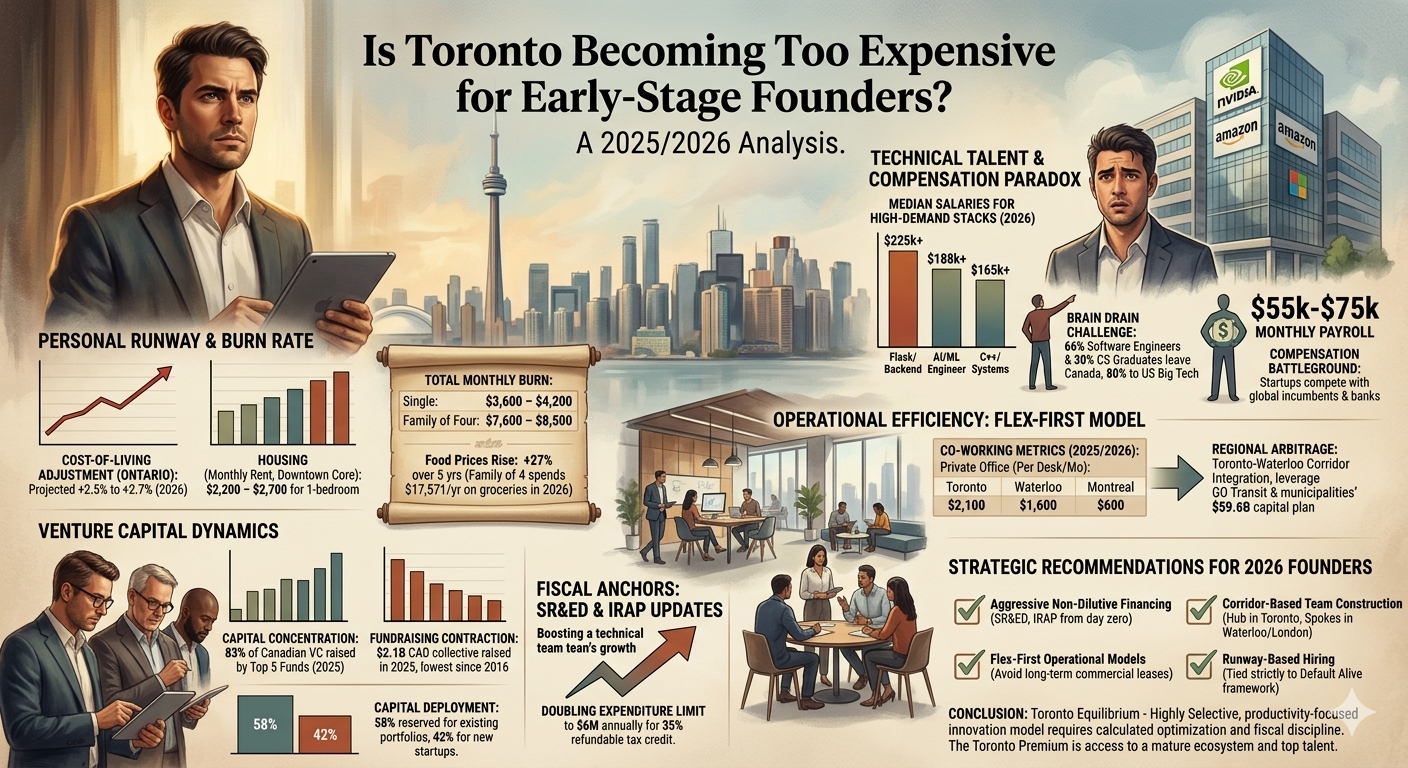
The structural evolution of the Toronto startup ecosystem has reached an inflection point where the traditional advantages of geographic concentration are being re-evaluated against the escalating friction of operational and personal survival. As the primary engine of Canada’s technological output, Toronto represents a dual reality: it is simultaneously the most capital-dense environment in the country and the most cost-prohibitive for founders operating at the pre-seed and seed stages. The following analysis examines the multidimensional pressures facing innovators in 2025 and 2026, synthesizing macroeconomic trends in venture capital, municipal and federal fiscal policies, and the microeconomics of talent acquisition to determine the current equilibrium of the "Toronto Premium."
The Microeconomics of Founder Survival: The Personal Burn Rate
The foundational component of any early-stage company is the personal runway of its founders. In the 2026 economic landscape, the cost-of-living adjustment in Ontario is projected to increase by 2.5% to 2.7%, driven by a persistent Consumer Price Index rise that continues to outpace wage growth in several technical sectors. For a founder, this necessitates a higher baseline of personal capital or a larger initial "friends and family" round simply to remain in proximity to the city's core innovation hubs.
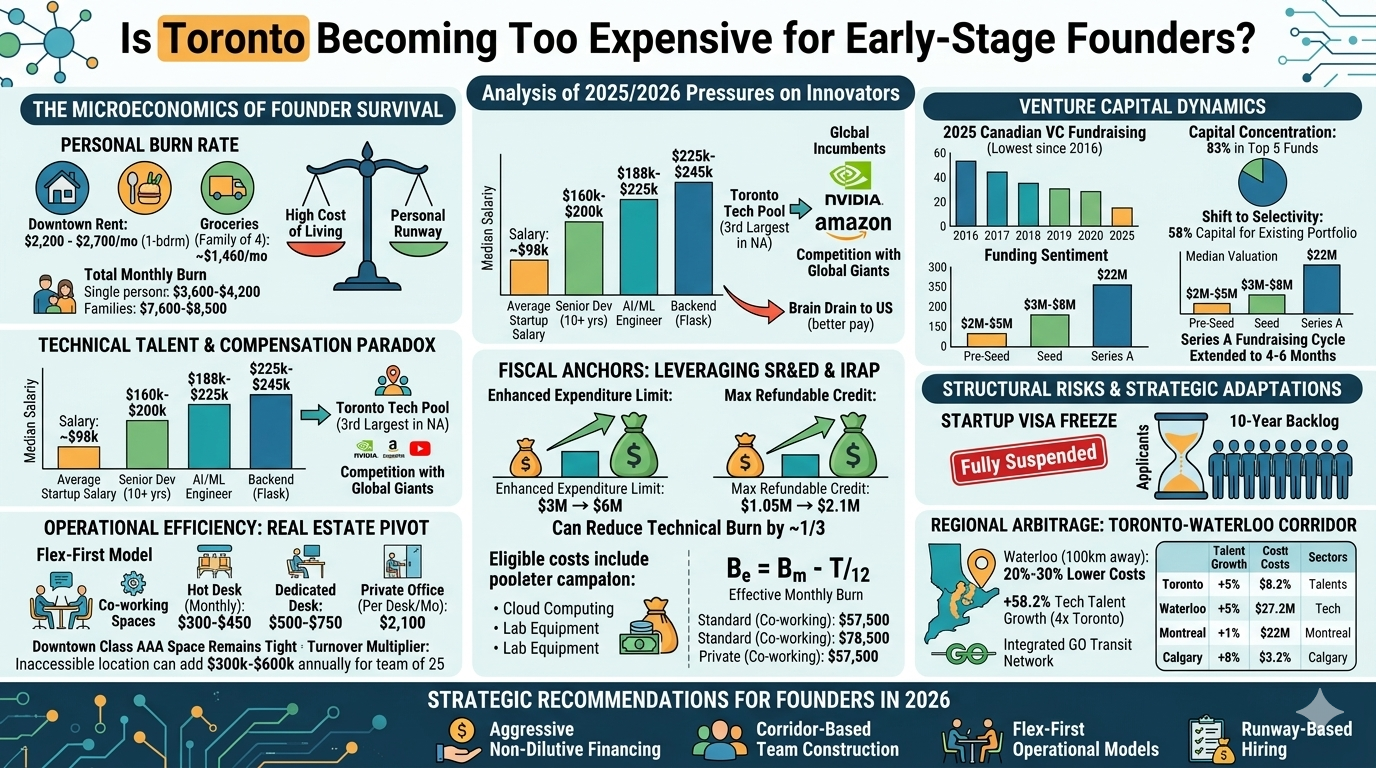
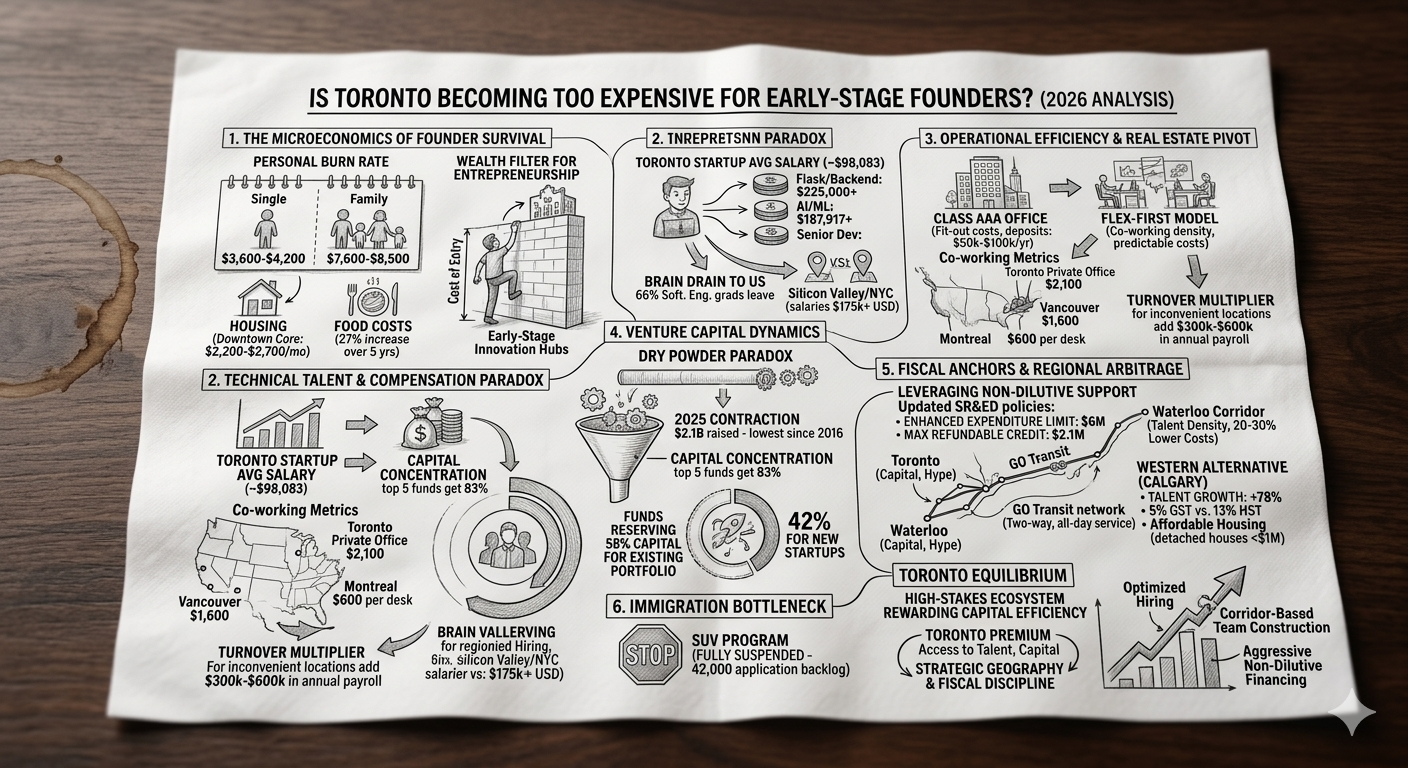
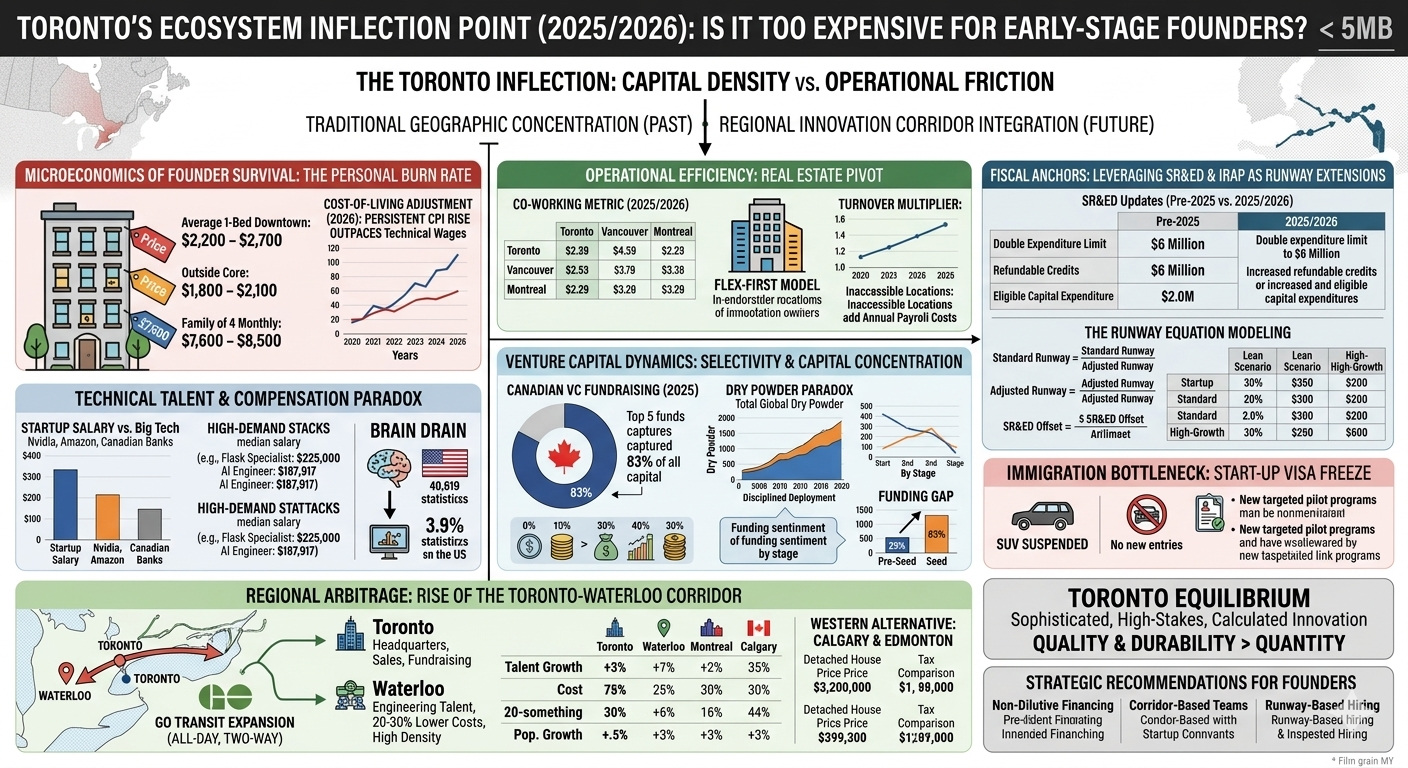
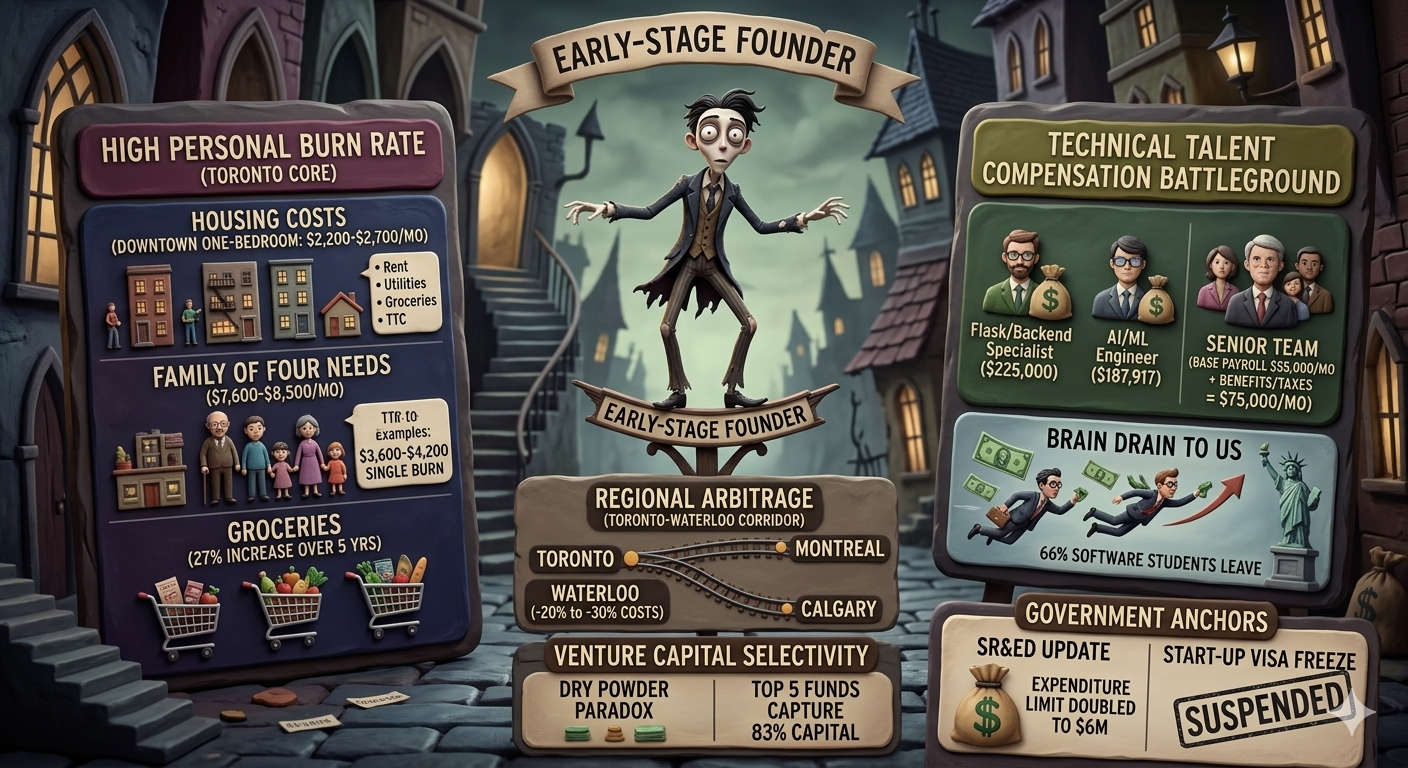
Housing remains the most aggressive driver of personal burn. The average monthly rent for a one-bedroom unit in the downtown core has reached between $2,200 and $2,700, while units outside the core offer only marginal relief at $1,800 to $2,100. For founders with families, the situation is increasingly untenable, with a family of four requiring between $7,600 and $8,500 monthly to cover basic expenses. This high barrier to entry effectively creates a "wealth filter" for entrepreneurship, where only those with significant prior savings or high-income partners can afford the risk of a low-salary founder role in the city's early stages.
Expense Category | Single Person (Monthly) | Family of Four (Monthly) |
Rent (Downtown Core) | $2,200 – $2,700 | $3,500 – $4,500 |
Utilities (Heat, Hydro, Water) | $120 – $145 | $200 – $250 |
Connectivity (Internet & Mobile) | $91 – $190 | $150 – $250 |
Groceries & Basic Food | $450 – $800 | $1,000 – $2,200 |
Public Transportation (TTC) | $156 | $350 – $860 |
Entertainment & Miscellaneous | $160 – $220 | $300 – $450 |
Total Monthly Burn | $3,600 – $4,200 | $7,600 – $8,500 |
Beyond housing, the volatility of essential goods contributes to a sense of financial insecurity. Food prices are projected to rise significantly in 2026, with a family of four expected to spend $17,571 annually on groceries, a 27% increase from five years prior. For a bootstrapped founder, these figures represent more than just costs; they represent a narrowing of the window for experimentation and a psychological weight that can detract from the focused ambition required to build a category-defining company.

Technical Talent and the Compensation Paradox
The second-order effect of Toronto's high cost of living is the upward pressure on technical salaries. While the city boasts the third-largest tech talent pool in North America with over 285,000 workers, it has become a "compensation battleground" where startups must compete with global incumbents such as Nvidia, Amazon, and the major Canadian banks. The average startup salary in Toronto for 2026 is approximately $98,083, but this figure is misleading for founders attempting to hire specialized engineers.
Tech Stack/Skill | Median Salary (2026) | High-End Range |
Flask / Backend Specialist | $225,000 | $245,000 |
AI / Machine Learning Engineer | $187,917 | $225,000 |
C++ / Systems Engineer | $165,000 | $190,000 |
Java / Enterprise Architect | $165,000 | $180,000 |
Docker / DevOps | $150,000 | $175,000 |
Senior Dev (10+ Years Experience) | $160,000 | $200,000 |
The data indicates a significant salary premium for high-demand stacks, with Flask developers commanding nearly 100% more than the city’s average startup salary. For an early-stage founder, this creates a severe dilemma: hiring local talent ensures collaboration and cultural alignment but drastically increases the monthly burn rate. A typical team of five senior hires—spanning engineering, product, and sales—requires an estimated base payroll of $55,000 monthly, which, when factoring in benefits and taxes, can escalate to $75,000.
This disparity has fueled a "brain drain" toward more lucrative markets. Approximately 66% of software engineering students and 30% of computer science graduates leave Canada shortly after graduation, with 80% relocating to the United States for better pay and larger corporate opportunities. For Toronto founders, this means they are not only competing for talent with their peers but also with the gravitational pull of Silicon Valley and New York City, where entry-level salaries often start at $175,000 USD.
Operational Efficiency and the Real Estate Pivot
The physical workspace in Toronto has undergone a structural repricing. While the downtown office market vacancy rate climbed to 14% post-pandemic, the demand for high-quality Class AAA space remains tight, particularly as major firms like the Royal Bank of Canada and Rogers Communications enforce return-to-office mandates. For a startup, the "hidden costs" of a traditional office lease—including fit-outs, furniture, and long-term deposits—can add between $50,000 and $100,000 annually to operational expenses.
Consequently, the ecosystem is shifting toward a "Flex-First" model. Co-working spaces have become the primary sanctuary for early-stage teams, offering predictable costs and essential networking density. However, even these spaces reflect the "Toronto Premium," with private office suites costing significantly more than their counterparts in other Canadian cities.
Co-working Metric (2025/2026) | Toronto | Vancouver | Montreal |
Hot Desk (Monthly) | $300 – $450 | $300 – $400 | $250 – $350 |
Dedicated Desk (Monthly) | $500 – $750 | $450 – $600 | $400 – $500 |
Private Office (Per Desk/Mo) | $2,100 | $1,600 | $600 |
Founders are increasingly advised that "budget" office space in inaccessible locations is a false economy. Companies in less accessible areas routinely pay 15% to 30% salary premiums to attract talent willing to endure difficult commutes. This "Turnover Multiplier" means that for a team of 25, an inconvenient location can add $300,000 to $600,000 in annual payroll costs just to maintain retention. Thus, the choice of location in Toronto is no longer just a real estate decision; it is a critical variable in the company’s talent strategy and capital efficiency.
Venture Capital Dynamics: The Rise of Selectivity
The capital environment for Toronto-based startups in 2026 is characterized by a "Dry Powder Paradox." While global venture capital firms have amassed a record $2.62 trillion USD in capital, the deployment of those funds has become historically disciplined. In 2025, Canadian VC fundraising hit its lowest point since 2016, with only 21 funds raising a collective $2.1 billion CAD. This contraction in fund creation means there is less domestic capital available for the earliest stages of company building.
Crucially, capital concentration has reached an extreme. In 2025, the top five Canadian funds captured 83% of all capital deployed, creating a "top-heavy" ecosystem where founders are increasingly competing for the attention of a shrinking number of decision-makers. Furthermore, a significant shift in strategy has seen funds reserving 58% of their capital for existing portfolio companies, leaving only 42% dedicated to backing new startups.
Funding Stage (Toronto 2026) | Median Post-Money Valuation | Funding Sentiment |
Pre-Seed | $2M – $5M | Highly Selective; Focus on AI/Deep Tech |
Seed | $3M – $8M | Conservative; Requires PMF Traction |
Series A | $22M | Highly Inflated; Focus on High-Growth SaaS |
Series B | $40M – $100M | Disciplined; Focused on Unit Economics |
For pre-seed and seed-stage founders, this creates a "funding gap." Total investment in these early stages fell 16% in total dollars and 28% in deal volume in the first half of 2025. Investors have shifted away from the "growth-at-all-costs" mentality of the pandemic era, prioritizing companies with sustainable growth models and proven paths to profitability. While Toronto remains the primary destination for 40% of all Canadian venture capital, the bar for securing that capital has never been higher.
Fiscal Anchors: Leveraging SR&ED and IRAP as Runway Extensions
In response to the rising cost of private capital and operational overhead, the Canadian federal government has drastically enhanced non-dilutive support mechanisms. The 2025 updates to the Scientific Research and Experimental Development (SR&ED) program represent a paradigm shift in how the state supports innovation. For a Toronto-based founder, these incentives are no longer "bonuses" but essential structural components of their financial model.
The primary enhancement is the doubling of the annual expenditure limit for the 35% refundable tax credit from $3 million to $6 million. This allow qualifying Canadian-controlled private corporations (CCPCs) to earn up to $2.1 million in refundable credits annually, effectively doubling the cash flow available for R&D-intensive activities.
Furthermore, the 2025 budget reinstated the eligibility of capital expenditures, such as lab equipment, prototyping machinery, and even cloud computing fees used for development. This is particularly transformative for founders in "Hard Tech," robotics, and AI, where the cost of physical assets and compute resources has historically been a significant barrier to entry.
SR&ED Component | Pre-2025 Policy | 2025/2026 Policy |
Enhanced Expenditure Limit | $3 Million | $6 Million |
Max Refundable Credit | $1.05 Million | $2.1 Million |
Phase-out Threshold (Capital) | $10M – $50M | $15M – $75M |
Capital Expenditures | Ineligible | Eligible (Acquired after Dec 16, 2024) |
Pre-Claim Approval | None | Voluntary Validation Available |
The inclusion of a "pre-claim approval" process is a vital tactical tool for founders. By validating a project’s eligibility before committing resources, startups can build more accurate financial models for investors and reduce the risk of a "funding shock" at tax time. When combined with the Industrial Research Assistance Program (IRAP), which provides grants ranging from $10,000 for feasibility to $10 million for major R&D, these programs effectively reduce a company's technical burn rate by roughly one-third.

The Immigration Bottleneck: The Startup Visa Freeze
A major structural risk to the Toronto ecosystem in 2026 is the suspension of federal business immigration pathways. On January 1, 2026, the Canadian government officially stopped accepting new applications for the Start-Up Visa (SUV) Program. This decision was a response to an unprecedented backlog of over 42,000 applications, which had pushed processing times to an untenable 10 years, with some ministerial estimates suggesting waits of up to 35 years for new applicants.
This freeze removes a vital "talent tap" for the Toronto ecosystem. The SUV was the flagship program for attracting international founders who brought both capital and diverse technical expertise to the city. While the government has promised a new "targeted pilot program" for immigrant entrepreneurs in late 2026, the initial targets are significantly lower, with a 50% cut in federal business immigration spots to just 500 principal applicants per year.
Immigration Stream | Current Status (2026) | Implications for Founders |
Start-Up Visa (SUV) | Fully Suspended | No new entries; 10-year backlog for existing |
SUV Work Permit | Suspended | Cannot be used as a stopgap for relocation |
Self-Employed Persons | Paused | No path for artistic or athletic entrepreneurs |
New Entrepreneur Pilot | Launching late 2026 | Selective; Focus on "readiness" and funding |
Express Entry (Tech) | Active | Prioritizing senior managers and researchers |
For international founders currently in Toronto on SUV work permits, the government has provided a grace period until June 30, 2026, to file for permanent residency. However, for the next wave of global talent, Toronto has become a "closed shop" until the new pilot program details are finalized. This has created a sense of urgency among existing international teams to secure their status, while simultaneously discouraging new talent from viewing Toronto as a viable alternative to other global hubs like London or Singapore.
Regional Arbitrage: The Rise of the Toronto-Waterloo Corridor
The narrative of Toronto becoming "too expensive" is increasingly countered by the integration of the regional innovation corridor. Founders are adopting a "Geographic Arbitrage" strategy, leveraging Toronto for capital and visibility while centering technical operations in more cost-effective satellite cities.
Waterloo, located just 100km from Toronto, offers a compelling alternative. It is the #1 small tech talent market in North America and has the highest tech talent density in Canada. Critically, operational costs in Waterloo are 20% to 30% lower than in Toronto. The region’s tech workforce grew by 58.2% between 2021 and 2024, nearly four times the growth rate of Toronto (14.7%) over the same period.
Metric (2025/2026) | Toronto | Waterloo | Montreal | Calgary |
Talent Growth (5-yr) | +44% | +38% | +28% | +78% |
Cost vs. Toronto | Baseline | -20% to -30% | -30% to -40% | -35% to -45% |
20-Something Pop. Growth | 16% | 40.3% | 1.7% | 10.6% |
Core Sector | FinTech/SaaS | Deep Tech/AI | AI/Gaming | Energy/AI |
The integration of this corridor is being accelerated by the $59.6 billion municipal capital plan and the expansion of the GO Transit network. The introduction of all-day, two-way service between Toronto and Kitchener-Waterloo has transformed the region into a single labor market. Programs like "One Fare" allow employees to save $1,600 annually on transit, effectively increasing the "commutable radius" for startups based in the GTA.
This regional synergy allows founders to maintain "roots" in Canada’s substance while reaching "branches" globally through Toronto’s hype and capital. The proximity of two world-class talent markets (U of T and U of Waterloo) within 100km of each other is a unique strategic advantage that distinguishes the Toronto ecosystem from more dispersed hubs in the United States.
The Western Alternative: The Appeal of Calgary and Edmonton
While the Toronto-Waterloo corridor remains the primary innovation hub, the 2026 cycle has seen an acceleration of talent and capital toward Western Canada, specifically Calgary. Calgary has recorded the highest tech talent growth among large North American markets, jumping 61.1% in workforce size. The appeal of Calgary to an early-stage founder is rooted in three primary factors: a lower tax environment, significantly lower housing costs, and an "inherently entrepreneurial" culture born from the boom-and-bust cycles of the energy sector.
Calgary offers a "small town feel with big city services". Founders can secure a detached house for under $1 million—an impossibility in Toronto—and benefit from a 5% GST compared to Ontario’s 13% HST. For a bootstrapped team, this difference in tax and cost of living can extend the runway by several months without any change in product strategy. Furthermore, Calgary’s focus on energy tech and AI has created a specialized investor pool that is increasingly competitive with the Toronto-based VCs.
Feature | Toronto | Calgary | Montreal |
Housing Market | Extremely Expensive | Affordable Detached | Affordable Rentals |
Tax Rate (Sales) | 13% (HST) | 5% (GST) | 14.975% (TVQ/TPS) |
Startup Ecosystem | Mature/Dense | Growing/Scrappy | Specialized (AI) |
Lifestyle | Fast-Paced Urban | Nature-Focused | Culture-Focused |
However, the "Westward Move" is not without trade-offs. Founders in Calgary report a "lack of variety in entertainment" compared to Toronto and a smaller pool of local technical peers. Nevertheless, for founders in the pre-revenue stage, the "Calgary Burn Rate" is becoming an increasingly attractive proposition to preserve equity and focus on product development.
Competitive Global Positioning: Toronto vs. US Hubs
To answer whether Toronto is "too expensive," one must evaluate it against its primary competitors: San Francisco, New York, and Austin. In 2026, San Francisco remains the undisputed startup capital of the world, but it also remains the most expensive ecosystem by an order of magnitude. A startup raising $2 million CAD in Toronto can often achieve the same milestones as a startup raising $4 million USD in the Bay Area, primarily due to the "technical salary discount" and the SR&ED subsidy.
City | Global Ecosystem Rank | Cost of Living | Talent Availability | Capital Density |
San Francisco | 1 | Extreme | High | Extreme |
New York | 2 | Very High | High | Very High |
London | 3 | High | Medium/High | High |
Toronto | 4 | High | High | Medium/High |
Austin | 7 | Medium | Medium | Medium |
Toronto is the only Canadian city that can "genuinely stand toe-to-toe" with Tier-1 US hubs. Its ranking as the #4 global startup ecosystem is supported by its massive pool of AI talent and its stability as a financial hub. However, the city faces a "Brain Gain vs. Brain Drain" paradox. While it attracts thousands of international students and young professionals, it struggles to retain the "cream of the crop" who are lured by the $300,000 USD compensation packages offered by Big Tech firms in Silicon Valley.
Jesse Rodgers, a prominent figure in the ecosystem, notes that while some of the best will always leave for San Francisco, the "substance" of the Canadian ecosystem compounds over time through its global alumni networks. The goal for Toronto founders is not to copy San Francisco but to leverage Canada’s "culture of substance and trust" to build durable, long-term platforms.
Strategic Recommendations for Founders in 2026
The conclusion of this analysis is that Toronto is not yet "too expensive" for early-stage founders, but it has become an environment that requires calculated innovation. The era of the "unoptimized startup" in Toronto is over. To thrive in the 2026 economic cycle, founders must adopt a multi-pronged strategy:
Aggressive Non-Dilutive Financing: Founders must prioritize SR&ED and IRAP from day zero. The doubling of the expenditure limit to $6 million means that technical teams can effectively subsidize their own growth, reducing the reliance on increasingly selective VC capital.
Corridor-Based Team Construction: Startups should avoid centering their entire engineering team in the downtown Toronto core. By utilizing a "hub" in Toronto for sales and fundraising while maintaining a "spoke" of engineering talent in Waterloo or London, companies can achieve a 20-30% reduction in burn.
Flex-First Operational Models: The avoidance of long-term commercial leases is a prerequisite for early-stage survival. Co-working density is not just about rent; it is about reducing the "Turnover Multiplier" and accessing a community that shares resources when growth hits a wall.
Bilingual/Regional Flexibility: Given the SUV freeze, founders should explore Provincial Nominee Programs (PNPs) or regions like Montreal and Ottawa, where local incentives and lower costs can provide a faster path to permanent residency and sustainability than the currently backlogged federal streams.
Runway-Based Hiring: Hiring must be tied strictly to the "Default Alive" framework. Founders should not hire based on a "hype cycle" but rather on the specific milestones required for a Series A, which now requires more significant revenue traction and unit economic proof than in previous years.
Conclusion: The Toronto Equilibrium
Toronto in 2026 represents a sophisticated, high-stakes ecosystem that rewards capital efficiency and technical substance. While the city has undoubtedly become more expensive, the simultaneous expansion of government incentives and the integration of the regional corridor provide founders with the tools to mitigate these costs. The "Toronto Premium" is the price of access to North America’s third-largest talent pool and a venture capital network that remains the most mature in the country. For the early-stage founder, the city is a viable headquarters, provided they treat the high cost of living not as an insurmountable obstacle, but as a variable to be managed through strategic geography and fiscal discipline. The transition to a more selective, productivity-focused innovation model suggests that while the quantity of startups in Toronto may slow, the quality and durability of those that survive the "2026 Filter" will likely define the next generation of Canadian global success.

Read More -
1. From Idea to MVP: A Step-by-Step Guide for Solo Founder
🔗 https://findnstart.com/blogs/from-idea-to-mvp-a-step-by-step-guide-for-solo-founder
2. How to Validate Your Startup Idea in 48 Hours for $0
🔗 https://findnstart.com/blogs/how-to-validate-your-startup-idea-in-48-hours-for-0
3. Remote vs. Local: Does Your Co-Founder Need to Live in the Same City?
🔗 https://findnstart.com/blogs/remote-vs-local-does-your-co-founder-need-to-live-in-the-same-city
4. The 2026 Startup Landscape: What Has Fundamentally Changed (and Why Founder Skills Matter More Than Ever)
5. The Most In-Demand Skills for Startup Founders in 2026
🔗 https://findnstart.com/blogs/the-most-in-demand-skills-for-startup-founders-in-2026
6. How to Find a Technical Co-Founder (Without a Six-Figure Salary)
🔗 https://findnstart.com/blogs/how-to-find-a-technical-co-founder-without-a-six-figure-salary
7. 5 Red Flags to Look for When Choosing a Startup Partner
🔗 https://findnstart.com/blogs/5-red-flags-to-look-for-when-choosing-a-startup-partner
8. How to Pitch Your Idea to Potential Co-Founders
🔗 https://findnstart.com/blogs/how-to-pitch-your-idea-to-potential-co-founders
9. How to Build a Portfolio that Attracts High-Growth Startup Founders
🔗 https://findnstart.com/blogs/how-to-build-a-portfolio-that-attracts-high-growth-startup-founders
10. Equity vs. Salary: How to Split Ownership with Your First Teammate
🔗 https://findnstart.com/blogs/equity-vs-salary-how-to-split-ownership-with-your-first-teammate
11. Why Joining an Early-Stage Startup is Better Than a Corporate Job
🔗 https://findnstart.com/blogs/why-joining-an-early-stage-startup-is-better-than-a-corporate-job
12. The Future of EdTech: Why Developers and Educators Need to Team Up Now
🔗 https://findnstart.com/blogs/the-future-of-edtech-why-developers-and-educators-need-to-team-up-now
13. The Architecture of Symbiosis: Analytical Perspectives on the Five Habits of Successful Startup Duos
14. Finding a Co-Founder in the AI Space: What Skills Should You Look For?
🔗 https://findnstart.com/blogs/finding-a-co-founder-in-the-ai-space-what-skills-should-you-look-for
15. Overcoming Analysis Paralysis and the Strategic Path to Execution
🔗 https://findnstart.com/blogs/overcoming-analysis-paralysis-and-the-strategic-path-to-execution
16. From College Project to Company: How to Find Your Student Co-Founder
🔗 https://findnstart.com/blogs/from-college-project-to-company-how-to-find-your-student-co-founder
17. How to Start a Startup While Working a Full-Time Job
🔗 https://findnstart.com/blogs/how-to-start-a-startup-while-working-a-full-time-job
18. How to Build a HealthTech Startup Without a Medical Degree
🔗 https://findnstart.com/blogs/how-to-build-a-healthtech-startup-without-a-medical-degree
19. The Solitary Architect: Executive Isolation in Entrepreneurship
20. The 2026 Guide to Launching a SaaS as a Solo Developer
21. What Sustainable Growth Actually Looks Like
🔗 https://findnstart.com/blogs/what-sustainable-growth-actually-looks-like
22. The Early Warning Signs Your Startup Is in Trouble
🔗 https://findnstart.com/blogs/the-early-warning-signs-your-startup-is-in-trouble
23. How to Grow Without Burning Out
🔗 https://findnstart.com/blogs/how-to-grow-without-burning-out
24. The Truth About “Runway” Most Founders Ignore
🔗 https://findnstart.com/blogs/the-truth-about-runway-most-founders-ignore
25. Revenue Solves More Problems Than Funding
🔗 https://findnstart.com/blogs/revenue-solves-more-problems-than-funding
26. What No One Tells You About Being a Solo Founder
🔗 https://findnstart.com/blogs/what-no-one-tells-you-about-being-a-solo-founder
27. Why Smart People Quit High-Paying Jobs to Build Startups (And Why Most Regret It)
28. Why Most Startup Advice on Twitter Is Dangerous
🔗 https://findnstart.com/blogs/why-most-startup-advice-on-twitter-is-dangerous
29. Decision Fatigue: The Silent Startup Killer
🔗 https://findnstart.com/blogs/decision-fatigue-the-silent-startup-killer
30. Fear vs Logic: How Founders Actually Make Decisions
🔗 https://findnstart.com/blogs/fear-vs-logic-how-founders-actually-make-decisions
31. How Overthinking Destroys Early Momentum
🔗 https://findnstart.com/blogs/how-overthinking-destroys-early-momentum
32. Ideas Don’t Scale. Systems Do.
🔗 https://findnstart.com/blogs/ideas-dont-scale-systems-do
33. The First Hire That Actually Matters
🔗 https://findnstart.com/blogs/the-first-hire-that-actually-matters
34. How the First 100 Users Decide Your Startup’s Fate
🔗 https://findnstart.com/blogs/how-the-first-100-users-decide-your-startups-fate
35. Why Your Startup Doesn’t Need Growth — It Needs Focus
🔗 https://findnstart.com/blogs/why-your-startup-doesnt-need-growthit-needs-focus
36. Why Most Startups Die Quietly
🔗 https://findnstart.com/blogs/why-most-startups-die-quietly
37. Lessons Learned Too Late by First-Time Founders
🔗 https://findnstart.com/blogs/lessons-learned-too-late-by-first-time-founders
38. The Myth of the “Overnight Success” Startup
🔗 https://findnstart.com/blogs/the-myth-of-the-overnight-success-startup