How Immigration Policies Help Canadian Tech Companies
March 13, 2026 by Harshit Gupta
The contemporary global economy is defined by a fierce competition for highly specialized technical talent, a resource that has become more valuable to national prosperity than traditional capital or natural resources. Within this context, Canada has distinguished itself by treating immigration policy not merely as a demographic tool, but as a central pillar of its industrial and innovation strategy. The Canadian government’s approach to talent acquisition is characterized by a deliberate focus on speed, operational flexibility, and strategic arbitrage—leveraging the policy instabilities of competing jurisdictions to attract the world’s most proficient engineers, researchers, and entrepreneurs. This report provides an exhaustive analysis of how these policies function as a catalyst for the Canadian technology sector, examining the mechanics of key programs, the economic implications of rapid talent influx, and the systemic challenges of long-term retention.
The Macroeconomic Context: Demographic Necessity and the Innovation Deficit
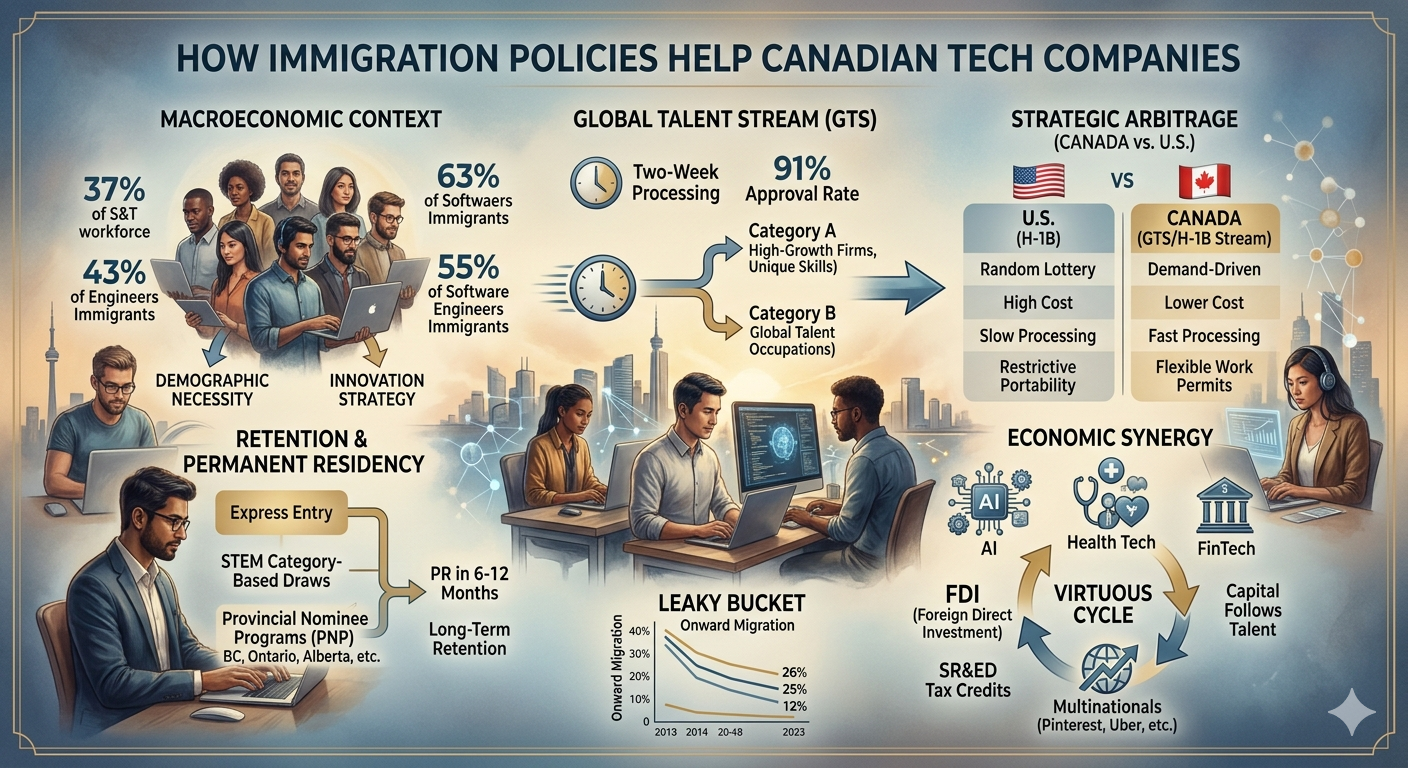
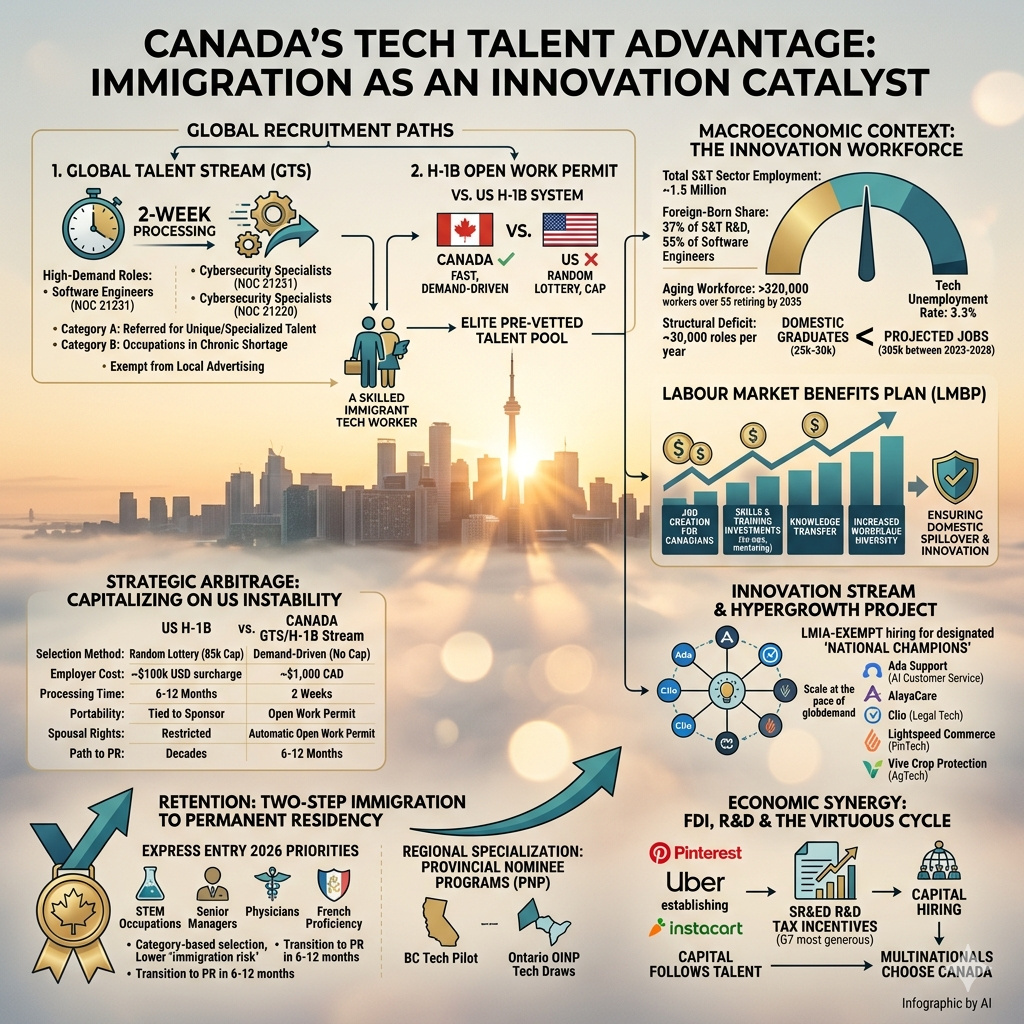
The Canadian technology sector operates against a backdrop of significant demographic pressure. Analysis indicates that the science and technology sector currently employs approximately 1.5 million individuals, yet the domestic labor supply is insufficient to maintain this momentum. With an aging workforce—where over 320,000 tech workers are currently over the age of 55 and expected to retire within the next decade—the reliance on international talent has transitioned from a preference to an existential requirement. Immigrants already constitute a disproportionate share of the innovation workforce, representing 37% of those in scientific research and development, 43% of engineers, and 55% of software engineers and designers.
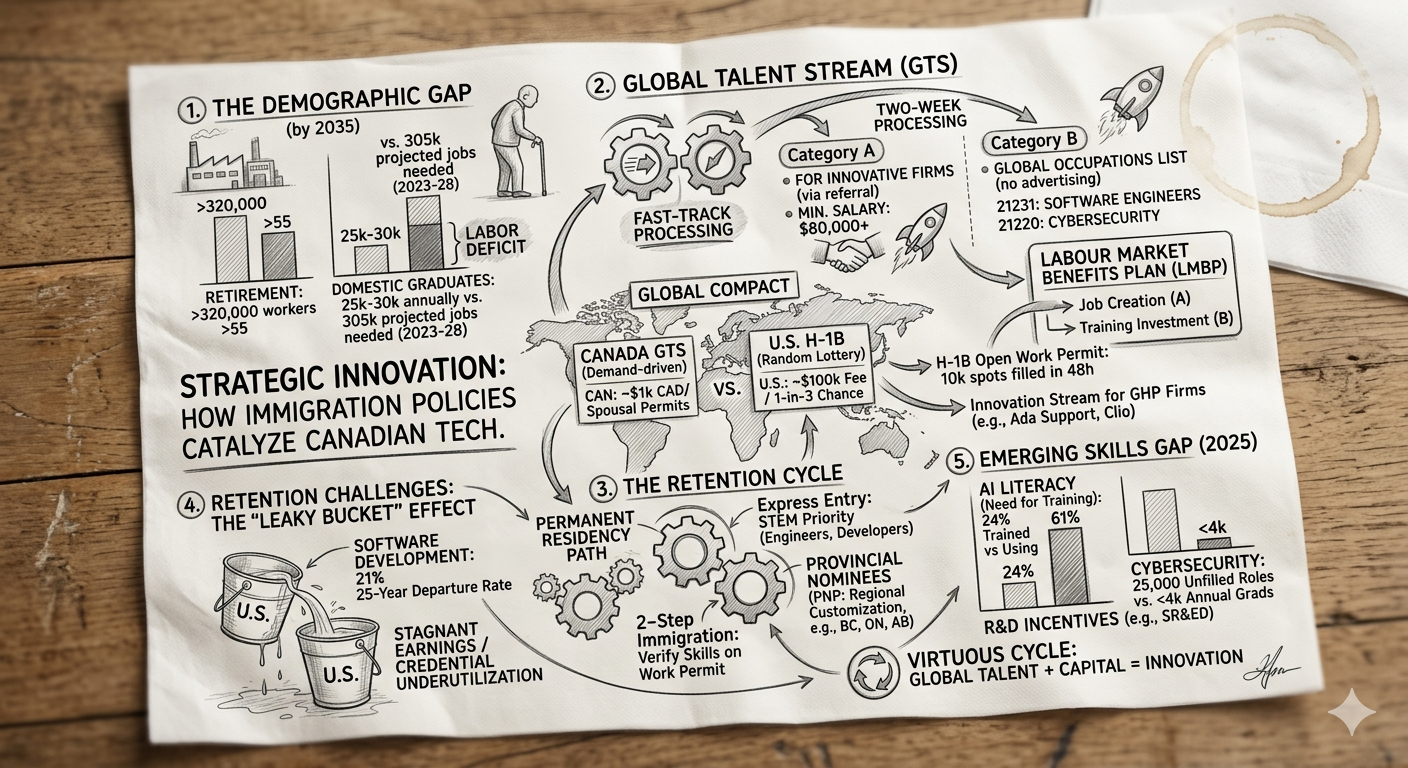
This reliance is further underscored by the current "talent crunch," which is less about the total number of available workers and more about the precision of skills matching. Projections from the Conference Board of Canada suggest that between 2023 and 2028, the economy will require an additional 305,000 technology workers, while domestic universities produce only 25,000 to 30,000 tech-related graduates annually. This creates a structural deficit of nearly 30,000 roles per year that must be filled through external recruitment. Consequently, immigration policy has been redesigned to function as a "just-in-time" supply chain for human capital.
Metric | Value/Percentage | |
Total S&T Sector Employment | 1.5 Million | |
Workers Over Age 55 (Retiring by 2035) | 320,000 | |
Foreign-Born Share of Software Engineers | 55% | |
Projected Tech Jobs Needed (2023-2028) | 305,000 | |
Annual Domestic Tech Graduates | 25,000 - 30,000 | |
Tech Unemployment Rate (2025) | 3.3% |
The Global Talent Stream: Operational Velocity as a Competitive Moat
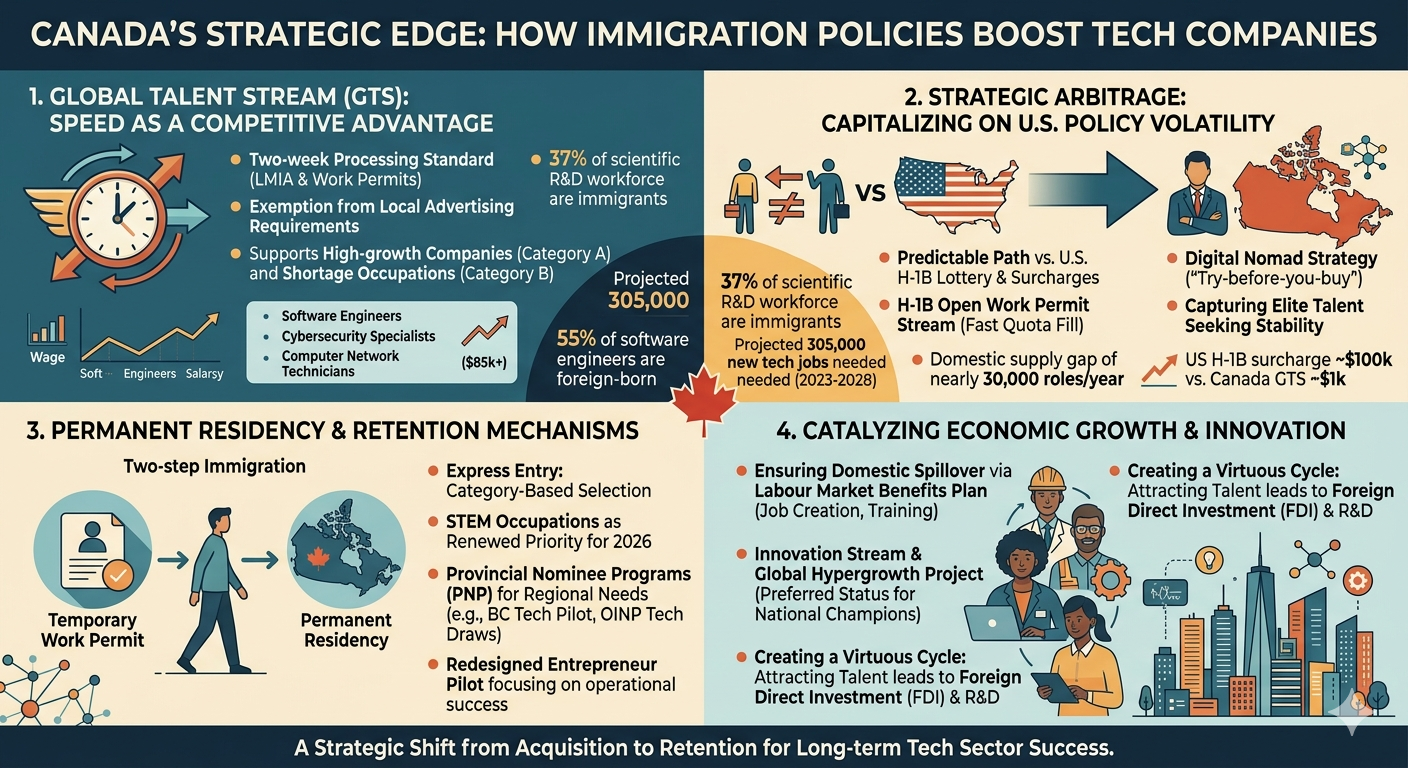
The Global Talent Stream (GTS) serves as the primary mechanism for high-growth tech firms to bypass the traditional administrative delays inherent in foreign worker recruitment. Under standard immigration protocols, obtaining a Labour Market Impact Assessment (LMIA) and a subsequent work permit can take four to six months—a timeline that is incompatible with the rapid development cycles of software engineering and artificial intelligence. The GTS addresses this by establishing a two-week processing standard for both the LMIA and the work permit application.
Categorical Framework and Application Mechanics
The GTS is structured into two distinct categories, each tailored to specific organizational profiles. Category A is reserved for high-growth, innovative companies that have been referred to the program by a designated referral partner, such as the MaRS Discovery District or the National Research Council’s Industrial Research Assistance Program (NRC-IRAP). These firms must demonstrate a need for "unique and specialized talent"—individuals who possess advanced knowledge of the industry and are offered a minimum annual salary of at least $80,000.
Category B targets employers hiring for occupations that have been identified as being in chronic shortage on the Global Talent Occupations List. This category does not require a referral and covers a broad range of technical roles, from cybersecurity specialists to mathematicians. A significant advantage of both categories is the exemption from standard advertising requirements; unlike the regular TFWP, employers using the GTS do not have to prove they unsuccessfully advertised the job locally for four weeks before looking abroad.
NOC Code (2021) | Occupation Title | Minimum Salary Floor/Condition | |
20012 | Computer and Info Systems Managers | Prevailing Wage | |
21220 | Cybersecurity Specialists | Prevailing Wage | |
21231 | Software Engineers and Designers | Prevailing Wage | |
22220 | Computer Network Technicians | $85,000 / $40.87 hourly | |
22222 | Info Systems Testing Technicians | $85,000 / $41.03 hourly | |
52120 | Digital Media and Design | $80,000 / $38.46 hourly |
The Labour Market Benefits Plan: Ensuring Domestic Spillover
A critical component of the GTS is the Labour Market Benefits Plan (LMBP), a customized agreement between the employer and Employment and Social Development Canada (ESDC). The LMBP ensures that the recruitment of foreign talent yields tangible advantages for the Canadian labor market. Employers must commit to one mandatory benefit and at least two complementary benefits.
For Category A firms, the mandatory benefit is direct or indirect job creation for Canadian citizens and permanent residents. For Category B firms, the mandatory benefit is increasing investment in skills and training for the local workforce, such as establishing co-op placements or internal mentorship programs. Complementary benefits often include knowledge transfer—where the foreign expert trains local staff in a specialized technology—or initiatives to increase workplace diversity, such as developing policies to hire more women in high-skilled leadership roles. This mechanism transforms the act of hiring a single foreign worker into a broader institutional capacity-building exercise.
Strategic Arbitrage: Capitalizing on U.S. Policy Volatility
One of the most profound ways immigration policies help Canadian tech companies is by positioning Canada as a more stable and cost-effective alternative to the United States. In recent years, the U.S. H-1B visa program has become increasingly restrictive and expensive. By late 2025 and early 2026, the U.S. introduced a $100,000 supplemental fee for certain new H-1B petitions, a move that made international recruitment nearly impossible for startups and small-to-medium enterprises (SMEs).
Canada’s Tech Talent Strategy, launched in June 2023, was a direct response to this instability. The centerpiece was the H-1B Open Work Permit stream, which allowed 10,000 current U-S. H-1B holders to obtain three-year Canadian work permits without a pre-existing job offer. This program filled its quota within 48 hours, demonstrating the immense appetite for a more predictable immigration path. For Canadian tech companies, this influx represents a pre-vetted pool of elite talent that is already acclimated to the North American corporate environment.
Comparative Economic Analysis: Canada vs. United States
The financial and operational differences between the two systems provide Canadian firms with a significant "talent moat." While the U.S. utilizes a lottery system with an 85,000-person cap—creating a 1-in-3 chance of success—Canada employs a demand-driven, first-come, first-served model.
Factor | U.S. H-1B System | Canada GTS/H-1B Stream | |
Selection Method | Random Lottery (85k Cap) | Demand-Driven (No Cap) | |
Employer Cost | ~$100,000 (New surcharge) | ~$1,000 CAD | |
Processing Time | 6 - 12 Months | 2 Weeks | |
Portability | Tied to Sponsor (60-day clock) | Open Work Permit (Switching allowed) | |
Spousal Rights | Restricted (H-4) | Automatic Open Work Permit | |
Path to PR | Decades (Country caps) | 6 - 12 Months (Express Entry) |
This "strategic arbitrage" is not without its nuances. Data from the initial H-1B pilot indicates that only about 12% of the 10,000 permit holders actually relocated to Canada by mid-2024. Many tech workers use the Canadian permit as an "insurance policy"—a backup plan in case their U.S. status is compromised. However, for Canadian companies, even a 12% conversion rate represents 1,200 of the world’s most sought-after engineers entering the market with minimal friction. Furthermore, the Digital Nomad Strategy allows workers to remain in Canada for up to six months while working for U.S. firms, effectively providing a "try-before-you-buy" period for potential Canadian employers to poach this talent locally.
The Innovation Stream and Global Hypergrowth Project
In 2024, Canada introduced the Innovation Stream, a two-year pilot program designed to support the nation’s most successful, high-growth companies. This stream allows designated firms under the Global Hypergrowth Project (GHP) to hire foreign workers without an LMIA, significantly reducing the administrative burden on these specific "national champions".
Eligible companies, including Ada Support, AlayaCare, Clio, and Lightspeed Commerce, can offer high-skilled positions (TEER 0, 1, 2, or 3) and bring in talent on employer-specific work permits that can be valid for up to five years. The primary benefit here is the elimination of the "proof of recruitment" phase, acknowledging that these hyper-growth firms have already reached a scale where their talent needs far outstrip domestic availability. This policy effectively grants these companies "preferred status," allowing them to scale at the pace of global demand rather than the pace of government bureaucracy.
GHP Designated Employers (Innovation Stream) | Focus Area | |
Ada Support Inc. | AI Customer Service | |
AlayaCare | Health Tech | |
CellCarta | Precision Medicine | |
Clio | Legal Tech | |
Lightspeed Commerce | FinTech / E-commerce | |
Vive Crop Protection | AgTech |
Permanent Residency and the STEM Priority: Express Entry 2026
The transition from temporary work permits to permanent residency (PR) is the ultimate retention mechanism in the Canadian system. Canada’s Express Entry system, which manages the Federal Skilled Worker Program (FSWP) and the Canadian Experience Class (CEC), shifted in 2023 to include category-based selection. This allows the government to issue Invitations to Apply (ITAs) specifically to candidates with experience in high-demand fields, regardless of their total Comprehensive Ranking System (CRS) score.
For 2026, STEM (Science, Technology, Engineering, and Math) remains a renewed priority category. This is a massive boon for tech companies because it lowers the "immigration risk" for their employees. If an engineer knows they have a high probability of securing PR within six months of arriving in Canada, they are far more likely to commit to a Canadian firm over a U.S. firm where they might languish in a green card backlog for decades.
New 2026 Categories and Thresholds
The 2026 Express Entry updates introduced several new categories that directly support the tech ecosystem's leadership and R&D requirements. These include new draws for researchers and senior managers with Canadian work experience. However, to ensure these immigrants are truly labor-market ready, the minimum work experience requirement for renewed categories has been increased from six months to one year of experience gained within the last three years.
2026 Express Entry Priority Categories | Target Population | Condition |
STEM Occupations | Engineers, Developers, Data Scientists | 12 months exp in 3 years |
Researchers | Post-secondary & Innovation R&D | Canadian work experience |
Senior Managers | Leaders in Financial, Health, Tech | Canadian work experience |
Physicians | MedTech and Healthcare Innovation | Canadian work experience |
French Proficiency | All skilled sectors | High linguistic ability |
This evolution toward "two-step immigration"—where workers first arrive on a temporary permit and then transition to PR—is a strategic choice. It allows employers to verify a worker's technical skills in the Canadian context before the government commits to permanent settlement. From the perspective of a tech company, this reduces the risk of "bad hires" having permanent immigration status attached to the firm's sponsorship.
Regional Specialization: Provincial Nominee Programs (PNP)
While federal programs provide the broad architecture, Provincial Nominee Programs (PNPs) allow for regional customization. Tech-heavy provinces like British Columbia and Ontario have developed specific "Tech Draws" that target the unique needs of their local ecosystems.
The B-C. Tech Pilot, for instance, conducts regular draws for 29 eligible tech occupations and only requires a one-year job offer rather than a permanent one, providing immense flexibility for startups on shorter funding runways. Ontario’s Tech Draws specifically target candidates in the Express Entry pool with experience in NOC codes like 21231 (Software Engineers) and often invite candidates with CRS scores in the 350-400 range—scores that would be too low for general federal draws but are considered elite for specialized tech roles.
Province | Program Feature | Recruitment Advantage | |
British Columbia | BC Tech Pilot (Weekly Draws) | Fastest provincial processing (2-3 months) | |
Ontario | OINP Tech Draws | Targets specific high-demand NOC codes | |
Alberta | Accelerated Tech Pathway | Priority for those with existing job offers | |
Saskatchewan | Tech Talent Pathway | Accessible to those with 1 year exp | |
Manitoba | Tech Pathway | Priority for those with "settlement plans" |
For companies in emerging tech hubs like Saskatoon or Winnipeg, the PNP system is often the only viable way to attract international talent that might otherwise gravitate toward the high-salary markets of Toronto or Vancouver. By providing a "guaranteed" path to PR through provincial nomination (which adds 600 points to a CRS score), these provinces can offer a level of immigration certainty that compensates for lower starting salaries.
The Entrepreneurial Pivot: From Start-up Visa to the 2026 Pilot
Canada’s approach to immigrant entrepreneurs has undergone a radical transformation due to systemic challenges. The original Start-up Visa (SUV) program was designed to be a market-driven filter: if a founder could secure investment from a designated Canadian VC fund or angel group, they were granted PR. However, the program became a victim of its own success. By 2023, application counts surged by 600%, leading to wait times of up to 35 years in extreme cases.
The structural flaw of the SUV was its "PR-first" model. Many applicants were granted residency before their business had to prove any operational success. In December 2025, the government effectively ended this era, pausing the SUV to make room for a redesigned system launching in 2026.
The 2026 Entrepreneur Pilot: Quality Over Quantity
The new 2026 Entrepreneur Pilot shifts the focus from volume to execution. The 2026-2028 Immigration Levels Plan reduces federal business spots by 50%, from 1,000 to just 500 per year. The new model is expected to be "execution-first," requiring entrepreneurs to arrive on work permits and demonstrate significant economic contribution—such as job creation or active R&D—before they are eligible for PR. This shift helps the tech sector by ensuring that the "founders" entering the ecosystem are genuine innovators committed to building companies in Canada, rather than individuals merely seeking an immigration pathway.

The Talent Shortage and the Compensation Arms Race
Despite these robust policies, the "talent crunch" in 2025 and 2026 has entered a new phase of intensity. Tech unemployment in Canada sits at a record low of 3.3%, which represents essentially full employment. This means that Canadian companies are no longer competing for unemployed candidates; they are in a constant state of "poaching" from one another, leading to rapid wage inflation.
Specialized roles now command significant premiums. According to Randstad’s 2025 Salary Guide, machine learning expertise offers a 35% salary increase over baseline tech roles, while cybersecurity skills command a 30% premium. For the average tech company, these rising costs make immigration programs like the GTS even more vital, as they allow firms to look beyond the hyper-competitive local market to regions where talent may be more affordable or available.
Tech Role | Specialization Premium (2025) | Median Salary (Major Hubs) | |
AI / Machine Learning | +35% | $150,000+ | |
Cybersecurity | +30% | $140,000+ | |
Cloud Architecture | +25% - 30% | $135,000+ | |
DevOps / SRE | +20% - 25% | $125,000+ | |
Standard Software Eng | Baseline | $100,000 - $120,000 |
Retention Challenges: The "Leaky Bucket" Phenomenon
The most significant threat to the efficacy of Canada’s immigration policies is the "Leaky Bucket"—the high rate of onward migration where immigrants leave Canada for other countries, most often the United States. A 2025 report from the Institute for Canadian Citizenship (ICC) and the Conference Board of Canada found that one in five immigrants leaves Canada within 25 years of landing.
Alarmingly, this rate is highest among the most educated and highly skilled immigrants—those with doctorates are nearly twice as likely to leave as those with bachelor’s degrees. The peak risk of departure occurs within the first five years, making the early integration period critical for tech companies hoping to retain their international hires.
Why Skilled Talent Leaves
The primary drivers of onward migration for tech workers include stagnant earnings and the underutilization of skills. Immigrants with stagnant or declining earnings have significantly higher departure rates than those whose income grows over time. Furthermore, highly skilled immigrants often face "licensing hurdles" or a lack of recognition for their foreign credentials, leading them to feel that their potential is better appreciated in the U.S. market, where salaries are roughly 46% higher.
Occupation Group | 5-Year Departure Rate | 25-Year Departure Rate | |
Software & Web Development | 7% | 21% | |
Business/Finance Management | High | 19% | |
Engineering Management | Moderate | 20% | |
Overall Immigrant Average | 5.3% | 20% |
For Canadian tech companies, these findings imply that the "immigration help" ends at the border. Once a worker arrives, the responsibility for retention shifts to the firm. Policies that grant PR quickly are essential, but they cannot overcome a lack of career progression or uncompetitive compensation.

The Emerging AI and Cybersecurity Skill Gap
As the tech sector pivots toward AI-driven business models, the skills gap has become more pronounced. In 2025, it was reported that while 61% of Canadian workers are intentionally using AI tools, only 24% have received formal training in AI. This lack of AI literacy is a major hurdle for companies attempting to automate operations and stay globally competitive.
In the cybersecurity sector, the situation is even more dire. Canada faces a deficit of up to 25,000 unfilled cybersecurity positions, yet the nation produces fewer than 4,000 graduates in this field annually. Immigration policy has attempted to mitigate this by including these roles in the 2026 Express Entry STEM draws and the GTS Occupations List, but the global competition for these individuals is so intense that Canada must compete not just on visa speed, but on the quality of life and the security of its long-term residency offers.
Economic Synergy: FDI, R&D, and the "Virtuous Cycle"
The ultimate measure of success for these immigration policies is their ability to attract Foreign Direct Investment (FDI). Capital follows talent, and Canada’s talent-first immigration strategy has successfully attracted global tech giants. Companies like Pinterest, Uber, and Instacart have established significant Canadian operations because they know they can move their global staff to hubs like Toronto or Vancouver with a 91% approval rate under the Global Skills Strategy.
Canada currently offers the most generous R&D tax incentives in the G7 through the Scientific Research and Experimental Development (SR&ED) program. When combined with a fast-track immigration system, these tax credits create a powerful incentive for multinationals to locate high-value R&D centers in Canada. This creates a "virtuous cycle": high-skilled immigrants arrive, they found or join innovative companies, these companies attract foreign capital, and that capital is used to hire more immigrants.
Conclusion: A Strategic Inflection Point
Immigration policies have moved from being a supportive function to the primary competitive advantage for the Canadian technology sector. The Global Talent Stream’s two-week processing, the Innovation Stream’s LMIA-exemptions, and the Express Entry STEM category-based draws collectively provide Canadian firms with a level of human capital agility that is currently unmatched by their global peers.
However, the "Leaky Bucket" data and the cooling of the Start-up Visa program suggest that Canada is at an inflection point. The next decade of growth will depend on shifting from "acquisition" to "retention." While the policy framework for bringing talent into Canada is world-class, the long-term success of the tech sector will require addressing the underlying economic factors—such as the wage gap with the United States and the underutilization of doctorate-level skills—that drive elite talent to depart. For Canadian tech companies, the government has provided the tools to recruit from the world; the challenge now lies in building the corporate environments where that talent chooses to stay permanently.

Read More -
1. From Idea to MVP: A Step-by-Step Guide for Solo Founder
🔗 https://findnstart.com/blogs/from-idea-to-mvp-a-step-by-step-guide-for-solo-founder
2. How to Validate Your Startup Idea in 48 Hours for $0
🔗 https://findnstart.com/blogs/how-to-validate-your-startup-idea-in-48-hours-for-0
3. Remote vs. Local: Does Your Co-Founder Need to Live in the Same City?
🔗 https://findnstart.com/blogs/remote-vs-local-does-your-co-founder-need-to-live-in-the-same-city
4. The 2026 Startup Landscape: What Has Fundamentally Changed (and Why Founder Skills Matter More Than Ever)
5. The Most In-Demand Skills for Startup Founders in 2026
🔗 https://findnstart.com/blogs/the-most-in-demand-skills-for-startup-founders-in-2026
6. How to Find a Technical Co-Founder (Without a Six-Figure Salary)
🔗 https://findnstart.com/blogs/how-to-find-a-technical-co-founder-without-a-six-figure-salary
7. 5 Red Flags to Look for When Choosing a Startup Partner
🔗 https://findnstart.com/blogs/5-red-flags-to-look-for-when-choosing-a-startup-partner
8. How to Pitch Your Idea to Potential Co-Founders
🔗 https://findnstart.com/blogs/how-to-pitch-your-idea-to-potential-co-founders
9. How to Build a Portfolio that Attracts High-Growth Startup Founders
🔗 https://findnstart.com/blogs/how-to-build-a-portfolio-that-attracts-high-growth-startup-founders
10. Equity vs. Salary: How to Split Ownership with Your First Teammate
🔗 https://findnstart.com/blogs/equity-vs-salary-how-to-split-ownership-with-your-first-teammate
11. Why Joining an Early-Stage Startup is Better Than a Corporate Job
🔗 https://findnstart.com/blogs/why-joining-an-early-stage-startup-is-better-than-a-corporate-job
12. The Future of EdTech: Why Developers and Educators Need to Team Up Now
🔗 https://findnstart.com/blogs/the-future-of-edtech-why-developers-and-educators-need-to-team-up-now
13. The Architecture of Symbiosis: Analytical Perspectives on the Five Habits of Successful Startup Duos
14. Finding a Co-Founder in the AI Space: What Skills Should You Look For?
🔗 https://findnstart.com/blogs/finding-a-co-founder-in-the-ai-space-what-skills-should-you-look-for
15. Overcoming Analysis Paralysis and the Strategic Path to Execution
🔗 https://findnstart.com/blogs/overcoming-analysis-paralysis-and-the-strategic-path-to-execution
16. From College Project to Company: How to Find Your Student Co-Founder
🔗 https://findnstart.com/blogs/from-college-project-to-company-how-to-find-your-student-co-founder
17. How to Start a Startup While Working a Full-Time Job
🔗 https://findnstart.com/blogs/how-to-start-a-startup-while-working-a-full-time-job
18. How to Build a HealthTech Startup Without a Medical Degree
🔗 https://findnstart.com/blogs/how-to-build-a-healthtech-startup-without-a-medical-degree
19. The Solitary Architect: Executive Isolation in Entrepreneurship
20. The 2026 Guide to Launching a SaaS as a Solo Developer
21. What Sustainable Growth Actually Looks Like
🔗 https://findnstart.com/blogs/what-sustainable-growth-actually-looks-like
22. The Early Warning Signs Your Startup Is in Trouble
🔗 https://findnstart.com/blogs/the-early-warning-signs-your-startup-is-in-trouble
23. How to Grow Without Burning Out
🔗 https://findnstart.com/blogs/how-to-grow-without-burning-out
24. The Truth About “Runway” Most Founders Ignore
🔗 https://findnstart.com/blogs/the-truth-about-runway-most-founders-ignore
25. Revenue Solves More Problems Than Funding
🔗 https://findnstart.com/blogs/revenue-solves-more-problems-than-funding
26. What No One Tells You About Being a Solo Founder
🔗 https://findnstart.com/blogs/what-no-one-tells-you-about-being-a-solo-founder
27. Why Smart People Quit High-Paying Jobs to Build Startups (And Why Most Regret It)
28. Why Most Startup Advice on Twitter Is Dangerous
🔗 https://findnstart.com/blogs/why-most-startup-advice-on-twitter-is-dangerous
29. Decision Fatigue: The Silent Startup Killer
🔗 https://findnstart.com/blogs/decision-fatigue-the-silent-startup-killer
30. Fear vs Logic: How Founders Actually Make Decisions
🔗 https://findnstart.com/blogs/fear-vs-logic-how-founders-actually-make-decisions
31. How Overthinking Destroys Early Momentum
🔗 https://findnstart.com/blogs/how-overthinking-destroys-early-momentum
32. Ideas Don’t Scale. Systems Do.
🔗 https://findnstart.com/blogs/ideas-dont-scale-systems-do
33. The First Hire That Actually Matters
🔗 https://findnstart.com/blogs/the-first-hire-that-actually-matters
34. How the First 100 Users Decide Your Startup’s Fate
🔗 https://findnstart.com/blogs/how-the-first-100-users-decide-your-startups-fate
35. Why Your Startup Doesn’t Need Growth — It Needs Focus
🔗 https://findnstart.com/blogs/why-your-startup-doesnt-need-growthit-needs-focus
36. Why Most Startups Die Quietly
🔗 https://findnstart.com/blogs/why-most-startups-die-quietly
37. Lessons Learned Too Late by First-Time Founders
🔗 https://findnstart.com/blogs/lessons-learned-too-late-by-first-time-founders
38. The Myth of the “Overnight Success” Startup
🔗 https://findnstart.com/blogs/the-myth-of-the-overnight-success-startup