How Brazil’s Consumer Market Shapes Startup Ideas
March 9, 2026 by Harshit Gupta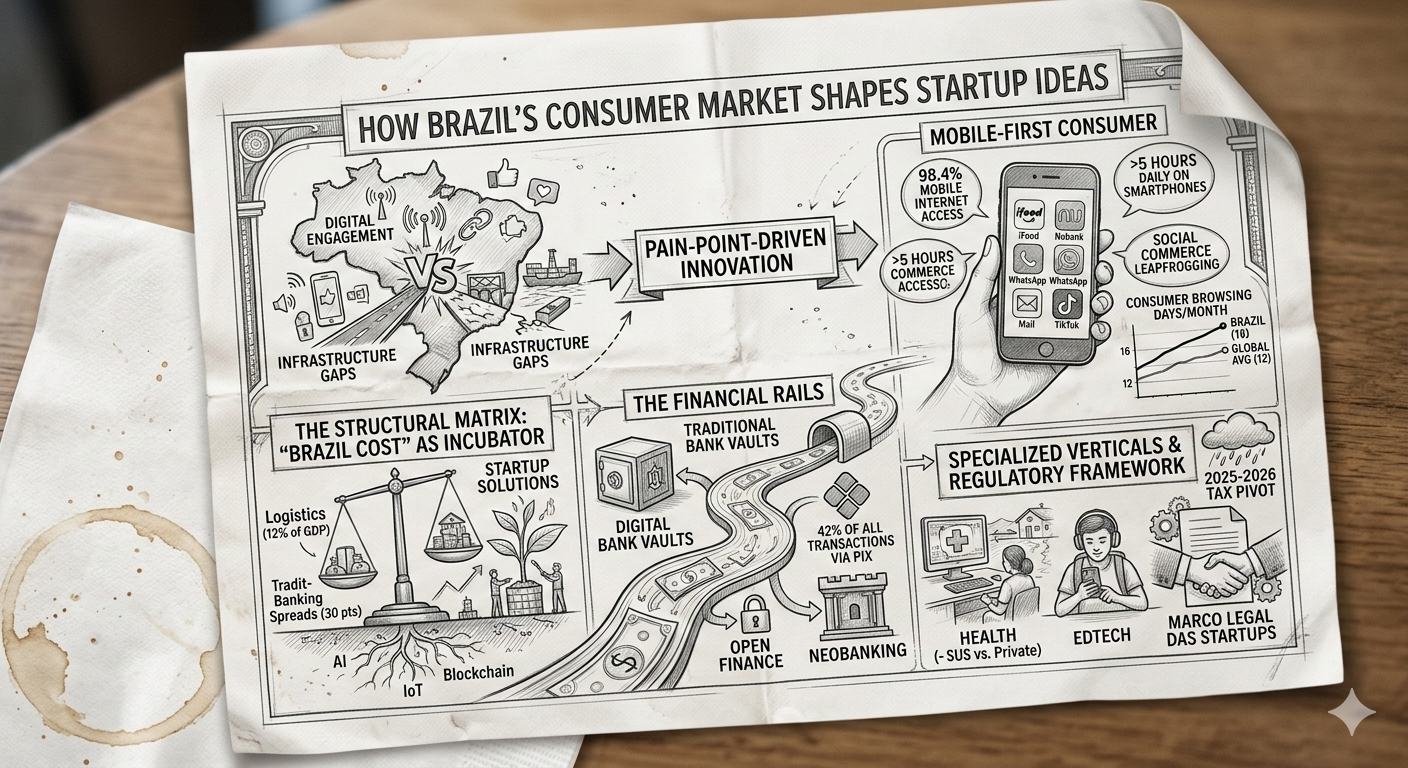
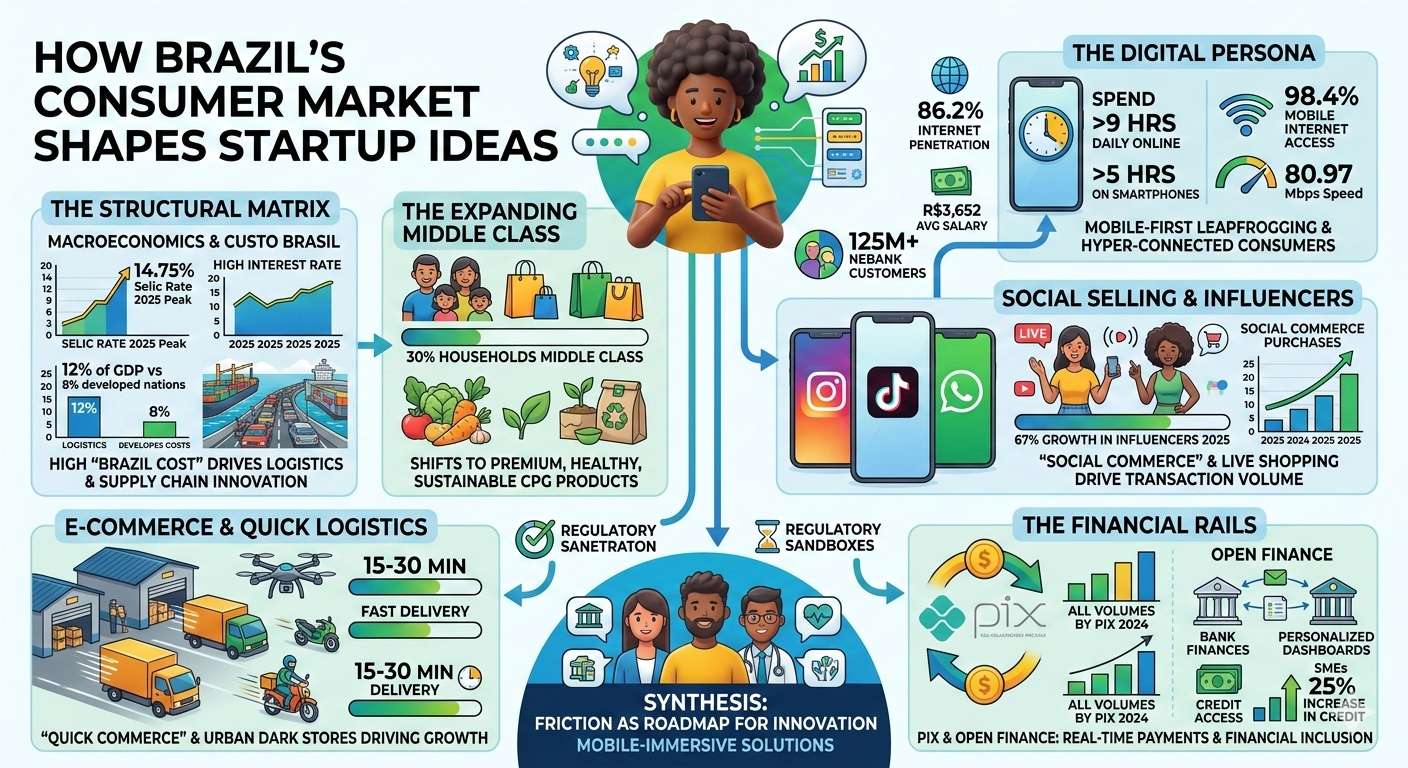
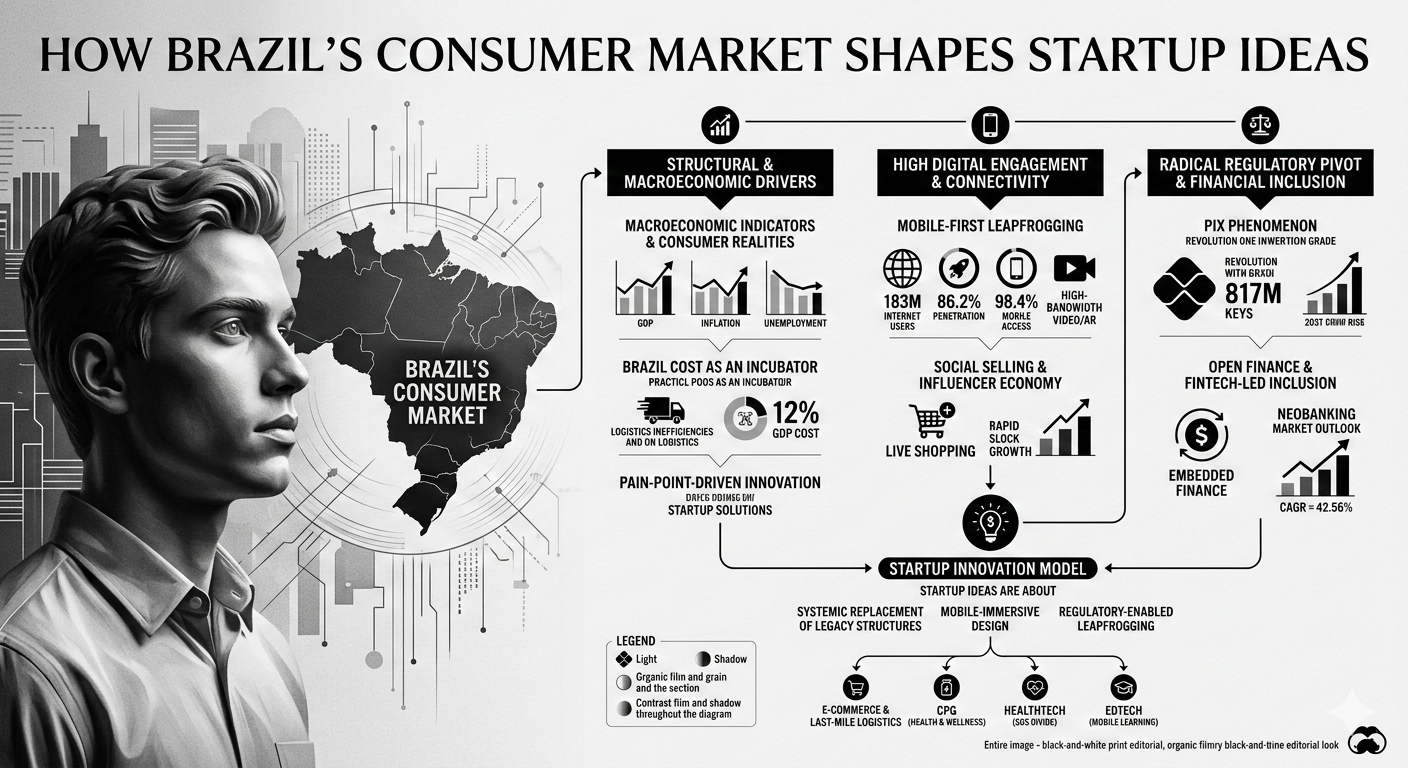
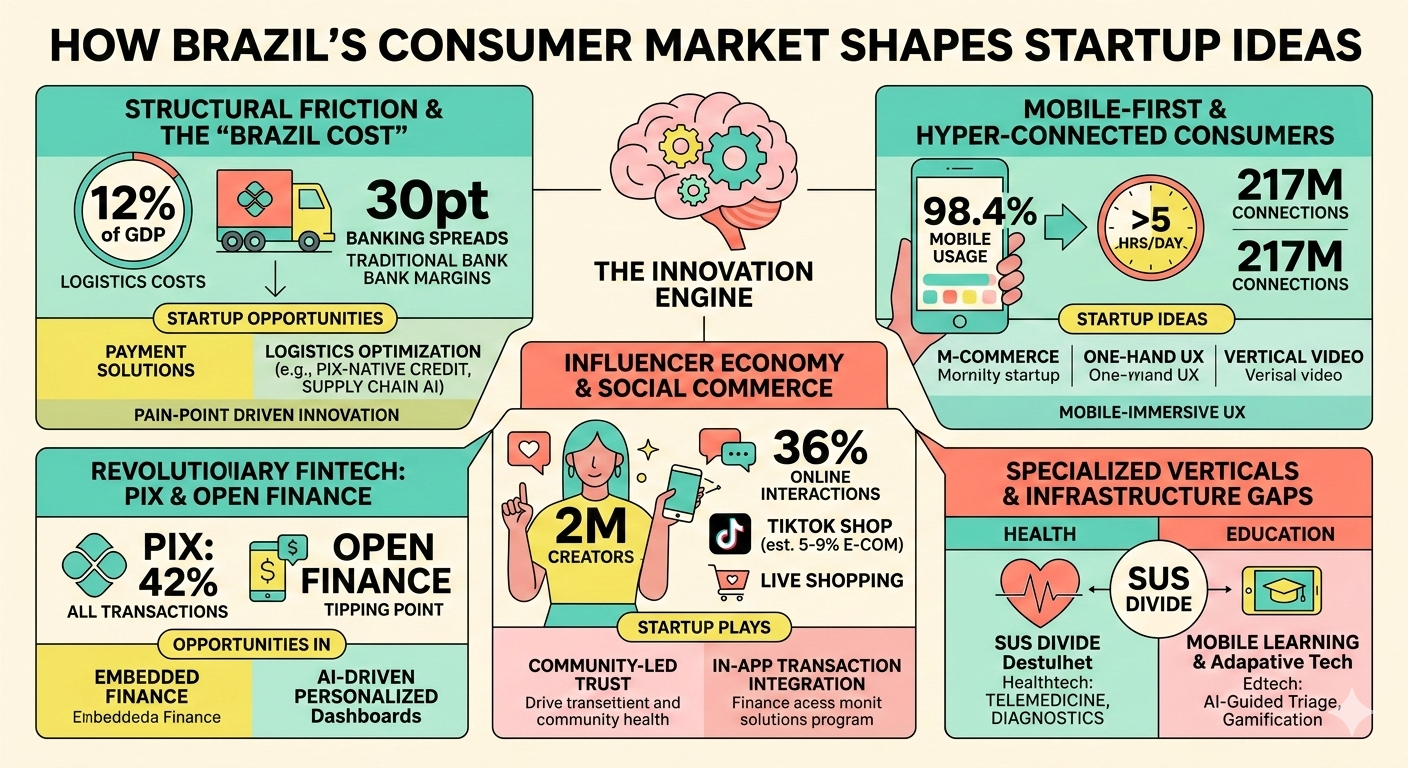
The evolution of the Brazilian startup ecosystem is fundamentally tethered to the unique structural, cultural, and economic idiosyncrasies of its domestic consumer market. As the eighth-largest consumer market globally, valued at approximately $1.3 trillion, Brazil presents a paradox of high digital engagement and significant infrastructure gaps. This tension has fostered a "pain-point-driven" innovation model where startup ideas are less about incremental convenience and more about systemic replacement of inefficient legacy structures. The interplay between a volatile macroeconomic environment, a mobile-first population, and a radical regulatory pivot toward open competition defines the current state of Brazilian entrepreneurship.
The Structural Matrix: Macroeconomics and the "Brazil Cost" as an Incubator
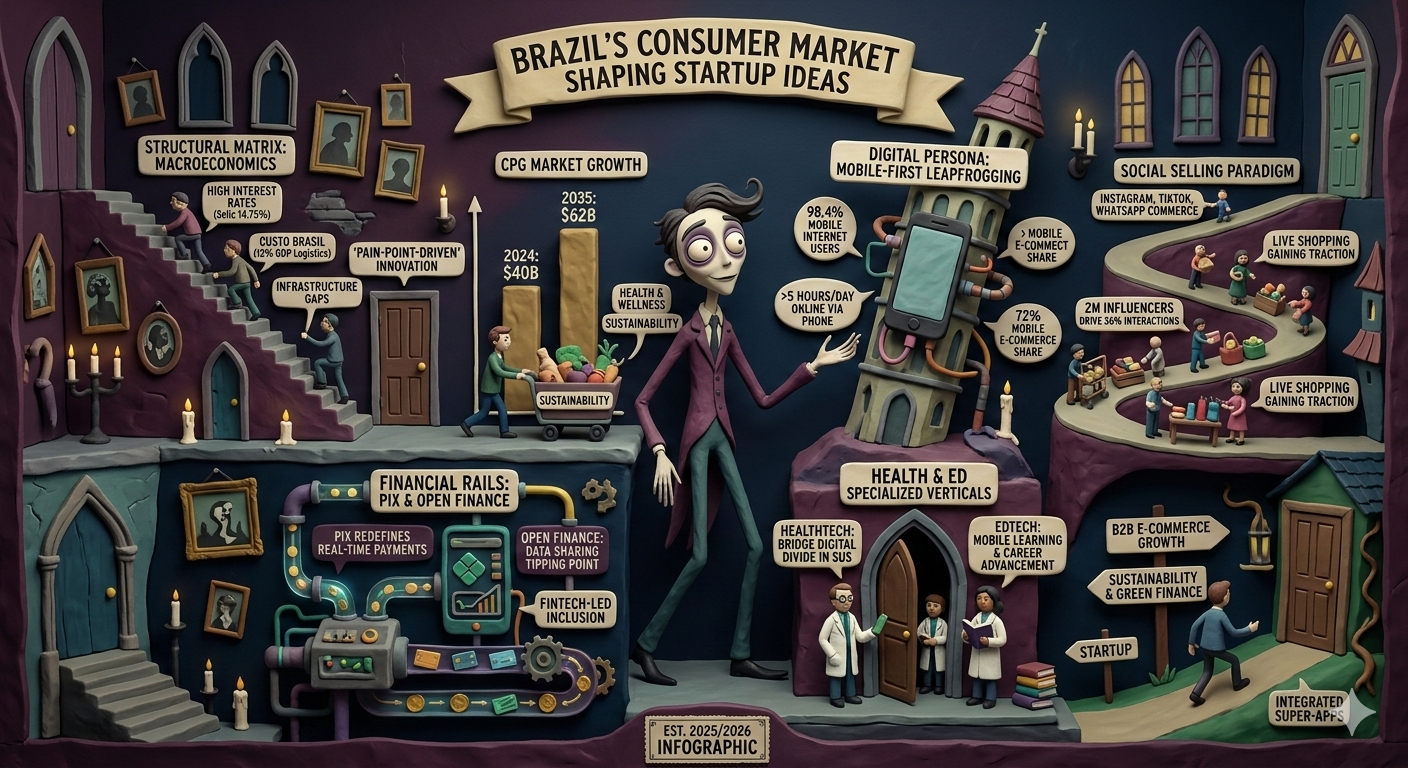
The Brazilian economy at the beginning of 2025 is characterized by a state of transition, where robust employment figures and a growing middle class collide with high interest rates and fiscal uncertainty. The macroeconomic backdrop is not merely a setting for startup activity but a direct shaper of business models. In 2024, the economy showed signs of "overheating," driven by reaccelerated inflation and a tightening labor market, which was fueled in large part by the extension of public support measures. This environment of persistent inflation, ending 2024 at 4.8%, above the central bank's target ceiling, has necessitated a highly restrictive monetary policy.
Macroeconomic Indicators and Consumer Realities
The persistence of the Selic rate—the country’s benchmark interest rate—at elevated levels (projected to peak at 14.75% by May 2025) creates a prohibitive cost of capital for both businesses and consumers. For startups, this creates a two-fold pressure: the need for disciplined capital allocation and a massive market opportunity to provide lower-cost financial alternatives to a population burdened by high interest rates. Traditional banking spreads in Brazil are among the highest in the world, with average market lending rates exceeding funding rates by 30 percentage points, compared to a global average of 5.9%.
Economic Indicator (Projected 2025-2026) | Value | Context and Source |
Nominal GDP (2025) | $2.26 Trillion | World's 11th largest nominal GDP |
GDP Growth Rate (2024 Actual) | 3.4% | Robust growth despite high rates |
GDP Growth Rate (2025 Forecast) | 2.2% | Slowdown due to fiscal adjustment |
Inflation (CPI Dec 2025) | 4.26% | Moving toward the 3.8% target for 2026 |
Unemployment Rate (Jan 2026) | 5.4% | Lowest levels since at least 2012 |
Average Gross Monthly Salary | R$3,652 ($677.55) | Reflects 5% real wage acceleration |
Selic Interest Rate (2025 Peak) | 14.75% | Highest level since 2006 |
General Government Debt (% of GDP) | 95% (by 2026) | High debt burden for emerging market |
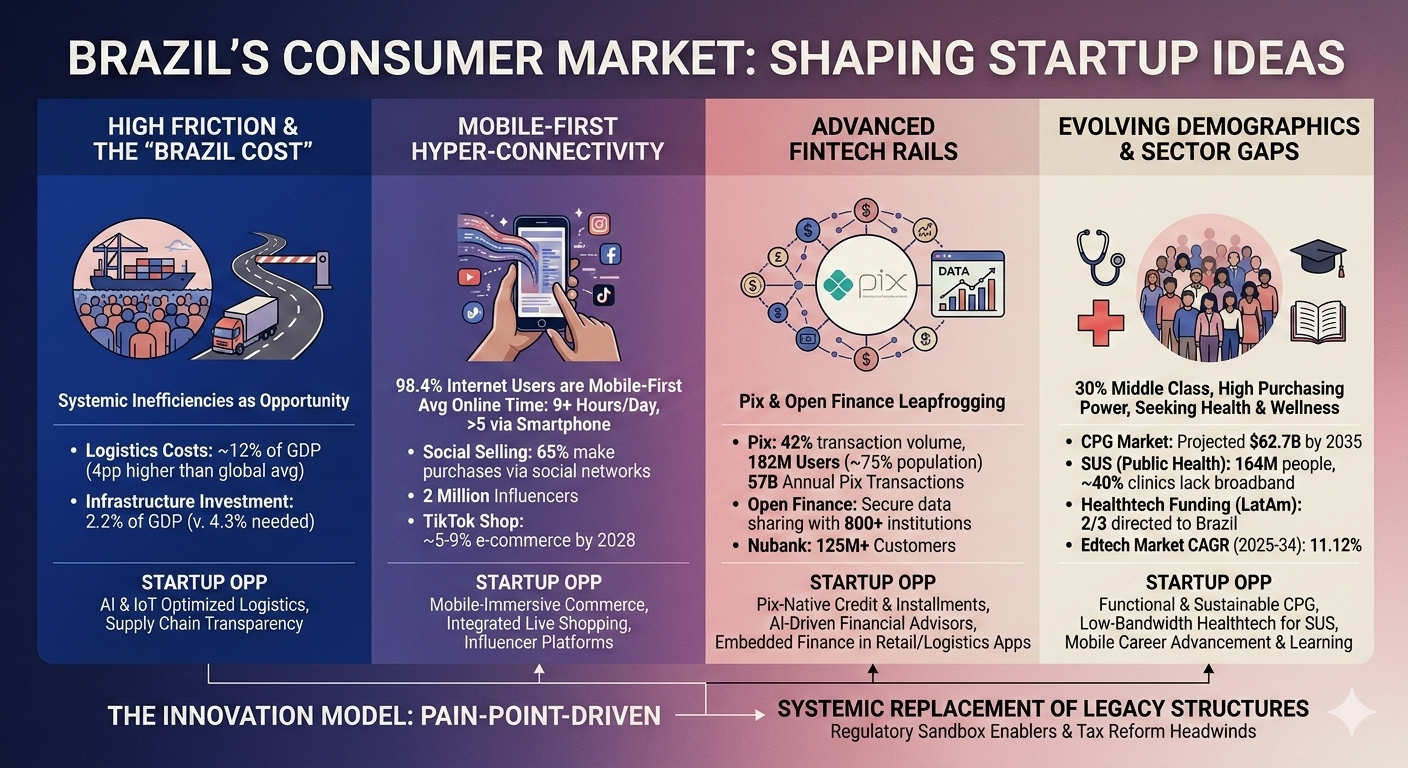
The "Custo Brasil" or Brazil Cost, particularly the logistical inefficiencies, acts as a primary catalyst for innovation in the supply chain and e-commerce sectors. Logistics costs in Brazil are estimated at 12% of GDP, which is a full four percentage points higher than the average for developed nations. This inefficiency stems from a chronic underinvestment in infrastructure; in 2024, the country invested only 2.2% of its GDP in infrastructure, far below the 4.3% required to meet national needs. Startup ideas that leverage AI, IoT, and blockchain to optimize these aging road networks and congested ports are not just "nice-to-have" features but essential components of economic competitiveness.
The Expansion of the Middle Class and Consumer Packaged Goods (CPG)
The rise of the middle class is a pivotal driver for the consumer market. Approximately 30% of Brazilian households are now classified as middle class, a significant demographic expansion that has increased purchasing power and shifted demand toward higher-quality, premium products. This shift is particularly evident in the Consumer Packaged Goods (CPG) market, which was valued at $40.12 billion in 2024 and is projected to reach $62.7 billion by 2035.
Startup ideas within the CPG space are increasingly shaped by a burgeoning health and wellness focus. Brazilians are seeking organic, natural, and functional foods, reflecting a broader societal trend toward preventive healthcare. Sustainability has also transitioned from a niche concern to a primary purchasing criterion, with consumers actively seeking eco-friendly packaging and brands that demonstrate environmental responsibility. For startups, this means that success in the CPG sector is no longer just about price and distribution but about aligning with these evolving values of health and sustainability.
The Digital Persona: Mobile-First Leapfrogging and Hyper-Connected Consumers
Brazil possesses advanced digital infrastructure and a level of connectivity that allows for high degrees of digital participation. By early 2025, there were 183 million internet users in the country, representing a penetration rate of 86.2%. The most critical aspect of this connectivity is its mobile-first nature; 98.4% of internet users in Brazil connect via mobile phones, and the median mobile internet download speed has reached 80.97 Mbps.
Mobile Dominance and Consumer Behavior
The Brazilian consumer spends a staggering amount of time online. In 2025, the average Brazilian spends over nine hours daily on the internet, with more than five of those hours accessed via smartphones. This intensity of usage has profound implications for startup design. Ideas must be optimized for "one-hand navigation" and "on-the-go browsing" to match the habits of a population that uses their phones for everything from finding information (78.8%) to researching products and brands (70.5%).
The "digital window shopping" phenomenon is particularly pronounced in Brazil. Consumers browse items or research products approximately 16 days per month using their phones, which is roughly four days more than the global average. This behavior creates a large top-of-funnel opportunity for startups that can capture attention through engaging content before a purchase intent is even fully formed.
Mobile and Digital Connectivity (2025) | Statistic | Implications for Startups |
Active Cellular Mobile Connections | 217 Million | 102% of the total population |
Mobile Share of Internet Access | 98.4% | Mobile-first is the only viable strategy |
Time Spent Online via Smartphone | >5 Hours/Day | High surface area for digital engagement |
Mobile E-commerce Volume Share | 72% | Desktop is a secondary channel |
Broadband Mobile Connections (3G/4G/5G) | 97.1% | High-bandwidth content (video/AR) is viable |
Social Media User Identities | 144 Million | 67.8% of the total population |
The Social Selling Paradigm and Influencer Economy
Brazil’s social media landscape is one of the most vibrant in the world, with the country ranking second globally in time spent on social networks. Platforms like Instagram, TikTok, and WhatsApp are not just communication tools; they have become the primary engines of discovery and transaction. Approximately 65% of Brazilians use social networks to make online purchases, a trend that has given rise to a massive influencer economy.
The number of digital influencers in Brazil grew by 67% in 2025, reaching approximately 2 million creators. These influencers act as gatekeepers, concentrating 36% of online interactions and driving digital consumption through a high level of trust and engagement. Startup ideas that integrate "Social Commerce"—the sales process initiated or carried out directly on social networks—are particularly effective. For instance, the TikTok Shop feature is projected to represent 5% to 9% of total Brazilian e-commerce by 2028.
Live shopping, or real-time broadcasts with integrated sales, is another format gaining significant traction. Opinions Box research indicates that 28% of Brazilian consumers have already purchased during a live stream, with nearly half of those doing so regularly. This bridge between entertainment and sales is a fertile ground for startups focusing on interactive video content and seamless in-app payment integrations.
The Financial Rails: Pix, Open Finance, and Fintech-Led Inclusion
The Brazilian fintech ecosystem is perhaps the most advanced laboratory for financial innovation in the world. This maturity is driven by a combination of high banking concentration (which led to poor service and high fees) and a proactive, visionary regulator in the Central Bank of Brazil (BCB).
The Pix Phenomenon: Redefining Real-Time Payments
Launched in November 2020, Pix has revolutionized the way money moves in Brazil. By late 2024, Pix accounted for 42% of all transaction volumes and 40% of e-commerce volume. The system's adoption has been meteoric: in April 2024 alone, Pix broke a single-day record with 250.5 million transactions, processing BRL 124.4 billion.
Pix’s success is rooted in its ubiquity and zero-cost structure for individuals. It has democratized access to payments for the financially excluded and the informal economy. For startups, Pix provides a rail for innovation that bypasses the expensive and slow traditional card networks. In 2025, new features like "Pix por Aproximação" (contactless Pix) and "Pix Parcelado" (installment payments via Pix) are further challenging the dominance of credit cards. These innovations allow retailers to offer flexible payment plans without the merchant fees associated with traditional credit, while consumers gain the convenience of instant transactions.
Pix Ecosystem Metrics (Nov 2024) | Value | Source |
Total Registered Pix Keys | 817 Million | |
Total Pix Accounts | 547 Million | |
Active Pix Users | 182 Million | ~75% of the population |
Annual Transaction Volume (2024) | 57 Billion | |
Annual Value Transacted (2024) | $3.8 Trillion |
Open Finance and Ecosystem Maturity
Brazil has successfully implemented the most advanced Open Finance framework in Latin America. By April 2024, the country had completed the first four stages of its Open Finance rollout, enabling the secure sharing of financial data among over 800 institutions with user consent. In 2025, this ecosystem has reached a "tipping point" where technology, policy, and consumer behavior are aligned.
Open Finance allows consumers to aggregate fragmented data from digital wallets, microloans, and traditional bank accounts into personalized dashboards. This interoperability has enabled startups to develop sophisticated AI-driven financial advisors and more accurate credit scoring models. For example, small and medium enterprises (SMEs) have seen a 25% increase in credit approvals due to the richer data insights provided through Open Finance APIs.
The synergy between Pix and Open Finance is a defining feature of the Brazilian model. Their roadmaps are intertwined, ensuring that progress in instant payments amplifies data sharing use cases. This has led to the rise of "intelligent, holistic, and user-centered products" that offer programmability and contextual relevance in financial experiences.
The Neobanking Challenge and Financial Inclusion
Fintech competition has fundamentally altered the profitability and behavior of traditional banks. Between 2018 and 2024, fintech competition reduced traditional banks' average lending rates by an estimated 2.7 percentage points and narrowed their net interest margins by 0.9 percentage points. Digital banks like Nubank, which boasts over 125 million customers across Brazil, Mexico, and Colombia, have validated that emerging market fintechs can solve critical infrastructure gaps while generating exceptional returns.
Neobanking Market Outlook | Value/Growth Rate | Source |
Market Size in 2025 | $6.1 Billion | |
Market Forecast in 2034 | $147.9 Billion | |
Forecasted CAGR (2026-2034) | 42.56% | |
Population with Smartphones | >80% | |
Unbanked/Underbanked Population | ~45 Million |
Startup ideas in the neobanking space are shifting toward "Embedded Finance," where financial services are integrated into non-financial platforms like retail apps, logistics tools, and even energy providers. This transition transforms finance from a standalone product into an operating model. For instance, UME, a Pix-native credit network, allows retailers to offer installment plans directly within their own ecosystems, further driving real-economy growth.
The Commercial Evolution: E-commerce, Social Selling, and Last-Mile Logistics
Brazil's e-commerce market is a vibrant hub that contributes 13% to the national GDP. The market volume for 2024 was estimated at $346 billion, with a forecasted CAGR of 19% through 2027, reaching $586 billion. This growth is propelled by the rapid uptake of Pix, accelerating smartphone penetration, and heavy investments in logistics to reduce delivery lead times.
Logistics Infrastructure and Dark Stores
To overcome the "Brazil Cost," e-commerce giants and startups alike are investing billions in delivery infrastructure. Mercado Libre, for example, committed $6.4 billion to double its Brazilian distribution center footprint. The goal for major players is to reduce delivery times to under 24 hours in core metropolitan areas and under 48 hours in underserved regions like Recife and Fortaleza.
"Dark stores"—local fulfillment centers used exclusively for online orders—have emerged as a critical driver for the "Quick Commerce" sector. These micro-hubs are spreading beyond major cities into secondary hubs like Curitiba and Porto Alegre. The rise of dark stores is essential for capturing the high-growth "Food and Beverage" category, which is projected to grow at a 16.72% CAGR. Startups like iFood and Rappi are stretching the competitive field by promising 15-30 minute delivery, forcing larger incumbents to adopt similar localized fulfillment strategies.
E-commerce Segment Growth and Shares | Statistic (2025/2026) | Source |
B2C Market Share (2025) | 85.23% | |
B2B E-commerce CAGR (through 2031) | 18.42% | Fastest growing slice |
Smartphone Share of Transaction Value | 53.67% | |
Food & Beverages CAGR | 16.72% | Driven by quick-commerce |
Fashion and Apparel Share (2025) | 24.73% | Strong influencer influence |
E-commerce Volume from Mobile Devices | 72% |
The Friction Gap and Opportunity for Checkout Solutions
Despite high digital adoption, Brazilian consumers experience extreme friction in the payment process. Only 1.5% of Brazilian consumers reported that their most recent purchase went "completely smoothly," compared to a global average of 61%. A staggering 99% of shoppers reported at least one payment issue, mostly in the form of processing errors or declined payments.
Furthermore, only 33% of Brazilian shoppers use stored credentials for online purchases, far below the global average of 54%, largely due to concerns over data security and privacy (60%). This "trust gap" creates a significant opportunity for startups focusing on secure, one-click checkout solutions and behavioral-based fraud prevention. The fact that 32% of consumers still manually enter payment information for online purchases—1.5 times the global average—highlights a massive area for UX and fintech innovation.
Specialized Vertical Markets: Healthtech and Edtech through the Lens of Infrastructure Gaps
The sectoral distribution of startup ideas in Brazil is increasingly focused on large, underserved public systems. Healthtech and Edtech, in particular, are regions where private capital is attempting to bridge the massive gap left by public infrastructure deficits.
Healthtech: Navigating the Digital Divide
The Brazilian healthcare system is characterized by a stark divide between the private sector, which serves 25% of the population but controls 60% of spending, and the public system (SUS), which serves the remaining 72%. This divide is increasingly being viewed as a "new social determinant of health".
Private networks in urban centers like Hospital Israelita Albert Einstein and Hospital Sírio-Libanês are at the forefront of digital transformation, employing telemedicine, remote monitoring, and integrated electronic health records. Startups such as Amigo, Mevo, and Beep Saúde are flourishing in this environment, using AI-guided triage to reduce waiting times and sending licensed nurses directly to patients' homes.
Healthtech Market Dynamics (2024-2025) | Value/Stat | Source |
Healthtech Funding in Brazil (2024) | $1.6 Billion | 2/3 of all LatAm healthtechs |
Private Healthcare Spend | >$42 Billion/Year | 7th largest globally |
Public System (SUS) Population | 164 Million | |
SUS Clinics Lacking Broadband | ~40% | Major barrier to digital health |
Healthtechs in Diagnosis/Prevention | 52% |
For startups, the challenge and opportunity lie in developing solutions that can operate in the resource-constrained environment of the SUS. With 40% of primary-care units lacking stable broadband, there is a desperate need for low-bandwidth digital tools that can function offline or via ubiquitous apps like WhatsApp, which many facilities already use for coordination despite lack of official support.
Edtech: Mobile Learning and Career Advancement
The Brazilian Edtech market is projected to grow from $6.0 billion in 2025 to $15.6 billion by 2034, with a CAGR of 11.12%. This growth is primarily fueled by the dramatic rise in mobile device usage among the younger population. Startup ideas in this space are leveraging AI and data analytics to provide personalized and remote learning solutions that cater to diverse student requirements and learning speeds.
Government initiatives like the "Education Connected Program" aim to enhance internet connectivity in public schools, but the primary driver remains private demand for flexible, accessible educational resources. The integration of gamification and adaptive technologies in mobile learning apps is increasing user participation and learning effectiveness, making Edtech a central pillar of the Brazilian digital economy. Regulatory Enablers and Constraints: The "Marco Legal" and Tax Reform
The legal and regulatory framework in Brazil has become a strategic asset for the startup ecosystem, though it remains complex and subject to sudden shifts.
Complementary Law 182/2021: The Startup Law
The "Marco Legal das Startups" established a facilitating environment for innovative companies. Key provisions include:
Recognition of Innovative Entrepreneurship: Formally identifies startups as drivers of economic development and qualified job creation.
Regulatory Sandboxes: Permits agencies like ANVISA and the Central Bank to temporarily suspend certain regulations so startups can test innovative business models under supervised conditions.
Investment Incentives: Recognizes "Angel Investors" and "Convertible Debt" (Mútuo Conversível), ensuring that investors are not immediately liable for the startup's labor or tax debts.
Public Procurement: Simplifies the process for the government to contract innovative solutions, allowing for pilot projects and proofs of concept with payments up to R$1.6 million per contract.
The 2025-2026 Tax Pivot: A Potential Headwind
While the 2021 law focused on enablers, the legislative environment entering 2026 is becoming more restrictive in terms of fiscal incentives. Complementary Bill 128/2025 mandates a 10% cut in federal tax incentives and increases the withholding tax rate on Interest on Net Equity (INE) to 17.5%.
Of particular concern for the ecosystem is the sharp increase in taxation for fintechs. Corporate income tax for these companies is set to rise from 34% to 40% or 45%, depending on their regulatory characterization. Additionally, the "Presumed Profit" regime, used by many smaller startups, will see its presumed margins increased by 10%, making it less attractive for service companies with lower actual margins. These changes signal a shift from an era of purely subsidized growth to one where startups must demonstrate robust, tax-resilient profitability.
Synthesis: How the Brazilian Market Shapes Innovation
The Brazilian consumer market does not merely "host" startups; it actively dictates their genetic makeup. The combination of high-velocity digital engagement and deep-seated structural friction creates a unique set of constraints that force innovation in specific directions.
The Mechanism of Adaptation
Friction as a Roadmap: The 12% GDP cost of logistics and 30-point banking spreads act as a roadmap for where the most value can be captured. Startup ideas that do not solve a fundamental structural inefficiency struggle to gain traction.
Community-Led Trust: In a society with historically low institutional trust but high social cohesion, startups that leverage influencers and "community" features (like group buying or social commerce) can bypass the trust barriers that plaque traditional digital marketing.
Regulatory-Enabled Leapfrogging: The BCB’s mandate for real-time payments and Open Finance has allowed Brazil to leapfrog the legacy financial systems of the United States and Europe. Startup ideas are now "Pix-native," assuming real-time, zero-cost transfers as a baseline rather than a future goal.
Mobile-Only UX: The 98.4% mobile internet usage rate means that "mobile-responsive" is insufficient; startups must be "mobile-immersive." This includes optimizing for vertical video, voice search, and low-bandwidth resilience.
Future Trajectories: 2025 and Beyond
Looking forward, the Brazilian startup ecosystem is likely to see a consolidation of "Quick Commerce" and "Embedded Finance" into integrated super-apps. The growth of B2B e-commerce (18.42% CAGR) indicates a transition where the digital tools perfected in the B2C space are now being deployed to modernize the country’s massive SME sector.
Sustainability and green finance are also poised for exponential growth. With Brazil hosting the 2025 BRICS presidency and the COP30 in Belém, there is a clear mandate for "green-credit" solutions and agtech innovations that align with global decarbonization goals. Startups like Solfácil, the country’s first green-energy lender, demonstrate how sector-specific financial tools can drive real-world infrastructure change.
In conclusion, the Brazilian startup ecosystem is a high-stakes, high-reward laboratory. It rewards those who can navigate its bureaucratic complexities while ruthlessly optimizing for the hyper-connected, yet often financially constrained, mobile consumer. The startup ideas emerging from this market are increasingly world-class, not because they are well-funded, but because they are forged in one of the most demanding and dynamic consumer environments on earth.

Read More -
1. From Idea to MVP: A Step-by-Step Guide for Solo Founder
🔗 https://findnstart.com/blogs/from-idea-to-mvp-a-step-by-step-guide-for-solo-founder
2. How to Validate Your Startup Idea in 48 Hours for $0
🔗 https://findnstart.com/blogs/how-to-validate-your-startup-idea-in-48-hours-for-0
3. Remote vs. Local: Does Your Co-Founder Need to Live in the Same City?
🔗 https://findnstart.com/blogs/remote-vs-local-does-your-co-founder-need-to-live-in-the-same-city
4. The 2026 Startup Landscape: What Has Fundamentally Changed (and Why Founder Skills Matter More Than Ever)
5. The Most In-Demand Skills for Startup Founders in 2026
🔗 https://findnstart.com/blogs/the-most-in-demand-skills-for-startup-founders-in-2026
6. How to Find a Technical Co-Founder (Without a Six-Figure Salary)
🔗 https://findnstart.com/blogs/how-to-find-a-technical-co-founder-without-a-six-figure-salary
7. 5 Red Flags to Look for When Choosing a Startup Partner
🔗 https://findnstart.com/blogs/5-red-flags-to-look-for-when-choosing-a-startup-partner
8. How to Pitch Your Idea to Potential Co-Founders
🔗 https://findnstart.com/blogs/how-to-pitch-your-idea-to-potential-co-founders
9. How to Build a Portfolio that Attracts High-Growth Startup Founders
🔗 https://findnstart.com/blogs/how-to-build-a-portfolio-that-attracts-high-growth-startup-founders
10. Equity vs. Salary: How to Split Ownership with Your First Teammate
🔗 https://findnstart.com/blogs/equity-vs-salary-how-to-split-ownership-with-your-first-teammate
11. Why Joining an Early-Stage Startup is Better Than a Corporate Job
🔗 https://findnstart.com/blogs/why-joining-an-early-stage-startup-is-better-than-a-corporate-job
12. The Future of EdTech: Why Developers and Educators Need to Team Up Now
🔗 https://findnstart.com/blogs/the-future-of-edtech-why-developers-and-educators-need-to-team-up-now
13. The Architecture of Symbiosis: Analytical Perspectives on the Five Habits of Successful Startup Duos
14. Finding a Co-Founder in the AI Space: What Skills Should You Look For?
🔗 https://findnstart.com/blogs/finding-a-co-founder-in-the-ai-space-what-skills-should-you-look-for
15. Overcoming Analysis Paralysis and the Strategic Path to Execution
🔗 https://findnstart.com/blogs/overcoming-analysis-paralysis-and-the-strategic-path-to-execution
16. From College Project to Company: How to Find Your Student Co-Founder
🔗 https://findnstart.com/blogs/from-college-project-to-company-how-to-find-your-student-co-founder
17. How to Start a Startup While Working a Full-Time Job
🔗 https://findnstart.com/blogs/how-to-start-a-startup-while-working-a-full-time-job
18. How to Build a HealthTech Startup Without a Medical Degree
🔗 https://findnstart.com/blogs/how-to-build-a-healthtech-startup-without-a-medical-degree
19. The Solitary Architect: Executive Isolation in Entrepreneurship
20. The 2026 Guide to Launching a SaaS as a Solo Developer
21. What Sustainable Growth Actually Looks Like
🔗 https://findnstart.com/blogs/what-sustainable-growth-actually-looks-like
22. The Early Warning Signs Your Startup Is in Trouble
🔗 https://findnstart.com/blogs/the-early-warning-signs-your-startup-is-in-trouble
23. How to Grow Without Burning Out
🔗 https://findnstart.com/blogs/how-to-grow-without-burning-out
24. The Truth About “Runway” Most Founders Ignore
🔗 https://findnstart.com/blogs/the-truth-about-runway-most-founders-ignore
25. Revenue Solves More Problems Than Funding
🔗 https://findnstart.com/blogs/revenue-solves-more-problems-than-funding
26. What No One Tells You About Being a Solo Founder
🔗 https://findnstart.com/blogs/what-no-one-tells-you-about-being-a-solo-founder
27. Why Smart People Quit High-Paying Jobs to Build Startups (And Why Most Regret It)
28. Why Most Startup Advice on Twitter Is Dangerous
🔗 https://findnstart.com/blogs/why-most-startup-advice-on-twitter-is-dangerous
29. Decision Fatigue: The Silent Startup Killer
🔗 https://findnstart.com/blogs/decision-fatigue-the-silent-startup-killer
30. Fear vs Logic: How Founders Actually Make Decisions
🔗 https://findnstart.com/blogs/fear-vs-logic-how-founders-actually-make-decisions
31. How Overthinking Destroys Early Momentum
🔗 https://findnstart.com/blogs/how-overthinking-destroys-early-momentum
32. Ideas Don’t Scale. Systems Do.
🔗 https://findnstart.com/blogs/ideas-dont-scale-systems-do
33. The First Hire That Actually Matters
🔗 https://findnstart.com/blogs/the-first-hire-that-actually-matters
34. How the First 100 Users Decide Your Startup’s Fate
🔗 https://findnstart.com/blogs/how-the-first-100-users-decide-your-startups-fate
35. Why Your Startup Doesn’t Need Growth — It Needs Focus
🔗 https://findnstart.com/blogs/why-your-startup-doesnt-need-growthit-needs-focus
36. Why Most Startups Die Quietly
🔗 https://findnstart.com/blogs/why-most-startups-die-quietly
37. Lessons Learned Too Late by First-Time Founders
🔗 https://findnstart.com/blogs/lessons-learned-too-late-by-first-time-founders
38. The Myth of the “Overnight Success” Startup
🔗 https://findnstart.com/blogs/the-myth-of-the-overnight-success-startup