Hidden Burnout of Bangalore Founders
March 8, 2026 by Harshit Gupta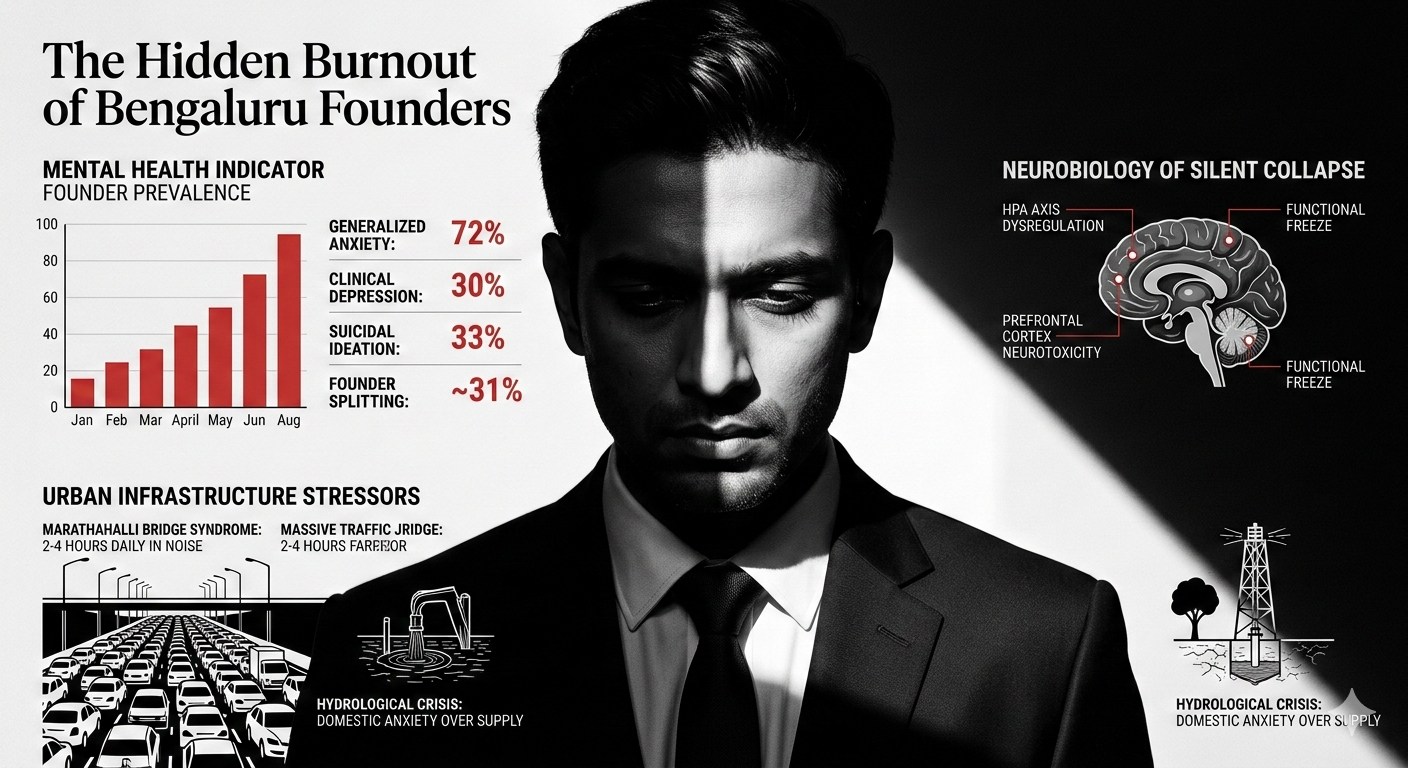
The metropolitan landscape of Bengaluru, historically recognized as a tranquil garden city and subsequently as the epicenter of India’s technological revolution, has undergone a fundamental transformation into a high-pressure crucible for entrepreneurial talent. While the city’s identity is constructed around the narratives of venture capital inflows, unicorn valuations, and disruptive innovation, a secondary, more insidious identity has emerged: that of a city teetering on the edge of a collective mental health crisis. This phenomenon, colloquially termed the "hidden burnout," represents a systemic erosion of the human capital required to sustain the world’s third-largest startup ecosystem. Data suggests a 15% to 35% increase in burnout cases among working professionals in the city compared to half a decade ago, with the most severe manifestations occurring within the age bracket of 24 to 38—the primary demographic for founders and early-stage tech operators.
The Quantitative Dimensions of Entrepreneurial Distress
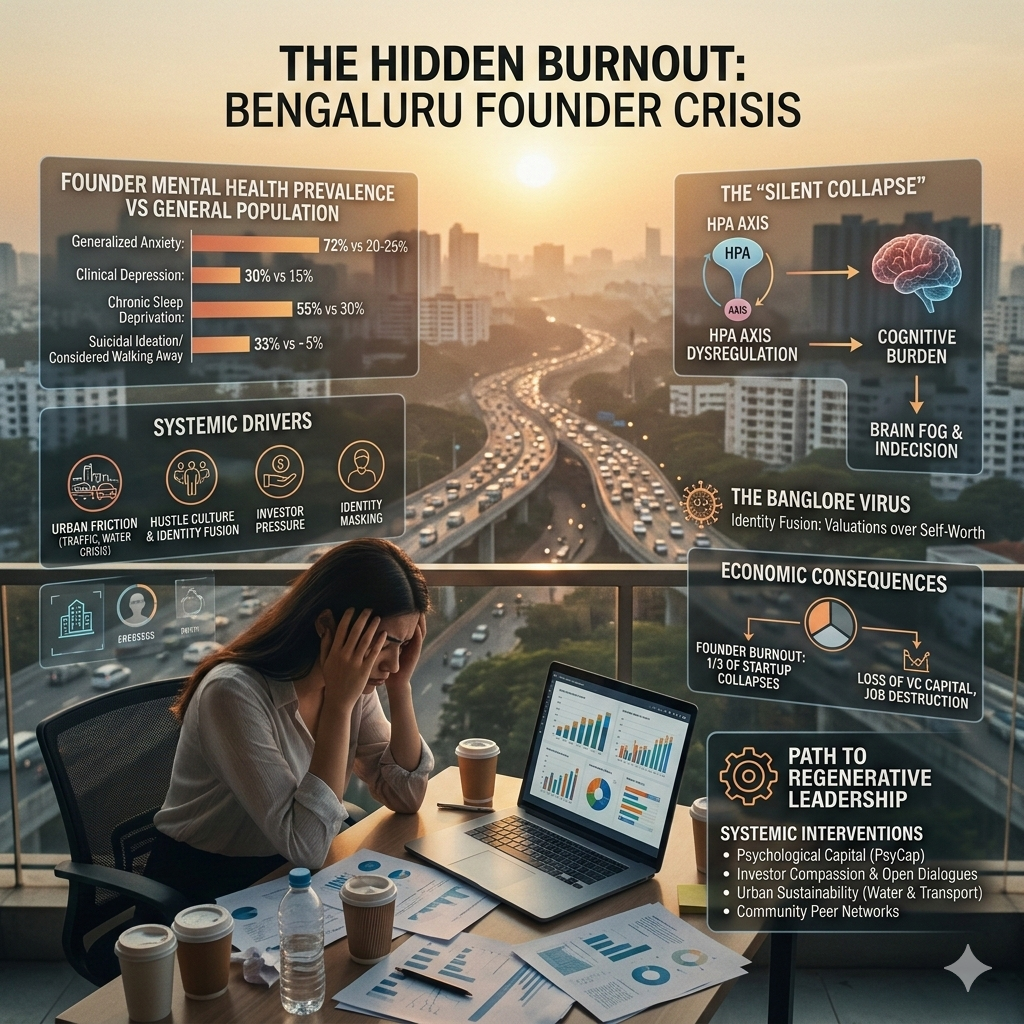
The psychological toll of entrepreneurship in Bengaluru is no longer a matter of anecdotal evidence but is increasingly documented through rigorous empirical surveying. In 2024, approximately 62% of Indian founders reported experiencing symptoms of clinical burnout, a figure that highlights a pervasive and often unacknowledged struggle within the high-performance corridors of the city. The statistics surrounding this crisis reveal a stark divergence between the entrepreneurial population and the general workforce.
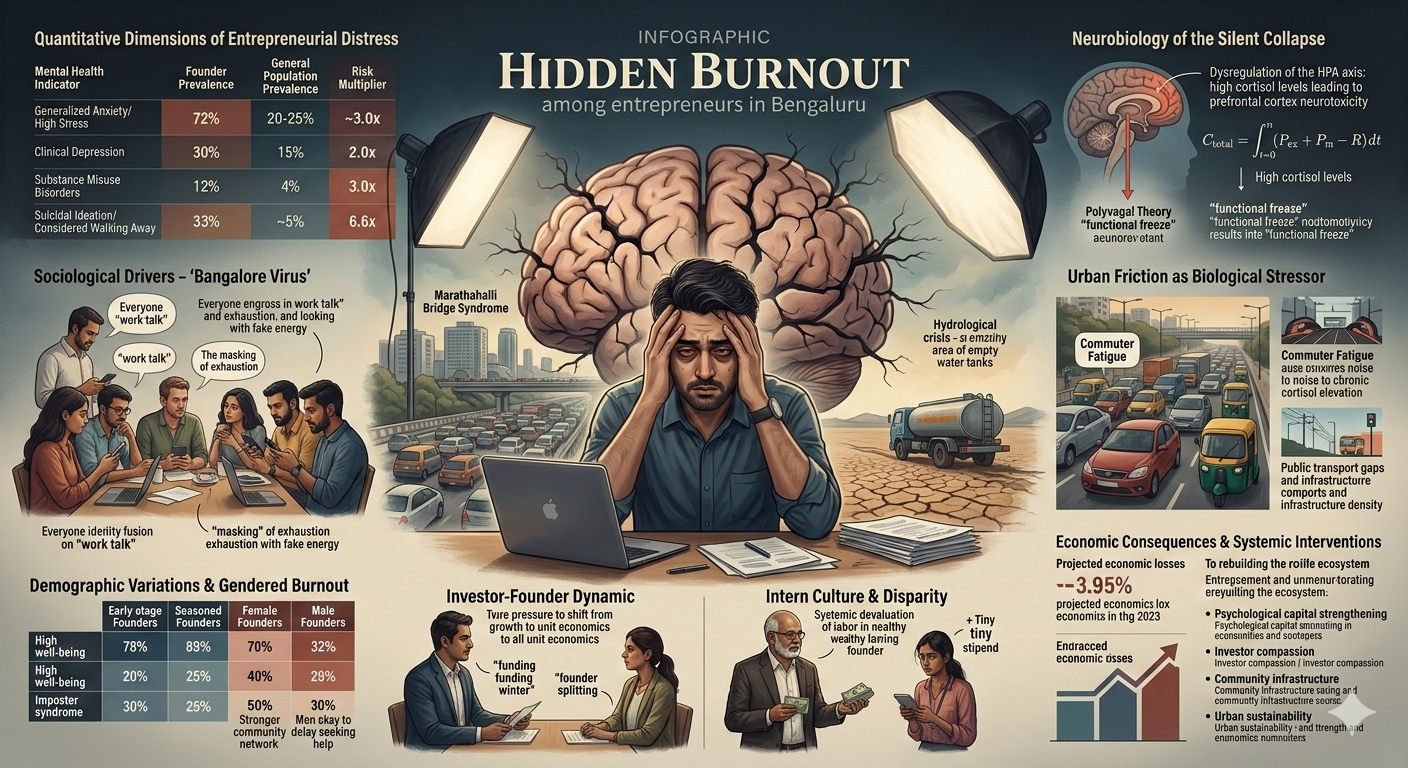
Mental Health Indicator | Founder Prevalence | General Population Prevalence | Risk Multiplier |
Generalized Anxiety/High Stress | 72% | 20-25% | ~3.0x |
Clinical Depression | 30% | 15% | 2.0x |
Substance Misuse Disorders | 12% | 4% | 3.0x |
Bipolar Disorder | 10% | 1% | 10.0x |
Chronic Sleep Deprivation | 55% | 30% | 1.8x |
Suicidal Ideation/Considered Walking Away | 33% | ~5% | 6.6x |
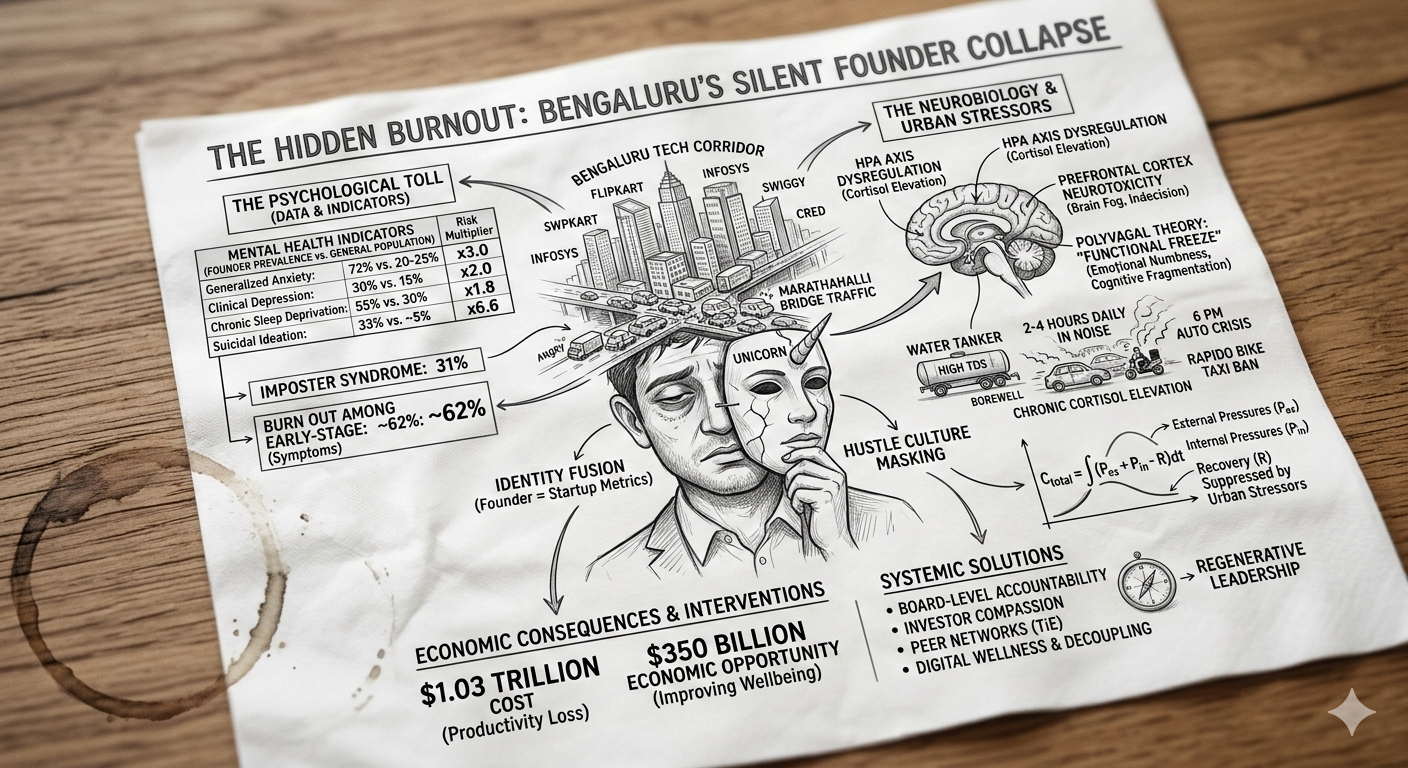
These figures, compiled from various wellbeing studies, indicate that the very traits often selected for in venture capital environments—extreme risk tolerance, obsessive focus, and a high threshold for pain—may serve as biological and psychological precursors to catastrophic collapse. The prevalence of imposter syndrome is also notable, affecting roughly 31% of the entrepreneurial community, with early-stage founders exhibiting significantly higher vulnerability than their seasoned counterparts.
The Neurobiology of the Silent Collapse
The "silent collapse" of the Bangalore founder is rarely a sudden event; rather, it is a multidimensional breakdown of physiology, emotional capacity, and nervous system regulation that unfolds over months or years before becoming visible to external stakeholders. This process is characterized by the slow muting of internal biological signals, where the founder gradually loses the ability to "hear" the warnings of their own body.
At the physiological level, burnout is mediated by the dysregulation of the Hypothalamic-Pituitary-Adrenal (HPA) axis. Under chronic stress, the sustained elevation of cortisol leads to neurotoxicity in the prefrontal cortex, the region of the brain responsible for executive function, impulse control, and strategic decision-making. The "burnt-out brain" is not less intelligent; it is less regulated. This neurological state manifests as "brain fog," indecision, and a heightened state of irritability that founders often dismiss as mere tiredness.
Ctotal=∫t=0n(Pex+Pin−R)dt
In this conceptualization, Ctotal represents the cumulative cognitive and physiological burden. Pex denotes external pressures (investor demands, market volatility), Pin represents internal pressures (imposter syndrome, fear of failure), and R is the rate of recovery. In the context of Bengaluru, the variable R is often severely suppressed by urban stressors, leading to an exponential rise in systemic collapse.
Furthermore, the application of Polyvagal Theory to founder burnout suggests a catastrophic failure of the body’s "vagal brake." When the dorsal vagal complex becomes over-stimulated due to perceived existential threats to the business, the individual may enter a state of "functional freeze"—a condition where they continue to perform tasks but are emotionally numb and cognitively fragmented. This explains why founders often continue to work 14-hour days while reporting that they feel "dead inside" or disconnected from the original passion of their vision.
The Bangalore Virus: Sociological Drivers of Identity Fusion
A unique sociological phenomenon has been observed in Bengaluru, frequently referred to by local entrepreneurs as the "Bangalore Virus". This describes a culture where the professional identity has entirely consumed the personal self. In this environment, social discourse is almost exclusively focused on "work talk," valuations, salaries, and hiring trends, regardless of the setting—be it a funeral, a wedding, or a casual gathering.
This obsession with professional output leads to "identity fusion," where the founder’s sense of self-worth is inextricably tied to the performance of their startup’s key metrics. If the revenue curve flattens or a funding round is delayed, the founder experiences it not as a business setback, but as a profound personal failure. This vulnerability is compounded by the city's "hustle culture," which celebrates self-abusive behaviors such as sleep deprivation and the neglect of physical health as markers of commitment.
The culture of "masking" is a direct consequence of this environment. Founders feel compelled to project unshakeable confidence to their teams and investors, creating a disparity between their public "unicorn" narrative and their private reality of exhaustion. This faked energy is cognitively expensive, further accelerating the depletion of psychological capital.
Urban Friction: Infrastructure as a Biological Stressor
Unlike other global tech hubs, the burnout in Bengaluru is inextricably linked to the city's physical environment. The urban infrastructure acts as a chronic biological stressor, draining the "emotional salary" of the workforce long before they reach their desks.
The Marathahalli Bridge Syndrome and Commuter Fatigue
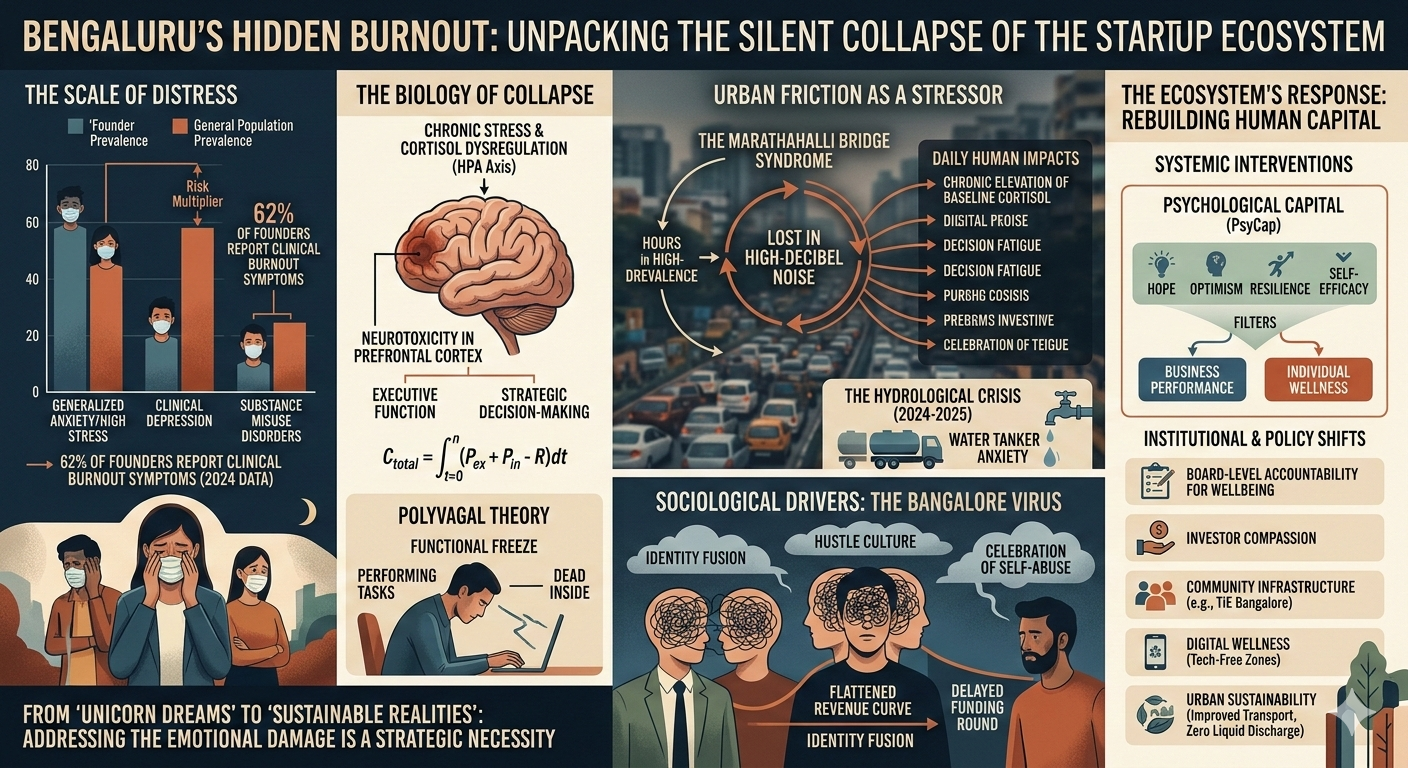
The "Marathahalli Bridge Syndrome" has become a pervasive metaphor for the city’s notorious traffic congestion. Commuters often spend more time stuck in traffic snarls than in their own homes, leading to a state of constant autonomic arousal. The 6 PM auto crisis and the banning of bike taxis like Rapido—once considered a "shortcut to freedom"—have added layers of unpredictability to daily life, forcing residents into a state of "psychological warfare" with their own environment.
Infrastructure Factor | Daily Human Impact | Systemic Consequence |
Traffic Congestion | 2-4 hours lost daily in high-decibel noise | Chronic elevation of baseline cortisol |
Public Transport Gaps | 10-minute metro gaps; lack of last-mile | Decision fatigue prior to office arrival |
Commute Post-6 PM | Extreme rejection from transport providers | Psychological detachment and isolation |
Urban Density | Overcrowding in newer tech corridors | Reduced restorative "down time" |
These environmental stressors deplete the "working memory" and "self-regulation" reserves that founders need for complex leadership. When a founder is subjected to two hours of Marathahalli traffic, their capacity for empathy and nuanced decision-making in the first meeting of the day is significantly diminished.
The Hydrological Crisis and Operational Anxiety (2024-2025)
The water crisis of 2024 and 2025 introduced a new, existential dimension to founder burnout. As borewells ran dry across the city's growing outskirts, the dependency on water tankers shifted from a utility concern to a survivalist struggle. Founders and tech professionals living in areas like Whitefield and Bellandur reported spending upwards of ₹25,000 per month on water alone, with the uncertainty of supply creating a layer of domestic anxiety that directly competed with the focus required for business operations.
The ecological collapse of the city’s lake systems and the subsequent reliance on tankers with high Total Dissolved Solids (TDS) levels have also led to physical health issues, which in turn exacerbate mental fatigue. For many founders, the stress of managing a failing borewell was the "little thing" that finally triggered a complete psychological breakdown, as it represented a failure of the most basic level of Maslow’s hierarchy of needs.
The Investor-Founder Dynamic: Capital as a Stressor
The relationship between venture capital and founder mental health is often characterized by a profound misalignment of incentives. The "funding winter" of late 2023 and 2024, during which Indian startups raised just $8 billion—a six-year low—has fundamentally altered the psychological landscape of the ecosystem.
The Transition from Growth to Unit Economics
Founders who were recruited into a narrative of "growth at all costs" now find themselves under intense pressure to achieve profitability and optimize unit economics. This shift is not merely a business pivot; it is an identity crisis for many founders whose skillsets and passions were aligned with rapid scaling rather than operational efficiency. The "unicorn failure" rate, often triggered by unsustainable cash burn and overvaluation pressures, has led to a climate of fear and "founder splitting".
Investors, while increasingly aware of burnout, often lack the tools to support founders effectively. Some describe entrepreneurship as a "personality tax"—a demand for an unusual tolerance for uncertainty that many find unsustainable in the long term. The pressure to deliver on robust growth projections made during the buoyant market of 2021 has left many founders trapped in a cycle of "faking energy," which leads to catastrophic burnout when the gap between projections and reality becomes insurmountable.
Disparity and the Intern Culture
A notable undercurrent of the ecosystem’s burnout is the internal disparity between the "hustle elite" and the "foot soldiers." A viral discourse in 2025 highlighted the stark economic divide, where a founder might earn ₹50 lakh a month while an intern managing critical infrastructure earns a ₹15,000 stipend. This "modern startup karma" creates a culture of resentment and exploitation that adds to the general exhaustion of the city's tech workforce. When interns are asked to handle 2 AM urgent fixes for a ₹500 Amazon voucher, it reflects a systemic devaluation of labor that mirrors the devaluation of the founder’s own wellbeing.
Demographic Variations and the Gendered Nature of Burnout
The experience of burnout in Bengaluru is mediated by gender and career stage. Data from YourDOST suggests a stark divide in how different segments of the founder population experience and cope with stress.
Demographic Segment | High Well-being (%) | Imposter Syndrome (%) | Primary Stressor |
Early-stage Founders | 57% | High (35%+) | Funding and Survival |
Seasoned (6+ years) | 74% | Low | Scaling and Legacy |
Female Founders | 68% | Moderate | Work-Life Integration |
Male Founders | 55% | Moderate | Societal Expectations/Stoicism |
Interestingly, women founders in Bengaluru report higher emotional wellbeing and work-life balance compared to men. This is partially attributed to women’s higher willingness to seek psychological support and their tendency to build stronger, more vulnerable community networks. Men, by contrast, are more likely to delay seeking help due to societal expectations of resilience, often leading to more severe physiological collapses before intervention occurs.
However, founders in the 30-to-50 age group face the unique pressure of the "sandwich generation"—balancing the care of aging parents and young children alongside the 14-hour days required by their startups. This domestic complexity acts as a significant multiplier of the burnout risk, as it reduces the available time for restorative sleep and hobbies.
The Economic Consequences of Psychological Erosion
The burnout crisis is not merely a personal tragedy for individual founders; it is a significant macroeconomic risk for India. The McKinsey Health Institute estimates that improving employee health and wellbeing could unlock a $350 billion annual economic opportunity in India. Conversely, poor mental health conditions are projected to cost the Indian economy approximately $1.03 trillion between 2012 and 2030 due to productivity loss, chronic illness, and high attrition rates.
Within the startup ecosystem specifically, founder burnout is a leading contributor to venture failure, accounting for nearly one-third of all startup collapses. When a founder’s decision-making ability is compromised by "brain fog" and "emotional numbness," they are more likely to engage in risky financial behavior, mismanage teams, and miss critical market pivots. The result is a loss of venture capital, job destruction, and a dampening of the innovation pipeline.
Systemic Interventions: Rebuilding the Ecosystem
The mitigation of burnout in Bengaluru requires a shift from individualistic "self-care" to systemic "regenerative leadership." The current reliance on caffeine and "nap blocks" in calendars is a superficial response to a deep-seated structural issue.
Psychological Capital as a Mediator
Research into Psychological Capital (PsyCap)—consisting of hope, optimism, resilience, and self-efficacy—offers a potential pathway for intervention. PsyCap acts as a mediator that buffers the negative effects of burnout on psychological wellbeing. Strengthening these resources through targeted psychological interventions and founder-specific peer groups has shown promise in enhancing both individual wellness and business performance.
Institutional and Policy Shifts
There is an urgent need for the institutionalization of mental health support within the venture capital framework. Strategies that have been proposed include:
Board-Level Accountability: Integrating mental health outcomes into organizational policies and assigning ownership at the leadership level.
Investor Compassion: Encouraging open dialogues between founders and investors to reduce the "masking" effect and build trust-based relationships.
Community Infrastructure: Strengthening peer-to-peer networks like TiE Bangalore, which provides a safe space for founders to normalize their struggles and reduce the isolation of the "top".
Digital Wellness and Decoupling: Addressing the "Bangalore Virus" by encouraging tech-free zones, setting firm boundaries around communication channels, and normalizing the ability to be "unreachable".
Urban Sustainability: Addressing the baseline stressors of the city through improved water management (Zero Liquid Discharge) and transport efficiency to reduce the "infrastructure tax" on the workforce.
Conclusion: The Path Toward Sustainable Innovation
The hidden burnout of Bengaluru founders is the "silent success killer" of the Indian startup story. The data indicates that the current model of building billion-dollar companies through the depletion of human biological resources is unsustainable. The "Bangalore Virus," fueled by identity fusion and urban friction, has created an environment where the cost of success is often a complete physiological and psychological collapse.
The future of the ecosystem depends on its ability to redefine success. This requires moving away from the glorification of "hustle" and toward a model of leadership that values regulation, resilience, and emotional intelligence as much as it values unit economics and market share. If the city that gave birth to India's unicorns is to continue its trajectory, it must first address the "emotional damage" of its most valuable asset: its people. The shift from "unicorn dreams" to "sustainable realities" is not just a moral imperative; it is a strategic necessity for the long-term survival of the Bengaluru dream.

Read More -
1. From Idea to MVP: A Step-by-Step Guide for Solo Founder
🔗 https://findnstart.com/blogs/from-idea-to-mvp-a-step-by-step-guide-for-solo-founder
2. How to Validate Your Startup Idea in 48 Hours for $0
🔗 https://findnstart.com/blogs/how-to-validate-your-startup-idea-in-48-hours-for-0
3. Remote vs. Local: Does Your Co-Founder Need to Live in the Same City?
🔗 https://findnstart.com/blogs/remote-vs-local-does-your-co-founder-need-to-live-in-the-same-city
4. The 2026 Startup Landscape: What Has Fundamentally Changed (and Why Founder Skills Matter More Than Ever)
5. The Most In-Demand Skills for Startup Founders in 2026
🔗 https://findnstart.com/blogs/the-most-in-demand-skills-for-startup-founders-in-2026
6. How to Find a Technical Co-Founder (Without a Six-Figure Salary)
🔗 https://findnstart.com/blogs/how-to-find-a-technical-co-founder-without-a-six-figure-salary
7. 5 Red Flags to Look for When Choosing a Startup Partner
🔗 https://findnstart.com/blogs/5-red-flags-to-look-for-when-choosing-a-startup-partner
8. How to Pitch Your Idea to Potential Co-Founders
🔗 https://findnstart.com/blogs/how-to-pitch-your-idea-to-potential-co-founders
9. How to Build a Portfolio that Attracts High-Growth Startup Founders
🔗 https://findnstart.com/blogs/how-to-build-a-portfolio-that-attracts-high-growth-startup-founders
10. Equity vs. Salary: How to Split Ownership with Your First Teammate
🔗 https://findnstart.com/blogs/equity-vs-salary-how-to-split-ownership-with-your-first-teammate
11. Why Joining an Early-Stage Startup is Better Than a Corporate Job
🔗 https://findnstart.com/blogs/why-joining-an-early-stage-startup-is-better-than-a-corporate-job
12. The Future of EdTech: Why Developers and Educators Need to Team Up Now
🔗 https://findnstart.com/blogs/the-future-of-edtech-why-developers-and-educators-need-to-team-up-now
13. The Architecture of Symbiosis: Analytical Perspectives on the Five Habits of Successful Startup Duos
14. Finding a Co-Founder in the AI Space: What Skills Should You Look For?
🔗 https://findnstart.com/blogs/finding-a-co-founder-in-the-ai-space-what-skills-should-you-look-for
15. Overcoming Analysis Paralysis and the Strategic Path to Execution
🔗 https://findnstart.com/blogs/overcoming-analysis-paralysis-and-the-strategic-path-to-execution
16. From College Project to Company: How to Find Your Student Co-Founder
🔗 https://findnstart.com/blogs/from-college-project-to-company-how-to-find-your-student-co-founder
17. How to Start a Startup While Working a Full-Time Job
🔗 https://findnstart.com/blogs/how-to-start-a-startup-while-working-a-full-time-job
18. How to Build a HealthTech Startup Without a Medical Degree
🔗 https://findnstart.com/blogs/how-to-build-a-healthtech-startup-without-a-medical-degree
19. The Solitary Architect: Executive Isolation in Entrepreneurship
20. The 2026 Guide to Launching a SaaS as a Solo Developer
21. What Sustainable Growth Actually Looks Like
🔗 https://findnstart.com/blogs/what-sustainable-growth-actually-looks-like
22. The Early Warning Signs Your Startup Is in Trouble
🔗 https://findnstart.com/blogs/the-early-warning-signs-your-startup-is-in-trouble
23. How to Grow Without Burning Out
🔗 https://findnstart.com/blogs/how-to-grow-without-burning-out
24. The Truth About “Runway” Most Founders Ignore
🔗 https://findnstart.com/blogs/the-truth-about-runway-most-founders-ignore
25. Revenue Solves More Problems Than Funding
🔗 https://findnstart.com/blogs/revenue-solves-more-problems-than-funding
26. What No One Tells You About Being a Solo Founder
🔗 https://findnstart.com/blogs/what-no-one-tells-you-about-being-a-solo-founder
27. Why Smart People Quit High-Paying Jobs to Build Startups (And Why Most Regret It)
28. Why Most Startup Advice on Twitter Is Dangerous
🔗 https://findnstart.com/blogs/why-most-startup-advice-on-twitter-is-dangerous
29. Decision Fatigue: The Silent Startup Killer
🔗 https://findnstart.com/blogs/decision-fatigue-the-silent-startup-killer
30. Fear vs Logic: How Founders Actually Make Decisions
🔗 https://findnstart.com/blogs/fear-vs-logic-how-founders-actually-make-decisions
31. How Overthinking Destroys Early Momentum
🔗 https://findnstart.com/blogs/how-overthinking-destroys-early-momentum
32. Ideas Don’t Scale. Systems Do.
🔗 https://findnstart.com/blogs/ideas-dont-scale-systems-do
33. The First Hire That Actually Matters
🔗 https://findnstart.com/blogs/the-first-hire-that-actually-matters
34. How the First 100 Users Decide Your Startup’s Fate
🔗 https://findnstart.com/blogs/how-the-first-100-users-decide-your-startups-fate
35. Why Your Startup Doesn’t Need Growth — It Needs Focus
🔗 https://findnstart.com/blogs/why-your-startup-doesnt-need-growthit-needs-focus
36. Why Most Startups Die Quietly
🔗 https://findnstart.com/blogs/why-most-startups-die-quietly
37. Lessons Learned Too Late by First-Time Founders
🔗 https://findnstart.com/blogs/lessons-learned-too-late-by-first-time-founders
38. The Myth of the “Overnight Success” Startup
🔗 https://findnstart.com/blogs/the-myth-of-the-overnight-success-startup
