Hackathons vs Real Startups: What Students Get Wrong
March 8, 2026 by Harshit Gupta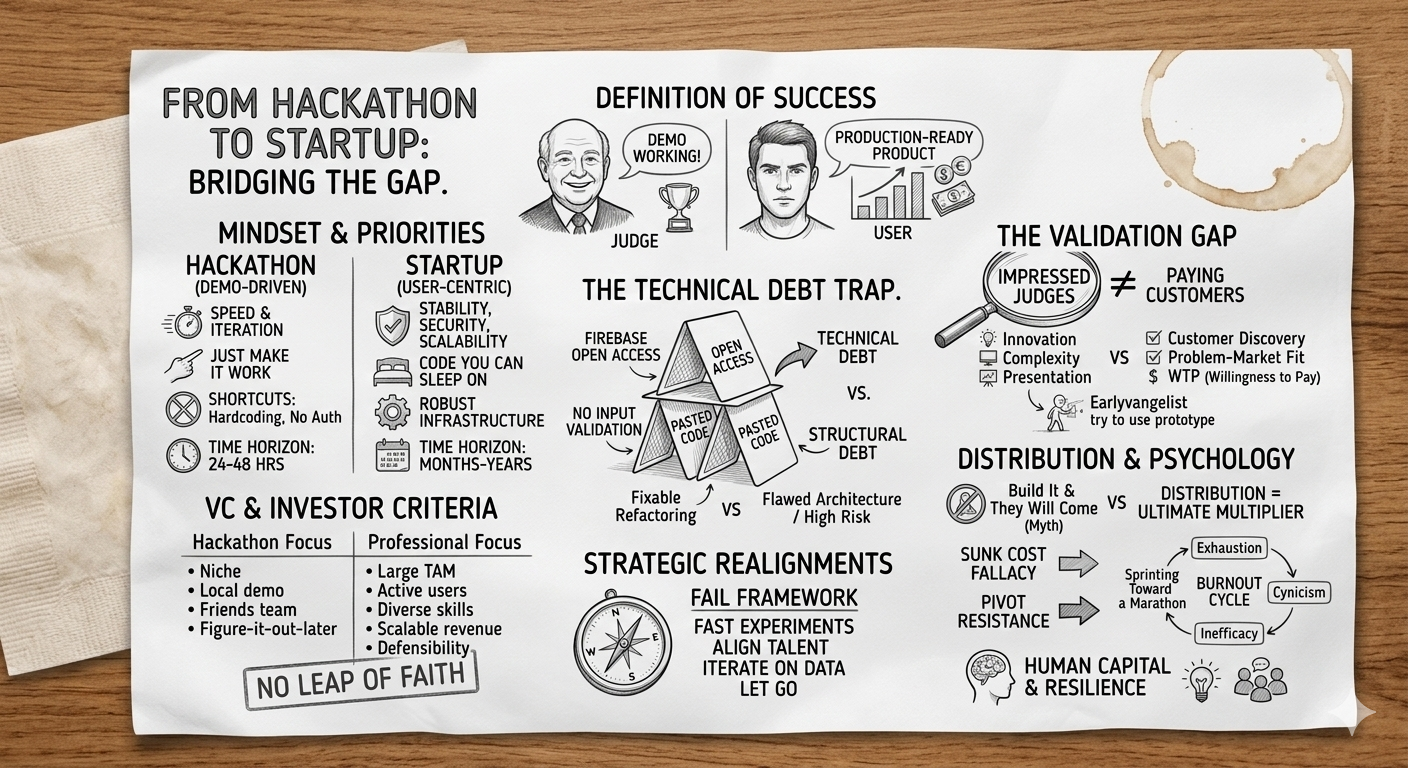
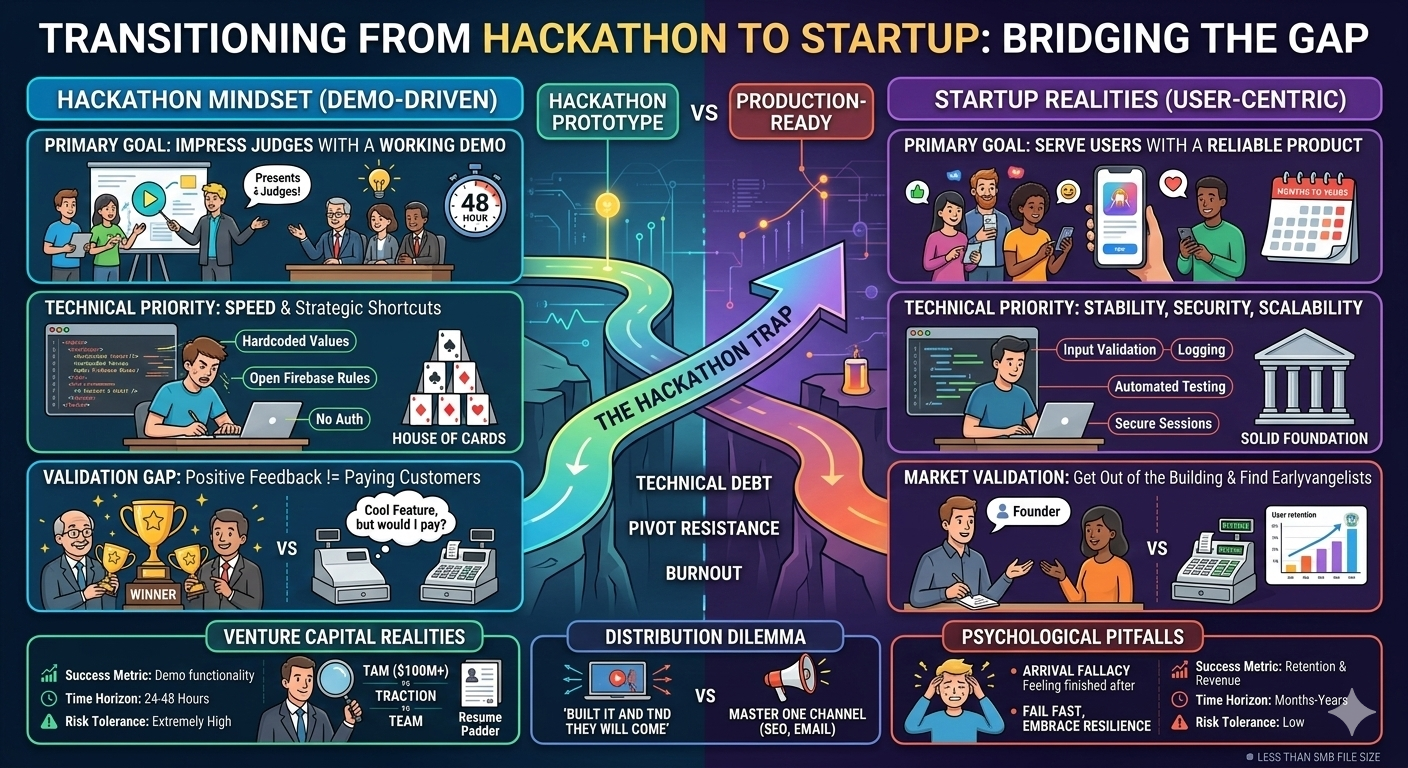
The transition from a competitive hackathon environment to the establishment of a viable startup represents one of the most significant cognitive and operational hurdles for student developers. While hackathons are frequently lauded as incubators for innovation, they foster a set of priorities, technical practices, and success metrics that are often diametrically opposed to the requirements of the real-world market. This discrepancy creates what is colloquially known as the hackathon trap—a phenomenon where the very skills that lead to a 48-hour victory become the primary inhibitors of long-term survival. The following report provides an exhaustive analysis of these disparities, examining the technical, psychological, and organizational dimensions that separate a "demo" from a "product."
The Paradox of the Prototype: Mindset Disparities in Development
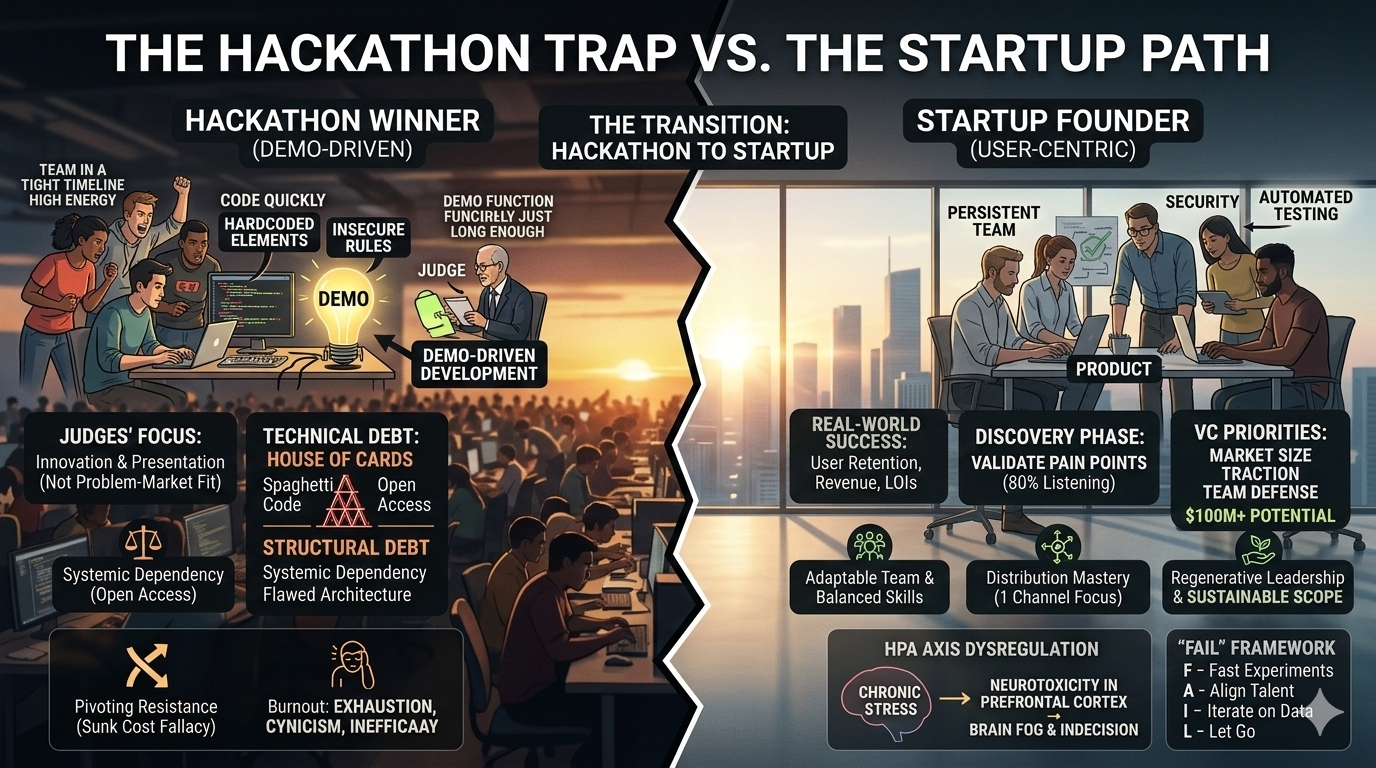
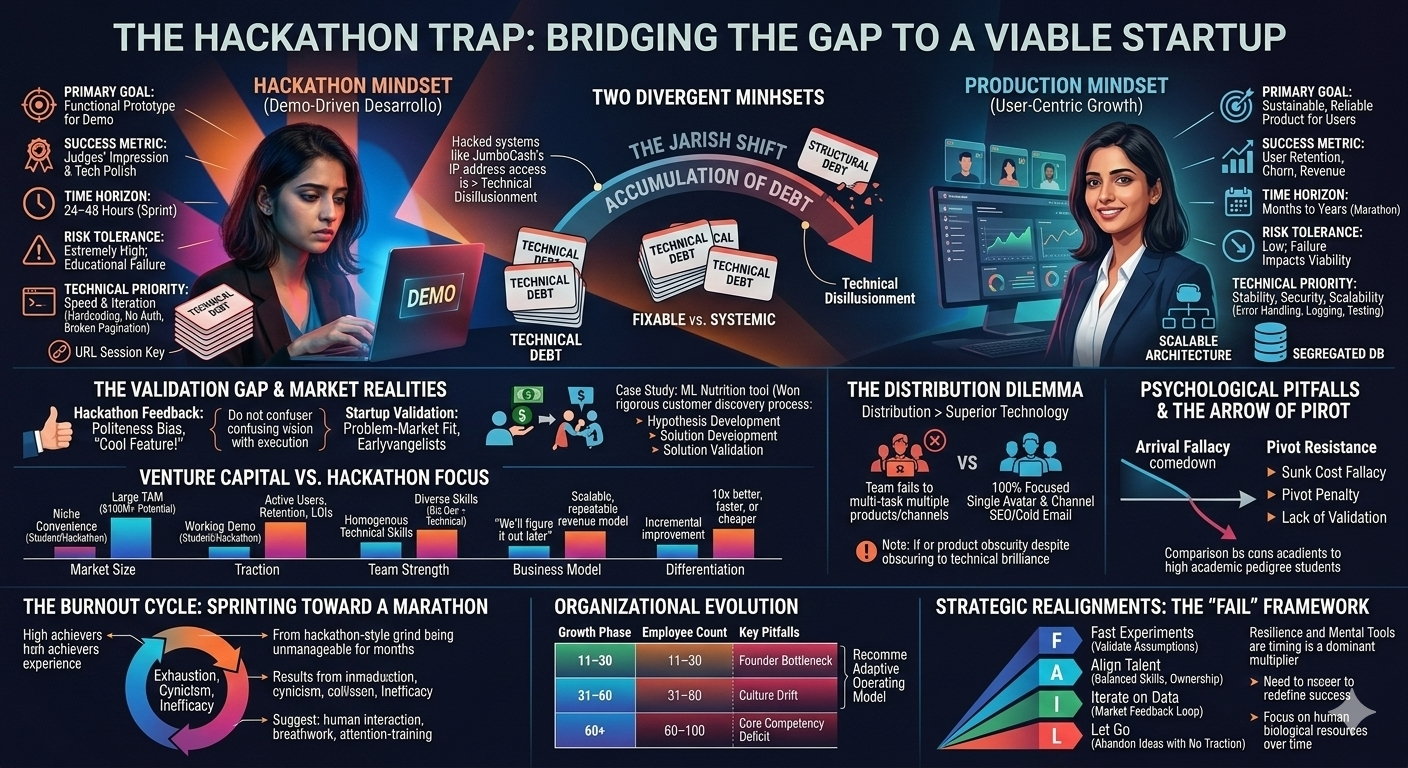
The fundamental difference between a hackathon project and a production-ready startup lies in the definition of success. In the compressed timeframe of a hackathon, typically spanning 24 to 48 hours, the objective is "Demo-Driven Development". The goal is to produce a functional illusion—a prototype that works just long enough for a three-minute walkthrough before a panel of judges. Speed is the absolute sovereign, leading to a "just make it work" philosophy that rewards strategic shortcuts, such as hardcoding values, bypassing authentication, and ignoring security protocols.
In contrast, the production mindset required for a startup prioritizes "Code You Can Sleep On". The objective shifts from impressing judges to serving real users who demand 24/7 reliability, data security, and seamless scalability. While a hackathon project thrives on high energy and low risk, a startup operates in an environment where failure has tangible consequences: angry customers, lost revenue, and late-night system failures.
Feature | Hackathon Mindset (Demo-Driven) | Production Mindset (User-Centric) |
Primary Goal | Functional prototype for demonstration | Sustainable, reliable product for users |
Success Metric | "Does the demo work for the judges?" | User retention, churn, and revenue |
Time Horizon | 24–48 hours | Months to years of maintenance |
Technical Priority | Speed and iteration | Stability, security, and scalability |
Risk Tolerance | Extremely high; failure is educational | Low; failure impacts business viability |
Target Audience | Judges and peers | Real-world customers and markets |
The technical architecture of a hackathon project is often a "house of cards". Developers frequently utilize Firebase rules that allow open access, skip input validation, and copy-paste unverified snippets from GitHub to save precious minutes. While these choices are rational within a 48-hour sprint, they accumulate massive technical debt that becomes a liability the moment the project moves toward production. The transition to the "real world" requires a jarring shift in focus, where the majority of development time is spent not on "cool" new features, but on the invisible infrastructure: error handling, logging, automated testing, and secure session management.
The Accumulation and Consequences of Technical Debt
Technical debt is the metaphorical cost of choosing an easy or quick solution today over a more robust approach that would take longer to implement. In the context of student founders, this debt is often incurred intentionally during a hackathon but becomes unmanageable thereafter. As the debt accrues interest—manifesting as increased rework, system instability, and reduced developer velocity—it can eventually lead to the collapse of the entire venture.
A critical insight for student founders is the distinction between technical debt and structural debt. Technical debt involves localized issues—spaghetti code, missing documentation, or hardcoded values—that can be refactored during slow development cycles. Structural debt, however, is systemic. It involves flawed architecture, such as a lack of clear boundaries between UI logic and database queries, which makes the system essentially unscalable.
Type of Debt | Manifestations | Impact on Iteration | Fixability |
Technical Debt | Spaghetti code, TODO comments, missing tests | Slows down development linearly | Manageable via refactoring and cleanup |
Structural Debt | Flawed architecture, systemic dependency issues | Breaks the ability to iterate; high risk | Requires expensive, risky system redesign |
Student projects are notorious for "hacking together" systems that ignore these distinctions. For instance, developers may use insecure session keys in URLs or incrementing integers for IDs, which creates significant security vulnerabilities and integration hurdles. When such projects attempt to transition to a startup model, the reality involves discovering that the entire foundation must be rebuilt to accommodate professional standards.
The Validation Gap: Why "Impressed Judges" Do Not Equal "Paying Customers"
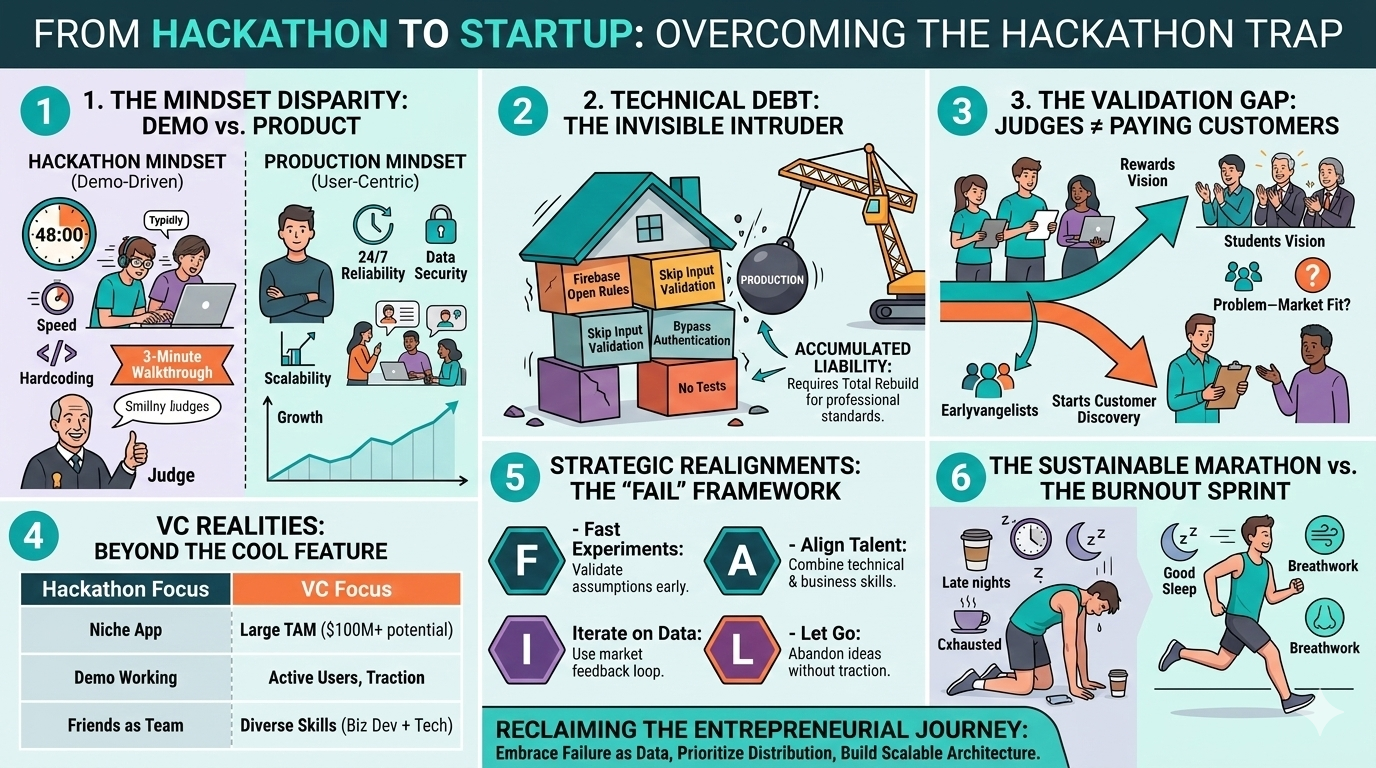
One of the most dangerous misconceptions held by student entrepreneurs is that winning a hackathon or receiving positive feedback on a demo constitutes market validation. In a hackathon, judges are looking for innovation, technical complexity, and presentation polish. They are rarely checking for problem-market fit or the willingness of a specific demographic to pay for the solution.
Real-world startup success is predicated on rigorous customer discovery—a process of validating assumptions about user problems before a single line of production code is written. This requires founders to "get out of the building" and conduct unbiased interviews with potential users. Student founders often fail this stage by asking leading questions (e.g., "Wouldn't you love a feature that...?") which elicit polite but unhelpful responses.
Discovery Phase | Objective | Key Activity |
Problem Identification | Validate that the pain point is "must-have" | Deep-dive research into market trends |
Hypothesis Development | Create testable assumptions about behavior | Framing specific "If/Then" scenarios |
Customer Interviewing | Gather first-hand insights without bias | Asking open-ended questions; 80% listening |
Solution Validation | Test if the proposed fix actually works | Running small experiments (landing pages, MVPs) |
The "politeness bias" is a particularly insidious trap for students. Friends and judges may offer encouraging words, but venture capitalists and professional analysts look for "Earlyvangelists"—customers who are so desperate for a solution that they are willing to pay for an unfinished prototype or run it in production despite bugs.
A notable example of the validation gap occurred during a 2014 hackathon where a winning team claimed to have built a tool using machine learning that could determine full nutritional content from a single photo—a feat that remains technically infeasible even a decade later. Despite the lack of functional code, the team won an accelerator grant based on their presentation. This illustrates a recurring theme: hackathons often reward the vision of a solution, whereas startups are judged on the execution of a viable one.
Venture Capital Realities: Moving Beyond the "Cool Feature"
Venture Capitalists (VCs) view hackathon wins as a "resume padder" or an indicator of hustle, but rarely as an investment-ready venture in their own right. VCs operate on a high-risk, high-reward model, seeking startups that address massive problems in multi-billion dollar markets. While a hackathon project might solve a niche convenience problem, an investment-ready startup must demonstrate a clear path to generating $100M+ in revenue.
Student pitches often focus on the "what" (the technology) while VCs care primarily about the "how much" (market size) and the "who" (the team). Investors prioritize active usage and retention over vanity metrics like download counts. They look for "defensibility"—a reason why a competitor cannot easily replicate the product.
Investor Criteria | Student/Hackathon Focus | VC/Professional Focus |
Market Size | Niche or "cool" application | Large TAM ($100M+ potential) |
Traction | Demo working on a local machine | Active users, retention, and LOIs |
Team Strength | Friends with similar technical skills | Diverse skills (Biz Dev + Technical) |
Business Model | "We'll figure it out later" | Scalable, repeatable revenue model |
Differentiation | Incremental improvement | 10x better, faster, or cheaper |
Rejection often stems from a startup being "too early"—not in terms of time, but in terms of customer validation. VCs are hesitant to take a "leap of faith" when a founder has not yet proven that anyone is willing to pay for the solution.
The Distribution Dilemma: The Myth of "Build It and They Will Come"
A pervasive fallacy among student founders is that superior technology automatically leads to market dominance. In reality, distribution is often more important than the product itself. With the rise of AI-assisted coding and the commoditization of software, building an MVP has never been easier; however, building awareness in a saturated market has never been harder.
Successful entrepreneurs often emphasize that reaching the first $1M in revenue requires mastering only one distribution channel—whether that be SEO, cold email, or targeted advertising. Students often "half-ass" multiple products or channels, diluting their energy and failing to compete with rivals who are 100% focused on a single avatar and channel.
The challenge of distribution is often what kills "high-quality" products built by skilled engineers who lack marketing acumen. A team without business sense cannot sell or pivot effectively, leading to a situation where the product dies in obscurity despite its technical brilliance.
Psychological Pitfalls: The Arrival Fallacy and Pivot Resistance
The psychological transition from hackathon winner to startup founder is fraught with cognitive biases. Chief among these is the "Arrival Fallacy"—the false belief that reaching a specific goal (like winning a hackathon or securing a first round of funding) will bring lasting happiness and that all subsequent problems will be solved. In reality, these milestones often lead to an intense "comedown" as the founder realizes they have merely reached the starting line of a much longer, more difficult race.
Ironically, students with high academic pedigree (e.g., 4.0 GPAs) often struggle most with the realities of entrepreneurship. Education systems train students to follow a syllabus and check boxes to succeed; entrepreneurship has no syllabus and requires a constant resilience to "getting punched in the face" daily. For these students, the concept of "failing fast" is anathema to everything they have been taught.
Pivoting—changing a startup's direction while staying grounded in what has been learned—is essential but incredibly difficult. Student founders often experience "pivot resistance" for several reasons:
Sunk Cost Fallacy: They have invested intense effort and emotional energy into a specific vision and are loath to abandon it.
The Pivot Penalty: Research indicates that the impact of new research or products declines the further a creator moves from their previous expertise. This creates a "penalty" that discourages founders from making necessary, drastic changes.
Lack of Validation: Many founders pivot to an adjacent idea without doing the foundational work of market research, merely moving from one misaligned idea to another.
The "solution team" (the developers) often feels the frustration of a failing product first, yet they are often the most resistant to pivoting because it means throwing out "brilliant" code.
The Burnout Cycle: Sprinting Toward a Marathon
Burnout is a chronic state of exhaustion, cynicism, and reduced efficacy resulting from unmanaged stress. The hackathon environment—characterized by little sleep, high caffeine intake, and intense pressure—is a perfect breeding ground for these symptoms. When students attempt to maintain this "sprint" pace for the months or years required to build a startup, they inevitably hit a breaking point.
Surveys indicate that a staggering 72% to 84% of high-achieving students report feeling burnt out or experiencing physical symptoms of stress, such as exhaustion and difficulty sleeping. This stress is often normalized as a prerequisite for success, but it leads to a gradual decline in motivation and engagement.
Dimension of Burnout | Student Experience | Impact on Startup |
Exhaustion | Chronic fatigue, sleep deprivation | Poor decision-making and reduced productivity |
Cynicism | Mental distance from the project | Loss of vision and team cohesion |
Inefficacy | Loss of confidence in impact | Inability to overcome technical or market hurdles |
To mitigate burnout, founders must transition from the "grind" mindset to one of intentional use of technology, prioritizing human interaction, and establishing a sustainable scope of service.

Organizational Evolution and the Scaling Trap
As a startup grows from a founding team of three to a structured organization, it faces predictable failure points. Failure often occurs not because of a lack of ideas, but because the founders fail to adapt their leadership and culture strategies.
Growth Phase | Employee Count | Key Pitfalls |
Growth-Stage | 11–30 | "Founder Bottleneck" (founders managing everything); loss of alignment |
Scaling-Stage | 31–60 | First-time manager struggles; emergence of team silos; culture drift |
Expansion-Stage | 60+ | Innovation stalls; bureaucracy increases; founder disengagement |
Student founders frequently fall into the "Founder Bottleneck," where they continue trying to oversee every technical and business detail rather than hiring experienced leaders. This transition requires a shift from a "Predictive Operating Model" (planning for stable markets) to an "Adaptive Operating Model" (built on empiricism and rapid learning).
Startup failure is often the result of a "Core Competency Deficit". While students may have high initiative, they often lack the "information-seeking" and "stakeholder-related" competencies necessary for long-term survival. These gaps hinder their ability to identify market opportunities and navigate complex regulatory or legal environments.
Technical Reality After the Win: A Case Study in Disillusionment
The journey of the "JumboCash" wrap tool at Tufts University serves as a masterclass in the technical disillusionment that follows a hackathon. The team attempted to build a "Spotify Wrapped" style summary for student dining habits, only to find themselves entangled in the legacy software from the 1990s.
The developers discovered that the university's dining portal was accessible via a raw IP address, used session keys in URL parameters (ignoring cookies), and had a header hotlinked from a defunct student WordPress site. They were forced to:
Reverse-engineer a login process that required a specific, undocumented two-step "activation" GET request after a POST login.
Deal with LDAP inconsistencies where the portal used legal names while the public directory API used preferred names.
Bypass broken pagination in the student directory that prevented searching for common last names.
This experience is typical of the transition from a clean-room hackathon environment to the messy reality of production software. It highlights that real innovation often requires more than just "cool" features—it requires the grit to navigate and integrate with insecure, outdated, and poorly documented legacy infrastructure.
Strategic Realignments: Lessons for Student Founders
To bridge the gap between hackathons and startups, student founders must adopt several strategic realignments. The most critical is the shift from a technology-first approach to a market-first approach. This involves defining a customer profile, analyzing competitors, and understanding macroeconomic trends before developing a product.
Market readiness often outweighs product quality or funding levels in predicting success. Timing is a dominant multiplier; a high-quality product in a market that is not yet ready will fail just as surely as a poor product. Founders must run small, rapid tests to validate assumptions before committing major resources.
Furthermore, the team composition must evolve. Teams with balanced skills and complementary strengths consistently outperform those built around individual genius or a homogenous group of developers. Entrepreneurial success comes from consistent execution and long-term collaboration rather than a "perfect idea".
The "FAIL" framework provides a productive approach to turning setbacks into strategic progress:
F – Fast Experiments: Run small tests to validate assumptions.
A – Align Talent: Ensure the team has the necessary skills and is motivated by ownership.
I – Iterate on Data: Use market feedback as a feedback loop instead of a stopping point.
L – Let Go: Be willing to abandon ideas that do not have traction.
The Role of Resilience and Mental Tools in Sustaining Performance
In high-pressure environments, maintaining clarity and preventing burnout is essential. Modern founders use a combination of mental tools, such as breathwork, short attention-training practices, and intentional preparation before important decision points. Periodic breaks help create a healthy detachment from the project, which is necessary for long-term endurance.
Founders must also treat failure as data rather than as part of their identity. When failure is integrated into a learning cycle, companies evolve faster and teams strengthen. The ability to keep building despite setbacks and prioritize measurable performance over assumptions is what distinguishes successful post-failure entrepreneurs.
Final Synthesis: Reclaiming the Entrepreneurial Journey
The disparity between hackathons and real startups is not merely a matter of degree, but a fundamental difference in kind. Hackathons are optimized for creativity, education, and rapid prototyping; startups are optimized for stability, distribution, and financial sustainability. To bridge this gap, student founders must recognize several key truths.
First, a working demo is a technical accomplishment, not a business validation. True validation comes from paying customers who rely on the product to solve a critical pain point. Second, technical debt is a strategic tool in a sprint but a lethal poison in a marathon. Foundations built on "hacks" must be systematically refactored into production-ready architecture before scaling is attempted. Third, distribution is the ultimate multiplier. A mediocre product with excellent distribution will consistently outperform a brilliant product with none.
Finally, the psychological resilience required for entrepreneurship is the opposite of the academic compliance taught in universities. Founders must embrace failure as data, prioritize long-term mental health over short-term sprints, and maintain the humility to pivot when the market contradicts their vision. By understanding these divergent realities, students can leverage the energy of the hackathon to launch ventures that are not only innovative in their conception but resilient in their execution and sustainable in their growth.

Read More -
1. From Idea to MVP: A Step-by-Step Guide for Solo Founder
🔗 https://findnstart.com/blogs/from-idea-to-mvp-a-step-by-step-guide-for-solo-founder
2. How to Validate Your Startup Idea in 48 Hours for $0
🔗 https://findnstart.com/blogs/how-to-validate-your-startup-idea-in-48-hours-for-0
3. Remote vs. Local: Does Your Co-Founder Need to Live in the Same City?
🔗 https://findnstart.com/blogs/remote-vs-local-does-your-co-founder-need-to-live-in-the-same-city
4. The 2026 Startup Landscape: What Has Fundamentally Changed (and Why Founder Skills Matter More Than Ever)
5. The Most In-Demand Skills for Startup Founders in 2026
🔗 https://findnstart.com/blogs/the-most-in-demand-skills-for-startup-founders-in-2026
6. How to Find a Technical Co-Founder (Without a Six-Figure Salary)
🔗 https://findnstart.com/blogs/how-to-find-a-technical-co-founder-without-a-six-figure-salary
7. 5 Red Flags to Look for When Choosing a Startup Partner
🔗 https://findnstart.com/blogs/5-red-flags-to-look-for-when-choosing-a-startup-partner
8. How to Pitch Your Idea to Potential Co-Founders
🔗 https://findnstart.com/blogs/how-to-pitch-your-idea-to-potential-co-founders
9. How to Build a Portfolio that Attracts High-Growth Startup Founders
🔗 https://findnstart.com/blogs/how-to-build-a-portfolio-that-attracts-high-growth-startup-founders
10. Equity vs. Salary: How to Split Ownership with Your First Teammate
🔗 https://findnstart.com/blogs/equity-vs-salary-how-to-split-ownership-with-your-first-teammate
11. Why Joining an Early-Stage Startup is Better Than a Corporate Job
🔗 https://findnstart.com/blogs/why-joining-an-early-stage-startup-is-better-than-a-corporate-job
12. The Future of EdTech: Why Developers and Educators Need to Team Up Now
🔗 https://findnstart.com/blogs/the-future-of-edtech-why-developers-and-educators-need-to-team-up-now
13. The Architecture of Symbiosis: Analytical Perspectives on the Five Habits of Successful Startup Duos
14. Finding a Co-Founder in the AI Space: What Skills Should You Look For?
🔗 https://findnstart.com/blogs/finding-a-co-founder-in-the-ai-space-what-skills-should-you-look-for
15. Overcoming Analysis Paralysis and the Strategic Path to Execution
🔗 https://findnstart.com/blogs/overcoming-analysis-paralysis-and-the-strategic-path-to-execution
16. From College Project to Company: How to Find Your Student Co-Founder
🔗 https://findnstart.com/blogs/from-college-project-to-company-how-to-find-your-student-co-founder
17. How to Start a Startup While Working a Full-Time Job
🔗 https://findnstart.com/blogs/how-to-start-a-startup-while-working-a-full-time-job
18. How to Build a HealthTech Startup Without a Medical Degree
🔗 https://findnstart.com/blogs/how-to-build-a-healthtech-startup-without-a-medical-degree
19. The Solitary Architect: Executive Isolation in Entrepreneurship
20. The 2026 Guide to Launching a SaaS as a Solo Developer
21. What Sustainable Growth Actually Looks Like
🔗 https://findnstart.com/blogs/what-sustainable-growth-actually-looks-like
22. The Early Warning Signs Your Startup Is in Trouble
🔗 https://findnstart.com/blogs/the-early-warning-signs-your-startup-is-in-trouble
23. How to Grow Without Burning Out
🔗 https://findnstart.com/blogs/how-to-grow-without-burning-out
24. The Truth About “Runway” Most Founders Ignore
🔗 https://findnstart.com/blogs/the-truth-about-runway-most-founders-ignore
25. Revenue Solves More Problems Than Funding
🔗 https://findnstart.com/blogs/revenue-solves-more-problems-than-funding
26. What No One Tells You About Being a Solo Founder
🔗 https://findnstart.com/blogs/what-no-one-tells-you-about-being-a-solo-founder
27. Why Smart People Quit High-Paying Jobs to Build Startups (And Why Most Regret It)
28. Why Most Startup Advice on Twitter Is Dangerous
🔗 https://findnstart.com/blogs/why-most-startup-advice-on-twitter-is-dangerous
29. Decision Fatigue: The Silent Startup Killer
🔗 https://findnstart.com/blogs/decision-fatigue-the-silent-startup-killer
30. Fear vs Logic: How Founders Actually Make Decisions
🔗 https://findnstart.com/blogs/fear-vs-logic-how-founders-actually-make-decisions
31. How Overthinking Destroys Early Momentum
🔗 https://findnstart.com/blogs/how-overthinking-destroys-early-momentum
32. Ideas Don’t Scale. Systems Do.
🔗 https://findnstart.com/blogs/ideas-dont-scale-systems-do
33. The First Hire That Actually Matters
🔗 https://findnstart.com/blogs/the-first-hire-that-actually-matters
34. How the First 100 Users Decide Your Startup’s Fate
🔗 https://findnstart.com/blogs/how-the-first-100-users-decide-your-startups-fate
35. Why Your Startup Doesn’t Need Growth — It Needs Focus
🔗 https://findnstart.com/blogs/why-your-startup-doesnt-need-growthit-needs-focus
36. Why Most Startups Die Quietly
🔗 https://findnstart.com/blogs/why-most-startups-die-quietly
37. Lessons Learned Too Late by First-Time Founders
🔗 https://findnstart.com/blogs/lessons-learned-too-late-by-first-time-founders
38. The Myth of the “Overnight Success” Startup
🔗 https://findnstart.com/blogs/the-myth-of-the-overnight-success-startup