Does Canada Produce Great Technology but Weak Commercialization?
March 13, 2026 by Harshit Gupta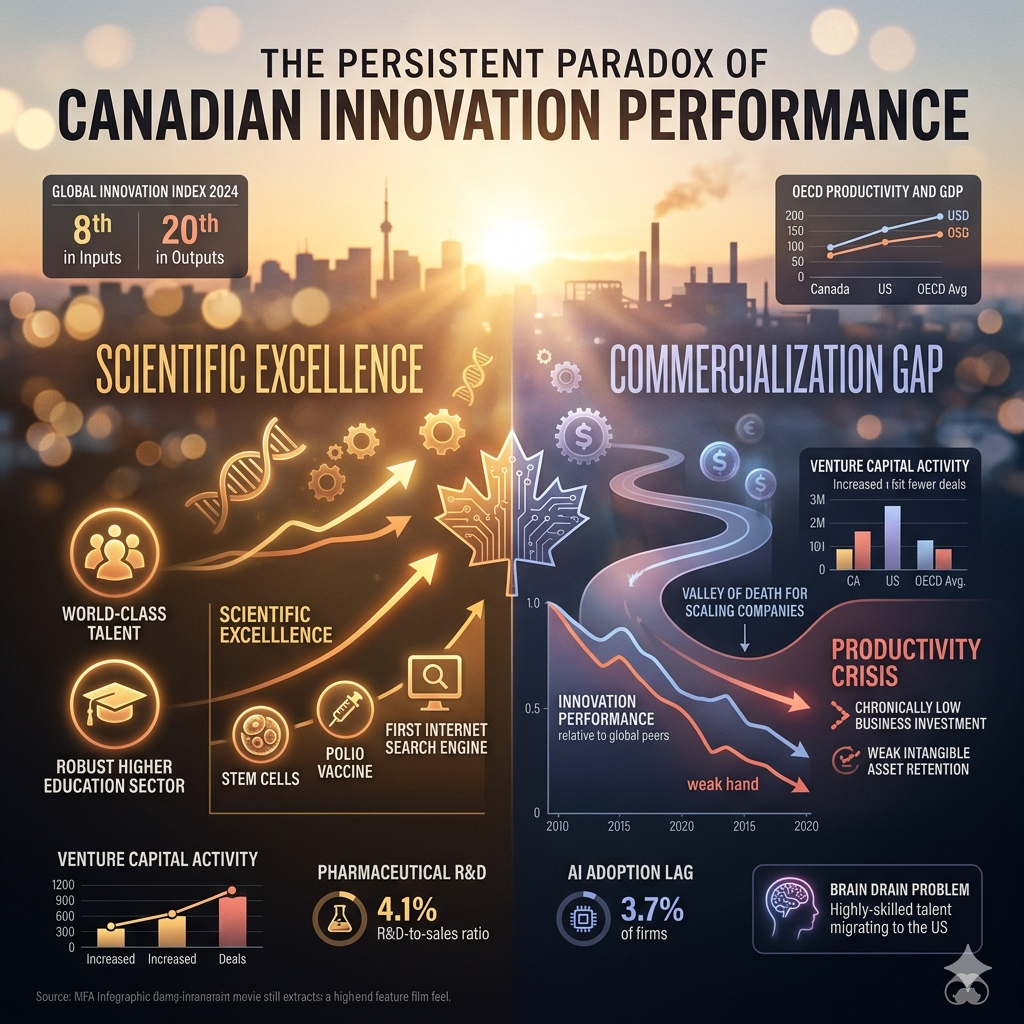
The Persistent Paradox of Canadian Innovation Performance
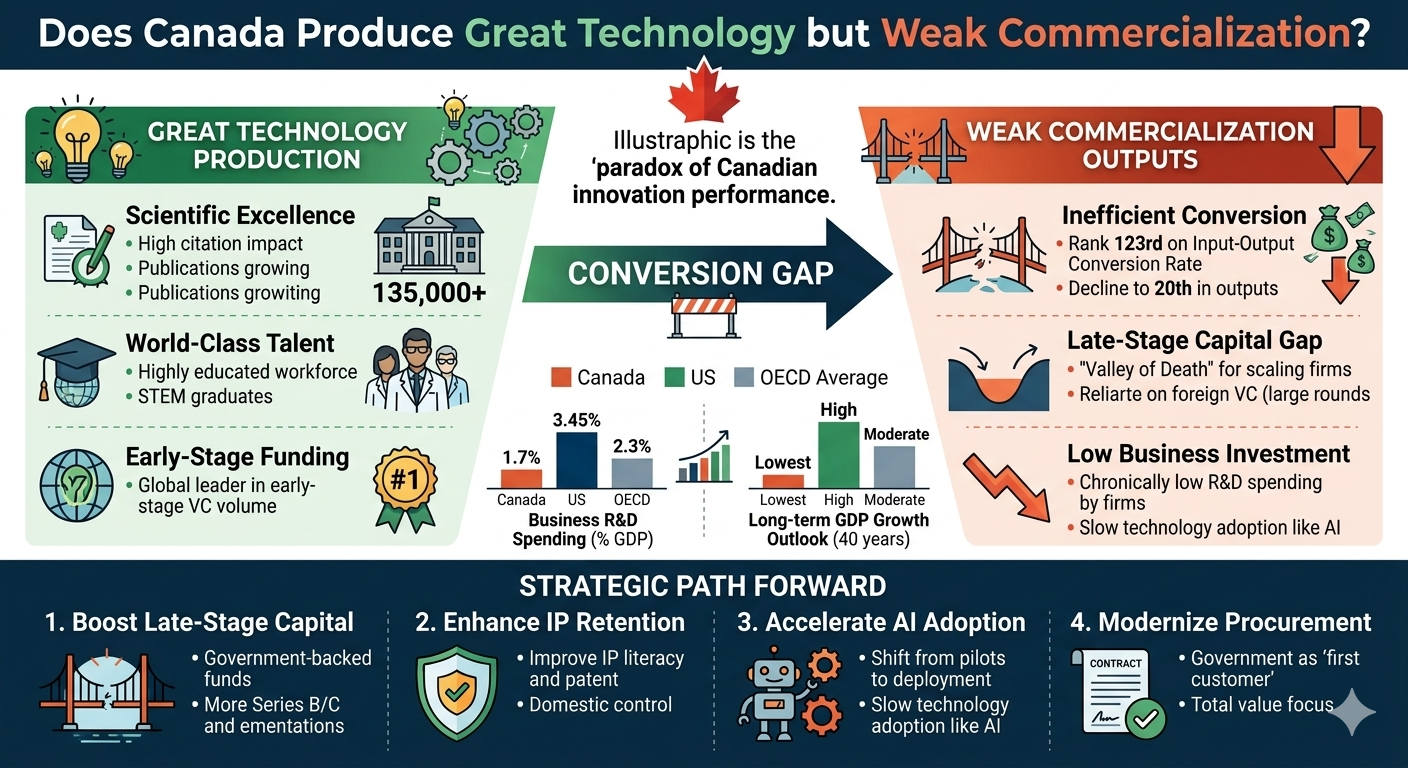
The Canadian economic landscape is currently defined by a profound and widening bifurcation between scientific discovery and commercial exploitation. Analysis of the national science, technology, and innovation (STI) ecosystem reveals a persistent innovation paradox where the nation excels in generating high-quality research and world-class talent but fails to translate these inputs into sustained economic growth, domestic intellectual property retention, or industrial scale-up. While Canada possesses a highly educated workforce and a robust higher education sector, its overall innovation performance continues to decline relative to global peers, threatening long-term prosperity and the national standard of living. This decline is not a recent phenomenon but a steady erosion that has left Canada facing a period of unprecedented global challenges with a "weak hand".
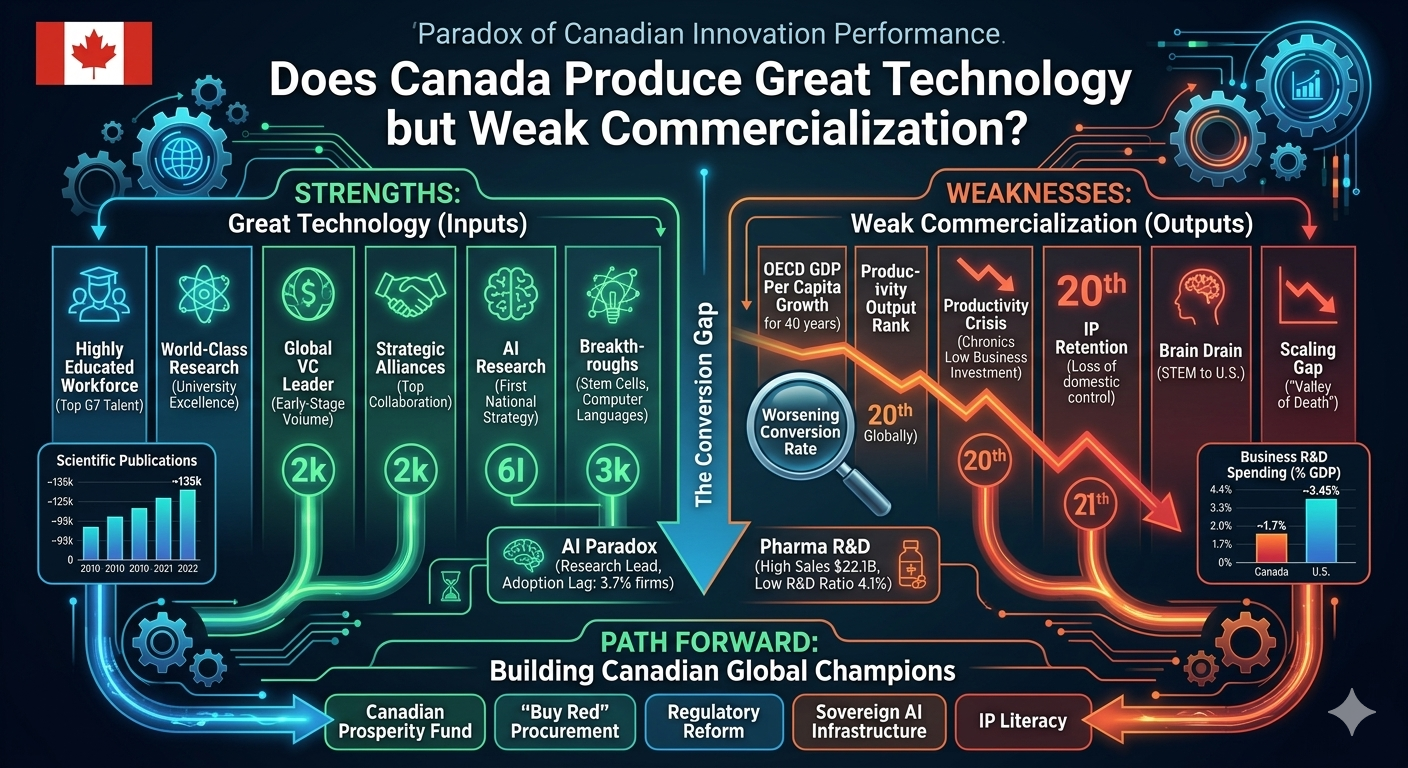
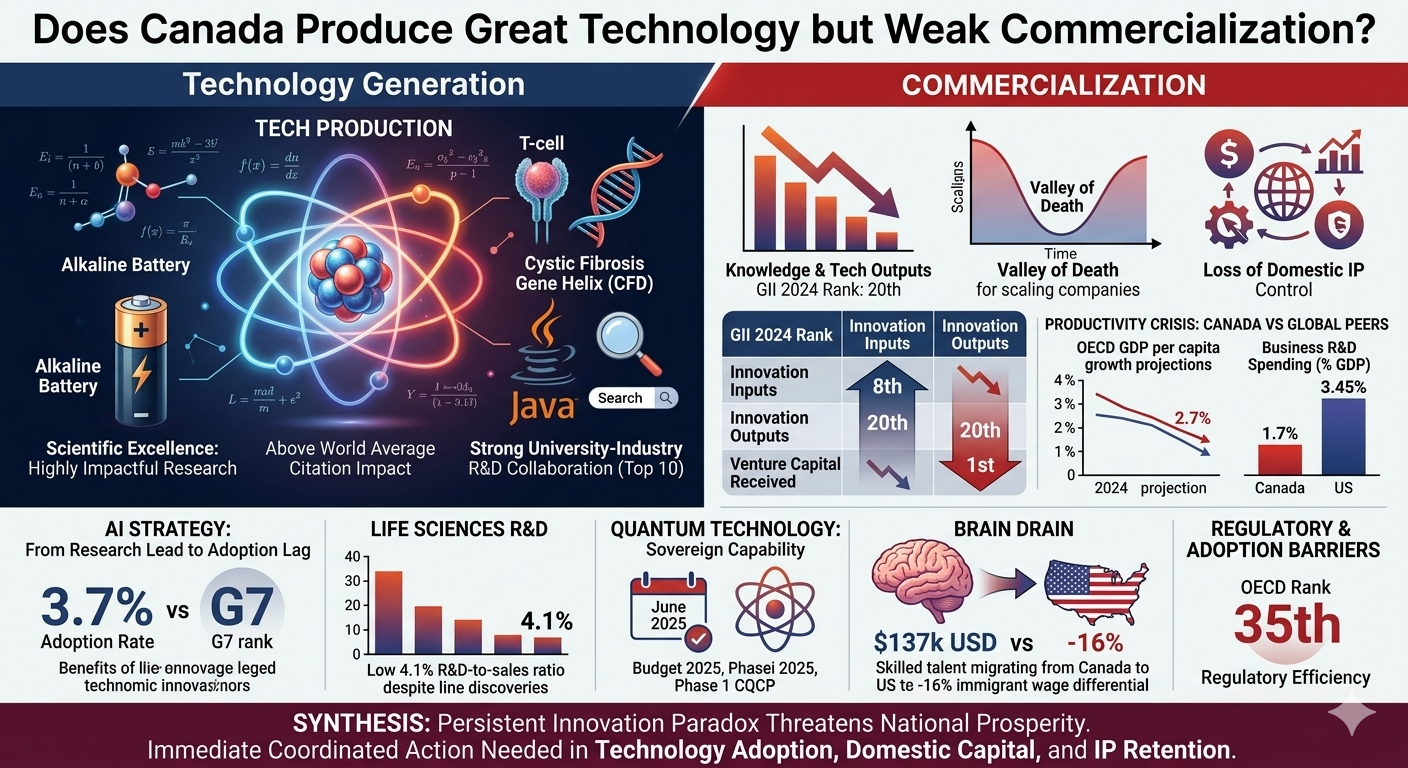
The Global Innovation Index (GII) 2024 highlights this discrepancy, ranking Canada 8th globally in innovation inputs—encompassing factors such as human capital, research infrastructure, and market sophistication—while it falls to 20th in innovation outputs, reflecting a significant inefficiency in converting investments into tangible economic results. This "conversion gap" is further evidenced by Canada’s ranking of 123rd globally on the World Intellectual Property Organization’s Input-Output Conversion Rate. The implications of this performance are severe, with the Organisation for Economic Co-operation and Development (OECD) predicting that Canada will be the worst-performing advanced member country over the next four decades in terms of real GDP per capita growth. This trajectory is largely attributed to a productivity crisis driven by chronically low business investment in technology and R&D.
Metric | Canada Rank (GII 2024) | Contextual Performance |
Overall Innovation Index | 14th | Highest rank since 2014 |
Innovation Inputs | 8th | Strength in human capital and research |
Innovation Outputs | 20th | Weakness in knowledge and tech outputs |
Venture Capital Received | 1st | Global leader in early-stage VC volume |
Strategic Alliances | 1st | High levels of organizational collaboration |
University-Industry R&D Collaboration | Top 10 | Strong academic-private links |
Knowledge and Tech Outputs | 20th | Underperformance in commercialization |
Creative Outputs | 25th | Lowest ranking pillar for Canada |
The Council of Canadian Academies (CCA) 2025 assessment brings together data from across the STI landscape to paint a consistent picture: notwithstanding real strengths in science and an impressive history of technology development, Canada remains an innovation laggard. The worsening productivity crisis, a fraught relationship with major trading partners, and lagging technology adoption across the economy make reversing this weak performance more urgent than ever. The loss of domestic control over intellectual property and the emigration of skilled talent to more competitive markets, primarily the United States, further exacerbate these structural issues.
Macroeconomic Drivers and the Productivity Crisis
The underlying cause of Canada’s declining standard of living is its persistent productivity gap compared to other high-income countries, notably the United States. While Canada’s labor productivity level remains close to the OECD average, it trails behind several comparable high-income nations. Between 2000 and 2023, Canada’s productivity growth lagged behind the OECD average and top-performing advanced economies. This crisis is underpinned by chronically low business investment, which prevents firms from adopting the new technologies—such as artificial intelligence and automation—required to remain competitive.
The 2024 Innovation Report Card from The Conference Board of Canada assigned the nation a "C" grade, ranking it 15th among 20 peer countries. Of the 21 innovation indicators examined, Canada scored below average on 14. This lack of commercial success and innovation-based economic growth is increasingly visible to the global community. The OECD’s prediction that Canada will be the worst-performing advanced member country over the next 40 years serves as a wake-up call for policy-makers and business leaders alike. The potential for further declines in the standard of living and social solidarity is high without ambitious and coordinated action.
OECD Productivity and GDP Comparisons (2024-2025) | Canada | US | OECD Average |
Labor Productivity Level | Near Average | High | Average |
GDP Per Capita Growth Trend | Weak | Strong | Stable |
Long-term Growth Outlook (40 years) | Lowest | High | Moderate |
Business R&D Spending (% GDP) | ~1.7% | ~3.45% | ~2.3% |
Evidence suggests that the failure to innovate is directly linked to an economy that consistently underuses and undervalues the capacity of its talented, well-educated population. While Canada’s longstanding economic dependence on abundant natural resources has some effect on innovation indices, the long-term solution lies in remedying the weakness in the private and public sectors' ability to adapt to new realities faster than their global competitors.
Scientific Excellence and the Higher Education Sector
Canada’s higher education sector remains a rare bright spot in the STI ecosystem. Canadian universities continue to produce world-class talent and research, with high levels of international collaboration and impact. The country consistently performs above the world average in citation impact, with scientific publication output increasing significantly from approximately 93,000 in 2010 to over 135,000 in 2022. This growth is particularly notable in health sciences, engineering, and social sciences.
However, this competitive edge is at risk. Canadian post-secondary institutions often struggle to support the transfer of technologies to new companies, and academic inventors frequently lack the incentives or support necessary to commercialize their work. The intellectual property that is the output of these institutions represents a key input to the innovation pipeline that is currently underutilized. Control over a large proportion of IP arising from post-secondary institutions is often lost to Canada before any attempt at value capture is made.
Research and Publication Metrics (2010-2025) | 2010 | 2022 | 2024 (Projected) | 2025 (Projected) |
Total Scientific Publications | 92,987 | 135,701 | 133,776 | 73,539* |
Citation Impact (World Average = 1.0) | >1.0 | >1.0 | >1.0 | >1.0 |
University-Industry Collaboration Rank | — | — | Top 10 | Top 10 |
*The projected decline for 2025 reflects deeper structural and funding challenges as government budget allocations for R&D have decreased from their 2020 peak.
Notable scientific developments in Canada include the creation of the modern alkaline battery, the polio vaccine, and discoveries about the interior structure of the atomic nucleus. Canada has a long history of discovery in genetics, including stem cells, the T-cell receptor, and the identification of genes causing cystic fibrosis and early-onset Alzheimer's disease. In the digital realm, Canadian ingenuity produced the internet’s first search engine (Archie) and the Java programming language. Despite these breakthroughs, the mechanisms to translate them into market-ready innovations remain underdeveloped.

The Commercialization Gap and the "Valley of Death"
The consensus across literature and practical analysis is that Canada faces a persistent "innovation gap" not from a lack of ideas, but from an inefficient process to commercialize them. This is particularly evident in the "valley of death" for scaling companies, where a shallow domestic capital pool for Series B and C funding causes many promising Canadian firms to be acquired by foreign entities or to move abroad. While startups excel at early R&D through public grants and angel funding, they struggle to raise the domestic funds required for expensive Phase III trials or building manufacturing capacity.
In the life sciences sector, this funding gap often leads to relocation to the United States to access venture funding or acquisition by larger foreign pharmaceutical companies. The same trend is observed in the semiconductor sector, where a lack of domestic investment sources and a less developed commercialization environment cause firms to gravitate toward the United States for funding and technological support.
Venture Capital Activity (2023-2024) | 2023 | 2024 | Change (%) |
Total Investment (CAD) | $7.1 Billion | $7.9 Billion | +11% |
Number of Deals | 688 | 592 | -14% |
Average Deal Size (CAD) | ~10.3 Million | ~13.3 Million | +29% |
Largest Deal (Clio Series F) | — | $1.2 Billion | — |
The 2024 data reveals that while total investment increased, the number of deals fell significantly, indicating a shift toward larger checks for a smaller number of later-stage firms. A single mega-transaction, such as Clio’s $1.2 billion round, can account for nearly half of a quarter’s total investment value, making average deal sizes irrelevant for the majority of the ecosystem. Deals under $25 million still made up 85% of the total deal count in 2025, but the minority investment average deal size dropped to its lowest on record.
Financial and Capital Architecture
Canada’s early-stage investment landscape is heavily influenced by the inherently risk-averse nature of its investors. Compared to their U.S. counterparts, Canadian investors often focus on minimizing risk, favoring safer, more predictable returns over high-reward opportunities. This conservative mindset limits the funding available for early-stage startups, which thrive on risk tolerance to support unproven business models. Macroeconomic conditions, including elevated interest rates and inflationary pressures, have further intensified this risk aversion.
The introduction of the 2024 capital gains tax hike became a flashpoint for the tech and investment communities. The proposal to raise the inclusion rate from 50% to 66.7% for capital gains over $250,000 for individuals (and all gains for corporations) was seen as discouraging high-risk investment behavior. By lowering overall investor returns, these changes could discourage investment in high-risk asset classes like venture capital, further entrenching risk-averse behavior.
Investment Sector Resilience (2025) | Average Deal Size (CAD) | Year-over-Year Change |
Life Sciences | $15.42 Million | +51% |
ICT | (Waning Appetite) | Decreasing Count |
Cleantech | $191M Total (24 deals) | Steady |
Pre-Seed/Seed | Lowest in years | Negative |
Canadian VCs have been cautioned against going into a "defensive shell" during recessionary periods, as downturns often create opportunities for those willing to invest in the next wave of high-growth businesses. Highly impactful companies like Shopify were launched in the wake of the dotcom bust, and others like Airbnb and Uber emerged during the 2007-2009 financial crisis. However, the growing importance of international investors since 2012—who accounted for 56% of total VC investments in Canada in 2019—leaves the ecosystem exposed to potential pullbacks.
The Role of Intellectual Property and Intangible Assets
As the value of the world's leading companies has shifted from tangible to intangible assets, Canada has made no significant changes to its strategy and has stagnated economically. Intellectual property rights are the mechanisms through which innovative ideas are commercialized and have become the primary currency of the international economic order. Canada’s inability to retain and translate IP into economic activity is a primary driver of its lagging performance in global innovation competitiveness.
A critical factor is the weak IP literacy among Canadian innovators and their inability to access affordable IP legal services and strategic advice at the earliest stages of their ventures. This results in non-existent or underdeveloped IP commercialization strategies that undermine global competitiveness. Furthermore, foreign owners are increasingly acquiring Canadian IP through mergers and acquisitions, leading to a "leakage" of valuable ideas from the domestic ecosystem.
IP Activity Indicators (2022-2023) | Applications/Registrations |
Patents (Foreign jurisdictions by Canadians) | 134,000+ |
Trademarks (CIPO from other countries) | 134,000+ |
Industrial Designs (CIPO) | High Volume |
Active NRC Patents | 1,807 |
NRC Patent Applications (2024-25) | 222 |
Research suggests that enhancing Canadians' use of IP rights both domestically and abroad is critical for success in an economy driven by intangible assets. The government supports the strategic use of IP through various initiatives, including the Global Innovation Clusters, which help businesses protect the assets they generate during collaborative projects. Nearly 75% of Phase 1 projects in these clusters resulted in the commercialization of foreground IP, and 98% of these projects were owned by companies operating in Canada.
Artificial Intelligence: From Research Lead to Adoption Lag
Canada has played a leading role in the development of AI, particularly in research and talent, but is losing ground in adoption and commercialization. Despite launching the world’s first national AI strategy in 2017, the country lacks large, innovative firms and faces barriers in scaling startups and retaining IP. By 2021, only 3.7% of Canadian firms had deployed AI in any capacity, trailing global leaders like Denmark.
The government has doubled down on its AI foundation, creating a dedicated Minister of Artificial Intelligence and Digital Innovation and launching an AI Strategy Task Force in late 2025 to shape the next phase of the national strategy. A 30-day national consultation in October 2025 received over 11,000 responses, emphasizing the need to shift from pilots to real-world deployment and ensuring Canadian ownership of AI-related IP.
AI Strategy Consultation Themes (2025) | Key Recommendations |
Research and Talent | Immigration support; competitive incentives |
Industry Adoption | Shift from pilots to productivity; workforce augmentation |
Commercialization | Canadian ownership of IP; investor tax credits |
Scaling | Access to domestic capital; sovereign wealth fund |
Infrastructure | Sovereign supercomputing; data access |
A 2024 Statistics Canada study confirmed that companies partnering with Mitacs on AI projects saw an 11% boost in productivity and a 9% growth in revenue. However, slow technology adoption remains a persistent barrier to national productivity. Canadian businesses are often cautious, with many unable to make a business case for AI or unaware of the tools available on the market. The risk right now for Canadian businesses is not moving too fast on AI, but falling behind global peers.
Quantum Technology and Technological Sovereignty
Quantum technology is understood as strategic infrastructure that will underpin economic competitiveness and national security for decades to come. Canada has anchored top quantum companies and talent at home through the Canadian Quantum Champions Program (CQCP), which forms part of a $334.3 million investment in Budget 2025. The initiative provides up to $92 million in initial funding to firms like Anyon Systems, Nord Quantique, Photonic, and Xanadu to accelerate the development of fault-tolerant quantum computers.
Xanadu, a leading photonic quantum computing company, has also entered negotiations for up to $390 million in support to advance quantum manufacturing capabilities in Canada. This project, known as Project OPTIMISM, aims to establish domestic capabilities for semiconductor and photonic manufacturing, addressing key gaps in the emerging quantum technology supply chain. By building this infrastructure domestically, Canada aims to translate its early leadership into scalable, sovereign capability.
Quantum Ecosystem Investments (2025) | Funding/Agreement |
Budget 2025 Total Quantum Investment | $334.3 Million |
Canadian Quantum Champions Program (Phase 1) | $92 Million |
Xanadu Support (Proposed) | $390 Million |
Individual Firm Agreements (Anyon, Photonic, etc.) | Up to $23M each |
Quantum technologies have critical applications in defense, medicine, and energy, making domestic technological sovereignty essential. The initiative also supports the forthcoming Defense Industrial Strategy, reflecting the growing role of quantum in cryptography and threat analysis. Establishing these capabilities locally helps prevent strategic talent and production from migrating abroad.
Life Sciences and Pharmaceutical R&D
Canada has a long history of breakthroughs in life sciences and biotechnology, with fundamental discoveries underpinning several global blockbuster drugs. The lipid nanoparticles that deliver mRNA vaccines were developed at the University of British Columbia, and the city is now home to visionary biotech companies like AbCellera and Aspect Biosystems. In 2021, the federal government unveiled a $2.2 billion Biomanufacturing and Life Sciences Strategy to strengthen domestic vaccine and therapeutics capacity.
Despite these strengths, Canada's overall R&D-to-sales ratio for pharmaceutical rights holders remains well below the average for peer countries. In 2024, rights holders reported $1.29 billion in total R&D expenditures, an increase of 21.1% over the previous year, yet the R&D-to-sales ratio was only 4.1%. Furthermore, 46% of reporting companies had no R&D expenditures at all in 2024.
Pharmaceutical Sales and R&D (2024) | Metric |
Sales of Patented Medicines (CAD) | $22.1 Billion |
R&D-to-Sales Ratio | 4.1% |
Total R&D Expenditures (CAD) | $1.29 Billion |
Growth in R&D Expenditures | +21.1% |
Companies Reporting Zero R&D | 46% |
Canadian list prices for patented medicines are among the highest in the OECD, ranking fifth highest among 31 countries in 2024. Sales were driven primarily by an increase in the use of new and higher-cost medicines, which accounted for 47% of all medicine sales in Canada. This high-cost environment, combined with relatively low domestic R&D investment, highlights the persistent challenge of retaining the economic value of life sciences innovations within the country.
Natural Resources, Cleantech, and Industrial Innovation
Canada’s economy remains dominated by traditional sectors such as natural resources and agriculture, but technology-driven industries are the key engines of innovation. In the mining sector, Canada has world-leading R&D in areas like automation, yet prototypes often stall at the pilot stage without industry uptake. The agriculture sector also faces a narrow policy lens that treats it as farming rather than a full value chain including value-added products.
Cleantech is a growing sector, with Canada well-positioned to seize opportunities in the global transition to sustainability. Canadian cleantech developers have proven their capacity for real-world innovation, but the country lags behind others in getting these ideas to market. Current regulations often create significant barriers because they are based on old standards and processes rather than being outcome-based and supportive of technological change.
Sectoral Innovation Characteristics | Strengths | Weaknesses |
Mining | World-leading automation R&D | Stalls at pilot stage; low industry uptake |
Agriculture | Enhanced growing performance (Yukon Gold) | Narrow policy lens; limited value-added |
Cleantech | Practical, results-driven innovation | Regulatory barriers; slow adoption |
Natural Resources | Abundant resource base | High dependence; sensitivity to trade |
The lack of stringent domestic environmental regulations can also hinder the adoption of new technologies. To compete globally, Canada needs an agile and high-performance regulatory system that enables innovation and de-risks compliance for first adopters. The proposed Canadian Innovation and Regulation Charter would aim to accelerate decision-making and strengthen investment certainty for innovators and their customers.
The Global Innovation Clusters Program
The five Global Innovation Clusters were established to strengthen connections between private, public, and academic organizations to drive impactful commercialization outcomes. These clusters—Digital Technology, Protein Industries, Advanced Manufacturing, Scale AI, and Ocean—aim to help Canadian SMEs scale up, access new markets, and drive growth. As of December 2025, the clusters had collectively engaged over 11,000 members and approved 676 projects involving 3,500 partners.
The program has had a total co-investment of over $3.39 billion to date, including more than $2.11 billion from industry and other partners. The clusters are estimated to have supported the creation of nearly 35,000 full-time equivalent jobs and are forecasted to produce up to $16 billion in GDP by 2034-2035.
Cluster Impact Metrics (As of Dec 31, 2025) | Metric Value |
Announced Projects | 676 |
Project Partners | 3,500 |
SME Partners | 1,805 |
Total Co-investment (CAD) | $3.39 Billion+ |
Federal Funding Contribution (CAD) | $1.28 Billion+ |
Industry Co-investment (CAD) | $2.11 Billion+ |
IP Licenses Granted to Third Parties | 6,000+ |
By helping businesses access new global markets and opportunities, the clusters are driving significant impacts in key industries. The program's success is evidenced by the fact that 42.8% of SME cluster project partners are high-growth firms, compared to a national baseline of only 6.8%. The clusters also facilitate connections with international organizations, further accelerating innovation and economic growth.
Human Capital and the Brain Drain Problem
Canada’s ability to compete on the global stage is directly linked to its talented and well-educated population, yet the country faces a significant brain drain problem. Highly skilled talent, particularly in the tech sector, frequently emigrates to the United States to access more competitive opportunities and higher pay. A recent Fraser Institute study revealed that university-educated immigrants in the U.S. earn more than their native-born counterparts, whereas in Canada, they make significantly less.
STEM professionals in the United States earn approximately 1.2% more than their native-born peers, while in Canada, highly educated immigrants make 16% less than native-born Canadians and are 9.5% more likely to be unemployed. Furthermore, a significant portion of recent immigrants with bachelor's degrees in Canada work in jobs requiring only a high-school diploma, suggesting a massive underutilization of available talent.
STEM Talent Retention and Wage Data (2024-2025) | Canada | United States |
Immigrant Wage Differential (vs Native) | -16% | +1.2% |
Immigrant Employment Differential (vs Native) | -9.5% | +8% |
STEM Graduate Tax-Filing Rate (3 years post-grad) | 89% | — |
Median Wage Offer for US Labor Cert (CAD) | — | ~$188,000* |
*Calculated from $137,000 USD median offer at an approximate 1.37 exchange rate.
While the gap in permanent migration flows between Canada and the United States has narrowed since 2018, the characteristics of those seeking U.S. employment remain a concern. Canadian citizens applying for U.S. labor certification are highly educated and concentrated in computer, mathematical, architecture, and engineering fields. Graduates from high-ranking Canadian universities have lower tax-filing rates than those from other institutions, indicating that the nation's top talent is the most likely to seek permanent residency in the U.S..

Regulatory and Institutional Barriers
Canada’s productivity is lagging its peers, and the complex, slow, and misaligned regulatory system is a significant deterrent to investment. The country ranks 35th of 38 in the OECD for regulatory efficiency, creating uncertainty for innovators and deterring the adoption of new technologies. This is particularly evident in sectors with fragmented regulation, such as healthcare, which is divided into a patchwork of 13 provincial and territorial systems.
This fragmentation creates a high-barrier market for suppliers, deterring innovative domestic companies and preventing the cost savings that come from large-scale purchasing. Furthermore, the public and private sectors in Canada often prioritize established vendors over new technologies from domestic companies, failing to use purchasing power as a "first customer" to catalyze commercialization.
Regulatory and Adoption Barriers | OECD Rank / Statistic |
Regulatory System Efficiency | 35th of 38 |
AI Adoption Rate (Firms) | 3.7% |
Fear of Technology Overspending | 78% of Firms |
Leadership Speed (Risk Aversion) | 63% Slower than Peers |
Healthcare System Fragmentation | 13 Jurisdictions |
Reviving Canada's productivity is critical as ongoing transformations, such as population aging and the green transition, threaten to compound the existing gap. Dispersed and relatively small domestic markets must be countered by ensuring regulatory barriers are as low as possible, including those restricting domestic trade and labor mobility.
Data Sovereignty and Cybersecurity Risks
As Canada expands its digital economy, data sovereignty and cybersecurity have become critical national priorities. The frequency of security breaches in Canada has increased, with 85% of companies affected by cybercriminals in 2021. The average cost of a data breach for Canadian companies is estimated at $5.4 million, prompting increased investment in security measures.
High-profile data breaches, such as those at LifeLabs and Desjardins, have compromised the personal information of millions of Canadians. The Desjardins breach, caused by an insider who leaked data over a 26-month period, highlighted systemic weaknesses in internal controls and user activity monitoring.
Major Canadian Data Breaches | Date | Impacted Records |
Canadian Tire Corporation | Oct 2025 | 42 Million |
LifeLabs | Oct 2019 | 15 Million |
Desjardins Group | June 2019 | 9.7 Million |
IKEA Canada | May 2022 | 100,000 |
Capital One (Canada/US) | 2019 | 100 Million |
Strong, secure, and trusted data supply chains are essential for the next phase of Canada's AI strategy. Researchers and firms cannot innovate without secure access to high-quality datasets, yet data-hosting organizations often hesitate to share information due to privacy concerns and potential liability. Establishing clear cost-benefit guidelines for data sharing is a foundational pillar that remains underdeveloped in the Canadian ecosystem.
International Cooperation and Strategic Alliances
In response to the shifting global trade environment and the potential for technological isolation, Canada has moved to deepen its international partnerships. Agreements with the United Kingdom and Germany aim to accelerate collaboration on AI, quantum technologies, and digital infrastructure. These alliances are designed to encourage the commercialization and adoption of technologies in strategic sectors and ensure Canada remains competitive as these fields reshape the global economy.
The Canada-Germany Digital Alliance and joint efforts with the UK on AI safety reflect a shared interest in building globally competitive digital industries. These partnerships also focus on secure communications and the development of transatlantic quantum networks.
International STI Agreements (2025-2026) | Partner Country | Focus Areas |
Renewed AI Strategy | United Kingdom | AI Safety; secure communications |
Digital Alliance | Germany | Quantum computing; large language models |
Joint R&D Call (Jan 2026) | Germany | Quantum sensing and computing |
G7 Industry/Digital Meeting | Multilateral | Digital sovereignty; ethical AI |
These efforts are part of a broader strategy to diversify markets and reinforce domestic capabilities, positioning Canadian industries to better withstand external economic pressures, including changes in U.S. trade policy. By aligning with like-minded nations, Canada seeks to establish globally recognized standards and best practices for responsible AI and quantum adoption.
The Future of STI in Canada: Challenges and Opportunities
The series of reports published on Canada’s innovation performance paint a picture of a country that excels in research but falls short when it comes to retaining the value of its innovations. Canada continues to fall further behind its peers in key measures of STI performance, which could ultimately threaten the country's economic prosperity and standard of living. Without ambitious and coordinated action to enhance technology adoption, increase access to domestic risk capital, and modernize regulatory frameworks, the ecosystem will likely continue to underperform.
The priorities for action have been signaled across multiple expert reviews for decades. What is urgently required is a shift from government policy adjustments alone to a priority for leaders in every social and economic sector. Canada's greatest resource—its diverse and talented population—must be empowered to create prosperity for future generations. The historical legacy of Canadian breakthroughs demonstrates the potential of the nation; the challenge remains in building a domestic economy that is as innovative as the researchers it produces.
Strategic Roadmaps and Path Forward
Addressing the innovation paradox requires a multi-faceted approach that targets capital, culture, and regulation. The evidence suggests that traditional means of investment are poorly suited to support deep tech in many sectors, necessitating novel mechanisms to bridge the pre-revenue phase. Risk-tolerant public funding focused on small businesses and spinouts from post-secondary institutions is essential to secure value for Canada.
Furthermore, the public sector can serve as a powerful catalyst by using its purchasing power to become a "first customer" for domestic technologies. Modernizing procurement to prioritize total value rather than upfront cost could help build domestic anchor companies and provide the bankable demand needed to reduce perceived risk. Combined with efforts to increase AI literacy and skills readiness, these interventions could help Canada turn the corner and lead in the emerging global knowledge economy.
Read More -
1. From Idea to MVP: A Step-by-Step Guide for Solo Founder
🔗 https://findnstart.com/blogs/from-idea-to-mvp-a-step-by-step-guide-for-solo-founder
2. How to Validate Your Startup Idea in 48 Hours for $0
🔗 https://findnstart.com/blogs/how-to-validate-your-startup-idea-in-48-hours-for-0
3. Remote vs. Local: Does Your Co-Founder Need to Live in the Same City?
🔗 https://findnstart.com/blogs/remote-vs-local-does-your-co-founder-need-to-live-in-the-same-city
4. The 2026 Startup Landscape: What Has Fundamentally Changed (and Why Founder Skills Matter More Than Ever)
5. The Most In-Demand Skills for Startup Founders in 2026
🔗 https://findnstart.com/blogs/the-most-in-demand-skills-for-startup-founders-in-2026
6. How to Find a Technical Co-Founder (Without a Six-Figure Salary)
🔗 https://findnstart.com/blogs/how-to-find-a-technical-co-founder-without-a-six-figure-salary
7. 5 Red Flags to Look for When Choosing a Startup Partner
🔗 https://findnstart.com/blogs/5-red-flags-to-look-for-when-choosing-a-startup-partner
8. How to Pitch Your Idea to Potential Co-Founders
🔗 https://findnstart.com/blogs/how-to-pitch-your-idea-to-potential-co-founders
9. How to Build a Portfolio that Attracts High-Growth Startup Founders
🔗 https://findnstart.com/blogs/how-to-build-a-portfolio-that-attracts-high-growth-startup-founders
10. Equity vs. Salary: How to Split Ownership with Your First Teammate
🔗 https://findnstart.com/blogs/equity-vs-salary-how-to-split-ownership-with-your-first-teammate
11. Why Joining an Early-Stage Startup is Better Than a Corporate Job
🔗 https://findnstart.com/blogs/why-joining-an-early-stage-startup-is-better-than-a-corporate-job
12. The Future of EdTech: Why Developers and Educators Need to Team Up Now
🔗 https://findnstart.com/blogs/the-future-of-edtech-why-developers-and-educators-need-to-team-up-now
13. The Architecture of Symbiosis: Analytical Perspectives on the Five Habits of Successful Startup Duos
14. Finding a Co-Founder in the AI Space: What Skills Should You Look For?
🔗 https://findnstart.com/blogs/finding-a-co-founder-in-the-ai-space-what-skills-should-you-look-for
15. Overcoming Analysis Paralysis and the Strategic Path to Execution
🔗 https://findnstart.com/blogs/overcoming-analysis-paralysis-and-the-strategic-path-to-execution
16. From College Project to Company: How to Find Your Student Co-Founder
🔗 https://findnstart.com/blogs/from-college-project-to-company-how-to-find-your-student-co-founder
17. How to Start a Startup While Working a Full-Time Job
🔗 https://findnstart.com/blogs/how-to-start-a-startup-while-working-a-full-time-job
18. How to Build a HealthTech Startup Without a Medical Degree
🔗 https://findnstart.com/blogs/how-to-build-a-healthtech-startup-without-a-medical-degree
19. The Solitary Architect: Executive Isolation in Entrepreneurship
20. The 2026 Guide to Launching a SaaS as a Solo Developer
21. What Sustainable Growth Actually Looks Like
🔗 https://findnstart.com/blogs/what-sustainable-growth-actually-looks-like
22. The Early Warning Signs Your Startup Is in Trouble
🔗 https://findnstart.com/blogs/the-early-warning-signs-your-startup-is-in-trouble
23. How to Grow Without Burning Out
🔗 https://findnstart.com/blogs/how-to-grow-without-burning-out
24. The Truth About “Runway” Most Founders Ignore
🔗 https://findnstart.com/blogs/the-truth-about-runway-most-founders-ignore
25. Revenue Solves More Problems Than Funding
🔗 https://findnstart.com/blogs/revenue-solves-more-problems-than-funding
26. What No One Tells You About Being a Solo Founder
🔗 https://findnstart.com/blogs/what-no-one-tells-you-about-being-a-solo-founder
27. Why Smart People Quit High-Paying Jobs to Build Startups (And Why Most Regret It)
28. Why Most Startup Advice on Twitter Is Dangerous
🔗 https://findnstart.com/blogs/why-most-startup-advice-on-twitter-is-dangerous
29. Decision Fatigue: The Silent Startup Killer
🔗 https://findnstart.com/blogs/decision-fatigue-the-silent-startup-killer
30. Fear vs Logic: How Founders Actually Make Decisions
🔗 https://findnstart.com/blogs/fear-vs-logic-how-founders-actually-make-decisions
31. How Overthinking Destroys Early Momentum
🔗 https://findnstart.com/blogs/how-overthinking-destroys-early-momentum
32. Ideas Don’t Scale. Systems Do.
🔗 https://findnstart.com/blogs/ideas-dont-scale-systems-do
33. The First Hire That Actually Matters
🔗 https://findnstart.com/blogs/the-first-hire-that-actually-matters
34. How the First 100 Users Decide Your Startup’s Fate
🔗 https://findnstart.com/blogs/how-the-first-100-users-decide-your-startups-fate
35. Why Your Startup Doesn’t Need Growth — It Needs Focus
🔗 https://findnstart.com/blogs/why-your-startup-doesnt-need-growthit-needs-focus
36. Why Most Startups Die Quietly
🔗 https://findnstart.com/blogs/why-most-startups-die-quietly
37. Lessons Learned Too Late by First-Time Founders
🔗 https://findnstart.com/blogs/lessons-learned-too-late-by-first-time-founders
38. The Myth of the “Overnight Success” Startup
🔗 https://findnstart.com/blogs/the-myth-of-the-overnight-success-startup