Digital Banking and Financial Inclusion Opportunities
March 10, 2026 by Harshit Gupta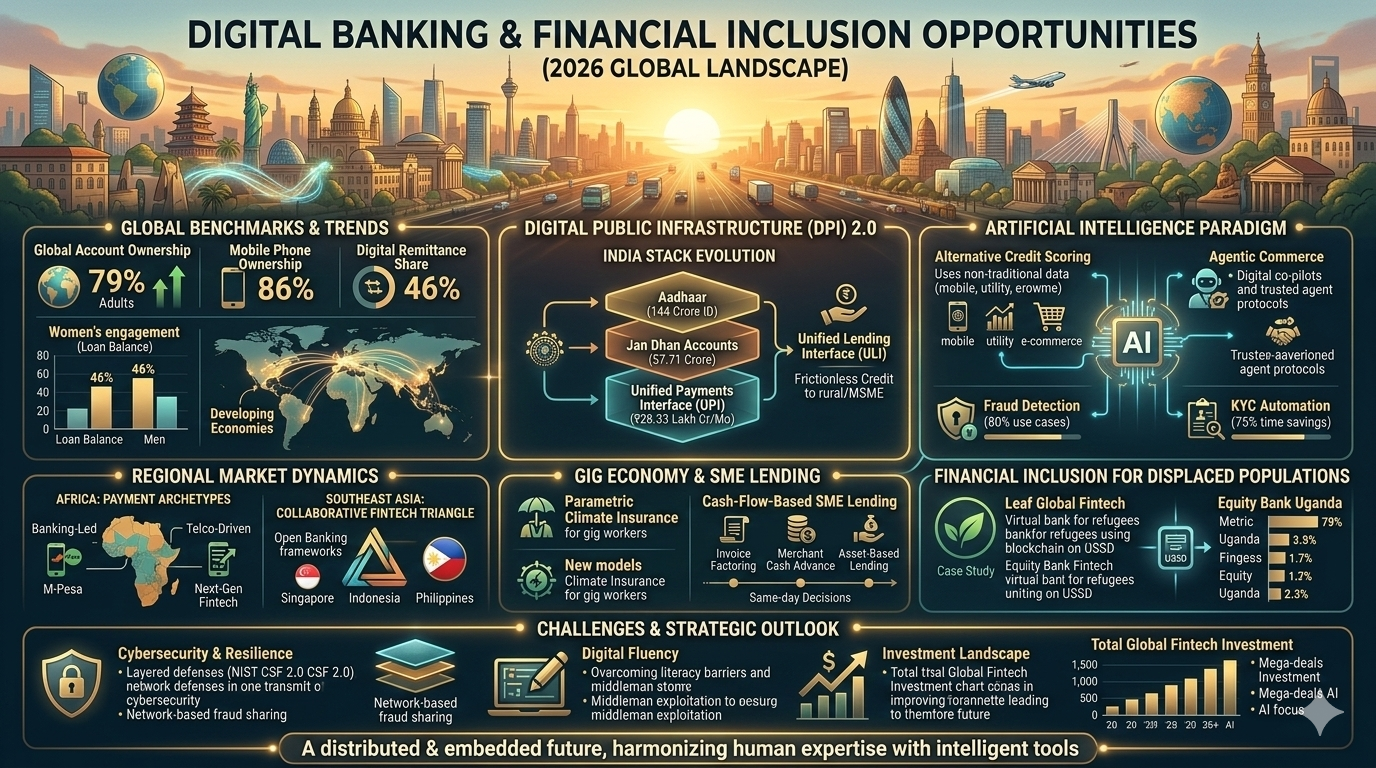
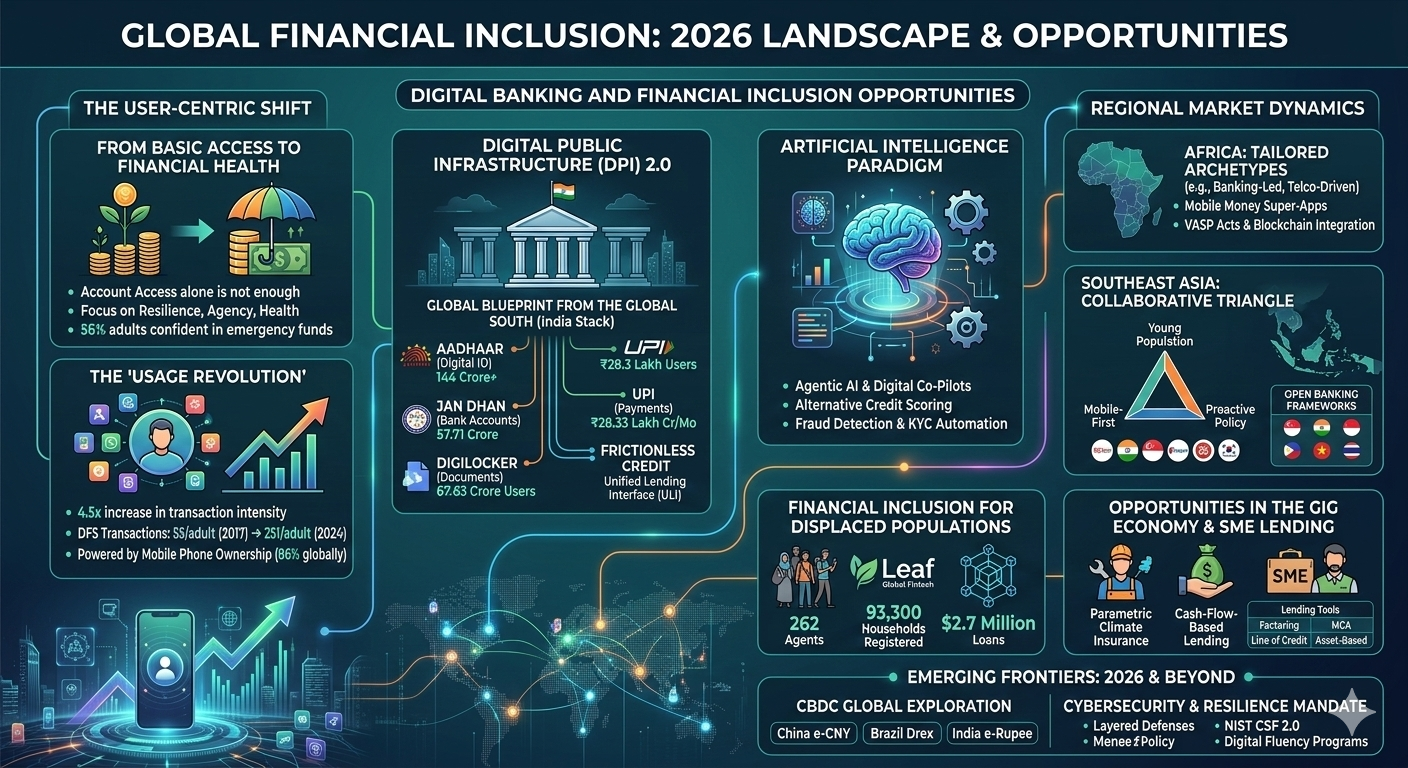
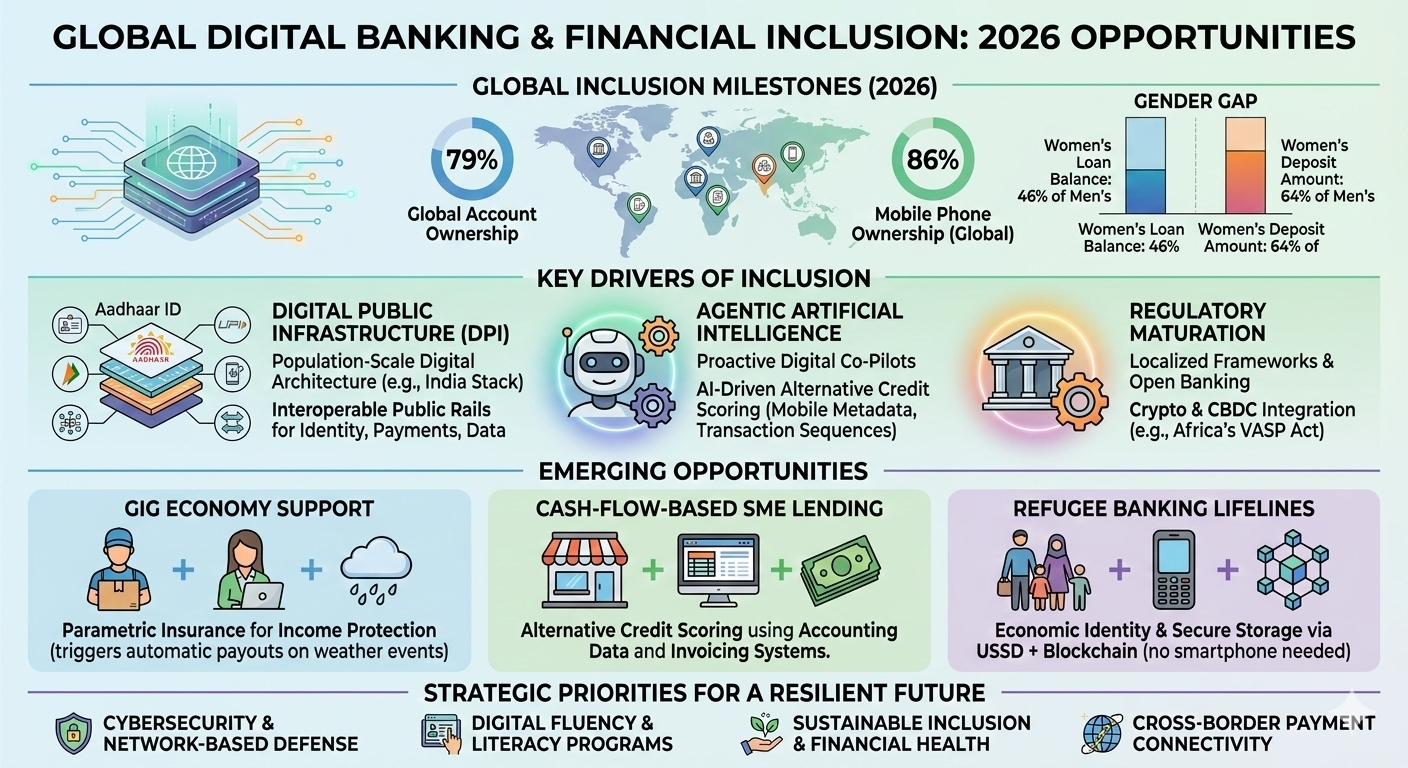
The landscape of global financial inclusion in 2026 is defined by a fundamental structural shift, moving away from the incremental objective of basic account access toward the sophisticated goal of fostering financial health, resilience, and meaningful economic agency. While the preceding decade focused on the "first mile" of bringing the unbanked into the formal system, the current era is characterized by a "usage revolution" powered by Digital Public Infrastructure (DPI), agentic artificial intelligence, and localized regulatory frameworks. This transition occurs amid a complex global environment where rising inclusion rates—now reaching 79% of the global adult population—clash with tightening donor resources and a fragmented geopolitical landscape. As traditional boundaries between telecommunications, banking, and technology continue to dissolve, the opportunities within digital banking have transitioned from providing simple transactional tools to delivering integrated, context-aware financial ecosystems.
The Global Financial Inclusion Benchmarks of 2026
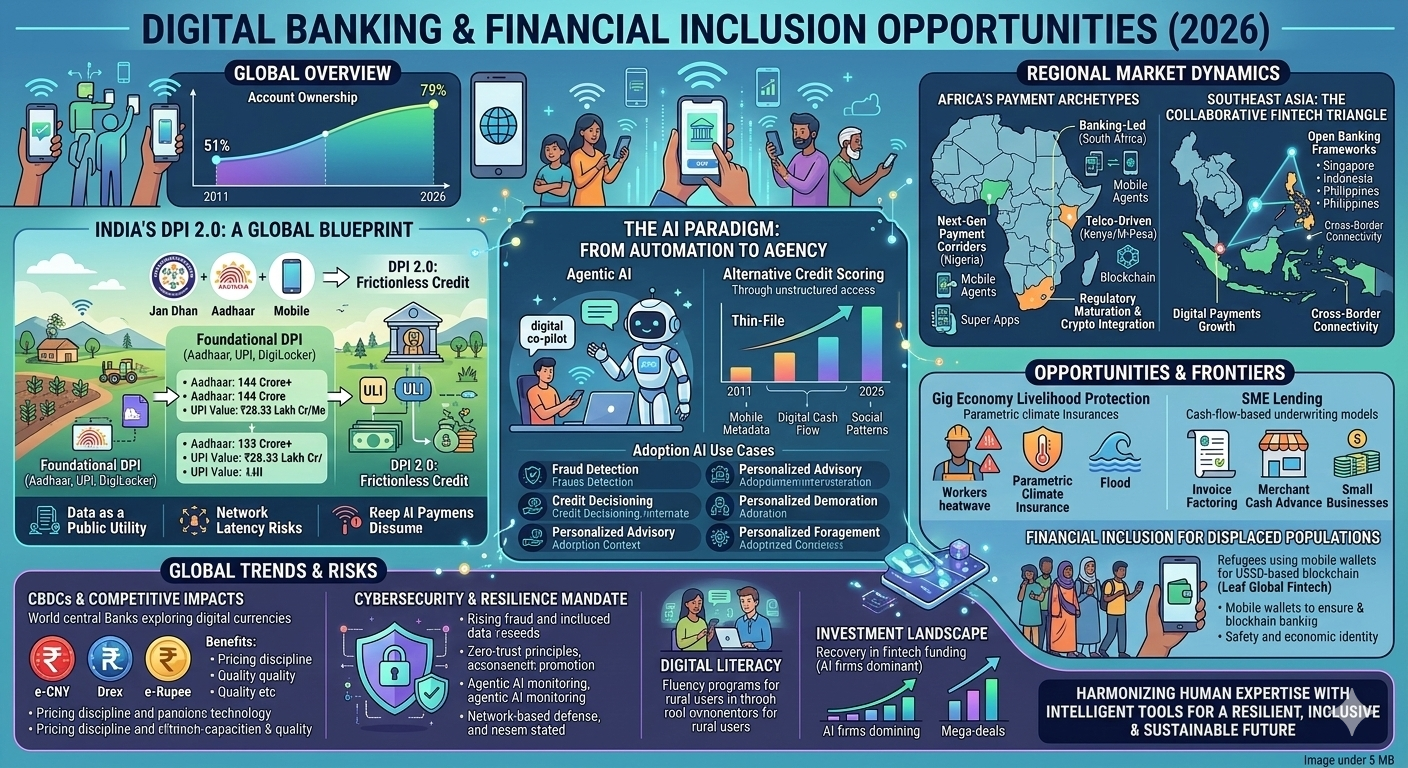
The definitive progress of the last fifteen years is reflected in the dramatic expansion of formal financial engagement. In 2011, the World Bank’s first Global Findex report revealed that only 51% of adults worldwide had access to formal financial services; by 2026, that figure has surged to 79%, representing billions of individuals who now possess the foundational tools to save, spend, and build security. This transformation is not merely statistical but reflects a qualitative shift in how digital connectivity facilitates economic participation.
Global Findex and IMF Financial Access Trends
Recent data indicates that the fastest rise in account ownership has occurred in developing economies, where 40% of adults saved in a financial account in 2024—a 16-percentage-point increase since 2021. This surge is underpinned by the pervasive ownership of mobile phones, with 86% of adults globally now owning a mobile device, creating an omnipresent platform for digital inclusion. However, the maturity of the sector has exposed deeper questions regarding whether the foundations for financial health and economic mobility are genuinely in place.
Indicator | 2011 Value | 2021 Value | 2026 Projected/Current | Trend Insight |
Global Account Ownership (% Adults) | 51% | 76% | 79% | Continued steady growth driven by LMICs |
Mobile Phone Ownership (Global) | N/A | 83% | 86% | Mobile as the primary gateway |
Digital Remittance Share | N/A | 13% (2019) | 46% | Massive cost reduction for migrants |
DFS Transactions per Adult (EMDEs) | N/A | 55 (2017) | 251 | 4.5x increase in usage intensity |
Women's Loan Balance vs Men's | N/A | N/A | 46% | Persistent gender usage gap |
The persistence of the gender gap remains a critical challenge. Globally, while more women have accounts, their outstanding deposit amounts are only 64% of those of men, and their loan balances are even lower at 46%. This discrepancy suggests that while access is becoming universal, the depth of engagement and the availability of credit products tailored for women-led enterprises and households remain insufficient. In emerging and developing economies, digital financial services (DFS) transactions have skyrocketed from 55 per adult in 2017 to 251 per adult by 2024, signaling that those who have access are using these tools with increasing frequency for their daily economic lives.
The Shift Toward Financial Health and Resilience
The sector’s future is being shaped less by incremental gains in access and more by its intersection with adjacent development agendas, such as climate resilience and healthcare. Financial health is now defined by a user's ability to reliably access extra money in an emergency—a metric where 56% of adults globally currently feel confident. As one in four adults in low- and middle-income countries (LMICs) has faced a natural disaster in the past three years, the role of digital banking in providing rapid, parametric relief and secure savings has become a primary policy objective.
Digital Public Infrastructure (DPI) 2.0: The Indian Model as a Global Blueprint
A fundamental catalyst for the current state of financial inclusion is the rise of Digital Public Infrastructure. India’s experience, moving from a large user of digital systems to a builder of population-scale digital architecture, has provided a roadmap for the Global South. The Indian approach distinguishes itself through scale, openness, and the integration of identity, payments, and data exchange through interoperable public rails.
The JAM Trinity and India Stack Evolution
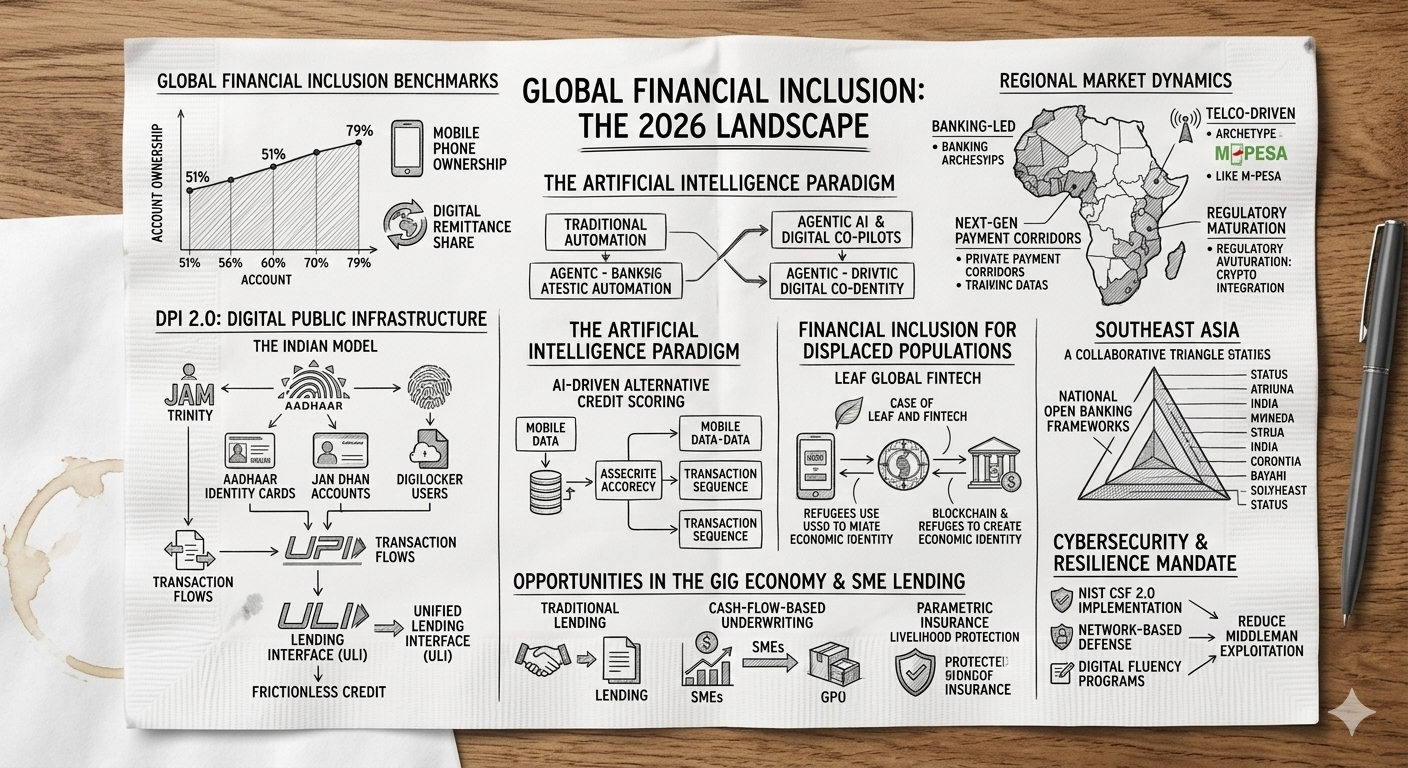
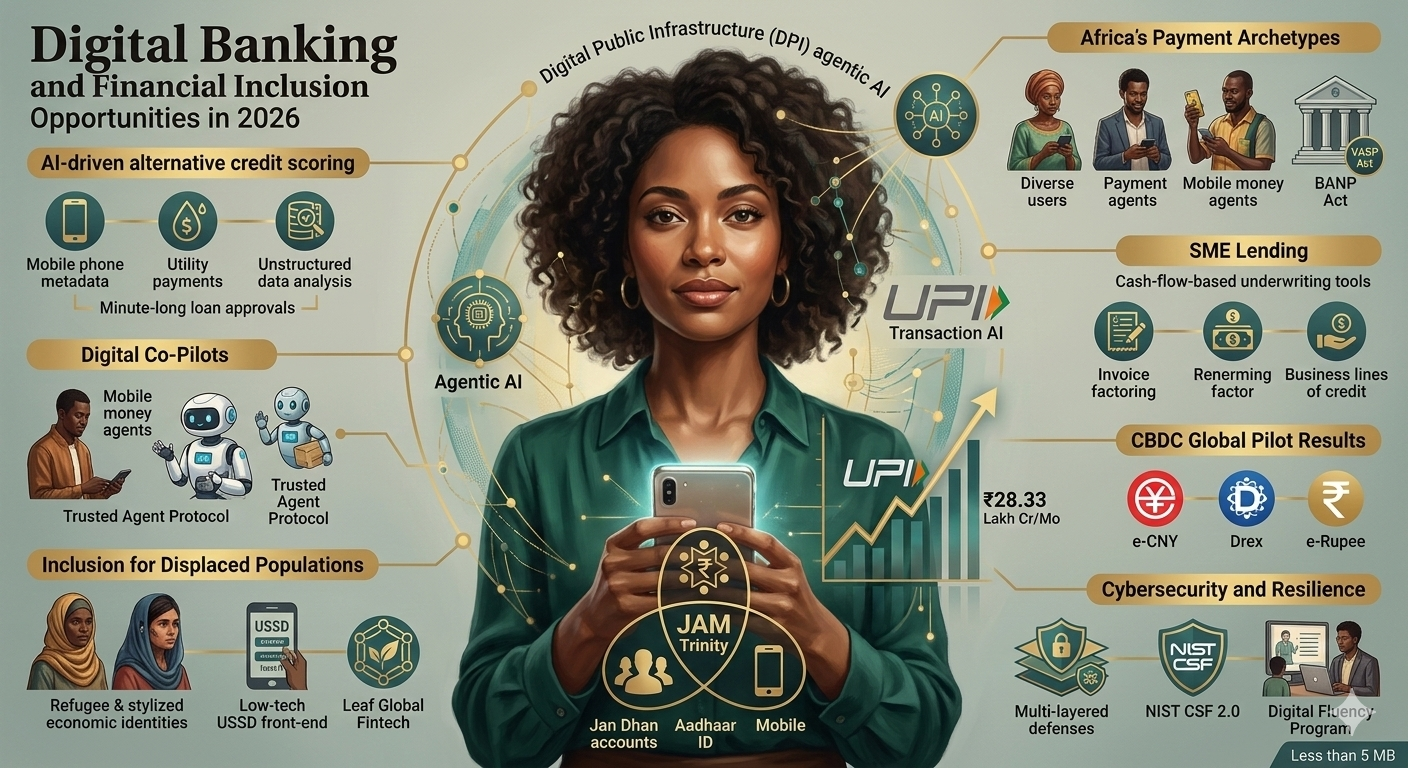
The foundation of India’s digital transformation remains the JAM trinity—Jan Dhan bank accounts, Aadhaar biometric identity, and Mobile connectivity. As of March 2026, the progress of these foundational layers is staggering. Aadhaar has issued over 144 crore unique digital IDs, enabling paperless and presence-less authentication. The Pradhan Mantri Jan Dhan Yojana has expanded from 14.72 crore accounts in 2015 to 57.71 crore by March 2026, with deposits growing from ₹15,670 crore to ₹2.94 lakh crore over the same period.
The Unified Payments Interface (UPI) continues to redefine real-time digital payments, handling nearly ₹28.33 lakh crore in monthly transactions through 21.7 billion individual events as of early 2026. This success has led to the development of "DPI 2.0," where the focus shifts toward "frictionless credit" through the Unified Lending Interface (ULI).
DPI Layer Component | 2026 Milestone | Economic/Social Impact |
Aadhaar Generation | 144 Crore+ | Biometric-based unique identification for 99% of residents |
Jan Dhan Accounts | 57.71 Crore | Direct Benefit Transfer (DBT) efficiency and formal savings |
DigiLocker Users | 67.63 Crore | Elimination of physical paperwork in 9.5 billion documents |
UPI Transaction Value | ₹28.33 Lakh Cr/Mo | Zero-cost real-time transfers fueling the retail economy |
5G Availability | 99.9% Districts | High-speed connectivity for 85% of the population |
The ULI pilot represents a landmark in India’s strategy, specifically targeting rural and MSME borrowers. By integrating diverse data sources—including geo-referenced cadastral maps known as Bhu-Aadhaar and agricultural profiles from the Digital Agriculture Mission—ULI reduces the time taken for credit appraisal from weeks to minutes. The Digital Agriculture Mission itself aims to create digital identities for 11 crore farmers by FY 2026-2027, integrating soil mapping and geospatial data to transform rural credit and insurance.
Global Implications of DPI Adoption
The UNDP has noted that deploying DPI in the financial sector can accelerate economic growth by up to 33% for emerging economies, effectively bypassing traditional, slower development trajectories. However, the centralization of such systems introduces significant risks. Robust legal frameworks and technical safeguards are essential, as centralized digital systems are prime targets for cyberattacks. Furthermore, the challenge of "network latency" in rural areas—where transactions time out due to unstable signals—creates a "digital ether" where the daily wages of poor workers can get stuck, a deterrent that requires "three-legged" infrastructure stability: electricity, mobile data, and backend banking reliability.
The Artificial Intelligence Paradigm: From Automation to Agency
By 2026, Artificial Intelligence has transitioned from a supporting technology to the foundational architecture of the financial services industry. The sector is moving toward the "10x bank," where AI-led teams deliver exponential impact, and banking experiences become conversational and ubiquitous.
Agentic AI and Digital Co-Pilots
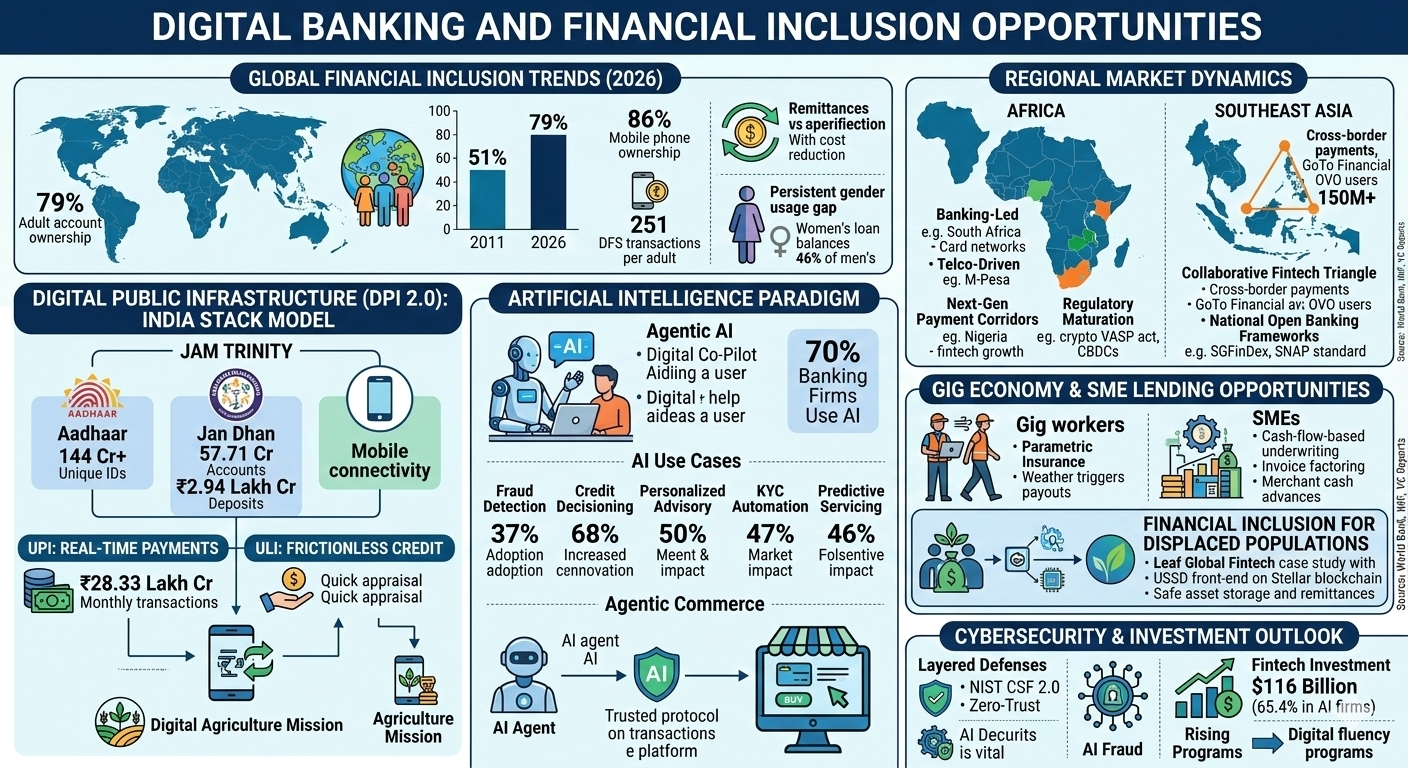
The rise of agentic AI is redefining productivity and customer engagement. Unlike previous iterations of AI that merely displayed data, 2026-era "digital co-pilots" proactively guide, educate, and automate financial decisions. Approximately 70% of banking firms report using agentic AI to some degree, with 16% having fully deployed solutions across their operations.
In 2026, the refinement of these systems has migrated to the consumer frontline through "Agentic Commerce". This paradigm involves AI agents empowered to browse, select, and transact across e-commerce platforms on behalf of users. To facilitate this safely, major payment networks like Visa and Mastercard are building standardized protocols—such as the Trusted Agent Protocol—to verify these agents and enable secure, bot-free payments.
AI-Driven Alternative Credit Scoring
One of the most transformative applications of AI in the context of financial inclusion is the development of alternative credit scoring models. Traditional systems rely on historical financial data like credit card usage and bank histories, which excludes the unbanked. AI-based models instead analyze unstructured data at scale, including:
Mobile phone metadata and usage patterns.
Digital transaction sequences and cash flow consistency.
Utility and rent payment behaviors.
E-commerce and social network characteristics.
AI Use Case in Fintech | Business/Social Impact | 2026 Adoption Context |
Fraud Detection | 80% pilot/live use cases | Reducing false alarms and improving quick resolution |
Credit Decisioning | Minute-long approvals | Expanding inclusion for "thin-file" customers |
Personalized Advisory | 71% customer demand | AI assistants in mobile apps for financial health |
KYC Automation | 75% time savings | Rapid onboarding for rural and MSME borrowers |
Predictive Servicing | 60% better collections | Proactive risk management before defaults occur |
Fintech platforms like ezee.ai and Roopya are operationalizing AI at scale. ezee.ai's no-code approach has processed over 5 million loan applications, supporting 14 of India's Regional Rural Banks and facilitating SHG (Self-Help Group) lending with a 95% repayment rate. Roopya utilizes AI agents to autonomously handle data collection and document verification, tasks that traditionally required heavy human involvement.
Regional Market Dynamics: Africa’s Payment Archetypes
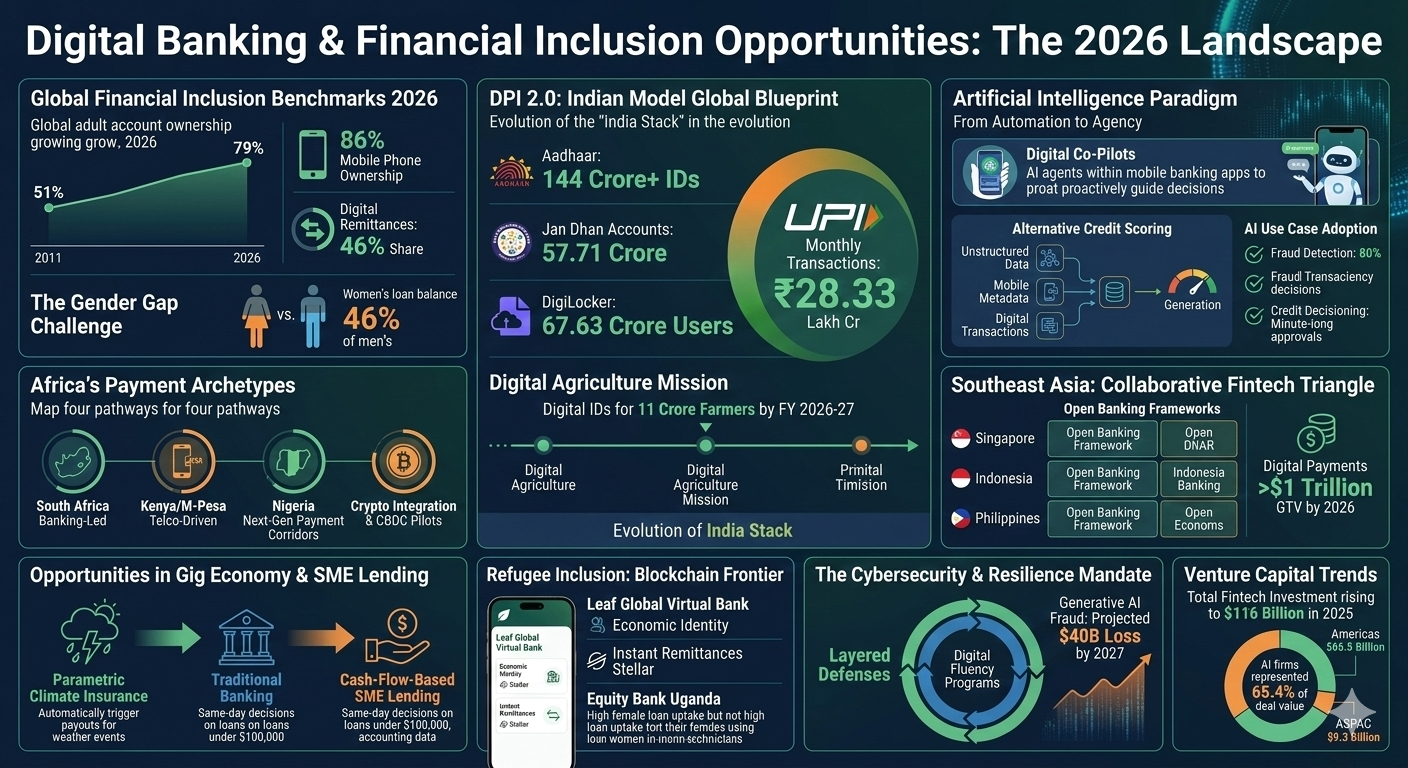
Africa’s financial landscape in 2026 is a diverse tapestry of infrastructure pathways, moving beyond the simple "leapfrog" narrative. Rather than a monolithic market, the continent demonstrates four observable archetypes of digital evolution.
Archetype 1: Banking-Led Digital Transformation
In markets like South Africa and Morocco, established card networks and mature banking systems form the foundation. South Africa maintains 85% bank account penetration, and its evolution trajectory focuses on implementing real-time payment systems—like PayShap—atop existing legacy rails. Recent legislative changes allowing non-banks into clearing systems signal a modernization that leverages decades of institutional trust.
Archetype 2: Telco-Driven Financial Inclusion
Kenya, Tanzania, Ghana, and Uganda represent the pioneering pathway where mobile network operators (MNOs) serve as the primary financial infrastructure. Kenya’s M-Pesa has evolved from simple person-to-person transfers into a comprehensive financial super-app offering savings, credit, and virtual cards. With over 10 million registered mobile money agents across the continent, this "human-digital" infrastructure blend is a distinctive innovation.
Archetype 3: Next-Generation Payment Corridors
Nigeria and Cote d'Ivoire have emerged as powerhouses of rapid fintech growth. West Africa’s mobile money sector recorded growth rates outpacing East Africa by 12 percentage points in 2023. Nigeria’s fintech industry alone grew by 70% in 2024, driven by a surge in digital transactions and the integration of alternative payment methods.
Regulatory Maturation and Crypto Integration
A significant milestone in 2026 is the expansion of formal regulation across African markets. Kenya's passage of the Virtual Asset Service Providers (VASP) Act in late 2025 has created a comprehensive framework for digital assets, enabling institutional actors and banks to engage with blockchain technology as building blocks of future financial infrastructure. In 2026, African central banks, including those in Nigeria and South Africa, are actively piloting central bank digital currencies (CBDCs) and tokenized assets to lower remittance costs and hedge against currency instability.
Southeast Asia: The Collaborative Fintech Triangle
Southeast Asia has emerged as a living laboratory for fintech innovation, driven by a young, mobile-first population and proactive government policies. The region’s digital payments ecosystem is projected to exceed $1 trillion in gross transaction value by 2026.
National Open Banking Frameworks
The move toward open finance is a major catalyst in ASEAN markets. Countries like the Philippines and Indonesia have launched frameworks encouraging data portability and competition.
Country | Open Banking Status | Key Framework/Mechanism |
Singapore | Live (Regulated) | SGFinDex public infrastructure and MAS API Playbook |
India | Live (Regulated) | Account Aggregator framework with 60 million linked accounts |
Indonesia | Live (Regulated) | SNAP national open API standard for payments |
Philippines | In Progress | BSP Open Finance Framework (Circular No. 1122) |
Vietnam | In Progress | SBV Open Banking Framework under development |
Thailand | In Progress | Building on PromptPay instant payment infrastructure |
Vietnam’s economy, projected to grow by 6.6% in 2025, is becoming a center for engineering excellence, while Indonesia’s massive consumer base is served by giants like GoTo Financial and OVO, which collectively reach over 150 million users. The Philippines, as the 2026 ASEAN chair, is steering the regional agenda toward financial integration and resilience, focusing on cross-border payment connectivity to enable faster and more affordable transactions.
Opportunities in the Gig Economy and SME Lending
The task-based nature of the modern economy has created a vast workforce that traditional banking systems struggle to serve. In India, the gig workforce is expected to expand to 12 million by FY2025, contributing ₹2.35 lakh crore to the GDP. However, 40% of these workers report earnings below ₹15,000 per month, and income volatility remains a persistent barrier to credit access.
Parametric Insurance and Livelihood Protection
Traditional insurance focuses on compensation after a loss occurs, but gig workers require immediate liquidity during disruptions. Parametric climate insurance is emerging as a critical tool for this segment. Unlike traditional policies, parametric insurance triggers automatic payouts when specific weather thresholds (e.g., floods or heatwaves) are met, protecting workers' incomes from climate-linked shutdowns.
Cash-Flow-Based SME Lending
SMEs frequently face the "battle of the daily balance," with an average daily cash balance of $13,900—significantly higher than the typical consumer. Yet, large banks only approve 68% of SMB loan applications. This has created a $130 billion revenue opportunity for digital lenders.
Modern SME lending platforms—such as HES LoanBox, Mambu, and American Express Business Blueprint—are shifting the paradigm toward cash-flow-based underwriting. By linking capital directly to accounting platforms and invoicing systems, these lenders can offer same-day decisions on loans under $100,000.
Lending Tool | Mechanism of Action | Benefit to SME |
Invoice Factoring | Lender advances funds against unpaid invoices | Immediate liquidity for operations |
Merchant Cash Advance | Repayments as a percentage of daily card sales | Aligns debt servicing with revenue cycles |
Business Line of Credit | Revolving credit with interest only on drawn funds | Strategic reserve for growth or emergencies |
Asset-Based Lending | Financing structured around business health/assets | Flexibility for seasonal or fluctuating revenue |
The strategic shift for SMEs involves moving away from interest-rate-only comparisons toward a focus on the "fit" and "flexibility" of capital. Capital works best when it supports the business rather than forcing the business to work around rigid repayment schedules.
Financial Inclusion for Displaced Populations: A Blockchain Frontier
Refugees and internally displaced persons (IDPs) face some of the most acute barriers to finance, often lacking documentation and being at high risk of theft when carrying physical cash. In 2026, the average duration of displacement is 13 years, making financial inclusion a long-term necessity rather than a temporary aid function.
Case Study: Leaf Global Fintech
Leaf Global Fintech provides a virtual bank for refugees using blockchain technology on a low-tech USSD front end. This allows individuals to create a secure economic identity, store assets, and receive international remittances without a smartphone. By utilizing the Stellar blockchain, Leaf minimizes transaction costs and enables instantaneous cross-border asset transfers. In initial tests, users reported feeling safe for the first time when crossing borders because they were no longer required to carry their life savings in cash.
Commercial Viability of Refugee Banking
The discourse around refugee inclusion is shifting from compassion to a calculated business decision. Equity Bank Uganda, for example, has recruited over 262 bank agents in refugee settlements and registered 93,300 households on its digital platform. Over 26,300 refugee customers have accessed loans worth $2.7 million, with a 73% loan uptake rate among women, demonstrating the entrepreneurial potential of displaced populations when given formal support.
Central Bank Digital Currencies (CBDCs) and Competitive Impacts
The global interest in CBDCs continues to grow, with 91% of central banks exploring retail or wholesale digital currencies. CBDCs are viewed as a tool to enhance competition in less competitive payment markets through four primary channels: pricing discipline, quality improvements, increased contestability, and broader financial access.
Global Pilot Results
China's e-CNY: Has reached a trillion-dollar transaction scale, with 325 million individual wallets opened.
Brazil's Drex: Planned for a 2026 launch to enhance efficiency through smart contracts and instant settlements.
India's e-Rupee: Expanding to include offline capabilities and programmable features to target specific welfare distributions.
Russia: Plans for largest banks to enable Digital Ruble transactions by September 2026.
However, the competitive impact of CBDC depends significantly on its adoption. While it can lower fees and reduce reliance on legacy systems, there is a risk it may "crowd out" private alternatives if priced too aggressively. Some advanced economies, like Canada and Australia, have paused retail CBDC efforts, concluding that existing systems already meet public needs effectively.
The Cybersecurity and Resilience Mandate
As the digital front door becomes the main entrance for 96% of banking customers, resilience and cybersecurity have risen as top-tier board imperatives. With 75% of institutions reporting increased cyberattacks, budgets for layered defenses and faster recovery systems are rising.
The Sophistication of Modern Fraud
Generative AI is not only a tool for defense but also a catalyst for fraud, with projected losses reaching $40 billion by 2027. Fraudsters now move across banks, fintech apps, and social platforms, requiring a "network-based defense" where institutions share information to spot emerging fraud rings early. Consumers increasingly demand instant breach notifications and transparency on how their personal data is used.
Digital Literacy as a Systemic Barrier
A significant insight for 2026 is that the digital divide is no longer just about access to a signal, but about the "Digital Fluency" required to navigate complex interfaces. Marginalized users often view digital banking as a "black box," and the fear of making a mistake acts as a massive psychological deterrent. In rural districts, only 62% of women feel comfortable performing a digital payment without assistance, leaving them vulnerable to "middleman" exploitation.
Cyber Resilience Action | Strategy for 2026 | Objective |
NIST CSF 2.0 Implementation | Full adoption of modern frameworks | Compliance and reduced exposure |
Agentic AI Monitoring | Standardized protocols for AI bots | Preventing unauthorized or bot-driven fraud |
Network-Based Defense | Data sharing across the Plaid Network/similar | Identifying clusters of suspicious behavior |
Zero-Trust Principles | Continuous verification of users/devices | Mitigating lateral movement after a breach |
Digital Fluency Programs | Institutionalized literacy initiatives | Reducing the "middleman tax" in rural areas |
Investment Landscape and Future Outlook
After three years of declining investment, the global fintech market turned a corner in 2025, with total investment rising from $95.5 billion to $116 billion. While deal volume reached an eight-year low, the concentration of capital in "mega-deals" and AI-focused startups indicates a phase of selective growth and a focus on clearer paths to profitability.
Venture Capital Trends
AI firms represented 65.4% of deal value and 39.4% of deal count in 2025, as investors prioritized the build-out of AI compute infrastructure and the scaling of advanced AI systems. The Americas continue to attract the largest share of funding (66.5 billion), while the ASPAC region saw $9.3 billion in investment. In Nigeria, the fintech industry's 70% growth in 2024 exemplifies the rapid rise of ecosystems in emerging markets.
Strategic Conclusions
The sector enters the second half of the decade shaped by the tension between rising inclusion and tightening institutional resources. What emerges is a "more distributed and embedded architecture" of financial inclusion support. Support institutions are clustering around viable archetypes—such as public-private stewardship for market infrastructure and consulting models capable of sustaining deep technical work in small markets.
Success in 2026 and beyond will depend on maintaining a keen awareness of higher business costs as rules diverge across jurisdictions. The "10x bank" model, the democratization of credit through AI, and the realization of blockchain-based lifelines for the displaced all point toward a future where financial services are no longer bound by traditional barriers. For the global financial community, the opportunity lies in harmonizing human expertise with these intelligent tools to create a resilient, inclusive, and sustainable economic future.
Read More -
1. From Idea to MVP: A Step-by-Step Guide for Solo Founder
🔗 https://findnstart.com/blogs/from-idea-to-mvp-a-step-by-step-guide-for-solo-founder
2. How to Validate Your Startup Idea in 48 Hours for $0
🔗 https://findnstart.com/blogs/how-to-validate-your-startup-idea-in-48-hours-for-0
3. Remote vs. Local: Does Your Co-Founder Need to Live in the Same City?
🔗 https://findnstart.com/blogs/remote-vs-local-does-your-co-founder-need-to-live-in-the-same-city
4. The 2026 Startup Landscape: What Has Fundamentally Changed (and Why Founder Skills Matter More Than Ever)
5. The Most In-Demand Skills for Startup Founders in 2026
🔗 https://findnstart.com/blogs/the-most-in-demand-skills-for-startup-founders-in-2026
6. How to Find a Technical Co-Founder (Without a Six-Figure Salary)
🔗 https://findnstart.com/blogs/how-to-find-a-technical-co-founder-without-a-six-figure-salary
7. 5 Red Flags to Look for When Choosing a Startup Partner
🔗 https://findnstart.com/blogs/5-red-flags-to-look-for-when-choosing-a-startup-partner
8. How to Pitch Your Idea to Potential Co-Founders
🔗 https://findnstart.com/blogs/how-to-pitch-your-idea-to-potential-co-founders
9. How to Build a Portfolio that Attracts High-Growth Startup Founders
🔗 https://findnstart.com/blogs/how-to-build-a-portfolio-that-attracts-high-growth-startup-founders
10. Equity vs. Salary: How to Split Ownership with Your First Teammate
🔗 https://findnstart.com/blogs/equity-vs-salary-how-to-split-ownership-with-your-first-teammate
11. Why Joining an Early-Stage Startup is Better Than a Corporate Job
🔗 https://findnstart.com/blogs/why-joining-an-early-stage-startup-is-better-than-a-corporate-job
12. The Future of EdTech: Why Developers and Educators Need to Team Up Now
🔗 https://findnstart.com/blogs/the-future-of-edtech-why-developers-and-educators-need-to-team-up-now
13. The Architecture of Symbiosis: Analytical Perspectives on the Five Habits of Successful Startup Duos
14. Finding a Co-Founder in the AI Space: What Skills Should You Look For?
🔗 https://findnstart.com/blogs/finding-a-co-founder-in-the-ai-space-what-skills-should-you-look-for
15. Overcoming Analysis Paralysis and the Strategic Path to Execution
🔗 https://findnstart.com/blogs/overcoming-analysis-paralysis-and-the-strategic-path-to-execution
16. From College Project to Company: How to Find Your Student Co-Founder
🔗 https://findnstart.com/blogs/from-college-project-to-company-how-to-find-your-student-co-founder
17. How to Start a Startup While Working a Full-Time Job
🔗 https://findnstart.com/blogs/how-to-start-a-startup-while-working-a-full-time-job
18. How to Build a HealthTech Startup Without a Medical Degree
🔗 https://findnstart.com/blogs/how-to-build-a-healthtech-startup-without-a-medical-degree
19. The Solitary Architect: Executive Isolation in Entrepreneurship
20. The 2026 Guide to Launching a SaaS as a Solo Developer
21. What Sustainable Growth Actually Looks Like
🔗 https://findnstart.com/blogs/what-sustainable-growth-actually-looks-like
22. The Early Warning Signs Your Startup Is in Trouble
🔗 https://findnstart.com/blogs/the-early-warning-signs-your-startup-is-in-trouble
23. How to Grow Without Burning Out
🔗 https://findnstart.com/blogs/how-to-grow-without-burning-out
24. The Truth About “Runway” Most Founders Ignore
🔗 https://findnstart.com/blogs/the-truth-about-runway-most-founders-ignore
25. Revenue Solves More Problems Than Funding
🔗 https://findnstart.com/blogs/revenue-solves-more-problems-than-funding
26. What No One Tells You About Being a Solo Founder
🔗 https://findnstart.com/blogs/what-no-one-tells-you-about-being-a-solo-founder
27. Why Smart People Quit High-Paying Jobs to Build Startups (And Why Most Regret It)
28. Why Most Startup Advice on Twitter Is Dangerous
🔗 https://findnstart.com/blogs/why-most-startup-advice-on-twitter-is-dangerous
29. Decision Fatigue: The Silent Startup Killer
🔗 https://findnstart.com/blogs/decision-fatigue-the-silent-startup-killer
30. Fear vs Logic: How Founders Actually Make Decisions
🔗 https://findnstart.com/blogs/fear-vs-logic-how-founders-actually-make-decisions
31. How Overthinking Destroys Early Momentum
🔗 https://findnstart.com/blogs/how-overthinking-destroys-early-momentum
32. Ideas Don’t Scale. Systems Do.
🔗 https://findnstart.com/blogs/ideas-dont-scale-systems-do
33. The First Hire That Actually Matters
🔗 https://findnstart.com/blogs/the-first-hire-that-actually-matters
34. How the First 100 Users Decide Your Startup’s Fate
🔗 https://findnstart.com/blogs/how-the-first-100-users-decide-your-startups-fate
35. Why Your Startup Doesn’t Need Growth — It Needs Focus
🔗 https://findnstart.com/blogs/why-your-startup-doesnt-need-growthit-needs-focus
36. Why Most Startups Die Quietly
🔗 https://findnstart.com/blogs/why-most-startups-die-quietly
37. Lessons Learned Too Late by First-Time Founders
🔗 https://findnstart.com/blogs/lessons-learned-too-late-by-first-time-founders
38. The Myth of the “Overnight Success” Startup
🔗 https://findnstart.com/blogs/the-myth-of-the-overnight-success-startup