Building a Startup While Living with Parents (Indian Reality)
March 8, 2026 by Harshit Gupta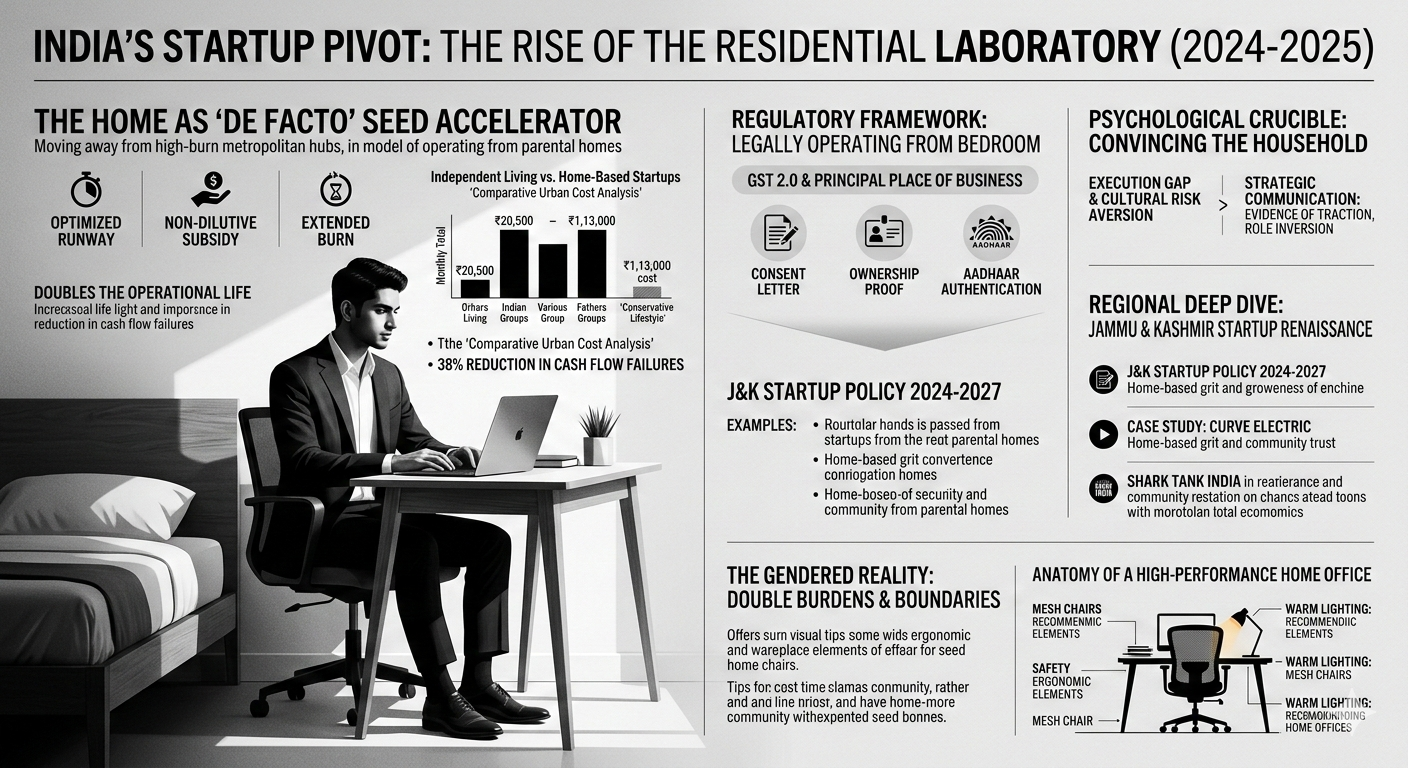
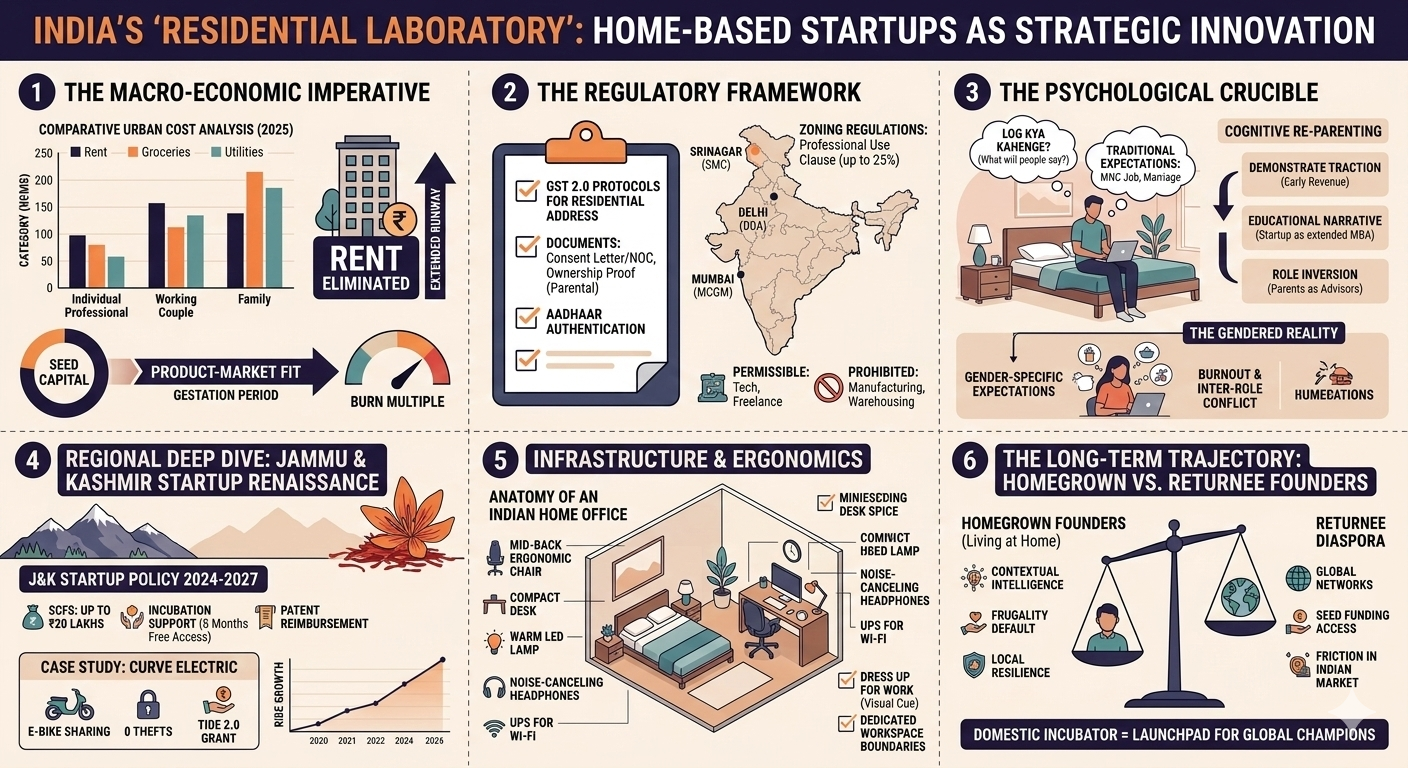
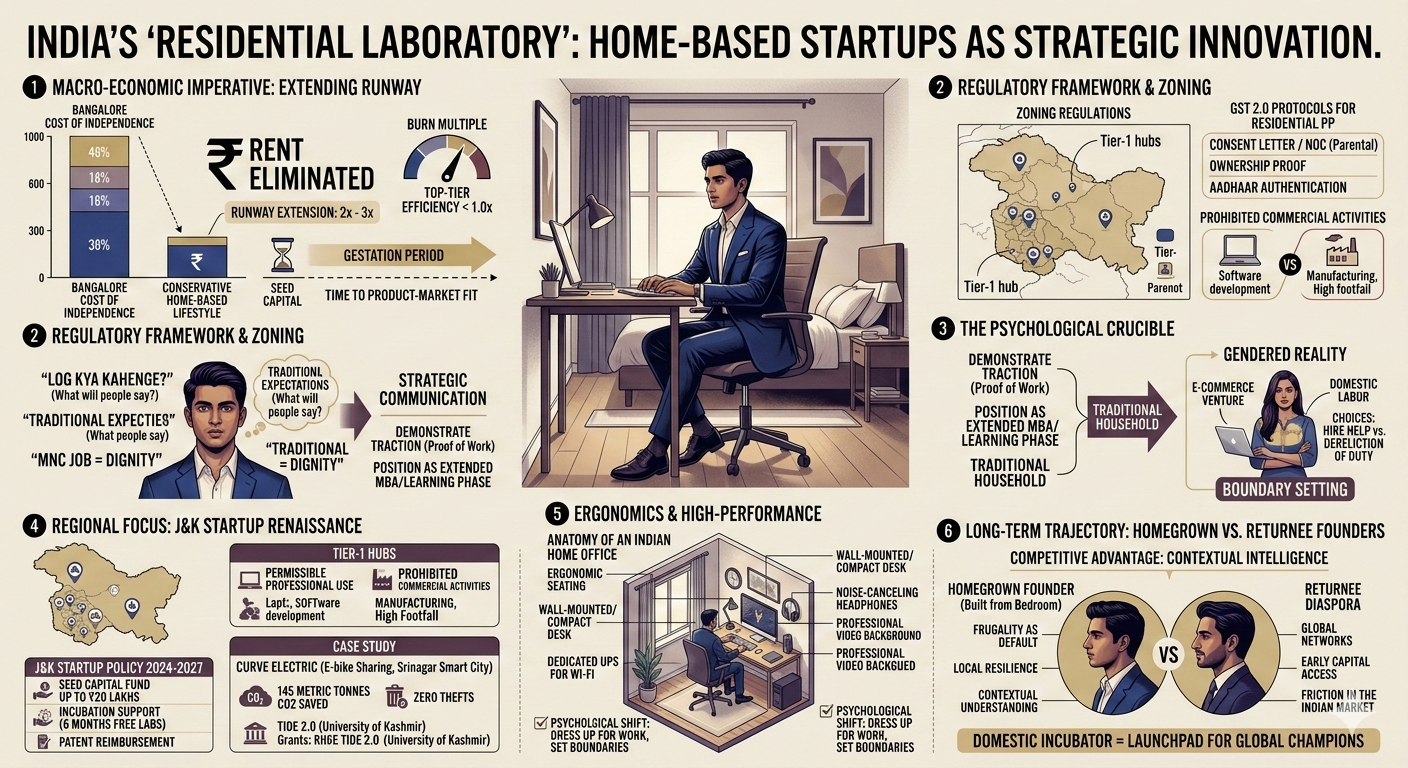
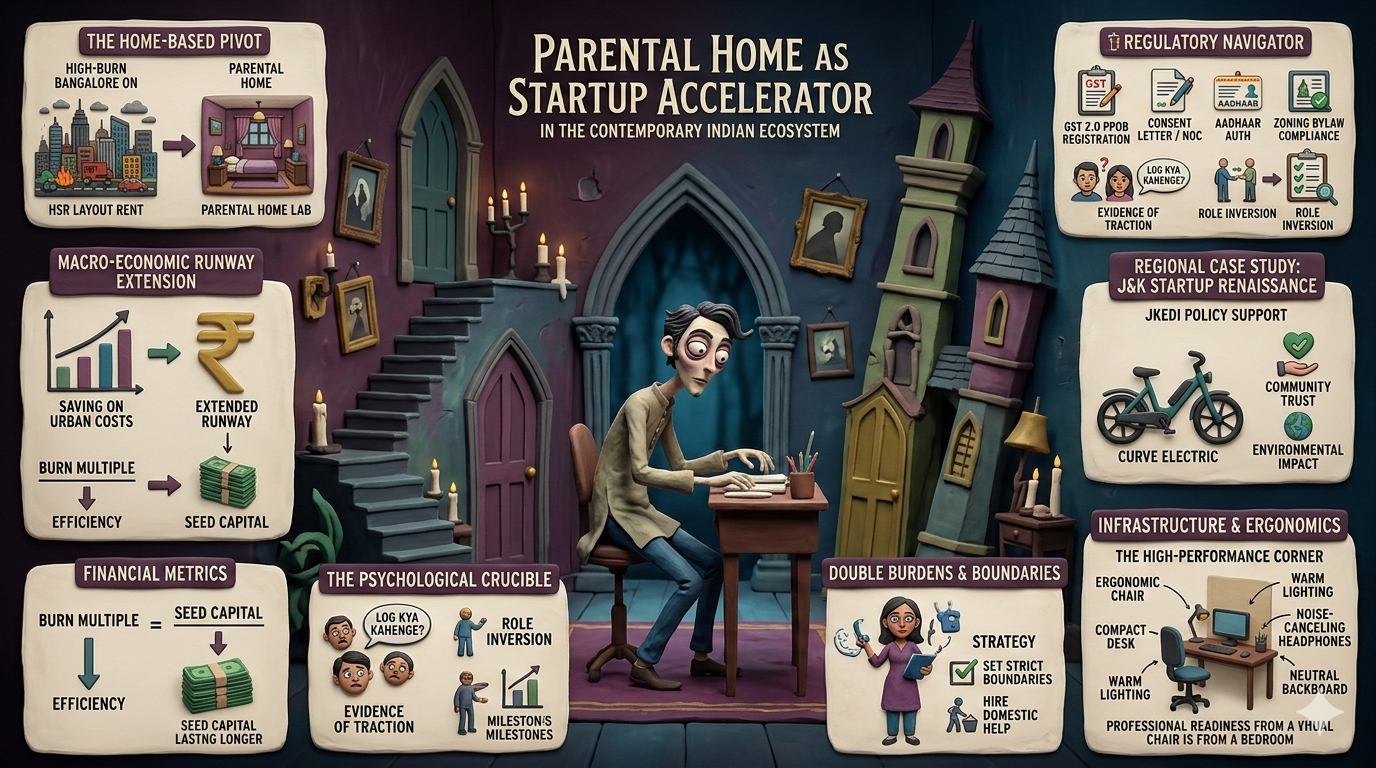
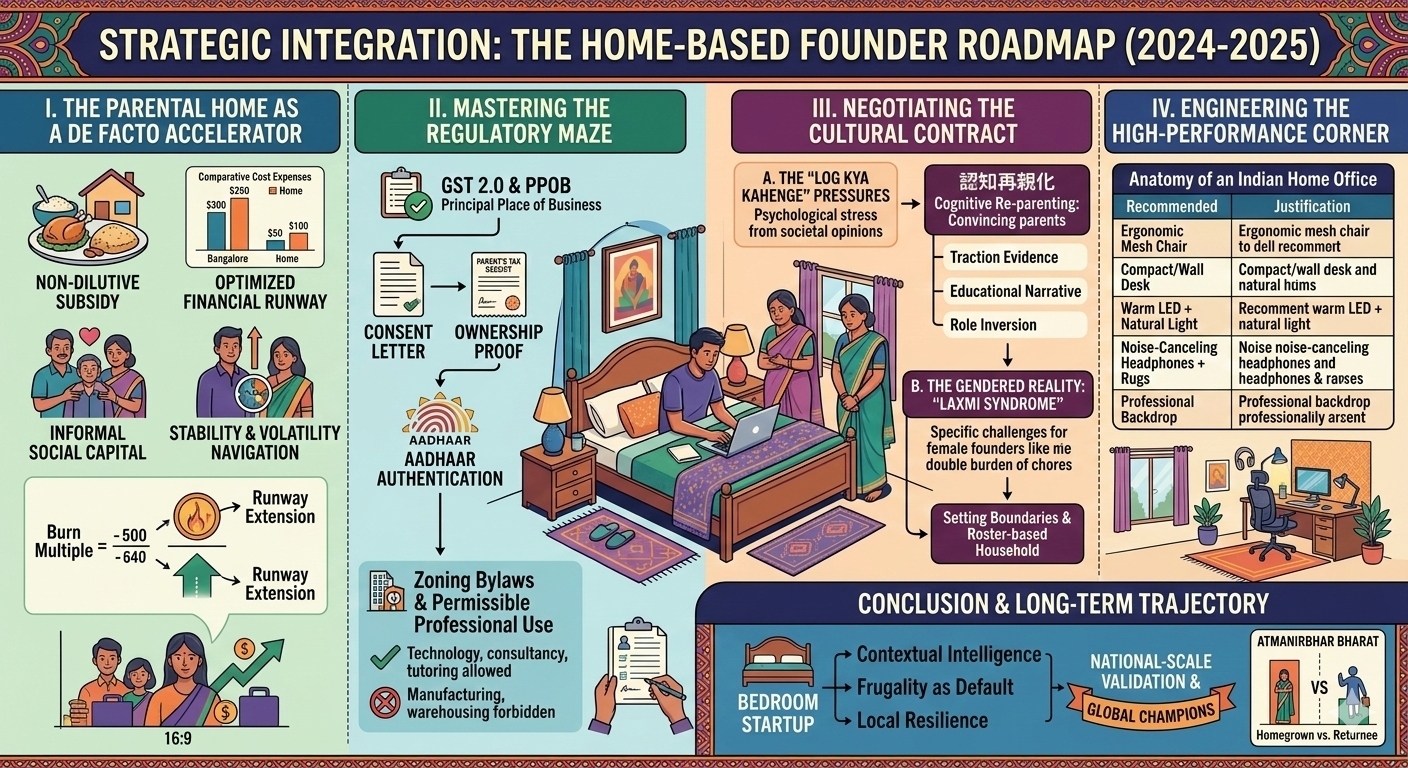
The contemporary Indian startup ecosystem is undergoing a fundamental structural pivot. While the previous decade was characterized by the glamorization of high-burn venture capital models and the centralization of innovation in metropolitan "hubs" like Bangalore’s HSR Layout or Mumbai’s Powai, the 2024-2025 fiscal period has seen a resurgence of the "residential laboratory." This phenomenon—building a high-growth venture while cohabiting with parents—is no longer viewed merely as a symptom of early-stage resource scarcity. Instead, it is being recontextualized as a sophisticated strategic maneuver designed to optimize financial runway, leverage informal social capital, and navigate the extreme volatility of the Indian urban economy. In the Indian reality, the parental home functions as a "de facto" seed accelerator, providing a non-dilutive subsidy of food, shelter, and stability that allows founders to survive the brutal gestation periods typical of deep-tech or consumer-centric startups.
The Macro-Economic Imperative: Metropolitan Cost Crises and the Parental Subsidy
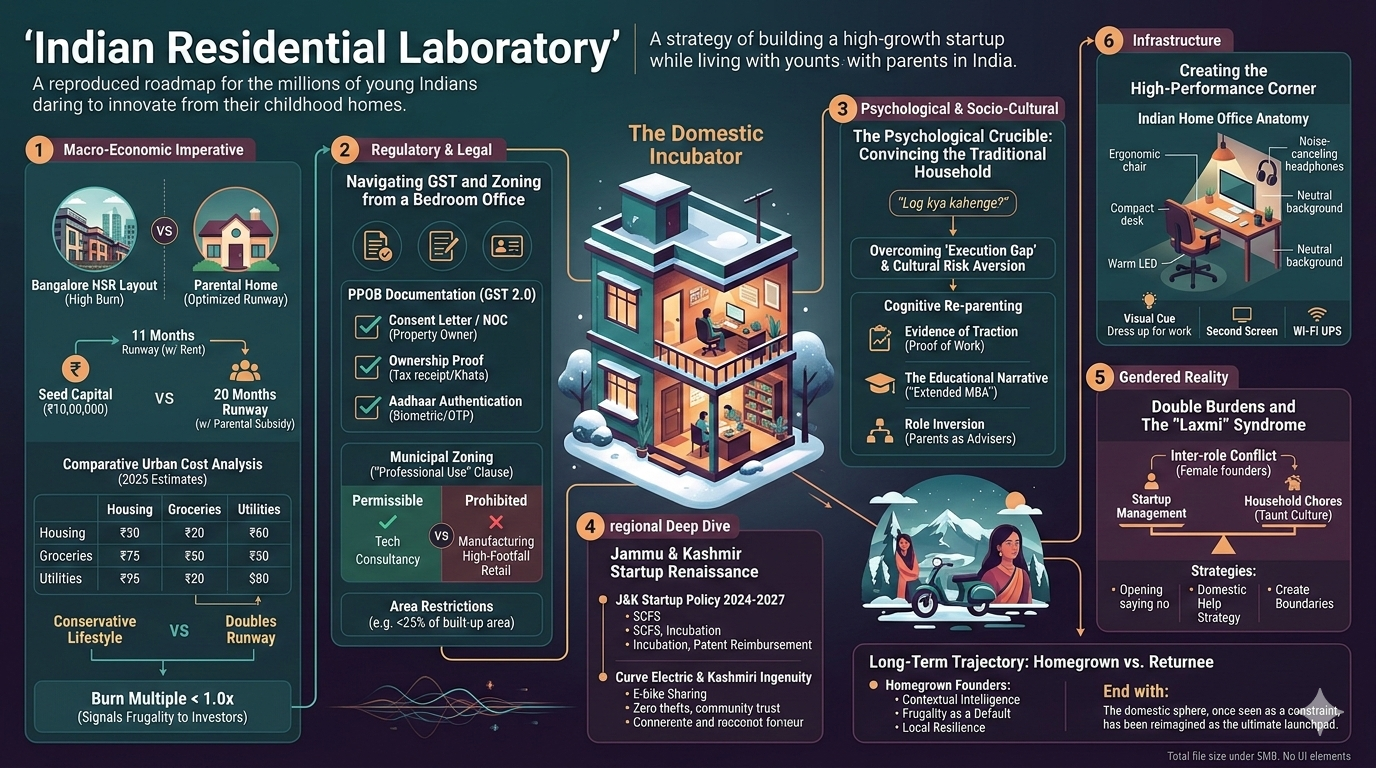
The primary catalyst for the home-based startup model is the widening chasm between entry-level entrepreneurial income and the cost of maintaining a professional standard of living in India’s Tier-1 cities. By 2025, Bangalore, often cited as the Silicon Valley of India, has seen housing and utility costs escalate to levels that match secondary European cities. For a founder, every rupee spent on HSR Layout rent is a rupee not spent on cloud infrastructure or customer acquisition. The decision to stay with parents is thus an exercise in "survival math," where the reduction of personal burn rate directly correlates to an extension of the startup’s operational life.
Comparative Urban Cost Analysis (2025 Estimates)
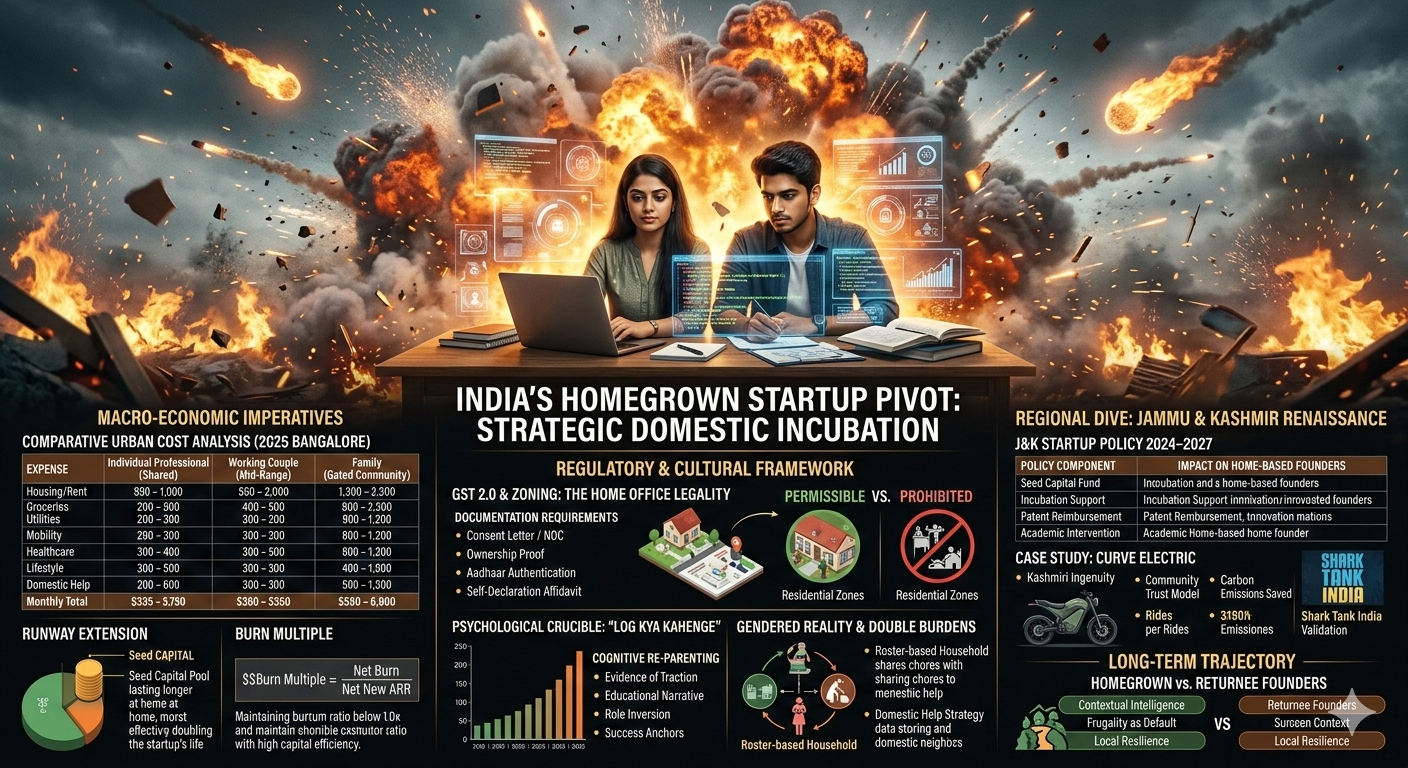
The financial pressure of independent living in a tech hub like Bangalore is multifaceted, encompassing housing, groceries, transport, and the "lifestyle inflation" inherent in networking-heavy environments. The following table delineates the estimated monthly burn for different demographic segments in Bangalore as of early 2025.
Expense Category | Individual Professional (Shared) | Working Couple (Mid-Range) | Family of 3-4 (Gated Community) |
Housing/Rent | ₹10,000 – ₹18,000 | ₹20,000 – ₹30,000 | ₹30,000 – ₹50,000 |
Groceries & Sustenance | ₹3,000 – ₹5,000 | ₹5,000 – ₹8,000 | ₹8,000 – ₹12,000 |
Utilities & Connectivity | ₹1,500 – ₹2,500 | ₹2,000 – ₹3,500 | ₹3,000 – ₹5,000 |
Mobility & Fuel | ₹2,000 – ₹4,000 | ₹3,000 – ₹6,000 | ₹5,000 – ₹8,000 |
Healthcare & Insurance | ₹500 – ₹1,500 | ₹1,500 – ₹3,000 | ₹2,000 – ₹4,000 |
Lifestyle & Leisure | ₹2,000 – ₹4,000 | ₹4,000 – ₹6,000 | ₹5,000 – ₹8,000 |
Domestic Help/Maintenance | Optional | ₹3,000 – ₹5,000 | ₹5,000 – ₹10,000 |
Monthly Total | ₹20,500 – ₹38,500 | ₹38,000 – ₹61,500 | ₹65,000 – ₹1,13,000 |
Data synthesized from 2025 cost-of-living indices and expat reports.
For a pre-revenue founder, the "Conservative Lifestyle" at home eliminates the rent, utilities, and a significant portion of the grocery budget. In a scenario where a startup has ₹10,00,000 in seed capital and a monthly business burn of ₹50,000, the founder’s personal independence in Bangalore (costing an additional ₹40,000 per month) would reduce the runway from 20 months to 11 months. The parental home effectively doubles the time available for product-market fit. This "runway extension" is a critical competitive advantage in a market where 38% of startups fail specifically due to cash flow mismanagement.
Financial Metrics and the "Burn Multiple"
Investors in the 2025 climate have moved beyond simple "gross burn" metrics, focusing instead on the efficiency of capital. The "Burn Multiple" has emerged as a key indicator of health, defined as:
$$Burn\ Multiple = \frac{Net\ Burn}{Net\ New\ ARR}$$
A home-based founder can maintain a Burn Multiple below 1.0x—a threshold signifying top-tier efficiency—because their "Net Burn" is decoupled from their "Cost of Living". This financial discipline signals to Series A investors that the founder is capable of "frugal innovation," a trait highly valued in the post-2023 "funding winter".
The Regulatory Framework: Navigating GST and Zoning from a Bedroom Office
One of the most persistent myths in the Indian startup community is the illegality of registering a business at a residential address. In reality, the legal landscape is remarkably permissive for digital and service-based ventures, provided specific documentary protocols are followed. The transition to the GST 2.0 system in November 2025 has further streamlined this process for home-based founders.
GST 2.0 and the Principal Place of Business (PPOB)
Under the 2025 guidelines, a residential address can legally serve as the registered office for GST purposes. The primary challenge is proving "legal possession" of the premises when the property is often in the name of a parent.
Documentation Requirement | Description and Application | Source Reference |
Consent Letter / NOC | A plain-paper declaration from the property owner (parent) permitting business use. | |
Ownership Proof | Latest Property Tax receipt, Municipal Khata, or Electricity bill in the parent’s name. | |
Aadhaar Authentication | Biometric or OTP-based verification to bypass physical inspection. | |
Self-Declaration Affidavit | A notarized statement used when a formal lease or registered NOC is absent. |
The "Consent Letter" is the cornerstone of home-based registration. It bypasses the need for a commercial lease agreement, which would otherwise attract commercial electricity rates and property taxes. However, founders must be vigilant: if the startup scales to include physical inventory or manufacturing, the "residential" status can be challenged by municipal authorities as a violation of zoning laws.
Municipal Zoning and the "Professional Use" Clause
Zoning regulations in cities like Delhi (DDA), Mumbai (MCGM), and Srinagar (SMC) typically allow for "home-based professional work". This is defined as activities that do not alter the residential character of the neighborhood.
Permissible Activities: Technology development, consultancy (legal, accounting, architectural), tutoring, and freelance creative services are generally permitted.
Prohibited Activities: Manufacturing, chemical processing, high-footfall retail, and warehousing are strictly forbidden in residential zones.
Area Restrictions: Most bylaws restrict professional use to a specific percentage of the built-up area (often 25%) or a flat cap (e.g., 500 sq. ft.).
Structural Changes: Any modification to the building’s exterior or internal load-bearing structures to accommodate a business requires prior approval from the local development authority.
In Srinagar, the Municipal Corporation (Building) Bye-Laws of 2011 (and updated 2021 unified versions) emphasize that "Commercial Buildings" are those used for the "sale and purchase of goods" or "storage/go-downs". A software startup operating from a laptop in a bedroom does not meet the "Commercial" definition in a way that triggers zoning violations, provided it does not install "Advertising Signs" that disturb the streetscape.
The Psychological Crucible: "Log Kya Kahenge" and the Generational Gap
The Indian experience of building a startup at home is inextricably linked to the socio-cultural fabric of the family. Unlike the Western "individualist" model, Indian entrepreneurship is often a "collective" decision involving parents, siblings, and extended kin. This proximity creates a unique set of psychological stressors, primarily the "Log kya kahenge" (What will people say?) phenomenon.
The "Execution Gap" and Cultural Risk Aversion
Indian society has historically viewed career paths through the lens of "safety first." The education system, which rewards rote learning and compliance, reinforces the idea that a job at a multinational corporation (MNC) or in the government sector is the only "dignified" outcome. When a founder chooses to work from their bedroom, they are often viewed not as a visionary, but as "unemployed" or "struggling" by their community.
This leads to a pervasive "Execution Gap," where brilliant minds freeze due to a lack of social validation. Parents, conditioned by decades of economic scarcity, may engage in "heart attack drama" or emotional manipulation to steer their children back toward traditional employment. The pressure to marry and achieve "stability" often conflicts with the 5-to-10-year timeline required to build a successful company.
Cognitive Re-parenting: Convincing the Traditional Household
To survive at home, a founder must treat their parents as their first "investors." This involves a shift from argument to "strategic communication."
Evidence of Traction: Nothing dissolves parental skepticism like "proof of work." Founders who demonstrate early revenue, media mentions, or even disciplined work hours find their parents more supportive.
The Educational Narrative: Positioning the startup as an "extended MBA" or a "learning phase" makes the risk more palatable to parents who value formal education.
Role Inversion: Successful founders often ask for their parents' advice on traditional business aspects (like accounting or vendor management). This "involvement" transforms the parents from critics to stakeholders.
Success Anchors: Using role models like Byju Raveendran or Falguni Nayar as "anchors" helps parents visualize the possible outcome of the "risky" path.
Regional Deep Dive: The Jammu & Kashmir Startup Renaissance
The Union Territory of Jammu & Kashmir, particularly the Srinagar-Jammu corridor, serves as a quintessential case study for home-based entrepreneurship. Faced with unique geographical and connectivity challenges, the region’s youth have leveraged robust government policies to build ventures from the ground up.
The J&K Startup Policy 2024–2027
Managed by the Jammu & Kashmir Entrepreneurship Development Institute (JKEDI), the 2024-2027 policy is among the most aggressive in the country in terms of supporting early-stage founders.
Policy Component | Details of Assistance | Impact on Home-Based Founders |
Seed Capital Fund (SCFS) | Up to ₹20 Lakhs one-time assistance. | Provides the initial "working capital" to move beyond the bedroom. |
Incubation Support | 6 months free access to CIIBM-JKEDI labs. | Offers a "professional" alternative to noisy households. |
Patent Reimbursement | Assistance in obtaining and funding patents. | Encourages deep-tech research from home. |
Academic Intervention | 1-year "Gap Year" for student founders. | Relieves the pressure of balancing exams and startups. |
Source: J&K Startup Policy 2024-2027 Compendium.
The policy recognizes 1,256 startups as of early 2026, with a significant concentration in Srinagar and Jammu. The focus on "Sustainable Development Goals" (SDGs) and "Financial Inclusion" allows founders in these sectors to access free office space for up to a year, effectively removing the "home vs. office" dilemma during the most critical growth phase.
Case Study: Curve Electric and the "Kashmiri Ingenuity"
The success of Curve Electric, an e-bike sharing startup co-founded by Sheikh Yameen and Zubair Bhat, highlights the power of local insight combined with home-based grit. Launched in 2023, the startup collaborated with Srinagar Smart City Limited (SSCL) to provide eco-friendly transportation.
The Trust Model: Operating in a high-risk environment, they eliminated "onboarding barriers" like security deposits and app downloads. In two years, they reported zero thefts—a testament to the "community trust" they leveraged from their local roots.
Environmental Impact: With 55,000+ rides and 145 metric tonnes of carbon emissions saved, they proved that a venture built in a "Kashmiri backyard" could achieve national-scale validation on platforms like Shark Tank India.
Institutional Linkages: Their journey was bolstered by the TIDE 2.0 grant from the University of Kashmir’s NewGen IEDC, showing how regional academic incubators act as the "connective tissue" for home-based founders.
The Gendered Reality: Double Burdens and the "Laxmi" Syndrome
For female founders in India, the "living at home" reality is layered with gender-specific expectations. While a male founder might be given a "pass" on household chores to focus on his business, women are often expected to maintain their traditional domestic roles alongside their professional ones.
Domestic Labor and the "Arrogance" of Earning
Female founders report a significant "inter-role conflict." Even if they are earning more than their peers, society—and sometimes their own families—act as if they are "stay-at-home daughters" who have unlimited time for chores.
The Taunt Culture: Earning women frequently face accusations of being "arrogant" or "neglectful" if they prioritize a client call over a family meal.
The Chore Roster: Successful female founders emphasize the need to "openly say no" and set strict boundaries. Many resort to "lying" about fixed online classes just to secure uninterrupted work time in their rooms.
Domestic Help Strategy: In India, the availability of affordable domestic help (costing ₹5,000–₹10,000 per month) is a vital tool for female founders to "buy back" their time. However, the decision to hire help is often met with resistance if the family views it as a "dereliction of duty" by the woman.
The "MOM’s" labor—childcare and housework—is often seen as non-negotiable, leading to high rates of burnout among women entrepreneurs who try to be "superwomen". The shift toward a "roster-based" household, where tasks are shared among all family members, is a prerequisite for the success of women-led home startups.
Infrastructure and Ergonomics: Creating the "High-Performance" Corner
Productivity in a home-based setting is often hampered by the lack of physical boundaries. In small Indian apartments (1BHK or 2BHK), the workspace must be a "masterclass in minimalism".
The Anatomy of an Indian Home Office
Component | Professional Recommendation | Justification |
Seating | Mid-back ergonomic chair with mesh. | Prevents back pain in non-AC Indian summers; saves space. |
Desk | Compact (3-foot) or wall-mounted. | Maintains "floor flow" in small bedrooms. |
Lighting | Warm LED desk lamp + Natural light. | Reduces eye strain; avoids "passport office" vibe of tube lights. |
Acoustics | Noise-canceling headphones + Rugs. | Blocks out pressure-cooker whistles and street noise. |
Background | Bookshelf or neutral wall panels. | Essential for "investor-ready" video presence. |
Guidelines synthesized from Misuraa and Durian ergonomic studies.
The psychological shift is as important as the physical one. Founders are advised to "dress up" for work even when at home. This "visual cue" signals to both the founder’s brain and the family members that the individual is currently in "business mode". Furthermore, the use of a second screen and a dedicated UPS for the Wi-Fi router ensures that the "professionalism" of the output is not compromised by the "informality" of the setting.
The Long-Term Trajectory: Homegrown vs. Returnee Founders
A significant study by Saxenian and Wadhwa highlights a counter-intuitive trend: "Homegrown" Indian founders—those who have never left the country—often outperform returnees in the long run. While the "Returnee Diaspora" has the initial advantage of global networks and easier access to seed funding, they often struggle with the "friction" of the Indian market.
Homegrown founders, particularly those who have built their businesses while living at home, possess:
Contextual Intelligence: An innate understanding of the "trust deficit" in Indian society and how to bridge it (e.g., the Curve Electric model).
Frugality as a Default: A high tolerance for low-resource environments, which allows them to pivot and persevere through long "pre-revenue" winters.
Local Resilience: The ability to navigate the "Log kya kahenge" pressure builds a level of psychological resilience that is often absent in those who have lived in more "supportive" Western ecosystems.
Conclusion: The Strategic Integration of Home and Venture
The "Indian Reality" of building a startup while living with parents is not a temporary compromise; it is a cultural and economic strategic pillar. By leveraging the "Domestic Incubator," Indian founders are able to bypass the "Rent Trap" of metropolitan hubs, effectively turning their homes into high-yield R&D centers.
The successful home-based founder of 2025 is one who:
Masters the Regulatory Maze: Uses GST 2.0 and "Consent Letter" protocols to maintain a professional legal standing.
Engineers Their Environment: Optimizes small spaces with ergonomic precision and noise-management technology.
Negotiates the Cultural Contract: Treats parents as stakeholders, uses "traction" to dissolve skepticism, and breaks gendered domestic labor patterns.
As India continues its demographic transformation, the "bedroom startup" will remain the engine of the "Atmanirbhar Bharat" (Self-Reliant India) mission. The transition from the "Dal Chawal" phase to the "Unicorn" phase is no longer a rare anomaly, but a reproducible roadmap for the millions of young Indians daring to innovate from their childhood homes. The domestic sphere, once seen as a constraint, has been reimagined as the ultimate launchpad for the next generation of global champions.

Read More -
1. From Idea to MVP: A Step-by-Step Guide for Solo Founder
🔗 https://findnstart.com/blogs/from-idea-to-mvp-a-step-by-step-guide-for-solo-founder
2. How to Validate Your Startup Idea in 48 Hours for $0
🔗 https://findnstart.com/blogs/how-to-validate-your-startup-idea-in-48-hours-for-0
3. Remote vs. Local: Does Your Co-Founder Need to Live in the Same City?
🔗 https://findnstart.com/blogs/remote-vs-local-does-your-co-founder-need-to-live-in-the-same-city
4. The 2026 Startup Landscape: What Has Fundamentally Changed (and Why Founder Skills Matter More Than Ever)
5. The Most In-Demand Skills for Startup Founders in 2026
🔗 https://findnstart.com/blogs/the-most-in-demand-skills-for-startup-founders-in-2026
6. How to Find a Technical Co-Founder (Without a Six-Figure Salary)
🔗 https://findnstart.com/blogs/how-to-find-a-technical-co-founder-without-a-six-figure-salary
7. 5 Red Flags to Look for When Choosing a Startup Partner
🔗 https://findnstart.com/blogs/5-red-flags-to-look-for-when-choosing-a-startup-partner
8. How to Pitch Your Idea to Potential Co-Founders
🔗 https://findnstart.com/blogs/how-to-pitch-your-idea-to-potential-co-founders
9. How to Build a Portfolio that Attracts High-Growth Startup Founders
🔗 https://findnstart.com/blogs/how-to-build-a-portfolio-that-attracts-high-growth-startup-founders
10. Equity vs. Salary: How to Split Ownership with Your First Teammate
🔗 https://findnstart.com/blogs/equity-vs-salary-how-to-split-ownership-with-your-first-teammate
11. Why Joining an Early-Stage Startup is Better Than a Corporate Job
🔗 https://findnstart.com/blogs/why-joining-an-early-stage-startup-is-better-than-a-corporate-job
12. The Future of EdTech: Why Developers and Educators Need to Team Up Now
🔗 https://findnstart.com/blogs/the-future-of-edtech-why-developers-and-educators-need-to-team-up-now
13. The Architecture of Symbiosis: Analytical Perspectives on the Five Habits of Successful Startup Duos
14. Finding a Co-Founder in the AI Space: What Skills Should You Look For?
🔗 https://findnstart.com/blogs/finding-a-co-founder-in-the-ai-space-what-skills-should-you-look-for
15. Overcoming Analysis Paralysis and the Strategic Path to Execution
🔗 https://findnstart.com/blogs/overcoming-analysis-paralysis-and-the-strategic-path-to-execution
16. From College Project to Company: How to Find Your Student Co-Founder
🔗 https://findnstart.com/blogs/from-college-project-to-company-how-to-find-your-student-co-founder
17. How to Start a Startup While Working a Full-Time Job
🔗 https://findnstart.com/blogs/how-to-start-a-startup-while-working-a-full-time-job
18. How to Build a HealthTech Startup Without a Medical Degree
🔗 https://findnstart.com/blogs/how-to-build-a-healthtech-startup-without-a-medical-degree
19. The Solitary Architect: Executive Isolation in Entrepreneurship
20. The 2026 Guide to Launching a SaaS as a Solo Developer
21. What Sustainable Growth Actually Looks Like
🔗 https://findnstart.com/blogs/what-sustainable-growth-actually-looks-like
22. The Early Warning Signs Your Startup Is in Trouble
🔗 https://findnstart.com/blogs/the-early-warning-signs-your-startup-is-in-trouble
23. How to Grow Without Burning Out
🔗 https://findnstart.com/blogs/how-to-grow-without-burning-out
24. The Truth About “Runway” Most Founders Ignore
🔗 https://findnstart.com/blogs/the-truth-about-runway-most-founders-ignore
25. Revenue Solves More Problems Than Funding
🔗 https://findnstart.com/blogs/revenue-solves-more-problems-than-funding
26. What No One Tells You About Being a Solo Founder
🔗 https://findnstart.com/blogs/what-no-one-tells-you-about-being-a-solo-founder
27. Why Smart People Quit High-Paying Jobs to Build Startups (And Why Most Regret It)
28. Why Most Startup Advice on Twitter Is Dangerous
🔗 https://findnstart.com/blogs/why-most-startup-advice-on-twitter-is-dangerous
29. Decision Fatigue: The Silent Startup Killer
🔗 https://findnstart.com/blogs/decision-fatigue-the-silent-startup-killer
30. Fear vs Logic: How Founders Actually Make Decisions
🔗 https://findnstart.com/blogs/fear-vs-logic-how-founders-actually-make-decisions
31. How Overthinking Destroys Early Momentum
🔗 https://findnstart.com/blogs/how-overthinking-destroys-early-momentum
32. Ideas Don’t Scale. Systems Do.
🔗 https://findnstart.com/blogs/ideas-dont-scale-systems-do
33. The First Hire That Actually Matters
🔗 https://findnstart.com/blogs/the-first-hire-that-actually-matters
34. How the First 100 Users Decide Your Startup’s Fate
🔗 https://findnstart.com/blogs/how-the-first-100-users-decide-your-startups-fate
35. Why Your Startup Doesn’t Need Growth — It Needs Focus
🔗 https://findnstart.com/blogs/why-your-startup-doesnt-need-growthit-needs-focus
36. Why Most Startups Die Quietly
🔗 https://findnstart.com/blogs/why-most-startups-die-quietly
37. Lessons Learned Too Late by First-Time Founders
🔗 https://findnstart.com/blogs/lessons-learned-too-late-by-first-time-founders
38. The Myth of the “Overnight Success” Startup
🔗 https://findnstart.com/blogs/the-myth-of-the-overnight-success-startup