Are Canadian Startups Too Risk-Averse Compared to Silicon Valley?
March 13, 2026 by Harshit Gupta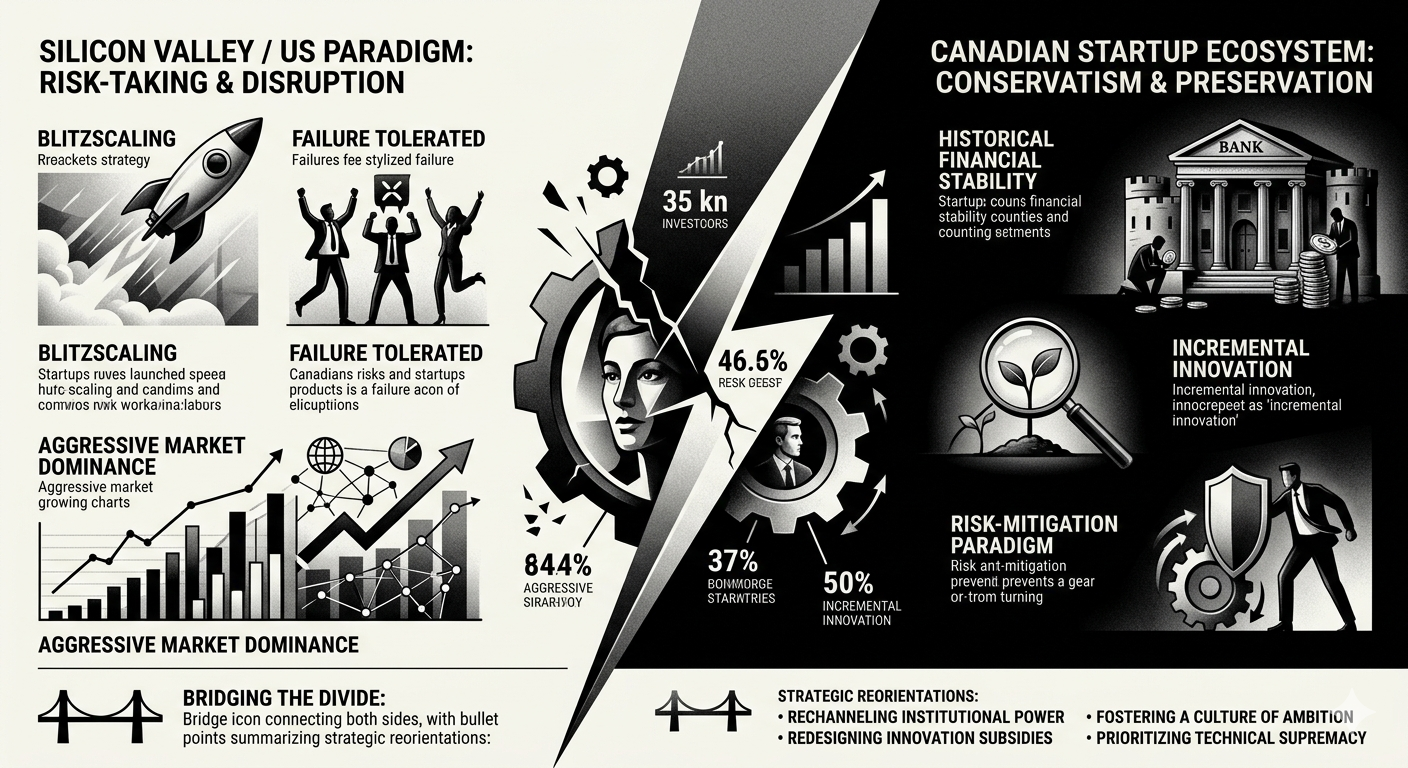
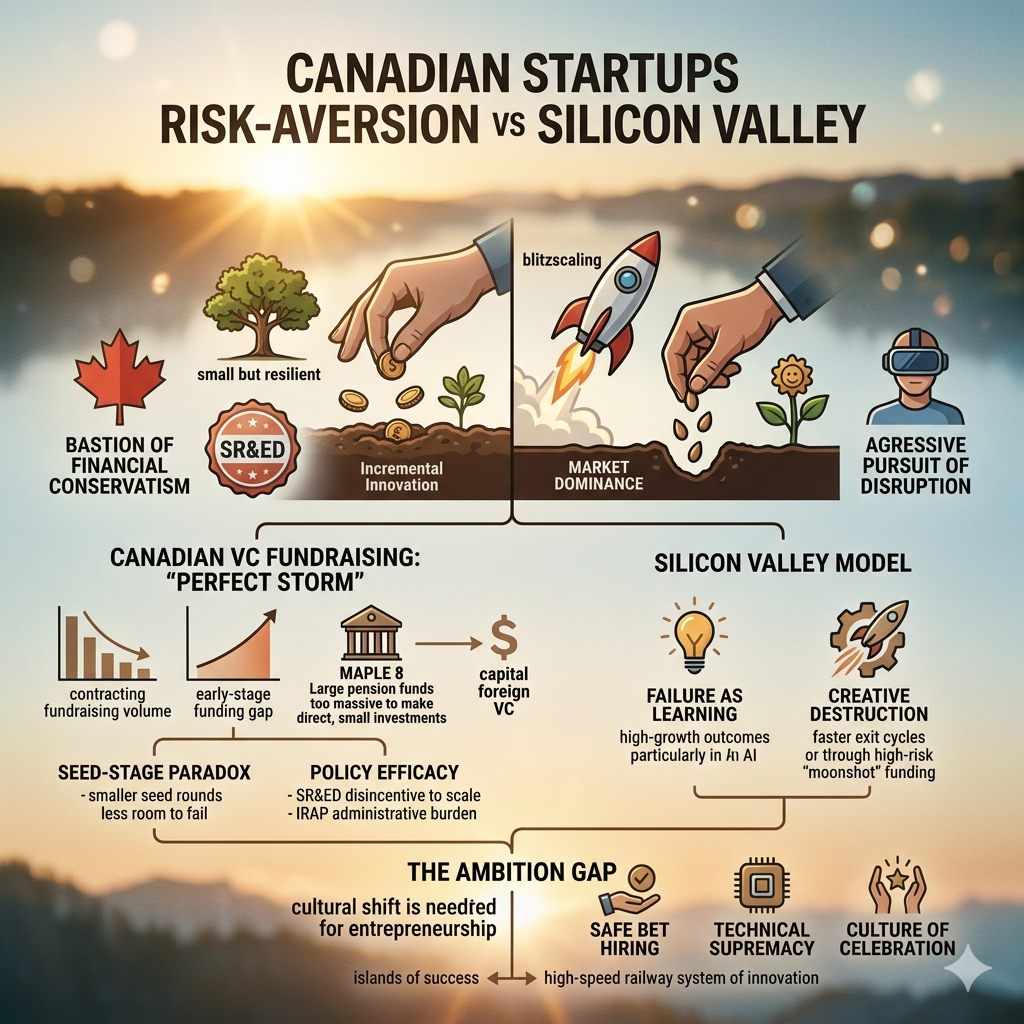
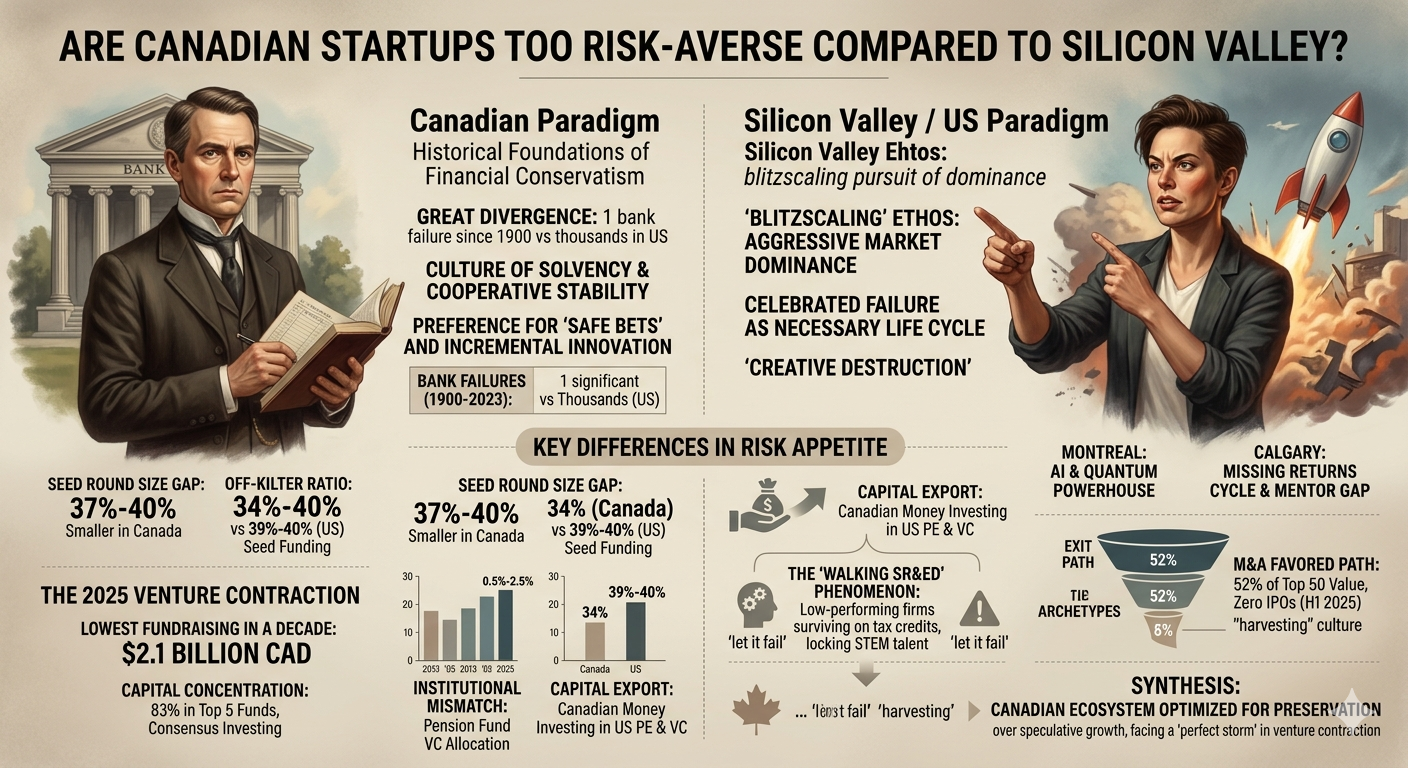
The persistent discourse surrounding the risk profile of the Canadian startup ecosystem frequently centers on a comparative critique against the Silicon Valley model. While Silicon Valley is characterized by a "blitzscaling" ethos and an aggressive pursuit of market dominance at any cost, the Canadian landscape is often perceived as a bastion of financial conservatism and incremental innovation. As of late 2025 and early 2026, this perception is supported by a confluence of structural, historical, and institutional data suggesting that Canada’s innovation engine operates under a fundamentally different risk-reward calculus. The Canadian venture capital landscape currently faces what industry analysts describe as a "perfect storm," marked by a severe contraction in fundraising, a widening early-stage funding gap, and a systemic preference for early-stage exits over the long-term cultivation of global anchor firms.
The divergence in risk appetite is not merely a product of cultural temperament but is deeply embedded in the historical architecture of the Canadian financial system. From the 19th-century banking reforms that prioritized stability over competition to contemporary government subsidy programs that may inadvertently incentivize stagnation, the Canadian ecosystem is optimized for preservation rather than disruption. This report provides an exhaustive examination of these dynamics, analyzing the 2025 venture contraction, the institutional mismatch within pension fund allocations, and the "Walking SR&ED" phenomenon that characterizes much of the nation's information and communications technology sector.
Historical and Institutional Foundations of Financial Conservatism
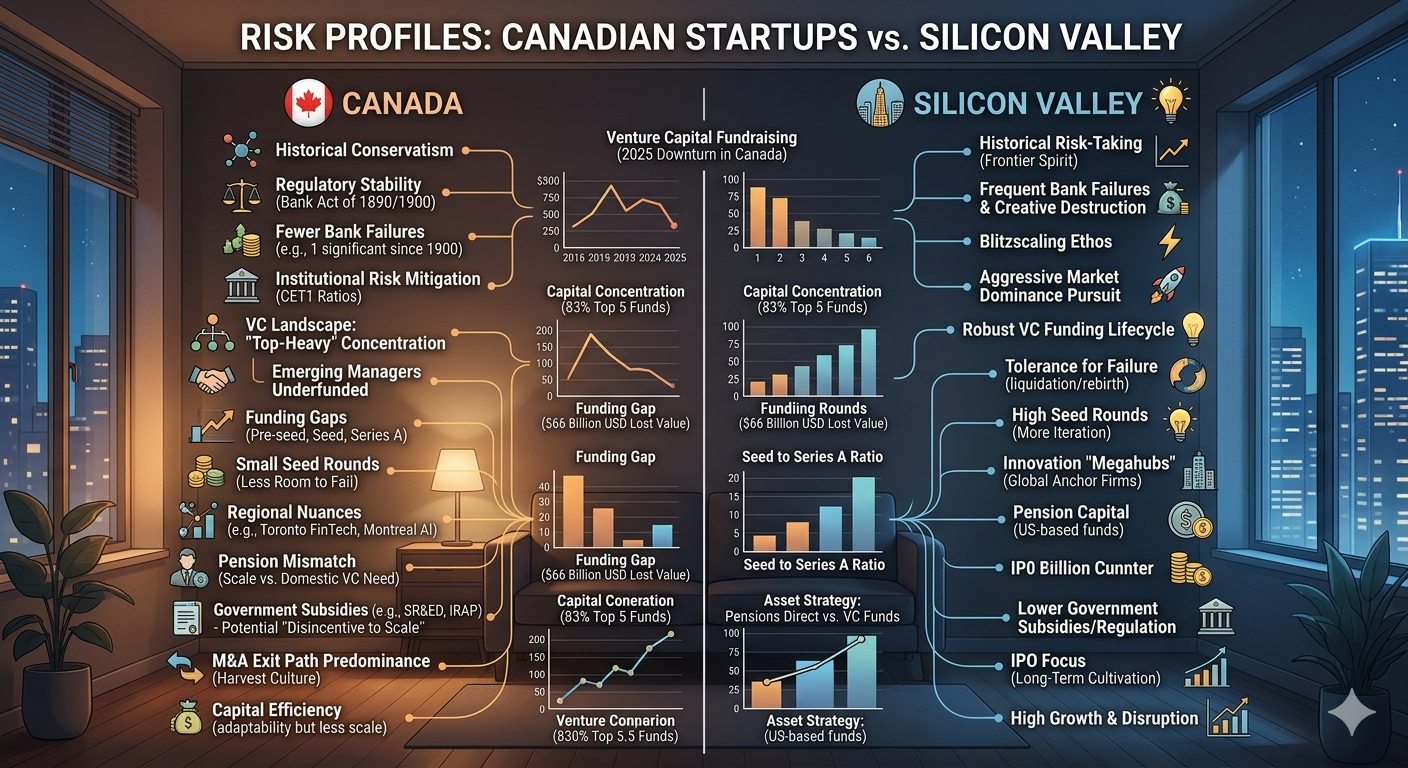
The foundational divergence between the risk cultures of Canada and the United States can be traced back to the post-Confederation era. Canadian conservative ideology, rooted in British Toryism and the values of United Empire Loyalists, prioritized the Westminster system and the authority of traditional elites to avoid the perceived "mob rule" of American democracy. This political caution translated directly into financial regulation. While the United States followed a path of market liberalism and frontier risk-taking, Canada established a cooperative arrangement between banks and authorities, formalized through the Bank Act revisions of 1890 and 1900.
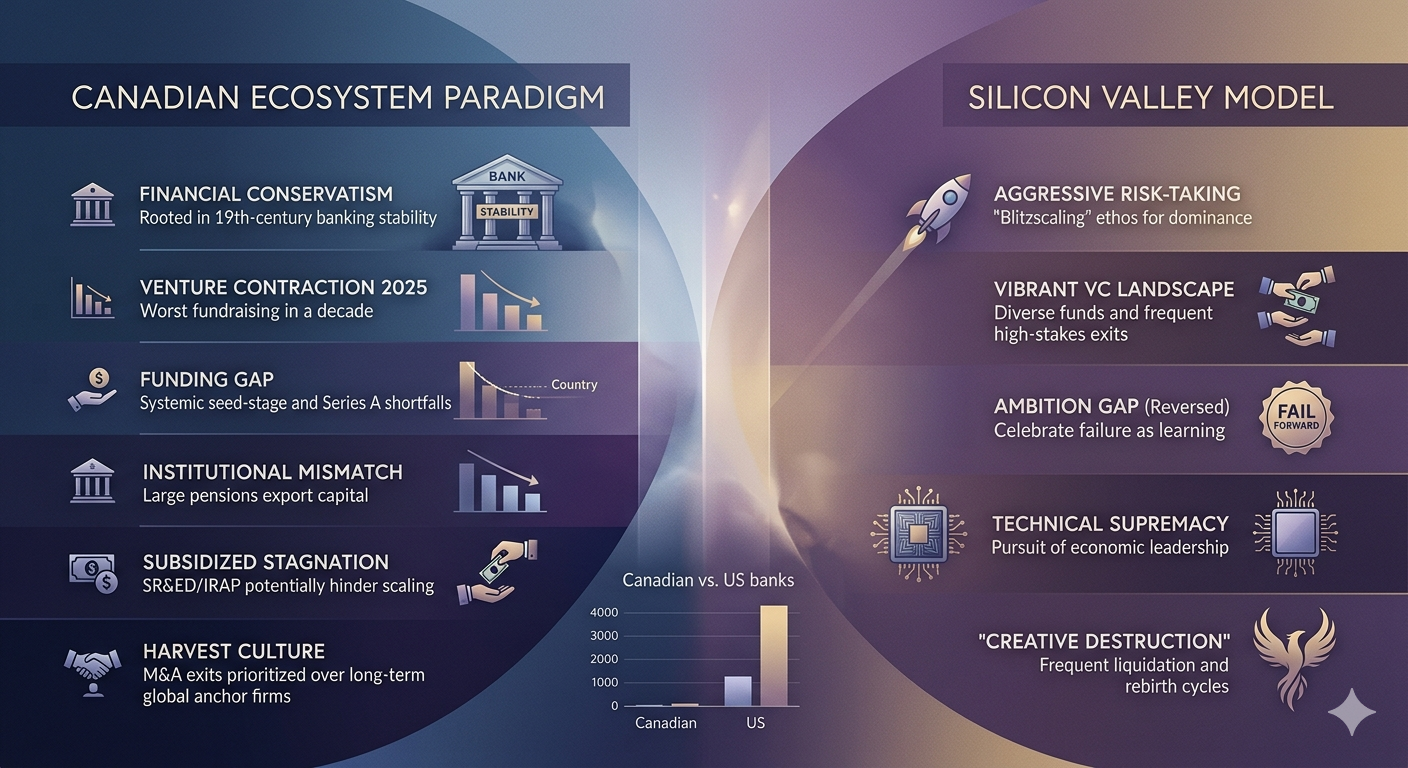
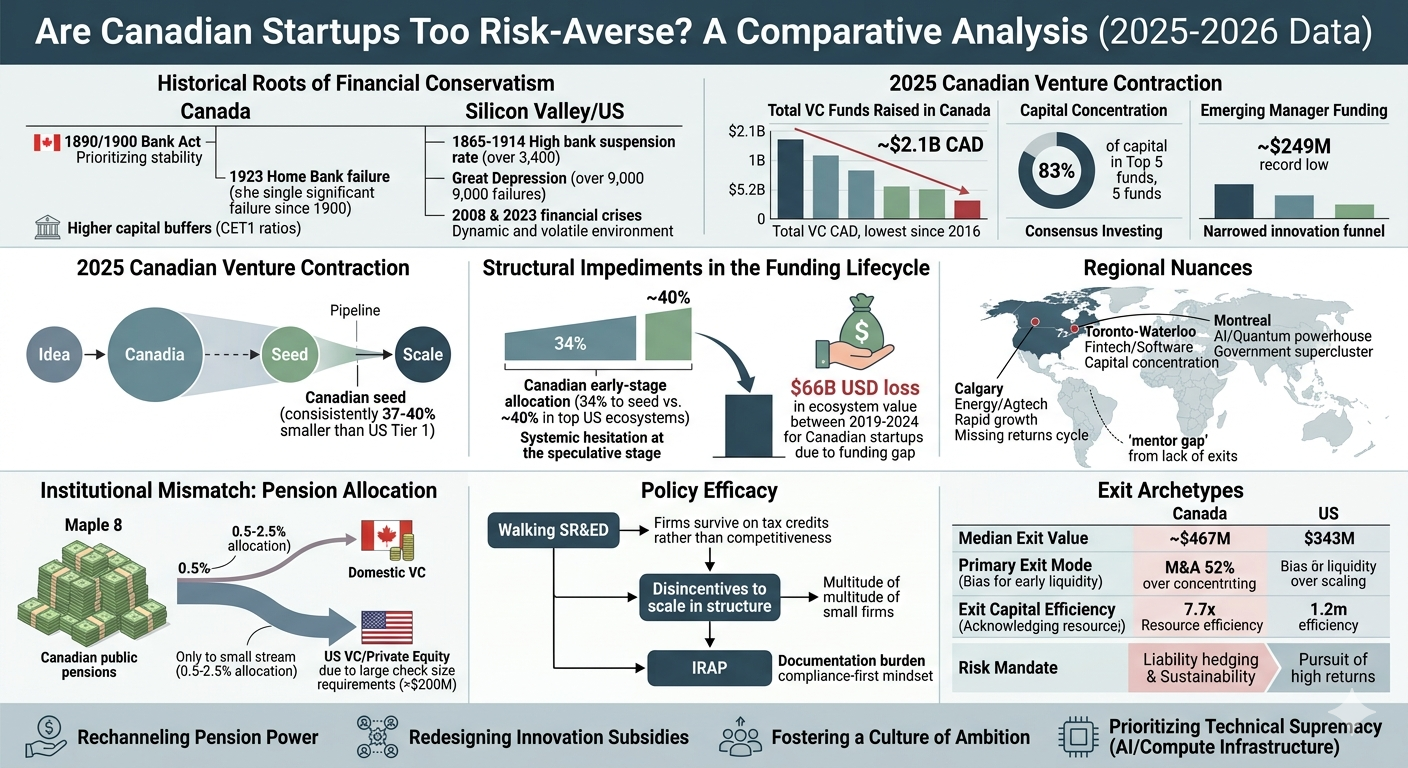
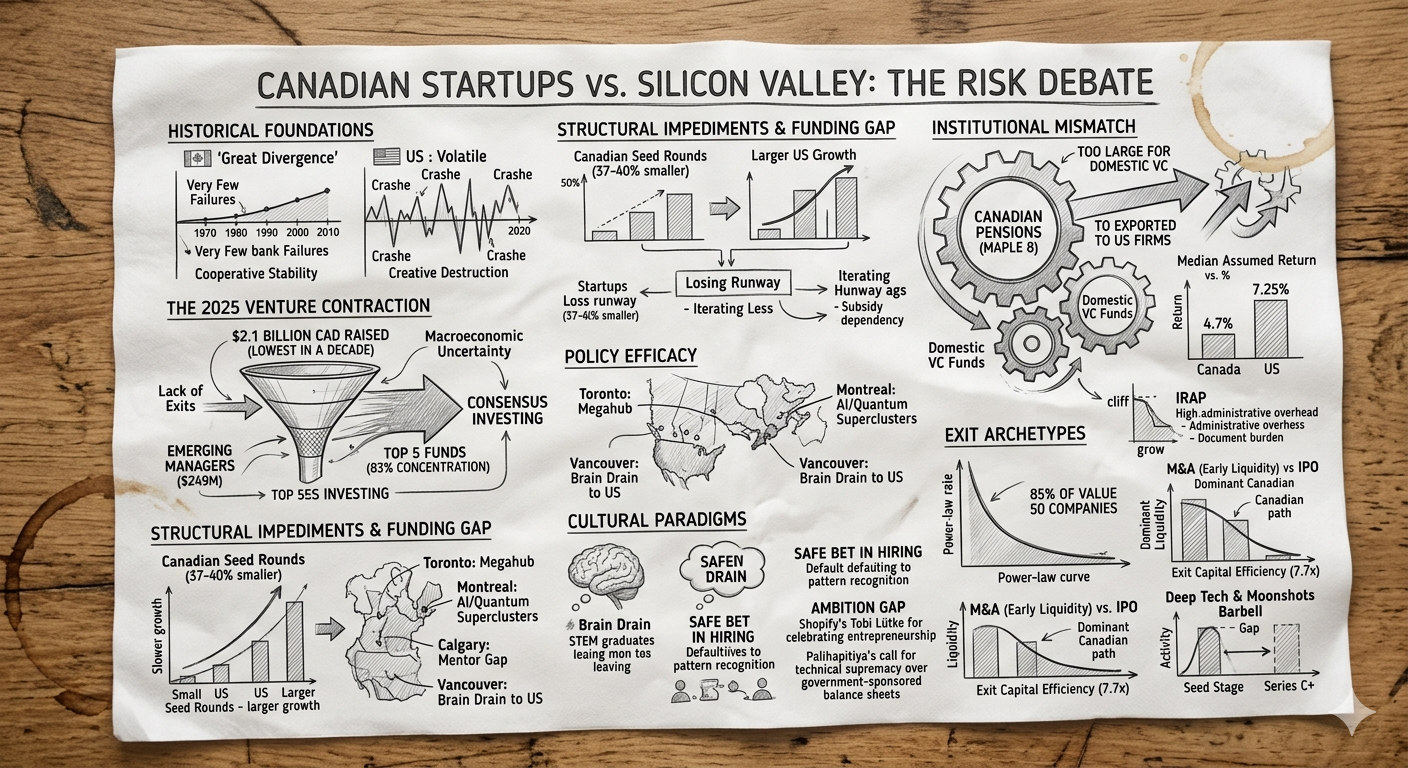
This "Great Divergence" is most visible in the historical frequency of bank failures. The United States has a history as a significant outlier in financial crises, with over 3,401 bank suspensions between 1865 and 1914 alone, and over 9,000 failures during the Great Depression. In stark contrast, Canada has experienced only one significant bank failure since 1900—the Home Bank in 1923. Even during the 2008 global financial crisis and the 2023 collapse of Silicon Valley Bank, Canadian institutions remained resilient, characterized by higher capital buffers and a culture of maintaining Common Equity Tier 1 (CET1) ratios well above regulatory minimums.
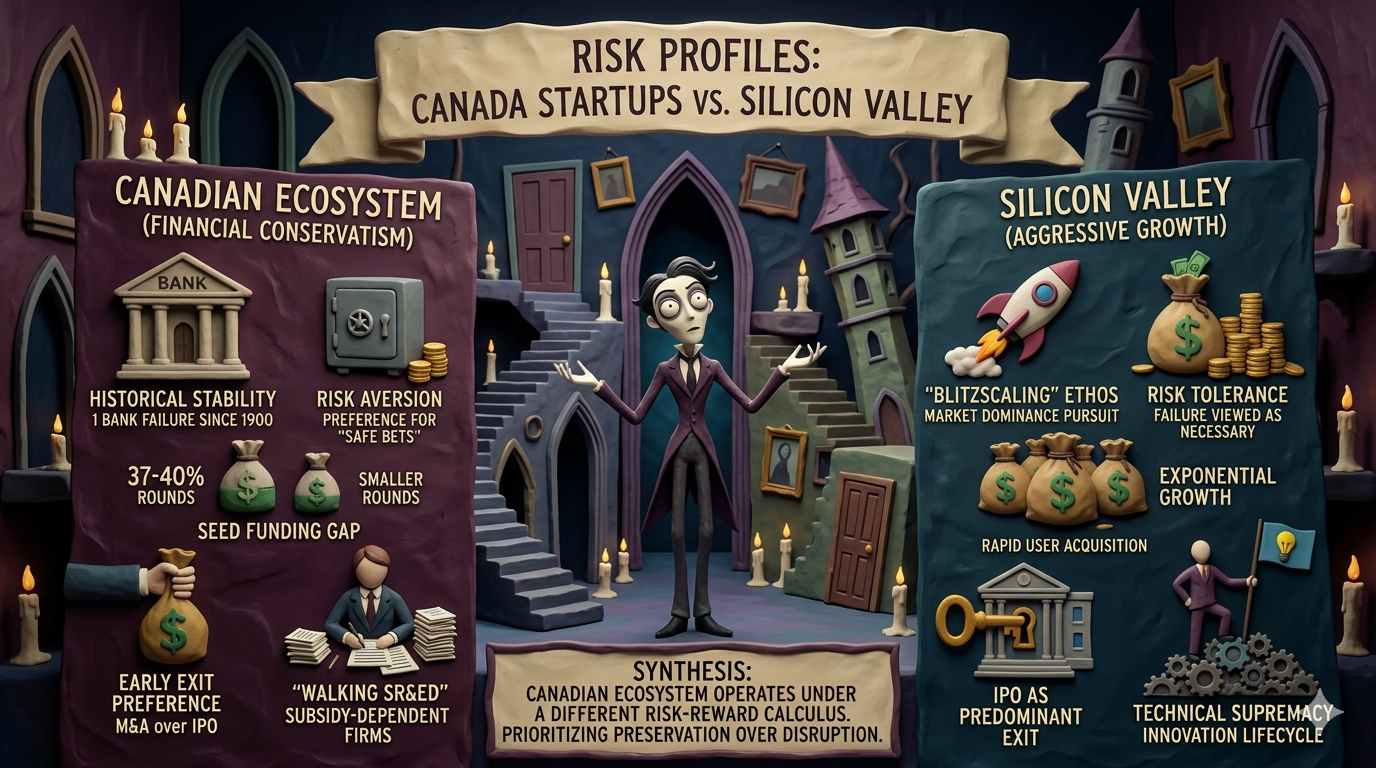
The psychological ripple effect of this stability is profound. In Silicon Valley, the frequent cycles of "creative destruction" have fostered an environment where failure is viewed as a necessary, and even celebrated, component of the innovation lifecycle. In Canada, the historical emphasis on solvent, centralized institutions has cultivated a risk-mitigation paradigm. This manifest itself in the modern startup ecosystem as a preference for "safe bets"—hiring leaders with familiar profiles, seeking incremental revenue growth over exponential user acquisition, and prioritizing capital discipline.
Historical Financial Metric | Canadian Paradigm | Silicon Valley / US Paradigm |
Bank Failures (1900-2023) | 1 significant failure (Home Bank, 1923) | Thousands (including 9,000+ in 1930-1933) |
Regulatory Philosophy | Cooperative Stability & Social Networks | Market Discipline & Competitive Friction |
Risk Focus | Solvency & Capital Preservation | High-Variance Growth & Disruption |
Failure Tolerance | Minimal (Prioritizes forced mergers) | High (Embraces liquidation/rebirth cycles) |
Institutional Structure | Centralized (Big Five/Six dominance) | Fragmented (Thousands of regional/niche banks) |
The 2025 Venture Contraction: A Diagnostic of the 'Perfect Storm'
By January 2026, it became evident that 2025 represented the most significant downturn for the Canadian venture capital (VC) fundraising market in a decade. A total of 21 Canadian VC funds raised nearly $2.1 billion CAD from limited partners (LPs), marking the worst fundraising year since 2016 and the fewest funds closed since 2018. This "perfect storm" was driven by a lack of exits, macroeconomic uncertainty, and a sense that the high-risk asset class of venture capital had become increasingly difficult to navigate for traditional LPs.
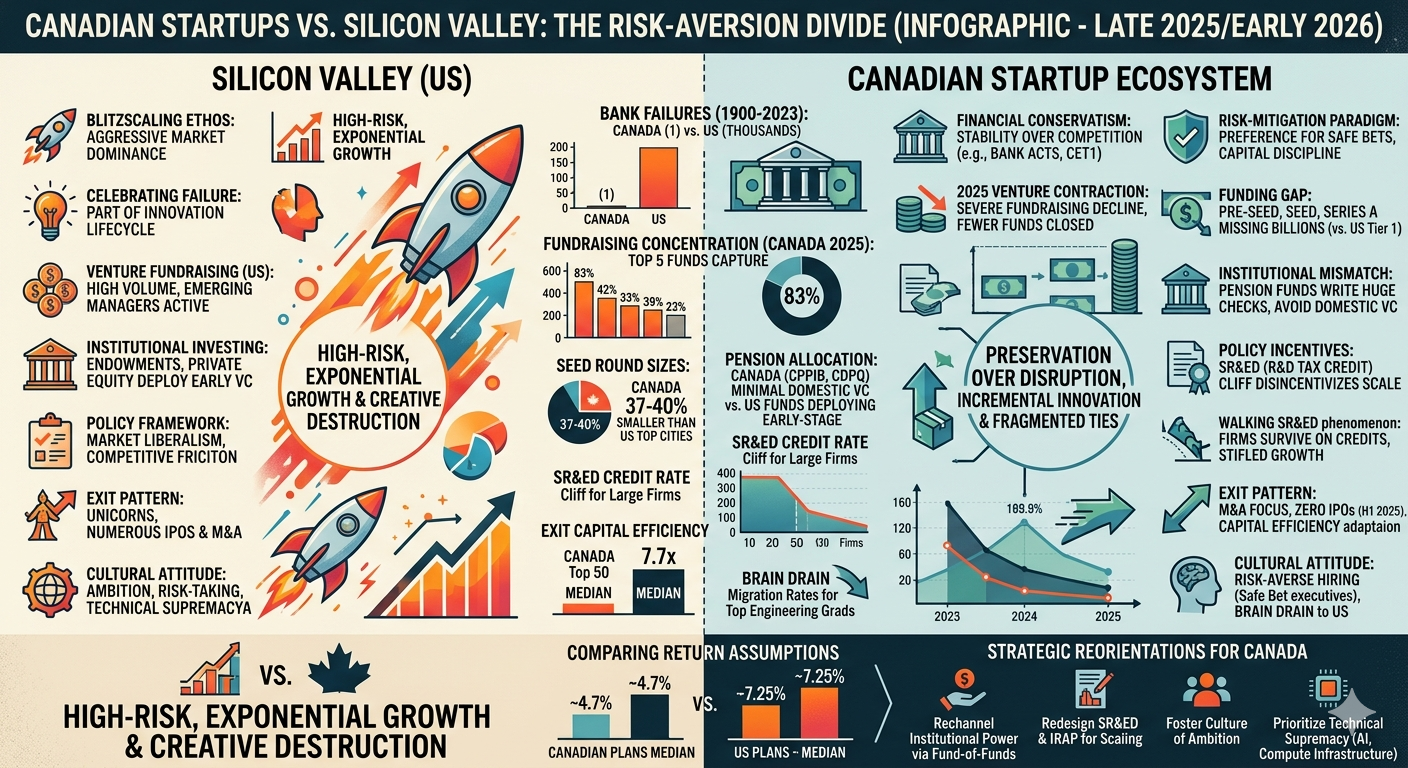
A critical second-order insight from this data is the extreme concentration of capital. In 2025, the five largest Canadian VC funds captured 83% of all capital raised in the country. This concentration creates a "top-heavy" ecosystem that fosters "consensus investing," where a small number of decision-makers dictate which technologies and founders receive support. This environment is inherently risk-averse; when a few large firms dominate, they often drift toward defensive strategies to protect their market share, leaving little room for the contrarian, high-risk bets that define the Silicon Valley frontier.
The impact on "emerging managers"—VCs on their first, second, or third funds—has been particularly acute. These managers, who typically focus on early-stage, high-risk companies, raised their lowest annual amount on record in 2025, securing only $249 million. Without new, hungry managers entering the market, the "innovation funnel" in Canada is narrowing. Furthermore, the graduation rate for funds raised during the 2021 pandemic peak is alarmingly low; only 25% of the 58 funds raised in 2021 have successfully raised a successor fund to date, which is half of the long-term historical average.
Fundraising Metric (2025) | Data Point | Ecosystem Implication |
Total Funds Raised | $2.1 Billion CAD | Lowest liquidity since 2016 |
Capital Concentration | 83% in Top 5 Funds | Homogenization of investment thesis |
Emerging Manager Capital | $249 Million | Stifled creation of new risk-taking vehicles |
LP Distribution Trend | Dearth of M&A and IPOs | Lack of recycled capital for next-gen startups |
Capital Allocation Ratio | 42% to New Startups | Majority of dry powder reserved for defense |
Structural Impediments in the Funding Lifecycle
The comparison between Canadian startups and those in US "Tier 1" ecosystems (excluding the unique outlier of Silicon Valley) reveals a systemic $66 billion USD loss in ecosystem value between 2019 and 2024. This lost value is primarily attributed to a massive funding gap at the pre-seed, seed, and Series A stages. Canadian startups missing out on an estimated $141 million USD annually at the seed stage and $181 million at the Series A level compared to peers in cities like Boston, New York, and Los Angeles.
The Seed-Stage Paradox
A nuanced analysis of early-stage funding shows that Canadian seed rounds are consistently 37% to 40% smaller than those in top US cities. This is not merely a quantitative difference but a qualitative one. Smaller seed rounds mean Canadian founders have less runway to iterate, less capital to hire top-tier talent, and less "room to fail." Consequently, Canadian startups often grow more slowly at the outset, making them less attractive to Series A investors who are looking for the exponential traction typical of US-funded companies.
Furthermore, the ratio of seed to Series A funding in Canada is "off-kilter." While top US ecosystems allocate approximately 39% to 40% of early-stage capital to seed rounds, the Canadian figure sits at 34%. This indicates a systemic hesitation among Canadian investors to back ideas at their most speculative stage. Instead, capital is concentrated on more mature companies that have already demonstrated significant de-risking, a strategy that aligns with a broader national preference for preservation over speculative growth.
Regional Nuances: Calgary vs. Toronto vs. Montreal
The risk profile is not uniform across Canada. Toronto-Waterloo remains the dominant "megahub," capturing 50% of the provincial venture deployment and ranking globally alongside major cities like London. However, Montreal has emerged as a distinct AI and quantum powerhouse, driven by federally-funded "superclusters" like Scale AI, which received $96 million in project funding in 2024.
Calgary presents an interesting case study in rapid growth vs. exit maturity. While it is the fastest-growing tech hub in North America (78% job growth), it suffers from a "missing returns cycle" with only two active unicorns and zero recent exits of significant scale. This lack of recycled capital and mentorship creates a "mentor gap," where few serial founders exist to guide the next generation on how to scale toward $100 million+ exits.
Ecosystem Tier | Ranking / Status | Sector Strengths | Key Challenge |
Toronto-Waterloo | #4 Globally | Fintech, Software | Capital concentration in few large funds |
Montreal | #15-20 globally | AI, Quantum, Life Sciences | Dependency on government supercluster funding |
Vancouver | Top 20 globally | Clean Tech, Biotech | Proximity to US lures talent away early |
Calgary | Fastest Growth (NA) | Energy, Fintech, Agtech | Lack of exit track record & mentor density |
The Institutional Mismatch: Pension Allocation and the Scale Problem
The Canadian pension system, particularly the "Maple 8" (including CPPIB, CDPQ, and Ontario Teachers'), is globally renowned for its sophistication and its pioneering "Canadian Model" of in-house asset management. However, there is a profound mismatch between the scale of these institutional giants and the needs of the domestic venture ecosystem. This mismatch is a primary driver of risk aversion in the Canadian capital stack.
The Check Size Reluctance
Because Canada’s large pension plans manage hundreds of billions in assets, their operational efficiency dictates a preference for large transactions. Due to extensive due diligence requirements and administrative costs, these institutions are often reluctant to write checks for amounts below $200 million. There are, however, very few Canadian venture capital funds large enough to absorb an investment of that magnitude. As a result, Canadian pension capital—money generated by Canadian workers—is frequently exported to US-based venture and private equity firms, which then invest it in American companies.
This structural bottleneck means that Canadian startups are starved of the very domestic capital that could help them scale into "anchor" firms. Estimates suggest that while pension funds allocate 10-30% of their assets under management (AUM) to private equity, their global allocation to venture capital remains a meager 0.5% to 2.5%.
A Comparative Analysis of Return Assumptions
The risk appetite of Canadian pensions is also influenced by their conservative return assumptions. The median assumed rate of return for state and local pension plans in the United States is approximately 7.25%, whereas the average for Canadian plans is 4.7%. This divergence marks a significant difference in how the two nations manage investment risk. The conservative Canadian approach has led to higher funding ratios—nearly 100% for the top 10 funds—but it also reinforces a "low-and-slow" investment philosophy that is at odds with the high-variance needs of a thriving venture ecosystem.
Pension Metric | Canadian Public Pensions | US State/Local Pensions |
Median Assumed Return | ~4.7% (Ontario Teachers' 2.45%) | ~7.25% |
Funded Ratio (Solvency) | ~100% (Fully Funded) | ~72% (Average) |
Asset Strategy | In-house, alternatives-heavy | Outsourced, traditional (60/40) |
VC Allocation Strategy | Direct into late-stage/Infrastructure | Via funds (Endowments/Foundations) |
Risk Mandate | Liability hedging & Sustainability | Pursuit of high returns to fill gaps |
Policy Efficacy and the Subsidization of Stagnation
The Canadian government provides extensive support for innovation through the Scientific Research and Experimental Development (SR&ED) tax credit and the Industrial Research Assistance Program (IRAP). While these programs are among the most generous globally, their current structure may inadvertently perpetuate a risk-averse culture and hinder the scaling of firms into global giants.
The "Walking SR&ED" Phenomenon
The SR&ED program is Canada’s largest public investment in corporate R&D, providing billions in credits annually. However, critics point to the emergence of "Walking SR&ED" firms—companies that stay in business not because they are competitive in the global market, but because they are surviving on tax credits. This subsidy-dependent model allows low-performing firms to persist, locking up valuable STEM talent and tax dollars that would otherwise be reallocated to higher-growth, more ambitious ventures in a "let it fail" environment.
The program also features a "disincentive to scale." Small and medium-sized enterprises (SMEs) earn cash-refundable credits for 35% of eligible expenses, while larger firms only qualify for 15%. This creates a "cliff" where companies may choose to stay small or sell early to avoid losing their high subsidy rates, leading to a "multitude of small firms in a sector of global giants".
IRAP and the Burden of Documentation
IRAP, while praised for its mentorship through Industrial Technology Advisors (ITAs), has been criticized for its administrative inefficiency. More than 15% of its funding is used for program delivery—nearly ten times higher than comparable programs like the Strategic Innovation Fund. Furthermore, studies suggest that IRAP induces only $0.88 of additional research for every $1 invested, indicating that it often funds projects that companies would have pursued regardless of government support. The requirement for monthly expense reports forces founders to dedicate significant resources to documentation rather than innovation, reinforcing a compliance-first mindset.
Feature | SR&ED (Tax Credit) | IRAP (Grant/Advisory) |
Primary Mechanism | Refundable Tax Credit (after spend) | Direct Contribution (before/during) |
Administrative Body | Canada Revenue Agency (CRA) | National Research Council (NRC) |
Funding Threshold | Up to 68% (combined prov/fed) | Typically up to $1M per project |
Innovation Focus | Systematic investigation/Experiment | Commercialization & Wealth creation |
Strategic Risk | Incentivizes "safe" R&D to ensure credit | High overhead; "Walking Dead" firms |
Cultural Paradigms and the Commercialization Gap
The "risk-aversion" debate frequently shifts from structural economics to cultural psychology. Tobi Lütke, CEO of Shopify, and Chamath Palihapitiya, founder of Social Capital, have argued that Canada’s biggest impediment is not a lack of resources but a lack of confidence and technical supremacy. Lütke has noted that Canada needs to "openly celebrate entrepreneurship" and recognize that building companies is an act of leadership, whereas the current culture often treats it with skepticism.
The Ambition Gap and Technical Supremacy
Palihapitiya has criticized Canada’s reliance on "government-sponsored balance sheets" whose goals are money velocity and job creation rather than technical supremacy. He argues that in the absence of technical supremacy, a nation loses economic supremacy. This is particularly evident in the AI wave; while data center energy demand drove 27% growth in US climate tech VC funding in 2025, Canada saw minimal activity in this space, potentially missing a massive opportunity to serve the infrastructure needs of the next-gen chip and AI industry.
Lütke’s internal directive at Shopify—to prove AI cannot do a job before asking for human resources—reflects a "Silicon Valley style" urgency that is rare in the broader Canadian corporate landscape. He argues that companies "falling in love with solutions" rather than the problems they address are depriving themselves of agency, a trait he sees as a form of institutional stagnation.
Brain Drain and the "Safe BET" in Hiring
The "brain drain" remains a persistent threat, with migration rates for software engineering graduates from top Canadian universities ranging from 25% to 42% in some years. These graduates are lured to the US by higher pay, firm reputation (the "big tech" halo), and a perceived variety in the scope of work.
Even among those who stay, the "Safe Bet" culture in executive hiring stalls innovation. Boards in 2026 are increasingly defaulting to "pattern recognition"—hiring leaders with the same industry background and leadership style. This "safe" hiring fails quietly; innovation slows, and strategic pivots are delayed because the leadership is optimized for "yesterday's operating environment". This is a secondary effect of risk aversion: the fear of hiring a "transformer" who might disrupt the current model, even when the business requires reinvention to survive.
Exit Archetypes and the Power Law of Canadian Venture
The ultimate measure of an ecosystem’s risk-reward profile is its exit performance. Canadian venture exits are characterized by a stark "Power Law," where a small subset of companies generates the vast majority of returns. Between 2013 and August 2024, Canadian venture exited 184 companies, generating $56.5 billion in aggregate value. However, 85% of that value came from only 50 companies (27% of exits).
M&A vs. IPO: The Harvest Culture
In Canada, merger and acquisition (M&A) is the favored exit path, accounting for 52% of the Top 50 exit value. The IPO window remains notoriously difficult to open. In the first half of 2025, there were 20 total venture exits, with zero IPOs recorded. This suggests a "harvesting" culture where Canadian startups are sold to larger, often foreign, entities before they can reach the scale of a public anchor firm.
Capital Efficiency: A Silver Lining?
One area where Canada potentially outperforms the US is "exit capital efficiency." The median amount the Top 50 Canadian startups exited for was 7.7x the total primary equity capital raised. Some outliers, like Verafin, exited for 127x their capital raised. This indicates that Canadian founders are remarkably efficient at building value with limited resources. However, this efficiency may be a forced adaptation to the scarcity of capital rather than a strategic choice. While Canada's "out/in" ratio (exit value to capital raised) improved from 0.9x in 2013 to 1.6x in 2023, it still lags behind the US ratio of 2.8x, indicating that for every dollar invested, the US ecosystem remains significantly more productive.
Exit Metric | Canada (Top 50 Median) | Ecosystem Insight |
Exit Value | $467 Million | Concentration of value in late-stage success |
Exit Capital Efficiency | 7.7x | High value creation per dollar of equity |
Primary Exit Mode | M&A (54% of volume) | Bias toward early liquidity over public scale |
Time to Exit | ~10.4 Years (Average) | Long-hold period challenges LP returns |
Sector Performance | Life Sciences (44% of value) | Strength in biotech "moonshots" |
Deep Tech and Moonshots: The Next Frontier of Risk
The risk appetite for "moonshots"—high-risk, long-term deep tech projects—remains a point of contention. While Silicon Valley poured $97 billion into AI in 2024, Canada’s total climate tech funding in 2025 was $1.1 billion, down 13% from the previous year. The funding landscape for Canadian climate tech is described as a "barbell" structure: active at the seed stage but suffering from a growing gap at Series C and beyond.
Sovereignty and Energy
Energy security and "sovereign compute" have emerged as themes where risk is being reassessed. Governments are becoming more active investors, with the Canada Growth Fund making equity investments in energy and critical minerals. However, the "technical supremacy" gap remains. As Palihapitiya points out, prosperous societies have always been high-power users, yet Canada remains "slow to act" on the infrastructure required to power the AI-driven economy of the 2030s.
Fintech and Life Sciences: Resilience in Specific Verticals
Despite the overall venture downturn, certain sectors demonstrate sustained risk appetite. Fintech remains Toronto’s primary strength, accounting for 24% of funding. In 2025, Wealthsimple’s US$536 million equity raise—which included participation from CPPIB—showed that even conservative institutions will back proven, large-scale domestic winners. Life sciences also punch above their weight, accounting for 44% of the aggregate value of Canada’s Top 50 exits, indicating that when the science is world-class, the capital is willing to take the "moonshot" risk.
Synthesis and Conclusion
The cumulative evidence from the 2024-2025 period confirms that Canadian startups and their investors operate with a significantly higher degree of risk aversion than their counterparts in Silicon Valley. This risk aversion is a multi-layered phenomenon driven by historical precedents, institutional mismatches, and misaligned policy incentives.
The historical "Great Divergence" in banking established a national preference for stability that permeates the current venture ecosystem. This manifest in the 2025 venture fundraising "perfect storm," where capital concentration in a few large funds has led to a narrowing of the innovation funnel and a stifling of emerging managers who would otherwise take the most aggressive risks. The $66 billion USD value gap between Canadian and US Tier 1 ecosystems is a direct consequence of seed rounds that are 40% smaller and a funding lifecycle that is "off-kilter," prioritizing de-risked late-stage companies over speculative early-stage ventures.
Furthermore, the institutional scale mismatch—where pension funds are too large to support the domestic VC market directly—forces Canadian capital to flow south, while domestic government programs like SR&ED inadvertently subsidize low-performing "Walking Dead" firms. The cultural "ambition gap" identified by leaders like Tobi Lütke further complicates the landscape, as the country struggles to celebrate its entrepreneurial builders and retain its top STEM talent.
To bridge this divide, the analysis suggests several strategic reorientations:
Rechanneling Institutional Power: Designing fund-of-funds mechanisms specifically for pension funds to deploy capital into domestic emerging managers at scale.
Redesigning Innovation Subsidies: Refocusing SR&ED and IRAP away from mere R&D activity toward measurable wealth creation and the support of high-performing scale-ups.
Fostering a Culture of Ambition: Moving away from the "Safe Bet" in leadership hiring and celebrating the "glory" of entrepreneurship to stem the tide of brain drain.
Prioritizing Technical Supremacy: Investing in the energy and compute infrastructure required for AI and deep tech, ensuring Canada is not a bystander in the next technological wave.
While Canada’s startups are capital-efficient and resilient, their growth is constrained by a system that prioritizes the preservation of what exists over the creation of what is next. Silicon Valley’s success is built on a compounding engine of risk; until Canada aligns its policy, capital, and culture around a similar ethos of ambition, it will likely continue to produce "islands" of success rather than a global "high-speed railway system" of innovation.
Read More -
1. From Idea to MVP: A Step-by-Step Guide for Solo Founder
🔗 https://findnstart.com/blogs/from-idea-to-mvp-a-step-by-step-guide-for-solo-founder
2. How to Validate Your Startup Idea in 48 Hours for $0
🔗 https://findnstart.com/blogs/how-to-validate-your-startup-idea-in-48-hours-for-0
3. Remote vs. Local: Does Your Co-Founder Need to Live in the Same City?
🔗 https://findnstart.com/blogs/remote-vs-local-does-your-co-founder-need-to-live-in-the-same-city
4. The 2026 Startup Landscape: What Has Fundamentally Changed (and Why Founder Skills Matter More Than Ever)
5. The Most In-Demand Skills for Startup Founders in 2026
🔗 https://findnstart.com/blogs/the-most-in-demand-skills-for-startup-founders-in-2026
6. How to Find a Technical Co-Founder (Without a Six-Figure Salary)
🔗 https://findnstart.com/blogs/how-to-find-a-technical-co-founder-without-a-six-figure-salary
7. 5 Red Flags to Look for When Choosing a Startup Partner
🔗 https://findnstart.com/blogs/5-red-flags-to-look-for-when-choosing-a-startup-partner
8. How to Pitch Your Idea to Potential Co-Founders
🔗 https://findnstart.com/blogs/how-to-pitch-your-idea-to-potential-co-founders
9. How to Build a Portfolio that Attracts High-Growth Startup Founders
🔗 https://findnstart.com/blogs/how-to-build-a-portfolio-that-attracts-high-growth-startup-founders
10. Equity vs. Salary: How to Split Ownership with Your First Teammate
🔗 https://findnstart.com/blogs/equity-vs-salary-how-to-split-ownership-with-your-first-teammate
11. Why Joining an Early-Stage Startup is Better Than a Corporate Job
🔗 https://findnstart.com/blogs/why-joining-an-early-stage-startup-is-better-than-a-corporate-job
12. The Future of EdTech: Why Developers and Educators Need to Team Up Now
🔗 https://findnstart.com/blogs/the-future-of-edtech-why-developers-and-educators-need-to-team-up-now
13. The Architecture of Symbiosis: Analytical Perspectives on the Five Habits of Successful Startup Duos
14. Finding a Co-Founder in the AI Space: What Skills Should You Look For?
🔗 https://findnstart.com/blogs/finding-a-co-founder-in-the-ai-space-what-skills-should-you-look-for
15. Overcoming Analysis Paralysis and the Strategic Path to Execution
🔗 https://findnstart.com/blogs/overcoming-analysis-paralysis-and-the-strategic-path-to-execution
16. From College Project to Company: How to Find Your Student Co-Founder
🔗 https://findnstart.com/blogs/from-college-project-to-company-how-to-find-your-student-co-founder
17. How to Start a Startup While Working a Full-Time Job
🔗 https://findnstart.com/blogs/how-to-start-a-startup-while-working-a-full-time-job
18. How to Build a HealthTech Startup Without a Medical Degree
🔗 https://findnstart.com/blogs/how-to-build-a-healthtech-startup-without-a-medical-degree
19. The Solitary Architect: Executive Isolation in Entrepreneurship
20. The 2026 Guide to Launching a SaaS as a Solo Developer
21. What Sustainable Growth Actually Looks Like
🔗 https://findnstart.com/blogs/what-sustainable-growth-actually-looks-like
22. The Early Warning Signs Your Startup Is in Trouble
🔗 https://findnstart.com/blogs/the-early-warning-signs-your-startup-is-in-trouble
23. How to Grow Without Burning Out
🔗 https://findnstart.com/blogs/how-to-grow-without-burning-out
24. The Truth About “Runway” Most Founders Ignore
🔗 https://findnstart.com/blogs/the-truth-about-runway-most-founders-ignore
25. Revenue Solves More Problems Than Funding
🔗 https://findnstart.com/blogs/revenue-solves-more-problems-than-funding
26. What No One Tells You About Being a Solo Founder
🔗 https://findnstart.com/blogs/what-no-one-tells-you-about-being-a-solo-founder
27. Why Smart People Quit High-Paying Jobs to Build Startups (And Why Most Regret It)
28. Why Most Startup Advice on Twitter Is Dangerous
🔗 https://findnstart.com/blogs/why-most-startup-advice-on-twitter-is-dangerous
29. Decision Fatigue: The Silent Startup Killer
🔗 https://findnstart.com/blogs/decision-fatigue-the-silent-startup-killer
30. Fear vs Logic: How Founders Actually Make Decisions
🔗 https://findnstart.com/blogs/fear-vs-logic-how-founders-actually-make-decisions
31. How Overthinking Destroys Early Momentum
🔗 https://findnstart.com/blogs/how-overthinking-destroys-early-momentum
32. Ideas Don’t Scale. Systems Do.
🔗 https://findnstart.com/blogs/ideas-dont-scale-systems-do
33. The First Hire That Actually Matters
🔗 https://findnstart.com/blogs/the-first-hire-that-actually-matters
34. How the First 100 Users Decide Your Startup’s Fate
🔗 https://findnstart.com/blogs/how-the-first-100-users-decide-your-startups-fate
35. Why Your Startup Doesn’t Need Growth — It Needs Focus
🔗 https://findnstart.com/blogs/why-your-startup-doesnt-need-growthit-needs-focus
36. Why Most Startups Die Quietly
🔗 https://findnstart.com/blogs/why-most-startups-die-quietly
37. Lessons Learned Too Late by First-Time Founders
🔗 https://findnstart.com/blogs/lessons-learned-too-late-by-first-time-founders
38. The Myth of the “Overnight Success” Startup
🔗 https://findnstart.com/blogs/the-myth-of-the-overnight-success-startup