AI-Native, Low-Headcount Startups
June 29, 2026 by Harshit Gupta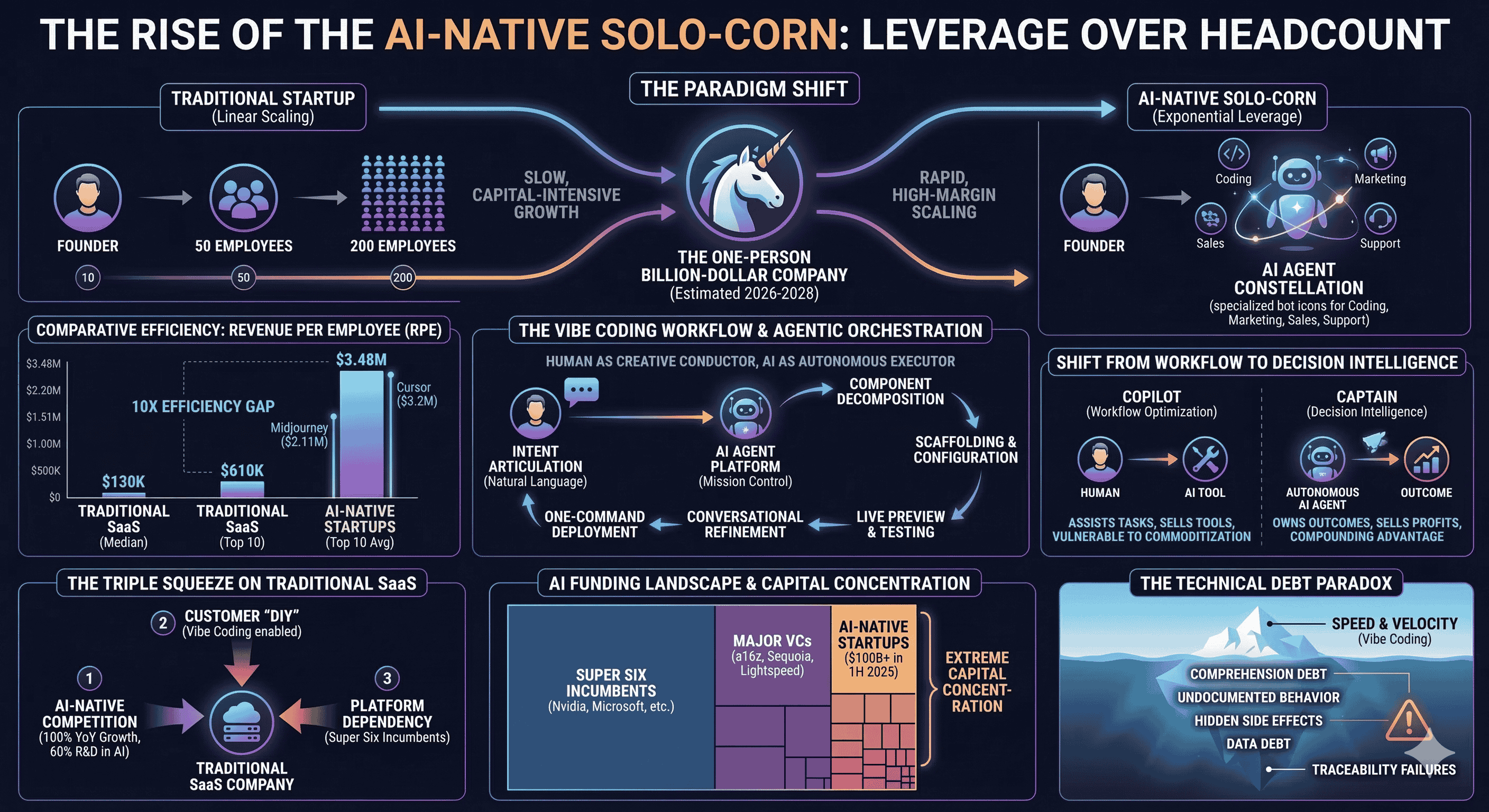
The contemporary startup ecosystem is currently navigating a fundamental reorganization of the relationship between labor, capitalization, and valuation. Historically, the trajectory of a successful technology venture was defined by a linear, albeit aggressive, expansion of headcount to support scaling infrastructure, customer acquisition, and product development. However, the advent of generative artificial intelligence and autonomous agentic systems has introduced a structural condition that industry analysts and technologists have termed the "one-person unicorn" or "solo-corn". This phenomenon describes a business entity achieving a valuation exceeding one billion dollars with a workforce that remains in the single digits, or in its most extreme form, comprises only the founder. This shift is not merely a quantitative reduction in payroll but a qualitative transformation in how organizational intent is translated into market value. As the cost of software authorship, content generation, and operational orchestration trends toward zero, the competitive moat of a company is migrating from the size of its human workforce to the sophistication of its "synthetic workforce" and the proprietary decision intelligence of its autonomous agents.
The Historical Evolution of Organizational Lean-ness
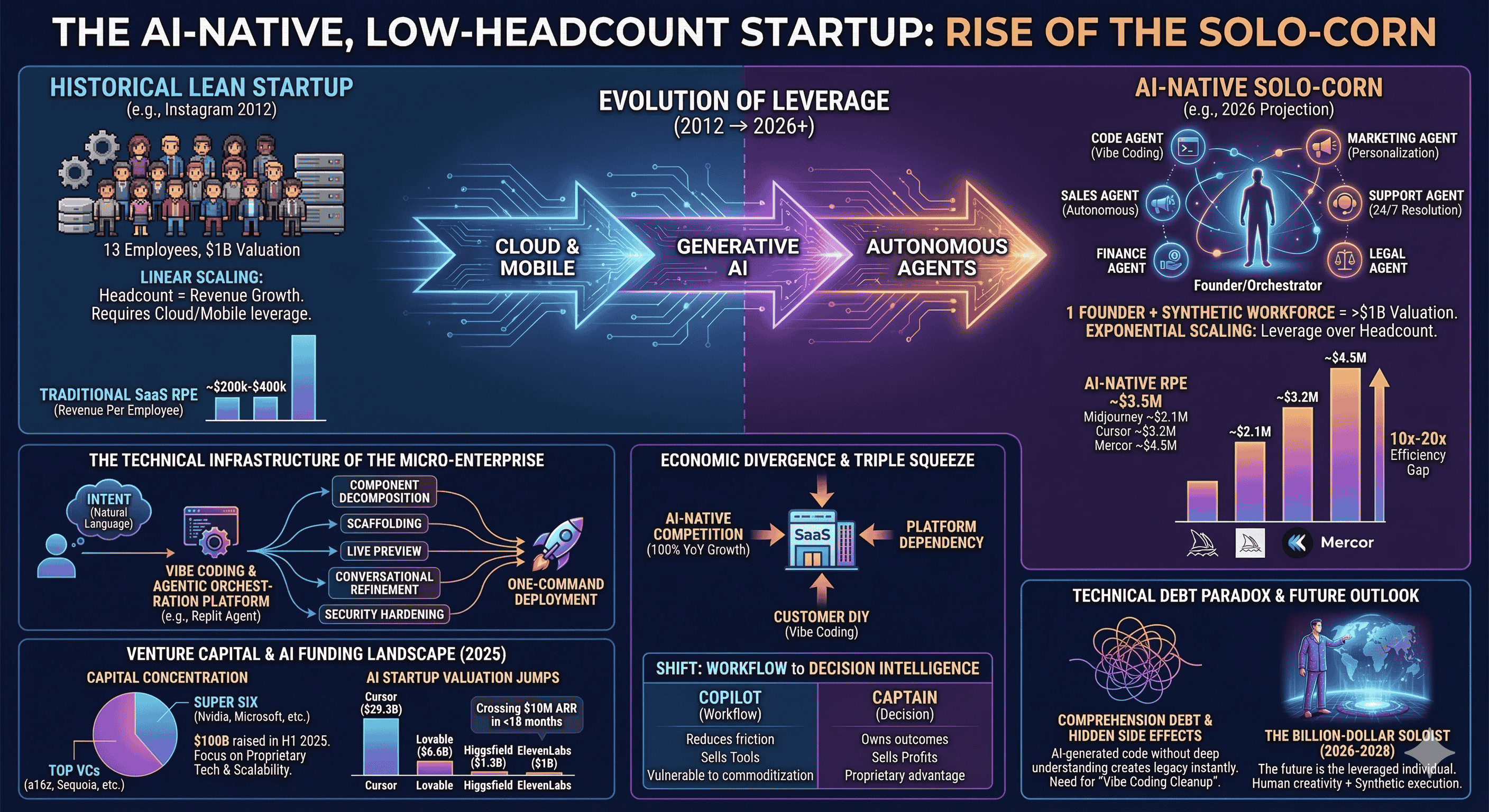
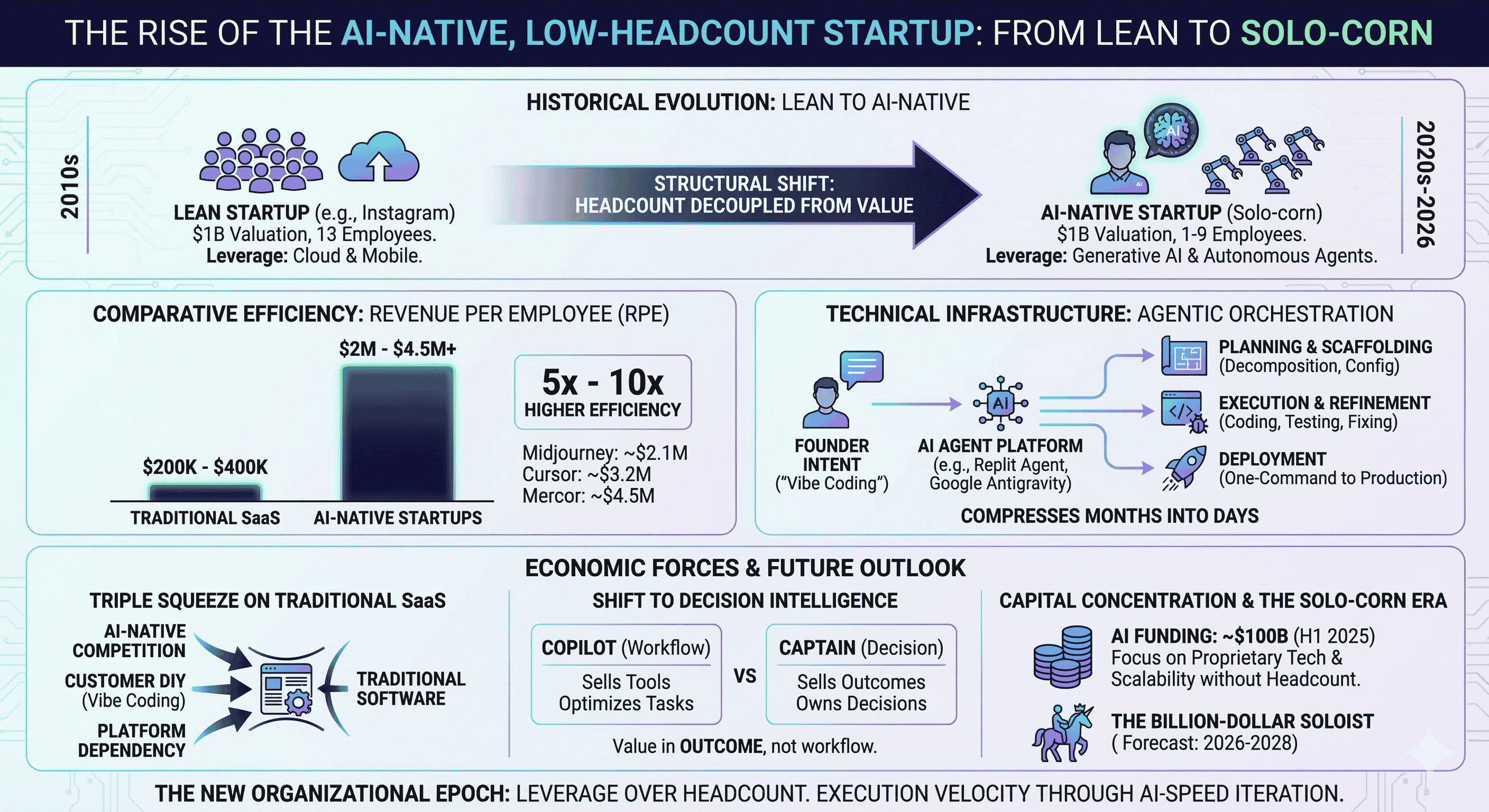
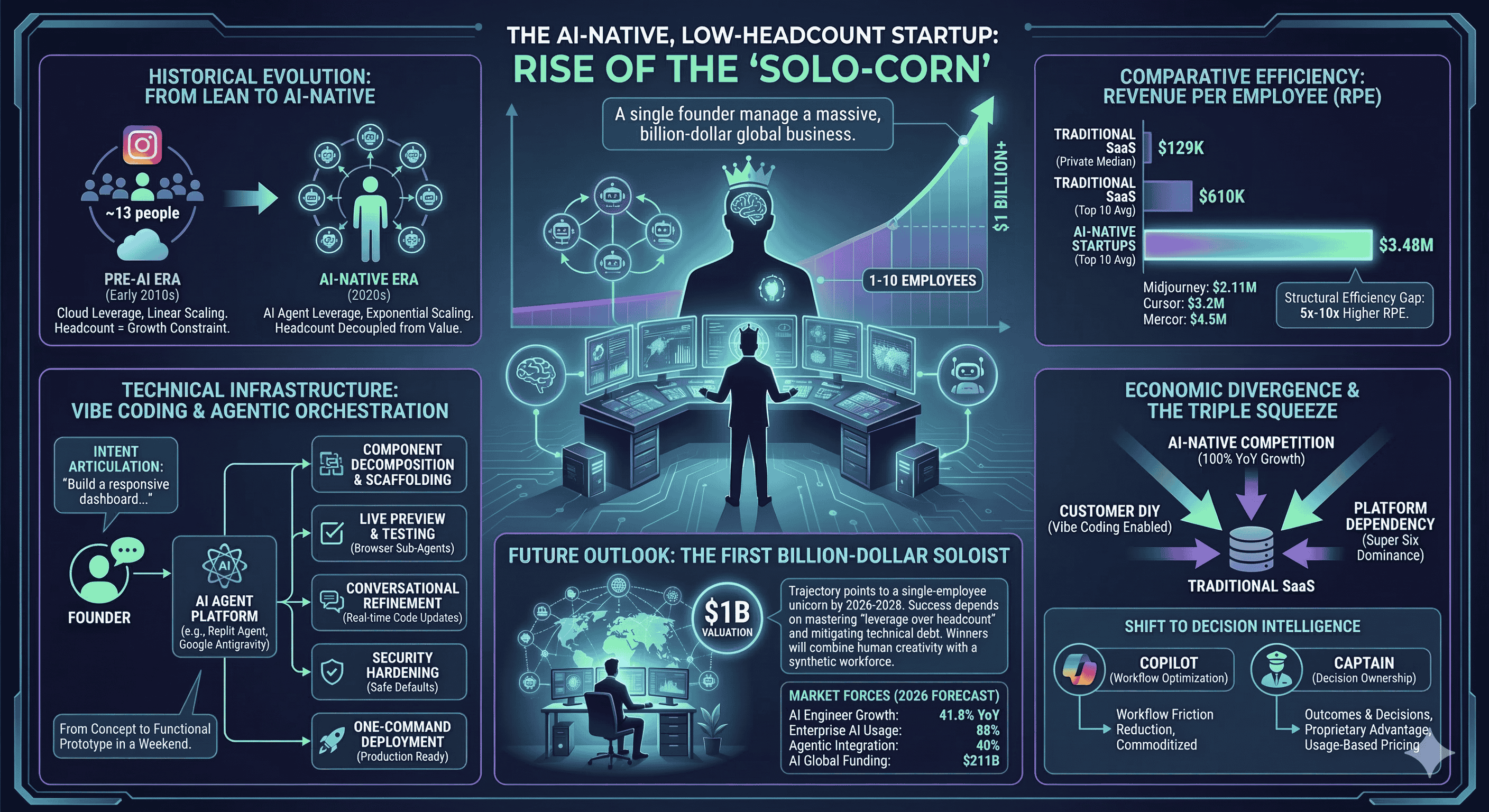
To understand the novelty of the AI-native micro-enterprise, it is necessary to contrast it with the lean startup models of the previous decade. In the early 2010s, companies like Instagram and WhatsApp established a precedent for reaching massive scale with minimal staff. Instagram, for instance, grew to 30 million users and achieved a $1 billion acquisition by Facebook with only 13 employees. While this was considered a radical outlier at the time, the underlying mechanism was the leverage provided by cloud infrastructure and mobile distribution networks. However, these companies eventually reached a point where further scaling necessitated absorption into larger corporate hierarchies to manage the complexities of global operations, legal compliance, and diverse revenue streams.
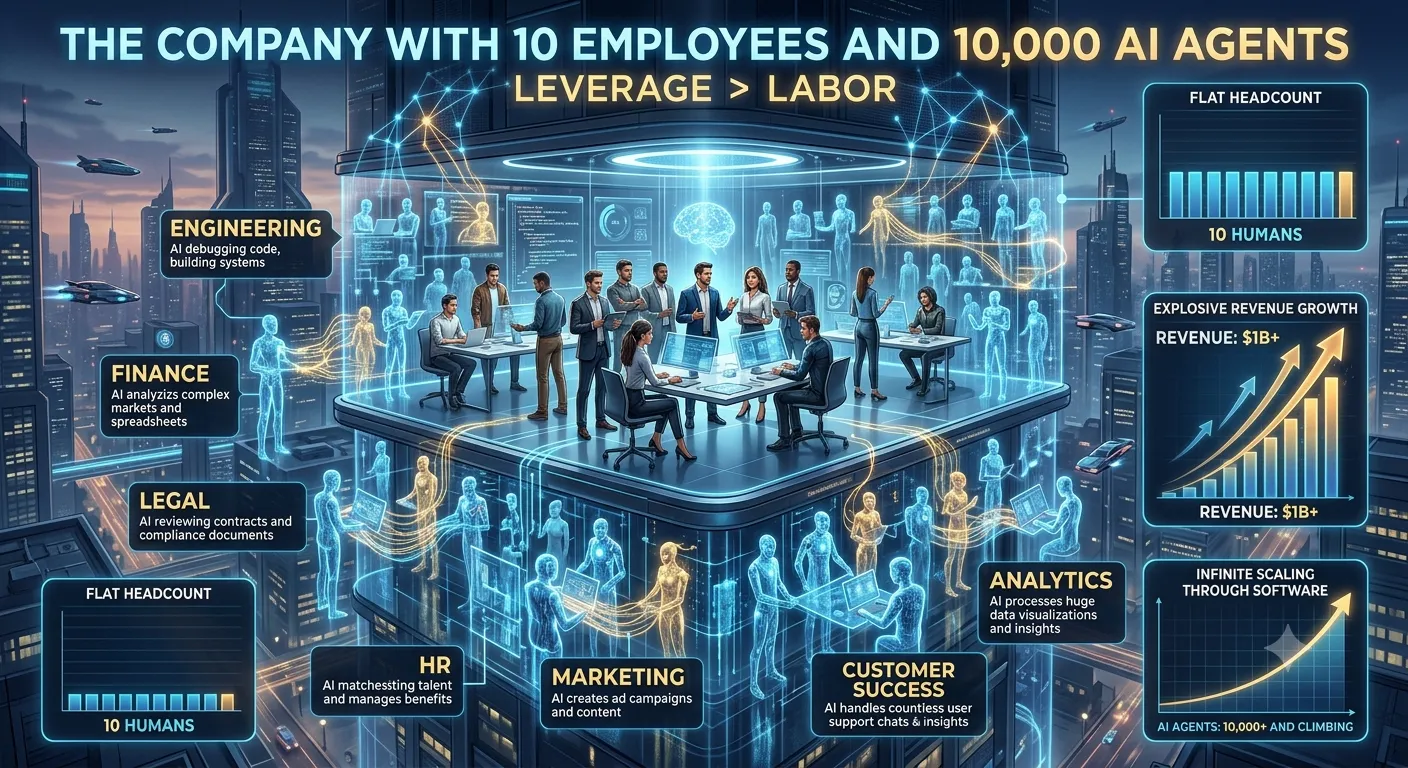
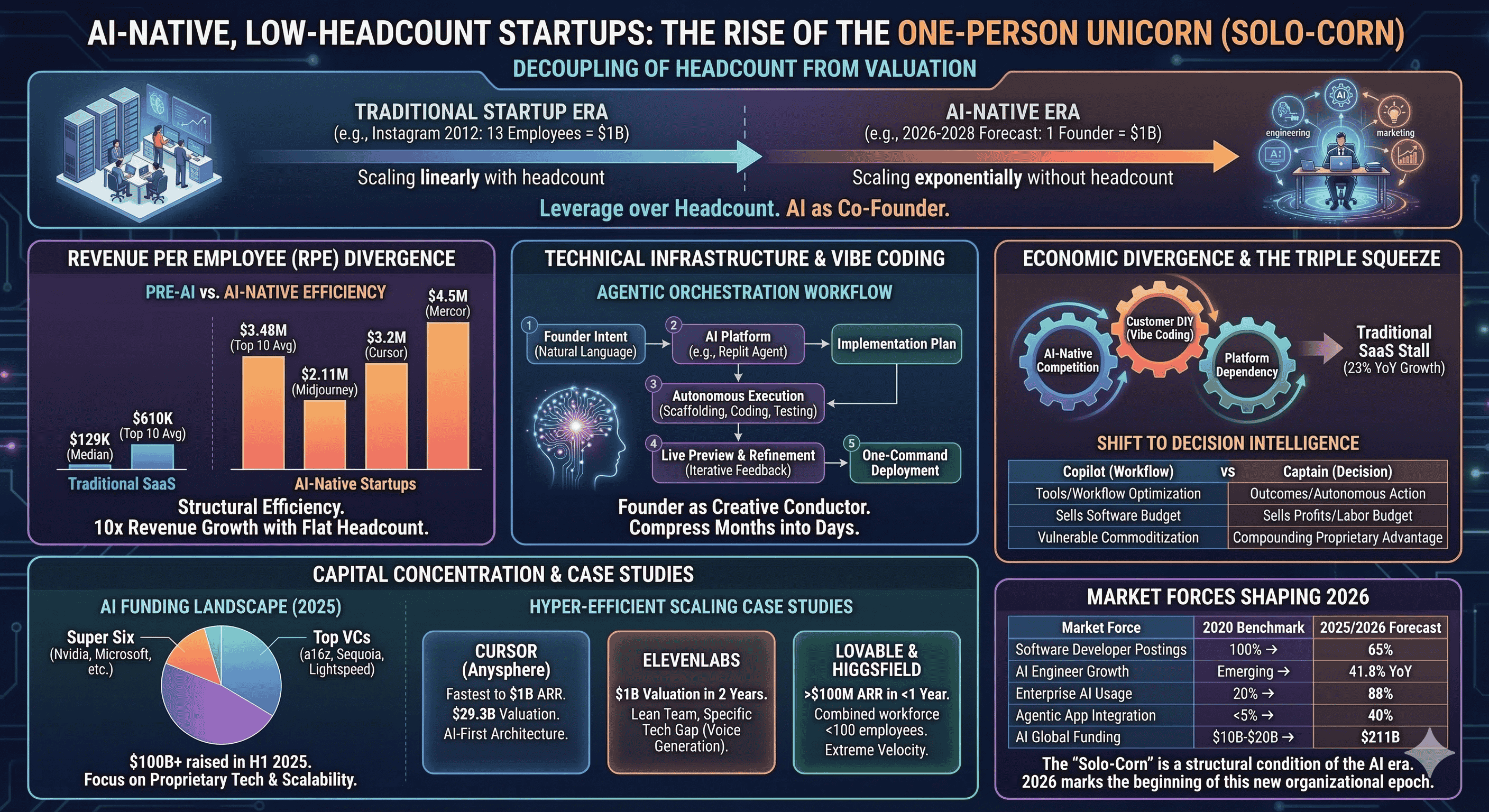
The AI-native era introduces a different paradigm. Where Instagram required 13 humans to manage its initial growth, a modern equivalent leverages a constellation of specialized AI agents to handle engineering, marketing, and customer support. The vision articulated by leaders such as Sam Altman of OpenAI and Dario Amodei of Anthropic suggests that by 2026 or 2028, the first one-person company will reach a billion-dollar valuation. This is facilitated by the fact that AI is no longer a simple tool for productivity but a silent co-founder capable of executing complex tasks from decision-making to execution. The historical pattern of expanding headcount as a prerequisite for expansion is being replaced by a model of "leverage over headcount," where execution velocity is maintained through AI-speed iteration cycles rather than human recruitment.
Comparative Organizational Efficiency: Pre-AI vs. AI-Native
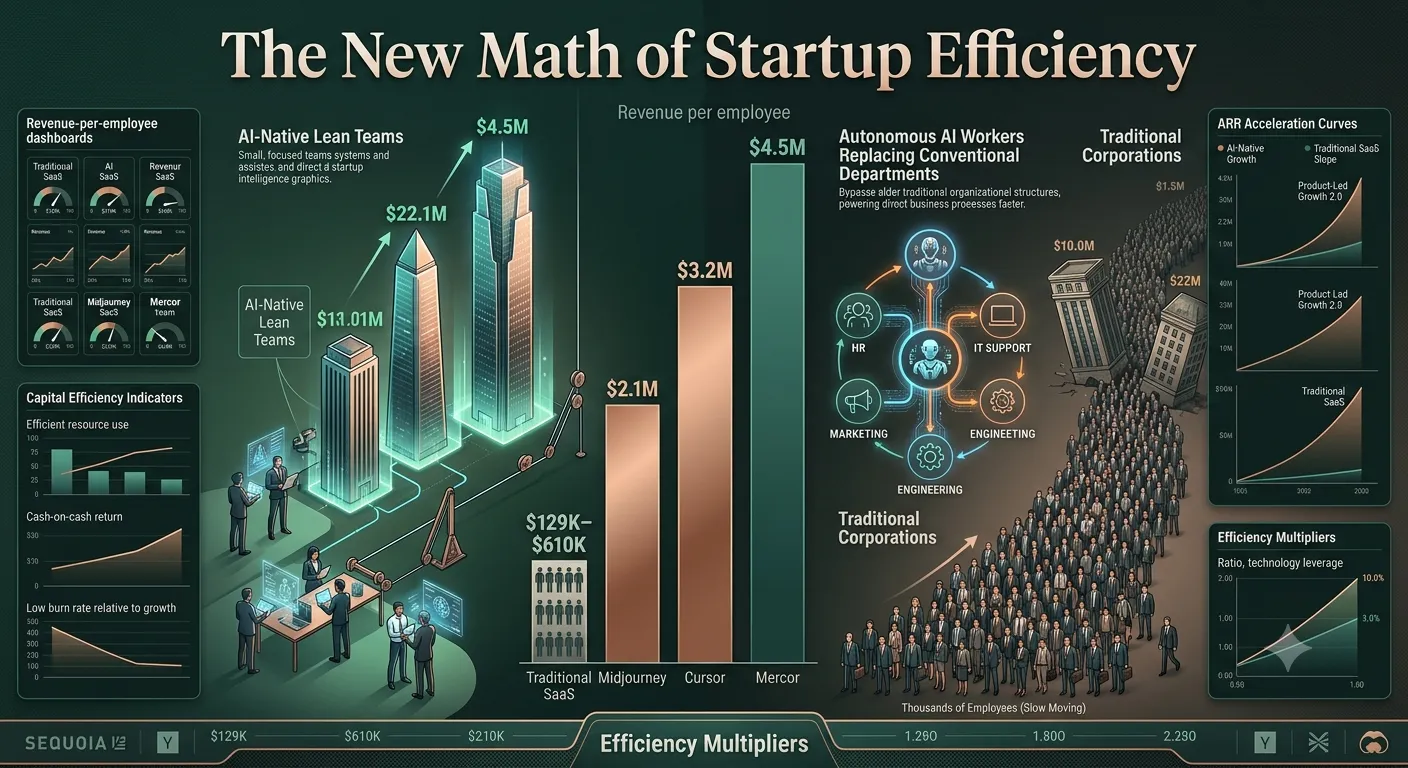
The economic divergence between traditional software-as-a-service (SaaS) firms and AI-native startups is most clearly visible in revenue-per-employee (RPE) metrics. While traditional SaaS companies have historically targeted an RPE between $200,000 and $400,000, AI-native firms are currently achieving figures that are five to ten times higher.
Organization Type | Metric | Performance Benchmark | Source |
Traditional SaaS (Private Median) | Revenue per Employee | $129,724 | |
Traditional SaaS (Top 10 Avg) | Revenue per Employee | $610,668 | |
AI-Native Startups (Top 10 Avg) | Revenue per Employee | $3,480,000 | |
Midjourney (2024) | Revenue per Employee | $2,110,000 | |
Cursor (Anysphere) | Revenue per Employee | $3,200,000 | |
Mercor | Revenue per Employee | $4,500,000 |
This gap is characterized as structural rather than cyclical, suggesting that AI-native firms have baked efficiency into their core business models rather than simply hiring more talented individuals. The "New Math" of the AI era suggests that a company can achieve 10x revenue growth with a flat or even decreasing headcount, as demonstrated by mature firms like Palantir and Shopify that have leaned into AI-first operations.
The Technical Infrastructure of the Micro-Enterprise
The primary enabler of the solo-corn is the emergence of "vibe coding" and agentic orchestration platforms. Vibe coding, a term popularized by Andrej Karpathy, describes a workflow where the developer describes desired functionality in natural language and guides autonomous agents to handle the implementation. This paradigm shifts the human role from a manual coder to a "creative conductor" or "orchestrator," focusing on high-level intent rather than the minutiae of syntax or boilerplate.
The Vibe Coding Workflow and Agentic Orchestration
The transition from AI-assisted engineering to agentic development is defined by the autonomy of the systems involved. Traditional tools like GitHub Copilot operate as suggestion engines, whereas agentic platforms like Replit Agent or Google’s Antigravity autonomously execute multi-step development projects. In these environments, the founder defines a high-level objective, such as building a responsive financial dashboard, and the agent initiates a "mission control" sequence.
The sequence begins with the generation of an implementation plan, which serves as a technical blueprint detailing the files to be created and the logic to be employed. Once the human provides their "vibe" or feedback on this plan, the agent moves into the execution phase, installing dependencies, creating database schemas, and fixing its own linting errors in real-time. Sophisticated agents even deploy "browser sub-agents" to capture visual proof of the working UI, clicking buttons and navigating pages to ensure the final product aligns with the founder's intent. This conversational loop allows a non-technical founder to "prompt their way" to a viable product, effectively flattening the steep learning curve traditionally associated with software engineering.
Implementation Steps in the Agentic Development Lifecycle
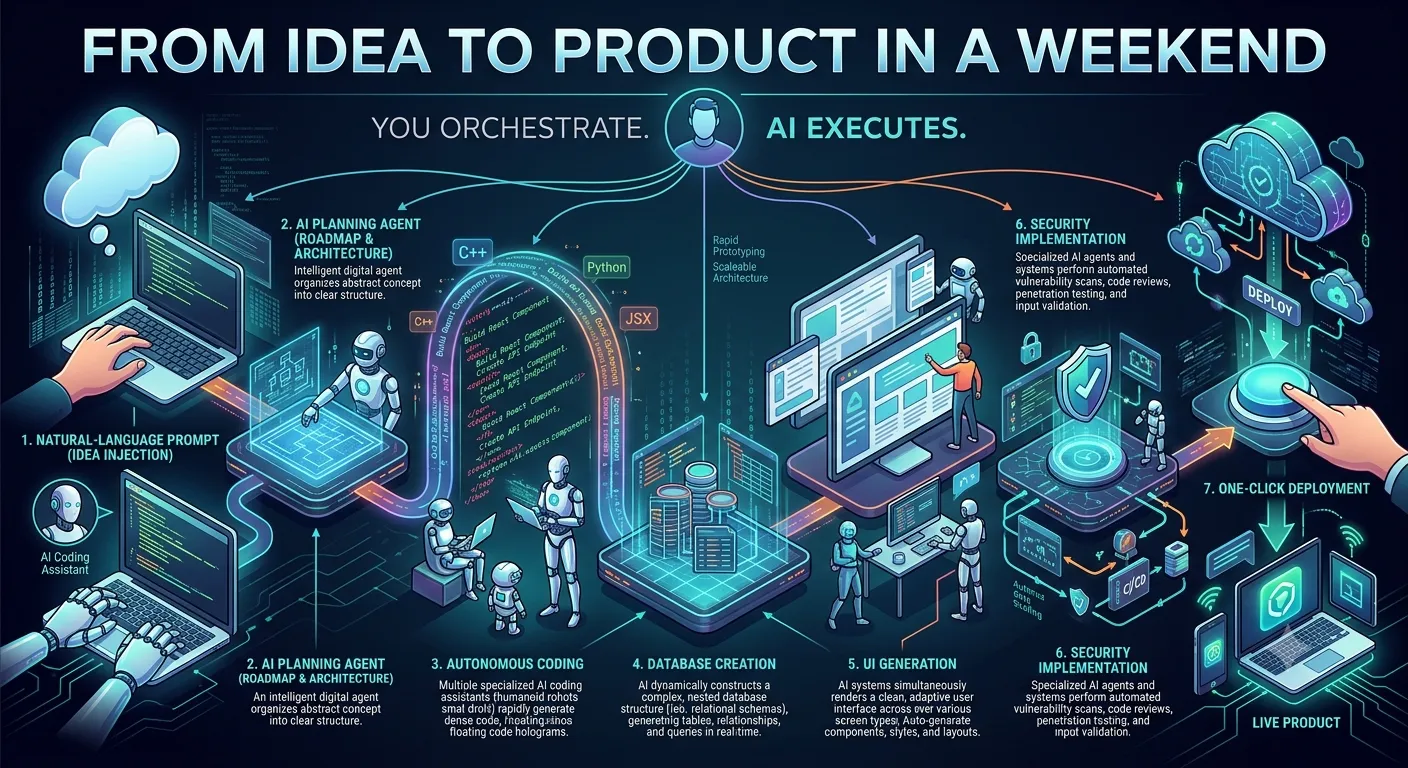
The workflow for an AI-native micro-startup follows a highly iterative and autonomous path that compresses months of traditional development into days.
Intent Articulation: The founder shares an idea or an "itch" for a specific feature or automation using natural language.
Component Decomposition: The AI platform breaks the prompt into required backend, frontend, and API components.
Scaffolding and Configuration: The system automatically configures hosting, environment variables, authentication, and database models.
Live Preview and Functional Testing: The founder receives a live environment where they can test the UI behavior on the first run.
Conversational Refinement: The founder requests design changes or functional updates, and the AI updates the code instantly.
Security Hardening: The founder asks the platform to apply security rules and user roles, which are implemented via safe defaults.
One-Command Deployment: The finished application is deployed to production, with the platform managing builds and custom domains.
This "DX" (Developer Experience) advantage allows solo founders to bypass the traditional bottleneck of hiring an engineering team, moving from concept to functional prototype in a single weekend.
Economic Divergence and the Triple Squeeze
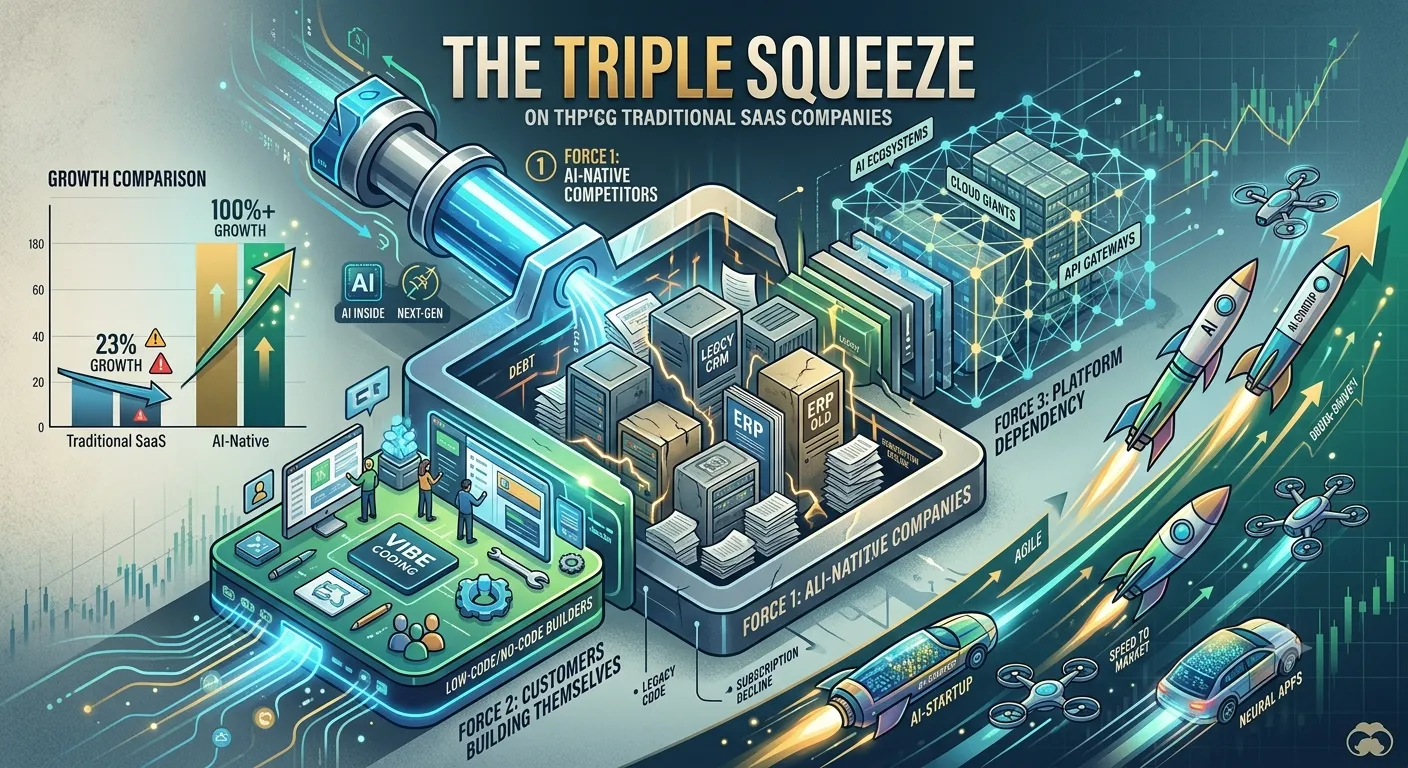
The emergence of AI-native startups is creating a "Triple Squeeze" on traditional SaaS companies. This phenomenon combines three coordinated threats: AI-native competitive pressure, customer "DIY" enabled by vibe coding, and platform dependency. AI-native companies, which dedicate an average of 56-60% of their R&D budget to AI, are growing at 100% year-over-year, while traditional SaaS companies stall at 23%.
The Shift from Workflow to Decision Intelligence
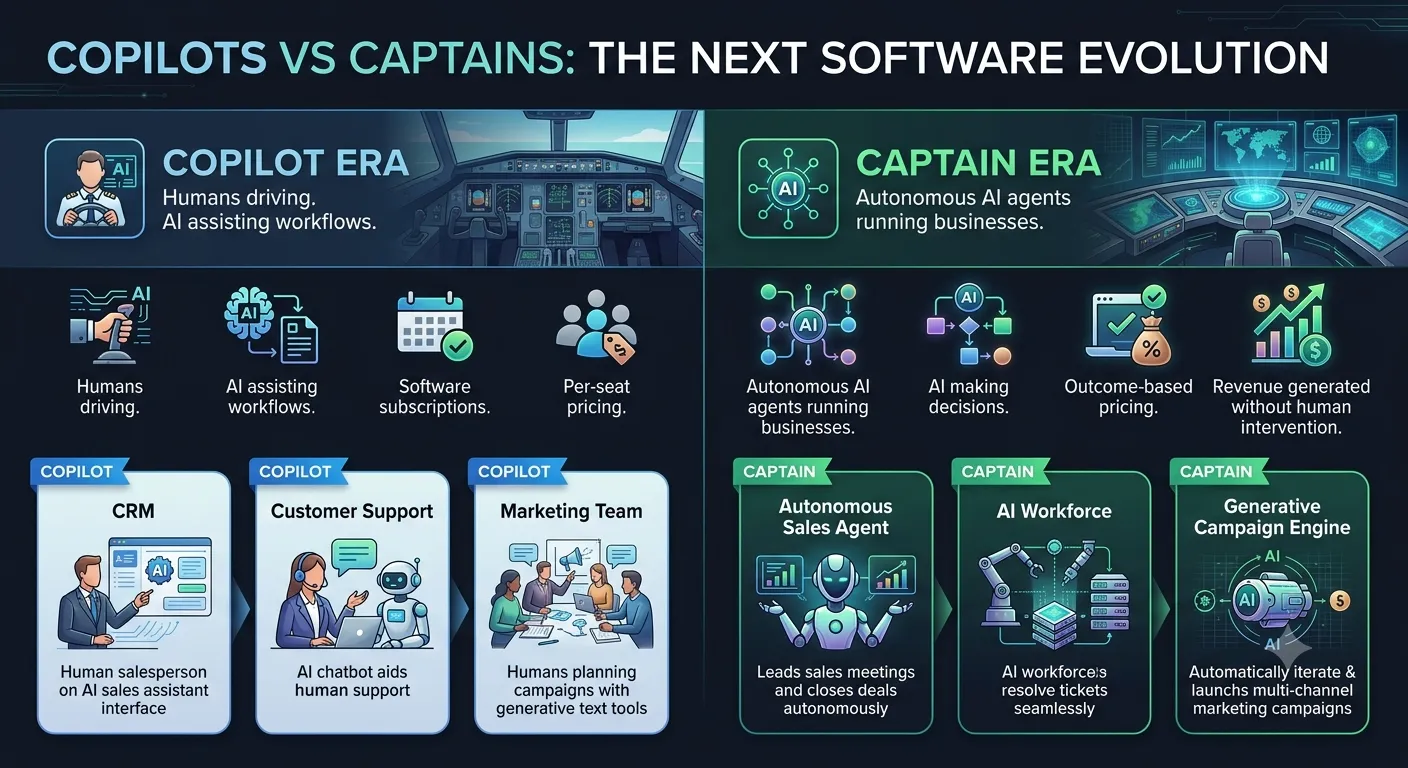
A critical insight into the defensibility of AI-native startups is the shift from workflow optimization to decision intelligence. Traditional software tools (Copilots) help users perform tasks faster within existing workflows. However, the next wave of AI-native products (Captains) "own" the decisions and deliver outcomes independently. For instance, instead of providing a CRM for a human to manage leads, an AI-native sales agent analyzes context, makes informed choices, and takes action without constant human direction.
Capability Model | Characteristics | Value Proposition | Strategic Outcome |
Copilot (Workflow) | Reduces friction, optimizes task completion | Sells "Tools" (Software Budget) | Vulnerable to commoditization |
Captain (Decision) | Owns outcomes, analyzes context, acts autonomously | Sells "Profits" or "Labor" (Human Capital Budget) | Creates compounding proprietary advantage |
This transition allows AI-native startups to capture revenue from autonomous buyers and agents, utilizing usage-based or outcome-based pricing models rather than traditional per-seat limits. Because the value is in the outcome rather than the workflow, these products require less change management and human hand-holding, allowing the startup to maintain a lean go-to-market (GTM) execution focused on engineering rather than sales.
Venture Capital and the AI Funding Landscape
The financial environment for AI-native startups in 2024 and 2025 is characterized by extreme capital concentration and rapid valuation jumps. AI startups raised approximately $100 billion in the first half of 2025 alone, matching the total for the entire previous year. Investors are increasingly prioritizing companies that demonstrate "proprietary technology" as a foundation for differentiation and "scalability" that does not require proportional headcount increases.
The Concentration of Capital in the AI Stack
The investment map is dominated by a "Super Six" group of incumbents—Nvidia, Microsoft, Apple, Alphabet, Amazon, and Meta—who are pouring hundreds of billions into AI infrastructure. Simultaneously, venture firms like Andreessen Horowitz (a16z), Sequoia Capital, and Lightspeed Venture Partners are making massive bets on both the infrastructure and application layers.
Lead Investor | Typical Check Size | Strategic Focus | Notable Portfolio Companies |
a16z | $5M – $50M+ | Infra, Enterprise, Consumer AI | OpenAI, Anthropic, ElevenLabs, Cursor |
Sequoia Capital | $1M – $100M+ | Applied AI, Vertical SaaS | OpenAI, Hugging Face, Nvidia, Physical Intelligence |
Lightspeed | $5M – $40M+ | AI Infra, Vertical Apps | Anthropic, Mistral AI, Glean |
AI2 Incubator | $100K – $500K | Research-led AI Startups | Access to AI research labs and technical resources |
NFX | Seed | Network Effects, Marketplaces | Focus on embedding products into customer workflows |
A striking trend in 2025 is the speed at which companies are crossing the $10 million ARR threshold—often in under 18 months through self-serve, product-led adoption. This represents a compression of the entire market cycle, as startups move from hype to real traction in a fraction of the time required by previous technological eras.
The Technical Debt Paradox of the AI-Native Era
While AI serves as a "throughput multiplier" for lean startups, it also acts as a "chaos amplifier" if the underlying codebase is poorly architected. The speed of vibe coding introduces novel forms of technical debt that can remain hidden until they cause catastrophic system failure.
Comprehension Debt and the Illusion of Competence
The most insidious form of debt in AI-assisted development is "comprehension debt." This occurs when a developer or founder accepts AI-generated code without fully internalizing its logic, edge cases, or dependencies. This code becomes "legacy code" the moment it is committed, as the person responsible for it cannot effectively debug or extend it. Furthermore, AI tools often prioritize brevity or generic naming conventions, leading to a loss of "contextual mastery" within the engineering team.
Studies have shown that AI-native development can lead to a reversal of long-standing best practices, such as the DRY (Don't Repeat Yourself) principle. For example, refactoring—the practice of cleaning up working code—dropped from 25% of changed lines in 2021 to under 10% in 2024, while code duplication increased fourfold. AI lacks whole-codebase context and frequently regenerates similar logic instead of reusing existing functions.
Dimensions of Technical Debt in AI-Native Systems
Undocumented Behavior: AI generates code based on what it does, not what it should do. Without documented intent, future AI prompts will break existing logic.
Hidden Side Effects: Functions that modify state in unexpected ways are difficult for both humans and AI to debug.
Data Debt: Generative AI systems often suffer from poor documentation of data dependencies, leading to "pipeline jungles".
Traceability Failures: In regulated industries like healthcare or finance, the inability to explain why an AI agent chose a specific approach can lead to compliance failures and suspended certifications.
To manage these risks, "vibe coding cleanup" has emerged as a professional service, where engineers refactor prototype code for production scale, implement proper design patterns, and establish "AI-safe development guardrails". Strategies like the "Traffic Light Protocol for AI Usage" help organizations decide when to use AI (for boilerplate and documentation) and when to avoid it (for security-sensitive code and core business logic).
Case Studies in Hyper-Efficient Scaling
The following case studies illustrate the practical application of the AI-native, low-headcount model across different sectors and growth stages.

Cursor (Anysphere): The Fastest $1B ARR Growth on Record
Cursor, an AI-first code editor built by Anysphere, represents the gold standard for lean scaling. Founded in 2022 by four MIT students, the company hit a $29.3 billion valuation by November 2025. Their engineering strategy centered on an AI-first architecture—a fork of VS Code where AI is embedded in the core runtime rather than being a plugin.
Metric | Figure | Note | Source |
Team Size | ~250 (Late 2025) | Expanded from <50 earlier in the year | |
ARR | $1 Billion | Fastest SaaS from $1M to $500M ARR | |
Valuation Multiplier | 29x Revenue | Signals that tool has become "infrastructure" | |
Market Penetration | >50% | Among Fortune 500 engineering organizations |
Cursor’s "Composer" model allows up to 8 agents to run in parallel in isolated environments to build features and write tests simultaneously, achieving an 8x speedup on complex feature development. Their strategy prioritized "speed as a moat," targeting tab suggestion latency of less than 100ms to maintain a "flow-state" for developers.
ElevenLabs and the Voice Generation Explosion
ElevenLabs demonstrates how two founders can build a dominant market position in the AI voice-generation space. Founded in 2022 by Mati Staniszewski and Piotr Dąbkowski, the company reached a $1 billion valuation within just two years. By focusing on a specific technological gap—poor quality dubbing—and utilizing AI to generate hyper-realistic speech, they achieved unicorn status with a team that remained remarkably lean compared to traditional media technology firms.
Lovable and Higgsfield: The New Velocity Benchmarks
The speed of the AI-native model is further exemplified by companies like Lovable and Higgsfield. Lovable, founded in 2024, surpassed $100 million in ARR in less than a year and tripled its valuation to $6.6 billion in under six months. Similarly, Higgsfield reached a $1.3 billion valuation within its first year of operation. These companies operate with extremely small teams; reports suggest the combined workforce of several top AI-native startups does not exceed 100 employees, yet they manage global multi-million dollar revenues.
Departmental Automation Workflows
The low-headcount model is supported by "digital teammates" that handle functions traditionally requiring entire departments.
Marketing and Personalization at Scale
Marketing automation is no longer limited to email scheduling. Companies like Michaels Stores have used generative AI to increase campaign personalization from 20% to 95%, boosting click-through rates by 41%. In 2024, the insurance giant Generali implemented AI-driven workflows that unified customer data and automated lead validation, resulting in a 3x increase in leads and a 20% shorter sales cycle. These systems utilize "adaptive learning" to refine recommendations over time based on individual user behaviors.
Sales and Customer Success
AI agents are increasingly managing the "Consideration" and "Close" stages of the sales funnel. For example, Flowla utilized AI-generated post-demo follow-ups to reduce manual preparation time by 30 minutes per call, lifting demo-to-deal conversion by 12%. In customer success, Klarna’s AI assistant handled the work of 700 full-time agents, managing two-thirds of all customer service chats and improving resolution times while maintaining flat headcount.
Organizational Culture and the Human-in-the-Loop
The transition to a low-headcount, AI-native startup presents unique cultural challenges. Research indicates that the need for a change in organizational culture is a major barrier to lean implementation. In teams of under 20 people, the absence of human interaction, informal banter, and shared physical experiences can lead to isolation and a lack of trust.
The AI-Native Founder Mindset
To succeed, founders must adopt a mindset that values "leverage over headcount" and "execution velocity" as the only sustainable moats. This requires a shift from viewing AI as an add-on to asking, "How does AI change what is possible?". Selective hiring becomes critical; startups must focus on "versatile generalists" who can effectively use AI to multiply their output.
Cultural Imperatives for AI-Native Leaders
Defining the Human Core: Leaders must distinguish between core competencies that define the brand (e.g., creative design) and contextual activities that can be automated.
Change Management: Pacing implementation to ensure the organization can "digest" the shifts is essential for long-term viability.
Transparency and Trust: Only 45% of employees trust that their company will use AI to their benefit; leaders must bridge this gap through clear communication and reskilling programs.
Human Oversight: Agentic AI should amplify human judgment rather than replace it. Establishing clear rules for pricing, tone, and brand standards allows AI to execute safely within defined boundaries.
Future Outlook: The First Billion-Dollar Soloist
The trajectory of the AI-native startup points toward a future where the most valuable company on the planet might have only one employee—its founder. This "billion-dollar soloist" model is particularly viable in digital-first industries like proprietary trading, SaaS, and content platforms. In these sectors, AI agents can manage the entire lifecycle of a product—from ideation and coding to marketing and automated service—allowing the founder to remain in their "pajamas" while managing a global unicorn.
However, the realization of the solo-corn depends on the continued maturation of agentic orchestration and the successful mitigation of the technical debt crisis. While the barriers to entry have been lowered, the complexity of building a sustainable, secure, and compliant business remains high. The winners of the next decade will be those who lean into distinctly human strengths—creativity, relationship-building, and high-level vision—while deploying a synthetic workforce to handle the mechanical execution of their ideas.
Summary of Market Forces Shaping the 2026 Landscape
Market Force | 2020 Benchmark | 2025/2026 Forecast | Impact on Startups |
Software Developer Postings | 100% (Baseline) | 65% (35% Decline) | Shift to AI-assisted coding |
AI Engineer Role Growth | Emerging | 41.8% YoY Growth | Highest demand in LinkedIn history |
Enterprise AI Usage | 20% Experimentation | 88% Implementation | AI becomes "table stakes" |
Agentic App Integration | <5% | 40% | Rapid shift from "Copilot" to "Agent" |
AI Global Funding | $10B - $20B | $211B | Extreme capital concentration |
The move toward "solo-corns" is no longer a radical idea but a structural condition of the AI era. As technology continues to collapse the cost of scale, the traditional limitations of geography, capital, and labor are being overwritten by the power of autonomous intelligence. The first one-person unicorn is not a matter of "if" but "when," and the evidence suggests that 2026 marks the beginning of this new organizational epoch.
Protect Your Future: The Precision Vesting Calculator
Don't let a "handshake deal" complicate your exit. Map out your ownership journey with our Vesting Calculator
Calculate Your Vesting Schedule →