FDM vs. SLA vs. SLS: Which 3D Printing Technology Is Right for You in India?
July 12, 2026 by Sheikh MohammadComparing FDM, SLA, and SLS for 3D printing in India: costs, materials, and use cases to help hobbyists, engineers, and businesses choose right.
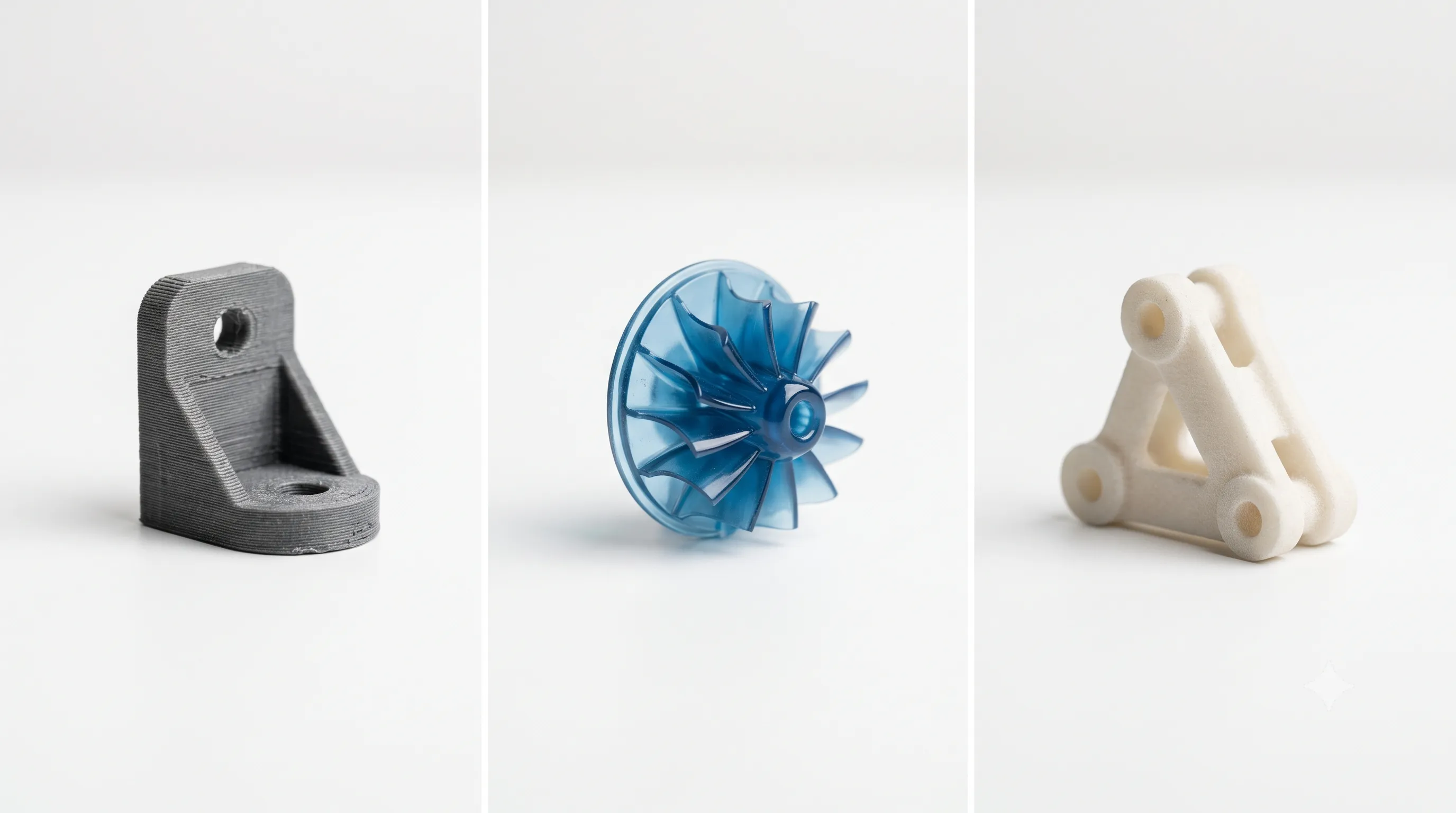
Why This Decision Matters Right Now
3D printing in India has moved well past the hobbyist workbench. The Indian government's Ministry of Electronics and Information Technology (MeitY) formalized this shift when it released the National Strategy on Additive Manufacturing, targeting 50 India specific technologies, 100 new startups, 500 new products, and 1 lakh newly skilled workers as part of the push to build a domestic additive manufacturing ecosystem, IBEF, 2022. MeitY has also set a goal of capturing 5% of the global additive manufacturing market within a few years of the strategy's release, IBEF, 2022.
That policy push is landing at a moment when Indian engineering teams, product designers, and small manufacturers are under real pressure to shorten development cycles. Whether you are running a one person product studio out of your apartment or managing tooling for a mid sized manufacturer, the question is rarely "should I use 3D printing." It is "which of the three dominant technologies, Fused Deposition Modeling (FDM), Stereolithography (SLA), or Selective Laser Sintering (SLS), actually fits my part, my budget, and my timeline."
This guide breaks down how each technology works, where it excels, what it costs in the Indian context, and how that maps onto prototyping in Bangalore, prototyping in Delhi, prototyping in Mumbai, prototyping in Surat, and prototyping in Srinagar, five cities where the additive manufacturing ecosystem looks meaningfully different.
The Basics: What FDM, SLA, and SLS Actually Do
All additive manufacturing processes build parts layer by layer from a digital 3D model, rather than removing material from a solid block the way CNC machining does. The official terminology for these processes is standardized by ASTM International's Committee F42, which classifies additive manufacturing into seven process categories, including material extrusion, vat photopolymerization, and powder bed fusion, SME.org. FDM falls under material extrusion, SLA falls under vat photopolymerization, and SLS falls under powder bed fusion.
Beyond that shared layer by layer principle, the three technologies diverge sharply in how they build a part, what materials they can use, and what kind of surface finish and mechanical strength you end up with.
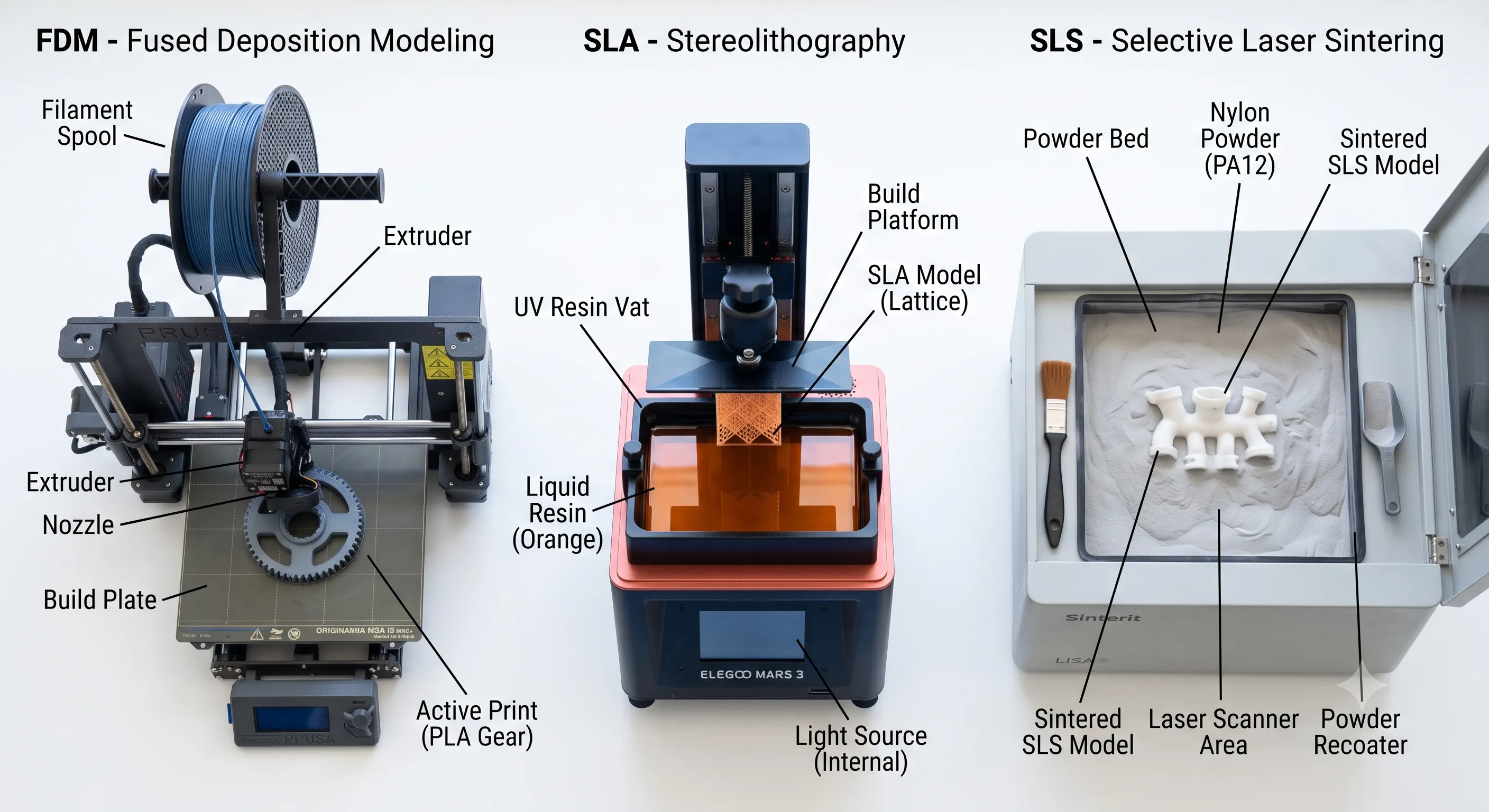
FDM Explained: The Workhorse Technology
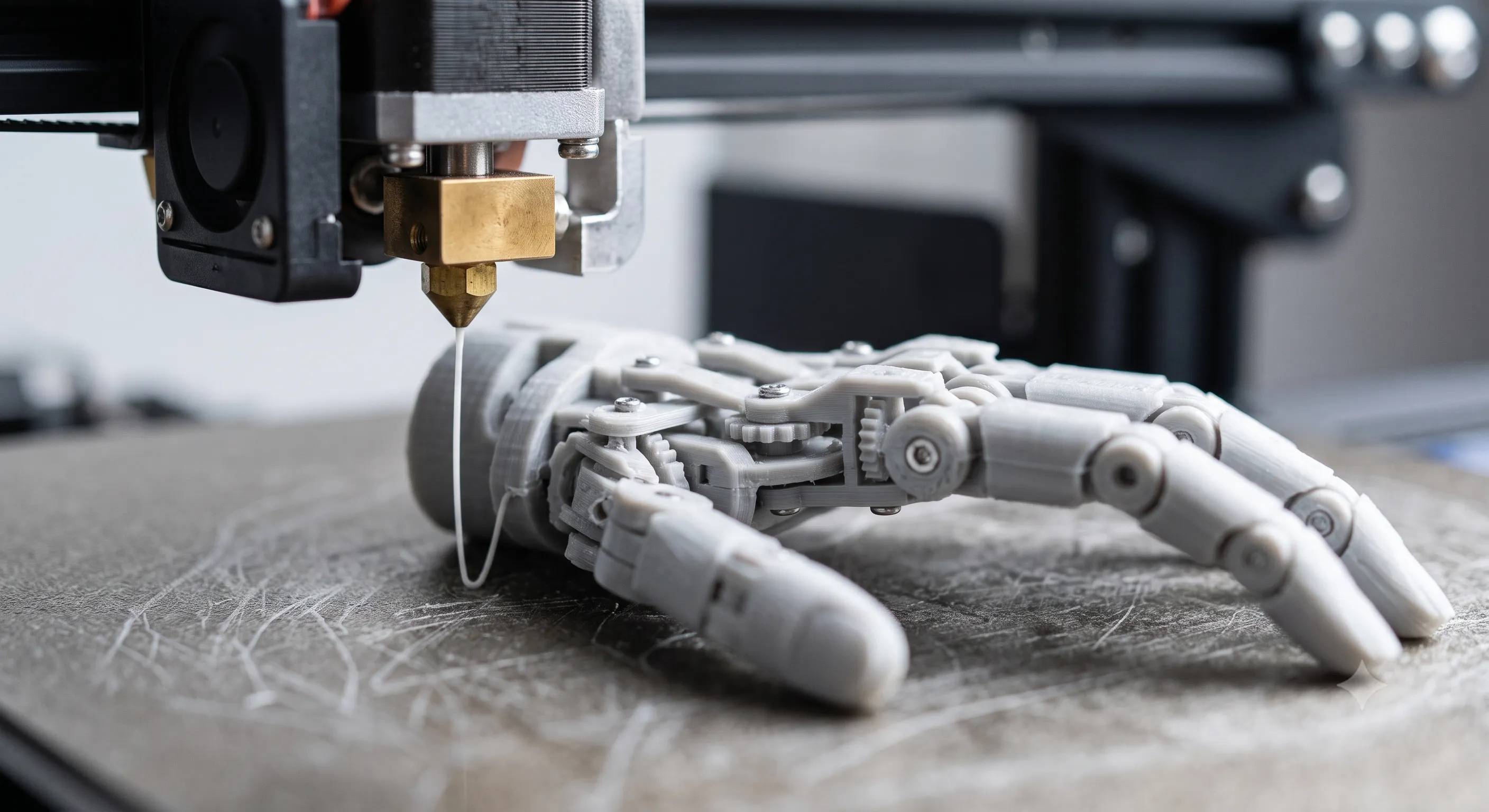
Fused Deposition Modeling (FDM), sometimes called Fused Filament Fabrication (FFF), works by melting a thermoplastic filament and extruding it through a heated nozzle, building the part one layer at a time. It is the most widely deployed 3D printing process both globally and in India, where it leads the technology segment with a 35.2% share of the additive manufacturing market in 2025, IMARC Group, 2026.
Key characteristics:
Materials: PLA, ABS, PETG, nylon, TPU (flexible), and composite filaments like carbon fiber reinforced nylon
Layer resolution: Typically 100 to 300 microns, visible layer lines are common
Strength: Good for functional prototypes and jigs, though parts can be weaker along the layer bond direction
Build size: Desktop machines handle small parts, industrial FDM systems can print large format tooling and enclosures
Cost: The lowest entry cost of the three technologies, both in hardware and material
FDM's dominance in India comes down to affordability, a wide material range, and a large installed base across small and medium enterprises and educational institutions, IMARC Group, 2026. It is why FDM shows up everywhere from school robotics clubs to automotive tooling shops. A notable industry example is a collaboration between ITC Ltd. and Fabheads that used FDM to develop lightweight packaging prototypes, illustrating how the technology has expanded beyond hobbyist use into industrial product development, MarkNtel Advisors, 2025.
SLA Explained: Precision Through Light
Stereolithography (SLA) uses a laser or light source to cure liquid photopolymer resin layer by layer inside a vat, hardening the resin into a solid part. Because the process works with light rather than a mechanical nozzle, SLA parts have a much smoother surface finish and finer detail than FDM, making it the technology of choice when appearance and dimensional precision matter more than raw mechanical toughness.
Key characteristics:
Materials: Standard, tough, flexible, castable, and dental or biocompatible resins
Layer resolution: Can achieve accuracy in the range of ±25 microns, which is why it dominates precision applications like dental models and jewelry casting in India, IMARC Group, 2026
Strength: Generally more brittle than FDM or SLS parts unless engineering grade resins are used
Build size: Usually smaller build volumes than FDM or SLS, though large format resin printers exist
Cost: Mid range hardware cost, but resin is more expensive per kilogram than filament, and post processing (washing and UV curing) adds time
In the Indian market, SLA held roughly a 20.8% share of the additive manufacturing technology segment in 2025, second only to FDM, IMARC Group, 2026. Its biggest pull is in dental laboratories, jewelry design houses, and consumer product studios that need showroom quality prototypes before committing to injection molding tooling.
SLS Explained: Powder, Lasers, and Functional Parts
Selective Laser Sintering (SLS) uses a high powered laser to fuse powdered material, typically nylon (polyamide) or nylon composites, layer by layer. Unsintered powder around the part acts as built in support, which means SLS can produce complex geometries, interlocking assemblies, and lattice structures without needing separate support structures the way FDM and SLA do.
Key characteristics:
Materials: Nylon (PA11, PA12), glass filled or carbon filled nylon composites, and in industrial settings, metal powders (a related but distinct process often called Direct Metal Laser Sintering, DMLS, or Selective Laser Melting, SLM)
Layer resolution: Comparable to FDM in visible texture, but with a slightly grainy, matte surface from the powder
Strength: The strongest and most isotropic (uniform in all directions) parts of the three processes, suitable for functional end use components, not just prototypes
Build size: No support structures needed, so complex assemblies can be printed fully formed
Cost: The highest entry cost, industrial powder bed systems represent a significant capital investment, and access is usually through a print service bureau rather than an in house desktop machine
India's market data flags SLS, along with metal and ceramic powder bed processes, as the fastest growing additive manufacturing technology segment, driven by aerospace functional part production and defense indigenization efforts under the Aatmanirbhar Bharat initiative, IMARC Group, 2026. The Indian Space Research Organisation (ISRO) has used additive manufacturing to produce lightweight components for satellite and rocket engine applications, and the Defence Research and Development Organisation (DRDO) has expanded investment in the technology for unmanned aerial vehicle components, Ken Research, 2026.
Head to Head Comparison Table
Factor | FDM | SLA | SLS |
|---|---|---|---|
Process type | Material extrusion | Vat photopolymerization | Powder bed fusion |
Typical materials | PLA, ABS, PETG, nylon, TPU | Photopolymer resins | Nylon (PA11/PA12), composites |
Surface finish | Visible layer lines | Smooth, high detail | Slightly grainy, matte |
Dimensional accuracy | Moderate | High (around ±25 microns) | High, consistent across builds |
Mechanical strength | Good, direction dependent | Lower unless engineering resin used | Strong and isotropic |
Support structures needed | Yes | Yes | No, powder self supports |
Best for | Functional prototypes, jigs, fixtures, education | Dental, jewelry, showroom prototypes, casting patterns | Functional end use parts, complex assemblies, aerospace and defense components |
Relative entry cost | Lowest | Moderate | Highest, often bureau based |
India market share (technology segment, 2025) | Around 35% | Around 21% | Fast growing, tied to metals and ceramics segment at roughly 26% |
Market share figures are drawn from IMARC Group's India 3D printing market research, 2026. Independent market sizing reports vary considerably in absolute market value estimates, so treat total market size figures as directional rather than precise.
3D Printing in India: The Regional Picture
India's additive manufacturing ecosystem is not evenly distributed. Regional strengths matter if you are sourcing a print service bureau rather than buying your own machine.
Prototyping in Bangalore sits at the center of India's additive manufacturing map. South India commands roughly 34.8% of the national additive manufacturing market share, with Bengaluru recognized as the country's additive manufacturing capital, thanks to its concentration of aerospace companies, R&D centers, and startups, IMARC Group, 2026. In Bengaluru's Peenya Industrial Hub alone, more than 300 small and medium enterprises adopted in house 3D printers between 2022 and 2024, cutting outsourcing costs and roughly doubling prototype turnaround speed, Research and Markets, 2025.
Prototyping in Delhi benefits from North India's position as the second largest regional market, at around 28% share, driven substantially by healthcare demand in the Delhi NCR region and emerging defense manufacturing corridors in Uttar Pradesh, IMARC Group, 2026. Hospitals in Delhi increasingly use 3D printed surgical models to plan complex procedures, MarkNtel Advisors, 2025.
Prototyping in Mumbai and the wider West and Central India region represent the fastest growing regional segment, at roughly 23% share in 2025, as Gujarat's production linked incentive backed manufacturing ecosystem accelerates adoption across automotive, pharmaceutical, and industrial applications, IMARC Group, 2026.
Prototyping in Surat, within that same West India growth corridor, is benefiting indirectly from Gujarat's broader manufacturing investment climate, though city specific additive manufacturing data remains limited. Businesses here are more likely to rely on service bureaus in Ahmedabad or Mumbai for SLA and SLS work while running FDM in house for early stage iteration.
Prototyping in Srinagar and the wider Jammu and Kashmir region currently sit outside the major reported additive manufacturing hubs. For teams and individuals here, the practical path is usually a hybrid one: keep a desktop FDM printer on hand for rapid iteration, and ship files to a bureau in Delhi or another North Indian hub for SLA or SLS jobs that need specialized equipment.
Choosing By Use Case
Hobbyists and students: Start with FDM. It is the cheapest way to learn design for additive manufacturing, and PLA is safe and easy to work with.
Product designers needing showroom quality models: SLA. The smooth finish and fine detail sell an idea to stakeholders far better than a layered FDM part.
Small business owners prototyping consumer goods: A mix. Use FDM for early functional iterations, then move to SLA for the final look and feel model before tooling.
Engineers building jigs, fixtures, or low volume tooling: FDM with engineering filaments (nylon, polycarbonate blends, or carbon fiber composites) usually delivers the best cost to strength ratio.
Dental labs and jewelry designers: SLA is close to an industry standard given its accuracy and castable resin options.
Aerospace, defense, and functional end use parts: SLS, or metal powder bed processes for load bearing components. Expect to work through a specialized bureau rather than in house equipment unless you are at real production scale.
Cost Considerations in the Indian Market
Entry level desktop FDM printers in India start in the low tens of thousands of rupees, while resin based desktop SLA machines typically cost somewhat more due to the precision optics involved. Both are accessible to individual makers and small studios.
Industrial grade systems sit in a completely different bracket. Industrial additive manufacturing equipment used in aerospace and defense contexts can range from roughly USD 500,000 to USD 2 million, which is why most businesses outside large manufacturers access SLS and industrial SLA capacity through print service bureaus rather than direct ownership, SkyMarket Insights, 2026.
On the materials side, FDM filament remains the cheapest per kilogram option, and cost reduction is a major reason small and medium enterprises account for a majority of filament demand in India, with reported savings of 20 to 35% compared to traditional manufacturing methods for suitable parts, SkyMarket Insights, 2026. SLA resins and SLS nylon powders both carry a materials cost premium over FDM filament, reflecting their tighter tolerances and specialized chemistry.
Common Misconceptions
"3D printing is only for prototypes." This was true a decade ago. It is no longer accurate. SLS and metal powder bed processes are now used for functional, end use components in aerospace and defense supply chains in India, IMARC Group, 2026.
"All 3D printed parts are weak." Only partially true, and it depends entirely on the process and material. SLS nylon parts, in particular, are engineered for functional durability and are used in production applications, not just prototyping.
"SLA and resin printing are basically the same as FDM, just fancier." The underlying chemistry, safety handling requirements, and post processing workflow for resin printing are meaningfully different from filament based FDM, and should not be treated interchangeably.
"3D printed medical devices don't need regulatory approval because they are custom made." This is a common and risky misconception. Genuine custom device exemptions have a narrow legal definition, and most individualized 3D printed medical products are properly classified as patient matched devices that still must meet standard premarket regulatory requirements, IMTS, 2026.
Safety Considerations
Each technology carries its own handling requirements, and cutting corners on safety is not worth the risk.
FDM: Operate printers in a ventilated area, particularly when printing ABS or other materials that can emit fumes when heated. Nozzles and heated beds present burn hazards.
SLA: Uncured resin is a skin and respiratory irritant for many people. Always follow the safety data sheet for your specific resin, wear nitrile gloves, work in a ventilated space, and dispose of waste resin according to local hazardous waste guidance rather than pouring it down a drain.
SLS: Fine powder handling requires care around inhalation and dust accumulation. Industrial SLS systems should only be operated by trained personnel following the equipment manufacturer's safety protocols.
Medical and healthcare applications: Any 3D printed device intended for diagnostic, surgical planning, or implantable use is subject to regulatory oversight. In the United States this falls under FDA guidance for additive manufactured medical devices, and equivalent regulatory pathways apply in India, FDA, 2026. Always consult a qualified medical professional and regulatory expert rather than treating 3D printed medical models or devices as a substitute for approved clinical tools.
Key Takeaways
FDM is the default starting point for most hobbyists, students, and businesses because of its low cost and wide material range, and it holds the largest technology share of India's additive manufacturing market.
SLA wins when surface finish and dimensional precision matter more than raw strength, making it the go to choice for dental, jewelry, and showroom quality prototypes.
SLS is the strongest and most production ready of the three, increasingly used for functional end use parts in aerospace and defense, but it usually requires going through a service bureau rather than in house equipment.
Regional access varies significantly across India. Bengaluru leads as the country's additive manufacturing hub, Delhi NCR leads in healthcare applications, and Mumbai and Gujarat are the fastest growing regional market, while smaller centers like Surat and Srinagar rely more heavily on a mix of in house FDM and outsourced SLA or SLS bureau work.
Government backing through MeitY's National Strategy on Additive Manufacturing is actively shaping the ecosystem, with targets for new startups, products, and skilled manpower.
Frequently Asked Questions
Which 3D printing technology is cheapest to start with in India?
FDM is the cheapest entry point, both for the printer itself and for filament material costs, which is why it has become the standard choice for hobbyists, students, and small businesses across India.
Can SLA resin prints be used for functional, load bearing parts?
Standard SLA resins tend to be more brittle than FDM or SLS parts. Engineering grade or tough resins can improve strength, but SLS or FDM with reinforced filaments are generally better suited for load bearing functional applications.
Is SLS available for small businesses, or only large manufacturers?
Industrial SLS equipment is expensive, often accessed through print service bureaus rather than purchased outright. Small businesses in cities like Bangalore, Delhi, and Mumbai can typically access SLS printing through local bureaus without owning the equipment themselves.
Do 3D printed medical devices need government approval in India?
Yes. 3D printed devices intended for medical use, whether diagnostic models, surgical guides, or implants, are subject to regulatory review, similar in principle to the FDA's framework for additive manufactured medical devices in the United States. These products are not a substitute for professional medical advice, and manufacturers should consult relevant Indian regulatory authorities before commercial use.
Which Indian city is best for outsourcing 3D printing prototypes?
Bengaluru currently offers the deepest bureau ecosystem across all three technologies, reflecting its status as India's additive manufacturing hub. Delhi NCR is strong for healthcare related printing, while Mumbai and the broader West India region are the fastest growing market for industrial prototyping services.
Suggested Internal Links
A deeper guide to choosing the right 3D printing material (PLA vs ABS vs nylon vs resin) for specific project types
A city by city directory of 3D printing service bureaus and prototyping labs across India
A case study style post on how Indian startups have used additive manufacturing to cut product development timelines
Sources
IBEF. "National Strategy on Additive Manufacturing." India Brand Equity Foundation, 2022. https://www.ibef.org/blogs/national-strategy-on-additive-manufacturing
Press Information Bureau, Government of India. "Shri Ashwini Vaishnaw... release National Strategy on Additive Manufacturing." Ministry of Electronics and Information Technology, 2022. https://www.pib.gov.in/PressReleaseIframePage.aspx?PRID=1800915®=3&lang=2
SME.org. "Additive Manufacturing Glossary." Society of Manufacturing Engineers. https://www.sme.org/technologies/additive-manufacturing-glossary/
IMARC Group. "India 3D Printing Market Size, Demand, Growth Report, 2034." 2026. https://www.imarcgroup.com/india-3d-printing-market
MarkNtel Advisors. "India 3D Printer Market Size & CAGR Outlook 2025 to 2030." 2025. https://www.marknteladvisors.com/press-release/india-3d-printer-market-growth
Research and Markets. "India 3D Printer Market Size, Competitors & Forecast to 2031." 2025. https://www.researchandmarkets.com/report/india-3d-printer-market
Ken Research. "India 3D Printing Market Outlook 2030." 2026. https://www.kenresearch.com/industry-reports/india-3d-printing-market-industry
SkyMarket Insights. "India 3D Printing and Additive Manufacturing in the Aerospace and Defence Market." 2026. https://www.skymarketinsights.com/report/india-3d-printing-and-additive-manufacturing-in-the-aerospace-and-defence-market
SkyMarket Insights. "India 3D Printing Filament Market Forecast by 2034." 2026. https://www.skymarketinsights.com/report/india-3d-printing-filament-market
U.S. Food and Drug Administration. "3D Printing of Medical Devices." 2026. https://www.fda.gov/medical-devices/products-and-medical-procedures/3d-printing-medical-devices
IMTS. "Medical 3D Printing: Applications, Types, and FDA Guidelines." International Manufacturing Technology Show, 2026. https://www.imts.com/read/article-details/Medical-3D-Printing-Applications-Types-and-FDA-Guidelines/2202/type/Read/1
Protect Your Future: The Precision Vesting Calculator
Don't let a "handshake deal" complicate your exit. Map out your ownership journey with our Vesting Calculator
Calculate Your Vesting Schedule →Co-Founder Equity Split Calculator
Answer 10 weighted questions objectively to determine a fair equity distribution baseline for your startup.
Calculate Equity Split →Read Next

How the 3D printing industry in india is Reshaping Manufacturing
The manufacturing landscape is undergoing a monumental shift. For decades, traditional production relied heavily on subtractive processes, massive...
Read Article →The 3D Printing Industry in India: Market Size, Growth, and Adoption Numbers
The 3D printing industry in India is scaling fast. See market size, growth rates, prototyping trends, and adoption data for 2025 and beyond. Ten...
Read Article →
Best 3D printers to buy in 2026 : The last guide you will ever need
Buying a 3d printer can be challenging for many, but it all comes down to understanding what you want to make and matching the machine's architecture...
Read Article →
Why Sales Is the Ultimate Founder Skill
The traditional narrative of the startup founder often emphasizes the "builder"—the visionary engineer or the creative genius working in isolation to...
Read Article →
Solo Founders with Leverage Are Winning
The historical narrative of industrial progress has long been defined by the accumulation of labor and capital within centralized, hierarchical...
Read Article →
Why Are D2C businesses thriving in Bangalore : Case study and more
Bangalore didn't set out to become India's direct-to-consumer capital. It became one because the ingredients that made it "India's Silicon Valley"...
Read Article →
Silicon Valley No Longer Has a Monopoly on Innovation
The historical epoch defined by the geographic and capital concentration of the technology industry within a seventy-seven-square-mile corridor of...
Read Article →
Founder-Led Media as a Distribution Strategy
The contemporary commercial landscape is witnessing a fundamental reconfiguration of the relationship between corporate entities and their target...
Read Article →
What Sustainable Growth Actually Looks Like
The conceptualization of sustainable growth has evolved from a nascent environmental concern into the definitive framework for 21st-century global...
Read Article →