Why Most Co-Founder Relationships Fail Within 12 Months
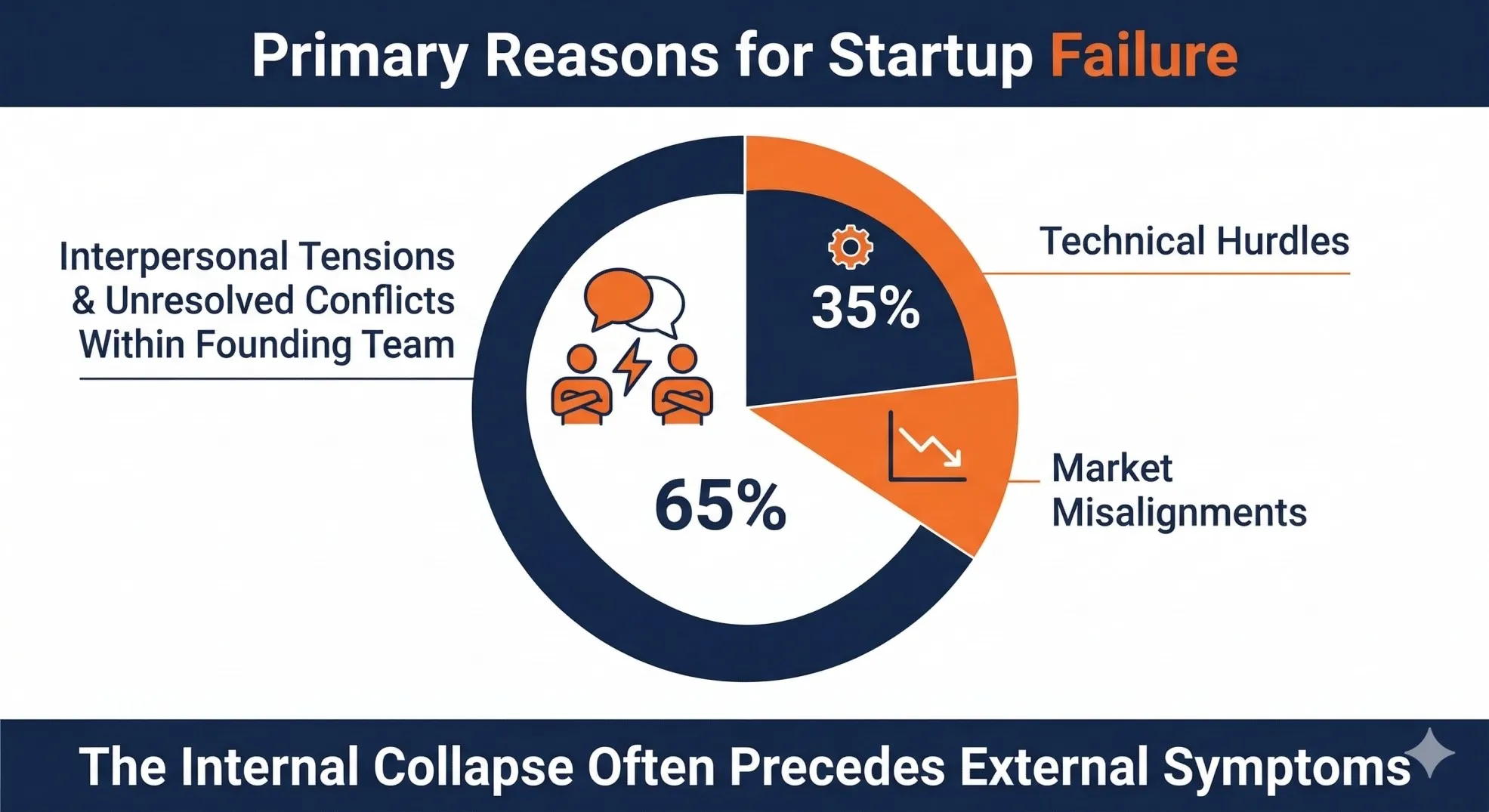
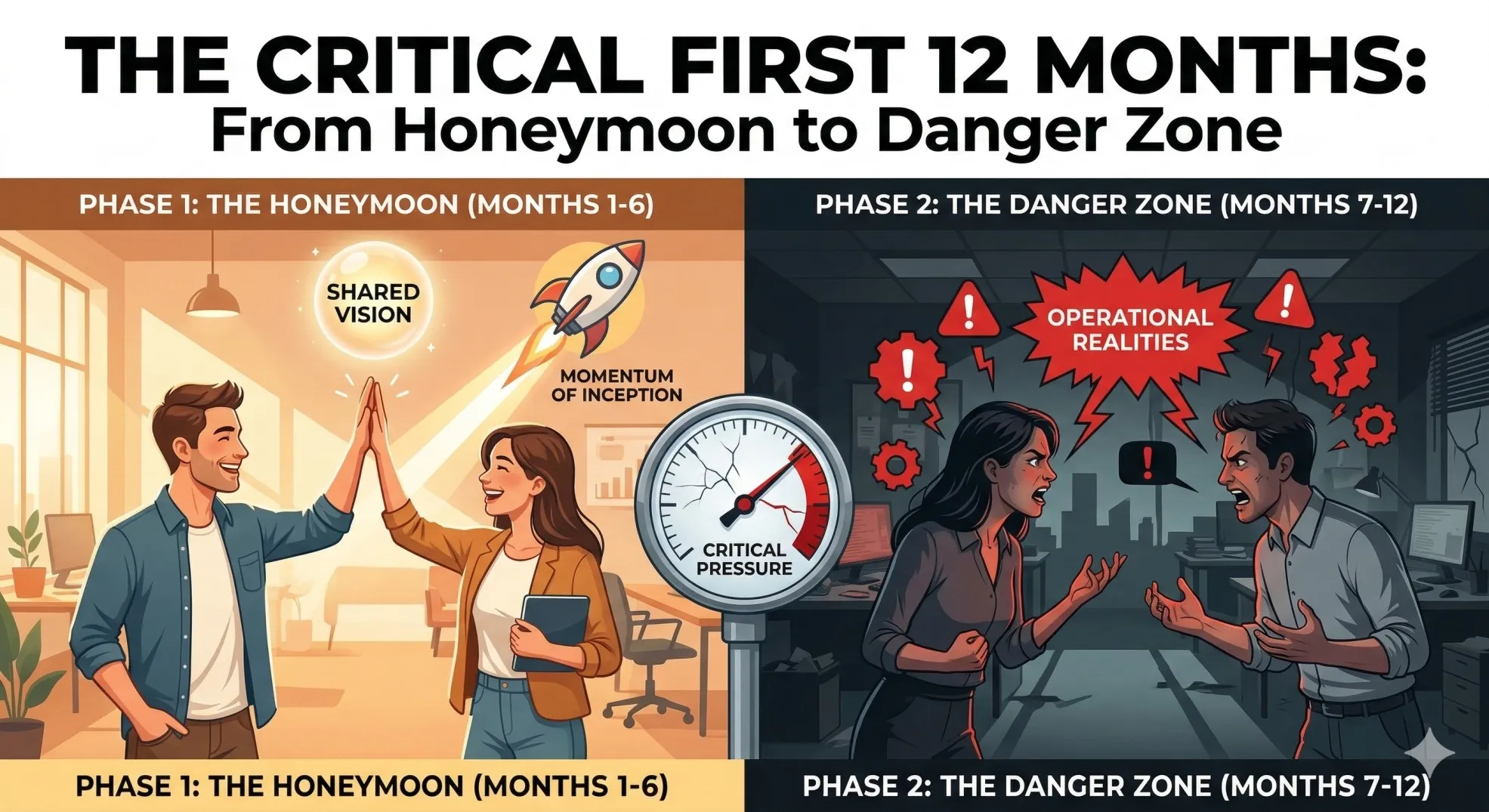
March 6, 2026 by Sheikh MohammadThe stability of the founding team is the primary determinant of a startup’s longevity, yet it remains the most volatile component of the early-stage ecosystem. Empirical evidence indicates that approximately 65% of high-potential startup failures are attributable to interpersonal tensions and unresolved conflicts within the founding dyad or triad. While technical hurdles and market misalignments frequently occupy the public discourse regarding business insolvency, the internal collapse of the co-founder relationship often precedes these external symptoms. The first twelve months represent a critical developmental window characterized by high-velocity role evolution, intense financial pressure, and the looming legal finality of equity vesting cliffs. This period, often transitioning from a "honeymoon phase" of shared vision to a "danger zone" of operational reality, reveals structural flaws in the partnership that were previously obscured by the momentum of inception.
Statistical Trajectories of Founding Attrition
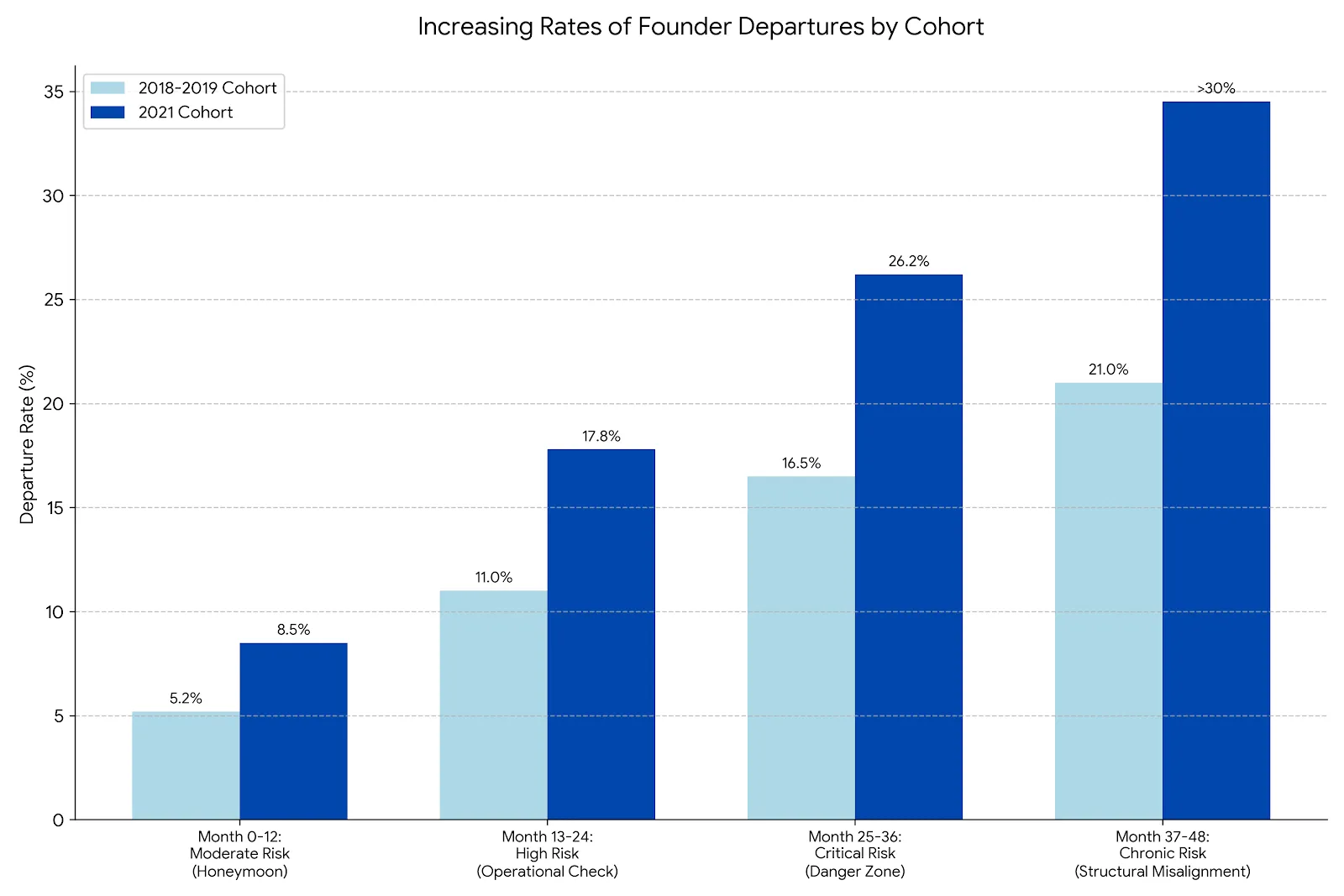
The prevalence of co-founder breakups is significantly higher than typically reported in entrepreneurial literature. Longitudinal studies across diverse datasets reveal a brutal rate of attrition that accelerates as ventures move toward their first major milestones. A study of American academic data found that 10% of co-founders terminate their relationship within the initial 12 months of operation, with this figure rising to 45% within four years. More recent analysis from Carta, covering 22,352 founders in venture-backed teams between 2016 and 2023, suggests that the rate of departure is not only high but is actively increasing.
Time Interval from Incorporation | Cumulative Departure Rate (2018-2019 Cohorts) | Cumulative Departure Rate (2021 Cohorts) | Risk Profile Level |
0–12 Months | ~5-7% | ~8-10% | Moderate: The "Honeymoon" Period |
13–24 Months | ~12-15% | ~17-20% | High: The Operational Reality Check |
25–36 Months | 19-20% | 23%+ | Critical: The "Danger Zone" Peak |
37–48 Months | ~25-28% | Projected >30% | Chronic: Structural Misalignment |
The data indicates a distinct "acceleration" in departures for more recent cohorts. For example, teams founded in 2021 are experiencing departure rates approximately 15-20% higher than those founded just three years prior. This trend is likely driven by the increased pressure for rapid scaling and the psychological burden of a more volatile macroeconomic environment. In specific portfolios, such as those analyzed by Icehouse Ventures, up to 35% of funded companies have experienced a founder departure, with the majority of these exits occurring within the first twenty-four months of investment.
The Structural Catalyst: Equity Vesting and the Twelve-Month Cliff
The 12-month mark is not merely a chronological milestone but a legal and financial inflection point that precipitates many partnership dissolutions. Most venture-backed startups operate under a four-year vesting schedule with a one-year (12-month) cliff. This structural mechanism is designed to protect the venture from "free riders," but it simultaneously creates a period of intense scrutiny as the cliff approaches.
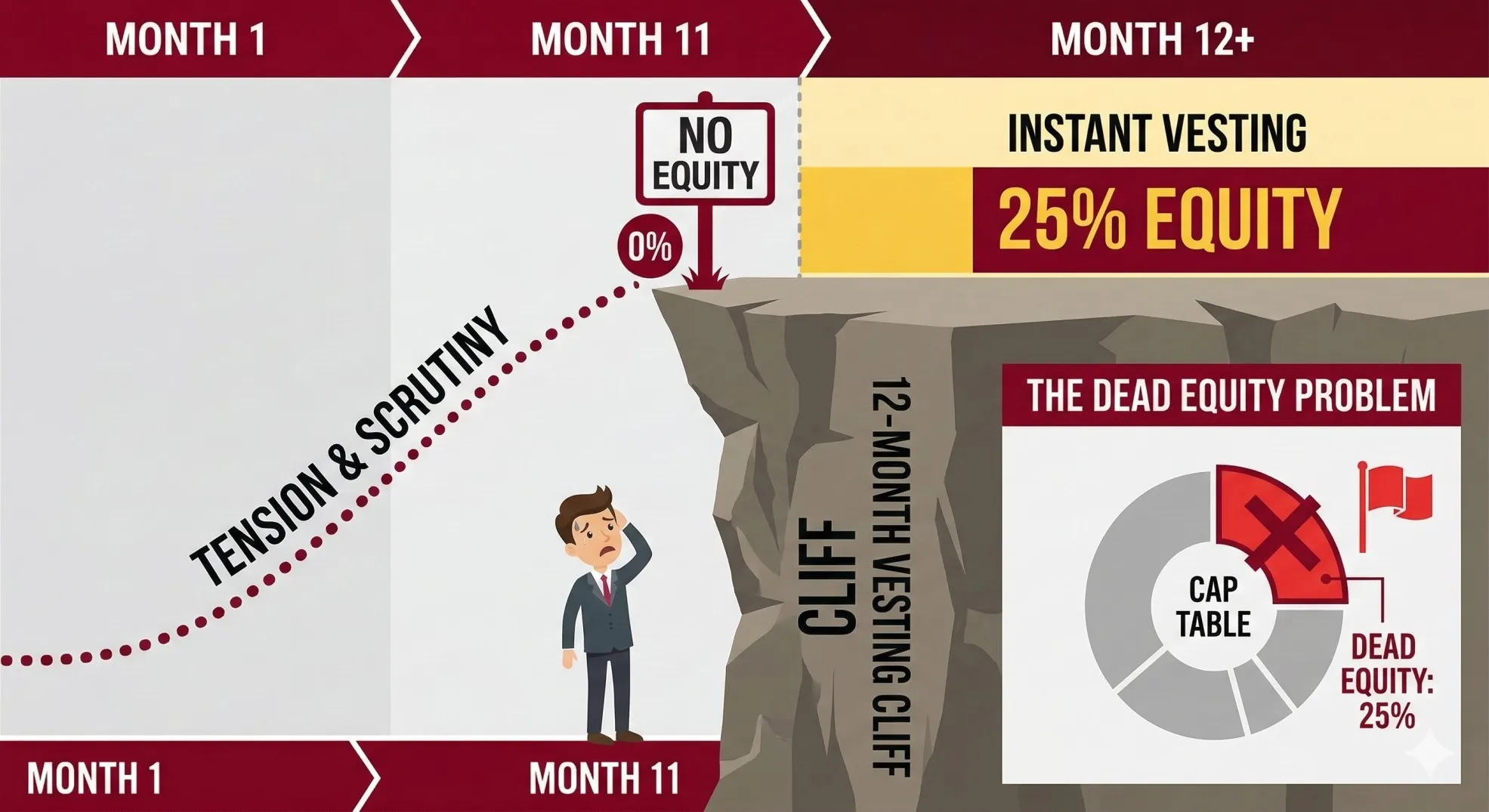
Under this arrangement, a founder who leaves or is terminated prior to the 365th day of service receives zero equity. Upon reaching the 12-month anniversary, the founder instantly vests 25% of their total grant. For a remaining co-founder or the board of directors, the months preceding this cliff represent the final opportunity to remove an underperforming or toxic partner without permanently encumbering the cap table with "dead equity". Consequently, tensions that might have been suppressed in months three or six often reach a breaking point in month eleven, as the financial cost of the relationship’s continuation becomes existential.
The implications of "dead equity"—shares held by a departed founder who no longer contributes to the company—are severe. Investors frequently view a cluttered cap table as a red flag, as it dilutes the incentive pool for future hires and remaining founders. This creates a "forced exit" dynamic where the technical or operational leads may feel a fiduciary duty to the company to terminate a relationship before the cliff, even at the cost of personal friendship or short-term operational stability.
The Founder’s Dilemmas: Relationships, Roles, and Rewards
Harvard Business School Professor Noam Wasserman’s research, based on a dataset of over 10,000 founders, identifies three core decision-making areas—Relationships, Roles, and Rewards—that serve as the primary conduits for conflict within the first year.
The Relationships Dilemma: The Trap of Prior Social Bonds
A significant majority of startups are founded by individuals with prior social connections, such as friends or family members. While these relationships provide a baseline of trust, they frequently suffer from what is termed the "Conflict Avoidance Paradox". Because the partners value their social bond, they are systematically less likely to address "elephants in the room" or provide critical professional feedback for fear of damaging the friendship.
The statistical reality is that teams founded by friends are often more unstable than those founded by professional acquaintances or even "strangers" met through matching platforms. In a professional-first relationship, the partners are more comfortable establishing clear boundaries and holding one another accountable to performance metrics. Conversely, in friend-founded ventures, the "playing with fire" gap allows operational inefficiencies and behavioral red flags to fester until they explode into a catastrophic breakup.
The Roles Dilemma: Neverland vs. Zeus
During the first twelve months, many founding teams default to an egalitarian "Neverland" model, where every founder has an equal vote and overlapping responsibilities. While this fosters a sense of unity during the ideation phase, it becomes a liability during the execution phase. As the startup scales and faces complex strategic choices, the lack of a clear hierarchy leads to "analysis paralysis" and power struggles.
The transition from a consensus-based model to a "Zeus" model—where a single CEO holds the final decision-making authority—is a frequent point of failure. If the founders have not pre-negotiated this transition, the sudden imposition of hierarchy can feel like a betrayal of the original partnership. This is particularly acute when the "technical" founder feels relegated to a subordinate role by a "business" founder who takes the CEO title.
The Rewards Dilemma: The Fallacy of Equal Splits
Perhaps the most common structural error in early-stage ventures is the 50/50 equity split. Research shows that 73% of founding teams split equity within the first month of founding, often defaulting to equal shares without a rigorous analysis of relative contribution. This decision, intended to signal fairness, often creates profound resentment as the reality of the work unfolds.
Founders rarely contribute equally in terms of domain expertise, capital, or opportunity cost. The LaTeX expression for a founder's capital claim can be modeled as:
Ec=Vpre+CcontributedCcontributed
Where Ec represents the equity stake justified by cash investment, Ccontributed is the actual capital provided, and Vpre is the pre-money valuation. When one founder provides $100,000 in seed capital while the other provides only "sweat equity," an equal split ignores the disproportionate risk taken by the former. Similarly, if one founder leaves a high-paying corporate role while the other is a recent graduate, the "opportunity cost" disparity becomes a source of friction as the financial stress of the first year intensifies.
Psychological Pathologies and Communication Failures
Beyond structural misalignments, co-founder relationships often succumb to deeply ingrained psychological patterns. Research by Dr. John Gottman on relationship stability identifies "Four Horsemen" of communication that predict the dissolution of a partnership with over 90% accuracy. These patterns are frequently observed in failing co-founder pairs within their first year.
The Four Horsemen of Founder Conflict
Communication Pattern | Startup Manifestation | Long-Term Impact |
Criticism | Attacking a partner's personality or character rather than a specific operational failure. | Erodes psychological safety and professional confidence. |
Contempt | Expressing superiority, disgust, or mockery toward a partner's ideas or abilities. | The strongest predictor of breakup; destroys mutual respect. |
Defensiveness | Responding to feedback with counter-complaints or playing the victim to avoid accountability. | Prevents the team from learning from mistakes and iterating. |
Stonewalling | Withdrawing from communication, giving the "silent treatment," or avoiding hard conversations. | Paralyses decision-making and leads to operational stagnation. |
When these patterns manifest, the relationship often enters a "pursue-withdraw" cycle. One founder (the pursuer) aggressively seeks to resolve an issue, which causes the other founder (the distancer) to withdraw further to maintain emotional safety. This cycle intensifies until the pursuer "ratchets up" their intensity to a breaking point, leading to a sudden and often explosive dissolution of the partnership.
The Impact of Narcissistic Dynamics and Toxic Leadership
A specialized but significant cause of first-year failure involves the presence of narcissistic personality traits in one or more founders. These relationships typically follow a three-phase cycle—Idealization, Devaluation, and Discard—that can leave the non-narcissistic founder professionally and emotionally devastated.
In the Idealization Phase, the narcissistic founder "love bombs" their partner, offering overwhelming praise and presenting themselves as the perfect mentor or collaborator. This moves the relationship forward unusually quickly, often bypassing the necessary "dating period" for business partners.
The Devaluation Phase begins once the partnership is legally formalized. The narcissist starts to hoard information, excludes the partner from key investor communications, and begins to attribute all successes to themselves while blaming the partner for all failures. Tactics such as "gaslighting"—making the partner question their own memory or judgment—are used to erode the partner’s autonomy.
The Discard Phase occurs when the narcissistic founder no longer sees value in the partner or feels threatened by their growing competence. They may trigger a "crisis" to justify a buyout or termination, often using legal threats or controlling the narrative with shared connections to isolate the departing founder.
The "Black Ice" Effect: Success as a Mask for Dysfunction
While it is intuitive that failure breeds conflict, early success can be equally dangerous. Rapid growth, often referred to as "black ice," can mask deep-seated relational issues. When a startup’s metrics are "up and to the right," founders are often too occupied with operational scaling to address communication gaps or role misalignments.
However, every startup eventually "hits the skids." When growth flatlines or a fundraising round is delayed, the lack of a healthy relational foundation becomes a terminal liability. Teams that have not practiced "relational hygiene" during the good times find themselves "at each other’s throats" precisely when they need unity to navigate a pivot. This phenomenon explains why many high-potential startups collapse shortly after their first significant period of success or after their Series A round.
Milestones and Peak Stressors in the First Twelve Months
The first year of a startup is punctuated by specific milestones that act as stressors, testing the resilience of the founding team. The transition from "Chief Building Officer" to "Chief Decision Officer" and eventually "Chief Inspiration Officer" requires a level of adaptability that many founders lack.
Month 1-3: The Equity Split and Incorporation. The first major hurdle where founders must quantify their worth. Disagreements here set the tone for the entire relationship.
Month 4-6: The First Pivot. Most startups realize their initial idea has flaws. The ability to discard a "darling" idea without damaging a partner's ego is a critical test of alignment.
Month 7-9: The Fundraising Grind. The stress of continuous rejection from investors often leads to "spillover" and "crossover" stress, where the tension between founders impacts their ability to pitch effectively.
Month 10-12: The Cliff and Re-vesting. As the one-year anniversary approaches, the board or lead founder must decide if their partner is truly a long-term fit.
Red Flags and Predictive Indicators of Failure
Experienced investors and founders identify several "red flags" during the first six months that correlate strongly with future dissolution.
Red Flag | Description | Underlying Threat |
Vision Misalignment | One founder seeks a "lifestyle" business; the other seeks a "unicorn" exit. | Fundamental strategic drift that becomes unmanageable under stress. |
Commitment Discrepancy | Mismatched expectations regarding hours worked or salary requirements. | Leads to intense resentment and "fairness" disputes. |
Skill Duplication | Founders with identical backgrounds (e.g., two backend engineers). | Creates gaps in critical areas like sales, marketing, and operations. |
Lack of "Skin in the Game" | A founder who demands a high salary or refuses to take personal financial risk. | Signals a lack of long-term commitment and misaligned incentives. |
Defensive Feedback | A partner who views any critique of their work as a personal attack. | Prevents the startup from adapting to market demands. |
The "Let’s Start Tomorrow" syndrome—rushing into a partnership without a trial project or a "dating period"—is one of the most consistent predictors of failure. Successful pairs often have a history of working together in low-stakes environments before tying their financial futures together in a binding legal contract.
Mitigation and Preventive Frameworks
To reduce the likelihood of a first-year failure, founding teams must move beyond "handshake deals" and embrace formal relational structures.
The Co-Founder "Prenup" and Agreement
A robust co-founder agreement is not merely a legal document but a tool for behavioral alignment. It should explicitly address "worst-case" scenarios before they occur. Key sections include:
Decision-Making Rights: Clearly defining who has the "final word" on product, hiring, and finance.
Vesting and Cliffs: Implementing standard 4-year vesting with a 1-year cliff to protect the company from early departures.
The "Ejection Seat" Plan: Agreeing in advance on a list of milestones that, if not met, allow any partner to "eject" from the venture without blame.
IP Assignment: Ensuring that all code and ideas are owned by the company, not the individuals.
Relational Hygiene and Conflict Resolution
High-functioning teams treat the health of their relationship as a Key Performance Indicator (KPI). This includes regular check-ins that focus on "meta-communication"—talking about how they are talking. Techniques such as "reflective listening"—where a founder reflects their partner’s concerns back to them before responding—can defuse tensions rooted in the need for respect and recognition.
When conflict does occur, founders are advised to focus on "situational" explanations rather than "character" assassinations. For instance, instead of labeling a partner as "unreliable," a founder should address the specific missed deadline and its impact on the sprint. Seeking outside support, such as founder coaching or therapy, is increasingly recognized as a strategic investment rather than a sign of weakness.

Conclusion: The Crucible of the First Year
The failure of most co-founder relationships within the first twelve months is the result of a complex interplay between structural flaws and psychological vulnerabilities. The "honeymoon period" of a startup provides a temporary reprieve from these issues, but the operational pressures of building a business—combined with the looming finality of the equity cliff—inevitably force these latent conflicts to the surface. Founding teams that survive this crucible are not those that avoid conflict, but those that have established the structural and emotional infrastructure to resolve it. By formalizing agreements early, addressing equity disparities transparently, and maintaining rigorous "relational hygiene," founders can transform their partnership from the venture’s greatest liability into its most enduring competitive advantage.
Protect Your Future: The Precision Vesting Calculator
Don't let a "handshake deal" complicate your exit. Map out your ownership journey with our Vesting Calculator
Calculate Your Vesting Schedule →