Why Confidence Matters More Than Certainty
February 12, 2026 by Harshit GuptaThe human cognitive architecture is a product of evolutionary pressures that favored the ability to act within high-entropy environments. Central to this capacity is the distinction between certainty and confidence—two metacognitive constructs that, while frequently conflated in vernacular speech, serve radically different computational and behavioral roles. Certainty is often characterized as a terminal cognitive state, a post-Cartesian pursuit of absolute, invariant truth that ostensibly eliminates risk. In contrast, confidence functions as a probabilistic evaluation of one’s internal decision-making processes, serving as a critical metric for navigating sequential decisions under conditions of limited information. This report argues that in complex, volatile, and uncertain systems—ranging from the neurological level to global market competition and military conflict—confidence is a far more robust, sustainable, and adaptive mechanism for success than the pursuit of absolute certainty.
The Neuro-Computational Framework: Distinguishing Confidence from Absolute Certainty
To understand the strategic superiority of confidence, one must first explore the brain's role as a probabilistic inference engine. When the central nervous system faces uncertainty, adaptive behavioral strategies require the execution of complex statistical computations. In this framework, certainty and confidence represent different stages of the brain’s statistical architecture, each with unique computational roles in the central nervous system.
Probabilistic Computations in the Central Nervous System
Confidence is defined as the belief that a specific choice or proposition is correct based on the available evidence. For instance, whether one is judging the ripeness of an avocado or assessing the population density of a nation-state, the brain performs a calculation regarding the probability of that judgment’s accuracy. This probability is a random variable that can take two values: correct or incorrect. Because confidence is a belief about a probability, it is technically a form of certainty, yet it is a "soft" certainty that remains open to Bayesian updating as new data points emerge.
The neurological distinction becomes critical in sequential decision-making. When a decision-maker chooses an action, they must also evaluate how likely that action is to yield the desired outcome. This evaluation—confidence—is what allows the brain to decide whether to commit additional resources to a path or to pivot. Absolute certainty, by contrast, acts as a "stop" command. It closes the cognitive loop, often prematurely, and signals to the brain that further information gathering is unnecessary. This can be problematic because most real-world environments are non-stationary; what was true at time t may no longer be true at time t+1.
Confidence as a Second-Order Belief
Metacognition, often defined as "thinking about one’s thinking," allows for a distinction between first-order decisions (the choice itself) and second-order evaluations (the degree of confidence in that choice). Research into value-based decision-making reveals that certainty and confidence are subjective, multidimensional constructs rather than simple, unidimensional reflections of objective data. When individuals evaluate choice alternatives, they do not merely aggregate all sources of uncertainty equally. Instead, they apply unequal weights to various attributes.
Metacognitive Component | Description | Functional Role |
First-Order Decision | The selection of an option or belief based on available data. | Direct action or proposition. |
Second-Order Confidence | The subjective probability that the first-order decision is correct. | Resource allocation and strategy adjustment. |
Attribute Certainty | The degree of sureness regarding specific components of an option. | Input for weighted metacognitive evaluation. |
Meta-Decision | The choice to act, wait, or seek more information. | Governed by the threshold of confidence. |
Attributes that carry more importance in determining the outcome of a decision are given disproportionate weight in the resulting metacognitive evaluation of confidence. This weighting mechanism ensures that the brain prioritizes its limited computational resources on the variables that matter most for survival and goal attainment. For example, when choosing an investment, a decision-maker might be highly certain about the company’s CEO but uncertain about market volatility. If they perceive market volatility as the primary driver of success, their overall confidence in the investment will be low, even if the "CEO certainty" attribute is high. This demonstrates that confidence is an integrative, adaptive process rather than a static snapshot of knowledge.
The Psychological Anatomy of the Certainty Illusion
The biological drive for certainty is rooted in the brain’s aversion to ambiguity. Uncertainty is often perceived by the limbic system as a threat, triggering a stress response characterized by the activation of the amygdala and the release of cortisol. Conversely, a feeling of certainty provides a dopamine reward, as it allows the brain to close a cognitive loop and experience a sense of control. This biological preference creates a "certainty addiction" that can lead to significant psychological and strategic pitfalls.
Cognitive Heuristics and the Biological Need for Closure
To avoid the discomfort of uncertainty, the human mind utilizes heuristics—mental shortcuts that simplify complex decision-making processes. While these heuristics are efficient, they frequently lead to systematic errors known as cognitive biases. Many of these biases are direct consequences of an over-weighted desire for 100% confidence, a phenomenon sometimes referred to as the "certainty illusion".
One prominent bias is the "Zero-Risk Bias," which describes the tendency to prefer eliminating a small risk entirely over reducing a much larger risk by a greater absolute amount. This preference is irrational from an expected-utility perspective but highly satisfying from a psychological perspective, as it offers the absolute certainty that one specific danger has been removed. Similarly, the "Certainty Effect" observes that individuals lose disproportionately more faith in an event when its probability decreases from 100% to 99% compared to a decrease from 50% to 49%, even though the mathematical shift is identical.
The Pathology of Over-Certainty: Dunning-Kruger and the Illusion of Control
Absolute certainty often masks a lack of competence, a relationship famously identified as the Dunning-Kruger effect. Individuals with limited knowledge in a specific domain often lack the metacognitive ability to recognize their own deficiencies. This "double curse" means they reach mistaken conclusions but are also robbed of the ability to realize they are performing poorly. Consequently, they often exhibit higher levels of certainty than genuine experts, who are more aware of the complexities and potential for error in their field.
The "Illusion of Control" further complicates this by leading individuals to overestimate their ability to influence events that are actually determined by chance. This bias is frequently observed in sports fans who believe specific rituals can influence the outcome of a game, or in investors who believe they have "solved" the volatility of the market. This illusion provides temporary psychological comfort but prevents individuals from engaging in the rigorous, critical thinking necessary for true growth and adaptive learning.
Bias Type | Mechanism | Impact on Decision Quality |
Confirmation Bias | Favoring information that supports pre-existing beliefs. | Limits consideration of alternative perspectives. |
Illusion of Control | Overestimating influence over external, stochastic events. | Leads to overconfidence and failure to hedge risks. |
Zero-Risk Bias | Preferring the total elimination of a minor risk. | Inefficient allocation of resources and attention. |
Anchoring Heuristic | Over-relying on the first piece of information received. | Distorts subsequent valuation and judgment. |
Availability Heuristic | Judging probability based on ease of recall. | Overestimates the frequency of rare, dramatic events. |
Leadership and the Confidence Heuristic
In the social and professional spheres, the projection of conviction is a powerful tool for establishing credibility. However, the distinction between a leader who is confident and one who is certain has profound implications for team dynamics and organizational resilience.
The Social Signaling of Competence
The "Confidence Heuristic" posits that people naturally take confidence as a cue for competence. In competitive environments, this can lead to a "confidence arms race," where individuals feel pressured to display more self-assurance than their rivals to win approval or votes. This is particularly evident in the political realm, where voters often place a high premium on the appearance of hope and strength. However, when this confidence is untethered from actual competence, the result is the adoption of misguided policies and a failure to prepare for future crises.
The way a leader communicates uncertainty also affects their perceived competence. Research suggests that leaders who frame uncertainty in external, objective terms ("The market is uncertain") are viewed as more competent than those who frame it in internal, personal terms ("I am uncertain"). External framing suggests that the leader has a sophisticated understanding of the environment’s complexity, whereas internal framing can be interpreted as a lack of knowledge or preparation.
The Power of Conviction in Persuasion and Sales
In high-stakes professional environments like B2B sales, confidence is often described as a "superpower." Research by RAIN Group and Gong.io indicates a direct correlation between conviction and success: top-performing sales managers are 67% more likely to be confident in their ability to help sellers, and sales representatives who speak with conviction achieve 36% higher win rates.
Confidence in sales operates through the mechanism of "Mirror Neurons" and "Emotional Contagion." Buyers subconsciously mirror the energy and assurance of the salesperson. If a seller is hesitant, the buyer perceives increased risk; if the seller is confident, the buyer feels reassured. This is critical because 40-60% of business deals end in "no decision" due to the buyer's lack of confidence in making the right choice. A confident salesperson helps eliminate this doubt and drives decisive action by offering strong, personal recommendations.
However, the efficacy of this confidence is contingent upon its alignment with competence. Senior buyers will often challenge pricing, assumptions, and claims. If a salesperson projects "false confidence" without real expertise to back it up, trust is eroded instantly. Therefore, true credibility is the sum of competence (the "What") and confidence (the "How").
Strategic Foresight vs. Institutional Inertia: Corporate Case Studies
The history of corporate failure and success provides perhaps the most visible evidence for why confidence—defined here as the courage to act on foresight—matters more than the certainty of maintaining the status quo.
The Fujifilm-Kodak Paradigm: A Study in Adaptive Foresight
The divergent fates of Kodak and Fujifilm are often cited as the definitive case study in technological disruption. Both companies were global leaders in analog photography, and both recognized the impending threat of digital imaging as early as the late 1970s. In fact, Kodak engineer Steven Sasson invented the digital camera in 1975. However, Kodak's response was hampered by a "Fixed Mindset" and a misplaced certainty in the longevity of the film business.
Kodak’s leadership was certain that analog photography would remain the central pillar of the industry, viewing digital technology merely as an enhancement to film rather than a replacement. This certainty led to a defensive strategy focused on "revenue protection." They invested billions in digital R&D but failed to align these investments with a coherent vision for a post-film world. Their principles were constrained by the need to protect their chemical and film labs, which paralyzed their delivery and execution.
Fujifilm, by contrast, institutionalized "Strategic Foresight." Under the leadership of Shigetaka Komori, the company launched the "VISION 75" plan, which involved a comprehensive audit of all its technologies to identify transferable capabilities. Fujifilm recognized with "humble confidence" that the film market was in structural decline. They pivoted decisively into healthcare, pharmaceuticals, and high-performance materials (such as LCD display films), leveraging their core competencies in chemical dispersion and imaging.
Level of Decision-Making | Kodak (Certainty Approach) | Fujifilm (Confidence Approach) |
Vision | Assume photography stays central; change the tech. | Acknowledge photography may vanish; pivot to capabilities. |
Strategy | Protecting market position and film revenue. | Systematic diversification into new markets. |
Discovery | Defensive; focused on existing relationships. | Forward-looking; "What problems can we uniquely solve?" |
Execution | Slow, constrained by organizational resistance. | Swift; 40+ acquisitions, retraining thousands. |
Outcome | Bankruptcy in 2012. | Record revenues and successful diversification. |
The Blockbuster Blunder: Data Negligence and Market Entrenchment
Blockbuster’s demise provides a similar lesson. The company was not killed by a lack of data; in fact, Blockbuster had more data on customer behavior than almost any other retailer in the 1990s. They saw the rise of Netflix and the shift in consumer preferences toward convenience and the elimination of late fees. However, Blockbuster’s leadership was "certain" that their physical store network and late-fee revenue model were its greatest assets.
This certainty blinded them to the reality that their "assets" were becoming liabilities. Blockbuster famously rejected an offer to buy Netflix for $50 million in 2000, dismissing the subscription model as a passing trend. Their deeply entrenched workflows and brick-and-mortar investments made experimentation slow and costly. By the time they launched their own digital offering, Netflix had already achieved market dominance. Blockbuster’s story is a cautionary tale of how a lack of vision and a resistance to changing a once-successful business model can lead to catastrophic failure.
Systemic Failures: Hershey’s, Wells Fargo, and Knight Capital
Beyond market disruption, certainty in flawed processes can lead to operational disasters.
Hershey’s: During an ERP implementation, Hershey’s prioritized speed over certainty in testing. They cut corners on rigorous testing to meet a holiday shipping deadline, resulting in a systemic failure that prevented them from delivering $100 million worth of candy during the Halloween season.
Wells Fargo: A "certainty-driven" culture that prioritized aggressive sales targets at all costs led to the creation of millions of unauthorized accounts. The high-pressure sales culture prioritized results over ethical communication and transparency, eventually destroying the bank's reputation and leading to massive legal penalties.
Knight Capital: In 2012, a software glitch in an automated trading system led to a loss of $440 million in just 45 minutes. This incident highlights the danger of absolute certainty in technological systems without rigorous monitoring and the capacity to intervene when the system deviates from expected parameters.
The Martial Imperative: Historical Consequences of Doctrinal Certainty
Military history is perhaps the most brutal teacher of the value of confidence over certainty. In battle, a commander's certainty is often their greatest weakness, while their confidence—the ability to act decisively while respecting the "fog of war"—is their greatest strength.
Ancient Tactical Hubris: Cannae and Carrhae
The Battle of Cannae (216 BC) remains one of the bloodiest days in Western military history. The Roman consuls were "certain" that their numerical superiority (80,000 men against Hannibal’s 40,000) and their massive infantry force would simply punch through the Carthaginian line. Hannibal, anticipating this certainty, used a crescent-shaped formation to draw the Romans in. The Roman generals’ overconfidence led them to ignore the risk of their flanks being turned. As they drove deep into the center, Hannibal’s cavalry circled around their rear, trapping the Roman legions so tightly they could not even swing their swords. Around 60,000 Romans perished due to this failure of tactical imagination and absolute certainty in traditional brute force.
In 53 BC, Marcus Licinius Crassus led his legions into the desert at the Battle of Carrhae. Crassus was certain that Roman infantry could withstand any threat, and he ignored the advice of experienced allies to stay near the mountains or the Euphrates River to protect against the Parthian heavy cavalry. His passion and pride overrode his reason. Deep in the desert, heat-exhausted and thirsty, the Romans were decimated by Parthian horse-archers and cataphracts. Crassus’s certainty led to the death of 20,000 soldiers and his own demise.
Modern Attrition: The Somme, Gallipoli, and the Value of Cryptographic Intelligence
The First World War provided catastrophic examples of the cost of inflexible tactical certainty.
The Somme (1916): General Sir Douglas Haig was "certain" that a massive, seven-day artillery barrage of 1.7 million shells had destroyed the German trenches and barbed wire. He ordered his men to advance in rigid lines, carrying 30kg packs, assuming the resistance had been neutralized. However, many shells were duds, and the Germans had deep, reinforced dugouts. On the first day alone, the British suffered 57,000 casualties, with 20,000 killed. Haig’s failure to adjust his tactics in the face of contrary evidence remains a definitive example of lethal over-certainty.
Gallipoli (1915-1916): Winston Churchill and Allied planners believed that naval bombardments followed by amphibious landings would break Ottoman resistance. They relied on poor maps, inadequate reconnaissance, and a misplaced certainty in the superiority of their naval assets. The result was a trench-warfare stalemate that cost the Allies over 250,000 casualties and significantly damaged Allied prestige.
Contrast these disasters with the Battle of Midway (1942). While Japanese Admiral Isoroku Yamamoto had a superior force, his plan was overly complex and rigid, based on a certainty that he could lure the American fleet into a trap. However, U.S. Navy intelligence had broken the Japanese code. The Americans did not have certainty of victory, but they had well-founded confidence in their intelligence. This allowed them to anticipate the attack and achieve a decisive victory, sinking four Japanese fleet carriers in three days.
Conflict/Battle | Leader | Source of Certainty | Critical Failure |
Cannae | Paullus & Varro | Numerical superiority. | Ignored the tactical risk of encirclement. |
Carrhae | Crassus | Traditional Roman infantry power. | Ignored terrain and specialized enemy tactics. |
The Somme | Haig | Faith in the artillery barrage. | Failure to acknowledge surviving defenses. |
Little Bighorn | Custer | Underestimation of native forces. | Attacked a superior force without support. |
Isandlwana | Chelmsford | Superiority of modern rifles. | Failed to secure the camp against Zulu numbers. |
The Philosophical Virtue of Epistemic Humility
The bridge between the psychological need for action and the neurological reality of uncertainty is found in the concept of epistemic humility. This is not a lack of self-confidence; rather, it is a virtuous "mean" between the extremes of overconfidence and debilitating self-doubt.
Recognition of Fragility and the Web of Conditions
Philosopher of science Ian James Kidd posits that epistemic humility arises from recognizing the "fragility" of epistemic confidence. This confidence is defined as the trust we invest in the processes of acquiring and applying knowledge. Any truth claim—particularly a scientific one—relies on a complex "web of conditions" including cognitive expertise, practical skill, and access to material data. A humble enquirer acknowledges that these conditions are contingent and easily disrupted: institutions can be corrupted, colleagues can fail us, and shared practices can be abused.
Epistemic humility requires the active regulation of one’s conduct in light of this fragility. This involves:
Modifying Speech: Using qualifiers like "perhaps," "I think," or "based on current evidence" to reflect the actual degree of justified confidence.
Modifying Ambition: Focusing on contributing to a field rather than attempting to definitively define it, ensuring that one’s projects remain within the bounds of what they can actually fulfill.
Engaging with Epistemic Resistance: Actively seeking out opposing perspectives to calibrate one’s own cognitive forces. As Jose Medina explains, the insensitivity to "epistemic resistances" promotes active ignorance and arrogance.
Socratic Wisdom and Clinical Application
The Socratic tradition views humility through the lens of justification. Socrates concluded that wisdom consists of "claiming not to know what one does not know". In modern clinical settings, this takes the form of "Relational Epistemic Humility." It is a meta-cognitive style where a practitioner reflects on their own mental patterns and recognizes the limitations of their expertise, especially when navigating language barriers or cultural scripts. Epistemic humility in medicine ensures that doctors do not disregard patient accounts and remain open to revising their diagnoses in the face of new information.
However, there is a risk of "excessive humility." If an agent inappropriately lowers their confidence in beliefs that are actually justified, they may become susceptible to misinformation or paralyzed by indecision. Thus, the goal is "Humble Confidence"—a state where one's level of conviction is precisely calibrated to the strength of the evidence.
Sustainable Confidence: Cultivating Resilience through Mindset
Confidence is more sustainable than certainty because it is rooted in a "Growth Mindset" and "Self-Efficacy," which allow for long-term psychological and physiological health.
The Growth Mindset and Self-Efficacy
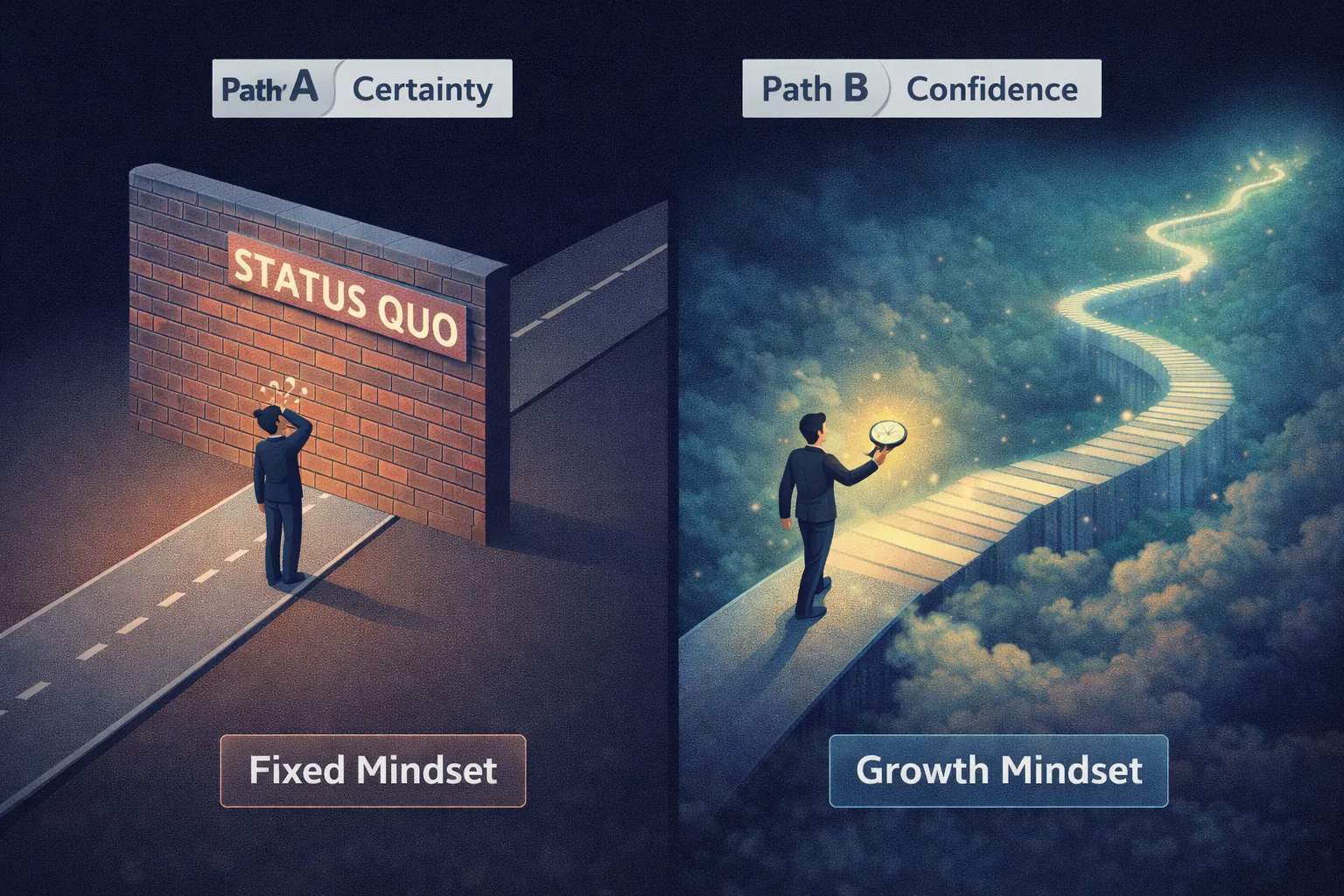
Developed by Carol Dweck, the "Growth Mindset" is the belief that intelligence and abilities can be developed through effort, strategy, and learning. This contrasts with a "Fixed Mindset," which assumes that abilities are static and innate traits. Individuals with a growth mindset view challenges as opportunities to expand their capacity and setbacks as temporary feedback rather than evidence of failure.
Research indicates that a growth mindset significantly improves resilience. It allows individuals to:
Bypass the Amygdala Hijack: Instead of seeing a challenge as a threat to their identity, they see it as an opportunity for growth, which reduces the psychological threat response.
Enhance Physiological Coping: Studies have shown that a growth mindset can help patients cope more effectively with chronic conditions like IBS by viewing their symptoms as part of a changeable system rather than a permanent limitation.
Foster Grit: Self-efficacy—the knowledge that "I'll figure it out and make it work"—is the cornerstone of sustainable confidence. It drives individuals to persevere through the "fog of uncertainty".
Navigating Uncertainty: Resilience as a Competitive Advantage
In a rapidly changing world, the ability to tolerate uncertainty is a vital skill. Certainty creates a "rigid worldview" that is easily shattered by change. Confidence, however, is flexible. It allows an individual to "unhook" from paralyzed thoughts and take action in line with their values, even when they feel fear.
Resilient individuals do not wait for 100% certainty before acting. Instead, they use "Micro-Experiments"—small, values-driven actions that build a "body of proof" for their own capabilities. This shifts the focus from "proving oneself" (a certainty-seeking behavior) to "improving oneself" (a confidence-building behavior).
Psychological State | Focus | Response to Failure | View of Effort |
Certainty-Seeking (Fixed) | Results and status. | Devastating to self-worth. | Seen as a sign of weakness. |
Confidence-Building (Growth) | Process and learning. | Educational feedback. | The necessary path to mastery. |
Insecurity/Indecision | Avoiding risk/shame. | Avoided at all costs. | Paralyzed by "what-ifs." |
Synthesis and Conclusion: The Architecture of the Confident Mind
The weight of evidence across multiple domains demonstrates that confidence is a superior cognitive and strategic asset to certainty. Certainty is an attempt to control the future by assuming it will look like the past; it is a defensive, closed-loop system that is highly vulnerable to disruption and error. Confidence, by contrast, is an offensive, open-loop system. It acknowledges the probabilistic nature of the world and focuses on the robustness of the decision-making process rather than the finality of the answer.
Confidence matters more because it:
Enables Faster Decision-Making: By reducing the need for absolute data, confidence prevents "Analysis Paralysis" and allows for decisive action in VUCA environments.
Builds Interpersonal Trust: Confident leaders inspire their teams not by claiming to have all the answers, but by demonstrating the resilience and curiosity to find them. This invites collaboration and "Appreciative Inquiry".
Drives Innovation: Certainty "shuts down conversation" and excludes mutuality. Confidence "allows for curiosity" and opens organizations to learning and growth.
Promotes Resilience: Sustainable confidence is rooted in self-efficacy and a growth mindset, allowing individuals and systems to pivot and bounce back from failure, as seen in the success of Fujifilm and the survival of the American fleet at Midway.
Ultimately, the pursuit of certainty is a psychological defense mechanism against the inherent unpredictability of life. In contrast, confidence—tempered by epistemic humility—is the signature of a high-functioning, adaptive mind. It is the "quiet knowing" that even if a situation is tough, one has the tools, the process, and the values to handle it. In an age defined by complexity and rapid change, the ability to lead, act, and live with confidence is not just a preference; it is a fundamental requirement for systemic survival.
Protect Your Future: The Precision Vesting Calculator
Don't let a "handshake deal" complicate your exit. Map out your ownership journey with our Vesting Calculator
Calculate Your Vesting Schedule →