Top 10 Free Payroll Processing Apps for Indian Businesses
June 29, 2026 by Sheikh MohammadProcessing corporate payroll in India is highly complex. Small and medium enterprises (SMEs), bootstrapped startups, and tax practitioners face an intricate web of overlapping statutory mandates, making manual calculation an operational hazard. From calculating Employees' Provident Fund (EPF) and Employees' State Insurance (ESI) contributions to adjusting for state-specific Professional Tax (PT) and tracking Tax Deduction at Source (TDS), errors can result in expensive legal compliance penalties.
Furthermore, the activation of the Income Tax Act of 2025 (effective for compensation events starting April 1, 2026) has replaced legacy regulations with a modernized, consolidated withholding tax code. Citing old sections (like Section 192 or 80C) on quarterly filings under the new Act can trigger immediate system-level validation failures. Concurrently, the gradual rollout of the New Labour Codes enforces a strict 50% basic wage definition and a mandatory two-day settlement timeline for exiting employees.
Managing this complexity on spreadsheets introduces substantial calculation risks. Fortunately, the Indian software market offers excellent free payroll processing tools.
Below is an extensive, evaluative guide to the Top 10 Free Payroll Processing Applications for Indian Businesses, detailing their features, limitations, and how they navigate India’s strict compliance frameworks.
The Legal and Mathematical Realities of Indian Payroll
Before selecting a platform, it is crucial to understand the mathematical structures that your payroll engine must automate.
Employees' Provident Fund (EPF)
Mandatory provident fund coverage applies to all establishments employing 20 or more individuals, where an employee's qualifying monthly wages are less than or equal to the statutory ceiling of $C_P = ₹15,000$ per month.
Let the qualifying monthly wage ($W$) be represented as:
$$W = \text{Basic Salary} + \text{Dearness Allowance} + \text{Retaining Allowance}$$
[cite: 13]
For an eligible employee, the mandatory monthly employee deduction ($\text{EPF}_{\text{employee}}$) is:
$$\text{EPF}_{\text{employee}} = 0.12 \times \min(W, C_P)$$
The employer’s matching 12% contribution is split into two pools:
Employees’ Pension Scheme ($\text{EPS}_{\text{employer}}$): $8.33\%$ of the minimum wage pool.
$$\text{EPS}_{\text{employer}} = 0.0833 \times \min(W, C_P)$$
Employees’ Provident Fund ($\text{EPF}_{\text{employer}}$): The remaining portion ($3.67\%$).
$$\text{EPF}_{\text{employer}} = \left(0.12 \times \min(W, C_P)\right) - \text{EPS}_{\text{employer}}$$
Employees' State Insurance (ESI)
The ESI scheme applies to factories and businesses with 10 or more employees. It covers employees whose gross monthly wages ($G$)—excluding overtime, bonuses, and gratuities—do not exceed the threshold ceiling of $C_E = ₹21,000$.
The statutory monthly deductions are:
$$\text{ESI}_{\text{employee}} = 0.0075 \times G$$
$$\text{ESI}_{\text{employer}} = 0.0325 \times G$$
Income Tax Act of 2025: Compliance Foundations
When evaluating software, verify that its tax calculators reflect the updated codes of the Income Tax Act of 2025. Key statutory shifts include:
Renumbered Withholding Sections: The historical Section 192 (TDS on salaries) has been re-designated as Section 392.
Consolidated Deductions: The legacy Section 80C investment deduction framework has moved to Section 123 (read with Schedule XV), which preserves the cumulative ₹1,50,000 annual limit exclusively for employees opting for the Old Tax Regime.
New Default Tax Slabs: Under Section 392, the default New Tax Regime provides a basic exemption of ₹4,00,000 and a standard deduction of ₹75,000. Slabs are structured as follows:
Taxable Annual Income Slab | Tax Rate |
Up to ₹4,00,000 | Nil |
₹4,00,001 to ₹8,00,000 | 5% |
₹8,00,001 to ₹12,00,000 | 10% |
₹12,00,001 to ₹16,00,000 | 15% |
₹16,00,001 to ₹20,00,000 | 20% |
₹20,00,001 to ₹24,00,000 | 25% |
Above ₹24,00,000 | 30% |
Updated Standard Filings: The legacy quarterly TDS return Form 24Q is replaced by Form 138 or Form 143. The annual TDS certificate (formerly Form 16) is now Form 130.
Detailed Evaluation of the Top 10 Free Payroll Applications
1. Zoho Payroll
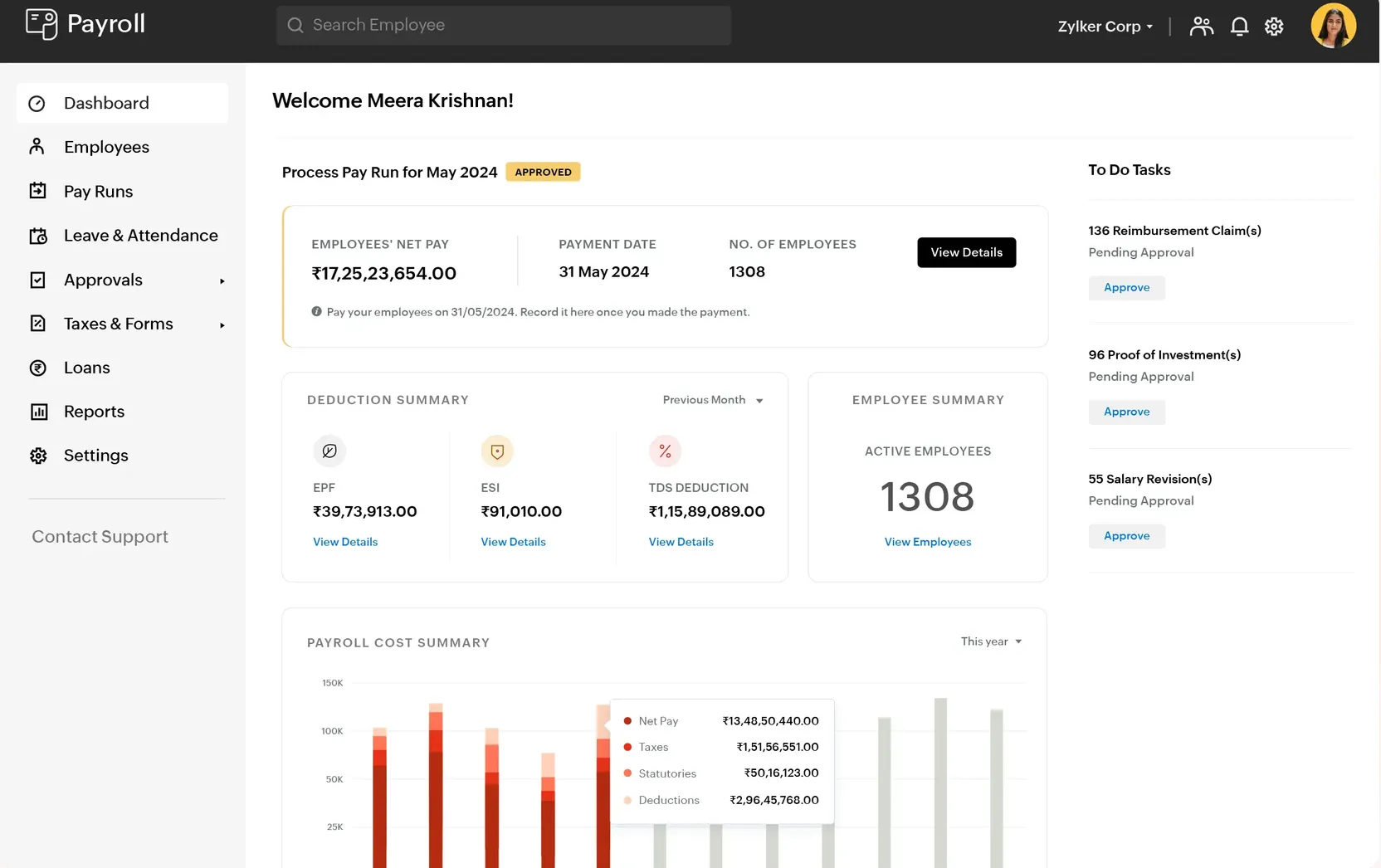
Operating as a standout module in the Zoho SaaS family, Zoho Payroll provides complete statutory compliance capabilities for small, growing operations.
Free Plan Boundary: Genuinely free forever for up to 10 employees, 1 administrative user, and 1 corporate work location.
Compliance Depth: Fully automates computations for EPF, ESI, state-specific PT, and Labour Welfare Fund (LWF). It natively supports both old and new tax regimes under Section 392 and automatically generates downloadable Form 12BB declarations, Form 130 certificates (Form 16), and Form 143 sheets (Form 24Q).
Disbursement & Integrations: Integrates directly with Zoho Books (accounting) and Zoho People (HRMS). Enables direct, automated salary disbursements via native banking integrations with ICICI Bank and HSBC.
Ideal For: Early-stage, tech-forward startups (under 10 staff) looking to automate their entire accounting and payroll loop.
2. greytHR Starter Plan
As a trusted payroll platform in India, greytHR provides a highly reliable compliance engine.
Free Plan Boundary: Free forever for up to 25 employees under the "Starter Plan".
Compliance Depth: The free plan handles basic payroll runs, automatically calculating EPF, ESI, and Professional Tax. It provides employees access to a secure employee self-service (ESS) portal to download payslips and view basic leave structures.
Key Limitations: Excludes advanced automation like Section 392 TDS calculations, income tax declarations, and Form 130 generation. It operates on web-clock only (no GPS tracking, mobile attendance, or biometric syncing). Inactive accounts (no logins for 3 months) are subject to deletion.
Ideal For: Small, single-location offices with stable teams (under 25 staff) that require high computational compliance but do not need complex tax-declaration tracking.
3. INDPayroll
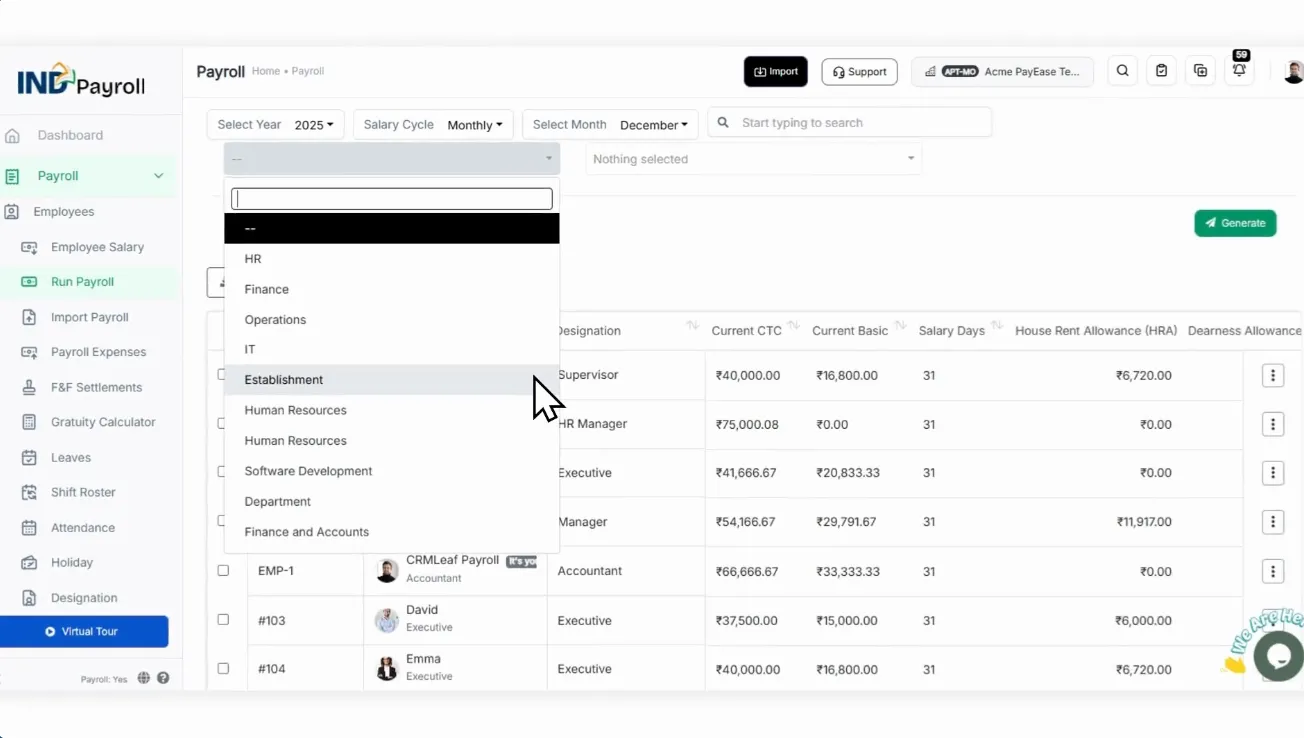
Built specifically for Indian SMEs, startups, and CA client managers, INDPayroll operates on a flat-rate scaling model that eliminates the per-employee licensing penalty.
Free Plan Boundary: Fully free with no expiration for up to 25 employees.
Compliance Depth: Runs automated monthly calculations for Basic-to-CTC structures, generates professional payslips, and computes standard EPF deductions.
Key Limitations: Full TDS, income tax projections, ESI, Professional Tax calculations, and Electronic Challan-cum-Return (ECR) generation are restricted to the paid Essentials tier (billed flat at an affordable ₹499 per month for up to 200 employees). The mobile app operates in read-only mode on the free tier.
Ideal For: Bootstrapped startups, service-based businesses, and accounting firms looking to transition from Excel without facing unexpected costs as they hire.
4. Kredily
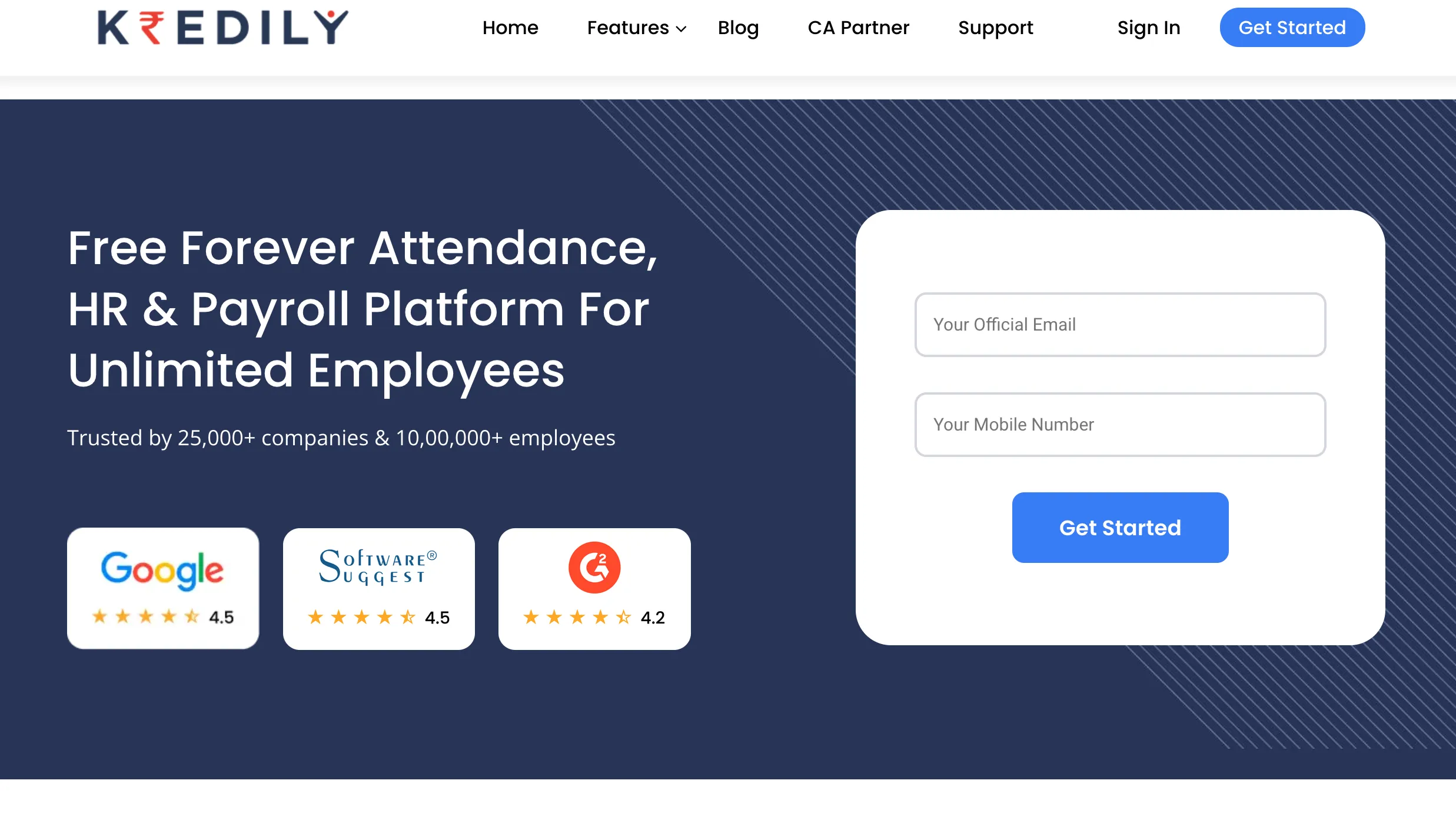
Kredily stands out as a cloud-based HRMS platform that offers its core software entirely free to make tools accessible to Indian MSMEs.
Free Plan Boundary: Genuinely free forever for unlimited employees with 250MB of database storage.
Compliance Depth: Auto-computes baseline EPF and ESI allocations, logs web check-ins and check-outs, and handles basic leave approval workflows.
Key Limitations: TDS computations and Form 130 (Form 16) generations are locked behind the paid Payroll OS plan (starting at a low ₹999/month).
Monetization Catch: To sustain its zero-cost model, Kredily markets pre-approved consumer financial products (such as loans and personal credit lines underwritten by Aditya Birla Capital) directly to your employees through their ESS dashboard. Using this free tier requires sharing basic employee KYC data, including PAN cards and verified compensation numbers.
Ideal For: Highly cost-sensitive startups seeking a centralized employee directory and basic payroll runs with no headcount limits.
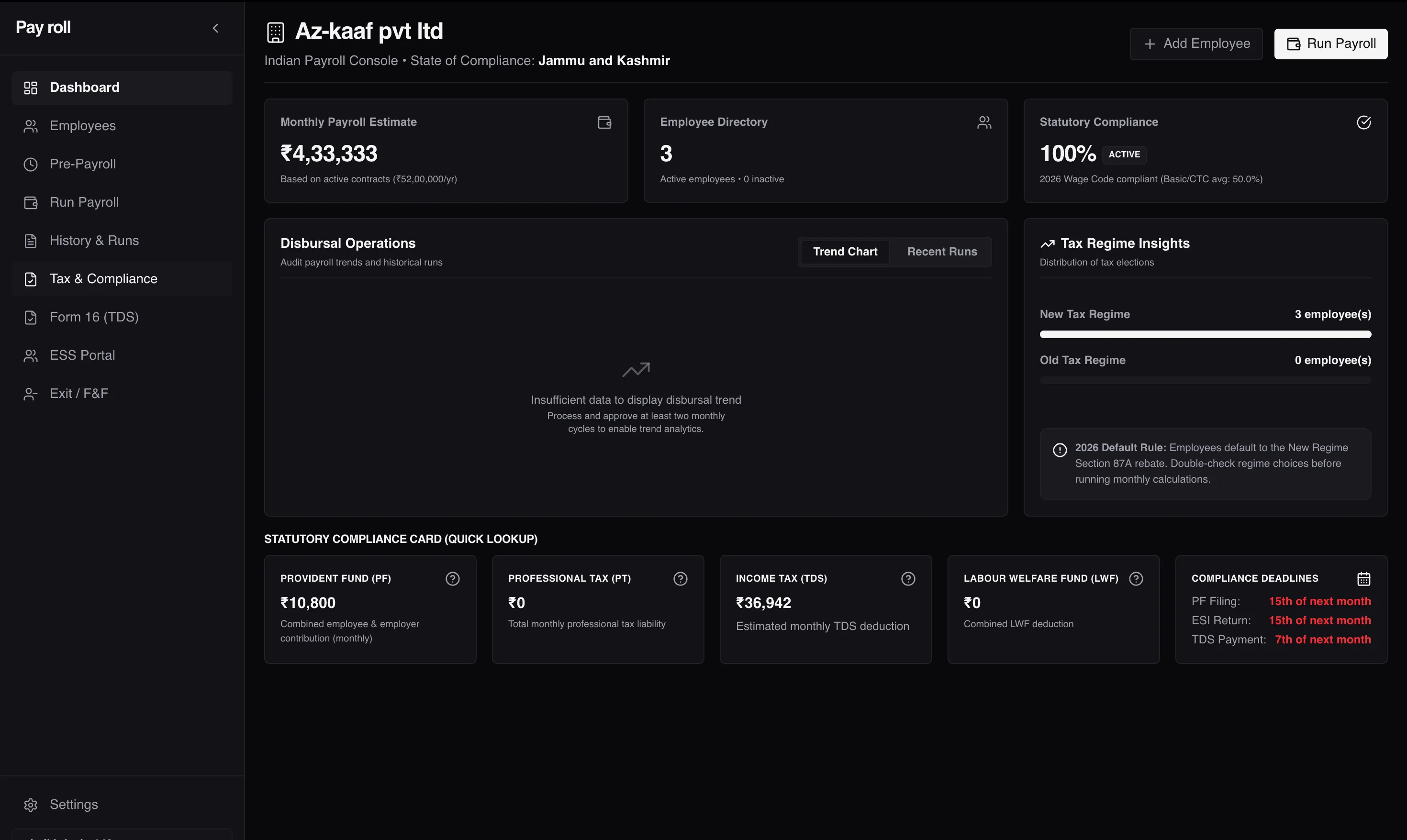
5. FindNStart Payroll (Co-Founder Utility)
For early-stage entrepreneurs, setting up a formal SaaS payroll system is often premature, as teams may still be pre-incorporation or focused on sweat equity modeling. FindNStart, a dedicated matchmaking and team-building platform for startup co-founders, addresses this phase directly.
Free Plan Boundary: 100% Free with no licensing or transaction fees.
Specialized Features: Accessed under the Tools menu at FindNStart, this utility is a specialized payroll modeling, equity vesting, and runway calculator. It allows early-stage teams to model sweat equity distributions, map milestone-based vesting schedules (critical to prevent co-founder disputes), and project cash runways.
Compliance Depth: Helps calculate baseline estimated salaries, projected TDS liabilities under Section 392, and standard statutory breakdowns before a formal corporate entity is established.
Ideal For: Pre-incorporation teams, bootstrapped co-founders, and early-stage startup builders looking to structure equity vesting and model their team compensation allocations.
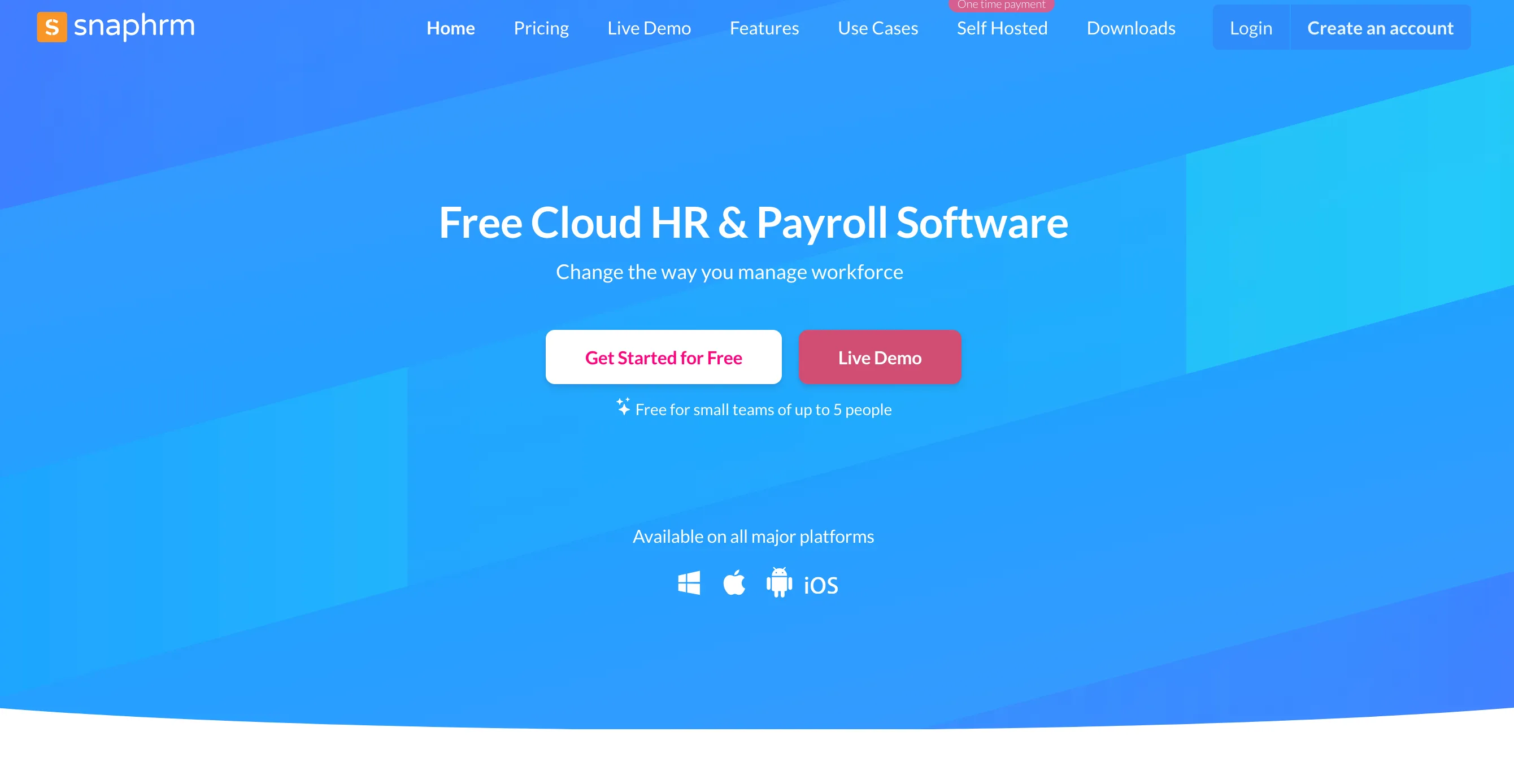
6. SnapHRM
SnapHRM is built for small teams that need an all-in-one HR platform without feature restrictions or complex implementation processes.
Free Plan Boundary: Free forever for up to 5 employees.
Compliance Depth: Unlike greytHR or Kredily, the free tier does not lock modules. You get access to the full, feature-unlocked system, including one-click payroll with complete EPF, ESI, state PT, and TDS calculations.
Unified HR Suite: Includes a built-in applicant tracking system (ATS), expense tracking, asset management, and digital document lockers.
Ideal For: Micro-teams (1 to 5 staff) that want a complete "hire-to-retire" platform without modular upsells.
7. Empxtrack
Empxtrack scales down its enterprise human capital management platform into a free, self-configurable portal for micro-enterprises.
Free Plan Boundary: Free forever for up to 10 employees with no credit card required.
Compliance Depth: Configures multi-tenant salary structures, automates standard deductions (PF/ESI), estimates taxes across old and new tax regimes, and generates PDF payslips.
Key Limitations: The user interface leans toward a traditional, utilitarian enterprise layout that may feel dated or require extra setup time for non-technical administrators.
Ideal For: Highly structured small teams with strict, detailed policy-approval steps who need strong access controls and custom salary templates.
8. ERPNext (Frappe HR with India Payroll Extension)
For businesses seeking complete operational control and data sovereignty, the open-source community provides a robust solution with ERPNext.
Free Plan Boundary: 100% Free with unlimited employees and no user licensing fees if you self-host the Community Edition on your own servers.
Compliance Depth: When paired with the "India Payroll" extension app, the platform handles statutory deductions directly via system hooks. It calculates EPF, ESIC, LWF, and state-wise PT based on the employee's work location, while managing tax declarations, investment proofs, and Form 130 generation.
Key Limitations: Self-hosting is not plug-and-play. It requires in-house technical IT skills to deploy, secure, and maintain the servers, as well as manually implement tax-slab updates as regulations evolve.
Ideal For: Tech-savvy SMEs, manufacturing plants, and engineering firms with internal IT staff capable of managing their own private cloud infrastructure.
9. SalaryBox
SalaryBox is a mobile-first platform built specifically for Indian businesses managing field sales, retail stores, and shifts.
Free Plan Boundary: Free for up to 15 employees.
Compliance & Attendance Depth: Features GPS-based attendance verification, geofencing, shift-roster scheduling, and basic salary slip generation with WhatsApp delivery.
Key Limitations: Advanced statutory calculations for EPF, ESI, TDS under Section 392, and automated compliance filing are restricted to paid tiers (such as SB Payroll Pro).
Ideal For: Single-outlet retail shops, local diagnostic clinics, and agencies with shift-based staff or mobile field teams.
10. SumoPayroll
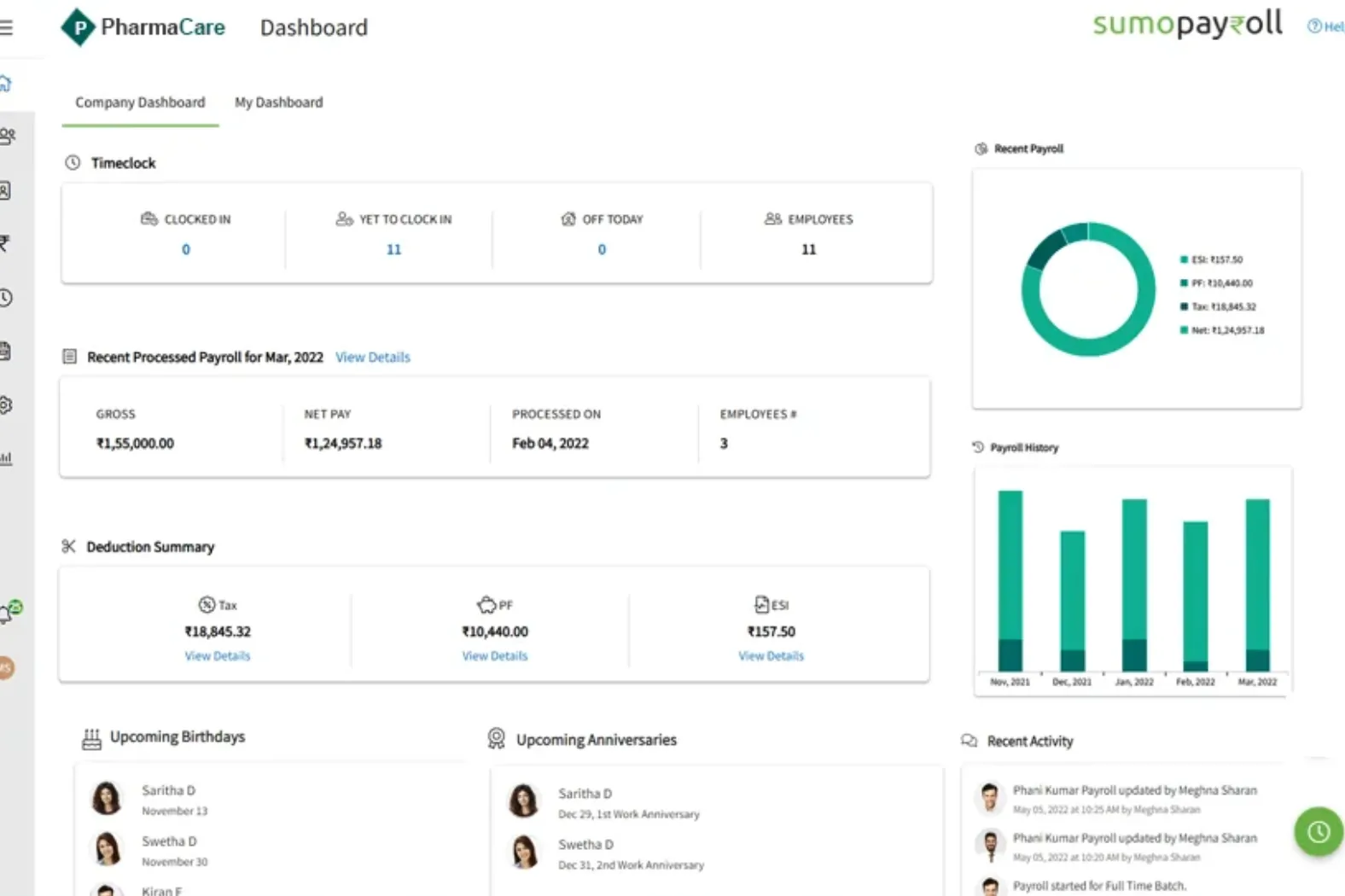
SumoPayroll focuses strictly on the core payroll and tax calculation loops, avoiding broader HRMS features to keep its processes simple.
Free Plan Boundary: Free forever for up to 10 employees. Above that, a tiered flat fee of ₹35 per employee is applied.
Compliance Depth: Automates gross-to-net salary processing, basic tax deductions, and provides direct bank disbursement reports.
Key Limitations: Lacks robust automation for EPFO-ECR filing and ESIC return generation, and does not support integration with physical biometric hardware or complex shift rosters.
Ideal For: Micro-sized service agencies and consulting shops managing a mix of permanent salaried employees and independent contractors.
Technical and Feature Comparison
The matrix below contrasts these tools across essential parameters, helping you evaluate them side-by-side:
Application Name | Free Plan Limit | Native Compliance (PF/ESI/TDS) | Primary Disbursal & Input Sync | Best For |
Zoho Payroll | Up to 10 employees | Full PF/ESI/PT/TDS natively | ICICI & HSBC bank-direct payout | Tech-integrated teams inside Zoho ecosystem |
greytHR Starter | Up to 25 employees | PF/ESI/PT; TDS requires upgrade | Web clock-in only on free | Established small offices with simple hours |
INDPayroll | Up to 25 employees | Standard PF; ESI/TDS on flat ₹499 paid plan | Basic spreadsheet & manual bank registers | Bootstrapped teams looking for flat-rate scaling |
Kredily | Unlimited employees | PF/ESI; TDS requires upgrade | Web clock-in with geo-tagging | Tiny teams comfortable with in-app financial ads |
FindNStart Payroll | 100% Free | Estimated TDS & baseline statutory rules | Vesting & sweat equity model tracking | Co-founders, bootstrappers, & pre-incorporation teams |
SnapHRM | Up to 5 employees | Full PF/ESI/PT/TDS natively | Web clock-in, expense imports | Micro-startups seeking a feature-unlocked HRMS |
Empxtrack | Up to 10 employees | Standard PF/ESI/TDS calculations | Manual spreadsheet imports, maker-checker flow | Micro-businesses requiring precise policy controls |
ERPNext | Unlimited (Self-Hosted) | Fully customizable state-aware hooks | Biometric APIs, expense & timesheet links | Mid-sized firms with technical IT departments |
SalaryBox | Up to 15 employees | Basic PF/ESI on free; TDS on paid | AI face selfie clock-in, geofencing | Field-heavy logistics, retail, & shift workers |
SumoPayroll | Up to 10 employees | Basic calculations, manual filings | Simple manual time entries | Freelance agencies with contract staff |
Critical Trade-offs to Consider
Before adopting a "free forever" payroll tool, it is important to evaluate the associated technical and operational trade-offs:
1. Data Privacy and In-App Advertising
Some platforms offer unlimited employee limits on their free tier by using alternative monetization methods. For example, platforms like Kredily offset software development costs by marketing financial products (like personal loans, salary advances, and medical insurance) directly to your employees through their self-service dashboard. Under their terms, sensitive employee profile information—such as PAN cards, verified salary numbers, and mobile coordinates—may be shared with third-party underwriting partners like Aditya Birla Capital. If your business prioritizes strict data privacy, check whether your free vendor monetizes through advertising.
2. The Operational and Financial Scaling Cliff
Many tiered-free platforms have a hard limit on headcount. While greytHR is free for up to 25 employees, adding a 26th employee requires upgrading to a paid plan starting at around ₹3,495/month. This sudden cost increase can surprise a bootstrapping startup. If you expect rapid hiring, prioritize options that offer flat-rate paid tiers (like INDPayroll) or modular, per-user pricing (like Zoho Payroll) to ensure a smooth transition.
3. Server Maintenance and Hosting Overhead
Open-source solutions like ERPNext offer freedom from licensing costs, but they are not entirely free to operate. Your business must cover the hosting costs, manage regular secure database backups, and manually configure complex, state-specific PT and TDS rate updates to remain compliant. If your team lacks technical expertise, a cloud-managed tool that updates compliance rules automatically is generally the safer option.
Strategic Guide: Selecting the Right Platform
Your choice of a free payroll app should align with your business profile, growth plans, and workforce structure:
For Pre-Incorporation Teams and Co-Founders: Use the tools on FindNStart. Before setting up a formal payroll system, it helps you model sweat equity distribution, track milestones, and estimate your early compliance and TDS structures.
For Tech Startups (Under 10 Staff): Use Zoho Payroll. It provides native compliance tracking, integrates with Zoho Books, and enables direct banking transfers, making it a highly efficient starter option.
For Small Offices (11 to 25 Employees): Use greytHR or INDPayroll. If reliability and a proven compliance history are your top priorities, greytHR’s Starter plan is a solid choice. If you want a cost-effective path to scaling without per-employee pricing penalties, INDPayroll is highly suitable.
For Retail, Restaurants, and Shift-Based Teams: Use SalaryBox. Its AI-selfie verification and geofenced attendance tracking allow you to manage retail and field staff without investing in physical biometric hardware.
Protect Your Future: The Precision Vesting Calculator
Don't let a "handshake deal" complicate your exit. Map out your ownership journey with our Vesting Calculator
Calculate Your Vesting Schedule →