The Hidden Costs of Free Users
February 18, 2026 by Harshit GuptaThe Software-as-a-Service (SaaS) industry is currently undergoing a fundamental re-evaluation of its most prolific acquisition strategy: the freemium model. For over a decade, the promise of the freemium architecture—offering basic product features at no cost to attract a massive user base—was viewed as the definitive path to viral growth and market dominance. However, as the global economic climate shifts toward a "Rule of 40" focus on profitability over pure growth, the hidden costs associated with supporting non-paying users have emerged as a primary threat to institutional margins and operational stability. The conversion paradox remains the central mathematical challenge of this model; while firms successfully build large user bases, the average freemium-to-paid conversion rate hovers persistently between 2% and 5%. This reality necessitates that a firm support 20 to 50 free users for every single revenue-generating customer, creating a resource consumption asymmetry that can silently drain infrastructure budgets and distract engineering teams from high-value innovation.
The Financial Framework of the Cost to Serve
The economic viability of any freemium venture hinges on the relationship between the Customer Lifetime Value (LTV) of the paying minority and the cumulative Cost to Serve (CTS) of the non-paying majority. Historically, firms applied "peanut-butter costing," spreading overhead evenly across all accounts. Modern activity-based costing (ABC) frameworks reveal that this approach obscures the true financial burden of free users, who often consume a disproportionate share of resources relative to their potential for conversion.
Quantifying Infrastructure and Data Management Overhead
In a freemium ecosystem, free users represent an ongoing variable expense rather than a one-time acquisition cost. These users consume server capacity, data storage, and compute power indefinitely. A 2022 analysis by Andreessen Horowitz highlighted that companies with expansive free tiers often allocate 15% to 25% of their total infrastructure budget strictly to servicing accounts that generate zero revenue. This cost is not static; as users accumulate data, the storage and management requirements grow. One cloud storage provider discovered that dormant free accounts—those with no activity for over 12 months—were costing approximately $2.3 million annually in storage infrastructure alone.
The complexity of these costs has intensified with the integration of generative AI. Unlike traditional SaaS, where the marginal cost of an additional user was historically negligible, AI-native platforms face significant marginal unit costs for every interaction. Large language models require substantial computing power from providers like OpenAI, Google, or Anthropic, making the "as much as you need" free tier economically unsustainable.
Estimated Monthly Technical Costs per Free User Cohort
Infrastructure Component | Low-Usage Estimate (Monthly) | High-Usage Estimate (Monthly) | Conservative Annual Total (100k Users) |
Server Compute & Bandwidth | $0.50 | $5.00 | $1,200,000 |
API & Third-Party Services | $0.25 | $1.00 | $300,000 |
Database Storage & Backups | $0.10 | $0.50 | $120,000 |
Monitoring & Observability | $0.05 | $0.20 | $60,000 |
Total Per User Cost | $0.90 | $6.70 | $1,680,000 |
The data indicates that even at a conservative estimate of $1.00 per month per user, a base of 100,000 free users requires $1.2 million in annual infrastructure investment. When support, marketing, and security are added, the total annual cost to support such a base can range from $2.25 million to $9.65 million. If the conversion rate remains at 5%, the firm must generate enough margin from 5,000 paying users to cover their own LTV and the $2.25 million to $9.65 million loss generated by the free segment.
The Operational Support Burden and Management Productivity Tax
A critical hidden cost of the freemium model is the disproportionate volume of support interactions generated by non-paying users. Studies by Zendesk show that free users frequently generate 30% to 40% of all support tickets. In mid-market SaaS environments, this imbalance is often more extreme; some firms have reported that free users represent 85% of the user base and 62% of support tickets, while contributing 0% of revenue.
The Support Ticket Fallacy
Confused customers generate questions, and free users—who may have lower intent and less formal training than enterprise users—often flood support channels with preventable, basic queries. The average cost of handling a single support ticket, factoring in agent salaries, software tools, and management overhead, ranges from $5 to $15. If free users average just one support interaction every three months, the annual support cost per free user is between $20 and $60.
Support Metric | Small-Scale Impact (Per User/Year) | Enterprise Impact (1M Users/Year) |
Interaction Frequency | 4 tickets | 4,000,000 tickets |
Average Cost per Ticket | $15.00 | $15.00 |
Total Support Cost | $60.00 | $60,000,000 |
Converted Revenue Requirement | $1,200 (at 5% conversion) | $1,200,000,000 |
This "support burden imbalance" forces difficult staffing decisions: either maintain service quality for all users at a massive loss or provide subpar service to free users and risk damaging the brand's reputation. Furthermore, poor onboarding practices exacerbate these costs. Research shows that every additional week it takes for a user to see value—the Time-to-First-Value (TTFV)—correlates with a 23% increase in churn probability within the first year.
Management and Engineering Opportunity Cost
The drain on productivity extends beyond the support team. High-level managers often find themselves spending nearly half their time on "emergency" onboarding calls or troubleshooting issues for users who have no clear pathway to conversion. A case study of a Head of Customer Success revealed she was spending 19 hours per week—representing $39,100 in annual management overhead—on preventable setup and billing issues for non-revenue accounts. Across an entire customer success team, this management productivity tax can exceed $156,000 annually.
Engineering Opportunity Cost and the Technical Debt Trap
Engineering resources are arguably the most valuable asset in a SaaS firm, and the freemium model frequently misallocates them toward low-value maintenance rather than high-value innovation. As a platform scales with predominantly free users, technical architecture decisions often prioritize handling high user volume and maintaining basic feature parity over optimizing revenue-generating functionality.
The Maintenance of Legacy Features and Feature Bloat
SaaS firms often suffer from "SaaS bloat," where unnecessary features are added to justify premium pricing tiers or to appease niche requests from the free user base. This complexity creates a form of technical debt where developers must maintain code that is no longer core to the business mission. According to Stripe's Developer Coefficient report, developers spend an average of 17.3 hours per week—over 42% of their time—dealing with technical debt and bad code. This results in an estimated $85 billion in global opportunity cost lost annually as engineers pursue "payoff tasks" like refactoring rather than software improvements.
Quantifying Technical Debt in Freemium Environments
Debt Metric | Statistical Value | Operational Impact |
Principal Tech Debt | $361,000 per 100k LOC | Future modernization cost |
Annual Maintenance Increase | 15% budget increase | Reduced capital for R&D |
Legacy System Component | 31% of total tech stack | Sluggish market reactivity |
Developer Morale Impact | 78% report frustration | Increased employee turnover |
Innovation Effective Rate | 25% of innovation spend | Diluted competitive advantage |
The "interest" on this technical debt consists of the ongoing charges incurred to keep outmoded legacy applications running as the technological context recedes. For firms supporting free users on older infrastructure, this debt can consume 40% of the entire IT budget by 2025. When engineers spend 75% of their time paying the "tech debt tax," the firm's ability to release innovative features is crippled, allowing more agile competitors to gain market share.
Security Risks and the Bot Mitigation Crisis
The absence of an upfront financial commitment makes freemium tiers a primary target for malicious actors. Because signing up for a free account is frictionless, fraudsters can automate the creation of thousands of accounts to exploit platform resources, conduct spam campaigns, or launch distributed denial-of-service (DDoS) attacks.
Automated Multi-Accounting and Verification Costs
In the AI SaaS sector, "multi-accounting" has become a pervasive issue. Users who find free limits (e.g., 10 images or 1,000 chat messages per day) too restrictive use bots and disposable email providers to create massive volumes of accounts. These bots utilize APIs from "throwaway" email services and temporary phone numbers to bypass SMS and identity verification.
The financial consequences are severe. Beyond consuming expensive GPU and server resources, firms often end up paying for SMS-based verification for junk accounts, a practice known as "SMS pumping" fraud. Additionally, bot-driven account creation biases user interaction data, leading to flawed product strategy decisions and potentially distorting investor valuations.
The High Cost of Defensive Infrastructure
To combat these threats, firms must invest in sophisticated bot mitigation solutions. Services such as Cloudflare, Akamai, and F5 provide essential protection but introduce significant recurring costs.
Bot Mitigation Vendor | Service Level | Indicative Pricing (2025) |
Cloudflare | Enterprise Bot Manager | $2,000+ per month |
Akamai | Kona Site Defender | $2,900 per month (base) |
Imperva | Advanced Bot Management | $6,000 - $100,000+ per year |
ThreatX | Managed WAAP Service | ~$60,000 per year |
AppTrana | Premium Managed Security | $399+ per month |
The implementation of these tools is a strategic necessity, but for a freemium business, it represents yet another layer of overhead dedicated to users who do not contribute revenue. If a firm fails to implement robust bot defense, it risks reputation damage from glitches, slow performance, and potential data breaches that expose consumer data—leading to fines under regulations like GDPR that can reach 4% of worldwide turnover.
The Psychology of "Free": Entitlement, Brand Devaluation, and the Comparison Filter
While the freemium model is intended to leverage the "endowment effect"—the psychological principle where users value a product more once they feel ownership—it often creates a "entitlement gap" that can damage the brand long-term.
The Entitlement Gap and Retaliatory Behavior
Customer entitlement occurs when non-paying users develop exaggerated expectations of rights and privileges. When brands implement "customer prioritization" strategies—focusing resources on high-value paid users—the free users who receive "disadvantaged treatment" often react with hostility. Research involving Canadian participants demonstrated that an increased sense of entitlement directly translates into retaliatory intentions, including vindictive complaining and the generation of negative word-of-mouth.
These "jaycustomers" can monopolize employee time and demoralize frontline staff, who must handle verbal aggression on an average of 10 times per day in call center environments. This psychological strain contributes to higher employee turnover and reduced customer empathy across the organization.
The Comparison Filter and Brand Devaluation
Offering a product for free can lead to a perception of lower quality. When users are presented with a free alternative, subsequent paid offerings are viewed through a "filtered lens of comparison," where the premium features are judged against the zero-cost baseline. This complicates the decision-making process; the allure of no-cost access can overshadow the tangible benefits of higher-priced alternatives, making it increasingly difficult for firms to persuade users to pay for professional-grade functionality.
Case Studies in Freemium Migration: Evernote, Dropbox, and the 2025 Price Surge
The strategic retreat from generous freemium models by industry leaders provides concrete evidence of the model's inherent risks.
Evernote: A Case Study in Resource Mismanagement and Technical Debt
Evernote, once a Silicon Valley unicorn, struggled under the weight of its massive free user base and monolithic architecture. Under the leadership of Phil Libin, the company attempted to diversify into niche offerings like Evernote Food, which diluted the core brand and diverted engineering resources. The turnaround required a "Wartime CEO" approach: trimming the fat, refocusing on the core note-taking product, and refining the pricing structure to target "power users" and businesses. Libin discovered that users who interacted with the product more than 20 times per month were the "high-value" cohort most likely to convert.
Dropbox: The End of Unlimited Storage
Dropbox’s transition from an "as much space as you need" model to a metered policy in 2023 was driven by systemic abuse. A minority of users were utilizing business accounts for non-business purposes, including cryptocurrency mining and personal storage pooling, consuming thousands of times more storage than genuine customers. To maintain platform stability and sustainability, Dropbox was forced to transition to a metered model, capping storage at 15TB for new customers—a move mirrored by competitors like Google and Microsoft.
The "Great Price Surge" of 2024-2025
By 2025, the SaaS market entered a phase of "Growth Pressure," where public companies prioritized margin optimization over logo acquisition. This led to a wave of price increases and free tier restrictions.
Company | 2024/2025 Pricing Strategy Change | Strategic Rationale |
Mailchimp | Free contact limit cut from 2,000 to 500 | Margin optimization post-Intuit acquisition |
Loom | Shifted to usage constraint of 25 videos | Functional pivot to free trial model |
Slack | Business+ plan increased 20% to $15/user | Pressure to maintain growth post-Salesforce merger |
Adobe | Discontinued 20GB Photography Plan for new users | Pushing users toward higher-margin Cloud plans |
HubSpot | Shifted to "Core User" model with view-only seats | Standardizing pricing to improve NRR |
This trend reflects a broader industry recognition that "free" users often represent a strategic liability in a saturated market. Firms are increasingly shifting toward "Outcome-Based" and "Usage-Based" pricing, ensuring that revenue scales directly with the infrastructure costs incurred.
Mathematical Modeling: Calculating the Real Break-Even Point
To evaluate the feasibility of a freemium model, firms must utilize rigorous financial formulas that account for the non-paying segment.
The Modified SaaS Break-Even Point
The break-even point is reached when subscription revenue equals total fixed and variable costs. In freemium environments, the formula is:
Break-Even Point=ARPA−Variable Costs Per UserTotal Fixed Costs
Where:
Total Fixed Costs: Includes rent, salaries for core teams, and debt interest.
ARPA: Average Revenue Per Account (the paid users).
Variable Costs Per User: Must include the infrastructure and support costs for all users, divided by the number of paid accounts.
If a firm has 100,000 free users and 5,000 paid users, the "Variable Costs Per User" for the paid accounts must absorb the costs of the 20 free users they are subsidizing. If it costs $2.00 per month to support a free user and $10.00 for a paid user, the variable cost for the paid user is functionally $50.00 ($10 + 20 * $2).
LTV and CAC Segmentation
The Customer Lifetime Value (LTV) must be calculated using the gross margin to account for these service costs.
LTV=Monthly Churn RateAverage Monthly Revenue×Gross Margin
A firm with a 70% gross margin on its paid tier may find its effective gross margin is much lower—perhaps 40%—once the costs of the free tier are fully allocated. If the LTV:CAC ratio falls below 3:1, the business model is typically unsustainable in the long term.
Strategic Alternatives: Graduation Models and Behavioral Gating
To mitigate the hidden costs of free users, sophisticated firms are moving away from permanent free access toward more dynamic monetization pathways.
Resource-Based Limitations vs. Feature Gating
Instead of purely gating features, firms like Slack and Notion utilize resource-based thresholds. This approach allows users to experience the full value of the platform until their consumption reaches a level that generates significant infrastructure cost, at which point an upgrade is required.
Behavioral Conversion Triggers
Firms are increasingly using product analytics to identify "Activation Thresholds"—precise moments when a user achieves initial success (e.g., importing data, inviting a team member). According to ProfitWell research, targeting conversion efforts at these behavioral milestones can increase conversion rates by up to 30%.
The Hybrid "Free Trial" Evolution
Many B2B SaaS companies are abandoning the permanent freemium model in favor of the unlimited free trial. This strategy offers products for free but with significant, time-bound limitations, prompting users to recognize the value of premium features quickly. Trial conversion rates for B2B SaaS typically reach 15-20%, significantly higher than the 2-5% observed in traditional freemium models.
Conclusion: Navigating the Post-Freemium Era
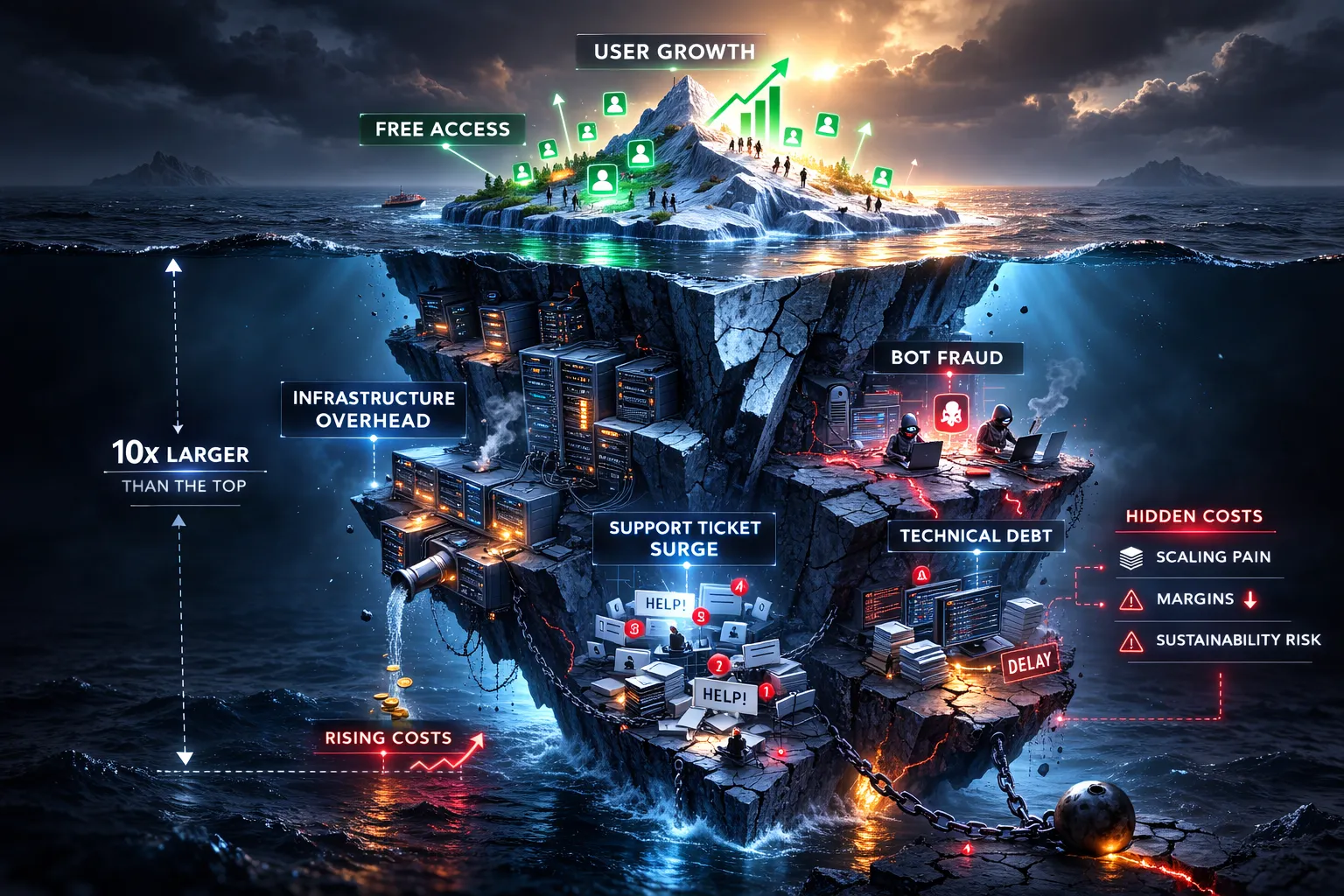
The freemium business model is no longer a guaranteed catalyst for sustainable success. The hidden costs associated with supporting non-paying users—infrastructure inflation, support ticket asymmetry, technical debt accumulation, and security vulnerabilities—create a complex economic reality that can jeopardize the very foundation of a SaaS company.
The transition seen in 2024 and 2025 toward usage-based billing and restricted free tiers reflects a strategic pivot toward "Profit-Led Growth". By employing activity-based costing, implementing resource-based limitations, and focusing on high-intent user behavioral triggers, firms can transform the free user from a silent drain on resources into a measured investment in future revenue. Ultimately, the firms that will lead the next decade of software innovation are those that prioritize "Outcome over Access," ensuring that every user—paying or not—is accounted for in a transparent and sustainable economic model.
Want to calculate the equity for your cofounder?
Nail your cap table before you sign. Whether you're splitting equity with a co-founder or planning your next funding round, our Equity Calculator gives you precision in seconds
Equity calculator →