Investimento Estratégico
April 23, 2026 by Harshit Gupta
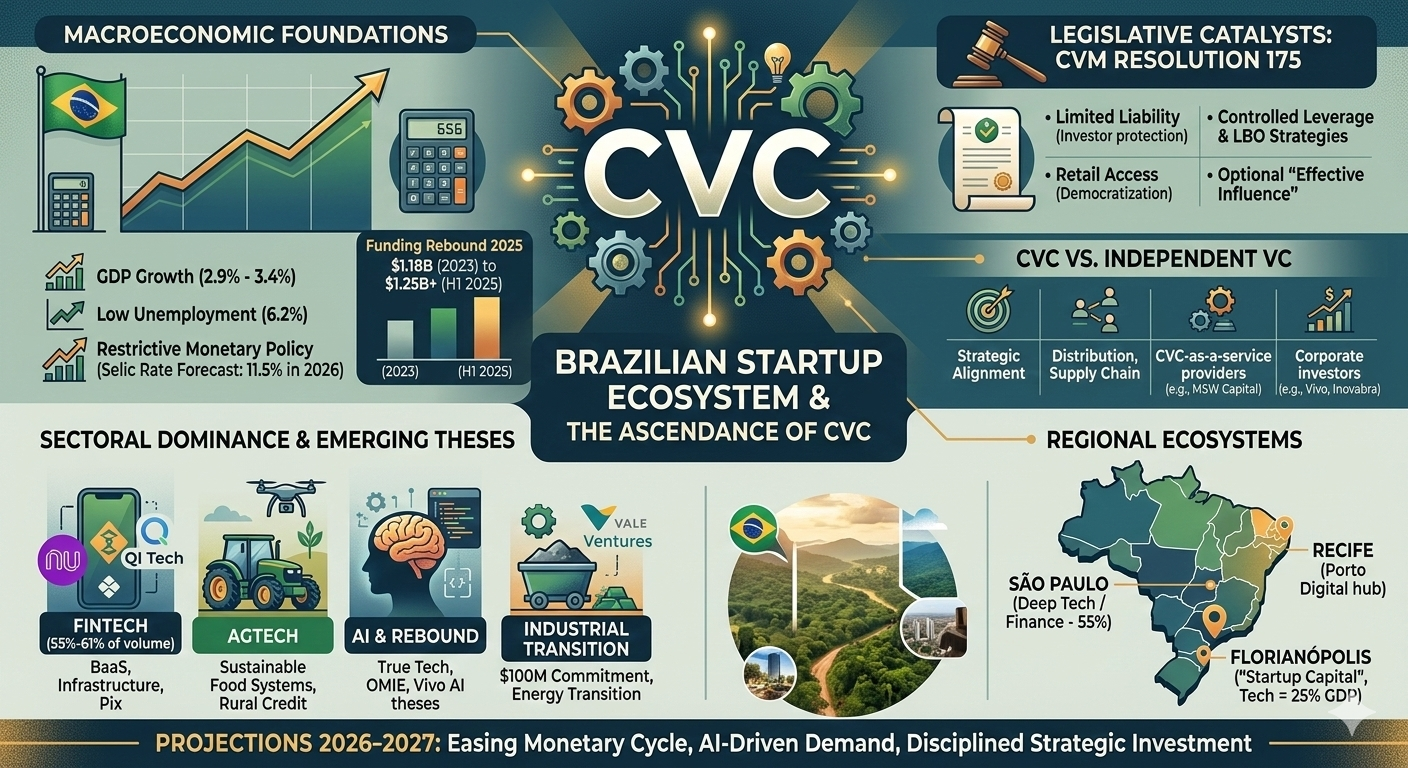
The Brazilian venture capital ecosystem has moved beyond the "survival" phase of 2023–2024 and is currently navigating a period of strategic re-acceleration. As of April 2026, the landscape is defined by the easing of monetary pressure and a massive pivot toward Artificial Intelligence (AI) and sustainability-linked industrial modernization.
Below is the updated data and structural analysis reflecting the 2025–2026 cycle.
Updated Macroeconomic Indicators (2025–2027)
The restrictive "high-for-longer" Selic era is finally beginning to thaw. Current forecasts indicate an imminent easing cycle starting in the first half of 2026 as inflation stabilizes within the target range.
Economic Indicator | 2024 (Actual) | 2025 (Actual/Est) | 2026 (Forecast) | 2027 (Forecast) |
GDP Growth (%) | 3.4 | 2.2 - 2.3 | 1.7 | 2.2 |
Inflation (IPCA) (%) | 4.4 | 4.4 | 3.8 - 4.2 | 3.0 - 3.5 |
Selic Rate (End of Year) (%) | 12.25 | 15.0 | 11.50 - 11.75 | 10.00 |
Debt-to-GDP Ratio (%) | 76.1 | 78.6 | 84.8 - 95.0 | Stable |
The 2025 Rebound: VC Funding Resurgence
The "Venture Capital Winter" effectively ended in late 2024. In 2025, global and regional funding saw its highest levels since the 2021 peak, largely driven by "AI mega-rounds" and a renewed appetite for late-stage deals.
Valuation Recovery: Valuations for Brazilian startups in late 2025 rebounded to levels not seen since 2021, particularly for companies with proven unit economics.
The AI Alpha: AI-related startups now represent over 25% of total VC funding in the region, up from just 7% in 2023.
Sector Focus: While Fintech remains the backbone, Defense Tech and Agtech saw record-high funding in 2025 as geopolitical tensions and climate risks drove corporations to secure domestic supply chains.
CVC Maturity: From Stabilizer to Leader
Corporate Venture Capital is no longer just "filling the void." In 2025, CVCs participated in 68% of the total deal value in the AI sector. The "CVC-as-a-Service" model has expanded, with traditional sectors like mining (Vale), energy (Petrobras), and retail (Magalu) shifting toward Evergreen fund structures to avoid the volatility of 10-year IVC cycles.
Key Structural Shifts in 2026
Industrial Modernization: Under the current "New Industrial Policy," CVCs are increasingly used as tools for decarbonization. Large Brazilian industrial groups are investing heavily in "Deep Tech" (biotechnology and hardware) to meet international ESG export standards.
M&A and IPO Exit Thaw: After a multi-year drought, the exit environment is beginning to unlock. 2026 is seeing a significant uptick in M&A activity as incumbents "buy innovation" to stay relevant against AI-native competitors.
Venture Debt and Hybrid Models: Given the high (though falling) Selic rates, startups are increasingly utilizing Venture Debt and Revenue-Based Financing to bridge rounds without excessive equity dilution.
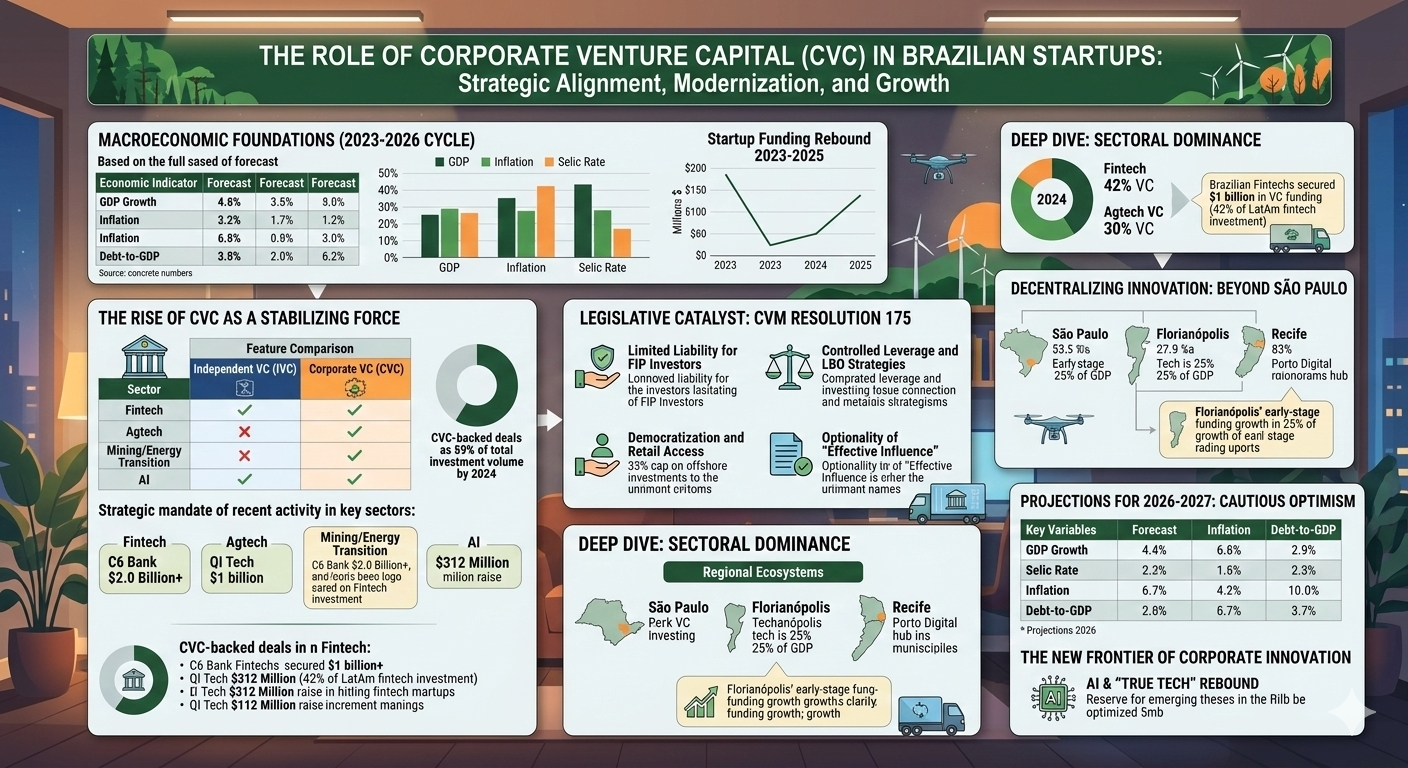
The transition from a "punitive" liability model to a globalized, limited-liability framework has fundamentally changed how Brazilian boards view venture risk. Below is the updated analysis of how these legislative catalysts are performing in the 2025–2026 cycle.
The "Resolution 175" Impact Ledger (2026 Update)
The "Unified Rulebook" has led to a surge in FIP-Multiclasse structures. By separating assets and liabilities into distinct "classes" within the same fund, CVCs are now running hybrid strategies (e.g., one class for equity, one for venture debt) under a single legal umbrella.
Regulatory Pillar | Previous Regime (Pre-2023) | Modernized Framework (2026 Status) |
Liability | Unlimited: Personal assets of investors were at risk if the fund went "red." | Limited: Capped at subscribed capital. This has led to a 40% increase in new CVC fund registrations by conservative "Old Economy" firms. |
Leverage | Prohibited: Funds were strictly "cash-in, cash-out." | Permitted: FIPs now use NAV-based lending. In 2025, venture debt via FIPs grew by 22%, allowing startups to extend runways without dilution. |
Influence | Mandatory: Investors had to interfere in management. | Optional: Funds can now be "passive" minority investors, enabling more "Club Deals" and co-investments with international giants. |
Offshore Allocation | Strictly Limited: Significant friction for global diversification. | 100% for Pros: Brazilian CVCs (like those of Itaú or Gerdau) now routinely invest in Israeli or Silicon Valley "Deep Tech" to import tech back to Brazil. |
The Surge of Venture Debt and "LBO-Lite"
With the 2024–2025 interest rate spike (Selic at 15%), the ability to use leverage became a survival mechanism.
The LBO-Lite Trend: We are seeing more "Bolt-on" acquisitions. A corporate-backed FIP uses its balance sheet to help a "winner" portfolio company acquire smaller, struggling competitors.
Asset Segregation: The introduction of "sub-funds" or classes has allowed CVCs to manage high-risk seed investments and lower-risk growth equity within the same legal structure, but with a "firewall" between their risk profiles.
Democratization: The "Retailization" of Private Equity
While most CVC activity remains among professional investors, the Retail Access provision has birthed a new class of "Venture-FIIs" (similar to Real Estate Investment Trusts).
Upfront Commitment: To mitigate the 2023 liquidity crunch, these retail-facing funds require 100% upfront payment, preventing the "default risk" seen in previous cycles when investors couldn't meet capital calls.
Secondary Market Growth: Increased retail participation is slowly creating a secondary market for FIP quotas, providing an "early exit" path for investors who don't want to wait the full 10-year fund life.
Strategic Conclusion for 2026
The removal of "Effective Influence" as a mandate has been the quietest but most effective change for the startup ecosystem. It has allowed Brazilian CVCs to participate in massive global rounds led by firms like Sequoia or Andreessen Horowitz without forcing the startup to change its bylaws to accommodate unique Brazilian "influence" rules.
As the Selic rate begins its projected descent toward 11.50% by the end of 2026, this modernized FIP structure is positioned to capture the massive influx of capital expected to rotate out of fixed income and back into risk assets.

As of April 2026, the sectoral landscape in Brazil has transitioned from "survival of the fittest" to "dominance through integration." While Fintech remains the undisputed heavyweight, the emergence of AI-native infrastructure and Nature-Based Assets (Carbon) are the defining theses of this cycle.
Fintech: The Infrastructure and "Drex" Era
The dominance of Fintech is evolving from front-end consumer apps to deep back-end "rails." The primary catalyst is the pilot and initial rollout of Drex (Brazil’s CBDC), which is enabling programmable payments and tokenized assets.
Pix Dominance: By early 2026, Pix has surpassed 6 billion transactions per month, effectively becoming the "digital public infrastructure" (DPI) upon which all other fintechs build.
QI Tech & Infrastructure: QI Tech remains the benchmark for the sector, having expanded its $312M equity base to dominate Banking-as-a-Service (BaaS) and fixed-income infrastructure.
The VASP Wave: Following new 2025/2026 Central Bank regulations, there is a surge in Virtual Asset Service Providers (VASPs), integrating crypto-assets directly into traditional foreign exchange frameworks.
Agtech: From Yield to "Nature-as-an-Asset"
The most profound shift in Agtech is the commoditization of sustainability. Agribusiness is no longer just about grain; it’s about Carbon Credits.
Carbon Credit Market: The Brazil carbon credit market has surged toward a projected $25.2 billion valuation by 2034, with 2026 serving as the "standardization year."
Agfintech Integration: Startups like AgriCapture (which launched methane-reducing projects in early 2025) are now the primary targets for CVCs. The thesis is "Regenerative Credit"—where farmers receive lower interest rates from Agfintechs in exchange for verifiable carbon sequestration data.
Mining and Industry: Vale’s Global "Mega-Hub" Strategy
Vale Ventures has moved from purely domestic operations to a global "Green Steel" coordinator.
The Oman/Middle East Pivot: In 2026, Vale is approving a $5 billion green mega-hub in Oman. This project focuses on producing Hot Briquetted Iron (HBI) to supply steelmakers seeking to bypass traditional carbon-heavy blast furnaces.
Autonomous Operations: The 2025 goal of fully autonomous haulage in major mines like Carajás has reached maturity, with AI-driven drilling and trucking now standard, significantly reducing fuel emissions and operational risk.
AI and the "Strategic Expansion" of CVC
AI is no longer a sub-sector; it is the mandatory overlay for all VC investments in 2026.
Vivo Ventures (R$470M): Wayra and Vivo Ventures have expanded their fund size specifically to target AI and Deep Tech. Their thesis has shifted toward "Business Integration"—investing only in startups that can directly enhance Vivo’s B2C ecosystem or network efficiency.
SaaS Evolution: Companies like Omie (SaaS) and Cortex (Data/AI) are leading the "True Tech" rebound. Omie’s late-2025 funding is being deployed to turn accounting software into a fully autonomous "AI CFO" for Brazil's massive SME market.
AI Mega-Rounds: 2026 Q1 saw a significant concentration of capital into AI mega-rounds, reflecting a "winner-takes-most" dynamic in the enterprise AI space.
Summary of Sectoral Theses (2026)
Sector | 2023–2024 Focus | 2025–2026 Thesis |
|---|---|---|
Fintech | Customer Acquisition | Programmable Money (Drex) & BaaS Rails |
Agtech | Farm Management | Carbon Sequestration & Nature-Based Assets |
Industrial | Cost Cutting | Decarbonization (Green Steel) & Autonomy |
AI | Generative Hype | Applied Enterprise AI & Operational Efficiency |

While Brazil remains a high-friction environment, the 2025–2026 period marks a historic turning point. The "Custo Brasil" is finally being addressed through systemic structural reforms, specifically the start of the dual-VAT transition.
Below is the updated operational and case-study analysis for the current cycle.
The 2026 "Custo Brasil" Update: Systemic Transition
The legendary complexity of the Brazilian tax system has entered a coexistence phase. On January 1, 2026, the first stage of the Tax Reform officially began, introducing a dual-VAT model that will eventually replace the old federal and subnational taxes.
The Dual-VAT Rollout: Companies are currently navigating the simultaneous existence of the old regime (PIS/COFINS, ICMS, ISS) and the new CBS (federal) and IBS (state/municipal) taxes. While this is designed to simplify the future, 2026 is seeing a temporary compliance spike as firms update their ERP systems to handle both calculations.
Labor Costs reaching a Peak: Labor rigidity remains the highest hurdle. By April 2026, the effective cost of a formal CLT employee has hit a record high, averaging approximately 186.68 points on the labor cost index. This means a formal employee still costs nearly double their nominal salary when accounting for social charges and benefits.
Cultural Bridging: The "CVC-as-a-Service" Solution
To solve the "culture gap," 2025–2026 has seen the rise of externalized innovation management. Instead of trying to force startup speed into corporate boardrooms, giants like Gerdau and Eurofarma are increasingly using specialized managers (like MSW Capital or Wayra) to act as a "buffer." This allows:
Operational Autonomy: Startups remain independent while tapping into the corporate parent’s resources.
Incentive Alignment: Venture partners are incentivized by financial returns (carry), while the corporate parent focuses on strategic integration.
Case Studies in Strategic Synergy (2026 Performance)
1. Vivo Ventures & Conexa: The Healthtech Scale-Up
The Hospital Púrpura initiative has matured into a cornerstone of Vivo's ESG and HR strategy. By 2025, the platform reached a milestone of over 220 active contracts between startups and Vivo.
The Outcome: Conexa has transitioned from a telemedicine provider to a full-stack corporate health administrator. For Vivo, this has resulted in a measurable reduction in health insurance premiums by moving employee triage to a digital-first model.
2. Ambev: BEES and the AI-Driven "Smart Drinking" Lab
Ambev’s BEES platform is no longer just a B2B ordering tool; it is now an AI-powered fintech. * Smart Drinking Lab: In 2026, AB InBev was named one of the "Most Innovative Companies" by Fast Company, specifically for its integration of technology into social responsibility. The lab now uses advanced data from BEES to identify retailers with high-risk sales patterns and deploys AI-driven moderation tools directly to consumers via mobile apps.
3. MaisMu and Btomorrow (BAT): Distribution at Scale
The partnership has become the "Gold Standard" for distribution-led CVC.
Market Penetration: By early 2026, MaisMu’s presence in the "convenience" segment (gas stations and kiosks) has reached saturation thanks to BAT's existing logistics. This has allowed MaisMu to pivot its internal capital toward R&D and product innovation rather than expensive logistical infrastructure.
Summary: The 2026 Operational Outlook
Friction Point | 2024 Status | 2026 Status |
Taxation | Total Labyrinth | Dual-VAT Transition (Active Coexistence) |
Labor | 190% CLT Multiplier | 187% Index (High Rigidity, High Cost) |
Logistics | Fragmented Infrastructure | Integrated CVC Supply Chains (BAT/Ambev model) |
Culture | "The Corporate Immune System" | Buffer-Led Management (CVC-as-a-Service) |
The Brazilian "Cost" is no longer an insurmountable wall, but rather a hurdle that can be bypassed through strategic CVC partnerships. For a startup in 2026, the question is no longer "How do I survive Brazil?" but "Which corporate partner has already solved my logistical and regulatory pain points?"
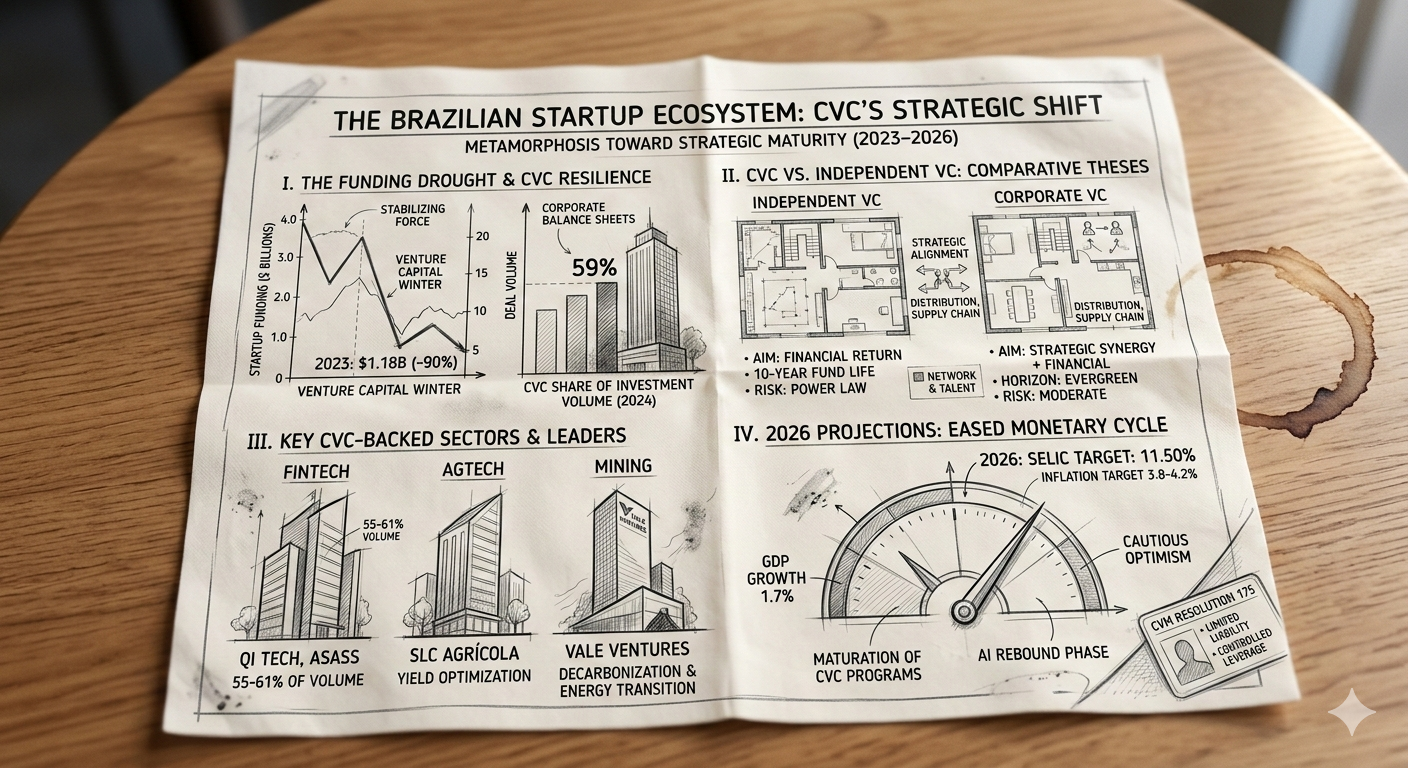
The geographical and financial borders of Brazilian innovation are expanding as we move into the second quarter of 2026. While São Paulo maintains its "financial engine" status, the rise of regional hubs and the shift in exit strategies are creating a more resilient, multi-polar ecosystem.
Here is the updated status of the regional ecosystems and the exit market for the 2026-2027 cycle.
Regional Ecosystems: The Decentralization of Talent
Innovation is no longer a "one-city" story. By 2026, the density of startups per capita in southern and northeastern hubs is challenging the dominance of the capital.
Florianópolis (Silicon Island): Now hosting 18 startups per 100,000 people, the ecosystem recorded a 15.2% growth rate in 2025. It has matured into Brazil’s 6th strongest ecosystem, focusing heavily on SaaS and high-margin B2B tech.
Recife (Porto Digital): The park has successfully integrated with global supply chains. As of early 2026, it serves as the primary "software export" hub for the Northeast, with a strong focus on open finance and cybersecurity.
Hub | Dominant Thesis (2026) | Ecosystem Status |
|---|---|---|
São Paulo | Fintech, AI Infra, Deep Tech | Center of 55% of all Brazilian deep tech ventures. |
Florianópolis | SaaS, MarTech, HealthTech | Tech sector contributes 25% of local GDP; 15% annual growth. |
Recife | Creative Tech, Cyber, BPO | Porto Digital hub; leader in software-as-a-service for retail. |
Belo Horizonte | E-commerce, Logistics, Mining | "San Pedro Valley" remains the nexus for logistics-tech. |
Export to Sheets
Exit Dynamics: The 2026 "Rebound" Phase
The exit market has transitioned from the "drought" of 2024 to a strategic recovery. While the IPO window is just beginning to crack open, M&A remains the primary liquidity event.
M&A Dominance: CVCs have become the "natural acquirer." In 2025, exit values reached $4.9 billion, with the majority of these being strategic acquisitions by domestic incumbents (Itaú, Bradesco, Ambev) rather than public listings.
The IPO Thaw: With the Selic rate entering a projected easing cycle (starting in March 2026), the B3 (Brazilian Stock Exchange) is preparing for a new wave of listings in late 2026 and 2027.
Secondary Markets: The emergence of specialized "secondary funds" has provided an alternative for early-stage investors looking to exit before an IPO, adding much-needed liquidity to the private market.
Macroeconomic Projections (2026–2027)
The outlook for the next 18 months is defined by monetary easing and AI-driven productivity.
Growth: GDP is projected to stay resilient at 1.6% - 1.7% for 2026, recovering toward 2.2% in 2027.
Monetary Policy: After holding the Selic rate at 15.0% through early 2026, the Central Bank initiated a 25-basis-point cut in March 2026. Forecasts suggest the rate will reach 11.75% by year-end 2026 and potentially drop to 10.00% in 2027.
+1
The AI Tailback: AI adoption is no longer a "future" trend; it is actively fueling demand. Spending on AI infrastructure is expected to offset some of the fiscal pressures caused by high debt-to-GDP levels (projected at 82.3% for 2026).
Indicator | 2026 Forecast | 2027 Forecast | Impact on CVC/VC |
|---|---|---|---|
GDP Growth | 1.6% | 2.2% | Sustainable environment for scaling. |
Selic Rate | 11.75% | 10.00% | Lowers hurdle rate; attracts global LP capital. |
Inflation | 4.0% | 3.9% | Predictable pricing and operational costs. |
Debt-to-GDP | 82.3% | 85.7% | High fiscal risk keeps pressure on the BRL. |
Export to Sheets
Conclusion: The New Frontier
As of 2026, the "Brazil Cost" is being mitigated by the dual-VAT reform and the professionalization of the CVC sector. The Brazilian ecosystem is entering a phase of "Institutionalized Innovation," where the synergy between agile startups and capitalized incumbents is the primary engine for growth. For the entrepreneur, success in 2026 depends on navigating this multi-polar map—tapping into the SaaS talent of Florianópolis, the software infrastructure of Recife, and the massive corporate balance sheets of São Paulo.
Want to calculate the equity for your cofounder?
Nail your cap table before you sign. Whether you're splitting equity with a co-founder or planning your next funding round, our Equity Calculator gives you precision in seconds
Equity calculator →