How to register an LLP in india
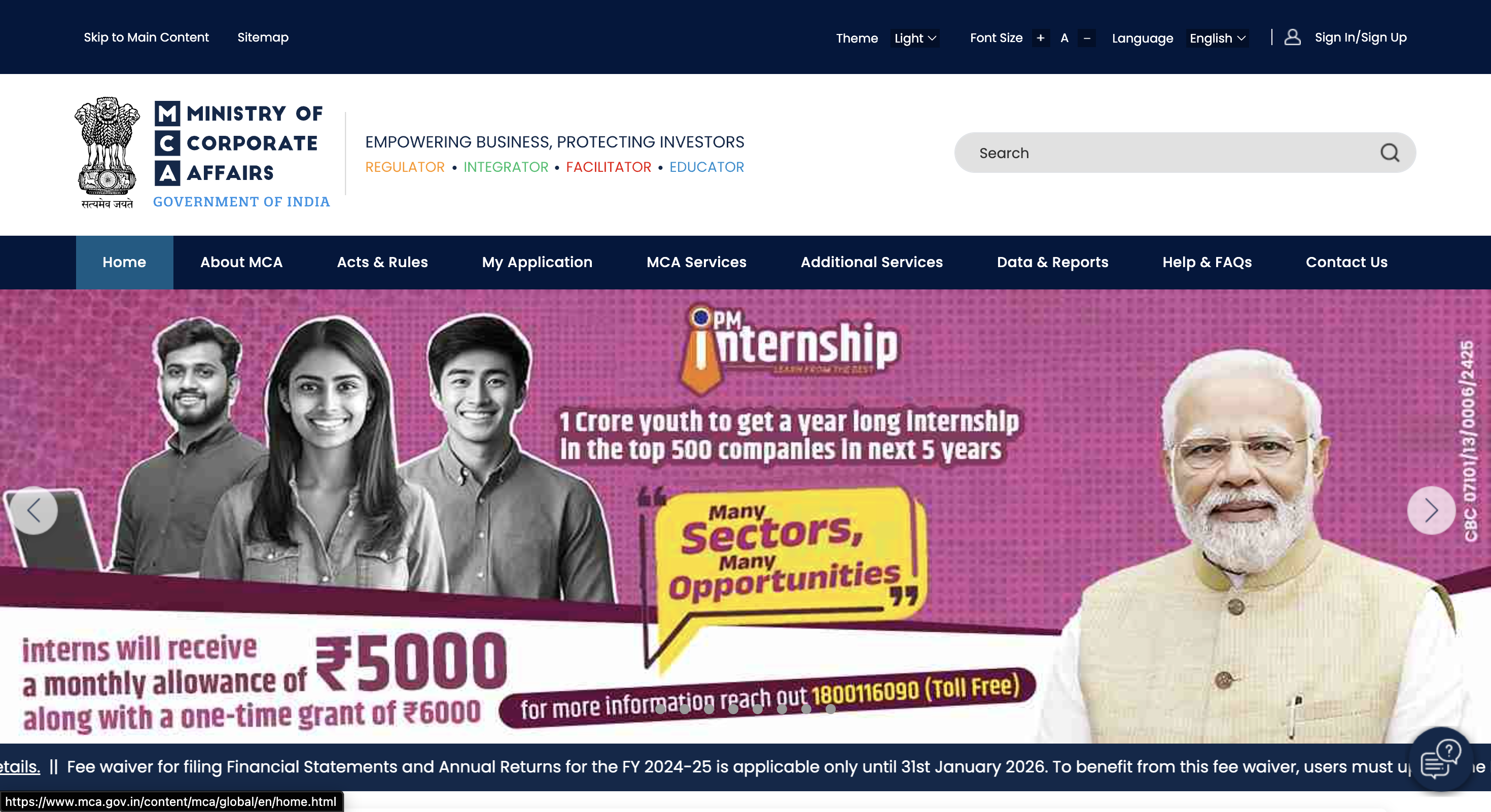
March 8, 2026 by Sheikh MohammadTo be elidgible for startup grants in india, your company must be registered under the Ministry of corporate affairs
, this can be very hard for new founders as they don't understand the process and hence are forced to pay alot more then required for registering their startup.
Here is some cost breakdown comparing both seeking professional help and self-registration:
Expense Catagory | Self-Registration | Professional Assisted |
|---|---|---|
DSC (2 Partners) | ₹2,000 – ₹3,000 | ₹2,500 – ₹4,000 |
Name Reservation (RUN) | ₹200 | ₹200 |
Incorporation (FiLLiP) | ₹500 | ₹500 |
LLP Agreement Filing | ₹50 | ₹50 |
Stamp duty(State dependent) | ₹100 - ₹3000 | ₹100 - ₹3000 |
PAN & TAN Fees | ₹140 | ₹140 |
Professional Fees | ₹0 | ₹3000 - ₹10000 |
Total Estimated Cost2 | ₹2990 - ₹6890 | ₹6490 - ₹17890 |
Disclaimer: The information provided in this guide is for educational and informational purposes only and does not constitute professional legal, financial, or tax advice. While we strive to provide accurate and up-to-date information as of 2026, the Ministry of Corporate Affairs (MCA) rules and fee structures are subject to frequent change.Registering an LLP involves strict statutory deadlines (such as the 30-day agreement filing rule). Errors in self-registration can lead to significant daily penalties and legal complications. The author and "FindnStart" shall not be held liable for any financial loss, penalties, or legal issues arising from the use of this guide. We strongly recommend consulting with a qualified Chartered Accountant (CA) or Company Secretary (CS) before making any final filings.On the lower end, there is atleast a difference of ₹3500 while using a professional's help which might not be necessary all the time. So, in this blog we have presented the step-by-step guide for the self-resigeration of an LLP.
Step 1: The "Digital Key" (Getting your DSC)
Before you even touch the government website, you need a Digital Signature Certificate (DSC). Think of this as your legal thumbprint for the internet.
How to get it: You don't get this from the government. You buy it from private agencies like eMudhra or Capricorn.
The 2026 Twist: It's now strictly Class 3 DSC. You’ll have to do a quick 2-minute video-KYC where you hold up your PAN card to the camera.
Cost: Roughly ₹800 – ₹1,500 per partner.
Step 2: Create your "Business User" Account
Head over to the MCA V3 Portal. This is where most people get stuck.
Do not register as a "Registered User." If you do, you won't see the registration forms. You must select "Business User" and then choose the role "Director/Designated Partner."
Use your PAN and the exact address mentioned on your bank statement to avoid "data mismatch" errors.
Step 3: The "What’s in a Name?" Phase (RUN-LLP)
You need a name that isn’t already taken.
Use the RUN-LLP service on the portal to reserve a name for ₹200.
If you’re feeling confident, you can skip this separate step and propose your name directly inside the main incorporation form (FiLLiP) for free. However, if that name gets rejected, your whole form gets sent back. Paying the ₹200 for RUN-LLP is usually worth the peace of mind.
Step 4: The Big One – The FiLLiP Form
This is the "Birth Certificate" of your business. The FiLLiP form is a long web-form where you’ll enter:
Partner Details: Names, addresses, and how much money each partner is "contributing" (even ₹1,000 works).
Registered Office: You need a utility bill (electricity/gas) not older than 2 months and an NOC (a simple letter saying "I'm okay with this business being here") from the property owner.
The Auto-Magic Part: In 2026, this form automatically applies for your PAN, TAN, and DPIN (Partner ID) all at once.
Step 5: The "30-Day Clock" (LLP Agreement)
Once your LLP is approved, you’ll receive a Certificate of Incorporation (CoI) via email. Celebrate! But don't stop yet.
The Deadline: You have exactly 30 days to upload your LLP Agreement (Form 3).
The Penalty: If you are even one day late, the government charges you ₹100 per day indefinitely. This is where most DIYers lose all the money they saved by not hiring a professional.
What to do: Print your agreement on your state’s stamp paper (e.g., ₹100 for J&K), get all partners to sign it, get it notarized, and upload it to the portal.
Conclusion: Is the DIY Route Right for You?
Registering your own LLP is a empowering milestone for any founder. It not only saves you a significant chunk of your initial capital—at least ₹3,500 that could be better spent on your MVP or initial marketing—but it also forces you to understand the legal skeleton of your startup.
However, the "DIY" path requires a high level of attention to detail. The MCA V3 portal is much more streamlined in 2026, but it is also less forgiving. One missed deadline or one incorrectly filled form can lead to penalties that quickly erase your savings.
Final Verdict:
Go DIY if: You are on a shoestring budget, tech-savvy, and have the patience to read every instruction twice. It’s a great way to take full ownership of your business from Day 1.
Hire a Pro if: You are currently in the middle of a high-growth phase or a funding round and cannot afford the mental bandwidth to track 30-day compliance windows.
Whichever path you choose, remember that registration is just the beginning. Once you have your Certificate of Incorporation and your LLP Agreement in hand, you are officially a part of the Indian startup ecosystem. Before you sign your LLP agreement, check out our Equity calculator to ensure your team's ownership is data-driven and built for long-term success. Now, the real work of building FindNStart begins!
Want to calculate the equity for your cofounder?
Nail your cap table before you sign. Whether you're splitting equity with a co-founder or planning your next funding round, our Equity Calculator gives you precision in seconds
Equity calculator →