From Zero to One: The Definitive Guide to Acquiring Your First Customers
June 16, 2026 by Sheikh MohammadThe primary cause of early-stage corporate failure is rarely a lack of product engineering; it is a failure of customer development. Too many founders build in isolation, assuming that execution of a product will automatically generate customer adoption. In reality, no business plan survives its first contact with a customer. To survive, early-stage ventures must transition from a faith-based model of business planning to a fact-based model of empirical validation.
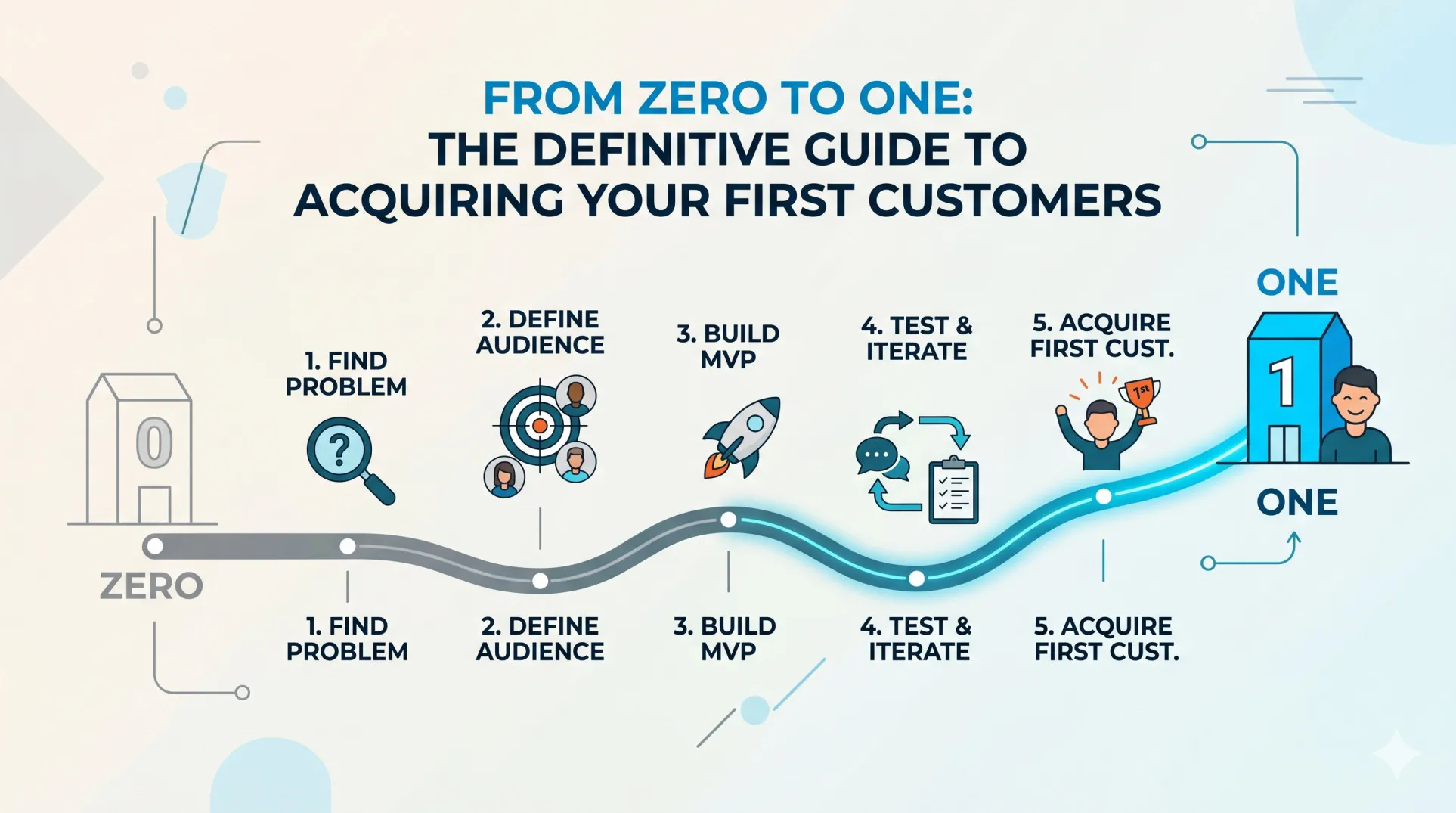
To build a repeatable machine for early growth, founders must master the art of customer development, run disciplined traction experiments, and utilize the unscalable tactics pioneered by successful startups.
1. The Foundation of Customer Discovery
Before committing heavy capital to development, founders must move out of the office and implement Steve Blank's customer development model. Customer discovery is not about gathering feature lists or hosting unstructured focus groups; it is about uncovering repetitive patterns of user friction and workflows.
To gather unbiased insights, founders must learn how to bypass polite bias using The Mom Test methodology. The core principle is simple: never ask anyone if your business idea is good. Instead, ask open-ended questions about how they currently solve the problem, how much they spent on their current workarounds, and when they last encountered the issue.
Once your initial cohort is onboarded, prioritize feedback systematically. This is exemplified by Superhuman's framework to find product-market fit, which isolates the high-expectation users who would be "very disappointed" if your product disappeared. By focusing your product roadmap on the features this core segment loves—and solving the friction points holding back on-the-fence users—you can engineer product-market fit with minimum wasted capital.
2. Finding Your Winning Traction Channel
A frequent pitfall for early-stage teams is a structural bias toward familiar marketing channels, such as paid search or PR. However, founders cannot accurately predict which channel will dominate their growth in advance.
To overcome this bias, spend 50% of your time on product development and 50% on gaining traction from day one. You can systematically test these channels by applying the Bullseye Framework to narrow down 19 potential marketing vectors:
The Outer Ring: Brainstorm at least one realistic hypothesis for each of the 19 channels.
The Middle Ring: Select the top two or three most promising channels and run cheap, parallel, 4-week experiments to measure acquisition costs and lead quality.
The Inner Ring (Bullseye): Focus all your resources on the single channel that demonstrated the highest return and lowest Customer Acquisition Cost (CAC).
3. Navigating Structural Economics (B2B vs. B2C)
The go-to-market playbook depends heavily on your underlying business model. Understanding structural B2B SaaS vs B2C SaaS differences allows founders to match their product, marketing, and pricing to the correct target audience.
B2B SaaS: Focuses on logical ROI and relationship-building. Sales cycles are longer (typically 84 to 104 days), demanding founder-led sales and personalized outreach. Lifetime Value (LTV) is higher ($5,000 to $50,000+), justifying a higher CAC ($500 to $5,000).
B2C SaaS: Focuses on immediate emotional appeal, impulsive transactions, and short sales cycles. Pricing is low ($5 to $50/month), requiring viral loops and mass distribution.
Local Brick-and-Mortar: Relies on localized foot traffic and proximity marketing. First customers are captured using highly visible signage, optimized Google Business Profiles, and community-based cross-promotions.
As digital advertising costs rise, maintaining a healthy 3:1 LTV-to-CAC ratio is crucial for long-term sustainability. Founders should invest early in organic content and structured onboarding. You must also learn to avoid common founder-led growth mistakes as operations begin to expand beyond your first dozen accounts, ensuring your onboarding workflows and customer support are documented and repeatable.
4. Doing Things That Don't Scale: Startup Case Studies
Many of today's largest companies scaled off the back of hyper-manual, unscalable tactics used to acquire their first 100 users:
Stripe: To acquire developers in a crowded, complex payments industry, the Collison brothers did not just email a sign-up link. Founders can study Stripe's early acquisition tactics and how they set up "Collison installations"—physically taking a prospect's laptop and coding the payments integration on the spot.
Airbnb: While Airbnb's New York growth hacks included scraping Craigslist vacation listings, their primary breakthrough occurred when the founders rented a $5,000 camera and went door-to-door, taking professional photos of New York listings for free. This resolved the "lemons problem" of visual information asymmetry, boosting trust and doubling revenue in the city.
Dropbox: When face-to-face sales and search ads proved too expensive, Drew Houston relied on a different validation method. Dropbox's legendary MVP launch involved posting a four-minute mock demo video packed with technical humor to Hacker News and Digg. The video demonstrated seamless file-syncing, generating 75,000 beta signups overnight before the backend was even fully built.
5. Operational Readiness Checklist
Before launching your customer acquisition campaigns, ensure you have checked off the following items to optimize conversion rates:
Define Clear Buyer Personas: Build highly detailed buyer profiles focusing on their biggest challenges and daily goals. Personas can drive a 900% increase in website dwell time and boost revenue.
Implement Analytics & Track Time-to-Value (TTV): Set up analytics to monitor user pathways. Focus heavily on minimizing Time-to-Value—the exact moment a user completes their first successful outcome.
Optimize Your Checkout Flow: The global average cart abandonment rate is a staggering 70.19%. Minimize checkout leaks by avoiding mandatory account registration, removing annoying upsells, and ensuring complete mobile optimization.
Prevent Branding Disconnects: Maintain visual and messaging consistency across all acquisition funnels to protect user trust, preventing costly checkout errors and top customer acquisition mistakes.
Acquiring your first customers requires a mixture of relentless manual outreach, structured experimentation, and absolute clarity on the problem you are solving. Start small, test often, and double down on what works to turn early traction into a scalable growth engine.
Protect Your Future: The Precision Vesting Calculator
Don't let a "handshake deal" complicate your exit. Map out your ownership journey with our Vesting Calculator
Calculate Your Vesting Schedule →