Why Non-Technical Founders Must Learn Product
June 23, 2026 by Harshit Gupta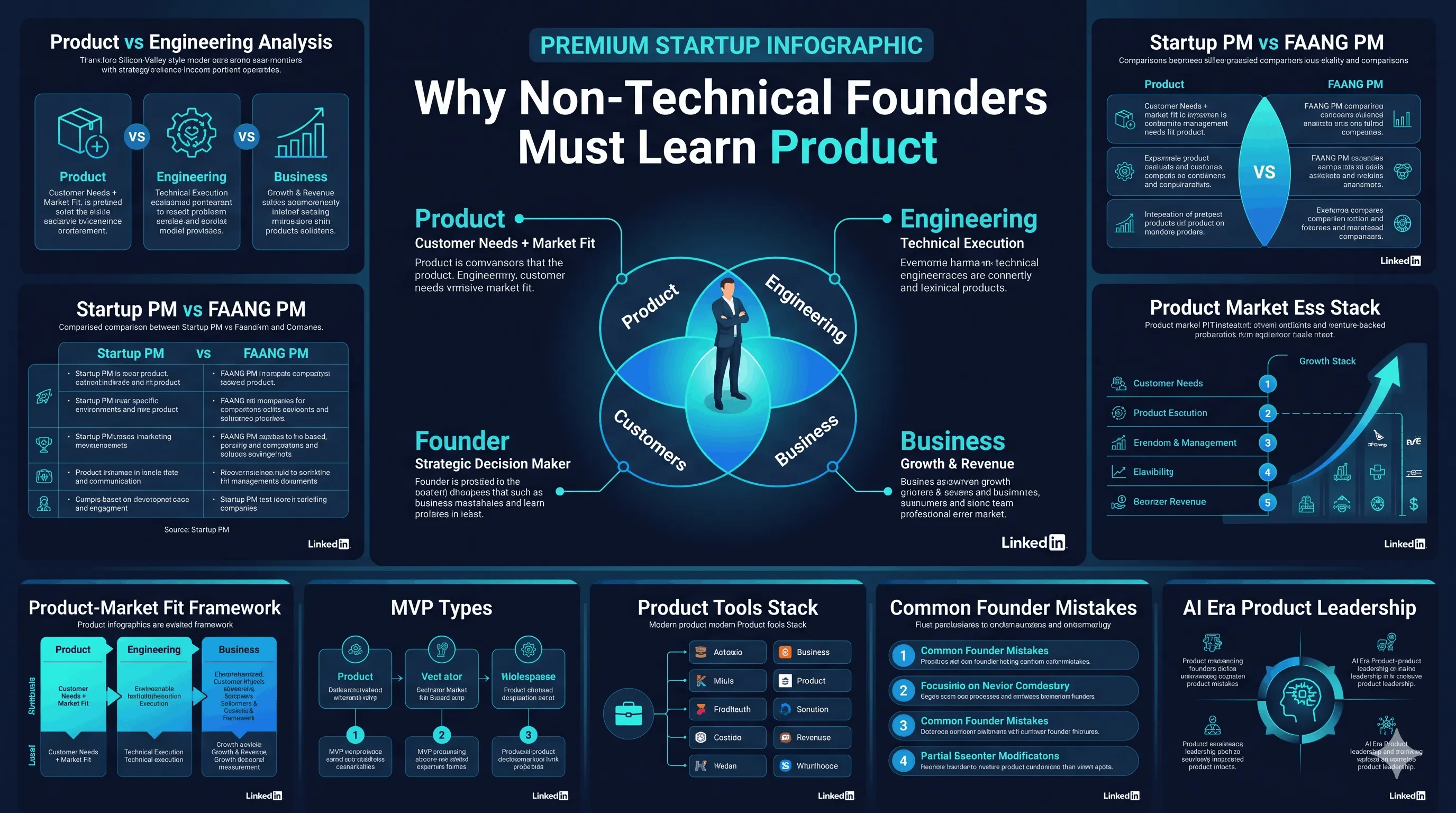
The modern technology startup ecosystem is increasingly defined by the transition from engineering-centric development to product-led strategy. For the non-technical founder, the acquisition of product management proficiency is no longer an optional skill set but a fundamental requirement for survival and scalable growth. The disconnect between a conceptual business vision and its technical realization serves as the primary inflection point where most early-stage ventures falter. This failure is rarely due to an inability to write code; rather, it originates from a lack of product literacy—the ability to identify market problems, define functional requirements, and manage the delicate trade-offs between technical feasibility, business viability, and user desirability.
Product management acts as the connective tissue between a founder’s abstract vision and a development team’s execution. Without this bridge, founders risk delegating the "soul" of their product to external agencies or early technical hires who, while skilled in engineering, may lack the domain context or strategic alignment necessary to achieve product-market fit. The following analysis examines the multidimensional necessity for non-technical founders to master the craft of product management, exploring its ontological foundations, tactical frameworks, and the shifting paradigms introduced by emerging technologies.
The Ontological Foundations of Product Management
To understand why a non-technical founder must learn product, one must first define the role's unique position within the corporate hierarchy. Product management is fundamentally a business-focused role that interfaces with technology to a higher degree than other functional areas. It is centered on identifying market problems that align with the company's strategy and solving them in a profitable manner. In software companies, product managers (PMs) are characterized as business leaders possessing significant technical expertise, though not necessarily the ability to develop software themselves.
The distinction between tech and business in product management is often described as a relationship between a floor and a ceiling: technology is the floor—the minimum requirement to enter the space—while business acumen is the ceiling, determining the ultimate height of the product’s success. This suggests that while a developer with no domain knowledge cannot be an effective PM, a business leader with no technical background can transition into the role if they master the process of building software.
Defining the Intersection of Product, Engineering, and Business
The product manager is often described as a "wolf in sheep’s clothing," representing business and customer needs within a technical team. This role requires a delicate balance of "healthy tension" between engineering quality and speed of development versus the product management focus on customer-centricity and market imperatives.
Functional Role | Primary Focus | Metrics for Success |
Product Management | Customer Needs & Market Fit | Revenue, adoption, product-market fit |
Engineering | Technical Excellence & Quality | Uptime, scalability, security, performance |
Business Development | Growth & Partnerships | Funding, market share, strategic alliances |
Project Management | Process & Execution | Timeline adherence, sprint velocity |
Success in product management relies on a combination of STEM and business knowledge, encompassing data analysis, market assessment, price modeling, and a nuanced understanding of user experience (UX). For a founder, this role is akin to that of a CEO; they set goals, define success, motivate teams, and are ultimately responsible for the outcome. However, the founder-as-PM must be wary of the "Founder Mode" paradox, where their authority can inadvertently stifle objective feedback and stall progress if they become too emotionally attached to a specific vision.
The Startup vs. FAANG Dichotomy: Why Context Matters
The role of a product manager changes dramatically based on the size and maturity of the organization. Non-technical founders often make the mistake of attempting to replicate the product processes of large technology firms like Google, Amazon, or Meta (FAANG), which can be catastrophic in a resource-constrained startup environment.
In a FAANG company, product managers tend to focus on small, highly specialized parts of a product, such as a single search algorithm tweak or a specific onboarding feature for a particular market. They have access to vast resources, including dedicated teams for user research, data analysis, and marketing. Decision-making is layered and bureaucratic, often requiring months of consultation across departments.
In contrast, a startup product manager operates in a space where every decision can determine the company's survival. Resources are minimal, and the PM must wear multiple hats, performing their own research, analytics, and even support. The pace is agile and immediate; a feature proposal in the morning can be live by the end of the week. For the non-technical founder, this means that product management is not about managing a process but about making high-stakes trade-offs in real-time.
Feature | FAANG Product Management | Startup Product Management |
Focus | Deep specialization (e.g., one algorithm) | Diversified (the entire product) |
Speed | Slower, bureaucratic, layered decisions | Agile, quick execution, same-day decisions |
Resources | Extensive (dedicated research/data teams) | Minimal (shoestring budget, DIY) |
Impact | Large scale but incremental | Immediate and foundational |
Stability | Defined career paths and procedures | Fast-moving, unpredictable, high stress |
Skills | Master of one thing | Adaptability and creative problem-solving |
The primary risk for a non-technical founder is "premature delegation"—hiring a PM from a large corporation who knows the "frameworks" but lacks the intuition for the "scrappy" iteration required pre-product-market fit. Founders must build their own "muscle memory" by running their own experiments and talking to users personally before they can effectively lead others.
Venture Capital and the Economics of Trust
Venture capitalists (VCs) and angel investors do not typically require founders to be able to code, but they are deeply concerned with a founder's ability to manage the capital they are provided. A common skepticism in fundraising is directed toward non-technical founders who lack a plan for how to build their product without wasting cash. Investors view a founder's lack of product knowledge as a primary driver of "burn," fearing that a founder will spend hundreds of thousands of dollars on a "failed experiment" because they do not understand how a product moves from idea to scale.
Product Leadership as Risk Mitigation
When a non-technical founder demonstrates proficiency in product management, they shift the investor's perception from a liability to a leader. This proficiency is signaled by:
A Credible Hiring Plan: Knowing exactly whom to hire for specific technical jobs and how to set KPIs for them.
Strategic Trade-offs: The ability to explain why certain features were prioritized or deprioritized based on business objectives rather than personal whims.
Growth Embeddedness: Talking about how growth is built into the product from day one through viral loops or retention tactics.
Domain Expertise: Leveraging "founder-market fit" to identify unique secrets in an industry (e.g., healthcare, construction, or finance) that a generalist engineer might overlook.
In the current "AI-first" era, the advantage is shifting toward founders with deep domain knowledge. Building software is becoming faster and cheaper due to AI builder tools, but knowing what to build remains the difficult part. A non-technical founder who can articulate an "AI-first" operation based on years of industry experience is often more valuable than a technical founder with no industry context.
First Principles of Product Management for Founders
To navigate the complexities of product development, founders must rely on "first principles"—foundational propositions that cannot be deduced from others. This approach, popularized by figures like Elon Musk, involves stripping a concept down to its bare bones and deconstructing problems at a fundamental level.
Maximizing Impact to the Mission
The core responsibility of product management is to inform the "builders and operators" of the right path to achieve the mission given a set of constraints. This strategy is synthesized from three specific inputs:
The Goal: Understanding the foundations of the mission, including customer assumptions and ethical boundaries.
Environment Signals: Detecting shifts in the world through "Customer signals" (data on how people use the product) and "Market signals" (changes in the competitive or socioeconomic landscape).
Constraints: Recognizing the limits of people (skills/experience), money (burn rate/runway), and time (the reality that un-shipped products produce no value).
The Role of the Coach
A product manager does not directly build the product but enables others to do it better. This is analogous to a sports coach: they don't play the game, they support the team and are held accountable if the team fails to perform. For the non-technical founder, this requires an acute sense of self-awareness—knowing when to lead (with junior hires), partner (with equals), or support (with senior experts).
Finding the Truth
One of the most powerful principles in product management is "finding the truth". When conflicts arise between engineering, design, and business, the product manager’s job is not to force their own way but to work collaboratively to find the objective truth based on data and research. This necessitates a culture of transparency and communication where information is accessible to everyone.
Frameworks for De-risking and Discovery
The most frequent error among seed-stage startups is dedicating insufficient time to understanding the user’s problem before jumping to a proposed solution. To mitigate this, founders should employ structured frameworks that isolate variables and validate assumptions.
The "Job To Be Done" (JTBD) Framework
The JTBD framework is designed to prevent premature solution-thinking by forcing the researcher to define the user's "Job" in isolation from any specific product. It asks: "What job is the user hiring this product to do?". By identifying the underlying motivation (e.g., "I need to get from point A to point B reliably at night"), a founder can innovate beyond existing categories (e.g., shifting from a taxi app to a text-based ride-hailing service).
Documenting Product-Market Fit Hypotheses
Documenting hypotheses is an efficient middle ground between a formal business plan and unstructured iteration. Founders should systematically validate eight key categories:
Target Audience: The specific "core" audience rather than the total addressable market.
The Problem: The specific pain point being addressed.
Value Propositions: A "promise of value" phrased in the customer’s own terms.
Strategic Differentiation: Unique assets or capabilities that ensure a superior offering.
Competition: Broadly defined to include substitutes and alternatives.
Customer Acquisition Strategy: Detailed understanding of the cost of acquisition per channel.
Monetization Strategy: Price points and the market’s willingness to pay.
Key Performance Indicators (KPIs): Metrics covering acquisition, engagement, and retention.
The Minimum Viable Product (MVP): Strategy Over Features
An MVP is the simplest version of a product that allows a team to validate ideas and gather feedback with minimal effort. It is not about releasing a half-finished application; it is about "trying before you buy big". For a non-technical founder, the MVP process involves identifying core customer pain points, describing the competitive landscape, and testing for validity before a full-scale launch.
Types of MVPs
MVP Type | Description | Best Use Case |
Low-Fidelity | Landing pages, explainer videos (e.g., Dropbox) | Gauging interest and building a waitlist without code. |
Concierge | Performing the service manually for a small group of users | Validating the process and value proposition before automation. |
Wizard of Oz | The user sees a functional UI, but a human performs the logic | Testing user behavior and the "magic" of a solution without building the engine. |
High-Fidelity | Functional prototypes or mockups (e.g., using Figma or Bubble) | Testing usability and flow with early adopters. |
The "MoSCoW" method (Must-have, Should-have, Could-have, Won't-have) is an essential tool for prioritization. Founders must focus solely on the "Must-haves" for the initial launch, resisting the urge to build their entire vision at once. The goal is to enter the Build-Measure-Learn (BML) feedback loop as quickly as possible.
Technical Literacy for the Non-Technical Founder
While non-technical founders should not learn to code, they must become acutely familiar with the process of building software. This "technical literacy" allows them to follow discussions, ask insightful questions, and hold their teams accountable.
Building a Mental Model of Software Architecture
Founders should develop a big-picture understanding of how software components connect :
Frontend vs. Backend: The user interface (what people see) vs. the logic and engine running behind the scenes.
Databases: Where information is stored and retrieved (users, content, activity).
APIs (Application Programming Interfaces): Like a "waiter in a restaurant," taking requests to the kitchen and bringing back the order.
Infrastructure: The cloud hosting and servers where the code runs.
Testing & Deployment: The process of ensuring code works before it reaches users.
Mastering Technical Tools
Modern product management requires proficiency in several "no-code" and "low-code" tools that facilitate communication and rapid prototyping.
Tool Category | Examples | Key Skills to Master |
Design & Prototyping | Figma, Sketch, Balsamiq | Wireframe creation, clickable mockups, component manipulation. |
Project Management | Jira, Trello, Asana | Creating user stories, managing sprints, setting up boards. |
Documentation | Notion, Confluence, Google Docs | Centralizing information, building knowledge graphs. |
Data & Databases | Airtable, Amplitude, Mixpanel | Interpreting audience reports, cohort analysis, conversion funnels. |
No-Code Building | Bubble, Adalo, Webflow | Building functional web/mobile apps without writing code. |
By learning to "show" rather than "tell" through wireframes and mockups, founders save significant time on iterations and bridge the gap between their mental vision and a developer’s understanding.
Tactical Execution: PRDs and User Stories
The transition from a "wish-list" of features to a structured set of requirements is a critical step for any non-technical founder. A well-written Product Requirement Document (PRD) acts as a blueprint, defining what needs to be built, why it matters, and how success is measured.
Six Steps to a Comprehensive PRD
Align Stakeholders: Articulate the "why" and define the specific user pain points.
Conduct Research: Ground the PRD in user interviews and competitive analysis.
Outline Features: Structure requirements hierarchically (Themes → Epics → User Stories).
Define Release Criteria: Set quantifiable goals for functionality, usability, and performance.
Solicit Feedback: Use a centralized platform to iterate on the draft with the team.
Maintain Version Control: A PRD is a "living document" that evolves through sprints.
User stories should follow a standard format: "As a [type of user], I want to [action] so that [benefit]". This focus on user outcomes—rather than technical implementation—allows engineers to determine the "how" while the founder maintains control over the "what" and "why".
Case Study: Airbnb and the Power of Design Thinking
The history of Airbnb provides a profound example of how non-technical founders can use product principles to transform a failing startup into a billion-dollar business. Brian Chesky and Joe Gebbia, both designers by training, realized early on that their product was failing because the listing photos "sucked".
Doing Things That Don't Scale
Following the advice of Paul Graham, the founders traveled to New York to personally take high-quality photos of properties. This non-scalable, non-technical solution doubled their weekly revenue to $400 in just one week. This lesson in "becoming the patient" became a core part of Airbnb's culture; every new employee takes a trip in their first weeks and documents the experience.
Iteration and the "Heart" Change
Airbnb's success is rooted in small bets and continuous shipping. For example, a single designer was tasked with reevaluating the "star" function for wish lists. By changing the icon from a "star" to a "heart," engagement increased by over 30%. This highlights the importance of "Metrics-driven Decision Making" and the willingness to experiment with even the smallest features.
The Shift to "Founder Mode"
As Airbnb grew, it faced the "Strategic Paradox of Non-Technical Leadership"—where a great product can become a liability if leadership loses sight of what makes it great. Brian Chesky unintentionally ignited a debate by shifting his leadership style to "Founder Mode". This involved moving away from a fragmented, divisional structure—where 150 different screens and 70 user policies existed—to a centralized, design-led organization. By consolidating product management and marketing and emphasizing design centrality, Chesky ensured a unified and cohesive user experience.
Anti-Patterns and Common Pitfalls
An "anti-pattern" is a well-known bad practice that may look orderly on the surface but leads to systemic failure. Non-technical founders are particularly susceptible to these due to self-biases and external pressure.
Strategic Anti-Patterns
Everything is P1: When everything is a top priority, nothing is. This leads to "Peanut Buttering"—spreading resources too thinly across multiple initiatives, resulting in mediocre outcomes.
The Killer App Delusion: The belief that "one more feature" will make the product a massive success. This leads to a "Frankenstein type of product" that serves no one well.
Listening to Customers Too Much: Treating customer wishes as requirements rather than insights. Products should solve user problems to drive business outcomes, not just implement a wish list.
Ignoring Technical Debt: Rushing into shiny new features while neglecting the underlying infrastructure. While it is acceptable to accumulate debt during an MVP, it must eventually be paid off, or it will slow development to a crawl.
Organizational Anti-Patterns
The Backlog Black Hole: Keeping a massive list of ideas that will never be implemented, which serves as a "trash bin" rather than a planning tool.
Proxy Product Ownership: Having a "proxy" PM who is not empowered to make tough business decisions, usually because the founder is unavailable.
Chain Sprinting: Jumping from one sprint to the next without a buffer or retrospective. This leads to creative exhaustion and a team that ships code on "autopilot".
Waterfall in Sprints: Using agile ceremonies but locking the roadmap months in advance, effectively treating sprints as mini-waterfall cycles.
The Future: AI and the "Expert + AI" Model
The landscape for non-technical founders is fundamentally changing as AI builder tools reach "baseline usefulness". We are entering an era of "supervised AI building," where a senior engineer can use AI agents to build production-grade products at a fraction of the traditional timeline and cost.
The New Building Paths
DIY AI Tools: Platforms like Lovable or Replit allow founders to generate functional prototypes from text descriptions. While not production-grade, they are ideal for validating ideas at almost zero cost.
Expert-Supervised Building: A senior engineer manages AI agents to produce high-quality code in weeks rather than months. This path is ideal for founders with a budget of $10K-$50K who need a product that can scale and handle sensitive data.
No-Code to Low-Code Transition: As development costs drop, the barrier to creating a "tech unicorn" is no longer the engineering effort but the "Product-Market-Sales Fit".
In this new paradigm, the founder’s role as a product manager becomes even more critical. If code generation is cheap, the value lies in the "Point of View" (POV) of the product and the intentionality of its impact. Founders must use AI reflexively and probe for unexpected capabilities to stay relevant.

Summary: The Path Forward for Non-Technical Leaders
Mastering product management is the only way for a non-technical founder to transition from "cosplaying professionalism" to actually running a successful technology company. It requires a shift from thinking about features to thinking about problems, from focusing on the "how" to obsessing over the "what" and "why".
The journey involves three distinct phases of learning:
Foundational Knowledge: Understanding the "Job To Be Done" and the first principles of strategy and constraints.
Tactical Proficiency: Learning the tools (Figma, Jira, Notion) and documentation (PRDs, User Stories) required to lead a team effectively.
Operational Wisdom: Recognizing anti-patterns, embracing "Founder Mode," and maintaining a relentless focus on product-market fit.
By becoming the "spider in the web"—understanding the connections between technology, market signals, and customer pain—the non-technical founder transforms their perceived weakness into a formidable strategic advantage. The successful tech companies of the next decade will be built not just by those who can code, but by those who can master the art of the product.
Protect Your Future: The Precision Vesting Calculator
Don't let a "handshake deal" complicate your exit. Map out your ownership journey with our Vesting Calculator
Calculate Your Vesting Schedule →