What the Red Sea Crisis Means for Global Logistics Startups
March 18, 2026 by Harshit Gupta
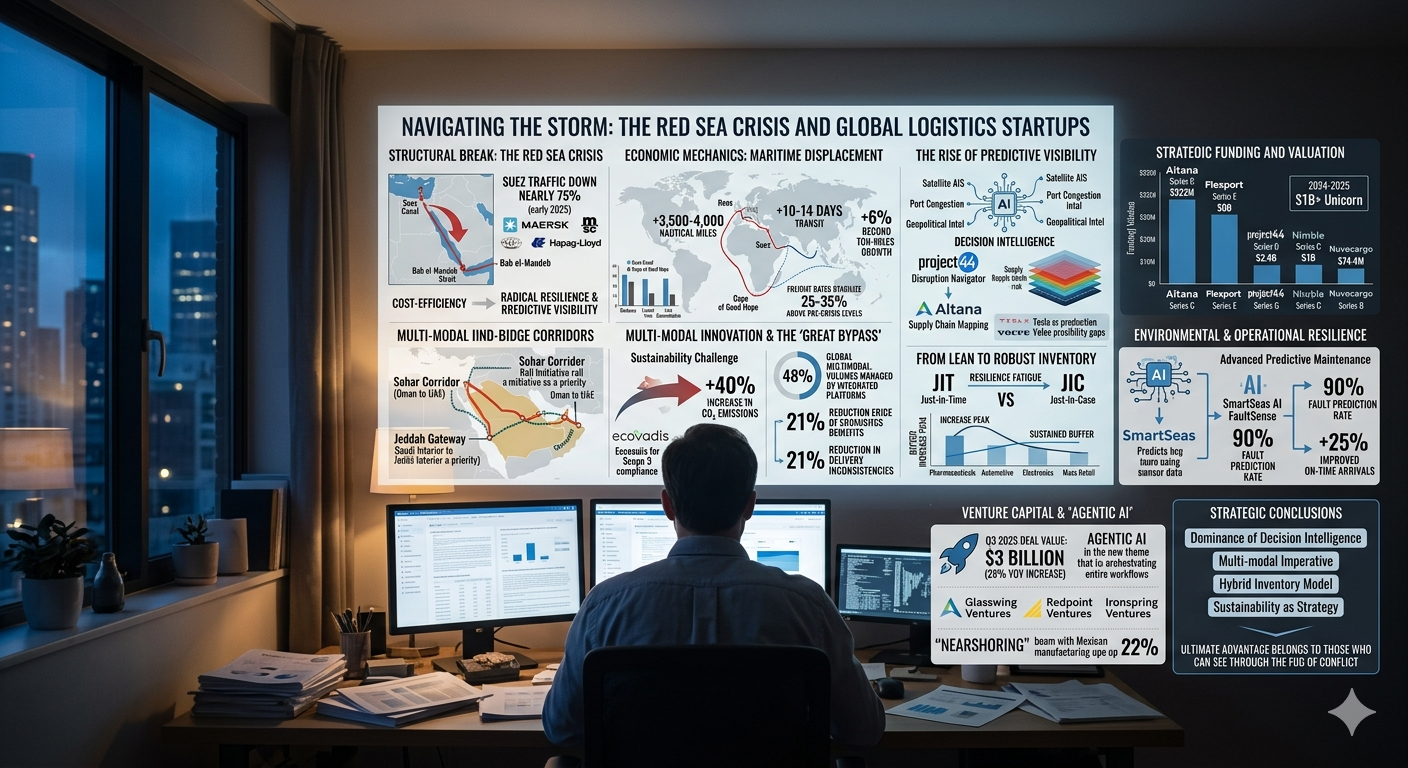
The global maritime industry, responsible for transporting over 80 percent of world trade, has long been susceptible to the volatility of geopolitical flashpoints. However, the Red Sea crisis, which escalated in late 2023 and has persisted into 2025, represents a structural break in the hegemonic order of international logistics. Historically, the Red Sea and its connection to the Mediterranean via the Suez Canal have facilitated approximately 12 to 15 percent of global trade and nearly one-third of all global container traffic. The onset of sustained attacks on commercial vessels in the Bab el-Mandeb Strait—a vital chokepoint between the Arabian Peninsula and the Horn of Africa—has compelled a mass exodus of shipping capacity from this corridor. By early 2025, vessel traffic through the Suez Canal had plummeted by nearly three-fourths, as major ocean carriers like Maersk, MSC, and Hapag-Lloyd implemented policies of route avoidance to protect crews and assets. This redirection has forced a fundamental transformation in the value proposition of global logistics startups, shifting the industry focus from pure cost-efficiency to radical resilience and predictive visibility.
The Economic Mechanics of Maritime Displacement
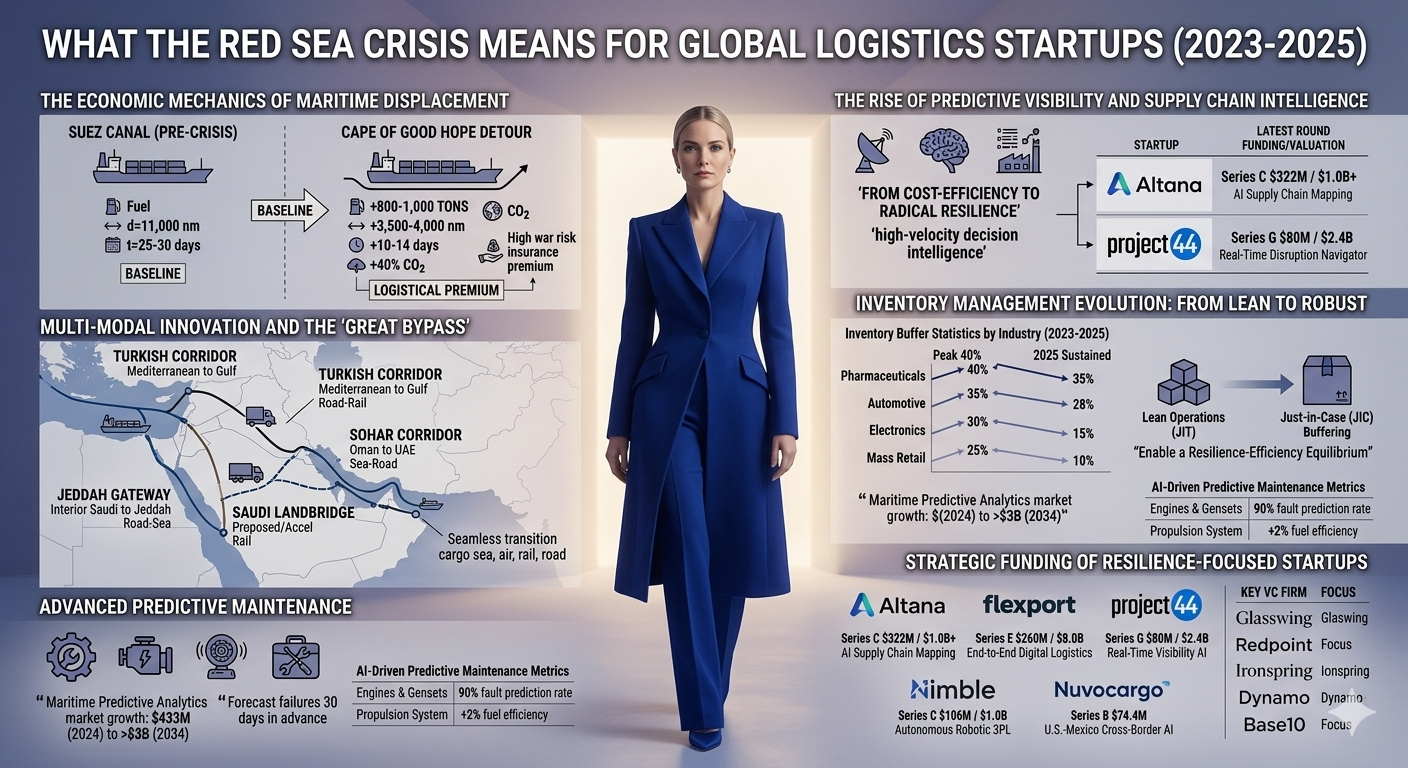
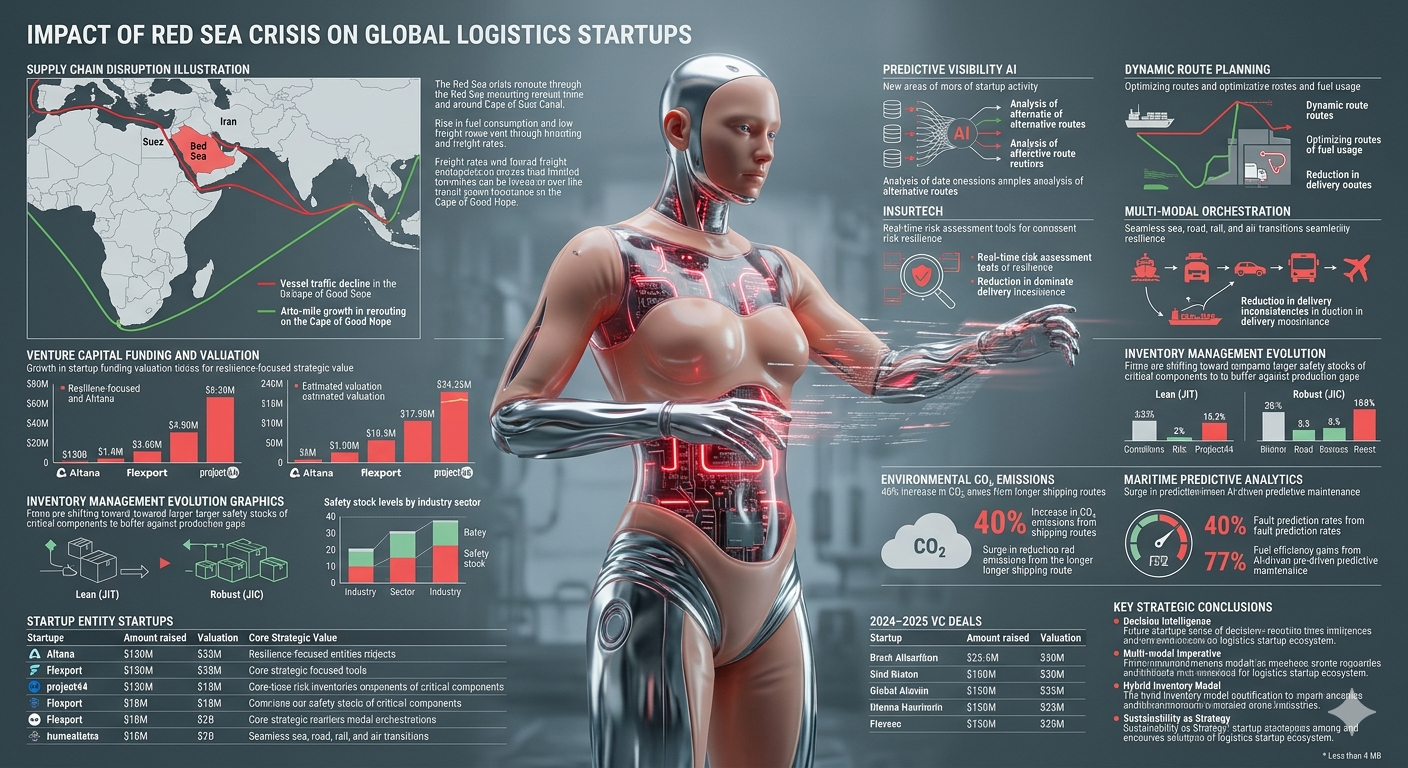
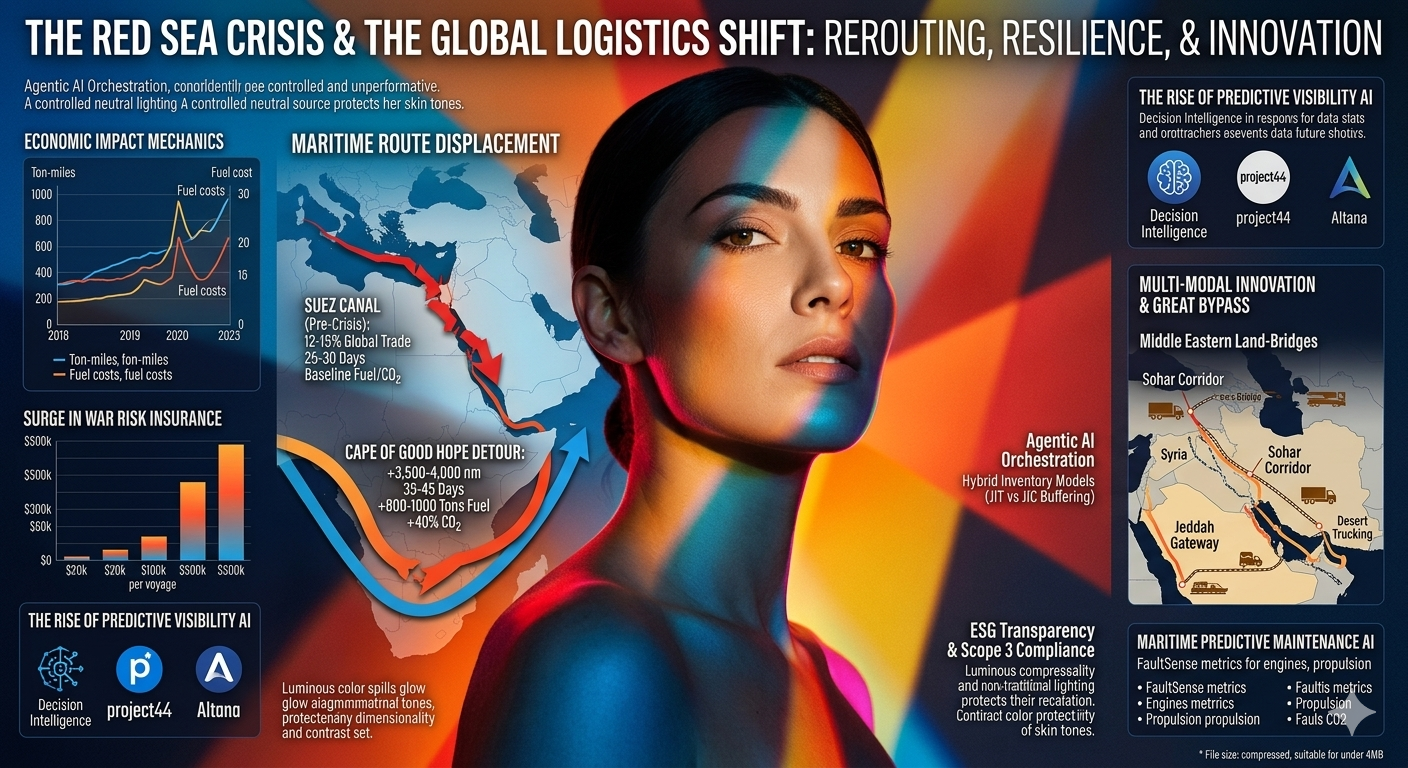
The displacement of maritime traffic from the Red Sea to the Cape of Good Hope has introduced a staggering "logistical premium" into the global economy. Rerouting vessels around the southern tip of Africa adds approximately 3,500 to 4,000 nautical miles to a standard Asia-Europe voyage, extending transit times by 10 to 14 days. This detour creates a massive surge in ton-miles, a metric measuring maritime trade adjusted for distance. In 2024, ton-miles grew by a record 6 percent, nearly three times faster than the growth in actual trade volumes, signaling that the global fleet is working significantly harder to move the same quantity of goods. For logistics startups, this inefficiency has become the primary problem set for innovation, particularly in the realms of fuel optimization and dynamic route planning.
The economic burden of the Cape route is multifaceted, involving increased fuel consumption, elevated labor costs, and capital tie-ups. A large container vessel traversing the extra distance requires an additional 800 to 1,000 tons of fuel per voyage. Furthermore, extended transit times impact cash flow and inventory management as goods spend two additional weeks in transit, effectively trapping working capital in the middle of the ocean. These factors have driven freight rates on key Asia-Europe routes to stabilize at levels 25 to 35 percent above pre-crisis benchmarks, after initial spikes of over 300 percent during the onset of the hostilities.
Comparative Impact of Maritime Route Rerouting
Operational Metric | Suez Canal (Pre-Crisis) | Cape of Good Hope Detour | Absolute Increase / Change |
Typical Distance (nm) | 11,000–12,000 | 15,000–16,000 | +3,500–4,000 nm |
Transit Time (Asia-Europe) | 25–30 Days | 35–45 Days | +10–14 Days |
Fuel Consumption (Per Voyage) | Baseline | +800–1,000 Tons | Significant Cost Impact |
CO2 Emissions | Baseline | +40% Increase | High Environmental Toll |
Insurance Surcharges | Standard Rates | War Risk + Surcharges | $150k–$500k per voyage |
Beyond fuel and time, the crisis has revolutionized the maritime insurance market. War risk insurance premiums for vessels transiting the Red Sea surged from typical rates of $10,000–$20,000 per voyage to as much as $500,000, rendering the route economically unviable for the majority of commercial carriers. Even vessels choosing alternative routes face a "spillover" effect in insurance costs, with industry-wide hull and machinery premiums increasing by 15 to 25 percent due to market-wide uncertainty and the increased risks associated with longer voyages. This environment has provided a fertile ground for InsurTech startups to develop more granular, real-time risk assessment tools that challenge the rigid, legacy pricing models of traditional maritime insurers.
The Rise of Predictive Visibility and Supply Chain Intelligence
The Red Sea crisis has exposed the fatal flaws in reactive supply chain management. For decades, many enterprises operated with a "visibility gap," only becoming aware of delays after a shipment missed a critical milestone. The disruptions of 2024 and 2025, which saw production halts at automotive giants like Tesla and Volvo due to component shortages, underscored the need for high-velocity decision intelligence. Startups in the real-time visibility space, such as project44 and Altana, have pivoted to offer platforms that synthesize massive datasets—including satellite AIS data, port congestion metrics, and geopolitical intelligence—to provide predictive insights.
Altana’s AI-driven platform, for instance, maps global supply chains at a granular level by analyzing 2.8 billion shipments and 500 million companies. This allows both governments and corporations to identify vulnerabilities deep within their sub-tier supplier networks, such as dependencies on critical minerals or components that must pass through maritime chokepoints. Similarly, project44’s AI Disruption Navigator has become a critical tool for logistics leaders, as it can identify precisely which in-transit containers are affected by Red Sea diversions and estimate the downstream impact on inventory levels and production schedules.
Strategic Funding and Valuation of Resilience-Focused Startups (2024-2025)
Startup Entity | Latest Funding Round | Amount Raised | Valuation (Est.) | Core Strategic Value |
Altana | Series C (2024) | $322 Million | $1.0 Billion+ (Unicorn) | AI Supply Chain Mapping |
Flexport | Series E (2024) | $260 Million | $8.0 Billion | End-to-End Digital Logistics |
project44 | Series G (2022-24) | $80 Million | $2.4 Billion | Real-Time Visibility AI |
Nimble | Series C (2025) | $106 Million | $1.0 Billion (Unicorn) | Autonomous Robotic 3PL |
Nuvocargo | Series B (2024) | $74.4 Million | N/A | U.S.-Mexico Cross-Border AI |
The emergence of "Anticipatory Logistics" represents a paradigm shift where startups utilize predictive biomarkers and historical data streams to forecast disruptions before they manifest physically. By 2026, the focus in the AI Predictive Analytics market has moved beyond simple Estimated Time of Arrival (ETA) predictions to complex "Risk & Resilience Modeling". This evolution is driven by the need to simulate "What-If" scenarios, allowing shippers to evaluate the impact of potential geopolitical events—such as a total closure of the Strait of Hormuz or persistent drought in the Panama Canal—on their total landed costs and service reliability.
Multi-modal Innovation and the "Great Bypass"
The persistent insecurity in the Red Sea has accelerated a desperate scramble for land-based and multi-modal alternatives, a phenomenon often described as the "Great Bypass." This strategy involves the creation of emergency trucking corridors and rail-links designed to circumvent maritime chokepoints. For example, the "Sohar Corridor" has emerged as a primary exit for goods from the United Arab Emirates, where cargo is offloaded at Oman's deep-water ports and trucked 350 kilometers overland to Jebel Ali. Conversely, the "Jeddah Gateway" serves as a primary export point for Saudi Arabia’s interior, requiring the massive logistical feat of trucking thousands of tonnes of refined metals across 1,200 kilometers of desert to reach the Red Sea, bypassing the Strait of Hormuz and the southern Bab el-Mandeb entirely.
Startups specializing in multi-modal orchestration have been the primary beneficiaries of this shift. In 2024, the global multimodal transport logistics market was valued at $726.9 million, with projections suggesting it will reach over $1.2 billion by 2033 as digital connectivity matures. Nearly 48 percent of global multimodal volumes are now managed by integrated logistics platforms that utilize digital tracking and automated documentation to reduce delivery inconsistencies by over 21 percent. These platforms allow shippers to seamlessly transition cargo between sea, air, rail, and road under a single contract, providing the flexibility needed to navigate a fragmented global trade landscape.
Middle Eastern Land-Bridge and Multi-modal Corridors
Corridor Name | Primary Ports Involved | Transport Mode | Distance / Delay Factor |
Sohar Corridor | Sohar (Oman) to Jebel Ali (UAE) | Sea to Road | 350 km Overland |
Jeddah Gateway | Interior Saudi to Jeddah | Road/Rail to Sea | 1,200 km Desert Transit |
Saudi Landbridge | Dammam to Jeddah | Rail (Proposed/Accel) | Transcontinental Link |
Turkish Corridor | Mediterranean to Gulf | Road/Rail | Alternative Trucking Path |
The "logistical premium" for these land-based workarounds is substantial. For heavy industrial goods like aluminum and copper, bypassing chokepoints through desert trucking can add $45 to $60 per tonne in additional freight costs, a 300 percent increase over traditional maritime rates. Despite these costs, the reliability of land-bridges has made them an essential component of the "anti-fragile" supply chain. This urgency has transformed long-term infrastructure projects, such as the Saudi Landbridge rail initiative, from 10-year goals into national security priorities.
Inventory Management Evolution: From Lean to Robust
The Red Sea crisis has necessitated a fundamental rethinking of inventory management, specifically the tension between Just-in-Time (JIT) and Just-in-Case (JIC) models. JIT, which prioritizes lean operations and minimal stock levels, proved highly vulnerable when lead times on Asia-Europe routes stretched by 14 days and became increasingly unpredictable. This vulnerability has triggered a pivot toward resilient JIC buffering strategies, where firms maintain higher safety stocks of critical components to insulate against production gaps.
Research conducted throughout 2024 and 2025 reveals a complex reality of "Resilience Fatigue." While 60 percent of firms increased their inventory buffers by 15 to 40 percent during the peak of the crisis, only 20 percent maintained these levels as working capital pressures mounted. For many startups, the challenge is now to enable a "Resilience-Efficiency Equilibrium." Industry leaders like Toyota have institutionalized strategic buffers for high-risk items like battery cells while maintaining lean flows for stable categories.
Inventory Buffer Statistics by Industry (2023-2025)
Industry Sector | Buffer Increase Peak (%) | 2025 Sustained Buffer (%) | Resilience Rationale |
Pharmaceuticals | 40% | 35% | High risk of stockout catastrophe |
Automotive | 35% | 28% | Persistent semi-conductor volatility |
Electronics | 30% | 15% | High obsolescence risk vs. resilience |
Mass Retail | 25% | 10% | Thin margins drive JIT reversion |
Startups focusing on inventory optimization, such as Zoho Inventory and Fishbowl, are increasingly integrating AI to forecast demand variability more accurately. By utilizing predictive analytics to set dynamic safety stock levels, these platforms help businesses avoid the traps of "Resilience Fatigue." The goal is no longer to eliminate inventory but to treat it as a strategic asset—a "shock absorber" against the inevitable shocks of a volatile trade environment.
Venture Capital and the Resilience Investment Thesis
The Red Sea crisis has significantly reshaped the venture capital landscape for logistics and supply chain technology. After a slowdown in 2023, funding for supply chain tech rebounded in 2024 and 2025, with Q3 2025 deal value hitting $3 billion—a 28 percent increase year-over-year. Investors are increasingly prioritizing startups that leverage AI to solve structural inefficiencies caused by geopolitical instability. "Agentic AI," which goes beyond simple automation to orchestrate entire logistics workflows without human intervention, has become the defining theme of the sector.
The investment thesis has shifted from pure growth to a focus on mission-critical applications. Traditional logistics leaders like C.H. Robinson and J.B. Hunt are now reporting measurable efficiency gains from AI agents, while startups like Augment and Kodiak Robotics have raised major rounds—$85 million and $207.9 million respectively—to advance autonomous logistics platforms. This "survival requirement" for automation is driven by rising labor costs and the need for zero-downtime operations in a 24/7 global economy.
Key Venture Capital Firms and Recent Supply Chain Deals (2024-2025)
Venture Capital Firm | Core Investment Focus | Notable 2024-2025 Deal |
Glasswing Ventures | AI-Native Enterprise SaaS | Iris Finance ($6.2M Seed) |
Redpoint Ventures | Autonomous AI Logistics | Augment ($85M Growth) |
Ironspring Ventures | Industrial Tech & Logistics | Reshape Automation ($5M Seed) |
Dynamo Ventures | Industrial Economy / Gatik | Autonomous Middle-Mile |
Base10 Partners | AI Workforce Automation | Happyrobot ($43.9M Series B) |
Furthermore, the rise of "nearshoring"—the relocation of manufacturing closer to end consumers—has created massive infrastructure gaps. Startups focusing on the U.S.-Mexico trade corridor, such as Nuvocargo, have seen increased interest as Mexican manufacturing capacity utilization increased by 22 percent. These startups are essential for navigating the complex regulatory and logistical environment of cross-border trade, which is increasingly viewed as a safer alternative to trans-Pacific routes vulnerable to maritime chokepoints.
Environmental Catastrophe and the Sustainability Challenge
The Red Sea crisis has also emerged as a significant environmental flashpoint. Attacks on tankers have resulted in oil spills that contaminate critical marine habitats, threatening the vibrant coral reefs and biodiversity that underpin local livelihoods and tourism in the region. Furthermore, the shift to longer routes around the Cape of Good Hope has led to a 40 percent increase in carbon dioxide emissions from shipping, as vessels consume more fuel and often sail at higher speeds to compensate for delays.
This environmental toll has created a strategic opening for startups focusing on ESG (Environmental, Social, and Governance) compliance and green technology. EcoVadis, a platform for business sustainability ratings, has become essential for "Scope 3" compliance—the tracking of emissions across a company’s entire supply chain. By 2026, companies will face stricter ESG disclosure requirements, making real-time transparency into the carbon footprint of various shipping routes a strategic necessity rather than a "nice-to-have" feature.
The mathematical relationship between transit distance (d) and carbon output (Cout) in the context of the Red Sea detour can be represented as:
Cout=∫t0t1f(v(t))⋅d(t)dt
Where f(v(t)) is the fuel consumption function based on vessel speed, and d(t) is the increased distance of the Cape route. For large container ships, this translates to an average increase of approximately 40% in total CO2 output per Asia-Europe voyage. Startups are responding by developing wind-assisted propulsion systems, hull optimization AI, and digital twins that help operators select the most fuel-efficient speeds and routes, even under the pressure of extended transit times.
Advanced Predictive Maintenance and Operational Resilience
As the distance and duration of maritime voyages increase, the reliability of onboard machinery becomes paramount. Reactive maintenance—fixing equipment only after it fails—is no longer viable when a ship is playing "maritime pinball" around the Cape of Good Hope, far from major repair hubs. This has spurred a surge in "Maritime Predictive Analytics," a market projected to grow from $433 million in 2024 to over $3 billion by 2034.
Startups like SmartSeas AI are leading this evolution with technologies like FaultSense, which converts raw shipboard sensor data (vibration, temperature, exhaust) into actionable insights. By leveraging AI models such as Gradient-boost and LSTM (Long Short-Term Memory), these platforms can forecast equipment failures 30 days in advance, allowing engineers to perform repairs during normal watch duties rather than facing "code red" calls at sea. This shift not only reduces unplanned maintenance but also improves on-time arrivals by up to 25 percent—a critical win in an era of unreliable schedules.
AI-Driven Predictive Maintenance Metrics
System Monitored | AI-Detected Issue Example | Voyage-Level Win |
Engines & Gensets | Combustion knock, oil degradation | 90% fault prediction rate |
Propulsion System | Bearing wear, cavitation shifts | +2% fuel efficiency |
Boilers | Tube scaling, feed-water leaks | Reduced downtime risk |
Technical Ops | Cross-system correlations | Lowered OPEX and CO2 |
The future of this field lies in "Prescriptive Maintenance," where AI doesn’t just predict a breakdown but automatically schedules a technician at the next port and orders the necessary spare parts. This level of automation is essential for maintaining the operational continuity of fleets that are already stretched to their capacity limits due to the Red Sea diversions.
Strategic Conclusions and Future Outlook
The Red Sea crisis of 2024-2025 has acted as a catalyst for a "new normal" in global logistics, where volatility is constant and resilience is the primary competitive differentiator. The transition from cost-optimized, lean supply chains to "anti-fragile" systems is being led by a new generation of tech-driven startups that utilize AI, multi-modal orchestration, and real-time visibility to navigate a fragmented world.
Key takeaways for the future of the logistics startup ecosystem include:
The Dominance of Decision Intelligence: Startups must move beyond providing data to providing answers. The rise of Agentic AI signifies a move toward self-optimizing supply chains that can pivot in real-time as geopolitical risks shift.
The Multi-modal Imperative: The dependence on single maritime chokepoints is a legacy risk. The successful logistics providers of the future will be those that can seamlessly integrate land-bridges and Arctic routes into a diversified global network.
The Hybrid Inventory Model: The era of pure JIT is over for critical components. AI-driven "Resilience-Efficiency Equilibrium" models will define how firms manage the trade-off between working capital and operational robustness.
Sustainability as Strategy: As carbon emissions rise due to rerouting, green technology and ESG transparency will become core components of logistics software, driven by both regulatory pressure and corporate net-zero commitments.
The Red Sea's strategic role connecting Asia to Europe and the Americas cannot be overstated, and its gradual reopening in late 2025 or 2026 will not lead to a simple return to the status quo. Instead, the industry has undergone a permanent structural realignment. The startups that emerged or matured during this crisis—Altana, Flexport, project44, and others—have set new benchmarks for what is possible in maritime logistics. For global investors and industry leaders, the Red Sea crisis has been a crucible, proving that in an unpredictable world, the ultimate advantage belongs to those who can see through the fog of conflict and act with predictive precision.