The structural architecture of zero-budget ventures
March 29, 2026 by Harshit Gupta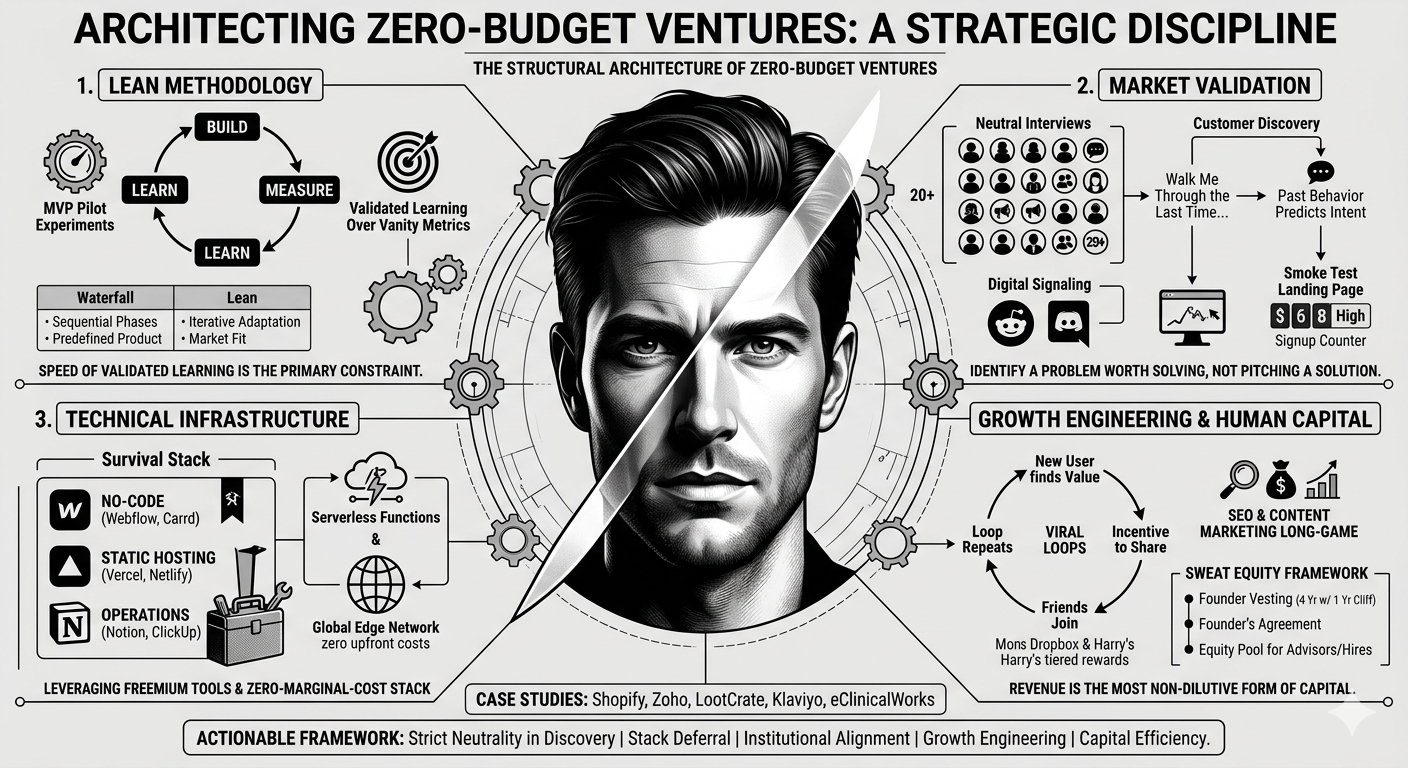
The democratization of entrepreneurial infrastructure has reached a critical inflection point where the traditional correlation between initial capital and venture viability has been fundamentally decoupled. In the current economic landscape, characterized by high-fidelity no-code tools, decentralized talent pools, and mature lean methodologies, the primary constraint on new enterprise formation is no longer financial liquidity but the speed of validated learning. Building a startup with zero budget is not merely a survival tactic for the undercapitalized; it represents a sophisticated strategic discipline that leverages extreme uncertainty to foster organizational agility and eliminate wasteful practices. This report analyzes the mechanisms through which founders can architect, validate, and scale high-growth institutions without initial funding, focusing on the synthesis of scientific management, technical tool-stack optimization, and creative human capital models.
Methodological foundations: The science of lean resource allocation
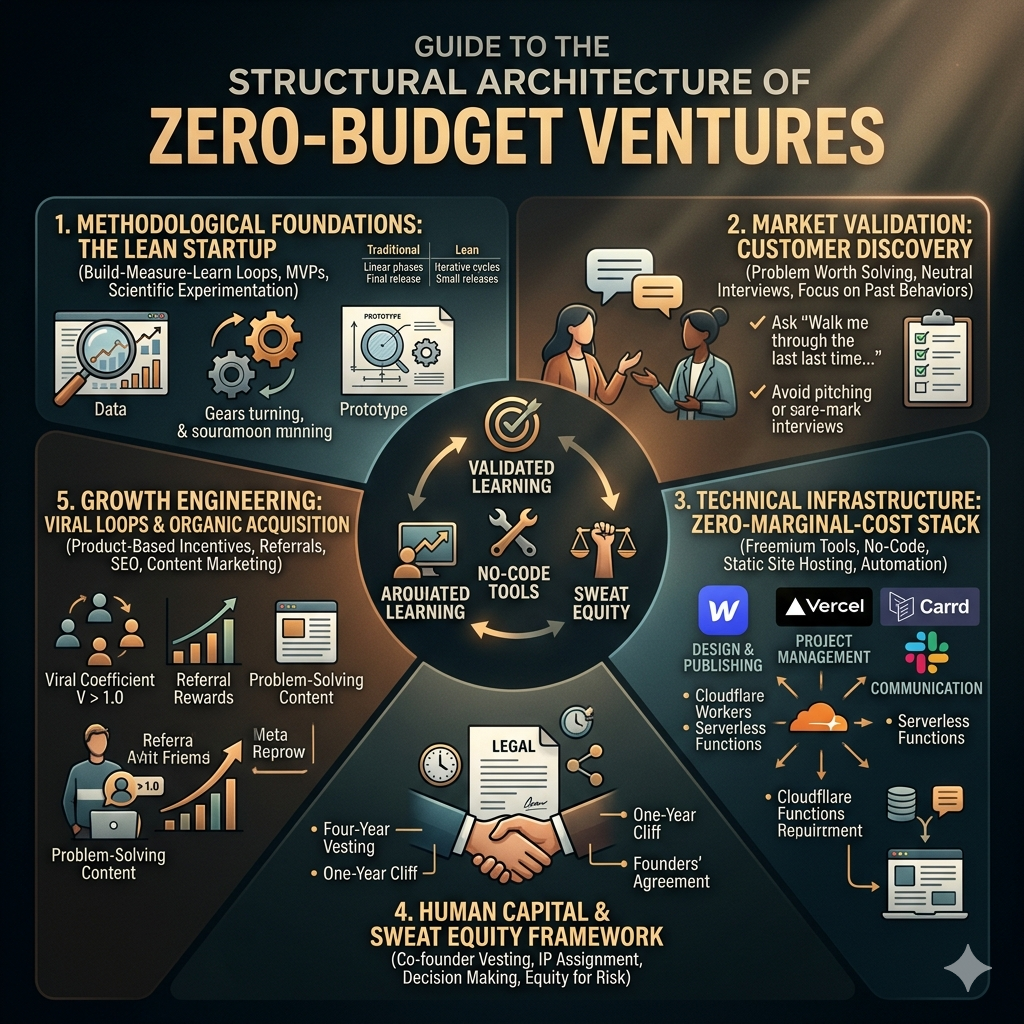
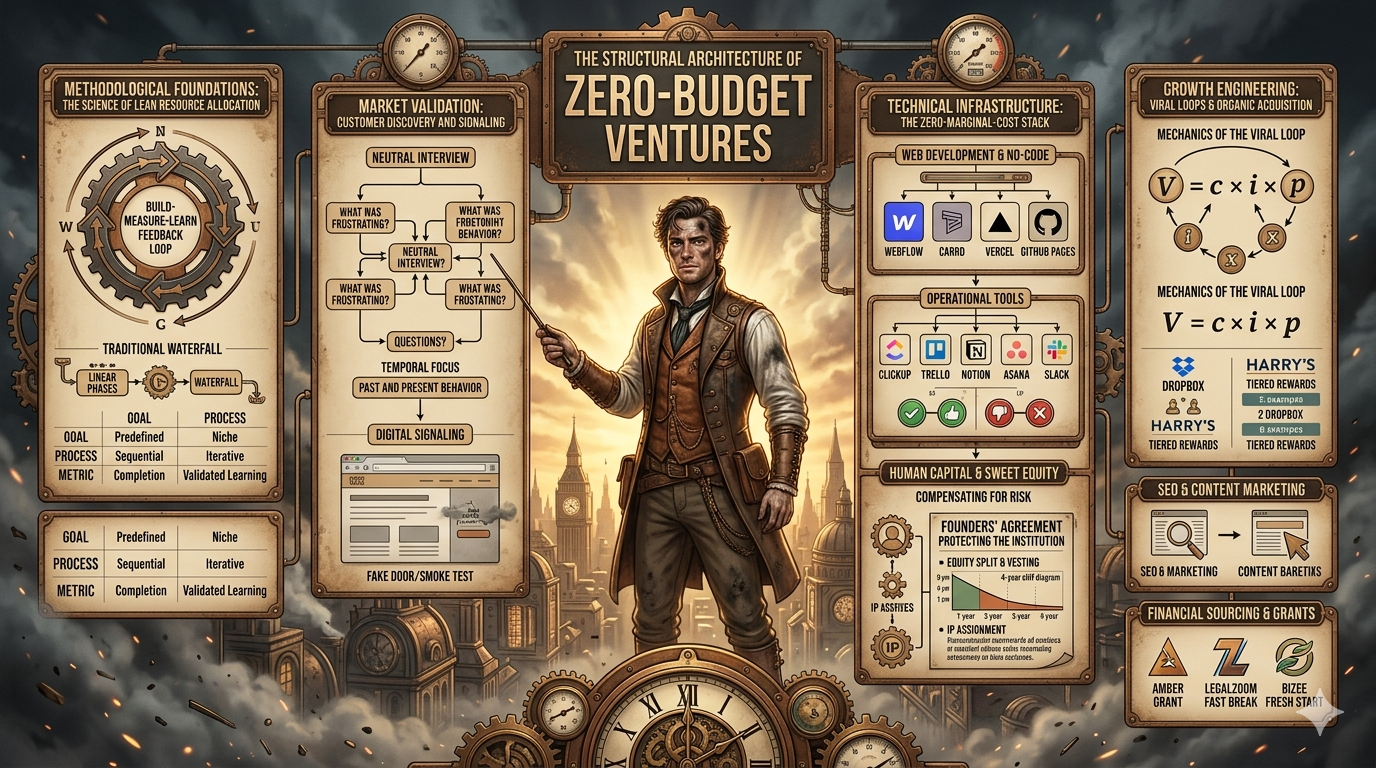
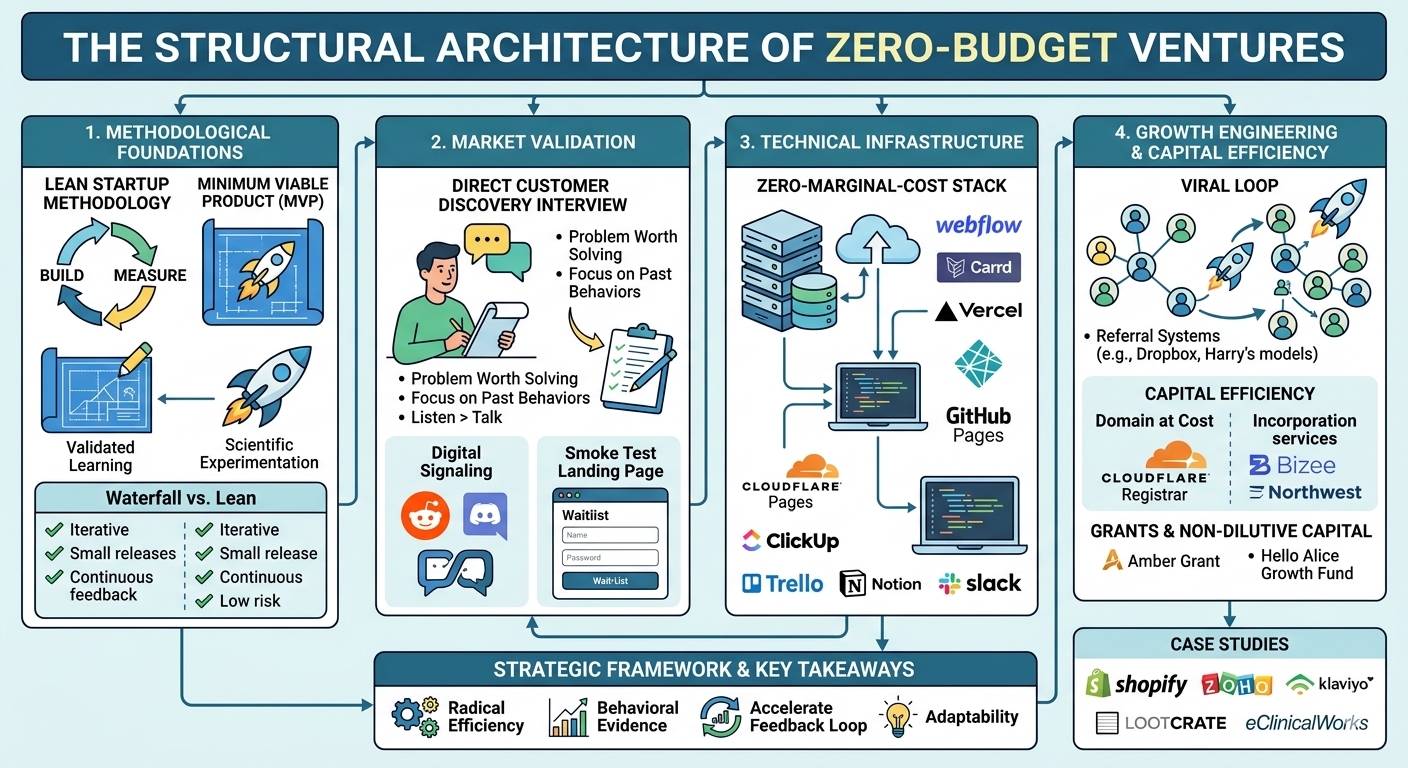
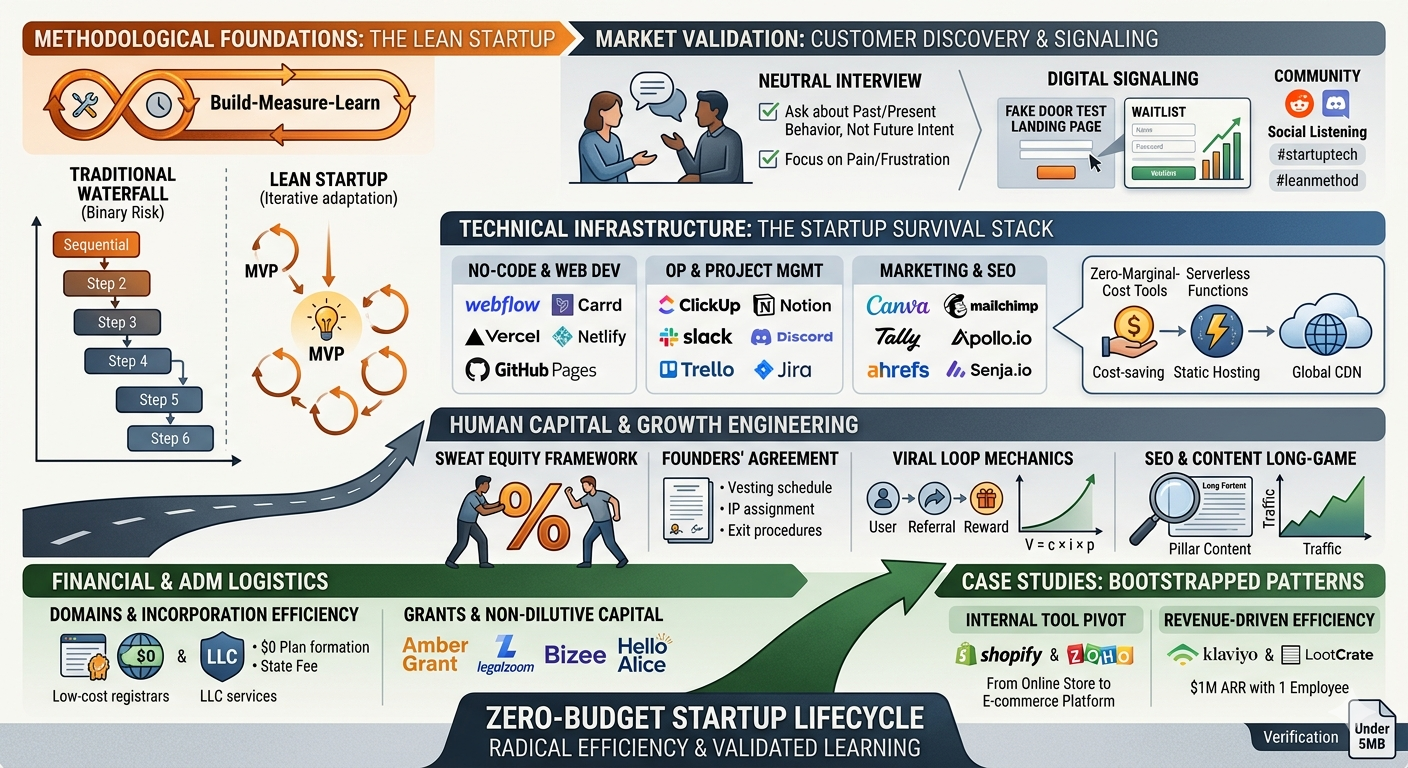
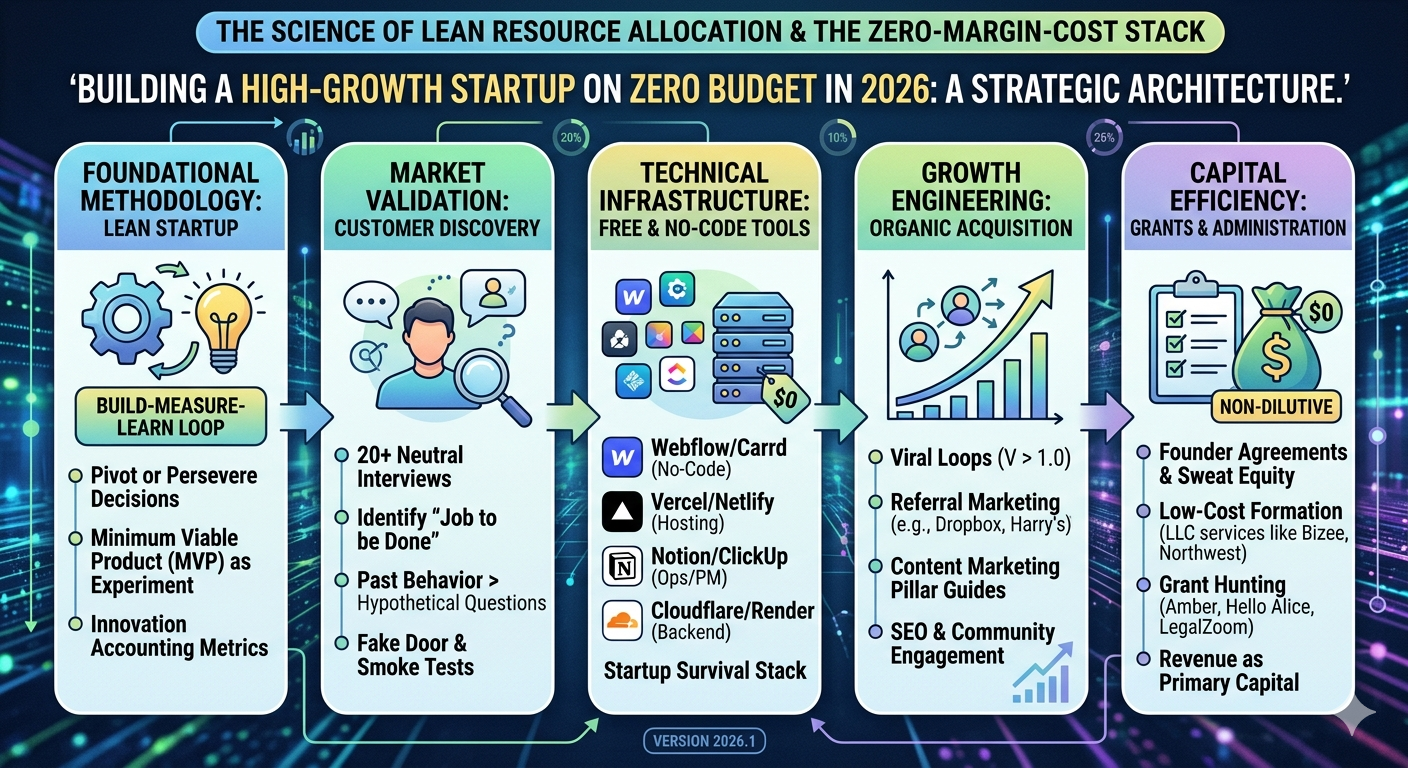
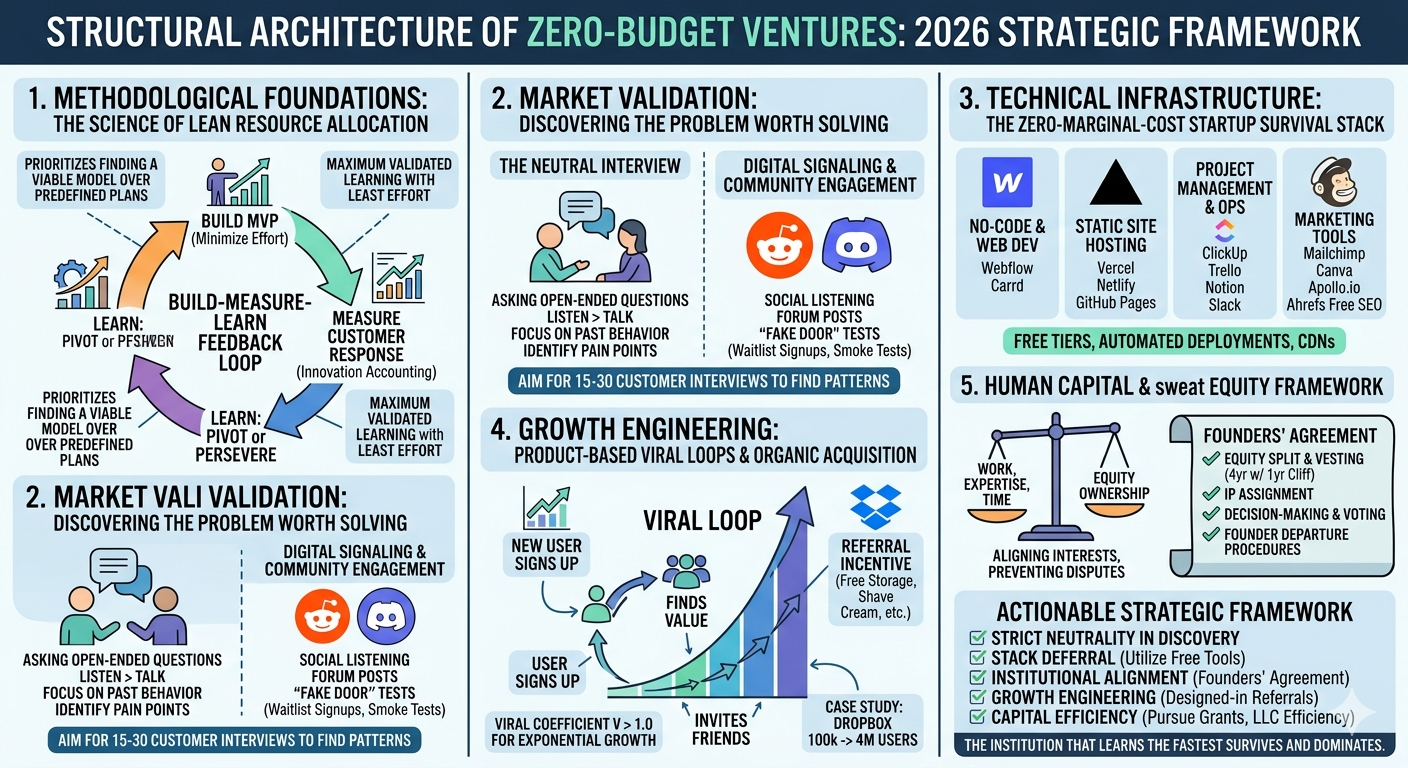
The conceptual bedrock of the modern zero-budget startup is the Lean Startup methodology, a framework that prioritizes the identification of a viable and profitable business model over the execution of a predefined plan. Traditional "Waterfall" development—characterized by long cycles of isolated building followed by a single "loud" delivery—is fundamentally incompatible with zero-budget constraints because it risks the total loss of limited human resources on a product that may lack market demand. Conversely, the lean approach utilizes a Build-Measure-Learn feedback loop to transform ideas into products, measure customer response, and determine whether to pivot or persevere.
The fundamental activity of a startup, within this paradigm, is not to "make money" or "serve customers" in the short term, but to learn how to build a sustainable business through rigorous scientific experimentation. This process is governed by three critical questions: how people find the product (growth hypothesis), how they start using it, and how they create value with it (value hypothesis). Progress is measured through innovation accounting, a new kind of accounting specifically geared to startups that focuses on milestones and validated learning rather than traditional financial statements which may be meaningless in the early stages of a pre-revenue venture.
Methodology Aspect | Traditional (Waterfall) | Lean Startup |
Initial Goal | Deliver a predefined product | Identify an effective, profitable niche |
Process Structure | Sequential phases (Linear) | Iterative Build-Measure-Learn loops |
Progress Metric | Completion of features | Validated learning and market fit |
Delivery Model | Single, final release | Small, frequent releases (MVP) |
Feedback | Post-launch evaluation | Continuous customer interaction |
Risk Profile | High (Binary success/failure) | Low (Iterative adaptation) |
The central premise of the Lean Startup is the Minimum Viable Product (MVP), defined as the version of a new product that allows a team to collect the maximum amount of validated learning about customers with the least effort. This is not necessarily a "small" product, but a "pilot experiment" designed to test fundamental business hypotheses. For a zero-budget founder, the MVP serves as a critical defense against resource depletion. By launching a rudimentary version of the vision, the entrepreneur begins the learning process as quickly as possible, adapting the plan incrementally—minute by minute—rather than waiting for a perfected beta launch that may never find an audience.
Market validation: The psychology and mechanics of customer discovery
For the entrepreneur operating without a budget, market validation is the most important pre-production phase. Every hour spent in direct conversation with potential customers potentially saves weeks of labor on the "wrong" features. The objective is to identify a "problem worth solving"—one that is painful, urgent, and carries a quantifiable cost to the customer in terms of time, money, or emotional frustration.
The mechanics of the neutral interview
The gold standard for early-stage validation is the direct customer discovery interview, conducted with 15 to 30 potential subjects. Success in these interactions requires a counter-intuitive approach: the founder must listen more than they talk and strictly avoid pitching their solution. Asking hypothetical questions like "Would you use this?" often results in polite but misleading affirmations. Instead, the founder must focus on past behaviors and current workflows.
Interview Component | Recommended Approach | Rationale |
Question Style | Open-ended, non-leading | Encourages dialogue and reveals hidden pain |
Temporal Focus | Past and present behavior | Past actions are better predictors than intent |
Core Prompt | "Walk me through the last time..." | Uncovers real-world bottlenecks and workarounds |
Objective | Understand the "Job to be Done" | Identifies the true functional need of the user |
Red Flag | "Nice to have" feedback | Suggests the problem is not urgent or painful |
Founders should ask probing questions such as "What was frustrating about your experience?" or "If you had a magic wand, what would you change?". By the 15th interview, patterns in user behavior and sentiment usually become evident; by the 25th, the founder often possesses more insight into the problem space than established competitors. This qualitative data is then distilled into a single customer persona and a single primary problem. If the problem is not verified as urgent, the founder must return to the discovery phase rather than proceeding to build.
Digital signaling and community engagement
Beyond direct interviews, zero-budget validation leverages existing digital communities where target users congregate. Platforms like Reddit and Discord provide unfiltered access to organic conversations, allowing founders to observe the specific language and "vibe" of their audience. Social listening involves tracking keyword mentions and hashtag research to uncover potential customers and analyze competitor weaknesses.
A highly effective validation technique is the "Fake Door" or "Smoke Test," where a founder creates a landing page with a value proposition and a call-to-action (CTA), such as a waitlist signup or early access request. By driving targeted traffic to this page through relevant forum posts or social media engagement, the founder can measure conversion rates. A high signup rate provides quantitative evidence of demand before a single line of code is written.
Technical infrastructure: Leveraging the zero-marginal-cost stack
The technical barrier to building a scalable startup has collapsed as professional-grade tools have shifted toward a "freemium" model that supports the earliest stages of venture formation. For the 2026 founder, the "Startup Survival Stack" consists of platforms that offer high functionality with zero upfront costs.
Web development and no-code architecture
In the 2026 landscape, the choice between custom code and no-code builders depends on the complexity of the MVP. Webflow has emerged as a dominant force for designers, generating production-ready HTML, CSS, and JavaScript from a visual canvas. This allows founders to build sophisticated marketing sites and CMS-driven applications that developers respect, without the overhead of a full engineering team. For simpler, one-page landing pages used in validation, Carrd provides high-speed, mobile-responsive templates that can be deployed in minutes.
For more technical founders, static site hosting has become a zero-cost utility. Platforms like Vercel, Netlify, and GitHub Pages allow for direct deployment from code repositories.
Hosting Provider | Primary Advantage | Best For |
Vercel | Optimized for modern frameworks | Next.js and high-performance frontend apps |
Netlify | Built-in serverless functions | JAMstack projects needing backend logic |
GitHub Pages | Truly free for public repos | Documentation and project-focused sites |
Cloudflare Pages | Global edge network security | Speed and DDoS protection at no cost |
Render | Simple, Git-based auto-deploys | Static sites and simple SaaS previews |
These platforms often include free SSL certificates, automated build pipelines, and global CDNs, which traditionally required substantial infrastructure spending. The integration of Cloudflare Workers and serverless functions further allows zero-budget startups to implement dynamic functionality—like authentication and database queries—without managing traditional server environments.
Operational and project management tools
Managing a zero-budget team—often distributed and working asynchronously—requires a structured operational hub. The 2026 project management landscape is characterized by deep feature sets in free tiers, though storage and user limits remain the primary constraints.
ClickUp is frequently cited as the most flexible all-in-one solution for early teams, offering unlimited tasks and users on its free plan, along with advanced features like time tracking and task dependencies. For teams that prefer visual simplicity, Trello’s Kanban-based system remains a "go-to" for its drag-and-drop ease of use, though it is limited to ten boards per workspace. Notion has increasingly become the "Swiss Army knife" of startup operations, combining documentation, wikis, and databases into a single customizable workspace that can replace five or more separate tools.
PM Tool | Best For | Free Tier Limitation |
ClickUp | Feature-rich workflows | 100MB storage cap |
Trello | Visual simplicity (Kanban) | 10 boards per workspace |
Asana | Structured task tracking | Up to 15 users |
Visual dashboards | Max 2 users | |
Notion | Custom workspace building | Limited AI blocks per month |
Jira | Agile software teams | Up to 10 users |
Collaboration is further streamlined through real-time communication platforms like Slack or Discord. Slack’s integration ecosystem—connecting with over 2,600 apps—allows it to act as the central nervous system of the startup, where notifications from GitHub, Trello, and HubSpot converge in a single interface. This reduces "context switching," which is a significant hidden cost in lean organizations.
Human capital and the sweat equity framework
The single most valuable investment a zero-budget startup receives is the labor of its founders and early believers. This contribution is institutionalized through the concept of sweat equity—ownership earned through work, expertise, and time rather than financial capital.
Compensating for risk and expertise
Founders typically work 80-hour weeks for months or even years without a market-rate salary, essentially betting on the future value of their ownership stake. This model extends to early employees who may accept salaries 20% to 40% below market rates in exchange for equity packages. Advisors—often industry veterans who command fees of $300 to $500 per hour—can be brought on for small equity grants (typically 0.1% to 1%) to provide critical introductions and strategic credibility.
To institutionalize these arrangements, founders must use formal equity agreements to prevent future disputes and align interests with the company's long-term success. Standard practice involves the creation of an "equity pool"—usually 10% to 20% of the company—allocated for early hires.
The Founders' Agreement: Protecting the institution
Conflict between co-founders is a leading cause of startup failure, with studies indicating that 65% of high-potential ventures fail due to such disputes. A legally binding Founders' Agreement is essential to clarify roles, responsibilities, and equity splits from day one.
Key sections of a 2026 Founders' Agreement include:
Equity Split and Vesting: Standard vesting schedules often occur over a four-year period with a one-year "cliff," ensuring that equity is earned through continued commitment.
Intellectual Property (IP) Assignment: Ensuring that all code, designs, and algorithms created for the startup belong to the company, not the individuals.
Decision-Making and Voting: Establishing clear rules for voting and conflict resolution to avoid gridlock during critical growth phases.
Founder Departure Procedures: Outlining how the company will handle a founder's exit to ensure stability and continuity.
Standardized templates—such as the Founder/Advisor Standard Template (FAST) or the Y Combinator Safe—allow startups to structure these complex agreements without incurring thousands of dollars in legal fees.
Growth engineering: Viral loops and organic acquisition
When the marketing budget is zero, the focus shifts from "buying" attention through paid ads to "engineering" growth directly into the product experience. This is achieved through viral loops and referral marketing systems that turn existing users into a cost-effective acquisition engine.
The mechanics of the viral loop
A viral loop is a deliberate system where a user signs up, finds value, and is incentivized to share the product with others, who then repeat the process. The effectiveness of a loop can be modeled using the viral coefficient V, defined as:
V=c×i×p
where c is the number of current users, i is the number of invitations sent per user, and p is the probability that an invite converts into a new signup. For a loop to drive exponential growth, V must exceed 1.0.
Lessons from Dropbox and Harry’s
The most successful zero-budget growth stories utilize product-based incentives. Dropbox famously grew its user base from 100,000 to 4 million in one year by offering 500MB of free storage to both the person referring and the person being referred. Because the reward was the product itself, the marginal cost to Dropbox was essentially zero, while the value to the user was high.
Harry’s used a pre-launch referral loop to capture 100,000 email addresses in just one week. Their strategy involved a tiered reward system:
Refer 5 friends: Earn free shave cream.
Refer 10 friends: Earn a free razor handle.
Refer 50 friends: Earn a year of free blades.
This approach turned a simple landing page into a viral event by leveraging the "fear of missing out" (FOMO) and providing tangible rewards for social sharing. For modern startups, platforms like Viral Loops offer no-code templates inspired by these giants, allowing small teams to implement sophisticated referral programs without a dedicated engineering team.
SEO and the content marketing long-game
Organic SEO remains the primary long-term play for zero-budget startups. A "problem-solving blog" that addresses the top ten questions customers have about a niche can establish authority and drive traffic without ad spend. Founders should focus on "pillar content"—comprehensive guides of 2,000 words or more—that provide definitive answers to high-intent search queries.
Marketing Tool | Free Plan Highlights | Best For |
Mailchimp | 500 contacts, 1,000 emails/mo | Email newsletters and lead nurturing |
Canva | 2M+ templates, 5GB storage | Professional design for non-designers |
60 emails/mo, 2 sequences | B2B sales outreach and lead scraping | |
Unlimited forms and submissions | Lead generation and feedback surveys | |
Ahrefs Free SEO | Backlink and keyword tracking | Organic search optimization |
15 text/video testimonials | Building social proof on zero budget |
Financial sourcing and administrative logistics
Even in a zero-budget scenario, certain administrative and legal costs are unavoidable. The strategic founder navigates these through cost-minimizing registrars and grant hunting.
Domain and incorporation efficiency
Domain registration is the first tangible cost of business formation. Cloudflare Registrar has emerged as a leader for cost-conscious founders by offering domains "at cost"—passing on the exact ICANN registry fee without markups. Other registrars like Namecheap and Porkbun are noted for transparent pricing and free lifetime WHOIS privacy, which protects the founder's personal information from public records.
For incorporation, US-based founders frequently use LLC structures for their flexibility and limited liability protection. Online services have commoditized this process:
LLC Service | Best For | Primary Value Prop |
Bizee (Incfile) | Tight budgets | $0 formation + free 1st yr registered agent |
ZenBusiness | First-time founders | Guided step-by-step formation chatbot |
Northwest | Maximum privacy | Personal address kept off public records |
LegalNature | Comprehensive docs | Robust library of business legal templates |
Choosing a $0 formation plan allows the founder to only pay the mandatory state filing fee, while services like Bizee’s free registered agent help satisfy legal requirements without recurring monthly costs during the critical first year.
Grants and non-dilutive capital
Founders should aggressively pursue grant programs that offer "free" cash without requiring equity. While the SBA does not offer federal grants for startup capital, many private and corporate programs fill this gap.
Recurring and high-value grant opportunities in 2026 include:
Amber Grant: $10,000 monthly award for women entrepreneurs with a $25,000 annual grand prize.
Hello Alice Growth Fund: Awards of $5,000 to $25,000, prioritizing underrepresented founders.
LegalZoom Fast Break: $10,000 in startup capital plus legal and formation services.
Bizee Fresh Start: $2,500 grant specifically for entrepreneurs starting new ventures.
These programs often focus on the "grit" and "potential" of the founder, making the application process itself an exercise in refining the startup's narrative and value proposition.
Case studies: Patterns of high-growth bootstrapped success
Analyzing successful startups that began with near-zero budgets reveals common strategic patterns: solving internal needs, delaying hiring, and focusing on "boring" but profitable markets.
Shopify and Zoho: The "Internal Tool" pivot
Shopify’s founders were originally building an online store for snowboards but found existing shopping cart solutions inadequate. By building their own bespoke solution on Ruby on Rails, they solved their own problem and eventually realized the solution was the product. Zoho followed a similar path, bootstrapping its way to over 18 million customers by taking on giants like Oracle and Salesforce through a focus on cost-efficient, high-utility software.
Klaviyo and LootCrate: The efficiency of revenue
LootCrate achieved $100 million in revenue and 600,000 customers before ever raising institutional capital, primarily by charging customers from the very first weekend of existence. Klaviyo’s founders famously postponed their first hire until they reached $1 million in Annual Recurring Revenue (ARR), relying on keen product design and tireless personal sales efforts. These examples highlight that revenue is the most non-dilutive form of capital available.
"Fortune Favors the Boring"
Many billion-dollar bootstrapped companies operate in "unsexy" niches. eClinicalWorks focuses on the meticulous management of clinical data and now generates over $320 million in annual revenue. Unity survived for years without capital by perfecting the technical aspects of game development—like cross-platform compatibility—that larger competitors ignored, eventually becoming the backbone of the mobile gaming industry. SurveyMonkey survived the dot-com crash by growing steadily into a nine-figure run rate, only raising its first $100 million eleven years after launch.
Conclusions and actionable strategic framework
Building a startup with zero budget in 2026 is a discipline of radical efficiency and behavioral evidence. The transition from a "garage underdog" to a scalable enterprise is structured around the continuous reduction of waste and the acceleration of the feedback loop.
The synthesized strategy for a zero-budget launch involves:
Strict Neutrality in Discovery: Conducting 20+ interviews focusing solely on the customer's past frustrations rather than the founder's future vision.
Stack Deferral: Utilizing free-tier no-code tools (Webflow/Carrd) and static hosting (Vercel/Netlify) to delay technical debt and infrastructure costs.
Institutional Alignment: Solidifying the venture through a written Founders' Agreement and sweat equity schedules before seeking external talent.
Growth Engineering: Designing referral mechanisms directly into the MVP, ensuring that every new user has an incentive to become a marketing advocate.
Capital Efficiency: Pursuing non-dilutive grants and commoditized incorporation services to preserve equity for future high-resolution fundraising.
Ultimately, the zero-budget founder's greatest asset is the ability to adapt minute-by-minute based on empirical data rather than rigid planning. In an environment of extreme uncertainty, the institution that learns the fastest—not the one with the most capital—is the one that survives and eventually dominates its niche.