Should Startups Stay Neutral During War—or Take a Stand?
March 20, 2026 by Harshit Gupta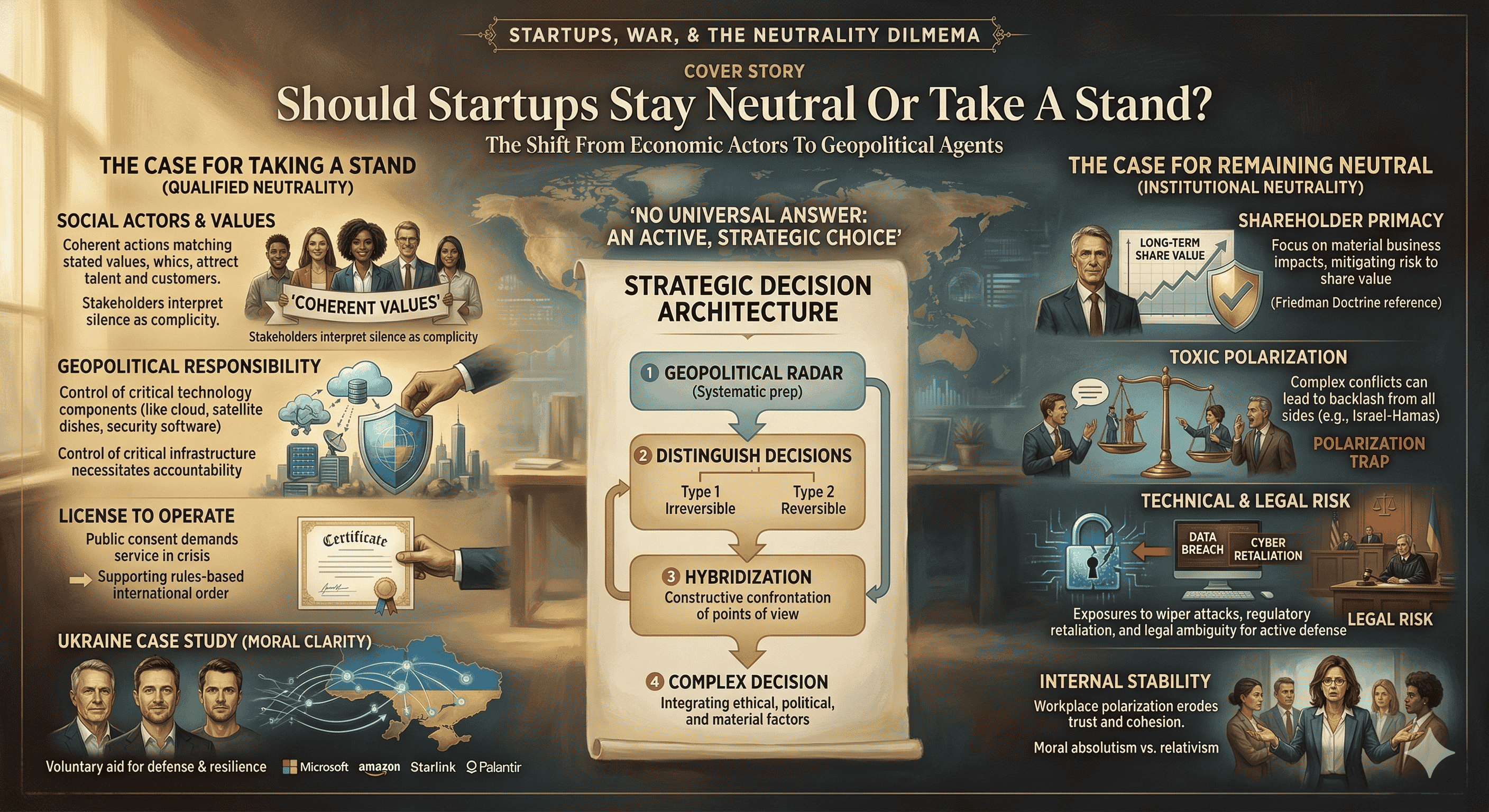
The Paradigm Shift: From Economic Actors to Geopolitical Agents
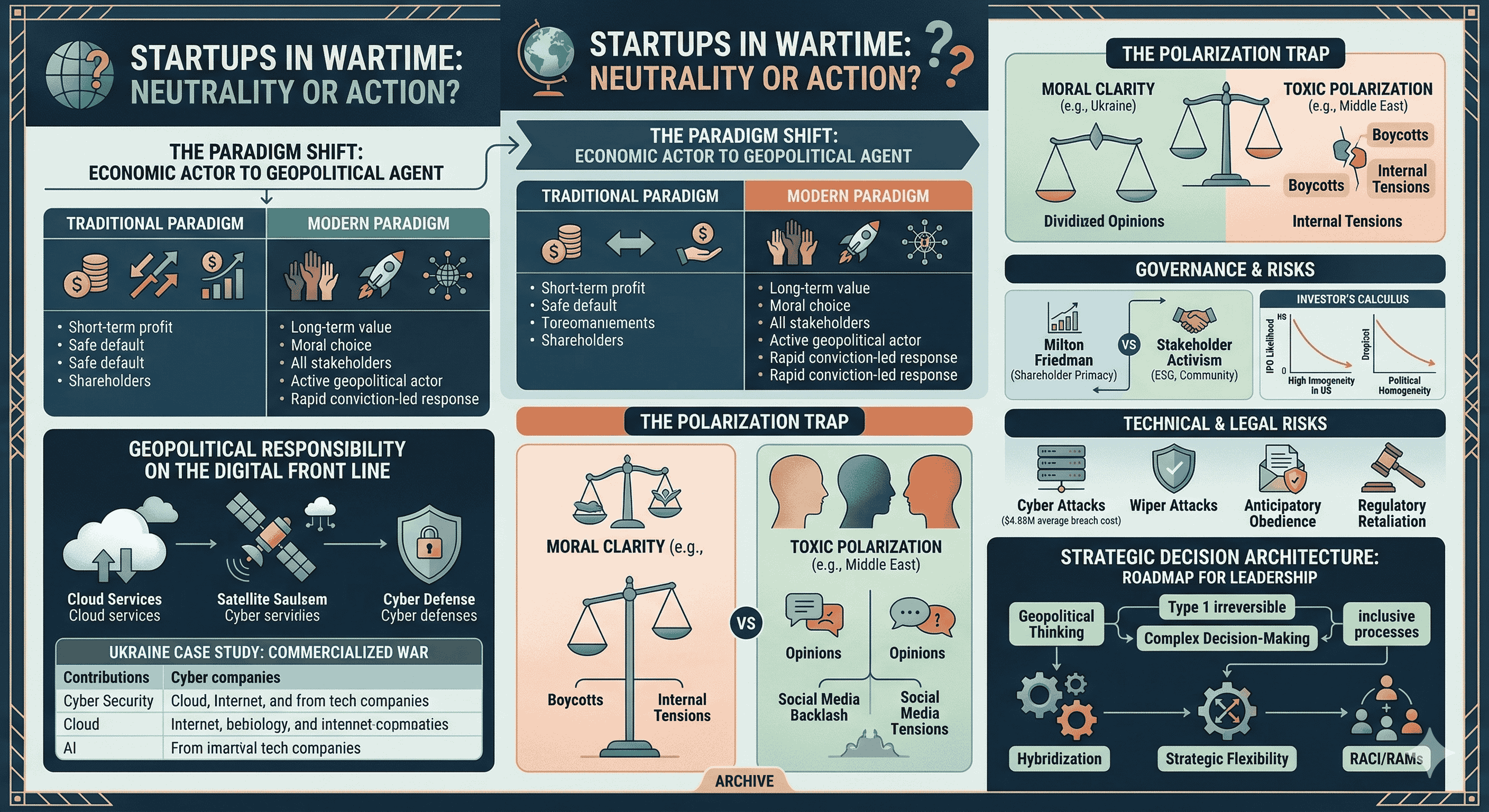
The contemporary global security environment has fundamentally redefined the role of the private sector, particularly for high-growth startups and technology firms. Historically, the prevailing wisdom for commercial entities was rooted in the avoidance of political entanglement to safeguard market access and minimize operational risk. However, the emergence of hybrid warfare and the datafication of the battlespace have shifted the burden of proof from those who choose to take a stand to those who attempt to remain neutral. In the modern perception-driven economy, silence in the face of visible humanitarian crises or clear-cut aggression is increasingly interpreted not as a stance of objectivity, but as a form of implicit complicity or strategic dissonance.
This evolution is driven by a profound cultural shift where startups are no longer viewed merely as producers of goods or services but as social actors bearing inherent values and responsibilities. For stakeholders—ranging from employees and customers to investors—the coherence between a company's actions and its stated values has become a critical metric of legitimacy. The transformation of communication ecosystems, characterized by the real-time scrutiny of social media and activist networks, has collapsed the traditional "crisis playbook" that prioritized defensive posturing and slow, cautious responses. Today, neutrality is frequently perceived as cowardice, particularly in conflicts characterized by a perceived binary between right and wrong.
Factor | Traditional Paradigm | Modern Paradigm |
Primary Goal | Short-term profit maximization | Long-term stakeholder value creation |
View of Neutrality | A safe, default objective stance | A moral and subjective choice with risks |
Stakeholder Priority | Shareholders only | Employees, customers, community, and state |
Conflict Role | Passive victim of instability | Active geopolitical actor and infrastructure provider |
Response Speed | Cautious, legalistic, and delayed | Rapid, conviction-led, and transparent |
The transition from economic actor to geopolitical agent is most visible in the technology sector. Startups now control the critical infrastructure—including cloud services, satellite imagery, and information platforms—that sovereign states require to function and defend their territorial integrity. This "geopolitical responsibility" necessitates that companies account for the consequences of their economic activities, especially when those activities fund or facilitate states accused of violating international law. As a result, the "license to operate" for a modern startup is no longer solely granted by legal charters but by a broader social contract that demands constructive service to the needs of society during times of crisis.
Historical Lineage of Neutrality: From State Doctrine to Corporate Moral Duty
The concept of neutrality did not originate as a humanitarian or corporate ideal but as a state-driven legal doctrine designed to protect national sovereignty. For centuries, neutrality meant non-intervention, allowing a state to avoid the costs of war while maintaining economic relations with all belligerents. This was codified in the Hague Conventions of 1899 and 1907, which established that neutral land and airspace are inviolable and that neutrals must be impartial in their dealings with warring parties. This "Strict Neutrality" was built on strategic interests rather than moral imperatives, viewing the state as an observer rather than a judge of the justice of a conflict.
However, the ethical dimensions of neutrality shifted with the rise of Just War Theory, which stretches back to medieval theologians like St. Thomas Aquinas. This theory posits that war must be waged for a "just cause" and with "right intention," such as defense against aggression. Within this framework, the idea of impartial neutrality often collapses; if a conflict is a battle between an aggressor and a victim, other states—and by extension, influential private actors—are morally obliged to assist the side acting justly and do nothing to advance the cause of the wrongdoer.
Neutrality Concept | Origin/Basis | Core Obligation | Modern Application |
Strict Neutrality | 1907 Hague Conventions | Total impartiality and non-participation | Standard legal baseline for states |
Qualified Neutrality | Just War Theory / UN Charter | Support the victim of unlawful aggression | Western corporate response to Ukraine |
Humanitarian Neutrality | ICRC / MSF Principles | Aid provided regardless of political side | NGO access in active conflict zones |
Institutional Neutrality | Corporate Governance Policy | Silence on issues not directly impacting business | Strategy to mitigate internal polarization |
The modern era has seen the emergence of "Qualified Neutrality" (or non-belligerency), which argues that neutrality rules need not be applied impartially when there is clear-cut aggression. This is supported by the UN Charter, which requires member states to assist in collective security enforcement and refrain from assisting aggressors. For startups, this creates a profound dilemma: while strict neutrality might protect them from immediate retaliation, it can violate the moral expectations of a global audience that witnesses the cynical disregard for international law. Taking a stand, therefore, is not merely a political act but an expression of a company's commitment to the rules-based international order that allows global commerce to thrive in the first place.
Governance and the Social Contract: Shareholder Primacy vs. Stakeholder Activism
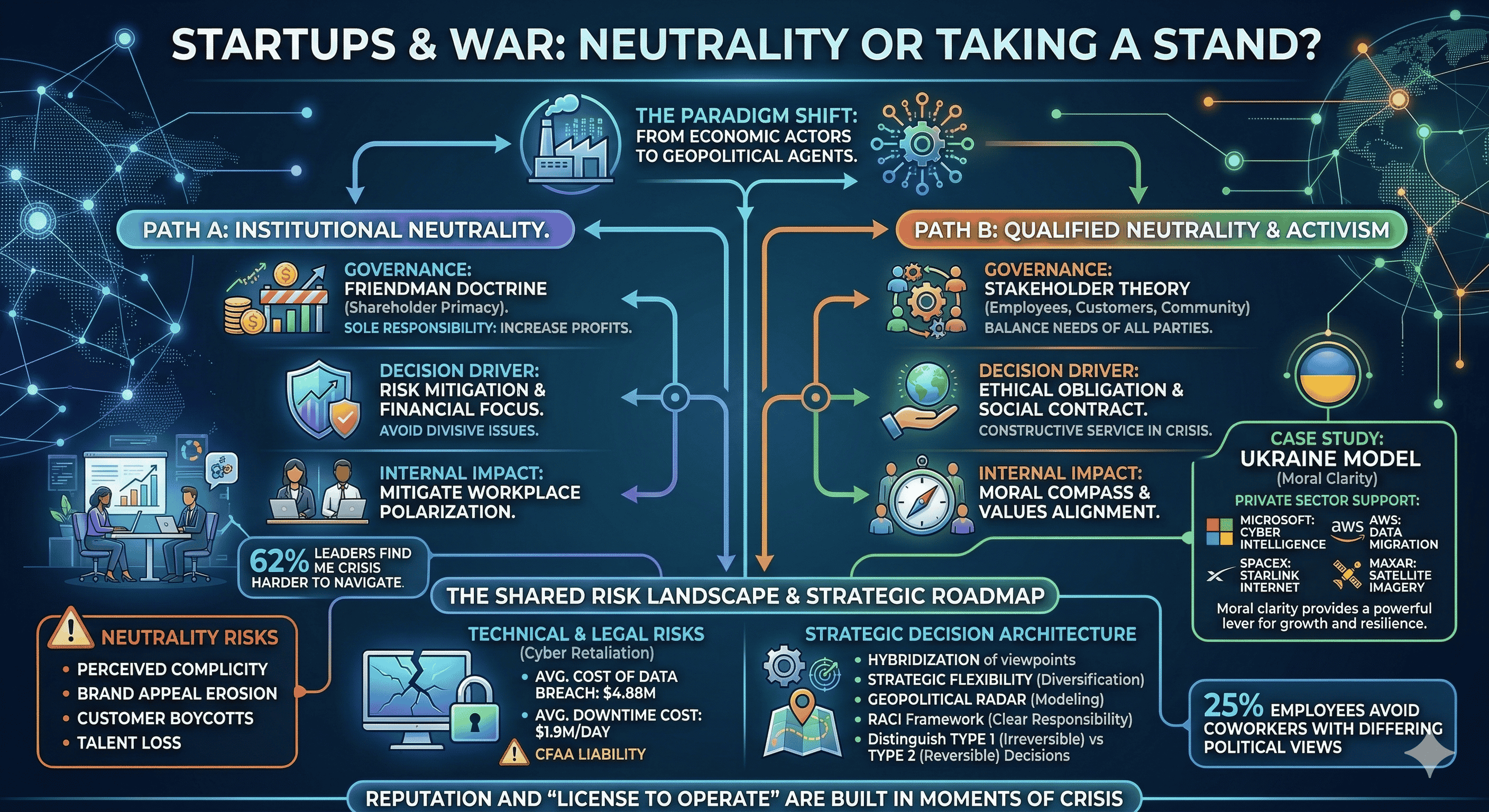
The debate over corporate activism is frequently structured as a conflict between the Friedman Doctrine of shareholder primacy and the more contemporary model of stakeholder capitalism. Milton Friedman’s 1970 manifesto argued that the sole social responsibility of business is to increase its profits, leaving ethical matters to individuals and the government. Proponents of this view caution that corporate activism can worsen the "principal-agent" problem, allowing executives to pursue personal political priorities using shareholder capital without explicit approval.
Yet, even within the Friedmanite framework, a compelling case for taking a stand in wartime exists. Friedman acknowledged that a corporation must act ethically and that it may be in its long-term interest to invest in the community or improve its government to generate goodwill. If silence during a conflict leads to consumer boycotts, the loss of key talent, or the erosion of "brand appeal," then taking a stand becomes a necessary action to maximize long-term share value. This convergence suggests that the distinction between "shareholder" and "stakeholder" capitalism is narrowing; both models recognize that treating stakeholders seriously is the only way to ensure sustainable profitability.
The "Stakeholder Theory" takes this further by arguing that businesses must be part of the solution to fundamental social problems. In the context of war, this is often expressed through the "Triple Bottom Line"—economic, social, and environmental dimensions. For a startup, this involves more than just philanthropy; it requires a strategic realignment of business operations to support social capital and reconstruction.
Governance Philosophy | View on Social Responsibility | Decision Driver in War | Role of the CEO |
Friedman Doctrine | Increase profits within rules | Mitigation of risk to share value | Fiduciary agent for owners |
Stakeholder Theory | Balance needs of all parties | Ethical obligation to community/staff | Moral leader and mediator |
Corporate Activism | Influence policy/moral standards | Proactive defense of core values | Public advocate and activist |
Institutional Neutrality | Avoid divisive political issues | Focus on material business impacts | Manager of apolitical culture |
The "license to operate" is a critical concept in this governance debate. It suggests that business functions only because of public "consent" and must therefore contribute more to society than merely its products. In wartime, this consent is tested. When startups provide critical humanitarian aid or support the defense of a sovereign state, they are reinforcing their social contract. Conversely, those that continue to operate in aggressor markets without a clear ethical justification risk a "symbolic loss of legitimacy" that can have permanent financial consequences.
The Digital Front Line: Ukraine as the First Commercialized War
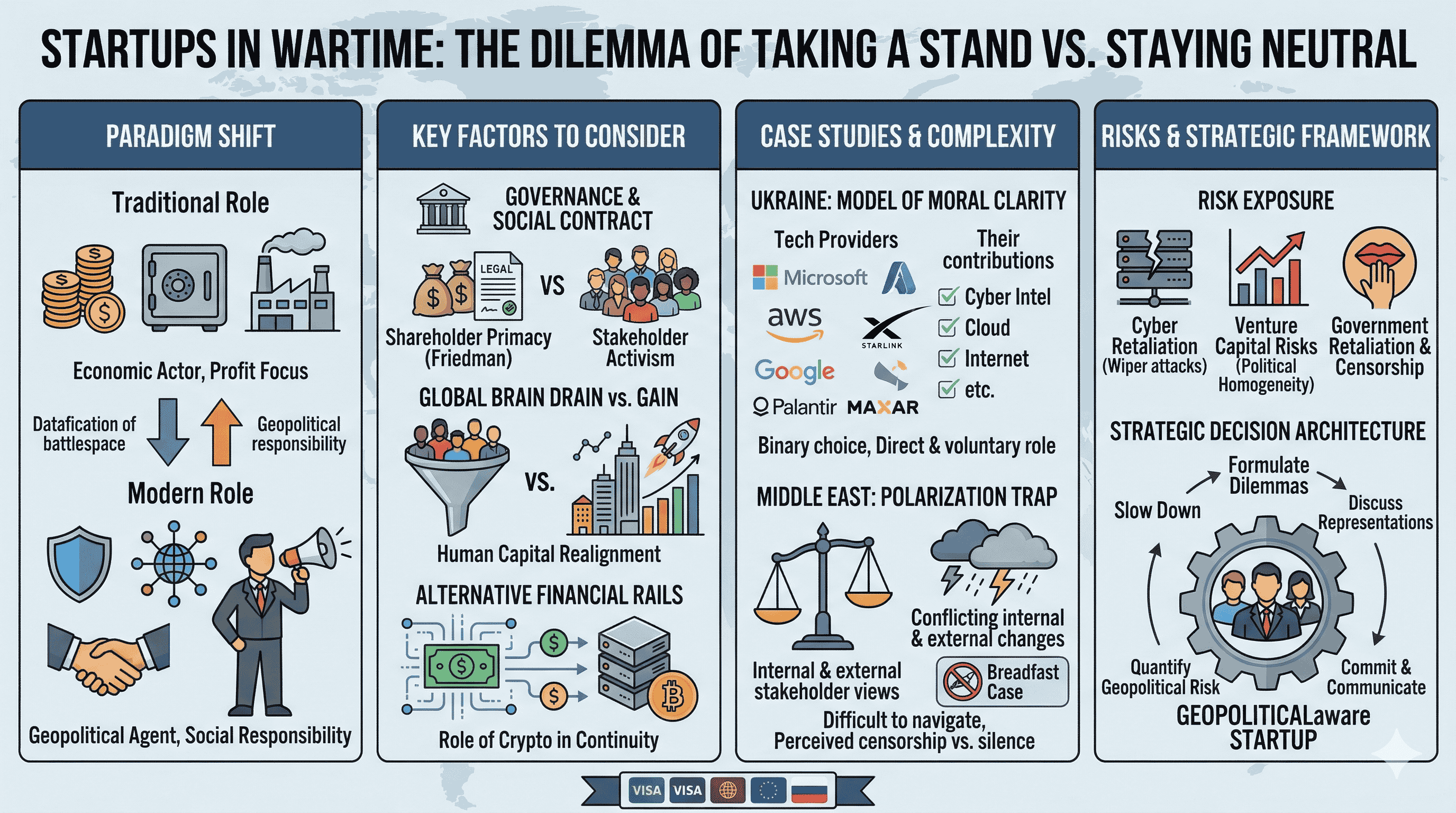
The Russian invasion of Ukraine in 2022 serves as the primary case study for the redefinition of tech startups as geopolitical actors. This conflict has demonstrated that the "state-centric" model of war, where sovereign governments control all aspects of the battlefield, is being replaced by a hybrid model where private tech companies provide essential and often irreplaceable support. For the first time, global technology companies have played a direct and central role in securing a state's territorial integrity through cyber-security, satellite imagery, and the surveillance of information.
The factors driving this involvement were rooted in "moral clarity". For many tech founders and their employees, the conflict presented a clear binary of right and wrong, making the decision to assist Ukraine "the easiest of all scenarios". This clarity allowed companies to bypass traditional diplomatic channels and provide aid voluntarily, often without a request from an allied state or payment from Ukraine.
Technology Provider | Core Contribution | Geopolitical Impact |
Microsoft | Threat intelligence; Data migration | Neutralized Russian "wiper" cyberattacks |
Amazon (AWS) | Cloud infrastructure; Data security | Secured 27 ministries and the "digital memory" of Ukraine |
SpaceX (Starlink) | Low-orbit satellite constellation | Provided internet for military and civilian coordination |
Air raid alerts; Anti-DDoS software | Protected infrastructure and notified civilians of attacks | |
Palantir | Big data / AI situational awareness | Fused intelligence data for real-time information edge |
Maxar / Capella | Commercial satellite imagery | Verified troop movements and exposed war crimes |
This commercialization of warfare has profound implications for security governance. Militaries now rely on commercial datafication software and hardware that were not developed through military tenders but rooted in business models prioritizing speed and flexibility. While this has enhanced Ukraine's "cyber resilience," it also highlights a deep underlying dependency on private products and infrastructure. The "empowerment of Big Tech" in this context has fundamentally shifted how nations conduct diplomacy;currying favor with tech CEOs has become as important as traditional state-to-state relations. However, this involvement is a "double-edged sword." When private interests diverge from military needs—such as when Elon Musk restricted Starlink's use for certain drone operations—it reveals the fragility of relying on non-state actors for sovereign defense.
The Polarization Trap: Navigating the Middle East Conflict and Global Backlash
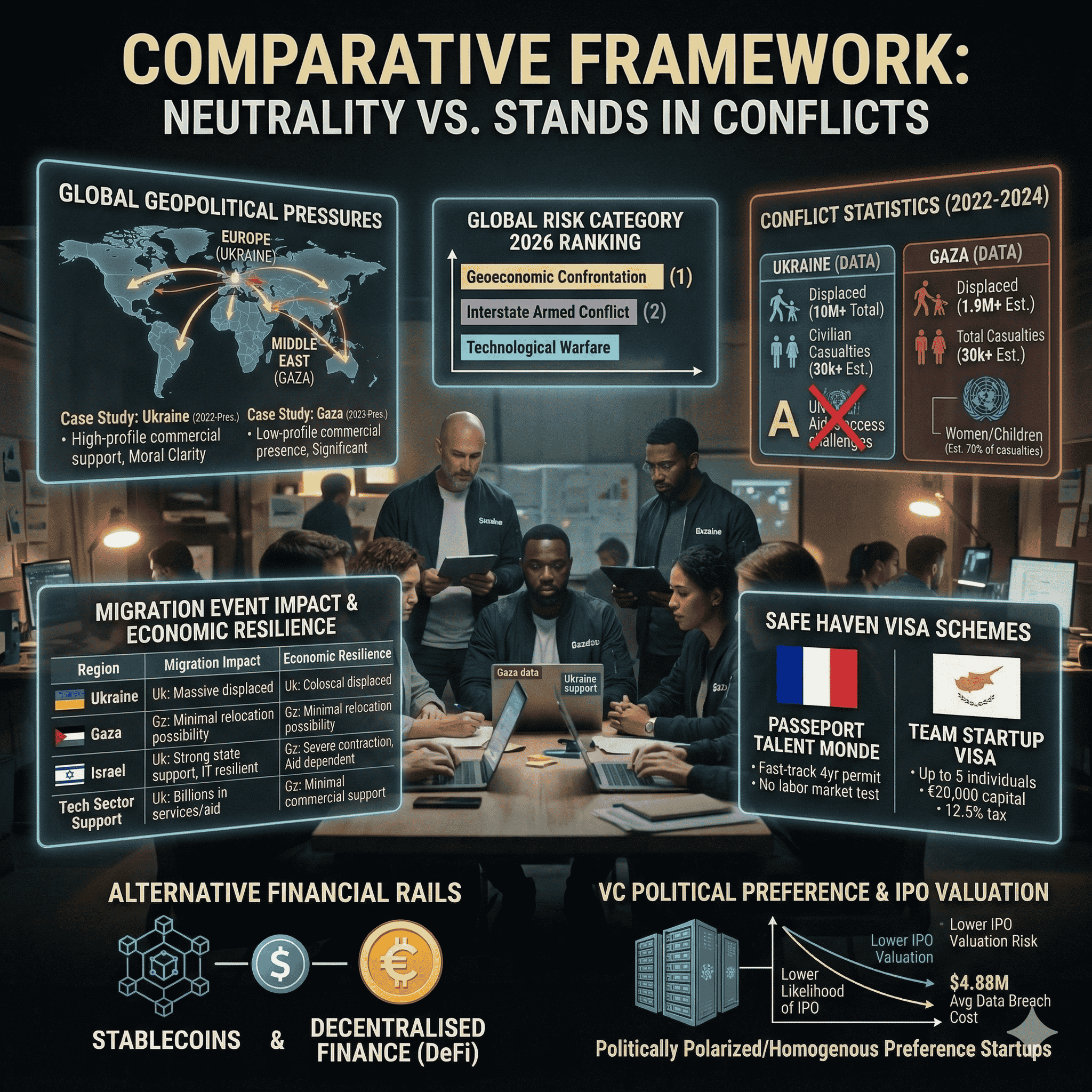
In contrast to the moral clarity observed in the Ukraine conflict, the Israel-Hamas war has presented a "toxic polarization" that complicates the decision-making process for startups. This conflict is perceived as significantly more challenging for businesses, with 62% of leaders finding it harder to navigate than previous crises. The difficulty stems from the deeply divided views of internal and external stakeholders, where even humanitarian aid can be interpreted as a political statement.
The Breadfast case in Egypt exemplifies the risks of indirect political entanglement. Despite being an Egyptian-controlled grocery delivery startup, Breadfast faced intense boycott calls because some of its minority investors, such as SBI Investment and Mubadala, had indirect links to Israel. This illustrates a "traceability" mandate in modern politics; as a firm's reputation becomes more scrutinized, the specific targets of its influence efforts—and its sources of capital—become critical variables for public monitoring.
Case Study | Stakeholder Group | Nature of Backlash | Core Dilemma |
Breadfast | Regional consumers | Social media boycott campaigns | Indirect link to Israeli-connected VCs |
Microsoft | Israeli employees | Frustration over "public silence" after attacks | Balancing global neutrality vs. staff support |
Meta / X | Human rights groups | Accusations of pro-Palestinian censorship | Moderation bias and "silencing" narratives |
Pale Blue Dot | VCs / LPs | Professional backlash over Gaza post | Risk of taking a humanitarian stance on Gaza |
Jefferies / Oracle | Pro-Israel stakeholders | Pressure to increase donations/statements | Aligning with "moral clarity" of terror attacks |
Internal dynamics also suffer under this polarization. Large tech firms with R&D hubs in Israel faced "jarring" silence from leadership after missile strikes, sending confusing signals to the very engineers they rely upon. Conversely, startups that express concern for the humanitarian crisis in Gaza have faced backlash from those who view such statements as a lack of support for Israel. The role of tech companies in content moderation further complicates this, as platforms are accused of either being too passive or engaging in "ruthless censorship" of specific parties. In this environment, the "vibe patriotism" that works in a clear-cut war can fail spectacularly, as influential civilians affiliate with a conflict's moral weight without being insulated from the social and reputational costs.
Internal Stability: Workplace Psychology, Moral Philosophy, and HR Resilience
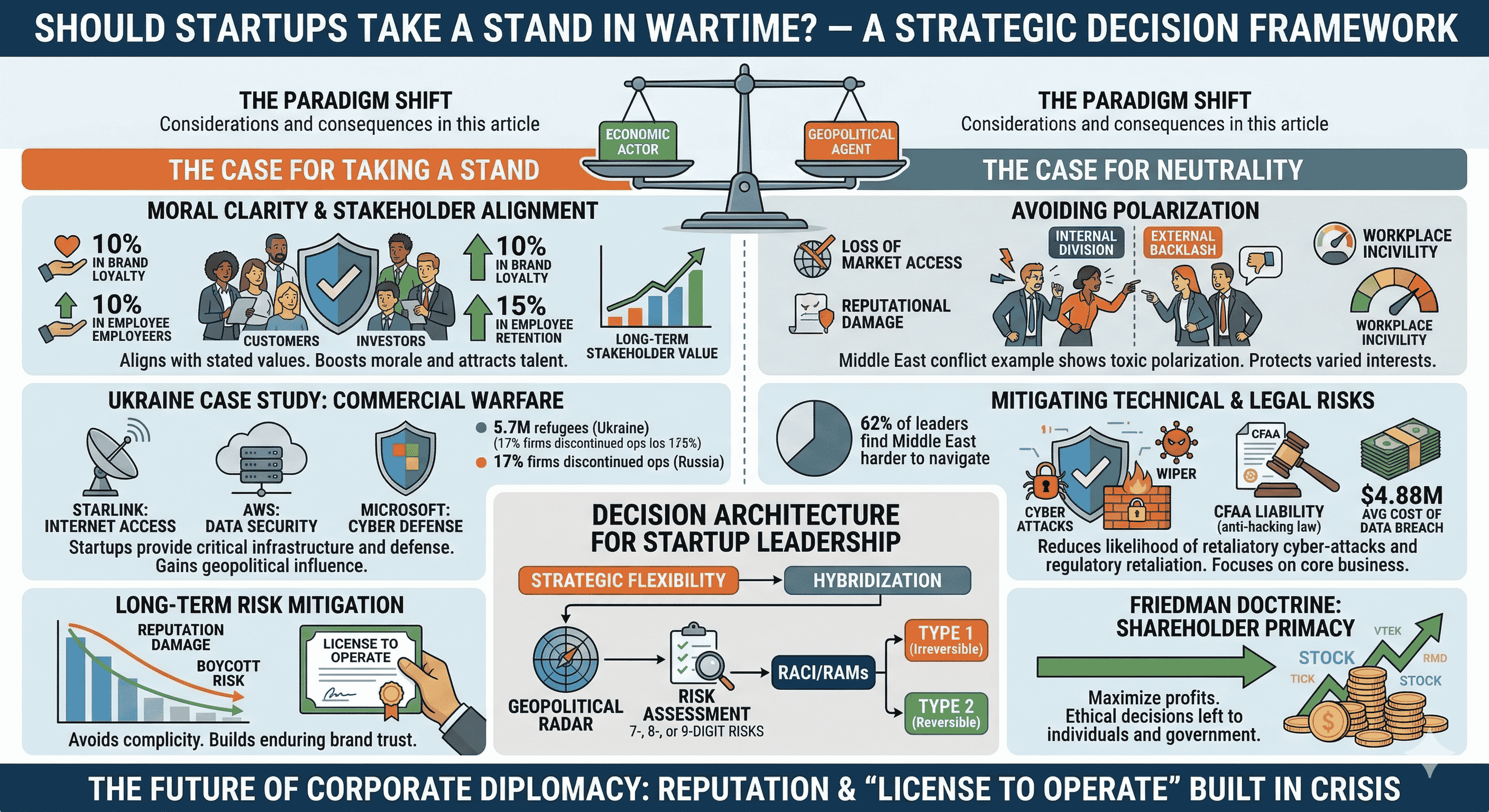
The intersection of geopolitical conflict and organizational life poses a direct threat to employee well-being and team cohesion. Workplace polarization is not merely a political disagreement but is often rooted in deep-seated differences between "moral absolutists" and "moral relativists". Absolutists view certain issues through a lens of non-negotiable core values and expect their employers to act as a moral compass. When leaders try to force a "middle-ground" solution or rely solely on data to justify a stance, they often alienate these employees and erode trust.
The impact of this polarization on HR and people management is profound. Identity-based tensions and "stereotyping" can undermine collaborative behaviors, with 25% of employees reporting that they avoid coworkers with differing political views. This "incivility" is often a response to a perceived threat from opposing views, leading to a breakdown in communication and the formation of hostile "in-groups" and "out-groups".
Psychological Factor | Impact on Startup Culture | Strategic HR Response |
Cognitive Dissonance | Discomfort from conflicting values and policies | Alignment of core values with public actions |
In-group/Out-group Bias | Ostracism and mistreatment of opponents | Standardized interventions for teamwork |
Organizational Silence | Withholding of ideas due to fear of backlash | Fostering psychological safety and open dialogue |
Moral Absolutism | Resistance to data-driven compromises | Diagnosis of trouble through a moral lens |
To mitigate these risks, HR's role has shifted from administrative to strategic and "people-centered". Lessons learned from previous crises, such as the COVID-19 pandemic, have enhanced HR's preparedness, yet "blind spots" remain, particularly regarding conflict-sensitive well-being tools for marginalized groups. One effective buffer against workplace polarization is remote work; evidence suggests that remote employees care less about the partisan fit of their colleagues, which can prevent political rifts from more seriously harming recruitment and retention. Ultimately, the quality of managers and their ability to model "constructive, team-building leadership" determines whether a startup can maintain its operational goals during times of external geopolitical upheaval.
The Investor’s Calculus: Political Homogeneity and the VC Ecosystem
For venture capital (VC) firms and their portfolio startups, the choice to stay neutral or take a stand is increasingly viewed through the lens of investment risk and exit potential. Research indicates that "political homogeneity preferences" in the VC ecosystem can shrink the number of syndicated investors and lengthen the time between staged investment rounds. In fact, political polarization in the U.S. has been shown to lower the likelihood of IPO and acquisition outcomes and reduce IPO valuations. This suggests that "partisan fit" is not just a social concern but a material factor in the financial success of a startup.
The "ESG" (Environmental, Social, and Governance) landscape continues to evolve as a specialized instrument for risk assessment. While some public firms have retreated from the terminology, global institutional investors continue to integrate these factors into their decision-making because they correlate with "sound business strategy" and "long-term value creation". In the VC sector, sustainability is no longer a "nice-to-have" but a necessity driven by limited partners (LPs) who demand ESG-compliant portfolios.
Investment Metric | Concern in Wartime | Startup Impact |
Social (S) Performance | Diversity, employee satisfaction, community aid | Correlation with recruitment and retention |
Governance (G) Quality | Compliance, transparency, board diversity | Mitigates legal and reputational risk |
Political Homogeneity | Cooperation and info sharing between VCs | Affects syndication and exit multiples |
Geopolitical Exposure | Supply chain or market links to aggressors | Determines valuation and "investability" |
Venture capital firms are now developing "scorecards" and "measurement frameworks" to track ESG performance across their portfolios. For a startup, maintaining a "license to operate" involves mitigating the legal and reputational risks associated with its geopolitical positioning. Investors are increasingly sophisticated at assessing these "value creation levers" during due diligence. A startup that demonstrates a clear, materiality-focused approach to conflict—rather than a reactive or hypocritical one—is more likely to attract top talent and maintain stakeholder confidence even in a volatile interest-rate environment.
Technical and Legal Risk: Cyber Retaliation and the Sovereignty Crisis
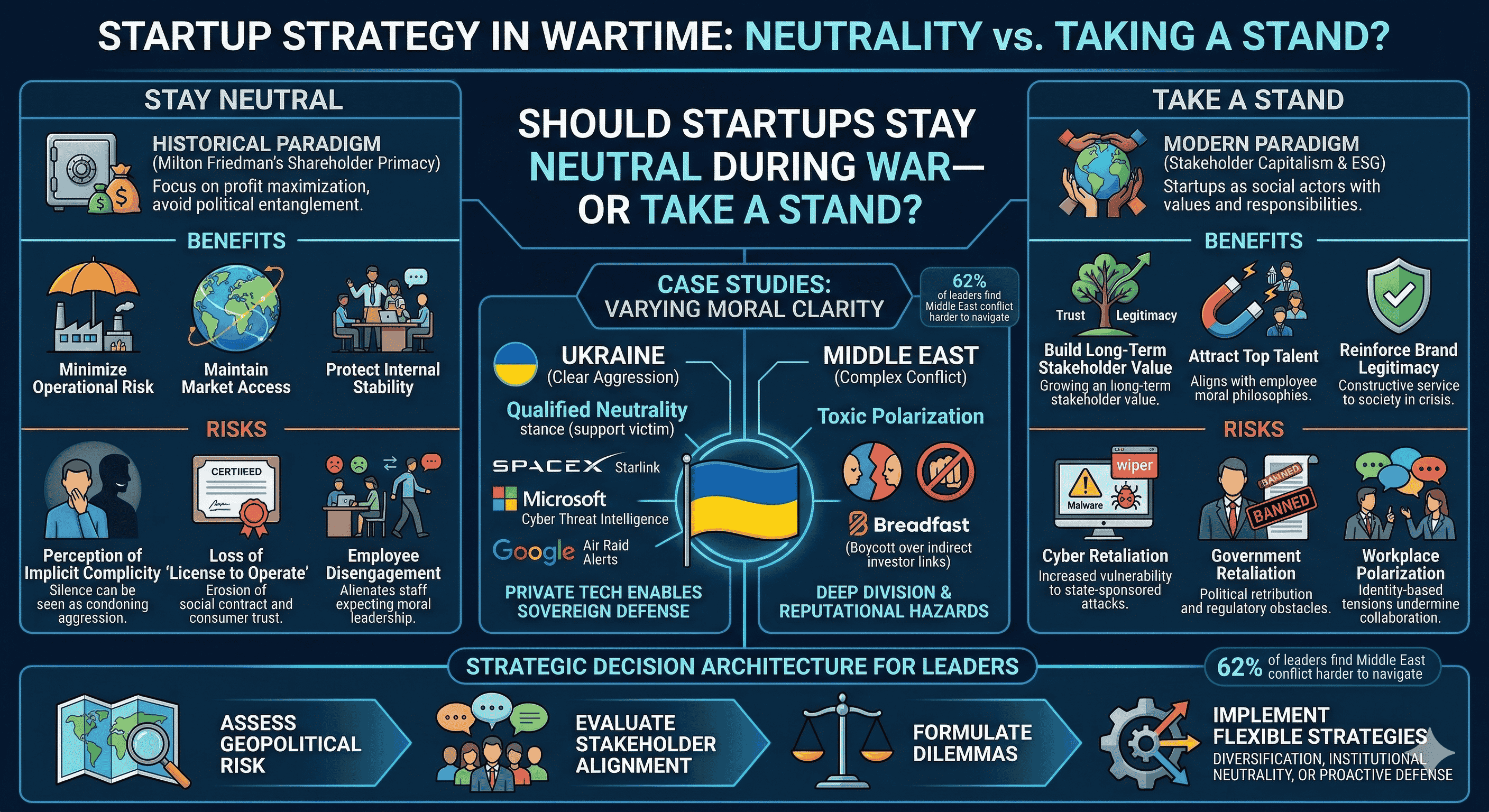
Taking a stand in an international conflict exposes a startup to significant technical and legal risks, most notably in the form of retaliatory cyber-attacks. Modern warfare does not stop at physical borders; when states or companies provide support to one side of a conflict, adversaries often respond with asymmetric strikes in cyberspace. For U.S.-based startups, this means that the next business disruption could arrive as a "wiper" attack designed to cause near-total operational paralysis by destroying critical data.
The cost of such disruptions is staggering. The average cost of a data breach has hit $4.88 million, and industrial sectors face average daily downtime costs of approximately $1.9 million after ransomware incidents. These technical attacks are frequently accompanied by "propaganda and psychological operations," such as website defacements, intended to undermine public trust.
Legal/Technical Risk | Description | Specific Statute/Risk |
CFAA Liability | Federal anti-hacking law in the U.S. | Risks of "offensive" cyber operations |
Wiper Attacks | Destructive code that erases data | Near-total operational disruption |
Anticipatory Obedience | Self-censorship due to fear of retribution | Loss of free speech and agency |
Regulatory Retaliation | Laws enacted as punishment by politicians | Chilling effect on market and investment |
Data Sovereignty | Reliance on foreign-owned tech infrastructure | Risk of being banned (e.g., TikTok, Huawei) |
Furthermore, the legal landscape for "active defense" remains treacherous. There is no federal framework that authorizes private companies to conduct offensive cyber operations, and doing so could run afoul of the Computer Fraud and Abuse Act (CFAA), which criminalizes accessing a computer "without authorization". Beyond technical risks, startups face "government retaliation" for taking political stances. High-profile feuds—such as those between Disney and the state of Florida—show how political leaders can use the powers of the state to target companies for their expressed viewpoints. This "political retribution" creates a chilling effect, hampering economic growth and deterring investment by undermining the fundamental tenets of business and democracy.
Strategic Decision Architecture: A Roadmap for Startup Leadership
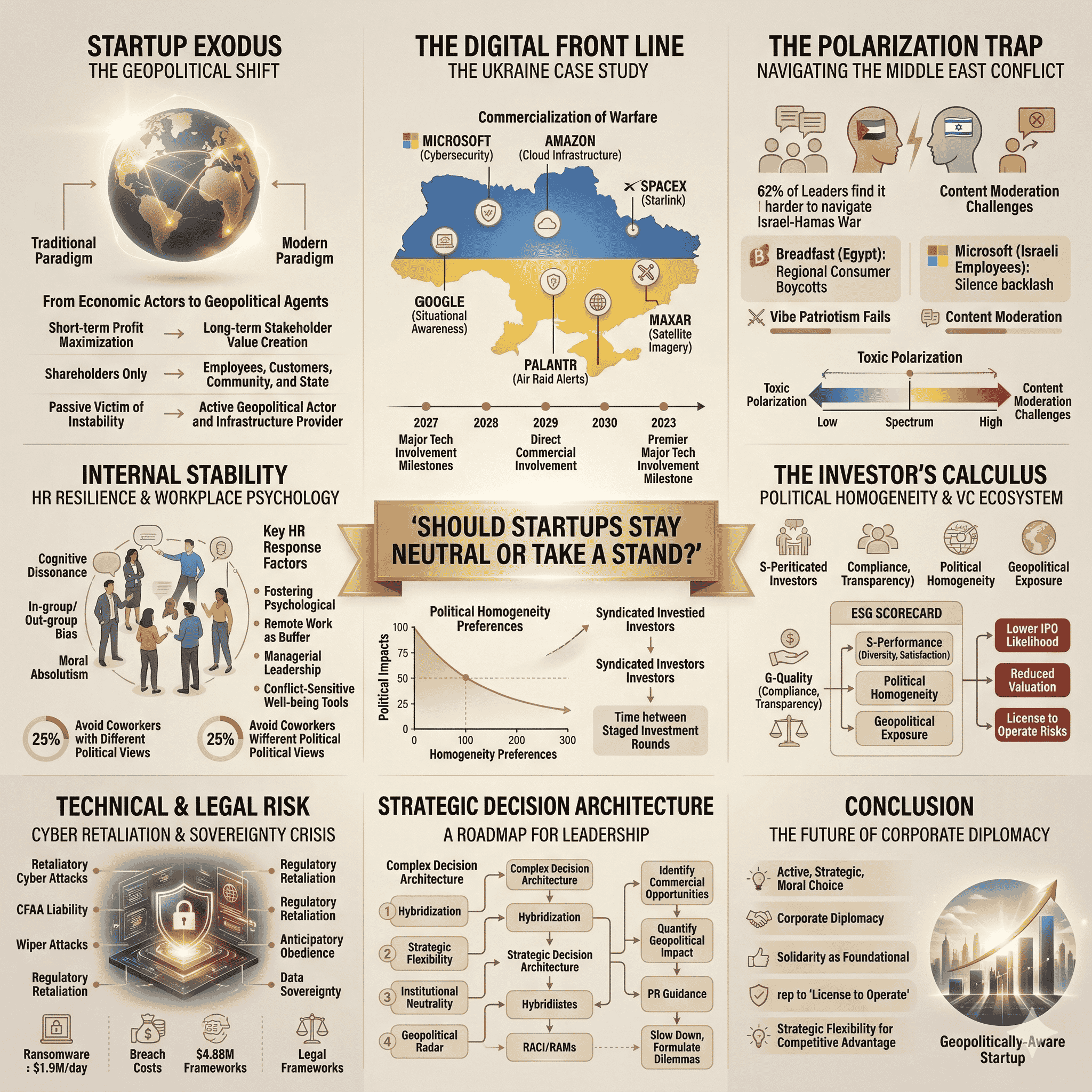
In a chaotic environment shaped by supply conflicts and systemic rivalries, startup leaders can no longer rely on linear decision-making models. Instead, they must implement a "complex decision architecture" that integrates geopolitical thinking into strategic planning and daily operations. This requires a fundamental shift: the skill is no longer to react quickly but to "slow down" to formulate the right dilemmas and discuss conflicting representations before committing.
Founders should distinguish between "Type 1" irreversible decisions and "Type 2" reversible ones. Taking a public stance on a war is often a Type 1 decision that can create chaos throughout the team if the process is not transparent and inclusive. To navigate these "tough calls," leaders should adopt a structured process that considers the social considerations and ramifications for all stakeholders—customers, patients, employees, and the board.
Decision Strategy | Core Mechanism | Goal |
Hybridization | Constructive confrontation of points of view | Produce a shared, realistic synthesis |
Strategic Flexibility | Diversification of markets and suppliers | Create "option value" for rapid adaptation |
Institutional Neutrality | Comment only on direct business impacts | Shield against "culture war" pressure |
Geopolitical Radar | Systematic preparation and modeling | Identify commercial opportunities in volatility |
RACI / RAMs | Clearly defined responsibilities for crisis | Create transparency and accountability |
Organizations should assess their geopolitical risk exposure and calibrate their management capabilities, moving from "passive mitigators" to "risk-ready enterprises". This involves using financial modeling to quantify geopolitical impact—when executives see "seven-, eight-, or nine-digit risks" at stake, they can make informed resource allocation decisions. Communication is equally critical. PR advisors must ensure that messages come from the top and provide a "higher shared purpose". Advising against self-promotion and ensuring that the company "stays in its lane" by speaking only on matters of genuine expertise helps preserve integrity and reputation during tumultuous times.
Conclusion: The Future of Corporate Diplomacy
The fundamental question of whether a startup should stay neutral or take a stand in wartime does not yield a universal answer. Instead, the evidence suggests that the very concept of "neutrality" has been transformed. It is no longer a passive state but an active, strategic, and moral choice that carries its own set of risks and rewards. For startups, the "Ukraine model" has shown that moral clarity can provide a powerful lever for growth and resilience, while the polarization surrounding the Middle East conflict has demonstrated the dangers of perceived hypocrisy and the high cost of silence.
The future of the startup ecosystem is inextricably linked to geopolitical dynamics. As private tech companies become "owners and rulers of critical assets," their agency in global affairs will only increase. To thrive in this "geopolitical recession," where global governance is languishing and instability is rising, business leaders must move beyond siloed risk management. They must embrace a form of corporate diplomacy that balances the needs of a diverse workforce, the demands of a morally attuned public, and the technical imperatives of a digital battlespace. In the final analysis, the most successful startups will be those that recognize that their reputation—and their "license to operate"—is built in moments of crisis, where solidarity is no longer symbolic but foundational. By building strategic flexibility and a robust decision architecture, founders can transform geopolitical turbulence into a sustainable competitive advantage.