Execution Is a Skill (And It’s Learnable)
February 15, 2026 by Harshit GuptaThe traditional dichotomy between strategy and execution has long favored the former as the primary domain of intellectual prestige, relegating the latter to a secondary, tactical status. However, contemporary research and empirical evidence from high-performance organizations demonstrate that the ability to implement a vision is not a natural byproduct of a well-conceived plan, nor is it an innate personality trait. Instead, execution is a sophisticated, learnable skill—a discipline of its own that requires the synchronization of organizational habits, psychological reframing, and environmental engineering. The gap between potential and achievement is not a failure of intelligence but a failure of execution, which manifests as the "gap nobody knows"—the disconnect between a company’s strategic aspirations and its organizational capacity to deliver on those promises.
The Ontological Shift: Execution as a Competency
The shift in understanding execution as a skill begins with the recognition that no individual is born with the innate ability to drive complex projects to completion. Productivity experts argue that the capacity to make ideas happen is developed by building specific organizational habits and harnessing collective support. While historical management theories focused on generating "great ideas," the current landscape emphasizes that ideas are essentially effortless, whereas implementation is arduous and requires a specialized set of tactics. This perspective is championed by leaders like Scott Belsky, who posits that creative organization and productivity are the results of a systematic approach rather than sporadic bursts of inspiration.
Execution acts as the missing link between potential and achievement, separating those who merely discuss success from those who experience it. At its core, execution is the foundational movement of progress, requiring the power of mindset to override the myth of readiness. The belief that one must be "ready" or that conditions must be perfect before taking action often leads to paralysis; in contrast, the skill of execution teaches that action creates readiness, not the other way around.
The Macro-Organizational Framework: Bossidy and Charan
In the seminal research conducted by Lawrence Bossidy and Ram Charan, execution is defined as the central discipline of getting things done. It is not merely a set of tactics but a systematic process that involves rigorously discussing the "hows" and "whats," questioning assumptions, following through tenaciously, and ensuring accountability. This framework suggests that execution must be ingrained in a company's culture and supported by strong leadership behaviors that connect people, strategy, and operations.
The Synchronization of the Three Core Processes
The organizational ability to execute depends on the leader’s capacity to link three critical, synchronized processes. If these links are not clear and integrated, the organizational effort becomes less than the sum of its parts.
Core Process | Primary Function and Execution Objective | Critical Leader Responsibility |
The People Process | Identifying and placing the right individuals in the right roles to support strategic goals. | Evaluating talent, building a leadership pipeline, and ensuring the right people are in the right jobs—a task that cannot be delegated. |
The Strategy Process | Mapping where the business is headed and defining the logic of how it will succeed. | Identifying target customers, value propositions, and essential capabilities while ensuring plans are not static but reactive to reality. |
The Operations Process | Translating strategy into the "road ahead" with specific, short-term targets. | Breaking long-term outputs into bite-sized milestones and putting "reality behind the numbers" through cross-functional decision-making. |
The people process is argued to be the most important. A leader's primary duty is to ensure every member of the team is carrying out their part of the plan, which requires the leader to be intensely involved in operations rather than formulating a "vision" and leaving the work to others. This active involvement includes fostering a culture of robust dialogue that brings reality to the surface, allowing the organization to adapt as the environment changes.
Leadership Behaviors for Execution Excellence
Execution requires leaders who possess "emotional firmness" and the ability to intervene when organizational values are violated. Six essential behaviors define a leader capable of high-level execution: knowing the people and the business, insisting on realism, setting clear goals and priorities, following through, rewarding the performers, and expanding people’s capabilities. Realism is particularly crucial; a great leader must embrace the truth, even if it means acknowledging significant weaknesses in the current business climate.
Bridging the Gap: Strategy vs. Execution
A recurring debate in organizational theory concerns whether strategy or execution is more critical to success. However, research suggests they are symbiotic, with strategy serving as the foundational element that enables effective execution. A superior strategy makes superior execution possible by providing the focus and clarity necessary for stakeholders to make aligned decisions.
Interdependence and Industry Realities
Analysis of industry leaders like Toyota and Southwest Airlines reveals that their ability to out-execute competitors like General Motors or American Airlines is rooted in their strategic choices. Southwest's consistent execution of low-price, point-to-point travel is a direct result of a strategy that simplifies operations, making execution more straightforward. Conversely, no amount of improved execution can overcome a fundamentally flawed or mediocre strategy, such as the "lousy economics" often found in the traditional hub-and-spoke airline model.
Organizational Attribute | Strategy Phase (Planning) | Execution Phase (Action) |
Focus | Where to play and how to win; market analysis. | Operating systems, people, and processes; measurable progress. |
Goal | Visionary blueprint and long-term value maximization. | Tangible results and translating vision into daily work. |
Adaptability | Flexible to market trends and competitor moves. | Agile navigation of unforeseen implementation challenges. |
Strategic execution is often described as the "crucible" where theory meets practice. It requires the precise alignment of human, financial, and technological resources. Organizations frequently fail because their strategies are mistaken for mere lists of goals or vague vision statements rather than deliberate, difficult choices. For a strategy to be "execution-ready," it must be translated into clear, SMART goals at every level of the organization.
The 4 Disciplines of Execution (4DX): A Practical Operating System
The 4 Disciplines of Execution (4DX) framework offers a prescriptive methodology for organizations to increase strategic execution by creating a culture of high performance. The primary challenge addressed by 4DX is the conflict between the "whirlwind"—the urgent daily tasks required to keep the business running—and the "Wildly Important Goals" (WIGs) that drive the organization forward.
Discipline 1: Focus on the Wildly Important
The first discipline is based on the principle of focus. Organizations that spread themselves too thin often fail to make significant progress on any objective. 4DX recommends selecting one or two WIGs that will have the highest impact, defined by the formula "From X to Y by When". By narrowing the focus, the team ensures that its most vital goals are not lost in the whirlwind.
Discipline 2: Act on the Lead Measures
While most organizations focus on "lag measures"—results such as revenue or customer satisfaction that have already happened—4DX emphasizes "lead measures". Lead measures are predictive of success and are influenceable by the team. For example, if the lag measure is weight loss, the lead measures would be calorie intake and exercise. Acting on lead measures provides the leverage needed to move the lag measure before it is too late.
Discipline 3: Keep a Compelling Scoreboard
Engagement is fueled by the knowledge of whether the team is winning or losing. A compelling scoreboard must be simple, visible, and designed by the team itself. It should track both lead and lag measures, providing instant feedback on the effectiveness of the team's actions.
Discipline 4: Create a Cadence of Accountability
The final discipline ensures that execution becomes a sustained habit. It involves a weekly "WIG session," a short meeting where team members hold each other accountable for commitments made the previous week and make new commitments for the coming week. This rhythm of accountability creates a performance-management system that drives results despite the daily whirlwind.
Comparison | Lag Measures | Lead Measures |
Timing | Past-oriented; tracks results after the event. | Future-oriented; tracks activities that drive results. |
Influence | Hard to influence directly; "the goal". | Highly influenceable by the team's daily efforts. |
Predictability | Indicates if the goal was achieved. | Predicts whether the lag measure will be achieved. |
Examples | Annual profit, customer churn rate, total sales. | Number of sales calls, training hours, proactive check-ins. |
Behavioral Psychology and the 3 Ps of Failure
The skill of execution is often undermined by a trio of psychological barriers: perfectionism, procrastination, and paralysis. This cycle keeps individuals and teams stuck, preventing them from accomplishing their goals. Understanding the behavioral science behind these "3 Ps" is essential for developing execution as a learnable skill.
The Mechanics of Perfectionist Paralysis
Perfectionism is not a pursuit of excellence but a defense mechanism rooted in a fear of failure, judgment, and rejection. Neurologically, perfectionism activates the amygdala—the brain's fear center—triggering a survival mode that defaults to avoidance rather than problem-solving. This leads to the "perfectionism-procrastination paradox," where high standards lead to inaction because the fear of falling short creates overwhelming anxiety.
To break this cycle, research suggests several evidence-based strategies:
Time Constraints: Setting firm limits on tasks (e.g., the Pomodoro Method) forces action over endless planning.
"Good Enough" Thinking: Challenging the false dichotomy between "perfect" and "worthless" by recalibrating standards based on the task's actual importance.
Implementation Intentions: Creating specific "if-then" plans (e.g., "If it is 10 AM on Tuesday, I will write for 45 minutes") dramatically increases follow-through.
Growth Mindset: Viewing abilities as developable rather than fixed reduces the pressure to be perfect and reframes mistakes as learning opportunities.
Breaking the Procrastination Loop
Procrastination is often an issue of emotional regulation rather than poor time management. Tasks that seem overwhelming or tedious are delayed to avoid immediate stress, even though this increases long-term anxiety. Breaking tasks into "bite-sized" pieces and focusing on "micro-actions" (e.g., just opening the document) can build the momentum necessary to overcome the initial hurdle of inaction.
Individual Execution Architectures: GTD and the Action Method
At the individual level, execution requires a system to manage the "clutter" in the brain. The "Getting Things Done" (GTD) framework, developed by David Allen, is a systematic approach to capturing, clarifying, and organizing tasks to free the mind for focused execution.
The Five Steps of GTD
Capture: Collecting everything that has your attention—ideas, tasks, events—into an external "inbox".
Clarify: Processing each captured item to determine if it is actionable and identifying the concrete "next action".
Organize: Placing clarified tasks into categorized lists (e.g., Next Actions, Projects, Waiting For, Someday/Maybe).
Reflect: Regularly reviewing and updating lists to ensure they remain relevant and aligned with broader goals.
Engage: Proactively working on the tasks that have been scheduled and organized, focusing on meaningful progress.
GTD emphasizes that the mind is for "having ideas, not holding them". By offloading open loops into a trusted external system, individuals minimize cognitive overload and stress. Similarly, Scott Belsky’s "Action Method" focuses on overcoming obstacles between vision and reality by building organizational habits. This method involves prioritizing "Action Steps"—concrete tasks starting with verbs—over "Backburner Items" and "Reference Materials".
Mastery through Deliberate Practice
Reaching an expert level in execution requires more than just repeated effort; it requires "deliberate practice". This concept, pioneered by Anders Ericsson, distinguishes itself from simple repetition or "play" by its primary goal of performance improvement through structured, high-intensity activities.
The Architecture of Deliberate Practice
Deliberate practice is characterized by several key dimensions that ensure skill acquisition:
Breaking Skills into Components: Isolating specific sub-skills, such as prioritization or problem-framing, and practicing them with focused attention.
Immediate Feedback: Obtaining instantaneous correction of flaws from a coach or mentor to reinforce optimal execution.
Operating Outside the Comfort Zone: Attempting tasks that are currently difficult rather than repeating what can already be done comfortably.
Consistency and Frequency: Engaging in regular, intense rehearsal sessions to override the shift to automatic, stagnant behavior.
Dimension | Play | Structured Practice | Deliberate Practice |
Primary Goal | Entertainment and fun. | Performance improvement. | Intense, individualized performance improvement. |
Monitoring | Loosely monitored, if at all. | Tracked by a coach in a group setting. | Carefully monitored in a one-on-one process with an expert. |
Perspective | Immersed experience. | Long-range pursuit of outcome. | Highly specific, individualized focus on weaknesses. |
Gratification | Immediate. | Delayed, outcome-based. | Delayed; can be frustrating during the process. |
In the context of execution, deliberate practice may include exercises such as "Environmental Analysis" to anticipate market shifts, or "Scenario Planning" to build adaptive flexibility. Research has shown that focused programs targeting these skills can improve strategic thinking capacity by up to 25%.
Traits of Highly Effective Execution
Kim Perell’s research on successful entrepreneurs identifies execution as the "one skill that drives success" and breaks it down into five interdependent traits: vision, passion, action, resilience, and relationships. These traits form an "execution mindset" that turns ambition into tangible achievement.
The Five Traits Breakdown
Vision: The "North Star" that guides action. A clear vision is not just a dream; it must be commercially relevant and grounded in practical reality.
Passion: Defined not just by enthusiasm but by the willingness to sacrifice and suffer for the goal (derived from the Latin root pati).
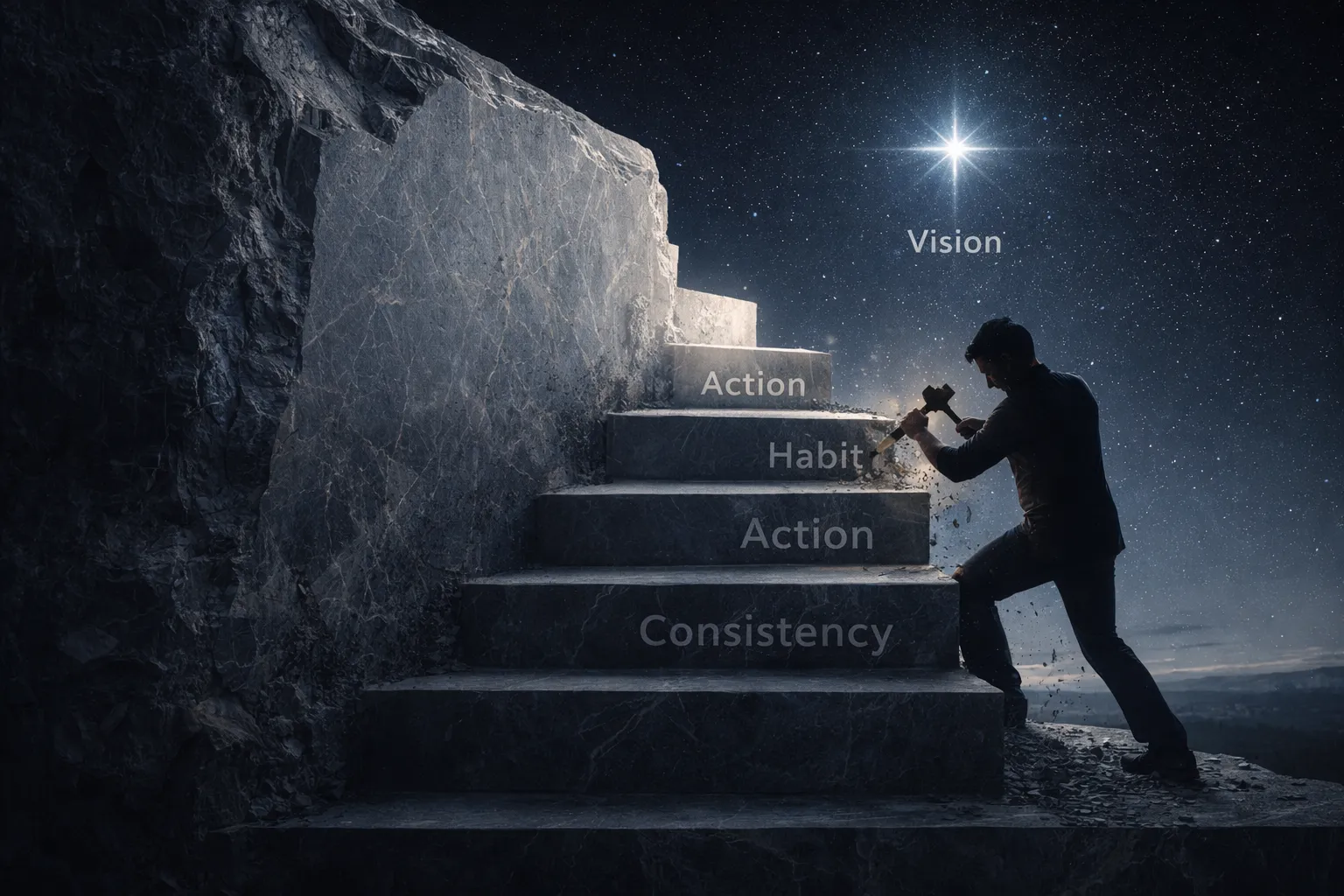
Action: The ability to take the first step without hesitating or getting stuck in analysis paralysis. Small, consistent steps build the momentum that propels a project forward.
Resilience: The "elasticity" of confidence that allows individuals to bounce back from setbacks and harness challenges for growth.
Relationships: Leveraging the power of collaboration and recognizing that no individual has unlimited time or energy.
These traits must be in balance; for instance, vision without action leads to unfulfilled potential, while action without vision leads to "chaos".
System Design vs. Willpower in Execution
A common mistake in personal development is relying on "ironclad willpower" to achieve goals. Behavioral science reveals that willpower is a finite mental resource that fatigues under stress or decision-making. In contrast, high-performance execution is achieved through "system design"—arranging the environment and routines so that the desired choice becomes the easiest and most automatic option.
Designing for Consistency
Systems thinking helps individuals create repeatable, reliable processes that drive progress over time without requiring constant motivation. Key techniques in system design include:
Automating the Environment: Laying out workout clothes the night before or setting bills on autopay to reduce "decision fatigue".
Habit Stacking: Linking a new desired habit to an existing routine.
Eliminating Friction: Preparing healthy meals in advance or removing distracting apps to make the productive choice the "default".
Pre-commitment: Locking oneself in through social accountability or upfront investments to ensure follow-through.
By building a system that "protects you on your weakest days," execution becomes a habit backed by clarity and alignment rather than a battle of will.
OKRs: Aligning Execution with Ambition
The "Objectives and Key Results" (OKR) framework serves as a collaborative goal-setting tool that helps organizations define and track ambitious goals with measurable outcomes. It connects high-level strategic objectives to concrete actions, fostering focus, alignment, and transparency.
The Components of OKRs
Component | Definition | Strategic Purpose |
Objective | A qualitative, aspirational statement of what needs to be achieved. | To provide inspiration, direction, and a unified vision for the team. |
Key Result | A quantitative, measurable outcome that tracks progress toward the objective. | To make the objective actionable and verifiable, ensuring teams know if they are succeeding. |
OKRs are designed to be "stretch goals" or "moonshots," pushing the limits of a team's capabilities. While KPIs tell a leader how the business is currently performing, OKRs define how the business needs to change and improve. A key best practice is to aim for a 60-70% achievement rate; scoring 100% consistently often indicates that the goals were not sufficiently ambitious.
Feedback Loops and Cognitive Artifacts
Modern execution research is increasingly exploring the role of "cognitive artifacts"—traceable records of thought and action—in improving decision-making over time. Tools like "PlanTraces" and "ExecutionSteps" allow individuals and teams to treat goal-directed actions as traceable events, complete with context, timing data, and error analysis.
The Role of Self-Reflection
Self-reflection is the final, recursive step in the learnable skill of execution. It involves:
Reviewing PlanTraces: Analyzing not just the results but the reasoning behind the scores and decisions.
Identifying Bottlenecks: Using metrics to discover where uncertainty is high or where processes are failing.
Refining Judgement: Allocating dedicated time for introspection on outcomes to refine strategic judgment and build a "memory of cognitive journeys".
By making self-improvement "explainable," individuals can identify which cognitive patterns lead to better results, effectively "watching themselves think" and correcting their path.
Synthesis: The Future of Execution as a Core Competency
The evidence presented underscores that execution is a distinct discipline that requires a unique set of skills, behaviors, and systems. Whether through the macro-level organizational processes described by Bossidy and Charan, the operational disciplines of 4DX, or the psychological reframing necessary to overcome the 3 Ps, execution is the primary driver of success in both business and life.
The learnable nature of execution suggests that performance is not fixed. By adopting structured frameworks like OKRs and GTD, practicing deliberately to push beyond comfort zones, and designing environments that minimize reliance on willpower, any individual or organization can close the gap between promise and result. In an increasingly complex global environment, the ability to translate vision into measurable progress is not just a competitive advantage; it is the fundamental code to survival and growth. Success is not built on singular, extraordinary actions but on the small, consistent, and disciplined steps taken over time. Those who choose relentless execution over excuses, and progress over perfection, are those who ultimately drive meaningful organizational and personal transformation.
Want to calculate the equity for your cofounder?
Nail your cap table before you sign. Whether you're splitting equity with a co-founder or planning your next funding round, our Equity Calculator gives you precision in seconds
Equity calculator →